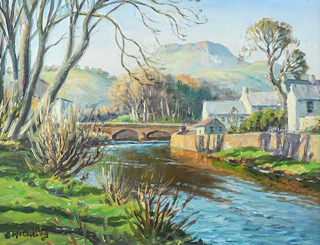
McAuley is the youngest of eight children in a family whose forebears had inhabited the Glens for many generations. He pursues painting from an early age, in a rural area when farming is one of the main sources of life and income. He goes on to become one of Ireland’s most celebrated landscape and figurative painters, his work synonymous with the Glens of Antrim.
A key encounter comes in McAuley’s mid-teens, when the artist James Humbert Craig, who is arts adjudicator at the Feis na nGleann, praises several of his youthful paintings, telling him, “You go ahead with this, and you’ll do well.” His paintings depicted the rivers, mountains, seascapes and rural life that surround him. He briefly studies at both the Belfast School of Art and Glasgow School of Art until he returns to his homeland to which he is utterly devoted. He is a member of the Royal Ulster Academy and the Royal Hibernian Academy.
In 1984. McAuley collaborates with his friend, the poetJohn Hewitt, on The Day of the Corncrake, a publication by the Glens of Antrim Historical Society, in which twenty-five colour reproductions of his paintings are coupled with thirty poems about the Glens by Hewitt. In a foreword, Hewitt writes that his “awareness was not merely graphic but demographic. This has made him for me the authentic regional artist, the painter who belongs to and finds his themes in a known place. Nowadays, with the rapid flow of international styles succeeding each other, this is a distinctive title one can seldom confer.”
In a BBC Television film made in the mid-1980s, McAuley remarks that he might have enjoyed more success if he had made a career in the wider world, but that he certainly would not have been happier. “I’ve spent my boyhood and manhood in the Glens. . .and I have no desire to leave them until I die.”
McAuley dies at the age of 89 on September 30, 1999. He is buried in St. Mary’s Roman Catholic Churchyard in Glenarm, County Antrim, Northern Ireland. On his death, BBC Northern Ireland describes him as “one of Ireland’s greatest colourists, but most significantly, a true and modest gentleman.”
The McAuley’s obituary in The Irish Times notes “Charles McAuley could fairly have claimed to be the artist of “the Glens”; for his native knowledge of the local landscape and people brought to the best of his work a special quality of emotion. Yet it is not a claim he would have made for himself, for self-promotion was a trait absent from his personality.”
Many of McAuley’s works are in private collections internationally. There are several of his paintings in public collections, for example at the Ulster Museum and Queen’s University Belfast.
(Pictured: “Bridge Near Cushendall” by Charles McAuley)
Luke is born at 4 Lewis Street in Belfast on January 19, 1906, the fifth of seven sons and one daughter of James Luke and his wife Sarah, originally from Ahoghill, County Antrim. He attends the Hillman Street National School and in 1920 goes to work at the York Street Flax Spinning Company. He goes on soon after to become a riveter at the Workman, Clark shipyard. While working there he enrolls in evening classes at the Belfast School of Art.
Luke excells at the college under the tutelage of Seamus Stoupe and Newton Penpraze. His contemporaries include Romeo Toogood, Harry Cooke Knox, George MacCann and Colin Middleton. In 1927 he wins the coveted Dunville Scholarship which enables him to attend the Slade School of Fine Art in London, where he studies painting and sculpture under the celebrated Henry Tonks, who greatly influences his development as a draughtsman.
Luke remains at the Slade School of Fine Art until 1930, in which year he wins the Robert Ross Scholarship. On leaving the Slade School he stays in London, intent on establishing himself in the art world. For a time he shares a flat with fellow Ulsterman F. E. McWilliam, and enrolls as a part-time student of Walter Bayes at the Westminster School of Art to study wood engraving. He begins to exhibit his work and in October 1930 shows two paintings, Entombment and Carnival, in an exhibition of contemporary art held at Leger Galleries. The latter composition, depicting a group of masked merry-makers, is singled out by the influential critic, Paul George Konody of the Daily Mail (October 3, 1930), as “one of the most attractive features of the exhibition.” But the economic climate is deteriorating and a year later, at the end of 1933, he is driven back to Belfast by the recession. He remains in Belfast, apart from a time during World War II when he goes to Killylea, County Armagh.
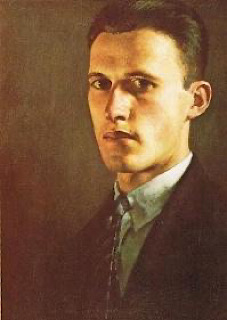
Luke paints in the style known as Regionalism, whose main proponents are Thomas Hart Benton, Grant Wood, John Steuart Curry and Harry Epworth Allen. His painting technique is painstakingly slow, his manner precise. “I’m afraid I’m very much a one job man,” he once writes to John Hewitt, continuing, “my strength lies in making the most of one job at a time, in sustained thought and effort, to bring it to the highest level of organisation and completeness I desire: the other way I lead to disintegrate in looseness and frustration with its inevitable weakness.” The precision characteristic of his work is manifested, too, in his appearance and personal manner. Dark haired, in stature he is erect and spare of build. Always tidy, his clothes brushed, his hair short, he is, in Hewitt’s words, “not at all close to the romantic stereotype of the artist.”
Apart from Luke’s work as a practising artist, he teaches from time to time in the Belfast School of Art, where he influences a generation of students “especially in the matter of drawing,” as he once puts it. Although principally a painter, throughout his career he occasionally makes sculptures, such as the Stone Head, Seraph of c. 1940 (Ulster Museum). Indeed it is for sculpture that he wins the Robert Ross Prize at the Slade School of Fine Art. He is also much interested in philosophical theories of art. In the 1930s, for example, as John Hewitt records, topical books such as Roger Fry’s Vision and Design, Clive Bell’s Art and R. H. Wilenski‘s Modern Movement in Art direct his thinking.
From the late 1930s until 1943, when Luke produces Pax, there is a gap in his output, occasioned, no doubt, by his move to County Armagh in order to escape Belfast after the Blitz. In 1946, he holds his first one-man exhibition at the Belfast Museum and Art Gallery, and this is followed two years later by a similar show, held under the aegis of CEMA, nearby at number 55A Donegal Place. In 1950, to celebrate the Festival of Britain the following year, he is commissioned to paint in Belfast City Hall, a mural representing the history of the city, a work which brings his name to the attention of a wider audience. In later years, other commissions follow for murals in the Masonic Hall, Rosemary Street, in 1956, and the College of Technology at Millfield in the 1960s. He also carves in relief coats of arms for the two Governors of Northern Ireland, John Loder, 2nd Baron Wakehurst (1959) and John Erskine, 1st Baron Erskine of Rerrick (1965). He is also a member of the Royal Ulster Academy.
Having been in declining health for some years, Luke dies, unmarried, at the Mater Infirmorum Hospital in Belfast on February 4, 1975, just a month into his sixty-ninth year. A retrospective exhibition of his work is held, in association with the Arts Councils of Ireland, in the Ulster Museum in 1978, and is accompanied by a short monograph on his life and career written by John Hewitt. Since that time his reputation has grown enormously, his loss rekindling memories in many of his former students of a fastidiously arranged life-room in the College of Art, his coat folded to perfection and his soft, gentle manner of instruction.
Colin MiddletonMBE, Northern Irishlandscape artist, figure painter, and surrealist, is born on January 29, 1910, in Victoria Gardens in north Belfast. Hus prolific output in an eclectic variety of modernist styles is characterised by an intense inner vision, augmented by his lifelong interest in documenting the lives of ordinary people. He has been described as “Ireland’s greatest surrealist.”
Middleton is the only child of damask designer Charles Middleton. He attends the nearby Belfast Royal Academy until 1927 and then continues his studies with night classes at Belfast School of Art where he trains in design under the Cornish artist Newton Penprase. However, he finds the college too traditional in outlook, as his first influence, his father, had been a follower of European Modernism, particularly the Impressionists.
Middleton shows his first works with the Ulster Academy of Arts in 1931, where he exhibits frequently until the late nineteen-forties. He first comes to public attention with the inclusion of his works in the groundbreaking inaugural exhibition of the Ulster Unit at Locksley Hall, Belfast, in December 1933. The Ulster Unit is a short-lived grouping of Ulster artists who take their inspiration from Paul Nash’s Unit One formed earlier in the same year. Just two years thereafter in the same year, he marries Maye McLain, also an artist and a domestic science teacher, who unfortunately dies four years later. He is also a poet and writer, whom along with his wife, is an active member of the Northern Drama League in the 1930s, with whom he designs sets. After the death of his first wife he destroys all of his early paintings and enters a period of seclusion at his mother’s home outside Belfast. He becomes a follower of Vincent van Gogh and James Ensor after viewing exhibitions in London and Belgium respectively. On his return to Ulster he begins to experiment with styles derived from European Modernism, the antithesis to traditional academism. Throughout the 1930s he is also a keen follower of Paul Nash, Tristam Hillier and Edward Wadsworth. After exposure to the works of Salvador Dalí, he declares himself “the only surrealist painter working in Ireland.”
Middleton’s work first appears at the Royal Hibernian Academy in 1938 where he shows intermittently until the final year of his life. He participates in an exhibition at 36 Arthur Street, Belfast, with the Czech artist Otakar Gregor, Joan Loewenthal and Sidney Smith in aid of the war effort at the end of 1940. He completes three paintings immediately after the Belfast Blitz and the trauma of the events prevent him from working for six months before his work is included in a portfolio of lithographs published by the Ulster Academy in December 1941 to raise money for rebuilding the Ulster Children’s and Women’s Hospital which had been destroyed in the Blitz earlier in the year.
Middleton’s first solo exhibition is given by the Belfast Municipal Museum and Art Gallery in 1943. It is the first exhibition staged at the gallery when it re-opens after the Belfast Blitz. At the time it is the largest one-person show the gallery has staged comprising one hundred fifteen works and it is also the first solo exhibition accorded to a local contemporary artist by the gallery. In an interview with Patrick Murphy in 1980, he says that the paintings represent “a first endeavour to harmonize the seemingly opposed and conflicting tendencies in human nature.” Dickon Hall says of this period that “Middleton’s painting is dominated by the female form; it is only rarely that men appear in his work. In part these women reflect his experience of Belfast and the difficult conditions that so many lived through.” This can be seen in the three female figures of The Poet’s Garden (1943), and even more so in The Conspirators (1942), both of which are featured in the 1943 exhibition. “The female form, pictorially and symbolically, becomes the landscape and the life force.”
The Belfast exhibition is followed by his first one-man show at the Grafton Galleries, Dublin, in 1944. In the following year he debuts at the Irish Exhibition of Living Art where he returns on a number of occasions, particularly in the periods 1949–55 and 1963–71. In 1945, he is married for the second time, to Kate Giddens, after both are named co-respondents at the Belfast High Court a few months earlier, in civil servant Lionel P. Barr’s application for a decree nisi. The suit is undefended and the couple has costs awarded against them. In the same year Middleton returns to the Belfast Museum for a solo exhibition arranged by the Council for the Encouragement of Music and the Arts. He is a founding member of the Northern Ireland branch of the Artists’ International Association, who show at the Belfast Municipal Gallery in spring 1945. Other members include Joan Loewenthal, Kathleen Crozier, Pat Hicking, Trude Neu, Sidney Smith, Nevill Johnston, George Campbell and Gerard Dillon.
Middleton’s work is displayed in New York‘s Associated American Artists gallery in 1947 with a selection of works chosen by Dublin art critic Theodore Goodman that includes paintings by his Northern contemporaries Daniel O’Neill, George Campbell, Gerard Dillon and Patrick Scott. He also retires from the family business that year to devote his time to painting, having worked at the business since his father’s death in 1933. He then takes his wife and child to live and work on John Middleton Murry’sSuffolk commune for a short period, before returning to Belfast in 1948. Their life in Suffolk is not a success as the family suffers from ill health, but the experience of working the land is to prove a profound influence on his future work.
In 1949, Middleton shows his first works at the Oireachtas na Gaeilge, where he returns periodically until 1977. Upon their return from Suffolk, his wife sends Victor Waddington photos of his work whereupon Waddington comes to represent him for a period of five years, until the Waddington Galleries face financial hardship in 1958. It is Waddington’s patronage that enables the Middleton family to live and work in Ardglass, County Down, for four years from 1949, which Middleton later describes as the happiest time of his life. When his works are displayed at Victor Waddington’s Dublin gallery in that same year, it acts as a springboard that opens Middleton’s work to an international audience. Group exhibitions in Boston and London follow in 1950 and 1951 respectively.
Middleton’s first solo show at London’s Tooth Gallery takes place in 1952, where his work had been shown in the previous year.
In 1953, Middleton moves to Bangor, County Down, where he designs for Marjery Mason‘s The Repertory Theatre. He later designs sets for the Circle Theatre and the Lyric Theatre, including the sets for a series of W. B. Yeats’s plays in 1970, and Seán O’Casey‘s Red Roses for Me in 1972, both at the latter. In 1952, he exhibits alongside Daniel O’Neill, Nevill Johnson, Gerard Dillon and Thurloe Connolly at the Tooth Galleries in London. He begins his career as an art teacher by the invitation of James Warwick who offers him a one year part-time post at the Belfast College of Art in 1954. That year he shows forty-two works at the Belfast Municipal Gallery under the auspices of the Council for the Encouragement of Music and the Arts. In the following year he delivers full-time classes at the Coleraine Technical School, before becoming head of art at Friends’ School, Lisburn in 1961 where he remains until 1970. He lives on Plantation Avenue in Lisburn for nine years next door to fellow artist and pedagogueDennis Osborne, who presents a portrait of Middleton at the annual exhibition of the Royal Ulster Academy in 1965.
A poet and musician, Middleton also produces murals, mosaics and posters. One such mural is commissioned for a house in Ballymena designed by the architect Noel Campbell in an international modernist style in 1951, and other works include a mosaic for a school in Lisburn, and a mural in a health clinic. He shows in many group shows throughout the fifties including the Royal Academy of Arts in 1955, in addition to more solo exhibitions at the Waddington Galleries in 1955, and his first showing at the Richie Hendricks Gallery in 1958. Of the Waddington exhibition TheDublin Magazine writes: “Apart from the brilliance of his paint, he has one rare quality in his inexhaustible capacity for wonder.”
Middleton shows in the Arts Council of Northern Ireland‘s gallery in 1965 with additional works at the Bell Gallery and his Bruges Series is shown at Alice Berger Hammerschlag’s New Gallery upon his return from a Belgian trip in 1966. The Arts Council of Northern Ireland suffers an extensive fire at their storage facility in south Belfast in autumn 1967 which decimates their collection of contemporary art and theatre costumes. Losses include several of Middleton’s paintings, in addition to the works of many other leading Ulster artists such as William Conor and T. P. Flanagan. He Is among the prizewinners at the Arts Council of Northern Ireland’s 4th Open Painting Exhibition in 1968. In the same year, John Hewitt curatea a joint exhibition of his paintings with T. P. Flanagan at the Herbert Art Gallery and Museum in Coventry.
The Arts Council hosts a joint retrospective of Middleton’s work in co-operation with the Scottish Arts Council in 1970. A major retrospective is to follow at the Ulster Museum and the Hugh Lane Municipal Gallery of Modern Art in Dublin in 1976. Comprising almost three hundred exhibits, the show is accompanied by a monograph written by Middleton’s lifelong friend, the patron and poet John Hewitt. Hewitt later bequeaths his art collection, including several of Middleton’s paintings to the Ulster Museum.
The Royal Mail uses Middleton’s painting of Slieve na Brock in the Mourne Mountains to commemorate the Ulster ’71 exhibition in a series of postage stamps that also feature the work of Thomas Carr and T. P. Flanagan. In 1972, Middleton tours extensively with his wife visiting Australia for two months and shows his works from the trip at the McClelland International Galleries on Belfast’s Lisburn Road the following year. In 1973 he also visits Barcelona and later shows a series of surrealist works inspired by the two trips at the Tom Caldwell Gallery in Belfast.
Middleton lives the last twelve years of his life in Bangor, County Down.
Middleton dies of leukemia in Belfast City Hospital on December 23, 1983. He is survived by his wife Kate, their daughter and a step-daughter. His son predeceases him by a year. Christie’s of London is entrusted with the sale of his studio works in 1985. The works are displayed before auction in both Dublin and Belfast during August 1985. In 2005, the Ulster History Circle unveils a commemorative blue plaque at his former home on Victoria Road in Bangor.
In September 2023, eighty years since the ground-breaking exhibition Middleton held at the Belfast Museum and Art Gallery, now the Ulster Museum, and forty years after his death, the Ulster Museum holds a new exhibition of his works, celebrating his association with Belfast, the city of which he says, “I belong here as I never belonged anywhere else in the country.” This exhibition brings together works held in the public collection with those from private lenders to provide a full picture of the artist’s talent and life.
Middleton wins the Royal Dublin Society‘s Taylor Scholarship worth £50 in 1932, and two further awards of £10 in 1933. In 1935, he is elected associate of the Ulster Academy, inducted alongside Helen Brett, Kathleen Bridle, Patrick Marrinan, Maurice Wilks, Romeo Toogood and William St. John Glenn,and in 1948 he becomes an elected Academician at the same.
In 1968, Middleton is appointed MBE in the Queen’s birthday honours list, and in 1969 he is elected an associate at the Royal Hibernian Academy with full membership conferred just a year later. He is awarded an honoraryMaster of Arts degree from Queen’s University Belfast in 1972. The Arts Council of Northern Ireland grants him a substantial subsistence award in 1970 which covers two years enabling him to retire from teaching to concentrate on painting full-time. In the same year, the Arts Council of Northern Ireland also commissions him to paint a portrait of their director, Kenneth Jamison.
Following the sudden death of his father in 1918, Bell is brought at the age of seven to live near Raffery in the Strangford Lough area of County Down. He lives with his mother and two brothers in a cottage with no electricity or running water. This is the setting of his acclaimed novel of Ulster rural life, December Bride (1951). He moves to Belfast in 1921, where he works at a variety of manual jobs before securing a post with the BBC in 1945. He is a co-founder of the left-leaning literary journal, Lagan, in 1943.
Bel’s first collection of short stories, Summer Loanen and Other Stories, is published in 1943. His novels include December Bride (1951), The Hollow Ball (1961), A Man Flourishing (1973) and Across the Narrow Sea (1987).
Bell is recruited to the BBC in 1946, along with fellow writer, W. R. Rodgers, by poet and radio producer, Louis MacNeice. Some of his work as a radio producer is highly innovative. This is Northern Ireland, An Ulster Journey (1949) is a classic radio feature incorporating actuality, poetry, music and narration. In later work, Bell incorporates the voices of “ordinary people” in his attempt to paint a picture of Ulster as rooted in the lives and traditions of its people. His collaboration with W. R. Rodgers, The Return Room (1955), is one of the most important post-war Irish radio features and shows the influence of Dylan Thomas on Rodgers, the poet.
In 1977, Bell is honoured with an MBE in recognition of his contribution to the cultural life of Northern Ireland.
December Bride is made into an acclaimed film in 1990. Reviewing the film, The Irish Times columnist and literary critic Fintan O’Toole says it is “not just a remarkable artistic achievement, but also a remarkable political one…restoring a richness and complexity to a history that has been deliberately narrowed.” In April 1999, December Bride is selected by award-winning novelist and critic Colm Tóibín and publisher, writer and critic Dame Carmen Callil, for inclusion in The Modern Library: The 200 Best Novels in English Since 1950 (Picador).
Bell dies on February 9, 1990, at 190 King’s Road, Knock, Belfast, aged 80, shortly before the premiere of the film of December Bride. On October 15, 2009, the eve of what would have been Bell’s centenary, a blue plaque is unveiled by Northern Ireland Minister of Culture, Arts and Leisure Nelson McCausland on the Belfast house where Bell had written December Bride. Such plaques are erected to commemorate and honour notable people.
Greacen is the only child of Henry Greacen and his wife Elizabeth (née McCrea). His father comes from a Presbyterian farming background in County Monaghan and, at one time, holds a position as a creamery manager, but is a heavy drinker and fails in several businesses. Most of his childhood is spent with his maternal grandmother and aunts when his parents temporarily separate. He briefly attends two local primary schools in Belfast, but when his father receives insurance compensation after his Belfast business burned down, he takes his family to the Castleblayney area in County Monaghan and for a short time goes back to farming. He goes to a national school there, but after another fire destroys the farmhouse, the Greacens return to Belfast to run the Kenilworth, a tobacconist’s shop on the Newtownards Road. He attends Templemore primary school and then enters Methodist College Belfast in 1933.
Greacen mostly enjoys school, though he is too short-sighted to participate with success in any sport, and sometimes, because of his background, feels out of his depth among middle-class children. He is always ashamed of his father’s drunken outbursts and is terrified of the violent temper which accompanies them. Literature provides both a temporary escape and the promise of future success. His first poems are published in school magazines, and he decides at a young age to try to make a career as a writer. He fails examinations and interviews for positions in a bank and an insurance company and instead starts studying history and English at Queen’s University Belfast.
At Queen’s, as earlier at Methodist College, the interests which characterise Greacen’s later career are apparent. Largely thanks to meeting John Boyd, he develops sympathies with left-wing political ideas, as well as a deepened commitment to poetry. His youthful 1930s enthusiasm for Marxism disappears after the Molotov-Ribbentrop Pact of 1939 between the Soviet Union and Nazi Germany, but up to his later years he describes himself as a socialist. The formation of enduring friendships and mutually supportive coteries, a phenomenon particularly characteristic of the Ulster literary scene of the period, continues to be of great importance throughout his life. He makes friends with almost all the significant figures in Belfast, especially Roy McFadden, John Hewitt and Sam Hanna Bell. At Queen’s, he and a friend take over in 1940 the editing of a student magazine, The Northman. They try with short-lived, limited success to make it a literary journal for the whole region, so as to enable aspiring poets to get work into print. His own early poems appear in The Bell, and he writes some pieces for the left-wing Irish Democrat newspaper. His poem The Bird (1941) is well reviewed and later appears in anthologies. In 1942 he publishes Poems from Ulster, a small anthology including work by his friends.
For several months, Greacen worships from afar a fellow student named Irene. When he fails to form a relationship with her, he stops going to lectures so that he does not have to see her and does not finish his degree. His McCrea relatives pay for him to go to Trinity College Dublin in 1943 to take a diploma in social work. He is glad to get away from wartime Belfast and never lives there again. At first, he enjoys Dublin, and again makes many friends, among them Brendan and Beatrice Behan, Blanaid Salkeld, Cecil ffrench Salkeld, Joseph and Mary O’Neill, Douglas Gageby, Arland Ussher and Hubert Butler. He and Patrick Kavanagh live in the same boarding house on Raglan Road for several months in 1945, but Kavanagh takes offence at a review in Horizon by Greacen of his poem The Great Hunger and calls him a “Protestant bastard.” Greacen is upset, as he had thought the review favourable, and is disappointed but not surprised when Kavanagh refuses to allow any of his poems to appear in the prestigious Faber and Faber book Contemporary Irish Poetry, edited by Greacen and Valentin Iremonger in 1949.
The collaborative compilation of anthologies of poetry is Greacen’s characteristic way of working. In 1942, he and Alex Comfort edit Lyra: An Anthology of New Lyric. With Roy McFadden, he edits Ulster Voices in 1943. He is sole editor of Northern Harvest in 1944 and, in the same year, he, Bruce Williamson and Valentin Iremonger publish their own work in On the Barricades. His own first solo collection, One Recent Evening, is also a 1944 imprint. In 1946, with support from Maurice Fridberg, a Jewish Dublin and London bookseller, his publishing company, New Frontiers Press, produces Irish Harvest, which, though designed on more ambitious lines, still consists chiefly of poems by his friends. He feels much more affinity with the modernism and social protest that he finds in contemporary English poetry, especially in the “new apocalypse” movement associated with Herbert Read, and later the “new romantics,” than with what he regards as the outmoded Celtic nationalism of W. B. Yeats and his followers. Like others of his contemporaries, he comes to resent the unquestioned shibboleths of life in Ireland, and particularly objects to the censorship of literature and film.
Consequently, when Greacen’s second small volume of poems, The Undying Day (1948), sells badly, and other avenues seem unpromising, he and his wife give up on Dublin and move to London. He finds a job with the United Nations Association, which suits his outlook and ideals. However, when he is made redundant, he has to take various jobs in adult education, in creative-writing courses, and in teaching English as a foreign language, in the City of London College, the City Literary Institute, and West London College. He retires in 1986. His involvement with the London literary world continues throughout his career, as he gets to know many of the leading figures, including Stephen Spender and T. S. Eliot, and he organises poetry readings and other projects, though he himself writes no poetry for more than twenty years. At one time he considers taking up journalism and continues to produce book reviews and articles in journals, as well as many letters to newspapers. He writes several, well-received short works of criticism, in particular, The Art of Noël Coward (1953) and The World of C. P. Snow (1962). After returning to Dublin in 1986, he writes an interesting memoir about his many friends and acquaintances, Brief Encounters: Literary Dublin and Belfast in the 1940s (1991) and Rooted in Ulster: Nine Northern Writers (2000).
Greacen marries Patricia Hutchins in Fisherwick Presbyterian Church in Belfast on April 10, 1946. She is from a Protestant family who has a small estate at Ardnagashel, near Bantry, County Cork, and is related to the botanist Ellen Hutchins. They have one daughter, Arethusa, but, after four years of separation, the marriage ends in divorce in 1966. He resents his wife’s conversion to vegetarianism and seems also to disapprove of her desire to achieve her own career goals. Probably also the depression he experiences throughout the 1950s contributes to the breakdown of the marriage, but he feels that twelve experiences in the early 1960s with the hallucinogenic drug LSD, under the guidance of a psychiatrist, had cured him. After the LSD treatments he feels that he is ready to begin working on an autobiography, Even Without Irene, published several years later in 1969. This comes out again in an enlarged version in 1995, and, still further augmented, as The Sash My Father Wore (1997).
Greacen begins to publish poetry again in his fifties, in A Garland for Captain Fox (1975). Poems about the career and friends of an imaginary, sophisticated adventurer do not always strike the exactly right note but are popular and mark a new beginning for him, who increasingly writes elegiacally about personalities, real and fictional, in more restrained diction and with careful irony. In interviews, he denies that Captain Fox is his own alter ego, but the interplay between the character of Fox and elements of his creator’s own life suggests a metaphor for the poet’s creative process, as well as reminding the reader of the poet friends whose support means much to his writing in real life. At the very least, Captain Fox becomes what could be called a character of virtual reality for his creator.
Greacen’s later poetry collections include Young Mr. Gibbon (1979), A Bright Mask (1985), Carnival at the River (1990), Collected Poems 1944–1994 (1995; awarded The Irish Times Literature Prize for Poetry in that year), Protestant Without a Horse (1997), Captain Fox: A Life (2000), Lunch at the Ivy (2002), Shelley Plain (2002), and Selected and New Poems (2006).
On his return to Dublin in 1986, Greacen for a time shares a flat on Anglesea Road with Beatrice Behan, until he finds her dead in her bed in 1993. In later years he lives in a flat in Sandymount. He is elected to membership of Aosdána in 1986, and during his later years in Dublin enjoys the status of a senior figure in the world of literature. He gives readings in the United States, appears often on RTÉ radio programmes, and has poems republished in anthologies. There was even one poem displayed on the Dublin Dart suburban rail network, St. Andrew’s Day: An Elegy for Patricia Hutchins, perhaps his best work. Perhaps only a few of his poems have been lodged in the public memory, but it is appropriate, given the themes of his career, that his work will be read with most attention by poets and by scholars, and that his reputation in the future may largely be based on his friendships with other poets.
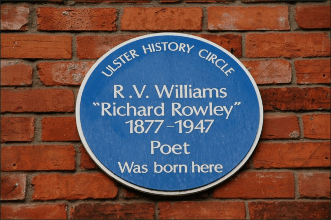
Richard Valentine Williams, who writes poetry, plays and stories under the pseudonym of Richard Rowley, is born on April 2, 1877, at 79 Dublin Road in Belfast, in what is now Northern Ireland.
At the age of sixteen, Rowley enters the family firm, McBride and Williams, which manufactures cotton handkerchiefs and eventually becomes its managing director. After the collapse of the company in 1931 he is Chairman of the Northern Ireland Unemployment Assistance Board. His early poems, in The City of Refuge and Other Poems (1917), are rhetorical celebrations of industry. His next volume, City Songs and Others (1918), includes his most quoted poem, The Islandmen, and is regarded as containing his most original work: “Browning-like monologues straight from the mouths of Belfast’s working-class.”
In 1918, Rowley goes to live in the Mourne country, residing in Brook Cottage, Bryansford Rd., Newcastle, County Down. He writes short stories, including Tales of Mourne (1937), as well as at least one highly successful play, Apollo In Mourne (1926). During World War II, he founds, and runs from his Newcastle home, the short-lived Mourne Press. He publishes first collections of Sam Hanna Bell and Michael McLaverty, but the press fails in 1942.
In 1946, Rowley sells Brook Cottage, which has since been demolished, and moves with his wife, the former Margaret Pollock, to Drumilly, Loughgall, County Armagh, as paying guests of their friends, Mr. and Mrs. Ralph Cope. He dies there on April 25, 1947.
George MacCann and Jack Loudan presents a commemoration of Rowley’s life on the radio in 1952. The programme uses recordings of his friends Lady Mabel Annesley, who illustrated several of his publications, along with the poet John Irvine, the playwright Thomas Carnduff and William Conor. In Newcastle, Rowley’s name is remembered through the Rowley Meadows housing development and the Rowley Path, which runs along the southern boundary of the Islands Park.
(Pictured: Blue plaque at Richard Rowley’s birthplace in Belfast, Northern Ireland)

 seamus dubhghaill