seamus dubhghaill

Promoting Irish Culture and History from Little Rock, Arkansas, USA


Leave a comment

Birth of Liam Tobin, Irish Army Officer

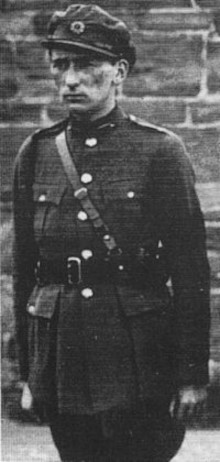
Liam Tobin, officer in the Irish Army and the instigator of the Irish Army Mutiny in March 1924, is born William Joseph Tobin at 13 Great Georges Street in Cork, County Cork, on November 15, 1895. During the Irish War of Independence, he serves as an Irish Republican Army (IRA) intelligence officer for Michael CollinsSquad.

Tobin is the eldest son of Mary Agnes (nee Butler) and David Tobin, a hardware clerk. He has two younger siblings, Katherine and Nicholas Augustine Tobin, also born in Cork. His family moves to John Street in Kilkenny and then to Dublin. He goes to school in Kilkenny and is an apprentice in a hardware shop at the time of the 1916 Easter Rising. As a participant in the Rising, he fights in the Four Courts garrison under Edward Daly. He is arrested, court martialed, and sentenced to death but his sentence is commuted to life imprisonment. He is a prisoner in Kilmainham, Mountjoy, Lewes, Dartmoor, Broadmoor and Pentonville prisons. He is released in June 1917.

In early 1919 Tobin becomes Collins’ chief executive in the Intelligence Directorate handling the many spies in Dublin Castle, including double agent David Neligan. Nancy O’Brien works for Under-Secretary for Ireland James Macmahon, decoding messages sent from London. Each day between 2:30 and 3:30 she passes any information acquired to either Tobin, Joseph McGrath, or Desmond FitzGerald. Tobin is involved in planning the assassinations of British soldiers, informants, members of the Royal Irish Constabulary, the Dublin Metropolitan Police, and operatives of MI5. He constructs detailed profiles of everyone remotely connected to the British government, often using Who’s Who, The Morning Post, and The Times, a newspaper that describes him as “one of the most formidable of [the] Twelve Apostles.”

In October 1921, Tobin travels with the Irish Treaty Delegation as part of Collins’ personal staff.

Tim Pat Coogan and James Mackay have examined Tobin’s involvement in the assassination of British Field Marshal Sir Henry Wilson. Wilson’s public tirades about Collins is evidence of mutual personal dislike between the two men. In May 1922 Collins tells Tobin “We’ll kill a member of that bunch” to the news of “bloody pogroms” in Belfast. Wilson is intimately involved with the Ulster loyalist cause, including the Curragh Mutiny and the establishment of the Ulster Special Constabulary. Just before the shooting, Coogan places Tobin in London. He meets courier Peig Ni Braonain at Euston Station collecting a document that has been sent from Dublin. Returning to Dublin before the incident, he is jubilant when he tells defence minister Richard Mulcahy about Wilson’s death. Mulcahy is appalled and threatens to resign.

Following the Anglo-Irish Treaty, Tobin is appointed deputy director of intelligence in the new state and assigned to the Criminal Investigation Department based at Oriel House. However Collins soon replaces him with Joseph McGrath. Tobin is placed on the Army Council and is Director of Intelligence from September 1922 until his appointment as Senior Aide-de-Camp to the new GovernorGeneral of the Irish Free State, Tim Healy, in November 1922. The position provides an apartment in Viceregal Lodge.

In October 1922, Tobin’s brother Nicholas, a Free State captain, is accidentally shot dead by his own troops during the raid and capture of a bomb making factory at number 8 Gardiner’s Place, Dublin.

Tobin believes in the steppingstone doctrine which sees the Treaty as a stage towards full independence. With the outbreak of the Irish Civil War he remains loyal to Collins and takes the Pro-Treaty side. He leads in the fight against the Anti-Treaty IRA in the south. Disillusioned with the continuing hostilities and in the aftermath of the death of Collins, he forms an association called the IRA Organisation (IRAO) or “Old Irish Republican Army” to distinguish themselves from the anti-treaty insurgents.

Richard Mulcahy, the new Irish defence minister, proposes to reduce the army from 55,000 to 18,000 men in the immediate post- Civil-War period. Tobin knows his own position is to be affected and shares the perception that the Irish Army treats former British officers better than former IRA officers. On March 7, 1924, Tobin, together with Colonel Charlie Dalton, sends an ultimatum to President of the Executive Council of the Irish Free State W. T. Cosgrave demanding an end to the army demobilisation. The immediate response is an order for the arrest of the two men on a charge of mutiny. The cabinet, already wary of the Irish Army, orders an inquiry and appoints Garda Commissioner Eoin O’Duffy to the army command.

On March 18, the mutineers assemble with hostile intent at a Dublin pub. An order is made to arrest the mutineers and the cabinet demands the resignation of the army council. The generals resign, affirming the subservience of the military to the civilian government of the new state.

In later years, Tobin rebuilds relations with his Civil War foes and joins Éamon de Valera‘s Anti-Treaty Fianna Fáil party. He joins up with Joseph McGrath to form the Irish Hospitals’ Sweepstake in the 1930s. Many other former army comrades find work in this lottery. He leaves the Sweep in 1938. After World War II, he becomes Superintendent of the Oireachtas for the Irish Dáil.

On October 14, 1929, Tobin marries Monica “Mona” Higgins at the Church of the Holy Family, Aughrim Street, Dublin. They have two daughters, Máire and Anne Tobin. Following the death of his father, David, in 1956, Tobin’s health declines, resulting in his death in Dublin on April 30, 1963.

Tobin is portrayed by actor Brendan Gleeson in Neil Jordan‘s biopic Michael Collins.


Leave a comment

Birth of Standish James O’Grady, Author, Journalist & Historian

Standish James O’Grady (Irish: Anéislis Séamus Ó Grádaigh), Irish author, journalist, and historian, is born in Castletownbere, County Cork, on September 18, 1846. He is inspired by Sylvester O’Halloran and plays a formative role in the Celtic Revival, publishing the tales of Irish mythology, as the History of Ireland: Heroic Period (1878), arguing that the Gaelic tradition has rival only from the tales of Homeric Greece.

O’Grady’s father is the Reverend Thomas O’Grady, the scholarly Church of Ireland minister of Castletown Berehaven, County Cork, and his mother Susanna Doe (or Dowe). The Glebe, his childhood home, lies a mile west of Castletownbere near a famine mass grave and ruined Roman Catholic chapel. He is a cousin of Standish Hayes O’Grady, another noted figure in Celtic literature, and of Standish O’Grady, 1st Viscount Guillamore. After a rather severe education at Tipperary Grammar School, he follows his father to Trinity College, Dublin, where he wins several prize medals and distinguishes himself in several sports.

O’Grady is a paradox for his times, proud of his Gaelic heritage, he is also a member of the Church of Ireland, a champion of aristocratic virtues (particularly decrying bourgeois values and the uprooting cosmopolitanism of modernity) and at one point advocates a revitalised Irish people taking over the British Empire and renaming it the Anglo-Irish Empire.

O’Grady proves too unconventional of mind to settle into a career in the church, and takes a job as a schoolmaster at Midleton College, then in a period of expansion. He also qualifies as a barrister, while earning much of his living by writing for the Irish newspapers. Reading Sylvester O’Halloran’s A general history of Ireland (1778) sparks an interest in early Irish history. After an initial lukewarm response to his writing on the legendary past in History of Ireland: The Heroic Period (1878) and Early Bardic Literature of Ireland (1879), he realises that the public wants romance, and so follows the example of James Macpherson in recasting Irish legends in literary form, producing historical novels including Finn and his Companions (1891), The Coming of Cuculain (1894), The Chain of Gold (1895), Ulrick the Ready (1896) and The Flight of the Eagle (1897), and The Departure of Dermot (1913).

O’Grady also studies Irish history of the Elizabethan period, presenting in his edition of Sir Thomas Stafford‘s Pacata Hibernia (1896) the view that the Irish people had made the Tudors into kings of Ireland to overthrow their unpopular landlords, the Irish chieftains. His The Story of Ireland (1894) is not well received, as it sheds too positive a light on the rule of Oliver Cromwell for the taste of many Irish readers. He is also active in social and political campaigns in connection with such issues as unemployment and taxation.

Until 1898, O’Grady works as a journalist for the Daily Express of Dublin, but in that year, finding Dublin journalism in decline, he moves to Kilkenny to become editor of the Kilkenny Moderator, which is printed at 28 High Street. It is here he becomes involved with Ellen Cuffe, Countess of Desart, and Captain Otway Cuffe. He engages in the revival of the local woolen and woodworking industries. In 1900 he founds the All-Ireland Review and returns to Dublin to manage it until it ceases publication in 1908. He also contributes to James LarkinsThe Irish Worker paper.

O’Grady’s influence crosses the divide of the Anglo-Irish and Irish-Ireland traditions in literature. His influence is explicitly stated by the Abbey Theatre set with Lady Gregory, W. B. Yeats and George William Russell attributing their interest in the Fenian Cycle of Gaelic tradition in part to him. This leads to him being known as the “Father of the Celtic Revival.” Some of the figures associated with the political party Sinn Féin, including its founder Arthur Griffith, have positive things to say about his efforts in helping to retrieve from the past the Gaelic heroic outlook.

O’Grady marries Margaret Allen Fisher, daughter of William Allen Fisher, and they have three sons. Advised to move away from Ireland for the sake of his health, they leave Ireland in 1918. After living in the north of France and Northamptonshire, they move to the Isle of Wight. He is working on a final exposition of his ideas when he dies suddenly on May 18, 1928.

O’Grady’s eldest son, Hugh Art O’Grady, is for a time editor of the Cork Free Press before he enlists in World War I in early 1915. He becomes better known as Dr. Hugh O’Grady, later Professor of the Transvaal University College, Pretoria (later the University of Pretoria), who writes the biography of his father in 1929.


Leave a comment

Death of Edmund Ignatius Rice, Missionary & Educationalist

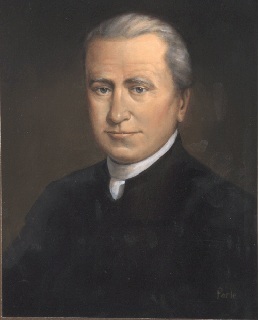
Edmund Ignatius Rice, Catholic missionary and educationalist, dies on August 29, 1844, at Mount Sion, Waterford, County Waterford, after living in a near-comatose state for more than two years.

Rice is born on June 1, 1766, at Westcourt, Callan, County Kilkenny, the fourth of seven sons of Robert Rice, a farmer, and his wife, Margaret Tierney. His education begins at a local hedge school. He subsequently transfers to a school in Kilkenny before being apprenticed in 1779 to his uncle, a prosperous merchant at Waterford. He amasses a fortune in the lucrative provisioning trade of the city, and in 1785 he marries Mary Elliott, the daughter of a local tanner. Their only child, Mary, has intellectual disabilities and Rice suffers additional heartbreak with the death of his wife in 1789 following an accident, possibly by a fever that set in afterwards.

The death of his wife clearly affects Rice’s life. While he continues in trade and is an active member of the Catholic committee in the city, his priorities are radically changed. From this point he becomes increasingly involved in pious and charitable pursuits. He assists in the foundation of the Trinitarian Orphan Society in 1793 and the Society for the Relief of Distressed Roomkeepers in 1794. He joins religious confraternities and devotes considerable attention to the plight of prisoners. His endeavours become more focused in 1797 when, in response to a controversial pastoral of Bishop Thomas Hussey of Waterford and Lismore, he embraces the cause of Catholic education. In 1802, he establishes a religious community of laymen who set out to do for the neglected poor boys of Waterford what Nano Nagle had done for poor girls in Cork. His community is the genesis of both the Presentation Brothers and the Irish Congregation of Christian Brothers. Rice’s “monks” follow a variation of the Presentation rule, and his school curriculum is a pragmatic combination of best practice of the time overlaid by an uncompromisingly Catholic emphasis. By the time of his death in 1844, the Christian Brothers run forty-three schools, including six in England.

Rice is pivotal in the revival of Irish Catholicism following the severe dislocation of the penal era. Among the urban poor the Brothers make a landmark contribution in widening the social base of the institutional church. Through their teaching and catechetical instruction, they introduce the poor to the new forms of devotion which become the hallmark of nineteenth-century Catholicism. This effort brings a previously marginalised class within the ranks of the institutional church, which in time becomes the backbone of the emerging Catholic Ireland. The Brothers also play a determined role in the Catholic response to the proselytising efforts of the protestant Second Reformation in the country. Rice’s Brothers assist in the moulding of a distinctively Catholic urban working class, by promoting literacy alongside piety and instilling in their pupils the middle-class virtues of personal discipline, hard work, and sobriety.

Rice collaborates closely with other Catholic leaders of his age. His congregation is central to the success of Theobald Mathew‘s temperance movement. In 1828, at the height of the emancipation campaign, he invites Daniel O’Connell to lay the foundation stone of the Brothers’ model school at North Richmond Street, Dublin. This “monster meeting” attracts an attendance of 100,000, before which O’Connell hails Rice as the “patriarch of the monks of the west.” During the Repeal campaign, too, the Brothers frequently host the Liberator. Reflecting on their efforts, O’Connell declares that “education to be suited to this country must be Catholic and Irish in its tone, having as its motto Faith and Fatherland.”

Rice’s uncompromising adherence to these principles is not without difficulty. It leads to a predictably acrimonious relationship with the secular national board and his eventual withdrawal of the Brothers’ schools from the system in 1836. Rejection of the national board imposes serious financial burdens on the Christian Brothers which are relieved only by the bounties provided by the Intermediate Education Act (1878). Withdrawal also serves to alienate many friends and benefactors, including Daniel Murray, Archbishop of Dublin, who is a commissioner of national education. But the bishops gradually adopt Rice’s stance. After 1838 they become increasingly hostile to the national board, and the Brothers’ schools, with their acclaimed textbooks, are recognised as a bulwark against non-denominational education. For similar reasons, the Brothers become closely associated with Irish nationalism. In 1892, the MP William O’Brien observes that “the Christian Brothers system was regarded in Ireland as the really national system.”

The 1830s bring a rapid deterioration in Rice’s health. Financial difficulties frustrate his plans, and the plight of the three Dublin foundations is particularly acute. Rice resigns as superior general of his congregation in 1838, but fraught relations with his successor, Br. Michael Paul Riordan, blights his later years.

From this time on, Rice spends an increasing proportion of his time at Mount Sion and the adjoining school, showing a continued interest in the pupils and their teachers. He also takes a short walk each day on the slope of Mount Sion, but his increasingly painful arthritis leads the community superior, Joseph Murphy, to purchase a wheelchair for his benefit. At Christmas time in 1841, his health takes a turn for the worse and even though expectations of his imminent death do not turn out to be justified, he is increasingly confined to his room.

After living in a near-comatose state for more than two years and in the constant care of a nurse since May 1842, Rice dies on August 29, 1844, at Mount Sion, Waterford, where his remains lie in a casket to this day. Large crowds fill the streets around his house in Dublin to honour him. He is beatified by Pope John Paul II in 1996.

(From: “Rice, Edmund Ignatius” by Dáire Keogh, Dictionary of Irish Biography, http://www.dib.ie, October 2009)


Leave a comment

Birth of Denis “Denny” Barry, Irish Volunteer & Trade Unionist

Denis “Denny” Barry, Irish Volunteer, commandant of the Cork No. 1 Brigade and trade unionist, is born into a farming family on July 15, 1883, in Riverstick, Cullen, County Cork.

Barry learns Irish from a young age. He attends Ballymartle National School but is unable to attend secondary school due to a lack of facilities in the area. He begins work on the family farm after primary school. In 1903, he moves to Cork to work as a draper‘s apprentice with the firm O’Sullivan and Howard, where he becomes involved in the Gaelic League and the Ancient Order of Hibernians. A successful athlete, he also plays for the Blackrock National Hurling Club and wins four senior county hurling championships between 1910–13.

In 1913, Barry joins the newly formed Irish Volunteers. In 1915, he moves to Kilkenny to take up employment there, where he continues his volunteer activities. Shortly after the 1916 Easter Rising, he is arrested in Kilkenny in a British Government crackdown, and sent to Frongoch internment camp in North Wales. In 1919, he returns to Cork, where he is Commandant of the Irish Republican Police (IRP) in Cork during the Irish War of Independence. In the Cork No. 1 Brigade of the Irish Republican Army (IRA), he helps with prisoner escapes and returning looted goods after the burning of Cork by Black and Tans. After the Anglo-Irish Treaty and the split that follows, he chooses the anti-Treaty branch of the IRA. He is captured by Irish Free State troops and is sent to Newbridge internment camp on October 6, 1922. He is not charged or convicted of any crime.

Irish Republican prisoners in Mountjoy Prison begin the 1923 Irish hunger strikes, protesting being interned without charges or trial and poor prison conditions. The strike quickly spreads to other camps and prisons, and Barry takes part starting on October 16. He dies 35 days later on November 20, 1923, at the hospital at Curragh Camp. IRA Volunteers Joseph Whitty from Newbawn, County Wexford, dies on September 2, 1923 and Andy O’Sullivan from Denbawn, County Cavan, dies as a result of hunger on November 22, 1923, in Mountjoy Prison. The 41-day hunger strike is called off the following day, November 23. Whitty, Barry and O’Sullivan are three of the 22 Irish Republicans who die on hunger-strike during the twentieth century. Barry is initially buried by the Free State army in the Curragh, but three days later, following a court order, his remains are disinterred. He is buried in the Republican plot at St. Finbarr’s Cemetery, Cork.

Prior to Barry’s body arriving in County Cork, the Bishop of Cork, Daniel Cohalan, issues a letter to the Catholic churches which forbids them to open their doors to his body. Bishop Cohalan expresses far different opinions on the 1920 death, also by hunger strike, of the Lord Mayor of Cork Terence MacSwiney. “Terence MacSwiney takes his place among the martyrs in the sacred cause of the Freedom of Ireland. We bow in respect before his heroic sacrifice. We pray that God may have mercy on his soul.”

In Barry’s hometown of Riverstick there stands a stone memorial, unveiled in 1966, in his honor and he is remembered with a wreath-laying commemoration every November.


Leave a comment

Birth of Hurler Seán Dowling

Seán Anthony Dowling, retired hurler who played for the Kilkenny Senior Hurling Championship club O’Loughlin Gaels, is born in Kilkenny, County Kilkenny, on June 10, 1978. He plays for the Kilkenny senior hurling team for five seasons, during which time he usually lines out as a right wing-back or at midfield.

Dowling begins his hurling career at club level with the O’Loughlin Gaels. He breaks onto the club’s top adult team as a 16-year-old in 1994 and enjoys his first success the following year when the club wins the 1995 Kilkenny Premier Junior Hurling Championship. He wins a Kilkenny Intermediate Hurling Championship title in 1996 and promotion to the top flight of Kilkenny hurling. He goes on to make numerous championship appearances at senior level and is at left wing-back on the O’Loughlin Gaels’ Leinster Senior Club Hurling Championship-winning team in 2003. His club career ends as a result of a hip injury in 2010, by which time he has also won two Kilkenny Senior Championship titles.

At inter-county level, Dowling is part of the Kilkenny minor team that wins back-to-back Leinster Minor Hurling Championships in 1995 and 1996 before winning the All-Ireland Under-20 Hurling Championship in 1999. He joins the Kilkenny senior team in 2001. From his debut, he lines out as a half-back or a midfielder and makes a combined total of 25 National League and Championship appearances in a career that ends with his last game in 2005. During that time, he is part of two All-Ireland Senior Hurling Championship-winning teams – in 2002 and 2003. He also secures three successive Leinster Senior Hurling Championship medals and three National Hurling League medals. He is dropped from the panel in June 2005.


Leave a comment

Birth of Eleanor Charlotte Butler, Recluse of Llangollen

Eleanor Charlotte Butler, recluse of Llangollen, is born in Cambrai, France, on May 11, 1739.

Butler is the youngest daughter of Walter Butler of Garryricken, County Tipperary, and his wife, Ellen (née Morres), of Latargh, County Tipperary. Her family are members of the old Catholic gentry, and her father is the sole lineal representative of James Butler, 2nd Duke of Ormonde. In 1740 her family returns to the Garryricken estate, where she spends part of her childhood. She is educated by the English Benedictine nuns of the convent of Our Lady of Consolation in Cambrai, where her Jacobite grand-aunt is a pensioner. Reared in the liberal and anti-clerical environment at Cambrai, she is open about her opposition to Irish Catholicism. She is also well read in literature.

By the time Butler returns to Ireland, her brother John had claimed the family titles and was recognised as 16th Earl of Ormond. Though he never uses the title, his sisters are recognised as the daughters of an earl. As the family is impoverished, and she is not disposed to marriage, a decade is passed in unhappiness. Then, in 1768, the thirteen-year-old Sarah Ponsonby arrives in Kilkenny to attend a local school. Following her visit to the Butler home at Kilkenny Castle, and despite the difference in age, the two form an immediate friendship and corresponded secretly, having discovered their mutual interest in the arts and Rousseau‘s ideal of pastoral retirement.

Ponsonby, upon finishing school, is sent to live with relatives at nearby Woodstock Estate, and there is subject to the uninvited attention of a middle-aged guardian. Butler is discontented with her life and the prospects of her family’s wish to send her back to Cambrai, so the two plan to leave their difficulties behind and settle in England. In their first attempt to flee in March 1778, they leave for Waterford disguised as men and wielding pistols, but their families manage to catch up with them. Butler is then sent to the home of her brother-in-law, Thomas ‘Monarch’ Kavanagh of Borris, County Carlow, but makes a second, successful attempt and runs away to find Ponsonby at Woodstock Estate. Her persistence wins out when both families finally capitulate and accepted their plans to live together.

Butler and Ponsonby set out for Wales in May 1778 and, after an extensive tour of Wales and Shropshire, eventually settle in Llangollen Vale, where they rent a cottage which is renamed Plas Newydd. They are accompanied by Mary Carryll, a former servant of the Woodstock household, who remains in their service until her death in 1809. Having made a deliberate decision to retire from the world, they spend the greater part of their days corresponding with friends, reading, building up a large library and making alterations to Plas Newydd, which takes on a fashionable Gothic look. Their garden, landscaped under their direction, becomes a popular attraction for visitors. Butler meticulously records their daily routine in a series of journals, some of which are now lost.

Their seclusion, eccentricities, semi-masculine dress and short-cropped powdered hair gain them notoriety, and it becomes fashionable to call on them. Their numerous and illustrious visitors include Hester Lynch Piozzi, Charles and Erasmus Darwin, Sir Walter Scott, Sir Arthur Wellesley, the Duke of Gloucester and Josiah Wedgwood. In 1792 they entertain Stéphanie Caroline Anne Syms, later that year to become the wife of Lord Edward FitzGerald, and her mother, Madame de Genlis. Following the arrest of Edward FitzGerald in 1798, Stéphanie and her suite flee to London and on May 27 pass through Llangollen, where the events in Dublin are already known. On hearing that she is staying in the local inn, Butler and Ponsonby invite her to call in. However, when she wishes to stay for the day, their apprehension of Jacobinism leads them to persuade her “principally for her own sake and a little for [our] own to proceed as fast and as incognito as possible for London.”

Both Anna Seward and William Wordsworth, who stay at Plas Newydd, write poems celebrating their friendship, and Lord Byron sends them a copy of The Corsair. Owing to her support of the Bourbons, Butler is sent the Croix St. Louis, which she wears about her neck. Though generally considered a hospitable couple, Seward, who is a good friend, admits that the “incessant homage” they received could make Butler “haughty and imperious,” while Lady Lonsdale thinks her “very clever, very odd.” Their celebrity does have its drawbacks: an article in the General Evening Post of July 24, 1790, entitled “Extraordinary female affection,” suggests indirectly that their relationship is unnatural. Butler is particularly angered by this publicity and appeals to Edmund Burke for legal advice. Their retirement is also continually dogged by financial difficulties. They live mainly off their respective allowances and Butler’s royal pension (granted through the influence of Lady Frances Douglas), but spend beyond their means and are often in debt. To add to their problems, Butler receives no mention in her father’s will. However, the Gothic eccentricities of their cottage, which they succeed over time in purchasing, and garden attract even the interest of Queen Charlotte.

Though it is claimed that neither woman spends a night away from Plas Newydd, in January 1786 they stay with their friends, the Barretts of Oswestry, and that September they visit Sir Henry Bridgeman of Weston Park, near Staffordshire. In June 1797 they take their only holiday, at the coastal resort of Barmouth. Despite their isolation they are well informed about international events and society gossip. The Irish serjeant-at-law Charles Kendal Bushe recalls how they gave him all the news of Dublin, London, Cheltenham, and Paris.

In later years Butler’s eyesight deteriorates, preventing her from keeping her journal. She is secretly painted as an old woman with Ponsonby by Lady Mary Leighton and sketched by Lady Henrietta Delamere. A distinctive, anonymous silhouette shows the two generously proportioned women in traditional riding habits (National Portrait Gallery, London). Butler dies on June 2, 1829, and is buried alongside Carryll at Llangollen church. Sarah Ponsonby is subsequently buried with them.

(From: “Butler, Lady (Charlotte) Eleanor” by Frances Clarke, Dictionary of Irish Biography, http://www.dib.ie)


Leave a comment

Birth of Nicholas “Nicky” Rackard, Irish Hurler

Nicholas “Nicky” Rackard, Irish hurler whose league and championship career with the Wexford senior team spans seventeen years from 1940 to 1957, is born on April 28, 1922, in Killanne, County Wexford. He establishes many championship scoring records, including being the top championship goal-scorer of all time with 59 goals. He is widely regarded as one of the greatest hurlers in the history of the game.

Rackard is the eldest son of five boys and four girls born to Robert (Bob) Rackard and Anastasia Doran, who had been married in 1918. He is introduced to sport by his father who had hoped he would become a cricketer. His uncle, John Doran, won an All-Ireland medal as a Gaelic footballer with Wexford in 1918 and it is hurling and Gaelic football that Rackard develops a talent for.

Rackard plays competitive hurling as a boarder at St. Kieran’s College in Kilkenny, County Kilkenny. Here he wins back-to-back Leinster Colleges Senior Hurling Championship medals in 1938 and 1939, however, an All-Ireland medal remains elusive. He later attends University College Dublin (UCD) where he studies to be a veterinary surgeon. In all, his studies take eight years to complete because of his huge commitment to his sporting exploits.

Rackard plays his club hurling with his local Rathnure club and enjoys much success. He wins his first senior county title in 1948. It was Rathnure’s first ever championship triumph. Two years later in 1950 he captures a second county title, a victory which allows him to take over the captaincy of the county senior team for the following year. He wins his third and final county medal in 1955.

Rackard makes his debut on the inter-county scene when he is selected for the Wexford minor panel. He is just out of the minor grade when he is selected for the Wexford senior team in 1940. Over the course of the next seventeen years, he wins two All-Ireland medals as part of the Wexford hurling breakthrough in 1955 and 1956. He also wins four Leinster Senior Hurling Championship medals, one National Hurling League medal and one Leinster Senior Football Championship medal as a Gaelic footballer. He plays his last game for Wexford in August 1957.

By the late 1940s, Rackard is a regular in the full-forward line on the Leinster inter-provincial team. Success comes in the twilight of his career and he claims his sole Railway Cup medal in 1956.

Rackard’s brothers, Billy and Bobby, also experience All-Ireland success with Wexford.

In retirement from playing Rackard becomes involved in team management and coaching. It is with the Wexford senior team that he enjoys his greatest successes as a selector when he helps the team secure the 1968 All-Ireland Senior Hurling Championship title.

Rackard is most famous for his scoring prowess and is the all-time top championship scorer at the time of his retirement from hurling. His private life is marred by periods of excessive drinking, which had started during his university studies, and eventually develops into alcoholism. After quitting drinking completely in 1970, he travels the country as a counsellor with Alcoholics Anonymous. In an interview in The Irish Press in 1975, he details his life as a recovering alcoholic and becomes one of the first sportspeople to break the taboo of alcoholism in Ireland.

Rackard death from cancer at St. Vincent’s Hospital in Dublin on April 10, 1976, sees a huge outpouring of grief amongst the hurling community. He is posthumously honoured by being named on the Hurling Team of the Century in 1984, however, he is sensationally omitted from the Hurling Team of the Millennium in favour of Ray Cummins. His scoring prowess has also earned him a place on the top ten list of all-time scoring greats. In 2005 the GAA further honours him by naming the Nicky Rackard Cup, the hurling competition for Division 3 teams, in his honour.

In 2006, a Wexford author, Tom Williams, writes a long-overdue biography of Rackard entitled Cuchulainn’s Son – The Story of Nickey Rackard. The same author also pens a now well-known song about Rackard many years earlier. It too is called Cuchulainn’s Son and has been recorded by various artists over the last 20 years and is a lament for the great sportsman.

In Wexford town, there is a statue to commemorate Rackard, erected in 2012.


Leave a comment

Death of Frederick William Hall, Victoria Cross Recipient

Frederick William Hall, VC, Irish Canadian recipient of the Victoria Cross, the highest and most prestigious award for gallantry in the face of the enemy that can be awarded to British and Commonwealth forces, dies on April 24, 1915, at Poelcappelle, Belgium.

Hall is born in Kilkenny, County Kilkenny, on February 21, 1885. His father is a British Army soldier from London. He emigrates to Canada around 1910, and lives on Pine Street in Winnipeg, Manitoba. He is 30 years old, and a company sergeant major (CSM) in the 8th (Winnipeg Rifles) Battalion, Canadian Expeditionary Force during World War I when he performs a deed for which he is awarded the Victoria Cross.

It is on the night of April 23, 1915, during the Second Battle of Ypres in Belgium that Hall discovers a number of men are missing. On the ridge above he can hear the moans of the wounded men. Under cover of darkness, he goes to the top of the ridge on two separate occasions and returns each time with a wounded man.

By nine o’clock on the morning of April 24 there are still men missing. In full daylight and under sustained and intense enemy fire, Hall, Cpl. Payne and Pvt. Rogerson crawl out toward the wounded. Payne and Rogerson are both wounded but return to the shelter of the front line. When a wounded man who is lying some 15 yards from the trench calls for help, Company Sergeant-Major Hall endeavors to reach him in the face of very heavy enfilade fire by the enemy. He then makes a second most gallant attempt and is in the act of lifting up the wounded man to bring him in when he falls, mortally wounded in the head. The soldier he is attempting to help is also shot and killed.

Hall’s name can be found on the Menin Gate Memorial to the Missing war memorial in Ypres, Belgium, honouring 56,000 troops from Britain, Australia, Canada and India whose final resting place in the Ypres salient is unknown.

In 1925, Pine Street in Winnipeg is renamed Valour Road because three of Canada’s Victoria Cross recipients resided on the same 700 block of that street: Frederick Hall, Leo Clarke and Robert Shankland. It is believed to be the only street in the British Commonwealth to have three Victoria Cross recipients to live on it, let alone the same block. A bronze plaque is mounted on a street lamp at the corner of Portage Avenue and Valour Road to tell the tale of these three men.


Leave a comment

Death of James Stephens, Fenian & Co-founder of the Irish Republican Brotherhood

James Stephens, Irish republican, dies in Blackrock, County Dublin, on March 29, 1901. He is a founding member of an originally unnamed revolutionary organisation in Dublin. This organisation, founded on March 17, 1858, is later to become known as the Irish Republican Brotherhood (IRB).

References to Stephens’s early life, according to one of his biographers, Desmond Ryan, are obscure and limited to Stephens’s own vague autobiographical recollections. He is born at Lilac Cottage, Blackmill Street, Kilkenny, County Kilkenny, on January 26, 1825, and spends his childhood there. No birth records have ever been located, but a baptismal record from St. Mary’s Parish is dated July 29, 1825. There is reason to believe that he is born out of wedlock in late July 1825. However, according to Stephens, his exact date of birth is January 26. He is educated at St. Kieran’s College, Kilkenny, for at least one quarter in 1838. He is later apprenticed to a civil engineer, and from 1844 onwards works for the Waterford–Limerick Railway Company.

When the Young Irelanders split from Daniel O’Connell‘s Repeal Association and found the Irish Confederation in January 1847, Stephens becomes involved in the activities of the Kilkenny Confederate clubs. After the government suspends habeas corpus and issues warrants of arrest against the Confederate leaders, William Smith O’Brien appears in Kilkenny on July 23, 1848, seeking support for a popular insurrection, and two days later Stephens joins him. For four days he follows O’Brien’s wanderings and takes part in all his encounters with government forces, including the affray at the home of Widow McCormack on July 29 when O’Brien’s followers besiege a party of policemen in a house near Ballingarry, County Tipperary. They are finally dispersed by gunfire and the arrival of reinforcements, thus ending O’Brien’s revolutionary efforts. Stephens reportedly receives two bullet wounds but manages to hide and evade arrest.

Three days later, Stephens proceeds to Ballyneale, near Carrick-on-Suir, County Tipperary, in search of John O’Mahony. He accompanies O’Mahony to meet Michael Doheny, and for six weeks Stephens and Doheny avoid arrest by roaming around the south of Ireland, an adventure that Doheny records in The Felon’s Track (1849). On September 12, Stephens is smuggled out of Ireland by the family of the Skibbereen attorney McCarthy Downing, and four days later manages to reach Paris. O’Mahony and Doheny join him shortly afterwards, although Doheny soon emigrates to the United States.

From their exile Stephens and O’Mahony watch the failure of the ’49 conspiracy of James Fintan Lalor and Philip Gray and witness the barricades against Louis Napoleon’s coup d’état in 1851. Stephens later claims to have joined the French republican insurgents, but according to O’Mahony this is merely a frustrated intention. Equally without foundation is the rumour that Stephens and O’Mahony at this time join a republican secret society as a training ground for their future Irish enterprise.

Stephens remains in Paris from 1848 to 1855, supporting himself by teaching English. He attends Sorbonne University and has plans to obtain a professorship that never materialises. Towards the close of his exile, he is employed by the Le Moniteur Universel, for which he allegedly translates Charles Dickens‘s Martin Chuzzlewit. Late in 1855 he returns to Ireland and undertakes a series of tours throughout the island. He later magnifies the venture as “the 3,000 miles’ walk” and reformulates it as an attempt to measure the country’s nationalist temperature. However, his primary intention at the time is to collect information for a book he is planning to write. The following autumn he returns to Dublin, becomes tutor of French to the children of several well-to-do families including that of the Young Irelander John Blake Dillon, and joins the nationalist circle of Thomas Clarke Luby, Philip Gray, and other veterans of the ’49 conspiracy.

When Gray dies in January 1857, Stephens asks O’Mahony, then living in New York, to collect funds for a funeral monument. This evidence of nationalist activity, coupled with the prospect of “England’s difficulty” awakened by the recent Crimean War and the insurrection in India, give life to O’Mahony’s and Doheny’s Emmet Monument Association (EMA). That autumn the EMA sends an envoy to Ireland with a proposal for Stephens to prepare the country for the arrival of a military expedition. Stephens offers to organise 10,000 men in three months, provided he is given at least £80 a month and absolute authority over the enterprise. On March 17, 1858, Saint Patrick’s Day, he receives the first installment and his appointment as “chief executive” of the Irish movement. The same day he and his associates take an oath to make Ireland “an independent democratic republic.” The nameless secret society thereby inaugurated eventually becomes known as the Irish Republican Brotherhood (IRB). It is organised in cells, each led by a “centre” with Stephens being known as the “head centre.”

The EMA’s failure to send a second installment prompts Stephens to travel to New York in October 1858. While in America he attempts, and fails, to engage the support of the Young Irelanders John Mitchel and Thomas Francis Meagher, but succeeds in establishing a solid partnership with Irish nationalists based in New York. Late in 1858 the surviving members of the EMA reorganise themselves into a modified replica of the IRB, and under John O’Mahony’s inspiration adopt the name of the Fenian Brotherhood (FB). Eventually the label “Fenian” comes to be applied to the members of both organisations. As part of the new arrangements, Stephens obtains a new appointment as head of the movement “at home and abroad.”

Despite Stephens’s success, his labours in America and the secrecy of his own activities in Ireland are almost spoiled in December by the arrest of Jeremiah O’Donovan Rossa and other members of the Phoenix National and Literary Society of Skibbereen, which had been incorporated into the IRB the previous May. On his return from America in March 1859 Stephens takes refuge in Paris and delegates management of the organisation to Luby. He only returns to Dublin in April 1861 when O’Mahony, then on a tour of inspection, suggests establishing an executive council to share Stephens’s power. Stephens succeeds in frustrating this plan, but from the time of O’Mahony’s visit the tension between the two leaders never subsides.

In the autumn of 1861 Stephens takes lodgings on Charlemont Street at the house of John and Rossanna Hopper, owners of a small tailoring establishment, and soon falls in love with their daughter Jane, almost twenty years his junior. The two are married on January 24, 1864, at the church of SS Michael and John, Exchange Street. The marriage produces no children.

The first success for Stephens’s IRB comes on November 10, 1861, when the IRB-dominated National Brotherhood of Saint Patrick stages the funeral for the Young Irelander Terence MacManus after an intense tug-of-war with both the Catholic church and constitutional nationalism. Stephens plays a central role in promoting IRB control of the funeral arrangements and although the event lacks the mythical nationalist significance claimed by Fenian apologists, it serves to boost Fenian self-assertion and hasten the divorce between middle-class nationalist elites and a new militant republican working class which has different interests at stake in an independent Ireland.

Despite the McManus funeral success, the IRB continues to endure financial difficulties throughout 1862. In 1863, Stephens resolves to address these difficulties and consolidate the movement’s position by founding a newspaper. The Irish People is first issued on November 28, 1863. He contributes leading articles to its first three numbers but finally abandons his literary efforts in favour of Luby, John O’Leary, and Charles J. Kickham, thereafter the paper’s leading writers and guiding spirits.

In the meantime, the relationship between Stephens and O’Mahony continues to deteriorate. In November 1863 O’Mahony has turned the tables and persuaded the FB to acknowledge Stephens merely as “its representative in Europe.” In March 1864 Stephens again travels to the United States in order to stimulate the flow of funds towards the IRB and regain some hold on the FB. As part of his new policies, he makes the sensational announcement that 1865, at latest, is to be the movement’s “year of action.” After the end of the American Civil War in April 1865, Fenian activity increases spectacularly, and demobilised soldiers travel to Ireland. However, on September 15, 1865, the government takes action, suppresses The Irish People, and arrests most of Stephens’s closest collaborators, including Luby, O’Leary and O’Donovan Rossa. Stephens himself is arrested on November 11 but, in a daring operation that proves a propaganda coup for the Fenians, is rescued from Richmond Bridewell penitentiary thirteen days later and eventually makes his way to America via Britain and France. By the time he arrives in the United States, the FB has split into two “wings,” the partisans of John O’Mahony and those of William R. Roberts, the president of the Fenian “senate,” who advocate shifting military efforts towards invading Canada. The split ends Stephens’s already slender chances of launching a successful rising before the end of December, and he calls a postponement.

On February 17, 1866, the government suspends habeas corpus in Ireland and arrests multiply. Stephens braves the members’ impatience, calls a new postponement, and in May travels to New York in order to try and solve the American crisis in the IRB’s favour. He accepts O’Mahony’s resignation, takes control of his wing, and starts an intensive campaign of propaganda and fund-raising. Again, he proclaims 1866 as the “year of action,” but by December the movement is weaker than ever, and he tries to call a new postponement. This time his lieutenants, led by Col. Thomas J. Kelly, lose patience, depose him from leadership and prepare to launch the insurrection themselves. The result is the ill-fated Fenian Rising of March 5-6, 1867.

After his deposition, Stephens spends most of his remaining years in France, in dire financial distress, but still hoping against hope to regain his position at the head of the movement. However, the IRB is now under the control of the anti-Stephens supreme council, and the FB is quickly losing its influence to the newly emerged Clan na Gael. His reputation, always tainted by his controversial personality and autocratic management, had been ruined forever by the 1866 events and his repeated failure to order the rising. With the exception of a small core of diehard partisans, the majority of his former associates and followers have grown resentful of his leadership and are vehemently opposed to his return.

Apart from occasional English tutoring and a ruinous venture as a wine merchant that takes him to the United States from 1871 to 1874, Stephens’s post-Fenian years are mainly spent in poverty while awaiting the next opportunity to resume leadership of the IRB. In 1880, after a last unsuccessful trip to the United States and a crushing defeat by John Devoy and Clan na Gael, he gives up hope, returns to Paris, and settles down to earn a living as an occasional newspaper contributor. In 1885 he is expelled from France under the unfounded suspicion of involvement in dynamiting activities with his cousins Joseph and Patrick Casey and the journalist Eugene Davis. He then takes up residence in Brussels but is able to return to Paris two years later. Finally, through Charles Stewart Parnell‘s intervention in 1891, he is allowed to return to Ireland. He moves into a cottage in Sutton, near Howth, and settles into retirement. After his wife’s death in 1895 he moves to the house of his in-laws in Blackrock, County Dublin, where he dies on March 29, 1901. Two days later he is given a solemn nationalist funeral and is interred in Glasnevin Cemetery.

Stephens’s controversial historical reputation never accords him a comfortable place in the post-independence nationalist pantheon. His egotism and defects as a leader overshadow the credit he is given as a founder and organiser. Yet his notorious personality is arguably the key to his success and ultimate historical significance. His obsessive self-confidence and single-mindedness turn the EMA’s half-matured proposal into a solid partnership that inaugurates an enduring pattern of American involvement in Irish nationalism. At the same time, by impressing the IRB with his own assertiveness he enables it to break the tacit monopoly of the middle classes on Irish political life. By the time of his downfall, Irish republicanism has acquired a definite shape and a marginal but stable position in the Irish political scene.

Stephens’s name has been incorporated into Kilkenny local heritage in institutions as diverse as a swimming pool, a military barracks, and a hurling team. In 1967 a plaque is unveiled at the site of his childhood home on Blackmill Street. The main collections of his documents are the James Stephens papers, MSS 10491–2, in the National Library of Ireland, and the Michael Davitt papers addenda, MS 9659d, in Trinity College Dublin.

(From: “Stephens, James” by Marta Ramón, Dictionary of Irish Biography, http://www.dib.ie, last revised March 2021)


Leave a comment

Giovanni Battista Rinuccini, Nuncio to Ireland, Returns to Rome

Giovanni Battista Rinuccini, an Italian Roman Catholic archbishop in the mid-seventeenth century, returns to Rome on February 23, 1649, after spending just over three years in Ireland supporting Catholics with arms, money, and diplomacy.

Rinuccini is born in Rome on September 15, 1592. He is educated by the Jesuits in Rome and studies law at the Universities of Bologna and Perugia. In due course, he is ordained a priest, having at the age of twenty-two obtained his doctor’s degree from the University of Pisa. He is named a camariere (chamberlain) by Pope Gregory XV and in 1625 becomes Archbishop of Fermo. In 1631 he carefully refuses an offer to be made Archbishop of Florence.

On September 15, 1644, a new pope, Pope Innocent X, is elected. He decides to step up the help for the Irish Catholic Confederates. He sends Rinuccini as nuncio to Ireland to replace the envoy Friar Pierfrancesco Scarampi, who had been sent to Ireland by his predecessor, Pope Urban VIII, in 1643.

Rinuccini departs France from Saint-Martin-de-Ré near La Rochelle on October 18, 1645, on the frigate San Pietro and arrives in Kenmare, County Kerry, on October 21, 1645, with a retinue of twenty-six Italians, several Irish officers, and the Confederation’s secretary, Richard Bellings. He proceeds to Kilkenny, the Confederate capital, where Richard Butler, 3rd Viscount Mountgarret, the president of the Confederation, receives him at the castle. He speaks Latin to Montgarret, but all the official business of the Confederates is done in English. He asserts in his discourse that the object of his mission is to sustain the King, but above all to help the Catholic people of Ireland in securing the free and public exercise of their religion, and the restoration of the churches and church property to the Catholic Church.

Rinuccini had sent ahead arms and ammunition: 1,000 braces of pistols, 4,000 cartridge belts, 2,000 swords, 500 muskets and 20,000 pounds of gunpowder. He arrives twelve days later with a further two thousand muskets and cartridge-belts, four thousand swords, four hundred braces of pistols, two thousand pike-heads, and twenty thousand pounds of gunpowder, fully equipped soldiers and sailors and 150,658 livres tournois to finance the Irish Catholic war effort. These supplies give him a huge input into the Confederate’s internal politics because he doles out the money and arms for specific military projects, rather than handing them over to the Confederate government, or Supreme Council.

Rinuccini hopes that by doing so he can influence the Confederates’ strategic policy away from making a deal with Charles I and the Royalists in the English Civil War and towards the foundation of an independent Catholic-ruled Ireland. In particular, he wants to ensure that churches and lands taken in the rebellion would remain in Catholic hands. This is consistent with what happened in Catholic-controlled areas during the Thirty Years’ War in Germany. His mission can be seen as part of the Counter-Reformation in Europe. He also has unrealistic hopes of using Ireland as a base to re-establish Catholicism in England. However, apart from some military successes such as the Battle of Benburb on June 5, 1646, the main result of his efforts is to aggravate the infighting between factions within the Confederates.

The Confederates’ Supreme Council is dominated by wealthy landed magnates, predominantly of “Old English” origin, who are anxious to come to a deal with the Stuart monarchy that will guarantee them their land ownership, full civil rights for Catholics, and toleration of Catholicism. They form the moderate faction, which is opposed by those within the Confederation, who want better terms, including self-government for Ireland, a reversal of the land confiscations of the plantations of Ireland and establishment of Catholicism as the state religion. A particularly sore point in the negotiations with the English Royalists is the insistence of some Irish Catholics on keeping in Catholic hands the churches taken in the war. Rinuccini accepts the assurances of the Supreme Council that such concerns will be addressed in the peace treaty negotiated with James Butler, 1st Duke of Ormond, negotiated in 1646, now known as the First Ormond Peace.

However, when the terms are published, they grant only the private practice of Catholicism. Alleging that he had been deliberately deceived, Rinuccini publicly backs the militant faction, which includes most of the Catholic clergy and some Irish military commanders such as Owen Roe O’Neill. On the other side there are the Franciscans Pierre Marchant, and later Raymond Caron. In 1646, when the Supreme Council tries to get the Ormond Peace ratified, Rinuccini excommunicates them and helps to get the Treaty voted down in the Confederate General Assembly. The Assembly has the members of the Supreme Council arrested for treason and elects a new Supreme Council.

However, the following year, the Confederates’ attempts to drive the remaining English (mainly Parliamentarian) armies from Ireland meets with disaster at the battles of Dungan’s Hill on August 8, 1647 and Knocknanuss on November 13, 1647. As a result, the chastened Confederates hastily conclude a new deal with the English Royalists to try to prevent a Parliamentarian conquest of Ireland in 1648. Although the terms of this second deal are better than those of the first one, Rinuccini again tries to overturn the treaty. However, on this occasion, the Catholic clergy are split on whether to accept the deal, as are the Confederate military commanders and the General Assembly. Ultimately, the treaty is accepted by the Confederacy, which then dissolves itself and joins a Royalist coalition. Rinuccini backs Owen Roe O’Neill, who used his Ulster army to fight against his former comrades who had accepted the deal. He tries in vain to repeat his success of 1646 by excommunicating those who support the peace. However, the Irish bishops are split on the issue and so his authority is diluted. Militarily, Owen Roe O’Neill is unable to reverse the political balance.

Despairing of the Catholic cause in Ireland, Rinnuccini leaves the country on February 23, 1649, embarking at Galway on the ship that had brought him to Ireland, the frigate San Pietro. In the same year, Oliver Cromwell leads a Parliamentarian re-conquest of the country, after which Catholicism is thoroughly repressed. Roman Catholic worship is banned, Irish Catholic-owned land is widely confiscated east of the River Shannon, and captured Catholic clergy are executed.

Rinuccini returns to Rome, where he writes an extensive account of his time in Ireland, the Commentarius Rinuccinanus. His account blames personal vainglory and tribal divisions for the Catholic disunity in Ireland. In particular, he blames the Old English for the eventual Catholic defeat. The Gaelic Irish, he writes, despite being less civilised, are more sincere Catholics.

Rinuccini returns to his diocese in Fermo in June 1650 and dies there on December 13, 1653.