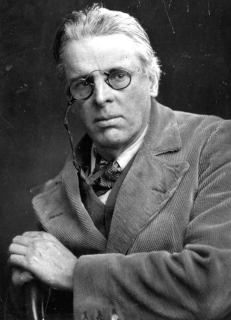
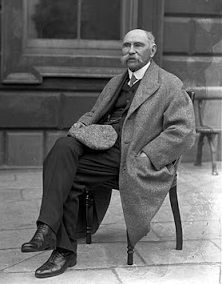
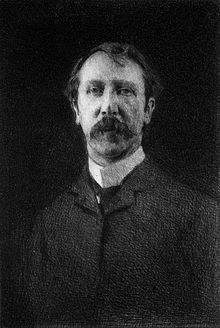
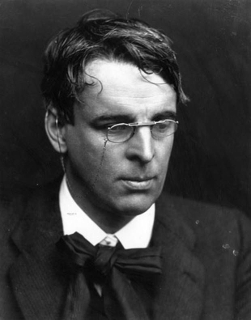
Yeats is born at Sandymount in County Dublin on June 13, 1865. His father, John Butler Yeats, is a lawyer and a well-known portrait painter. He is educated in London and in Dublin but spends his summers in the west of Ireland in the family’s summer house at Connacht. The young Yeats is very much part of the fin de siècle in London. At the same time, he is active in societies that attempt an Irish literary revival. His first volume of verse appears in 1887, but in his earlier period his dramatic production outweighs his poetry both in bulk and in import.
After 1910, Yeats’s dramatic art takes a sharp turn toward a highly poetical, static, and esoteric style. His later plays are written for small audiences. They experiment with masks, dance, and music, and are profoundly influenced by the Japanese Noh plays. Although a convinced patriot, he deplores the hatred and the bigotry of the Nationalist movement, and his poetry is full of moving protests against it. He is appointed to the Irish Senate, Seanad Éireann, in 1922.
Yeats is one of the few writers whose greatest works are actually written after the award of the Nobel Prize. Whereas he receives the Prize chiefly for his dramatic works, his significance today rests on his lyric achievement. His poetry, especially the volumes The Wild Swans at Coole (1919), Michael Robartes and the Dancer (1921), The Tower (1928), The Winding Stair and Other Poems (1933), and Last Poems and Plays (1940), make him one of the outstanding and most influential twentieth-century poets writing in English. His recurrent themes are the contrast of art and life, masks, cyclical theories of life (the symbol of the winding stairs), and the ideal of beauty and ceremony contrasting with the hubbub of modern life.
Hyde is born at Longford House in Castlerea, County Roscommon, on January 17, 1860. In 1867, his father is appointed prebendary and rector of Tibohine, and the family moves to neighbouring Frenchpark, in County Roscommon. He is home schooled by his father and his aunt due to a childhood illness. While a young man, he becomes fascinated with hearing the old people in the locality speak the Irish language.
Rejecting family pressure to follow previous generations with a career in the Church, Hyde instead becomes an academic. He enters Trinity College, Dublin, where he gains a great facility for languages, learning Latin, Greek, Hebrew, French, and German, but his great passion in life is the preservation of the Irish language.
After spending a year teaching modern languages in Canada, Hyde returns to Ireland. For much of the rest of his life he writes and collects hundreds of stories, poems, and folktales in Irish, and translates others. His work in Irish helps to inspire many other literary writers, such as W.B. Yeats and Lady Gregory.
In 1892, Hyde helps establish the Gaelic Journal and in November of that year writes a manifesto called The necessity for de-anglicising the Irish nation, arguing that Ireland should follow her own traditions in language, literature, and even in dress.
In 1893, Hyde founds the Gaelic League (Conradh na Gaeilge) along with Eoin MacNeill and Fr. Eugene O’Growney and serves as its first president. Many of the new generation of Irish leaders who play a central role in the fight for Irish independence in the early twentieth century, including Patrick Pearse, Éamon de Valera, Michael Collins, and Ernest Blythe first become politicised and passionate about Irish independence through their involvement in the Gaelic League. Hyde does not want the Gaelic League to be a political entity, so when the surge of Irish nationalism that the Gaelic League helps to foster begins to take control of many in the League and politicize it in 1915, Hyde resigns as president.
In 1938, Hyde is unanimously elected to the newly created position of President of Ireland, a post he holds until 1945. He is inaugurated on June 26, 1938, in the first inaugural ceremony in the nation’s history. He sets a precedent by reciting the Presidential Declaration of Office in Irish. His recitation, in Roscommon Irish, is one of a few recordings of a dialect of which Hyde is one of the last speakers. Upon inauguration, he moves into the long vacant Viceregal Lodge in Phoenix Park, since known as Áras an Uachtaráin.
Despite being placed in a position to shape the office of the presidency via precedent, Hyde by and large opts for a quiet, conservative interpretation of the office.
In April 1940 Hyde suffers a massive stroke and plans are made for his lying-in-state and state funeral, but to the surprise of everyone he survives, albeit paralysed and confined to a wheelchair. One of Hyde’s last presidential acts is a visit to the German ambassador Eduard Hempel on May 3, 1945, to offer his condolences on the death of Adolf Hitler, a visit which remains a secret until 2005.
Hyde leaves office on June 25, 1945, opting not to nominate himself for a second term. He opts not return to his Roscommon home due to his ill-health but rather moves into the former Secretary to the Lord Lieutenant’s residence in the grounds of Áras an Uachtaráin, where he lived out the remaining four years of his life.
Hyde dies in Dublin on July 12, 1949, at age 89. As a former President of Ireland, he is accorded a state funeral which, as a member of the Church of Ireland, takes place in Dublin’s Church of Ireland St. Patrick’s Cathedral. Since contemporary rules of the Roman Catholic Church in Ireland at the time prohibit Roman Catholics from attending services in non-Catholic churches, all but one member of the Catholic cabinet remains outside the cathedral grounds while Hyde’s funeral takes place. Hyde is buried in Frenchpark, County Roscommon at Portahard Church.
Violet Florence Martin, Irish author, is born at Ross House in Connemara, County Galway on June 11, 1862. She is the co-author of a series of novels with her cousin Edith Somerville under the pen name of Martin Ross in the late nineteenth and early twentieth centuries.
Martin is the youngest of sixteen children of James Martin of Ross (1804–1872). The Martin family, a branch of the Martyn family – one of the Tribes of Galway – had settled at Ross by the early seventeenth century, having previously inhabited the town of Galway for some three hundred years. Her father is a Protestant, his grandfather having converted from the Catholic faith in order to retain the family estates under the Penal Laws. Nevertheless, each child of the family is secretly ‘baptised’ by the family servants.
Martin is a kinswoman of Richard Martin and her contemporary, Edward Martyn, two other notable members of the tribe. Her older brother, Robert Jasper Martin, is a noted songwriter and a well-regarded member of the Tory party in London. She shares a great-grandmother with the writer Maria Edgeworth, whose use of Irish vernacular speech she follows in her work.
Martin’s father manages to save both his estate and his tenants during the Great Famine boasting that not one of his people died during the disaster, but at the cost of bankruptcy. Following his death in 1872, the family moves to Dublin and only returns to Ross in 1888 following revelations of financial fraud of the estate by their agent.
Martin and Edith Somerville are second cousins. They originally meet on January 17, 1886, at Castletownshend, after which they become lifelong companions and literary partners. They come to share a home in Drishane, County Cork. In 1889, Violet adopts the pseudonym Martin Ross, which comprises her surname and the name of her ancestral home. Thus, the authors are called Somerville and Ross. Their works include The Real Charlotte (1889), Some Reminiscences of an Irish R.M. and In the Vine Country.
Martin is a convinced Irish Unionist, in opposition to Somerville’s open nationalism. Both she and her brother Robert are well-regarded members of the literary circle in Irish unionism. However, unlike her brother, Martin is a convinced suffragette, becoming vice-president of the Munster Women’s Franchise League. While on friendly terms with the leading members of the Gaelic literary revival such as W.B. Yeats and Lady Gregory, she objects to their romantic version of Irish peasantry. She is on good terms with Edward Martyn, partner of Gregory and Yeats – and her kinsman – and shares his love of the Irish language and culture.
Martin is seriously injured in a riding accident in November 1898, from which she never fully recovers. This is a contributing factor to her death in Drishane, County Cork, on December 21, 1915. Edith Somerville continues to write under their joint literary names, claiming that they are still in contact. The two women leave thousands of letters and 116 volumes of diaries, detailing their lives, much of them yet unpublished. Edith dies at Castletownshend in October 1949, aged 91, and is buried alongside Violet Florence Martin at Saint Barrahane’s Church, Castletownsend, County Cork.
The play centers on the Irish Rebellion of 1798. The play is startlingly nationalistic, in its last pages encouraging young men to sacrifice their lives for the heroine Cathleen ni Houlihan, who represents an independent and separate Irish state. The title character first appears as an old woman at the door of a family celebrating their son’s wedding. She describes her four “beautiful green fields,” representing the four provinces of Ireland, that have been unjustly taken from her. With little subtlety, she requests a blood sacrifice, declaring that “many a child will be born and there will be no father at the christening” and that “they that have red cheeks will have pale cheeks for my sake, and for all that, they will think they are well paid.” She convinces the future groom, Michael, to give up the wedding and go fight.
After the youth leaves the safety of his home to fight for her, she appears as an image of youth with “the walk of a queen,” professing of those who fight for her: “They shall be remembered forever, They shall be alive forever, They shall be speaking forever, The people shall hear them forever.”
Death is common during the time around the rising, but becoming a martyr is somethings that is admirable, so oftentimes people welcome death so they can create themselves a heroic memory. The martyrs will be remembered forever, which is why this theme is so ingrained into this play.
Cathleen ni Houlihan is such a simple play that contains many symbols and has the goal of convincing men to fight for Ireland. While the play is written about the rising of 1798, it is meant to inspire people for the 1916 Easter Rising. Throughout the whole play, there is constant reference to memory and its influence on the public. The men that die while fighting for Ireland are considered heroes, which is why memory and martyrdom are such important themes that are incorporated into works about revolution.
Cathleen ni Houlihan is about Irish Independence, but there are themes of martyrdom in other works, like the musicals about American Independence, Hamilton and 1776.
(Pictured: Scene from a production of “Cathleen ni Houlihan,” circa 1912)
Augusta is the youngest daughter of the Anglo-Irish gentry family Persse. Her mother, Frances Barry, is related to Standish O’Grady, 1st Viscount Guillamore, and her family home, Roxborough, is a 6,000-acre estate located between Gort and Loughrea, the main house of which is later burned down during the Irish Civil War. She is educated at home, and her future career is strongly influenced by the family nanny, Mary Sheridan, a Catholic and a native speaker of the Irish language, who introduces the young Augusta to the history and legends of the local area.
In 1880 Augusta marries Sir William Henry Gregory, a neighbouring landowner who had previously served as a Member of Parliament and as governor of Ceylon. He is a well-educated man with many literary and artistic interests, and his estate at Coole Park houses a large library and extensive art collection, both of which Lady Gregory is eager to explore. He also has a house in London, where the couple spends a considerable amount of time.
Lady Gregory’s literary career does not begin until after Sir Gregory’s death in 1892. In 1896 she meets William Butler Yeats and becomes his lifelong friend and patron. She takes part in the foundation of the Irish Literary Theatre in 1899 and becomes a director of the Abbey Theatre in 1904, which owes much of its success to her skill at smoothing the disputes among its highly individualistic Irish nationalist founders. As a playwright, she writes pleasant comedies based on Irish folkways and picturesque peasant speech, offsetting the more tragic tones of the dramas of Yeats and John Millington Synge.
Lady Gregory writes or translates nearly forty plays. Seven Short Plays (1909), her first dramatic works, are among her best, vivid in dialogue and characterization. The longer comedies, The Image and Damer’s Gold, are published in 1910 and 1913 and her strange realistic fantasies, The Golden Apple and The Dragon, in 1916 and 1920. She also arranges and makes continuous narratives out of the various versions of Irish sagas, translating them into an Anglo-Irish peasant dialect that she labels “Kiltartan.” These are published as Cuchulain of Muirthemne (1902) and Gods and Fighting Men (1904).
Lady Gregory returns to live in Galway after ill health forces her retirement from the Abbey Theatre board in 1928, although she continues to visit Dublin regularly. The house and demesne at Coole Park are sold to the Irish Forestry Commission in 1927, with Lady Gregory retaining life tenancy. Her Galway home had long been a focal point for the writers associated with the Irish Literary Revival, and this continues after her retirement. On a tree in what were the grounds of the house, one can still see the carved initials of Synge, Æ, Yeats and his artist brother Jack, George Moore, Seán O’Casey, George Bernard Shaw, Katharine Tynan and Violet Martin.
Lady Gregory, whom Shaw once described as “the greatest living Irishwoman,” dies at the age of 80 on May 22, 1932, at home from breast cancer. She is buried in the New Cemetery in Bohermore, County Galway. The entire contents of Coole Park are auctioned three months after her death, and the house is demolished in 1941.
Moore comes from a distinguished Catholic family of Irish landholders. When he is 21, he leaves Ireland for Paris to become a painter. His Reminiscences of the Impressionist Painters (1906) vividly describes the Café Nouvelle-Athènes and the circle of Impressionist painters who frequent it. He is particularly friendly with Édouard Manet, who sketches three portraits of him. Another account of the years in Paris, in which he introduces the younger generation in England to his version of fin de siècle decadence, is his first autobiography, Confessions of a Young Man (1888).
Deciding that he has no talent for painting, Moore returns to London in 1882 to write. His first novels, A Modern Lover (1883) and A Mummer’s Wife (1885), introduce a new note of French Naturalism into the English scene, and he later adopts the realistic techniques of Gustave Flaubert and Honoré de Balzac. Esther Waters (1894), his best novel, deals with the plight of a servant girl who has a baby out of wedlock. It is a story of hardship and humiliation illumined by the novelist’s compassion. It is an immediate success, and he follows it with works in a similar vein: Evelyn Innes (1898) and Sister Teresa (1901).
In 1901 Moore moves to Dublin, partly because of his loathing for the South African War and partly because of the Irish Literary Revival spearheaded by his friend, the poet William Butler Yeats. In Dublin he contributes notably to the planning of the Abbey Theatre. He also produces The Untilled Field (1903), a volume of fine short stories reminiscent of Ivan Turgenev’s writing that focuses on the drudgery of Irish rural life, and a short poetic novel, The Lake (1905). The real fruits of his life in Ireland, however, come with the trilogy Hail and Farewell (Ave, 1911; Salve, 1912; Vale, 1914). Discursive, affectionate, and satirical by turns, it reads like a sustained monologue that is both a carefully studied piece of self-revelation and an acute, though not always reliable, portrait gallery of his Irish acquaintance, which included Yeats, George William Russell, and Lady Gregory. Above all it is a perfectly modulated display of the comic spirit.
The increasing narrowness of the Irish mind, politics, and clericalism sends Moore back to England in 1911. After Hail and Farewell, he makes another literary departure. Aiming at epic effect he produces The Brook Kerith (1916), an elaborate and stylish retelling of the Gospel story that is surprisingly effective despite some dull patches. He continues his attempts to find a prose style worthy of epic theme in Héloïse and Abélard (1921). His other works include A Story-Teller’s Holiday (1918), a blend of autobiography, anecdote, Irish legend, and satire, Conversations in Ebury Street (1924), autobiography, The Pastoral Loves of Daphnis and Chloe (1924) and Ulick and Soracha (1926), an Irish legendary romance.
George Moore dies at his home at Ebury Street in the London district of Belgravia on January 21, 1933, leaving a fortune of £70,000. He is cremated in London at a service attended by Ramsay MacDonald among others. An urn containing his ashes is interred on Castle Island in Lough Carra in view of the ruins of Moore Hall, which had been burned by anti-treaty forces in 1923, during the final months of the Irish Civil War.
Allgood joins Inghinidhe na hÉireann (“Daughters of Ireland”), where she first begins to study drama under the direction of Maud Gonne and William Fay. She begins her acting career at the Abbey Theatre and is in the opening of the Irish National Theatre Society. Her first big role is in December 1904 at the opening of Lady Gregory‘s Spreading the News. By 1905 she is a full-time actress, touring England and North America.
In 1915 Allgood is cast as the lead in Peg o’ My Heart which tours Australia and New Zealand in 1916. She marries her leading man, Gerald Henson, in September 1916 in Melbourne, however, her happiness is short lived. She gives birth to a daughter named Mary in January 1918, who dies just a day later. Her husband dies of influenza during an outbreak in November 1918. After her return to Ireland, she continues to perform at the Abbey Theatre. Her most memorable performance is in Seán O’Casey‘s Juno and the Paycock in 1923. She wins acclaim in London when she plays Bessie Burgess in O’Casey’s The Plough and the Stars in 1926.
Allgood is frequently featured in early Alfred Hitchcock films, such as Blackmail (1929), Juno and the Paycock (1930), and Sabotage (1936). She also has a significant role in Storm in a Teacup (1937).
(Note: Many accounts give October 31, 1879, as her date of birth. Her headstone also gives 1879 as her year of birth. However, her sister Margaret is born on August 1, 1879, meaning she could not have been born in that year. Sara Allgood may have been born on October 31, 1880, but her parents may have been late registering her.)
Yeats is the oldest child of John Butler Yeats and Susan Mary Pollexfen. Although John trained as a lawyer, he abandons the law for art soon after his first son is born. Yeats spends much of his early years in London, where his father is studying art, but frequently returns to Ireland.
In the mid-1880s, Yeats pursues his own interest in art as a student at the Metropolitan School of Art in Dublin. Following the publication of his poems in the Dublin University Review in 1885, he soon abandons art school for other pursuits.
After returning to London in the late 1880s, Yeats meets writers Oscar Wilde, Lionel Johnson and George Bernard Shaw. He also becomes acquainted with Maud Gonne, a supporter of Irish independence. This revolutionary woman serves as a muse for Yeats for years. He even proposes marriage to her several times, but she turns him down. He dedicates his 1892 drama The Countess Cathleen to her.
Around this time, Yeats founds the Rhymers’ Club poetry group with Ernest Rhys. He also joins the Hermetic Order of the Golden Dawn, an organization that explores topics related to the occult and mysticism. While he is fascinated with otherworldly elements, Yeats’s interest in Ireland, especially its folktales, fuels much of his output. The title work of The Wanderings of Oisin and Other Poems (1889) draws from the story of a mythic Irish hero.
In addition to his poetry, Yeats devotes significant energy to writing plays. He teams with Lady Gregory to develop works for the Irish stage, the two collaborating for the 1902 production of Cathleen ni Houlihan. Around that time, he helps found the Irish National Theatre Society, serving as its president and co-director, with Lady Gregory and John Millington Synge. More works soon follow, including On Baile’s Strand, Deirdre and At the Hawk’s Well.
Following his marriage to Georgie Hyde-Lees in 1917, Yeats begins a new creative period through experiments with automatic writing. The newlyweds sit together for writing sessions they believe to be guided by forces from the spirit world, through which Yeats formulates intricate theories of human nature and history. They soon have two children, daughter Anne and son Michael.
Yeats then becomes a political figure in the new Irish Free State, serving as a senator for six years beginning in 1922. The following year, he receives an important accolade for his writing as the recipient of the Nobel Prize in Literature. According to the official Nobel Prize website, he is selected “for his always inspired poetry, which in a highly artistic form gives expression to the spirit of a whole nation.”
Augusta is born at Roxborough, County Galway, the youngest daughter of the Anglo-Irish gentry family Persse. She is educated at home, and her future career is strongly influenced by the family nanny, Mary Sheridan, a Catholic and a native Irish speaker, who introduces her to the history and legends of the local area.
Augusta marries Sir William Henry Gregory on March 4, 1880, in St Matthias’ Church, Dublin. He is a well-educated man with many literary and artistic interests, and the house at Coole Park houses a large library and extensive art collection. He also owns a house in London, where the couple spends a considerable amount of time, holding weekly salons frequented by many leading literary and artistic figures of the day, including Robert Browning, Lord Tennyson, John Everett Millais and Henry James.
Augusta’s earliest work to appear under her own name is Arabi and His Household (1882), a pamphlet in support of Ahmed Orabi Pasha, leader of what has come to be known as the Urabi Revolt. In 1893 she publishes A Phantom’s Pilgrimage, or Home Ruin, an anti-Nationalist pamphlet against William Ewart Gladstone‘s proposed second Home Rule Act.
Augusta continues to write prose during the period of her marriage. She also writes a number of short stories in the years 1890 and 1891, although these never appear in print. A number of unpublished poems from this period have also survived. When Sir William Gregory dies in March 1892, Lady Gregory goes into mourning and returns to Coole Park. There she edits her husband’s autobiography, which she publishes in 1894.
A trip to Inisheer in the Aran Islands in 1893 re-awakes for Lady Gregory an interest in the Irish language and in the folklore of the area in which she lives. She organises Irish lessons at the school at Coole and begins collecting tales from the area around her home. This activity leads to the publication of a number of volumes of folk material, including A Book of Saints and Wonders (1906), The Kiltartan History Book (1909) and The Kiltartan Wonder Book (1910).
With William Butler Yeats and Edward Martyn, she co-founds the Irish Literary Theatre and the Abbey Theatre and writes numerous short works for both companies. Lady Gregory produces a number of books of retellings of stories taken from Irish mythology. Born into a class that identifies closely with British rule, she turns against it. Her conversion to cultural nationalism, as evidenced by her writings, is emblematic of many of the political struggles to occur in Ireland during her lifetime.
Lady Gregory, whom George Bernard Shaw once described as “the greatest living Irishwoman” dies at home at the age of 80 from breast cancer on May 22, 1932. She is buried in the New Cemetery in Bohermore, County Galway. The entire contents of Coole Park are auctioned three months after her death, and the house is demolished in 1941.
Lady Gregory is mainly remembered for her work behind the Irish Literary Revival. During her lifetime her home at Coole Park in County Galway serves as an important meeting place for leading Revival figures. Her early work as a member of the board of the Abbey Theatre is at least as important as her creative writings for that theatre’s development. Lady Gregory’s motto is taken from Aristotle: “To think like a wise man, but to express oneself like the common people.”
Land disputes in Ireland had been a contentious issue for much of the 19th century, with tenants of landlords insisting on fixity of tenure, which later grows into a demand to own their own land. In addition, The Wyndham Land Act of 1903 enables the transfer of about 9 million acres, up to 1914, from landlords to tenants. However, tenure and ownership of land is still a live issue on the eve of the Irish War of Independence.
Shawe-Taylor is a land agent to a local landlord and is himself a tenant. Early in January 1920, a group of local IRA soldiers, including Mick Kelly, Bill Freaney and Larry Lardner, approach Shawe-Taylor on behalf of some local people who are requesting a road to travel to Mass. While Shawe-Taylor himself is amenable to their demands, his landlord refuses them outright and makes this known via Shawe-Taylor.
On March 3, 1920, Shawe-Taylor and his driver, Barrett, are making their way to Galway to attend the fair. At 6:00 AM the coach reaches Egan’s Pub, Coshla, where they find the road blocked. The donkey cart of a local, Johnny Kelly, has been stolen and placed across the road. From behind the wall, at least two shooters fire at Barrett and Shawe-Taylor, wounding Barrett and killing Shawe-Taylor. This results in a huge security presence in the area, which in turn leads to more unrest with the locals. This increases with the arrival of the Black and Tans, whose irregular methods result in shootings, assaults, rapes and deaths. Moorpark House is placed under Royal Irish Constabulary protection out of fear of further killings.
Other people who subsequently die as a result of the unrest in Galway include Ellen Quinn, a pregnant mother of six and a tenant of Lady Gregory, Fr. Michael Griffin, Tom Egan and brothers Patrick and Harry Loughnane. In addition, there are numerous incidents of violence, many of which are recorded with horror by Lady Gregory in her journal, who remarks that “the country has gone wild since the killing of Frank Shawe-Taylor.”
No one is ever tried for Frank Shawe-Taylor’s killing, though the identities of those involved are known to some locals at the time. His widow eventually sells their property and, with her young children, moves to England.