seamus dubhghaill

Promoting Irish Culture and History from Little Rock, Arkansas, USA


Leave a comment

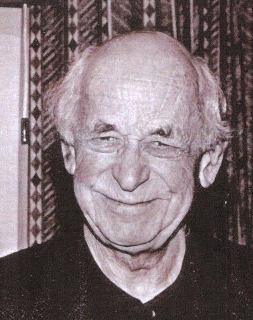
Birth of Roger McCorley, Irish Republican Activist

Roger McCorley, Irish republican activist, is born into a Roman Catholic family at 67 Hillman Street in Belfast on September 6, 1901.

McCorley is one of three children born to Roger Edmund McCorley, a meat carver in a hotel, and Agnes Liggett. He has two elder brothers, Vincent and Felix. He joins the Fianna in his teens. His family has a very strong republican tradition, and he claims to be the great-grandson of the United Irishmen folk hero Roddy McCorley, who was executed for his part in the Irish Rebellion of 1798.

McCorley is a member of the Belfast Brigade of the Irish Republican Army (IRA) during the Irish War of Independence (1919–1922). He is commandant of the Brigade’s first battalion, eventually becoming Commandant of the Belfast Brigade. In June 1920, he is involved in an attack on a Royal Irish Constabulary (RIC) police barracks at Crossgar, County Down. On Sunday, August 22, 1920, in Lisburn, he is involved in the assassination of RIC District Inspector Oswald Swanzy, who was held responsible by Michael Collins for the assassination of Tomás McCurtain, Lord Mayor of Cork.

McCorley is noted for his militancy, as he is in favour of armed attacks on British forces in Belfast. The Brigade’s leaders, by contrast, in particular, Joe McKelvey, are wary of sanctioning attacks for fear of loyalist reprisals on republicans and the Catholic population in general. In addition, McCorley is in favour of conducting an armed defense of Catholic areas, whereas McKelvey does not want the IRA to get involved in what he considers to be sectarian violence. McCorley writes later that in the end, “the issue settled itself within a very short space of time, when the Orange mob was given uniforms, paid for by the British, and called the Ulster Special Constabulary (USC).” The role of the USC, a temporary police force raised for counter-insurgency purposes, in the conflict is still debated, but republicans maintain that the organization was responsible for the indiscriminate killings of Catholics and nationalists.

On January 26, 1921, McCorley, is involved in the fatal shooting of three Auxiliary Division officers in their beds in the Railway View hotel in central Belfast. Shortly afterwards, he and another IRA man, Seamus Woods, organize an active service unit (ASU) within the first battalion of the Belfast Brigade, with the intention of carrying out attacks, with or without the approval of the Brigade leadership. The unit consists of 32 men. McCorley later writes, “I issued a general order that, where reprisal gangs [State forces] were cornered, no prisoners were to be taken.” In March 1921, he personally leads the ASU in the killing of three Black and Tans in Victoria Street in central Belfast. He is responsible for the deaths of two more Auxiliaries in Donegall Place in April. In reprisal for these shootings, members of the RIC assassinate two republican activists, the Duffin brothers in Clonard Gardens in west Belfast. On June 10, 1921, both and Woods and McCorley units are involved in the killing a RIC man who is suspected in the revenge killings of the Duffin brothers. Two RIC men and a civilian are also wounded in that attack.

Thereafter, there is what historian Robert Lynch has described as a “savage underground war” between McCorley’s ASU and RIC personnel based in Springfield Road barracks and led by an Inspector Ferris. Ferris is accused of murdering the Lord Mayor of Cork Thomas MacCurtain and had been posted to Lisburn for his safety. Ferris himself is among the casualties, being shot in the chest and neck, but surviving. McCorley claims to have been one of the four IRA men who shot Ferris. In addition, his men bomb and burn a number of businesses including several cinemas and a Reform Club. In May 1921, however, thirteen of his best men are arrested when surrounded by British troops during an operation in County Cavan. They are held in Crumlin Road Gaol and sentenced to death.

On June 3, McCorley organizes an attack on Crumlin Road Gaol in an attempt to rescue the IRA men held there before they are executed. The operation is not a success; however, the condemned men are reprieved after a truce is agreed between the IRA and British forces in July 1921. On Bloody Sunday (July 10, 1921), he is a major leader in the defense of nationalist areas from attacks by both the police and loyalists. On that day twenty people are killed before he negotiates a truce beginning at noon on July 11. At least 100 people are wounded, about 200 houses are destroyed or badly damaged – most of them Catholic homes, leaving 1,000 people homeless.

In April 1922, McCorley becomes leader of the IRA Belfast Brigade after Joe McKelvey goes south to Dublin to join other IRA members who are against the Anglo-Irish Treaty. With McKelvey’s departure, Seamus Woods becomes Officer Commanding of the IRA’s 3rd Northern Division, which has up to 1,000 members, with McCorley designated as Vice Officer Commanding. McCorley for his part, supports the Treaty, despite the fact that it provides for the partition of Ireland and the continued British rule in Northern Ireland. The reason for this is that Michael Collins and Eoin O’Duffy have assured him that this is only a tactical move and indeed, Collins sends men, money and weapons to the IRA in the North throughout 1922.

However, McCorley’s command sees the collapse of the Belfast IRA. In May 1922, the IRA launches an offensive with attacks all across Northern Ireland. In Belfast, he carries out an assault on Musgrave Street RIC barracks. He also conducts an arson campaign on businesses in Belfast. His men also carry out a number of assassinations, including that of Ulster Unionist Party MP William J. Twaddell, which causes the internment of over 200 Belfast IRA men.

To escape from the subsequent repression, McCorley and over 900 Northern IRA men flee south, to the Irish Free State, where they are housed in the Curragh. McCorley is put in command of these men. In June 1922, the Irish Civil War breaks out between Pro and Anti-Treaty elements of the IRA. He takes the side of the Free State and Michael Collins. After Collins is killed in August 1922, his men are stood down. About 300 of them join the National Army and are sent to County Kerry to put down anti-Treaty guerrillas there. In the Spring of 1923, bitterly disillusioned by the brutal counterinsurgency against fellow republicans, he resigns his command.

McCorley later asserts that he “hated the Treaty” and only supported it because it allowed Ireland to have its own armed forces. Both he and Seamus Woods are severe critics of the Irish Free State inertia towards Northern Ireland after the death of Michael Collins. He comments that when Collins was killed “the Northern element gave up all hope.”

In 1936 McCorley is instrumental in the establishment of the All-Ireland Old IRA Men’s Organization, serving as Vice-President with President Liam Deasy (Cork No. 3 Brigade) and Secretary George Lennon (Waterford No. 2 Brigade).

In the 1940s, McCorley is a founding member of Córas na Poblachta, a political party which aspires to a United Ireland and economic independence from Britain. He dies on November 13, 1993, and is buried in the Republican Plot of Glasnevin Cemetery.

Leave a comment

The Battle of Antrim

The Battle of Antrim is fought on June 7, 1798, in County Antrim during the Irish Rebellion of 1798 between British troops and Irish insurgents led by Henry Joy McCracken. The British win the battle, beating off a rebel attack on Antrim town following the arrival of reinforcements but the county governor, John O’Neill, 1st Viscount O’Neill, is fatally wounded.

The outbreak of the United Irish rebellion in Leinster on May 23 had prompted calls from Ulster United Irishmen to take to the field in support of their southern comrades. However, the organisation in Ulster had been severely damaged in a brutal disarmament campaign the previous year, and the new leadership are less radical and are not willing take to the field without French assistance, which is expected daily.

After waiting for two weeks while the rebellion rages in the south, the grassroots United Irish membership in Antrim decides to hold a number of meetings independent of their leaders. The outcome is the election of Henry Joy McCracken as their adjutant general and the decision to rise immediately. McCracken, together with James Hope, quickly formulate a plan to attack and seize all government outposts in County Antrim and then for the main attack to fall on Antrim town. Then using artillery seized at Antrim, the rebels are to march on Belfast in conjunction with the United Irish rebels in County Down.

McCracken has high hopes that many members of the militia will desert and join him, as disaffection is believed to be widespread, evidenced by the execution of four of the Monaghan militia for treason in Belfast in May.

On 6 June, McCracken and James Hope issue a proclamation calling for the United army of Ulster to rise. The initial plan meets with success, as the towns of Larne, Ballymena, Portaferry and Randalstown are taken and the bridge at Toome damaged to prevent the government from rushing reinforcements into Antrim from west of the River Bann. The rebels then assemble at Donegore Hill in preparation for the march and attack on Antrim town, where an emergency meeting of the county’s magistrates called by the county governor, Lord O’Neill, is due to take place.

Although almost 10,000 rebels assemble at Donegore, many display reluctance for the coming fight and stay on the hill in reserve or desert later so that probably fewer than 4,000 actually take part in the attack. The United Irishmen in Ulster are mostly Presbyterian, but are joined with Catholic Defenders and the tension between the two groups on the march likely causes some desertions. These difficulties lead to a loss of momentum, and the attack is delayed. McCracken is forced to make adjustments to his plan of attack, which had envisaged a simultaneous overwhelming assault on the town from four separate points.

The town is garrisoned by a small force of about 200 yeomen, cavalry under Lt. Col. William Lumley and armed volunteers but they also have four artillery pieces and the delay in the rebel attack allows them to send requests for assistance to Belfast and Lisburn from where reinforcements are already on the way. The garrison forms themselves at the base of the demesne wall of Antrim Castle, with artillery to the front and cavalry to the rear with their flanks anchored by the Market House and Presbyterian Meeting House. A part of the Scottish Quarter in the town is also burned by the garrison as it is perceived to be a stronghold of rebel sympathisers.

The attack finally begins shortly before 3:00 p.m. when the rebels begin a cautious march through the town. As rebel front ranks arrive to face the garrison’s defensive line, artillery opens fire on the rebels, causing them to pull back out of range. Large clouds of dust and smoke are thrown up which, together with the fires from the Scottish Quarter, obscure the garrison’s view of events.

The rebel withdrawal is mistaken for a full retreat and the cavalry moves out to pursue and rout the supposed fleeing rebels. The cavalry effectively runs into a gauntlet of rebels who are protected by a long churchyard wall and stationed in houses along the main street, suffering heavy losses to the gunfire and pikes of the rebels.

After routing the cavalry, the rebels attack the remainder of the garrison, which then begins to pull back to the safety of the castle wall. This is mistaken by a newly arrived rebel column as an attack on them, causing them to flee in panic. In the confusion, the county commander, Lord O’Neill, trapped with his magistrates, is fatally wounded by James Clements who avoids trial by joining the army. A rebel attempt to seize the artillery is only narrowly beaten off by troops stationed behind the demesne wall.

At this critical juncture, British reinforcements from Belfast arrive outside the town and, assuming it to be held by the rebels, begin to shell it with their artillery. This prompts more desertions and the rebel army begins to disintegrate, but their withdrawal is protected by a small band under James Hope which fights a successful rearguard action from the church grounds along the main street. This allows the bulk of the rebels to withdraw safely.

When the military enters the town, they begin a spree of looting, burning and murder, of which the most enthusiastic perpetrators are reported to be the Monaghan militiamen, who are anxious to prove their loyalty and expunge the shame of the recent executions of their comrades for sedition. The town of Templepatrick is burned to the ground and Old Stone Castle is razed to the ground. McCracken, Hope and their remaining supporters withdraw northward, establishing camps of ever dwindling size along the route of their retreat until news of the defeat at Ballynahinch causes their final dispersion. McCracken is arrested by yeomen on July 7 and is hanged in Belfast on July 17, having refused an offer of clemency in return for informing on his comrades.

Commemoration of the centenary of the battle, marked by a nationalist parade in Belfast on June 6, 1898, provokes loyalist riots.


Leave a comment

The Battle of Lisnagarvey

The Battle of Lisnagarvey is fought on December 6, 1649, near Lisnagarvey, County Antrim, during the Irish Confederate Wars, an associated conflict of the Wars of the Three Kingdoms (1638-51). Forces loyal to the Commonwealth of England defeat an army supporting Charles II of England, composed of Royalists and Scots Covenanters.

The Irish Confederate Wars, sparked by the Irish Rebellion of 1641, are initially fought between the predominantly Catholic Confederation, and a largely Protestant government army led by James Butler, 1st Duke of Ormond. Both claims to be loyal to Charles I, while there is a three-sided war in Ulster. The latter involves Royalists, Gaelic Catholic leader Eoghan Ó Néill, and Presbyterian militia known as the Laggan Army, supported by Scots Covenanters under Robert Monro.

In September 1643, Ormond agrees to a truce, or ‘Cessation’, with the Confederation, freeing his troops for use in England against Parliament in the First English Civil War. Some Irish Protestants object, and switch sides, including Sir Charles Coote, who becomes Parliamentarian commander in Connacht. Charles surrenders in 1646, while a Covenanter/Royalist uprising is quickly suppressed in the 1648 Second English Civil War. On January 17, 1649, the Confederation allies with Ormond’s Royalists. Following the execution of Charles on January 30, they are joined by the Laggan Army and remaining Scots troops in Ulster.

There are various reasons for this. The Covenanter government, who provides support for Scottish settlers in Ulster, considers Oliver Cromwell and other leaders of the new Commonwealth of England dangerous political and religious radicals. As Scots, they object to the execution of their king by the English; as Presbyterians, they view monarchy as divinely ordained, making it also sacrilegious, and transfer their allegiance to his son, Charles II of England.

However, this is offset by a split within the Confederation, between Catholic landowners who want to preserve the position prevailing in 1641, and those like Ó Néill, whose estates had been confiscated in 1607. As a result, he agrees a truce with Coote, and refuses to join the Alliance, depriving them of their most effective fighting force in the north. Despite this, by late July, Ormond’s combined Royalist/Confederate army controls most of Ireland.

In Ulster, Derry is the only major town still held by forces loyal to the Commonwealth. The garrison is commanded by Coote, who is besieged by the Laggan Army under George Munro, Robert’s nephew. In July, Munro is forced to lift the siege by Ó Néill, an example of the impact of the truce between two unlikely allies.

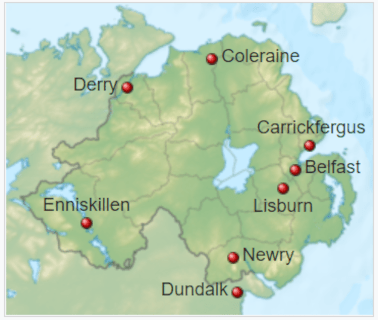
Ormond’s defeat at Rathmines on August 2 allows Cromwell and an army of 12,000 to land in Dublin unopposed. After capturing Drogheda on September 11, his main force heads south towards Wexford. Colonel Robert Venables is sent north with three regiments, or around 2,500 men, to take control of Ulster. Munro’s garrisons surrender with minimal resistance, and by the end of September, Venables has occupied Dundalk, Carlingford, Newry, and Belfast. These are accompanied by the mass expulsion of Scots settlers, as punishment for their defection. When Coote captures Coleraine on September 15, he massacres the largely Scottish garrison.

At the end of October, Coote joins Venables at Belfast. They spend November reducing remaining Royalist garrisons in the north, and in early December, assemble 3,000 men to attack Carrickfergus. After lifting the siege of Derry, Munro has retreated to Enniskillen with the remainder of the Laggan Army. Since the loss of Carrickfergus would effectively cut communications with Scotland, he is determined to prevent this if at all possible.

He combines forces with Royalist leader James Hamilton, 1st Earl of Clanbrassil, creating an army of around 5,000. However, it comprises remnants from many different regiments, its men are poorly equipped, and demoralised, while most have not been paid for over two years. As they march north, their numbers dwindle due to desertion.

Learning of their advance, Coote and Venables move to intercept Munro, and the two advance guards make contact outside Lisnagarvey, near Lisburn, on December 6. Despite superior numbers, the Royalists cannot hold their ground against their far more experienced opponents. When the main body of the Parliamentarian force appears, the retreat rapidly turns into a rout, the majority fleeing without firing a shot. In the pursuit that follows, they lose 1,500 men, killed or captured, along with their baggage train and supplies. Clandeboye and the remnants of his army surrender shortly afterwards, although Monro escapes to Enniskillen.

Lisnagarvey ends resistance by Scottish forces to the Parliamentarian army. Carrickfergus surrenders on December 13, and as with other towns, its Scottish settlers are expelled. Early in 1650, Monro agrees to evacuate Enniskillen for £500, and returns to Scotland, leaving Ó Néill’s army as the only remaining obstacle to Parliamentarian control of the north. However, his death in November 1649 proves a major blow to its morale and fighting ability. In June 1650, it is destroyed by Coote and Venables at Scarrifholis.

(Pictured: Map of key locations of the 1649 campaign in Ulster)


Leave a comment

Loyalists Protest Sinn Féin Minister’s Refusal to Fly Union Flag

On Friday, August 4, 2000, Loyalists protest after Northern Ireland health minister Bairbre de Brún, a member of Sinn Féin, refuses to fly the Union flag outside her Belfast offices to mark the 100th birthday of Britain’s Queen Mother. First Minister David Trimble had written to the Northern Ireland secretary requesting that the Union Flag should be flown on all government buildings.

About 20 people take part in the picket organised by the loyalist Progressive Unionist Party (PUP) as the minister leaves the Department of Health offices on Friday morning.

In Bangor, County Down, a group of loyalist protesters put up a Union Flag outside the offices of Sinn Féin education minister Martin McGuinness at his department’s Rathgael House headquarters. Another group of PUP protesters demonstrate at government buildings in Adelaide Street in Belfast city centre, where the Union Flag is flying above two of the government buildings in the street.

Protestors hold up posters showing the faces of de Brun and McGuinness printed on a Union Flag. The posters also show the face of the nationalist Social Democratic and Labour Party (SDLP) agriculture minister Bríd Rodgers.

The PUP’s Billy Hutchinson criticises Sinn Féin ministers over their refusal to fly the Union Flag. “These people cannot even recognise that we have a monarch who’s 100 years old and they can’t even fly the flag, just because they think that everything that is British is no good,” he says. “These people forget that they have lived in Britain all their lives, most of them. They weren’t even born at Partition (of Ireland).” He adds that Sinn Féin’s ministers should accept that they are “British ministers in a British state.”

However, Sinn Féin’s Alex Maskey condemns the protests as “intimidating and sectarian.” He says Sinn Féin’s position on the flying of flags is designed not to cause offence. “Where British cultural and political symbols are invoked in public life, equivalent Irish cultural and political symbols should be given equal prominence. Where this cannot be agreed, no such symbols should fly,” he says.

The issue of flags has been emotive and divisive in Northern Ireland. The Sinn Féin ministers anger unionists on May 2 by ordering their civil servants not to fly the flag as part of the Coronation Day celebrations. The row reaches a head when the anti-agreement Democratic Unionist Party (DUP) attempts to guarantee the flying of the Union Flag with an assembly motion in June. However, the party fails to win enough support for their motion to be passed.

There are about 13 days in the year when the Union Flag is flown on designated government offices in the United Kingdom. Government buildings across the UK – from Whitehall ministries to town council offices are expected to raise the Union Flag on these days.

It is the second time in a week that the health minister has run into controversy. On Wednesday, August 2, she is confronted by angry loyalist protesters during an official visit to a County Antrim hospital. Around 20 demonstrators picket the Lagan Valley Hospital in Lisburn, while she is on a visit to see a GP scheme as part of a programme to learn about aspects of the health service. The tyres on the minister’s car are let down and an egg is thrown. De Brun is forced to leave the complex by another door.

(From: “Trimble joins Union Flag row,” BBC News, news.bbc.co.uk, Friday, August 4, 2000 | Pictured: Protesters picket the Department of Health)


Leave a comment

The Moira Car Bomb Attack

Eleven people are injured when a car bomb rocks the centre of Moira, County Down, on the evening of February 20, 1998. The injured include seven Royal Ulster Constabulary (RUC) officers, one a policewoman, and four civilians. The RUC Chief Constable, Ronnie Flanagan, who visits the scene the following morning, says that a warning was issued by a man with a “southern” accent in calls to the Maze and Maghaberry prisons. He adds that a vehicle, possibly the getaway car, was discovered on the southern route of the M1 motorway, suggesting that the attack may have come from south of the Border.

While unionist politicians blame the Irish Republican Army (IRA), this also suggests that the attack could have been the work of the Continuity IRA.

The car bomb, estimated at 500 lbs., is planted outside the local RUC station and explodes at approximately 11:40 PM, about ten minutes after the warnings are issued. Houses and pubs in the vicinity of the RUC station are evacuated. Local people described the explosion as “huge” and “massive.”

The attack comes just hours after Sinn Féin is expelled from the talks about the future of the province by the British Government because of recent IRA killings. By the following morning, no organisation has admitted responsibility for the bombing.

There are reports of the explosion being heard 20 miles away from Moira, which is a picturesque village about 20 miles west of Belfast.

The injured are rushed to Craigavon Area Hospital. None of the injuries are believed to be critical. Flanagan says the damage caused to the local RUC station is significant. A number of nearby houses are also extensively damaged. “One house was virtually demolished in the explosion,” says a police source.

The Democratic Unionist Party (DUP) justice spokesman, Ian Paisley, Jr., who lives nearby, believes that the bomb is initially intended for a specific target in the nearby town of Lisburn, but because of heavy policing the bombers set off the device instead in Moira. “I lay the blame completely at the door of the Provisional IRA,” he says.

In December 2013, a 43-year-old man is arrested in Moy, County Tyrone, and questioned about the attack, but is later released unconditionally. A 47-year-old man is arrested in Dungannon, County Tyrone, on May 7, 2014. He is taken to Antrim police station for questioning but is also released unconditionally.

(From: “11 injured in bomb blast in Co Down,” by Gerry Moriarty, The Irish Times, http://www.irishtimes.com, February 21, 1998)


Leave a comment

Birth of James Craig, 1st Viscount Craigavon & First Prime Minister of Northern Ireland

James Craig, 1st Viscount Craigavon PC PC (NI) DL, prominent Irish unionist politician, leader of the Ulster Unionist Party and the first Prime Minister of Northern Ireland from 1921 until his death in 1940, is born at Sydenham, Belfast, on January 8, 1871.

Craig is the seventh of nine children of James Craig (1828–1900), a wealthy whiskey distiller who had entered the firm of Dunville & Co. as a clerk and by age 40 is a millionaire and a partner in the firm. Craig Snr. owns a large house called Craigavon, overlooking Belfast Lough. His mother, Eleanor Gilmore Browne, is the daughter of Robert Browne, a prosperous man who owned property in Belfast and a farm outside Lisburn. Craig is educated at Merchiston Castle School in Edinburgh, Scotland. After school he begins work as a stockbroker, eventually opening his own firm in Belfast.

Craig enlists in the 3rd (Militia) battalion of the Royal Irish Rifles on January 17, 1900, to serve in the Second Boer War. He is seconded to the Imperial Yeomanry, a cavalry force created for service during the war, as a lieutenant in the 13th battalion on February 24, 1900, and leaves Liverpool for South Africa on the SS Cymric in March 1900. After arrival he is soon sent to the front and is taken prisoner in May 1900, but released by the Boers because of a perforated colon. On his recovery he becomes deputy assistant director of the Imperial Military Railways, showing the qualities of organisation that are to mark his involvement in both British and Ulster politics. In June 1901 he is sent home suffering from dysentery, and by the time he is fit for service again the war is over. He is promoted to captain in the 3rd Royal Irish Rifles on September 20, 1902, while still seconded to South Africa.

On his return to Ireland, having received a £100,000 legacy from his father’s will, Craig turns to politics, serving as Member of the British Parliament for East Down from 1906 to 1918. From 1918 to 1921 he represents Mid Down and serves in the British government as Parliamentary Secretary to the Minister for Pensions (1919–20) and Parliamentary Secretary to the Admiralty (1920–21).

Craig rallies Ulster loyalist opposition to Irish Home Rule in Ulster before World War I, organising the paramilitary Ulster Volunteers (UVF) and buying arms from Imperial Germany. The UVF becomes the nucleus of the 36th (Ulster) Division during World War I. He succeeds Edward Carson as leader of the Ulster Unionist Party in February 1921.

In the 1921 Northern Ireland general election, the first ever, Craig is elected to the newly created House of Commons of Northern Ireland as one of the members for Down.

On June 7, 1921, Craig is appointed the first Prime Minister of Northern Ireland by the Lord Lieutenant of Ireland. The House of Commons of Northern Ireland assembles for the first time later that day.

Craig is made a baronet in 1918, and in 1927 is created Viscount Craigavon, of Stormont in the County of Down. He is also the recipient of honorary degrees from Queen’s University Belfast (1922) and the University of Oxford (1926).

Craig had made his career in British as well as Northern Irish politics, but his premiership shows little sign of his earlier close acquaintance with the British political world. He becomes intensely parochial and suffers from his loss of intimacy with British politicians in 1938, when the British government concludes agreements with Dublin to end the Anglo-Irish trade war between the two countries. He never tries to persuade Westminster to protect Northern Ireland‘s industries, especially the linen industry, which is central to its economy. He is anxious not to provoke Westminster, given the precarious state of Northern Ireland’s position. In April 1939, and again in May 1940 during World War II, he calls for conscription to be introduced in Northern Ireland (which the British government, fearing a backlash from nationalists, refuses). He also calls for Winston Churchill to invade Ireland using Scottish and Welsh troops in order to seize the valuable ports and install a Governor-General at Dublin.

While still prime minister, Craig dies peacefully at his home at Glencraig, County Down at the age of 69 on November 24, 1940. He is buried on the Stormont Estate on December 5, 1940, and is succeeded as the Prime Minister of Northern Ireland by the Minister of Finance, J. M. Andrews.

(Pictured: James Craig, 1st Viscount Craigavon, bromide print by Olive Edis, National Portrait Gallery, London)


Leave a comment

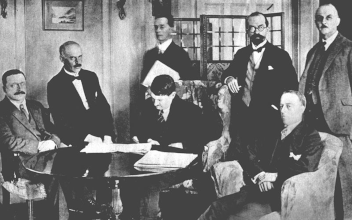
British Ultimatum to the Irish Delegation at the Anglo-Irish Treaty Talks

The Irish delegation at the Anglo-Irish Treaty talks in London are given an ultimatum by British Prime Minister David Lloyd George on December 5, 1921. Sign the treaty or face “immediate and terrible war.”

In 1920, during the Irish War of Independence, the Government of Ireland Act not only establishes the new state of Northern Ireland but gives that state the right to opt-out of a future self-governing Irish Free State within the British Commonwealth of Nations.

The Northern state consists of the six northeastern counties of Ulster with a unionist majority. They are Antrim, Down, Armagh, Derry, Tyrone, and Fermanagh. Belfast is to be the seat of a government and hold limited devolved powers. The counties of Donegal, Cavan, and Monaghan are to be absorbed within the Irish Free State controlled from parliament in Dublin.

Irish nationalists are dismayed with the plan. Protestant Unionists, particularly those living within the boundaries of the new state, accept and start to implement the Act. Sectarian attacks are launched upon Catholic homes in Belfast, Derry, Banbridge, Lisburn, and Dromore. Catholics are driven from Belfast shipyards and from various engineering works in the city. Supposedly these attacks are in revenge for Irish Republican Army (IRA) assassinations.

The IRA continues the campaign to establish a republic with the Irish War of Independence. By the middle of 1921, both sides are exhausted, and a truce is called on June 9.

In July 1921, Éamon DeValera, the president of Dáil Éireann, goes to London to meet with Prime Minister Lloyd George. They agree an Irish delegation will come to London to discuss terms in the autumn.

The delegation appointed by the Dáil to travel to London consists of Arthur Griffith (Minister for Foreign Affairs and chairman of the delegation); Michael Collins (Minister for Finance and deputy chairman of the delegation); Robert Barton (Minister for Economic Affairs); George Gavan Duffy and Éamonn Duggan, with Erskine Childers, Fionán Lynch, Diarmuid O’Hegarty, and John Chartres providing secretarial assistance. DeValera himself does not attend. Future historians wonder if he knew they would not be able to negotiate a 32 county Irish Republic.

During the debate, Lloyd George insists Ireland remain part of the Commonwealth and Dáil Éireann members take the oath of allegiance to the British throne. After a delay of two months, Lloyd George delivers the ultimatum on December 5, sign a treaty within three days or there will be war.

The Anglo-Irish Treaty is to give Ireland a 26 county Free State with Dominion status. The right to raise taxes, regulate foreign trade, independence in internal affairs, own an army, and the oath of allegiance is changed to one of fidelity.

The British are to retain three naval bases within the jurisdiction of the Free State, at Cobh, Lough Swilly, and Berehaven. The Northern Ireland boundary is to be determined by a commission. This gives false hope to large tracts of Tyrone, Fermanagh, Down, Armagh, and Derry City would be given to the Free State as they have Catholic majorities.

Just after 2:00 AM on December 6, 1921, the Irish delegation, without consulting the Dáil, finally sign a treaty with the British. Collins writes, prophetically, later on the day of the signing, “early this morning I signed my death warrant.”

The Treaty displeases the Catholics in the north and the unionists in the south. Meanwhile, many of those involved in the conflict are abhorred at the fact that not all of Ireland is to leave the United Kingdom.

(From: “The Anglo-Irish Treaty (1921)” by Brian O’Neill, Your Irish Culture, http://www.yourirish.com, May 20, 2020)


Leave a comment

Birth of Roy McFadden, Poet, Editor & Lawyer

Roy McFadden, Northern Irish poet, editor, and lawyer, is born in Downpatrick, County Down, on November 14, 1921.

McFadden is born to Roland Victor MCFadden and his wife Maud Steele. A short time after his birth the family relocates to Belfast. He is educated at Knock Grammar School, Regent House School in Newtownards, and later graduates in Law from Queen’s University Belfast in 1944. He becomes a prominent lawyer and an influential figure in the Belfast literary scene.

McFadden’s first poem is published before he is thirteen. His earliest influences are from magazines and journals that his father brings home, and by Francis Turner Palgrave‘s Golden Treasury. He first comes to prominence as a promoter of Ulster literature in the 1940s when he edits two anthologies of poetry, Ulster Voices and Irish Voices in 1943. In 1948, he co-founds with Barbara Edwards (née Hunter) the Northern Irish poetry magazine Rann and then, co-edits it with her during its whole run, until 1953. Like its predecessor Lagan, it is unapologetically regionalist.

McFadden is the author of nine volumes of poetry, from Swords and Ploughshares (1943) to the posthumously published Last Poems (2002). Among his poems are “Saint Francis and the Birds” and “Independence”. His book, The Garryowen, is published by Chatto & Windus in the Phoenix Living Poets series. Most recently, his poem “Post-War” has been anthologised in Armistice: A Laureate’s Choice of Poems of War and Peace (Faber Poetry) (2018). There is a long gap between 1947 and 1971 when he publishes no collections of his work, however he continues to write and publishes in periodicals and newspapers such as The Irish Times where in that time he has sixty poems printed. His voice is well known on local BBC Radio through the Poetry Notebooks series, and he also has several verse-plays broadcast.

In 1952 McFadden marries Margaret Ferguson. Together they produce three sons and two daughters. He lives for a number of years in Lisburn, County Antrim. Inspired by Herbert Read and Alex Comfort, he describes himself as a pacifist and an anarchist in 1999. McFadden dies at his Belfast home on September 15, 1999.

The Roy McFadden Papers, comprising the poet’s personal manuscripts and papers, are lodged at Queen’s University Belfast. The Roy McFadden Library at Trinity College Dublin comprises books and journals on Irish and world literature from his collection. A comprehensive collection of his published work is held at the National Poetry Library, Southbank Centre, London.


1 Comment

Bernadette Devlin McAliskey Assassination Attempt

Bernadette Devlin McAliskey, Northern Ireland civil rights campaigner and former Westminster Member of Parliament (MP), is shot by members of the Ulster Freedom Fighters, a cover name of the Ulster Defence Association (UDA), who burst into her home at Coalisland, County Tyrone on January 16, 1981. She survives the assassination attempt.

The three men shoot McAliskey nine times in the chest, arm and thigh as she goes to wake up one of her three children. Her husband, Michael, is also shot twice at point blank range. British soldiers are watching the McAliskey home at the time but fail to prevent the assassination attempt. It is claimed that Devlin’s assassination was ordered by British authorities, and that collusion was a factor. An army patrol of the 3rd Battalion, Parachute Regiment enter the house and wait for half an hour. McAliskey claims they are waiting for the couple to die.

Another group of soldiers then arrive and transport them by helicopter to a nearby Dungannon hospital for emergency treatment and then to the Musgrave Park Hospital, Military Wing, in Belfast, under intensive care. Their condition is initially said to be serious, but not life-threatening.

The attackers, Ray Smallwoods, Tom Graham, both from Lisburn, and Andrew Watson from Seymour Hill, Dunmurry, are captured by members of the Parachute Regiment, who are on patrol nearby when they hear the shots and are taken in for questioning by the police and subsequently jailed. All three are members of the South Belfast UDA. Smallwoods is the driver of the getaway car. Police say it is a professional attack. The gunmen cut the telephone wires to the house before breaking down the front door with a sledgehammer.

McAliskey had played a leading role in the campaign for Republican prisoners in the HM Prison Maze, who are demanding “prisoner of war” or political status. They want to be held separately from loyalist supporters in the Maze. Four other members of the campaign for the H-block inmates have been murdered.

Seven Maze prisoners went on hunger strike before Christmas in support of their demands for political status. The strike is called off on December 12 after Taoiseach Charles Haughey convinces the inmates their families want them to start eating again.


Leave a comment

Birth of Provisional IRA Member Seán Savage

sean-savage

Seán Savage, Provisional Irish Republican Army member who is shot dead by the British Army while attempting to plant a car bomb in Gibraltar, is born in Belfast on January 26, 1965.

Born into an Irish Republican family in the Kashmir area of Belfast, Savage is educated at St. Gall’s Primary School, and at St. Paul’s Secondary School in the Falls Road area of West Belfast.

In 1987 Savage and Daniel McCann shoot and kill two Royal Ulster Constabulary officers at Belfast docks. He is also the leader of an IRA attack that places a car bomb beneath the car of John McMichael, an Ulster loyalist paramilitary, in Lisburn in December 1987. McMichael dies of his injuries two hours after the blast.

In March 1988, Savage and McCann, along with another Provisional IRA member, Mairéad Farrell, are sent to the British overseas territory of Gibraltar to plant a bomb in the town area targeting a British Army band which parades weekly in front of The Convent, the official Governors’ residence. However, the British Government acquires information about the intended attack and specially dispatches a British Army detachment there to intercept it, in an operation that it code-names Operation Flavius.

On March 6, 1988 Savage, McCann and Farrell enter Gibraltar from across the Spanish border to carry out a reconnaissance of the target. Having conducted it, they are leaving Gibraltar on foot approaching the Spanish border in two separate parties, when Savage sees McCann and Farrell up ahead being confronted and shot dead by soldiers from the Special Air Service regiment. He turns around and flees, running back into Gibraltar town, closely pursued on foot by another SAS soldier. After a 300-yard chase the soldier catches up with Savage and shoots him dead beneath a beech tree in Smith Dorrien Avenue. Civilian witnesses to the incident state afterwards that Savage is repeatedly fired upon by the soldier that had run him down while he is lying on the ground seemingly incapacitated.

The IRA team is subsequently found to be unarmed at the time of their deaths. A hire car rented by them, converted into a car bomb containing 140 lbs. of Semtex, with a device timed to go off during the changing of the guard ceremony in Gibraltar, is found two days later by the Spanish Police, who had assisted the British Government in tracking the IRA team’s movements in its territory before it had entered Gibraltar.

The bodies of Savage, Farrell and McCann are repatriated to Northern Ireland, where a collective IRA-sponsored funeral is held for them on March 16, 1988 at the IRA plot in Milltown Cemetery in West Belfast. As the coffins are being lowered into the ground Michael Stone, an Ulster loyalist paramilitary, stages a single-handed attack upon the ceremony, throwing grenades and firing a handgun at mourners. The funeral immediately descends into chaos. One group of mourners pursues the retreating attacker, who continues to throw grenades and fire bullets, through the cemetery grounds. Three of the unarmed mourners are killed and scores are injured. Stone retreats onto the adjoining M1 motorway, where he is arrested.

A Gibraltar inquest into the deaths of Savage, McCann and Farrell concludes the three had been lawfully killed. In 1995, the European Court of Human Rights rules that the human rights of the three were infringed, and criticizes the British authorities for lack of control in the arrest operation. They also rule that the three had been engaged in an act of terrorism, and consequently dismissed unanimously the applicants’ claims for damages, for costs and expenses incurred in the Gibraltar Inquest and the remainder of the claims for just satisfaction.

A British television documentary, Death on the Rock (1988), is produced and broadcast about the failed IRA operation in Gibraltar, examining the details of the events, and raising doubts about aspects of the British Government’s statements about the circumstances of the shootings of the IRA team, and questioning whether excessive force had been used in the confrontation in line with persistent rumours in the British media at that time of a “Shoot to Kill” strategy being used against the Provisional IRA by the British Government.