On December 25, 1715, Joshua Dawson, Irish public servant, land developer and politician, sells the Mansion House with its gardens and park to Dublin Corporation for £3,500 plus 40 shillings per annum and a “loaf of double refined sugar of six pounds weight” which is to be paid to the Dawsons every Christmas.
Dawson is born in 1660 at the family seat, which becomes Castledawson, County Londonderry, the son of Thomas Dawson, Commissary of the Musters of the Army in Ireland. He resides in County Londonderry and Dublin. His ancestral family had owned land and lived in the area where, in 1710, he founds Dawson’s Bridge, named after the bridge over the River Moyola, which becomes present-day Castledawson. In his estate he builds Moyola House in 1713.
Dawson develops an area of Dublin in 1705-1710 which includes the setting out and construction of the streets of Dawson Street, Anne Street, Grafton Street and Harry Street. These streets are named after, respectively, himself, Queen Anne (widow of William III), and Henry FitzRoy, 1st Duke of Grafton, the son of Charles II and cousin of Queen Anne. This development includes the construction of the Mansion House in Dawson Street in 1710 which is purchased in 1715 to be the official residence of the Lord Mayor of Dublin, which it has remained for 300 years.
(Pictured: Mansion House, official residence of the Lord Mayor of Dublin)
Whaley is born in Dublin on December 15, 1766, the eldest surviving son of the landowner, magistrate and former Member of Parliament Richard Chapell Whaley. At the age of sixteen, he is sent to Europe on the Grand tour, accompanied by a tutor. He settles in Paris for some time, maintaining both a country residence and town house, but is forced to leave Paris when his cheque for the amount of £14,000, to settle gambling debts accrued in one night of gambling, is refused by his bankers. Following his return to Dublin, Whaley, at the age of eighteen, is elected to the Irish House of Commons in 1785 representing the constituency of Newcastle in County Dublin.
While dining with William FitzGerald, 2nd Duke of Leinster at Leinster House, wagers totaling £15,000 are offered that Whaley cannot travel to Jerusalem and back within two years and provide proof of his success. The reasoning of those offering the bets is based on the belief that, as the region was part of the Ottoman Empire and had a reputation for widespread banditry, it will be too dangerous for travelers, and it will be unlikely that Whaley can complete the journey.
Whaley embarks from Dublin on October 8, 1788. He sails first to Deal, Kent, where he is joined by a companion, a Captain Wilson, and then on to Gibraltar. In Gibraltar, his party is joined by another military officer, Captain Hugh Moore. The party sets sail for the port of Smyrna, although Wilson is prevented from travelling any further due to rheumatic fever. The remaining pair make an overland journey from there to Constantinople, arriving in December.
The British ambassador in Constantinople introduces Whaley to the VizierCezayirli Gazi Hasan Pasha. Taking a liking to Whaley, Hasan Pasha provides him with permits to visit Jerusalem. Whaley’s party leaves Constantinople on January 21, 1789, by ship and sail to Acre, Israel. He encounters the Wāli of Acre and Galillee, Ahmad Pasha al-Jazzar. Al-Jazzar, notoriously known as “The Butcher” in the region he rules, takes a liking to Whaley and, though he dismisses the documents issued in Constantinople as worthless, he permits Whaley to continue his journey.
Whaley and his companions make their way overland to Jerusalem, arriving on January 28. During his visit, he stays at a Franciscan monastery, the Convent of Terra Sancta. It is a signed certificate from the superior of this institution, along with detailed observations of the buildings of Jerusalem, that provide the proof needed to prove the success of his journey. They stay for little over a month before returning overland to Ireland.
Whaley arrives back in Dublin in the summer of 1789 to great celebrations and collects the winnings of the wager. The trip costs him a total of £8,000, leaving him a profit of £7,000.
Following his Jerusalem exploit, Whaley remains in Dublin for two years and later spends time in London and travelling in Europe, including Paris during the Revolutionary period. Due to mounting debts, he is forced to sell much of his estate in the early 1790s and these financial problems also lead to his departure from Dublin.
Thomas Whaley dies on November 2, 1800, in the Cheshire town of Knutsford, while travelling from Liverpool to London. The cause of death is attributed to rheumatic fever, although a popular story circulated in Ireland is that he is stabbed in a jealous rage by one of two sisters, both of whom are objects of his attentions.
Threatened by lung trouble in 1879, Plunkett goes to the United States and spends ten years as a cattle rancher in the Bighorn Mountains of Wyoming. He returns to Ireland in 1889 and devotes himself to the agricultural cooperative movement, first organizing creameries and then, in 1894, the Irish Agricultural Organisation Society, a forerunner of similar societies in England, Wales, and Scotland. A moderate Unionist member of Parliament for South County Dublin from 1892 to 1900, he becomes vice president (1899–1907) of the new Department of Agriculture and Technical Instruction for Ireland, which he has been instrumental in creating.
Plunkett’s later experience convinces him of the need for the independence of an Ireland without partition inside the Commonwealth, and he fights strongly for this goal, as chairman of the Irish Convention (1917–18) and, in 1919, as founder of the Irish Dominion League and of the Plunkett Foundation for Cooperative Studies, an agricultural research and information centre. He is appointed to the first Senate of the Irish Free State (1922–23). His house in Dublin is bombed and burned during in the Irish Civil War and he lives in England thereafter. In 1924 the Plunkett Foundation also moves to England. In 1924 he presides over a conference in London on agricultural co-operation in the British Commonwealth and in 1925 he visits South Africa to help the movement there.
The League is the main base of support for the Irish Parliamentary Party (IPP), and under Parnell’s leadership, it grows quickly to over 1,000 branches throughout the island. In 1884, the League secures the support of the Roman Catholic Church in Ireland. Its secretary is Timothy Harrington who organises the Plan of Campaign in 1886. The Irish League is effectively controlled by the Parliamentary Party, which in turn is controlled by Parnell, who chairs a small group of MPs who vet and impose candidates on constituencies.
In December 1890 both the INL and the IPP split on the issues of Parnell’s long standing family relationship with Katharine O’Shea, the earlier separated wife of a fellow MP, Captain William O’Shea, and their subsequent divorce proceedings. The majority of the League, which opposes Parnell, breaks away to form the “Anti-Parnellite” Irish National Federation (INF) under John Dillon. John Redmond assumes the leadership of the minority Pro-Parnellite (INL) group who remains faithful to Parnell. Despite the split, in the 1892 general election the combined factions still retain the Irish nationalist pro-Home Rule vote and their 81 seats.
Early in 1900 the Irish National League (INL) finally merges with the United Irish League and the Irish National Federation (INF) to form a reunited Irish Parliamentary Party under Redmond’s leadership returning 77 seats in the September 1900 general election, together with 5 Independent Nationalists, or Healyites, in all 82 pro-Home Rule seats.
(Pictured: A hostile Punch cartoon, from 1885, depicting the Irish National League as the “Irish Vampire”, with Parnell’s head)
In the late 1960s, a civil rights campaign develops in Northern Ireland. Adams is an active supporter and joins the Northern Ireland Civil Rights Association in 1967. However, the civil rights movement is met with violence from loyalist counterdemonstrations and the Royal Ulster Constabulary. In August 1969, Northern Ireland cities like Belfast and Derry erupt in major rioting.
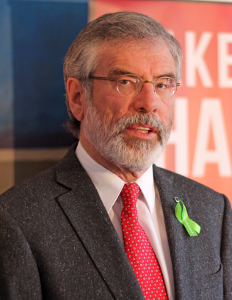
Adams has been the president of Sinn Féin since 1983. Since that time the party has become the third-largest party in the Republic of Ireland, the second-largest political party in Northern Ireland and the largest Irish nationalist party in that region. In 1984, Adams is seriously wounded in an assassination attempt by several gunmen from the Ulster Defence Association (UDA), including John Gregg. From the late 1980s onwards, Adams is an important figure in the Northern Ireland peace process, initially following contact by the then-Social Democratic and Labour Party (SDLP) leader John Hume and then subsequently with the Irish and British governments.
In 1986, Sinn Féin, under Adams, changes its traditional policy of abstentionism towards the Oireachtas, the parliament of the Republic of Ireland, and later takes seats in the power-sharing Northern Ireland Assembly. In 2005, the Provisional Irish Republican Army (IRA) states that its armed campaign is over and that it is exclusively committed to democratic politics.
In September 2017, Adams says Sinn Féin will begin a “planned process of generational change” after its November ardfheis and will allow his name to go forward for a one-year term as Uachtaran Shinn Fein (President Sinn Fein).
Wellesley rises to prominence as a general during the Peninsular War of the Napoleonic Wars and is promoted to the rank of field marshal after leading the allied forces to victory against the First French Empire at the Battle of Vitoria in 1813. Following Napoleon’s exile in 1814, he serves as the ambassador to France and is granted a dukedom. During the Hundred Days in 1815, he commands the allied army which, together with a Prussian army under Gebhard Leberecht von Blücher, defeats Napoleon at Waterloo. Wellesley’s battle record is exemplary, and he ultimately participates in some 60 battles during the course of his military career.
Wellesley is famous for his adaptive defensive style of warfare, resulting in several victories against numerically superior forces while minimising his own losses. He is regarded as one of the greatest defensive commanders of all time, and many of his tactics and battle plans are still studied in military academies around the world.
Wellesley dies at Walmer Castle in Deal, Kent, his residence as Lord Warden of the Cinque Ports, on September 14, 1852. He is found to be unwell on that morning and is aided from his military campaign bed, the same one he used throughout his historic military career and seated in his chair where he dies. His death is recorded as being due to the aftereffects of a stroke culminating in a series of seizures.
Although in life Wellesley hates travelling by rail, his body is taken by train to London, where he is given a state funeral, one of only a handful of British subjects to be honoured in that way, and the last heraldic state funeral to be held in Britain. The funeral takes place on November 18, 1852. He is buried in a sarcophagus of luxulyanite in St. Paul’s Cathedral next to Horatio Nelson, 1st Viscount Nelson.
Fortescue serves as High Sheriff of Louth in 1746. He represents Louth in the Irish House of Commons from 1745 to 1760 and subsequently Monaghan Borough from 1761 to 1770. He tries unsuccessfully in the 1760s to introduce a bill “to preserve partridges and hares and to take away the lives of above half the dogs in the nation.” In 1768 he briefly sits as Member of Parliament for Dundalk before opting to sit for Monaghan Borough, for which he has also been elected.
He marries Frances Cairnes Murray, daughter and coheiress of Colonel John Murray, MP for County Monaghan. They have an only daughter, Louisa. On his death his Earldom of Clermont and 1770 Barony of Clermont become extinct whilst his Viscountcy and 1776 Barony of Clermont are inherited by a nephew, William Charles Fortescue, who had been MP for Louth (Parliament of Ireland constituency) and then Louth (UK Parliament constituency) since 1796.
Bodkin is the eldest son of Matthias McDonnell Bodkin, a nationalist journalist, judge and Member of Parliament. Graduating from the Royal University of Ireland in 1908 he practises law from 1911 until 1916 while collecting art privately, influenced by his uncle Sir Hugh Lane. With the death of Lane in the sinking of the RMS Lusitania in 1915, Bodkin is charged with ensuring that Lane’s collection of art is displayed in Dublin, a dispute that would only finally be settled in 1957 and about which Bodkin is to write Hugh Lane and his Pictures in 1932.
Bodkin leaves the legal profession in 1916 to become a Governor of the National Gallery of Ireland, being appointed Director in 1927. He also serves in 1926 on the committee that commissions the design of the new coinage of the Republic of Ireland from Percy Metcalfe.
In 1935 Bodkin leaves Ireland upon being appointed Director of the newly established Barber Institute of Fine Arts and Barber Professor of Fine Art at the University of Birmingham. The funds available to the Barber Institute for the purchase of new works compare favourably even to some national museums and Bodkin is able to make a string of exceptional purchases in the depressed art market around the time of World War II. The collection that in 1935 numbers just seven works, by 1939 holds major pieces such as Tintoretto‘s Portrait of a Youth (1554), Simone Martini‘s St. John the Evangelist (1320), Nicolas Poussin‘s Tancred and Erminia (1634) and James Abbott McNeill Whistler‘s Symphony in White No. III (1867). Bodkin retires in 1952 but retains control over acquisitions until 1959. His successor as Director and Professor, Ellis Waterhouse, wistfully refers to Bodkin’s wayward later purchases as “Acts of Bod.”
Bodkin is also an active broadcaster and author, publishing personal reminiscences and translations of modern French poetry as well as works of art history and criticism. In particular, his The Approach to Painting (1927), an introduction for a popular audience, runs through many editions over the succeeding thirty years.
Bodkin is awarded the Civil Division of the Order of St. Gregory the Great for services to his church. A bust of Bodkin, previously exhibited at the Royal Academy in 1958, is donated to the Barber Institute of Fine Arts by its sculptor, Sir Charles Wheeler, President of the Royal Academy and a personal friend of Bodkin’s, on the latter’s death.
Bodkin is the subject of This Is Your Life in March 1960 when he was surprised by Eamonn Andrews at the BBC’s Costa Green Studios in Birmingham.
Thomas Bodkin dies in Birmingham, England on April 24, 1961. His remains are interred in Glasnevin Cemetery, Dublin.
Born Charles William St. John Burgess, Brugha is the tenth of fourteen children and is educated at the JesuitBelvedere College but is forced to leave at the age of sixteen because of the failure of his father’s business.
In 1899 Brugha join the Gaelic League, and he subsequently changes his name from Charles Burgess to Cathal Brugha. He meets his future wife, Kathleen Kingston, at an Irish class in Birr, County Offaly and they marry in 1912. They have six children, five girls and one boy. Brugha becomes actively involved in the Irish Republican Brotherhood (IRB) and in 1913 he becomes a lieutenant in the Irish Volunteers. He leads a group of twenty Volunteers to receive the arms smuggled into Ireland in the Howth gun-running of 1914.
He is second-in-command at the South Dublin Union under Commandant Éamonn Ceannt in the Easter Rising of 1916. On the Thursday of Easter Week, being badly wounded, he is unable to leave when the retreat is ordered. Brugha, weak from loss of blood, continues to fire upon the enemy and is found by Eamonn Ceannt singing “God Save Ireland” with his pistol still in his hands. He is initially not considered likely to survive. He recovers over the next year but is left with a permanent limp.
Brugha is elected speaker of Dáil Éireann at its first meeting on January 21, 1919, and he reads out the Declaration of Independence in Irish, which ratifies “the establishment of the Irish Republic.” On the following day, he is appointed president of the ministry pro tempore. He retains this position until April 1, 1919, when Éamon de Valera takes his place.
Brugha has differences with Michael Collins, who, although nominally only the IRA’s Director of Intelligence, has far more influence in the organisation as a result of his position as a high-ranking member of the Irish Republican Brotherhood, an organisation that Brugha sees as undermining the power of the Dáil and especially the Ministry for Defence. Brugha opposes the oath of allegiance required for membership of the IRB and, in 1919, his proposition that all Volunteers should swear allegiance to the Irish Republic and the Dáil is adopted.
At a top-level IRA meeting in August 1920, Brugha argues against ambushes of Crown forces unless there is first a call to surrender, but it is dismissed as unrealistic by the brigade commanders present. Brugha also has the idea of moving the front line of the war to England but is opposed by Collins.
In the months between the Treaty debates and the outbreak of Civil War, Brugha attempts to dissuade his fellow anti-treaty army leaders including Rory O’Connor, Liam Mellows and Joe McKelvey from taking up arms against the Free State. When the IRA occupies the Four Courts, he and Oscar Traynor call on them to abandon their position. When they refuse, Traynor orders the occupation of the area around O’Connell Street in the hope of easing the pressure on the Four Courts and of forcing the Free State to negotiate.
On June 28, 1922, Brugha is appointed commandant of the forces in O’Connell Street. The outbreak of the Irish Civil War ensues in the first week of July when Free State forces commence shelling of the anti-treaty positions.
Most of the anti-Treaty fighters under Oscar Traynor escape from O’Connell Street when the buildings they are holding catch fire, leaving Brugha in command of a small rearguard. On July 5, he orders his men to surrender but refuses to do so himself. He then approaches the Free State troops, brandishing a revolver. He sustains a bullet wound to the leg which severs a major artery.
Cathal Brugha dies on July 7, 1922, eleven days before his 48th birthday. He has been re-elected as an anti-Treaty Teachta Dála (TD) at the 1922 Irish general election but dies before the Dáil assembles. He is buried in Glasnevin Cemetery.
Burke receives his early education at a Quaker school in Ballitore, County Kildare. In 1744, he enters Trinity College, Dublin, a Protestant establishment, which up until 1793, did not permit Catholics to take degrees. He graduates from Trinity in 1748. Burke’s father wants him to read Law, and with this in mind he goes to London in 1750, where he enters the Middle Temple, before soon giving up legal study to travel in Continental Europe. After eschewing the Law, he pursues a livelihood through writing.
Burke criticizes British treatment of the American colonies, including through its taxation policies. He also supports the American Revolution, believing both that it could not affect British or European stability and would be an innovative experiment in political development since the Americas are so far away from Europe and thus could have little impact on England.
Burke is remembered for his support for Catholic emancipation, the impeachment of Warren Hastings from the East India Company, and for his later opposition to the French Revolution. In his Reflections on the Revolution in France, he claims that the revolution is destroying the fabric of good society and condemned the persecution of the Catholic Church that results from it. This leads to his becoming the leading figure within the conservative faction of the Whig Party, which he dubs the “Old Whigs,” as opposed to the pro–French Revolution “New Whigs” led by Charles James Fox.
For more than a year prior to his death, Burke realizes that his “stomach” is “irrecoverably ruind.” Edmund Burke dies in Beaconsfield, Buckinghamshire, on July 9, 1797, and is buried there alongside his son and brother. His wife, Mary Jane Nugent, survives him by nearly fifteen years.
In the nineteenth century Burke is praised by both conservatives and liberals. Subsequently, in the twentieth century, he becomes widely regarded as the philosophical founder of modern conservatism.





 seamus dubhghaill