seamus dubhghaill

Promoting Irish Culture and History from Little Rock, Arkansas, USA


Leave a comment

Death of Irish Language Writer Máirtín Ó Cadhain

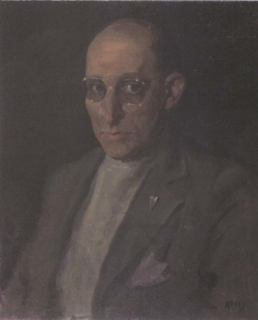
Máirtín Ó Cadhain, one of the most prominent Irish language writers of the twentieth century, dies on October 18, 1970. Perhaps best known for his 1949 work Cré na Cille, Ó Cadhain plays a key role in bringing literary modernism to contemporary Irish language literature.

Born in Connemara, County Galway, Ó Cadhain becomes a schoolteacher but is dismissed due to his membership in the Irish Republican Army (IRA). In the 1930s he serves as an IRA recruiting officer, enlisting fellow writer Brendan Behan, and participates in the land campaign of the native speakers, which leads to the establishment of the Ráth Cairn neo-Gaeltacht in County Meath. Subsequently, he is arrested and interned in the Curragh Camp in County Kildare during the Emergency years due to his continued involvement in the violent activities of the IRA.

Ó Cadhain’s politics are a nationalist mix of Marxism and social radicalism tempered with a rhetorical anti-clericalism. In his writings concerning the future of the Irish language he is, however, practical about the position of the Catholic Church as a social and societal institution, craving rather for a wholehearted commitment to the language cause even among Catholic churchmen. It is his view that, as the Church is there anyway, it would be better if it were more willing to address the Faithful in the national idiom.

As a writer, Ó Cadhain is acknowledged to be a pioneer of Irish language modernism. His Irish is the dialect of Connemara, but he is happy to cannibalise other dialects, classical literature and even Scottish Gaelic for the sake of linguistic and stylistic enrichment of his own writings. Consequently, much of what he writes is reputedly hard to read for a non-native speaker.

Ó Cadhain is a prolific writer of short stories. His collections of short stories include Cois Caoláire, An Braon Broghach, Idir Shúgradh agus Dháiríre, An tSraith Dhá Tógáil, An tSraith Tógtha and An tSraith ar Lár. He also writes three novels, of which only Cré na Cille is published during his lifetime. The other two, Athnuachan and Barbed Wire, appear in print only recently. He translates Charles Kickham‘s novel Sally Kavanagh into Irish as Saile Chaomhánach, nó na hUaigheanna Folmha. He also writes several political or linguo-political pamphlets. His political views can most easily be discerned in a small book about the development of Irish nationalism and extremism since Theobald Wolfe Tone, Tone Inné agus Inniu. In the early 1960s he writes, partly in Irish, partly in English, a comprehensive survey of the social status and actual use of the language in the west of Ireland, published as An Ghaeilge Bheo – Destined to Pass. In August 1969 he delivers a speech, published as Gluaiseacht na Gaeilge: Gluaiseacht ar Strae, in which he speaks of the role Irish speakers should take in ‘Athghabháil na hÉireann’, or the Re-Conquest of Ireland as James Connolly first coins the term.

He and Diarmaid Ó Súilleabháin are considered the two most innovative Gaelic authors to emerge in the 1960s. He has frequent difficulties to get his work edited, but unpublished writings have appeared at least every two years since the publication of Athnuachan in the mid-nineties.

Máirtín Ó Cadhain dies on October 18, 1970, in Dublin and is buried in Mount Jerome Cemetery.

A lecture hall at Trinity College, Dublin is named after Ó Cadhain who was professor of Irish. A bronze bust is also located in the Irish department.


Leave a comment

Samuel Beckett Awarded the 1969 Nobel Prize for Literature

samuel-beckett

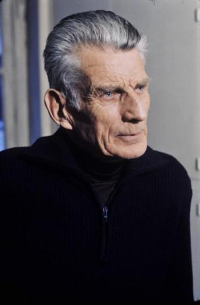
Samuel Barclay Beckett, Irish avant-garde novelist, playwright, theatre director, and poet, is awarded the Nobel Prize in Literature on October 23, 1969. Beckett lives in Paris for most of his adult life and writes in both English and French. He is widely regarded as among the most influential writers of the 20th century. He is elected Saoi of Aosdána in 1984.

Beckett’s work offers a bleak, tragicomic outlook on human existence, often coupled with black comedy and gallows humour, and becomes increasingly minimalist in his later career. He is considered one of the last modernist writers, and one of the key figures in what Martin Esslin calls the “Theatre of the Absurd.” Waiting for Godot is generally regarded as his best-known play.

In October 1969 while on holiday in Tunis with his wife Suzanne, Beckett hears that he has won the Nobel Prize for Literature. Anticipating that her intensely private husband would be saddled with fame from that moment on, Suzanne calls the award a “catastrophe.” In true ascetic fashion, he gives away all of the prize money. While Beckett does not devote much time to interviews, he sometimes meets the artists, scholars, and admirers who seek him out in the anonymous lobby of the Hotel PLM St. Jacques in Paris near his Montparnasse home. Although Beckett is an intensely private man, a review of the second volume of his letters by Roy Foster in the December 15, 2011 issue of The New Republic reveals Beckett to be not only unexpectedly amiable but frequently prepared to talk about his work and the process behind it.

Confined to a nursing home and suffering from emphysema and possibly Parkinson’s disease, Beckett dies on 22 December 22, 1989, just five months after the passing of Suzanne. The two are interred together in the Cimetière du Montparnasse in Paris and share a simple granite gravestone that follows Beckett’s directive that it should be “any colour, so long as it’s grey.”

Of all the English-language modernists, Beckett’s work represents the most sustained attack on the realist tradition. He opens up the possibility of theatre and fiction that dispense with conventional plot and the unities of time and place in order to focus on essential components of the human condition.

On December 10, 2009, a new bridge across the River Liffey in Dublin is opened and named the Samuel Beckett Bridge in his honour. Reminiscent of a harp on its side, it is designed by the celebrated Spanish architect Santiago Calatrava, who also designed the James Joyce Bridge further upstream. The newest ship of the Irish Naval Service, the LÉ Samuel Beckett (P61), is named for Beckett. An Ulster History Circle blue plaque in his memory is located at Portora Royal School, Enniskillen, County Fermanagh.


Leave a comment

The Death of James Augustine Aloysius Joyce

james-joyce

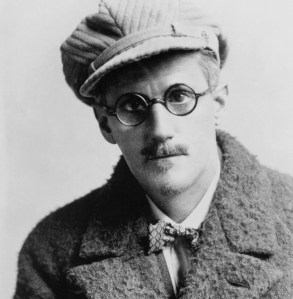
James Augustine Aloysius Joyce, considered to be one of the most influential writers in the modernist avant-garde of the early 20th century, dies in Zurich, Switzerland, following surgery for a perforated ulcer on January 13, 1941.

Joyce is born on February 2, 1882, in the wealthy Rathgar suburb of Dublin. The family is initially well off as Dublin merchants with bloodlines that connected them to old Irish nobility in the country. James’ father, John Stanislaus Joyce, is a fierce Irish Catholic patriot and his political and religious influences are most evident in Joyce’s two key works A Portrait of the Artist as a Young Man (1916) and Ulysses (1922).

The Joyce family is repeatedly forced to move to more modest residences due to their steadily diminishing wealth and income. John Joyce’s habitual unemployment as well as his drinking and spending habits make it difficult for the Joyces to retain their social standing. As a young man, Joyce is sent away to the renowned Clongowes Wood College in County Kildare in 1888, a Jesuit institution regarded as the best preparatory school in Ireland. The Clongowes school figures prominently in Joyce’s work, specifically in the story of his recurring character Stephen Dedalus. Joyce earns high marks both at the Clongowes School and at Belvedere College in Dublin where he continues his education. At this point in his life, it seems evident that Joyce is to enter the priesthood, a decision that would please his parents. However, as Joyce makes contact with various members of the Irish Literary Renaissance, his interest in the priesthood wanes. Joyce becomes increasingly critical of Ireland and its conservative elements, especially the Church.

Against his mother’s wishes, Joyce leaves Ireland in 1902 to pursue a medical education in Paris and does not return until the following year upon receiving news of his mother’s debilitation and imminent death. After burying his mother, Joyce continues to stay in Ireland, working as a schoolteacher at a boys’ school, another autobiographical detail that recurs in the story of Stephen Dedalus. After barely spending a year in Dublin, Joyce returns to the Continent, drifting in and out of medical school in Paris before taking up residence in Zurich. It is during this period that Joyce begins writing professionally.

In 1905, Joyce completes a collection of eight stories entitled Dubliners, although it is not actually printed until 1913. During these frustrating and impoverished years, Joyce heavily relies upon the emotional support of Nora Barnacle, his unmarried Irish lover, as well as the financial support of his younger brother, Stanislaus Joyce. Both Nora and Stanislaus remain as protective, supporting figures for the duration of Joyce’s life. During the eight years between Dubliners‘ completion and publication, Joyce and Barnacle have two children, a son named Giorgio, and a daughter named Lucia.

Joyce’s next major work, A Portrait of the Artist as a Young Man, appears in serialized form in 1914 and 1915. Joyce is “discovered” by Ezra Pound and the complete text is printed in New York City in 1916, and in London in 1917. It is with the assistance of Pound, a prominent literary figure of the time, that Joyce comes into contact with Harriet Shaw Weaver, who serves as both editor and patron while Joyce writes Ulysses.

When Ulysses is published in Paris in 1922, many immediately hail the work as genius. With his inventive narrative style and engagement with multiple philosophical themes, Joyce has established himself as a leading Modernist. The novel charts the passage of one day, June 16, 1904, as depicted in the life of an Irish Jew named Leopold Bloom, who plays the role of a Ulysses by wandering through the streets of Dublin. Despite the fact that Joyce is writing in self-imposed exile, living in Paris, Zurich, and Trieste while writing Ulysses, the novel is noted for the incredible amount of accuracy and detail regarding the physical and geographical features of Dublin.

Similar in theme to Joyce’s previous works, Ulysses examines the relationship between the modern man and his myth and history, focusing on contemporary questions of Irish political and cultural independence, the effects of organized religion on the soul, and the cultural and moral decay produced by economic development and heightened urbanization. While Joyce is writing it, there is serious doubt as to whether Ulysses will be completed. Midway through his writing, Joyce undergoes the first of eleven eye operations to salvage his ever-worsening eyesight. At one point, a disappointed Joyce casts the bulk of his manuscript into the fire, but Nora Barnacle immediately rescues it.

While Ulysses is hailed by some, the novel is banned in both the United Kingdom and the United States on obscenity charges. It is not until 1934 that Random House wins a court battle that grants permission to print and distribute Ulysses in the United States. The novel is legalized in Britain two years later.

By this time, Joyce is approaching the end of his public career and has concluded work on his final novel, Finnegan’s Wake (1939). Considered to be far more baffling and convoluted than Ulysses, Finnegan’s Wake is a critical failure. At the outbreak of World War II, Joyce remains in Paris until he is forced to move, first to Vichy, and then to Switzerland. On January 13, 1941, Joyce dies of a stomach ulcer at the age of 58 and is buried in Zurich’s Fluntern Cemetery.