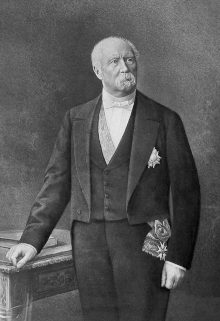
Patrice de MacMahon, a descendant of an Irish family, resigns as president of France on January 30, 1879, and retires to private life. His resignation comes after he dissolves the Chamber of Deputies, resulting in public outrage and a Republican electoral victory earlier in the month.
Born Marie Edme Patrice Maurice de MacMahon on July 13, 1808, in Sully, France, he serves as Marshal of France and second president of the French Third Republic. During his presidency the Third Republic takes shape, the new constitutional laws of 1875 are adopted, and important precedents are established affecting the relationship between executive and legislative powers.
MacMahon begins his army career in 1827 in Algeria and distinguishes himself during the Siege of Constantine (1837) and in the Crimean War (1853–56). The climax of his military career comes in the Italian campaign of 1859, when his victory at Magenta results in his being created Duke of Magenta. In 1864 he becomes Governor General of Algeria. Commanding the I Army Corps in Alsace during the Franco-Prussian War (1870–71), he is wounded and defeated at the Battle of Wörth. After a short convalescence at Sedan, he is appointed head of the army of the French Third Republic, which defeats the Paris Commune revolt in May 1871.
When Adolphe Thiers resigns as president of the republic on May 24, 1873, French rightists turn to MacMahon as his successor. He is elected president the same day. On November 20, 1873, the National Assembly passes the Law of the Septennate, conferring upon him presidential power for seven years. He assumes his presidential duties somewhat reluctantly, for he dislikes publicity and lacks an understanding of the complex political issues of his day.
During MacMahon’s term the French Constitutional Laws of 1875 are promulgated. The National Assembly dissolves itself, and the elections of 1876 returns a large majority of republicans to the new chamber. The first crisis comes in December 1876, when the republican chamber compels him to invite the moderate republican Jules Simon to form a government. The conservative Senate disapproves of Simon because he had purged some rightist officials, and, on May 16, 1877, MacMahon posts a letter to Simon that is tantamount to dismissal. Premier Simon’s resignation precipitates the crise du seize mai. When MacMahon commissions conservative Albert de Broglie to form a ministry and wins the Senate’s assent to dissolve the chamber on June 25, 1877, the question of whether the President or Parliament would control the government is squarely posed.
The new elections to the chamber return a majority of republicans, and the de Broglie ministry is given a vote of “no confidence.” The succeeding ministry, headed by Gaëtan de Rochebouët, also collapses. By December 13, 1877, MacMahon gives in to the extent of accepting a ministry led by conservative republican Jules Dufaure and composed mostly of republicans. On January 5, 1879, the republicans gain a majority in the Senate, and MacMahon resigns on January 30. The constitutional crisis during his presidency is resolved in favour of parliamentary as against presidential control, and thereafter during the Third Republic the office of president becomes largely an honorific post.
From 1887 to 1893, MacMahon directs the Société de secours aux blessés militaires (S.S.B.M) – Rescue Society of Wounded Military, which in 1940 becomes the French Red Cross.
Ganly also studies painting in the Royal Hibernian Academy School where she has Margaret Clarke and Seán O’Sullivan as teachers. She is made an associate of the Royal Hibernian Academy (RHA) in 1928 and becomes a member in 1935 though, in 1969, resigns her membership in protest of the lack of young artists being given the opportunity to exhibit. In 1972 she is made an honorary member and returns.
Ganly is a representational artist and while known as a portrait artist, she also paints landscapes, interiors and may be best known for her still lifes. Some of her best works are portraits of her husband, her sister Ethel, her father, and her friend Sheila Pim. She illustrates the book-jackets of Sheila Pim’s works. She has many exhibitions, with the RHA and the Water Colour Society of Ireland. There is a retrospective of her life in 1998 at the Hugh Lane Gallery and her works are in the collections there. She is also in the collections of the Waterford Municipal Gallery, Crawford Art Gallery, Cork and in The National Self-Portrait Collection of Ireland. She is part of the 2014 exhibition ‘Irish Women Artists: 1870-1970.’
Ganly’s sister-in-law is Kitty Wilmer O’Brien with whom she often exhibits. She marries Andrew Ganly, a dental surgeon and writer with a strong involvement in theatre, in 1936. He dies in 1982. They have two children, Eoghan and Phillida.
Brigid Ganly dies on March 25,2002.
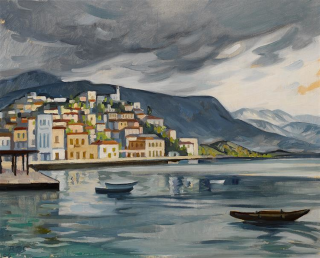
(Pictured: “Storm Over Poros” (1964) by Rosaleen Brigid Ganly, HRHA)
Brady leaves little record of his life before photography. Speaking to the press in the last years of his life, he states that he was born between 1822 and 1824 in Warren County, New York, near Lake George. He is the youngest of three children to Irish immigrant parents, Andrew and Samantha Julia Brady. In official documents before and during the war, however, he claims to have been born in Ireland.
At age 16, Brady moves to Saratoga, New York, where he meets portrait painter William Page and becomes Page’s student. In 1839, the two travel to Albany, New York, and then to New York City, where he continues to study painting with Page, and also with Page’s former teacher, Samuel F. B. Morse. Morse had met Louis-Jacques-Mandé Daguerre in France in 1839 and returned to the United States to enthusiastically push the new daguerreotype invention of capturing images. At first, Brady’s involvement was limited to manufacturing leather cases that hold daguerreotypes. But soon he becomes the center of the New York artistic colony that wishes to study photography. Morse opens a studio and offers classes. Brady is one of the first students.
In 1844, Brady opens his own photography studio at the corner of Broadway and Fulton Street in New York, and by 1845, he begins to exhibit his portraits of famous Americans, including the likes of Senator Daniel Webster and poet Edgar Allan Poe. In 1849, he opens a studio at 625 Pennsylvania Avenue in Washington, D.C., where he meets Juliet Handy, whom he marries in 1850 and lives with on Staten Island. His early images are daguerreotypes, and he wins many awards for his work. In the 1850s ambrotype photography becomes popular, which gives way to the albumen print, a paper photograph produced from large glass negatives most commonly used in American Civil War photography.
In 1850, Brady produces The Gallery of Illustrious Americans, a portrait collection of prominent contemporary figures. The album, which features noteworthy images including the elderly Andrew Jackson at the Hermitage, is not financially rewarding but invites increased attention to his work and artistry. In 1854, Parisian photographer André-Adolphe-Eugène Disdéri popularizes the carte de visite and these small pictures rapidly become a popular novelty, with thousands being created and sold in the United States and Europe.
At first, the effect of the American Civil War on Brady’s business is a brisk increase in sales of cartes de visite to departing soldiers. He readily markets to parents the idea of capturing their young soldiers’ images before they might be lost to war by running an ad in The New York Daily Tribune. However, he is soon taken with the idea of documenting the war itself. He first applies to an old friend, General Winfield Scott, for permission to have his photographers travel to the battle sites, and eventually, he makes his application to President Abraham Lincoln himself. Lincoln grants permission in 1861, with the proviso that Brady finances the project himself.
His efforts to document the American Civil War on a grand scale by bringing his photographic studio onto the battlefields earns Brady his place in history. His first popular photographs of the conflict are at the First Battle of Bull Run, in which he gets so close to the action that he barely avoids capture. While most of the time the battle has ceased before pictures are taken, he comes under direct fire at the First Battle of Bull Run, Petersburg, and Fredericksburg.
Brady also employs Alexander Gardner, James Gardner, Timothy H. O’Sullivan, William Pywell, George N. Barnard, Thomas C. Roche, and seventeen other men, each of whom is given a traveling darkroom, to go out and photograph scenes from the American Civil War. He generally stays in Washington, D.C., organizing his assistants and rarely visiting battlefields personally.
This may be due, at least in part, to the fact that Brady’s eyesight has begun to deteriorate in the 1850s. Many of the images in Brady’s collection are, in reality, thought to be the work of his assistants. He is criticized for failing to document the work, though it is unclear whether it is intentional or due simply to a lack of inclination to document the photographer of a specific image. Because so much of his photography is missing information, it is difficult to know not only who took the picture, but also exactly when or where it was taken.
In October 1862 Brady opens an exhibition of photographs from the Battle of Antietam in his New York gallery, titled The Dead of Antietam. Many images in this presentation are graphic photographs of corpses, a presentation new to America. This is the first time that many Americans see the realities of war in photographs, as distinct from previous “artists’ impressions.”
Brady, through his many paid assistants, takes thousands of photos of American Civil War scenes. Much of the popular understanding of the Civil War comes from these photos. There are thousands of photos in the U.S. National Archives and Records Administration and the Library of Congress taken by him and his associates. The photographs include Lincoln, Ulysses S. Grant, and soldiers in camps and battlefields. The images provide a pictorial cross reference of American Civil War history. He is not able to photograph actual battle scenes, as the photographic equipment in the day is still in the infancy of its technical development and requires that a subject be still for a clear photo to be produced.
Following the conflict, a war-weary public loses interest in seeing photos of the war, and Brady’s popularity and practice decline drastically.
During the war, Brady spends over $100,000 (equivalent to $1,691,000 in 2020) to create over 10,000 plates. He expects the U.S. government to buy the photographs when the war ends. When the government refuses to do so he is forced to sell his New York City studio and go into bankruptcy. The United States Congress grants Brady $25,000 in 1875, but he remains deeply in debt. The public was unwilling to dwell on the gruesomeness of the war after it has ended, and so private collectors are scarce.
Depressed by his financial situation and loss of eyesight and devastated by the death of his wife in 1887, Brady dies penniless in the charity ward of Presbyterian Hospital in New York City on January 15, 1896, from complications following a streetcar accident. His funeral is financed by veterans of the 7th New York Infantry Regiment. He is buried in the Congressional Cemetery, which is located in Barney Circle, a neighborhood in the Southeast quadrant of Washington, D.C.
Brady photographs 18 of the 19 American presidents from John Quincy Adams to William McKinley. The exception is the 9th President, William Henry Harrison, who dies in office three years before Brady starts his photographic collection. He photographs Abraham Lincoln on many occasions. His Lincoln photographs have been used for the $5 bill and the Lincoln penny. One of his Lincoln photos is used by the National Bank Note Company as a model for the engraving on the 90c Lincoln Postage issue of 1869.
(Pictured: “Mathew B. Brady,” oil on canvas by Charles Loring Elliott, 1857, Metropolitan Museum of Art, New York)
Lynch is born in Dublin on March 25, 1859. Her father, who is a committed, non-violent Fenian, dies when she is young. Her mother, Anna Theresa Calderwood, is married twice. She grows up in a very female house with her mother and ten sisters and half-sisters. Her stepfather is James Cantwell, also a Fenian, who runs the Star and Garter Hotel. After finishing school, she works as a sub-editor for a provincial paper and as a governess in Europe.
A nationalist like her father and stepfather, Lynch is an executive member of the Ladies’ Land League and as a result closely associates with Fanny Parnell. She writes extensively, producing short stories and satirical sketches, as well as Land War fiction, travel writing, translations and literary criticism. Her satirical pieces include “A Dublin Literary Coterie Sketched by a Non-Pretentious Observer” (1888) and “My Friend Arcanieva” (1895). She publishes William O’Brien‘s paper United Ireland from France, after it is suppressed in Ireland. She disagrees with William Butler Yeats on the literary merit of Emily Lawless, calling her work “highly polished literary stories.”
Lynch also writes fiction on the subject of political and cultural affairs in Ireland, sometimes meeting controversy. Her first novel, Through Troubled Waters (1885), is a fictionalised version of a real-life incident in Galway in which the daughters of a prosperous landowning family are murdered to make way for the sons to inherit the land. The novel also depicts the rural clergy as complicit, by denouncing the victims from the pulpit. The newspaper United Ireland strongly criticises the novel, claiming it peddles in anti-Irish stereotypes for a British audience. She responds by stating that she had intended the book for an Irish publisher and audience, and that she should not be asked “to prove my patriotism at the expense of truth.”
Lynch publishes across Ireland, the United Kingdom and from Paris. By 1896, she has settled in Paris, having also lived in both Spain and Greece. She speaks Greek and French. She then returns to lecture in Ireland and is a part of the salons of Paris in the Belle Époque as well as the Irish Literary Revival in Dublin. She is friends with the historian, biographer and literary critic Arvède Barine (pseudonym of Louise-Cécile Vincens), the writers Mabel and Mary Robinson, and the medievalist Gaston Paris. Her work however does not bring significant income, and she is forced to apply to the Royal Literary Fund for help on multiple occasions. Eventually it takes a toll on her health. She spends time in hospital in Margate, England in 1903.
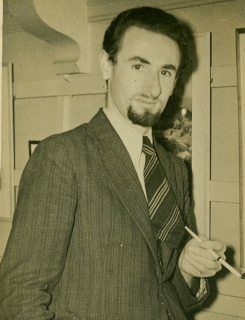
Patrick Anthony HennessyRHA, Irish realist painter known for his highly finished still lifes, landscapes and trompe-l’œil paintings, dies in London on December 30, 1980. The hallmark of his style is his carefully observed realism and his highly finished surfaces, the result of a virtuoso painting technique.
Hennessy is born in Cork, County Cork, on August 28, 1915. The son of John Hennessy an army sergeant major from County Kerry and Bridget Hennessy from Cork. His father is killed in World War I at the Battle of Passchendaele in 1917. In 1921, when he is five years old, his mother remarries in Cork. Her second husband is a Scot named John Duncan and shortly afterwards the whole family moves to Arbroath, Scotland, where Duncan has relatives.
Hennessy is educated in Arbroath at St. Thomas RC Primary School followed by secondary education at Arbroath High School, where he begins to show an aptitude for art, leaving in 1933 with the Dux for Art and an accompanying medal. In the autumn of 1933 he enrolls at the Dundee of Jordanstone College of Art & Design, for a four-year Diploma course in Drawing and Painting under James McIntosh Patrick and Edward Baird. Here he meets Harry Robertson Craig who becomes his lifelong companion. He plays a full part in the social activities of the college, winning a fancy dress award at the Christmas revels in 1935 and producing a ballet “Paradise Lost” the following year. He gains a First Class Pass in each year of the course along with winning first prize in 1934 and 1936 for work done during the summer vacation. He graduates with a First Class Distinction in 1937.
Having gained a scholarship, Hennessy continues his studies at the Dundee of Jordanstone College of Art & Design for a further year by doing a Post-Graduate Diploma course in Drawing and Painting. Within a month of gaining his Post-Graduate Diploma he holds his first joint exhibition at the Art Galleries in Arbroath. In June 1938 he is awarded the Annual Travelling Scholarship for further studies in Paris and Italy. In Paris he meets up with the artists Robert Colquhoun and Robert MacBryde, whom he had met the previous year, the three travelling south together to Marseilles towards the end of that year. On his return to Scotland he is selected for the residential summer school course at Hospitalfield House near Arbroath under James Cowie. Two of his paintings, a still life and a self-portrait, are accepted that year by the Royal Scottish Academy for their Annual Exhibition. However, by the autumn of 1939 with war looming and feeling somewhat disenchanted on his return to Scotland, he decides to return to Ireland.
On arrival in Dublin Hennessy is offered an exhibition in December 1939 at the Country Shop on St. Stephen’s Green which is opened by Mainie Jellett. This attracts favourable attention. During the early 1940s he lives at various addresses in and around Dublin with frequent trips to Cork. In 1940 he is invited to join the Society of Dublin Painters and holds regular annual exhibitions of his work there during the 1940s and early 1950s. These exhibitions are supplemented by an eclectic mix of commissions, mostly portraits which he undertakes during this period. In 1941 he has three of his paintings accepted by the Royal Hibernian Academy (RHA) for their annual exhibition. This is the beginning of a long relationship with the RHA. He exhibits there virtually every year from 1941 until 1979, the year before his death.
From the early 1940s onwards, Hennessey’s work sometimes incorporates a homosexual visual subtext. He re-unites with Harry Robertson Craig in 1946 and soon after they move to Crosshaven, County Cork, and later to Cobh. In 1947, Time magazine selects him as one of Ireland’s outstanding painters, in recognition of the important position he has then attained in the art world. In 1948 he has an exhibition at the Victor Waddington Gallery, Dublin, and that same year is elected an associate of the Royal Hibernian Academy and a full member the following year. In 1950 his painting De Profundis is selected for the Contemporary Irish Painting exhibition that tours North America. As a result of this tour, the American public and critics begin to take notice of his work. In 1951 he visits Italy, taking in Venice and Sicily and returning to Dublin with many of his canvases painted abroad. One of these paintings, Bronze Horses of St. Marks, is exhibited at the Royal Academy of Arts in London in 1954.
In 1956, a friend of Hennessy, David Hendriks, opens the Ritchie Hendriks Gallery on St. Stephen’s Green, Dublin and it is this gallery that is to be the main outlet for his work over the following 22 years. In October 1956 the Thomas Agnew Gallery in London holds an exhibition of his work comprising 38 of his paintings. However, during the winter of 1959 he becomes seriously ill with pneumonia. As a consequence of this, in the autumn of that year he and Craig decide to winter in Morocco. This is the beginning of a new era in both their lives. They would never again spend a full year in Ireland. His exhibitions at the Ritchie Hendriks Gallery had for many years enjoyed favourable reviews from the art critics but in the 1960s this changes with critics claiming his paintings to be dull, repetitive and suggest he needs to explore new areas. Despite the barrage of criticism, in 1965 the Guildhall Gallery in Chicago offers him a major exhibition. Shortly after this exhibition takes place in 1966 he becomes one of the artists on permanent display at the gallery with an annual exhibition. The North American market is extremely lucrative for him and by the end of the decade he is selling more of his work in the United States than in Ireland. In 1968 he finally moves to Tangier, Morocco on a permanent basis and in 1970 sells his studio on Raglan Lane, Dublin.
In Morocco, Hennessy paints prolifically for nine years to keep up with demand from the Hendriks Gallery and Guildhall Gallery along with the RHA. In 1975 the Guildhall Gallery mounts a highly successful Retrospective of his work. In 1978 he has his last exhibition in Dublin at the Hendriks Gallery. By this time he has moved to the Algarve, Portugal and is beginning to have health problems.
In November 1980, with his health deteriorating, Craig brings Hennessy to a hospital in London for treatment. However, on December 30, 1980 he dies from cancer. Following cremation his ashes are buried in nearby Golders Green Crematorium. He leaves his entire estate to Harry Robertson Craig with the proviso that on Craig’s death the Royal Hibernian Academy should be the beneficiary. This legacy has been used to set up the annual Hennessy Craig Scholarship for aspiring artists.
Hennessy falls into the category of painter who develops a distinctive personal style, labelled at various times in his life as a Traditional Realist, Romantic, Photo Realist, Illusionary and Surrealist. However, he always remains intrinsically himself. His subjects range from still life and interiors to landscapes and portraits.
Born into an Anglican family with a military tradition. Russell is intended for an ecclesiastical career in the Church of Ireland, but in 1783 sails with his brother’s regiment to India and fights at the battle of Cannanore. He is, however, disgusted by what he regards as “the unjust and rapacious conduct pursued by the authorities in the case of two native women,” and returns disaffected to Ireland in 1786. After briefly studying for the church ministry, he spends the next four years as a half-pay officer in Dublin pursuing studies of science, philosophy and politics.
In 1790, Russell meets Theobald Wolfe Tone in the visitors’ gallery of the Irish House of Commons and a lifelong friendship begins. At the end of the year, he is commissioned to Belfast as an ensign in the 64th infantry regiment of foot. Being convivial, good looking, charismatic and charming, he fits quickly into Belfast society. He is deeply religious and holds strong millennialist beliefs. On the other hand, he is also of a restless nature, drinks heavily, and is highly promiscuous.
Russell becomes a founder member of the first Society of United Irishmen in Belfast in 1791, writes for the Northern Star, and acts as secretary for the Dublin United Irishmen. He is the most socially radical of all United Irish leaders, an outspoken opponent of slavery and industrial exploitation.
Russell posts bail for a friend in order to secure his release from a debtor’s prison. When the friend defaults, Russell has to sell his ensigncy in July 1791. After several months, and to avoid further debt, he accepts the offer of Thomas Knox, 1st Viscount Northland, the father of an old army friend, to become seneschal (a kind of stipendiary magistrate) to the Northlands’ manor court at Dungannon. However, he resigns within a year, apparently disgusted by the sectarian animosities there. His financial situation worsens until he becomes librarian at the Belfast Society for Promoting Knowledge (the later Linen Hall Library) in 1794.
Russell is arrested on September 16, 1796, is charged with treason, and detained without trial in Newgate Prison, Dublin, until March 1799. He is then sent to Fort George in the north of Scotland. The longest serving United Irish prisoner, he is released in June 1802 on condition of exile to Hamburg. However, he soon makes his way to Paris where he meets Robert Emmet who, with William Putnam McCabe are advancing the plans for insurrection pending the French renewal of the war against England. Having little confidence in the French, however, he returns to Ireland in March 1803 to organise the North in conjunction with the veteran of the Battle of Antrim, James Hope. However, he meets with little success as much of the North is subdued following the suppression of the Irish Rebellion of 1798.
In 1803 Russell joins a general insurrection that is to take place throughout Ireland with blows being struck simultaneously at Dublin, Belfast, and Downpatrick. Unknown to him, Robert Emmet is unable to secure help and promised firearms. In Dublin after a brief street battle on the evening of July 23, 1803, Emmett calls off the rising.
Russell manages to hide for a number of weeks in Dublin but is caught in the authorities’ dragnet on September 9. He is sent under heavy escort to Downpatrick Gaol. There, convicted of high treason, he is hung and beheaded on October 12, 1803. His remains are buried in the graveyard of the parish church, Down Cathedral, in a grave paid for by his friend Mary Ann McCracken.
Pearse follows his brother into the Irish Volunteers and the republican movement. He takes part in the Easter Rising in 1916, always staying at his brother’s side at the General Post Office. Following the surrender, he is court-martialed and sentenced to death. It has been said that as he is only a minor player in the struggle it is his surname that condemns him. However, at his court martial he emphasizes his involvement.
On May 3, 1916, Pearse is granted permission to visit his brother in Kilmainham Gaol, to see him for the final time. However, while he is en route, Patrick is executed. He is executed on May 4. He and his brother are the only two brothers to be executed after the Easter Rising.
There are many more public commemorations of Patrick Pearse than of William. In 1966, Dublin’s Westland Row railway station is renamed Dublin Pearse railway station to honour both brothers. Pearse Square and Pearse Street in Dublin are renamed in honour of both, Pearse Street (then Great Brunswick Street) having been their birthplace. Many streets and roads in Ireland bear the name Pearse. Few name William, but there is a Pearse Brothers Park in Rathfarnham. The bridge over the River Dodder on the Rathfarnham Road, between Terenure and Rathfarnham is named after them and carries a plaque depicting the brothers in profile.
Brothers Pearse Athletic Club, founded in Rathfarnham, is named after the two brothers. A number of Gaelic Athletic Association clubs and playing fields are named after both Pearses, and at least one after William.
Wejchert was born in Kraków, Poland on October 16, 1921. Her father is Tedeusz Wejchert, who ran a shipping business out of Gdańsk. She enters University of Warsaw to study architecture in 1939, and while there witnesses the German invasion of Poland during World War II. Having graduated in 1949, she works as a town planner and architect in Warsaw, where she graduates from the Academy of Fine Arts in 1956 with a degree before moving to Italy.
Wejchert holds her first solo show in 1959 in the Galeria dell’ Obelisco, Rome. She then returns to Warsaw where she is featured in the National Museum “Fifteen years of Polish art” exhibition in 1961. At this time she is still working as an architect, but does not support the social realism of Soviet architecture, which leads her to decide to concentrate solely on art from 1963. She leaves communist Poland in 1964, when she accompanies her younger brother, the architect Andrej Wejchert, when he and his wife Danuta moved to Dublin.
She holds her first solo show in Dublin in November 1966 with an exhibition of 30 paintings at The Molesworth Gallery. In 1967 she shows Blue relief at the Irish Exhibition of Living Art, which is a wall relief of “sculpted paintings” which are precursors to her later free-standing sculpture. She wins the Carroll Open award of £300 at the 1968 Irish Exhibition of Living Art for Frequency No. 5. Also in 1968 she holds a solo exhibition in the Galerie Lamert, Paris, becoming a regular exhibitor there. During this period her work is used as a setting for an electronic music concert with the critic Dorothy Walker noting her designs have a rhythmic quality.
From the 1970s, Wejchert wins commissions for public art, starting with the 1971 wood and acrylic wall relief in the arts building at University College Dublin. In the same year, the Bank of Ireland purchases Blue form 1971 and then Flowing relief in 1972. Her 1971 triptych, Life, is commissioned for the Irish Life headquarters in Abbey Street. The Lombard and Ulster Bank in Dublin commissions untitled in 1980, and Allied Irish Banks (AIB) purchases Freedom in 1985 for their branch in Ballsbridge. Her entry wins a competition in 1975 for a stamp marking International Women’s Year, and features an image of hands reaching for a dove with an olive branch.
Wejchert becomes an Irish citizen in 1979, a member of Aosdána in 1981, and a member of the Royal Hibernian Academy (RHA) in 1995. She is recognised internationally when she is the only Irish sculptor included in Louis Redstone’s new directions (1981). She is shown at the Solomon gallery from 1989 numerous times, including a solo show in 1992. A number of her most important pieces are for Irish universities, such as Geometric form at the University of Limerick and Flame at the University College Cork in 1995, her last work.
Wejchert dies suddenly at her home on Tivoli Road, Dún Laoghaire on October 24, 1995. She has one son, Jacob. The RHA holds a posthumous exhibition of her work in 1995. She is said to have influenced the younger generation of Irish sculptors, including Vivienne Roche, Eilis O’Connell, and Michael Warren. Flame is selected to be a part of the Irish Artists’ Century exhibition at the RHA in 2000.
(Pictured: “Flame,” 1995, brass and granite, University College Cork. This sculpture commemorates the people who bequested their bodies to the UCC Anatomical Gift Programme for the purpose of science and learning. It represents the flame of knowledge which leads to the light of understanding.)
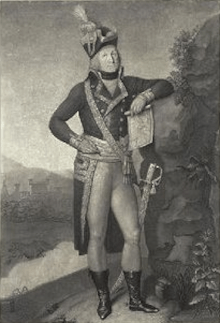
General Charles Edward Saul Jennings, Irish soldier and revolutionary who serves France in the eighteenth century and is sometimes romanticised as Brave Kilmaine, is born on October 19, 1751, in Sauls Court, Dublin.
Jennings is the second son of Theobald Jennings, a physician of Polaniran (Ironpool), Tuam, County Galway, and Eleonore Saul, daughter of Laurence Saul, a wealthy Dublin distiller. Educated privately in Dublin, he leaves Ireland in 1769, settling in Tonnay-Charente in the south of France, where his father had set up practice. His father had, several years previously, assumed the fictitious title of ‘baron of Kilmaine’ in the hope of improving his position in French society, and he subsequently assumes the same title.
In 1774 Jennings joins the Royal Dragoons as a trooper, transferring in 1778 into the Légion de Lauzun, a corps made up mostly of foreign volunteers. After the campaign in Senegal (1778–79) he returns to France and is commissioned as a sous-lieutenant. He then campaigns with Gilbert du Motier, Marquis de Lafayette, during the American Revolutionary War and teaches cavalry tactics at Metz on his return. Promoted to captain in 1788, at the outbreak of the French Revolution, he is stationed at Verdun and, despite a short period in prison, continues to serve with his regiment. In 1791, when several of the regiment’s officers flee from France, he remains and is one of the first officers to swear allegiance to the national assembly.
Promoted to Chef d’escadron in April 1792, Jennings serves under Charles François Dumouriez during the invasion of the Netherlands, distinguishing himself at the Battle of Valmy and the Battle of Jemappes, where he reinforces the French centre at a critical point, ensuring victory. A series of rapid promotions follow. He is made a colonel in January 1793, a general of brigade in March 1794, and a general of division in May1794.
After a series of reverses in the summer of 1793, in which the French lose the fortress-towns of Condé and Valenciennes, the committee of public safety appoints Jennings to command the Armée du Nord on May 15, 1793, with the rank of full general. In August, in order to preserve his force in the face of overwhelming opposition, he retreats from a position 120 miles north of Paris known as ‘Caesar’s camp.’ Although the allied army swings away to invest Dunkirk, he is arrested and imprisoned for endangering the city, and remains in prison until after the fall of Robespierre in July 1794. Within a few days, due to the turbulent political situation, he is rearrested and not released until December 1794. In May 1795 he cooperates with Napoléon Bonaparte in suppressing the Jacobin uprising in Faubourg Saint-Antoine in Paris and, having reestablished his credentials, commands the cavalry during the invasion of Italy (1796). Bonaparte regards him highly, and he distinguishes himself at the Battle of Lodi on May 10, 1796, seizing the city of Milan five days later. He defeats a large Austrian force in the Battle of Borghetto before investing and taking the fortress-town of Mantua in February 1797.
When peace terms are agreed with Austria, Jennings returns to France, taking command of the centre column of the Armée d’Angleterre, which had been raised to invade Britain and Ireland. However, his deteriorating health makes some observers question his suitability for such an appointment. An associate of Thomas Paine and James Napper Tandy, and a friend of Wolfe Tone, he is forced to watch the gradual reduction of his army as Napoleon diverts troops for his campaign in Egypt. Tone is at first suspicious of him, given that many Irish-born French officers had deserted the revolutionary cause but comes to admire him.
After the defeat of Admiral Bombard’s expedition to Ireland and Tone’s arrest on November 3, 1798, Jennings requests that the French government should take a senior British prisoner as hostage and subject him to the same treatment as Tone. After Tone’s death he assists Matilda Tone and her children. In early 1799 he is appointed military governor of Switzerland but is forced to resign due to his failing health.
In a fragile condition Jennings leaves Switzerland and returns to Passy in Paris, where his domestic griefs and chagrins add to the poignancy of his bodily sufferings, for his constitution is now completely broken up. He dies of dysentery on December 11, 1799, at the age of 48. He is buried with full military honours.
Jennings is historically honored at the Arc de Triomphe in Paris, where his name can be seen on the inside triumphal arch, on the Northern pillar, Column 05. Underneath the Arc is the Tomb of the Unknown Soldier (World War I). There is a personal portrait of Jennings in the ‘Hotel de Ville’ (City Hall) at Tonnay-Charente, where his father Dr. Theobald Jennings practiced as a physician.
A monument was erected in Jennings’s memory in Tonnay-Charente in the 19th century. Rue du Général Kilmaine, a street in Tonnay-Charente, is named in his honour in the 19th century.
Cyril James Cusack, Irish actor who appears in numerous films and television productions in a career lasting more than 70 years, dies in Chiswick, London, England on October 7, 1993. In 2020, he is listed at number 14 on The Irish Times‘s list of Ireland’s greatest film actors.
Cusack is born in Durban, Natal, South Africa, on November 26, 1910. His mother, Alice Violet (née Cole), is an English Cockney actress and chorus girl, and his father, James Walter Cusack, is an Irish mounted policeman in the Colony of Natal, South Africa. His parents separate when he is young and his mother takes him to England, and then to Ireland. His mother and her partner, Brefni O’Rorke, join the O’Brien and Ireland Players.
Cusack makes his first stage performance at the age of seven. He is educated at Newbridge College in Newbridge, County Kildare, then reads law at University College Dublin. He leaves without a degree and joins the Abbey Theatre in 1932. Between then and 1945, he performs in over 60 productions, particularly excelling in the plays of Seán O’Casey. He also performs Irish playwright Teresa Deevy‘s plays Katie Roche and The King of Spain’s Daughter. In 1932 he also joins the Gate Theatre company, appearing with them in many notable productions over the years. In 1947, he forms his own company and stages productions in Dublin, Paris and New York.
In 1963, Cusack joins the Royal Shakespeare Company in London and appears there for several seasons. By this stage he has established a successful career in films, which had started at the age of eight. Also in 1963, he wins a Jacob’s Award for his performance in the Telefís Éireann production of Triptych. He receives honorary degrees in 1977 and 1980 from the National University of Ireland (NUI) and the University of Dublin respectively.
Cusack, who is bilingual in English and Irish, has a leading role in the controversial Irish language film Poitín (1977). He is also offered the role of the First Doctor in Doctor Who.
Cusack’s last stage performance is in Anton Chekhov‘s Three Sisters (1990), in which three of his daughters play the sisters.
Cusack is twice married, firstly to Mary Margaret “Maureen” Kiely (1920–1977), on April 5, 1945. Together they have five children: Paul (1946), Sinéad (1948), Sorcha (1949), Niamh (1959), and Pádraig (1962). He and his second wife, Mary Rose Cunningham (1979–1993), have one daughter, Catherine (1968).
In later life, Cusack becomes a campaigner for conservative causes in Ireland, notably in his opposition to abortion, where he becomes a frequent letter-writer to the main liberal Irish newspaper, The Irish Times. Regarding his Catholic faith, he comments “Religion promotes the divine discontent within oneself, so that one tries to make oneself a better person and draw oneself closer to God.” His religious credentials come under scrutiny following his death and the revelation that he had been unfaithful in his first marriage, with a long-term mistress, Mary Rose Cunningham. He marries Cunningham following his first wife’s death.
On October 7, 1993, Cusack dies at the age of 82 at home in Chiswick, Greater London, from amyotrophic lateral sclerosis (ALS). His acting career had lasted 75 years.