Pery is the son of William Cecil Pery, 1st Baron Glentworth, and his first wife, Jane Walcott, daughter of John Minchin Walcott. He is educated at Trinity College Dublin (TCD). He marries Alice Mary Ormsby, the daughter of Henry Ormsby of County Mayo, by his wife Mary Hartstonge, in 1783, and they have at least eight children. Alice Mary is the heiress of her uncle, Sir Henry Hartstonge, 3rd Baronet, who leaves her substantial property in the south of Ireland.
Pery is elected to the Parliament of Ireland as the Member of Parliament for Limerick City in 1786 and holds the seat until 1794, when he inherits his father’s barony and takes his seat in the Irish House of Lords. As a politician, he is a vocal Unionist. He holds the office of Keeper of the Signet and Privy Seal of Ireland between 1795 and 1797. In 1797, he is invested as a Privy Counsellor. He subsequently holds the office of Clerk of the Crown and Hanaper of Ireland between 1797 and 1806. In 1800, he is created Viscount Limerick of the City of Limerick.
Pery’s eldest son and heir, Henry Hartstonge Pery, Viscount Glentworth, predeceases him on August 7, 1834, and thus Pery is succeeded in his titles by Henry’s eldest son, William Henry Tenison Pery. One of Pery’s daughters, Theodosia, marries the Whig politician and Chancellor of the Exchequer, Thomas Spring Rice, 1st Baron Monteagle of Brandon.
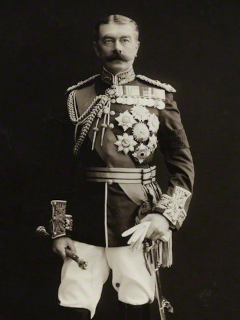
Kitchener is the second son of Lieutenant Colonel Henry Horatio Kitchener and his first wife, Frances Anne (née Chevallier), daughter of clergyman John Chevallier. Col. Kitchener resigns his commission in 1849 and purchases Ballygoghlan House estate near Tarbert, County Kerry, in early 1850 under the provisions of the Encumbered Estates Act of 1849. Ballygoghlan House is in a state of disrepair, however, and the family lives in Gunsborough Villa until the end of 1850. In 1857, Col. Kitchener purchases Crotta House, near Kilflynn, County Kerry, and the Kitcheners divide their time between the two residences. While innovative and successful in his agricultural methods, Col. Kitchener is harsh towards his tenants and, after carrying out many evictions, becomes extremely unpopular in the area. He is a rigid disciplinarian and occasionally punishes his son severely.
Although Kitchener attends Ballylongford village school, his education is largely neglected. When examined by his cousin Francis Elliot Kitchener, fellow of Trinity College Dublin (TCD), he is found to have only the most rudimentary knowledge of grammar and arithmetic. Education by private tutors follows. In 1864, his father sells his Irish estates and moves to Switzerland for the sake of his wife’s health. After further private tuition, he passes into the Royal Military Academy, Woolwich, in 1868, and is commissioned into the Royal Engineers in December 1870.
Kitchener begins his career on survey missions and carries out such work in Palestine (1874–78) and Cyprus (1878–82). He then enters the Egyptian Army and takes part in the Sudan campaign of 1883–85, organised to relieve Genral Charles George Gordon. Subsequent appointments include governor of Suakin (1886–88), adjutant-general of the Egyptian Army (1888–92), and Sirdar (Commander-in-Chief) of the Egyptian Army (1892–96). After the Dongola Expedition in 1896, he is promoted to major-general. He commands the Khartoum Expedition of 1898, defeating Mahdist forces at Atbara and Omdurman, and is raised to the peerage.
At the outbreak of the Second Boer War in 1899, he is appointed chief of staff to Frederick Roberts, 1st Earl Roberts, and assumes total command, with the rank of lieutenant-general, in 1900. While acting as commander-in-chief in South Africa he reorganises the British forces and, using new tactics, manages finally to defeat the Boers. He is severely criticised in the world press for the conditions in the concentration camps where Boer families are confined, but is made a viscount, promoted to general, and awarded £50,000 by parliament at the end of the war.
Kitchener serves as commander-in-chief in India beginning in 1902, is promoted to Field Marshal in 1909, and is a member of the Committee of Imperial Defence (1910) and consul-general in Egypt (1911–14). At the outbreak of World War I he is made Secretary of State for War and begins to reorganise the British Army, an immense achievement, raising 1,700,000 men in service battalions by May 1915, creating an army of volunteers to reinforce the depleted regular army in Belgium and France. An archconservative, he totally opposes Home Rule for Ireland, and initially blocks plans by John Redmond for the formation of a southern Irish division from members of the National Volunteers. Convinced that an all-Irish brigade or division would be a security risk, he rejects Redmond’s suggestions in a meeting of August 1915 and originally proposes dispersing Irish recruits through the numerous regiments in the army. Impressed by Redmond’s persistence, and impelled by the recruiting crisis of late 1915, he finally reverses his decision and sanctions the establishment of the 16th (Irish) Division.
On June 5, 1916, Kitchener is making his way to Russia on HMS Hampshire to attend negotiations with Tsar Nicholas II when in bad weather the ship strikes a German mine 1.5 miles (2.4 km) west of Orkney, Scotland, and sinks. He is among 737 who perish. He is the highest-ranking British officer to die in action in the entire war.
Although he only spends his early years in Kerry, Kitchener occasionally returns to Ireland. While on leave in June 1910 he goes on a tour of County Kerry, visiting places connected to his childhood. There are numerous portraits and memorials to him in England, including a marble effigy by W. Reid Dick in St. Paul’s Cathedral in London and a statue by John Tweed in Horse Guards Parade, London. There is a commemorative bible in the Church of Ireland church at Kilflynn, County Kerry, where he regularly attended Sunday service as a boy. There are some Kitchener letters in the John Redmond papers in the National Library of Ireland.
(From: “Kitchener, Horatio Herbert” by David Murphy, Dictionary of Irish Biography, http://www.dib.ie, October 2009)
Guinness is born on November 10, 1847 at St. Anne’s, Clontarf, County Dublin, the youngest of three sons of Sir Benjamin Lee Guinness, brewer, of Dublin, and Elizabeth, third daughter of Edward Guinness of Dublin. He is not sent to public school but is taught at home by a private tutor before entering Trinity College Dublin, where he takes his degree in 1870. His father dies in 1868, leaving him a share in the brewery, and he takes over management of the business with his brother Arthur, who in 1876 sells his shares, making Edward sole proprietor.
Guinness is also prominent in municipal life, holding the offices of Sheriff of Dublin City in 1876 and High Sheriff of the County of Dublin in 1885, the year in which he is created a baronet. He is a brilliantly effective businessman, with close attention to detail and a focus solely on the brewery, to the extent of remaining independent from the rest of the brewing trade. In 1888 he bluntly tells the Country Brewers’ Association, “I have always declined to identify myself with any trade question, or to take any side in a controversy on the liquor question, and to this I must adhere.” In 1886 Guinness is floated as a public company, a superbly successful venture with applications for shares exceeding £100 million, and Edward remains as chairman until 1890, although his formal retirement in that year brings little reduction in his involvement with the company, and he continues to make the final decision on many minor matters as well as all major questions of policy.
Socially innovative, with a concern for the welfare of employees, from as early as 1870 Guinness establishes a free dispensary for his workforce and makes provisions for pension and other allowances – acts of social reform that are remarkable for the time. To mark his retirement in 1890 he places in trust £250,000 to be expended in the erection of working-class housing in London and Dublin. Both funds are administered from London until 1903, when the Dublin fund is amalgamated by the Iveagh Trust act with other schemes carried out in Dublin by Edward, who had been raised to the peerage of the United Kingdom in 1891 as Baron Iveagh of Iveagh, County Down. The funds, which increase considerably from the original amount, are thereafter managed entirely in Dublin as a separate undertaking under the name of the Iveagh Trust, still in existence in the early twenty-first century.
As one of the pioneers of the voluntary housing movement Guinness is essentially carrying on the tradition of “merchant prince and city father” established by his father and shared by his brother. Wealthy, ambitious, and resolutely unionist, he gives generous financial support to the Irish Unionist Alliance, and is also public-spirited, religious, and devoted to duty. Acknowledging that the Iveagh Trust is essentially ameliorative, he believes that major social change will only be achieved if numerous other wealthy people follow his example. He insists that gifts of money from the fund are permissible only to assist individuals to improve their condition “without placing them in the position of being the recipients of a bounty.” Numerous other philanthropic donations follow, including another £250,000 for slum clearance in the Bull Alley district of Dublin; various contributions to Dublin hospitals, particularly in 1903 and 1911 on the occasion of royal visits; and in 1907 the opening of the Iveagh Markets, situated in the Francis Street and Patrick Street areas of Dublin, are made possible with his financial backing. Generous contributions are also made to Trinity College Dublin, of which he is elected chancellor in 1908, and he donates land in Iveagh Gardens to University College Dublin (UCD).
In 1905 Guinness is raised to a viscountcy and in September 1909 the nationalist corporation of Dublin presents him with an address of thanks for his many gifts, and even discusses the possibility of offering him the lord mayoralty of the city, which he declines owing to his political affiliations. By this time he lives chiefly in England, having bought Elveden Hall in Suffolk, where he frequently entertains royalty. He also purchases Lord Kensington’s London estate and makes many donations to medical research societies in England, and in conjunction with Sir Ernest Cassel he founds the London Radium Institute, as well as donates £250,000 to the Laster Institute of Tropical Medicine for the endowment of bacteriological research.
In 1919 Guinness is elevated to an earldom and in 1925 purchases the remainder of the Kenwood estate to the north of Hampstead Heath and arranges for it to become public property, ensuring the estate will not be sold for building purposes, and also bequeaths to the nation a valuable collection of art for use in the gallery at the same location. As well as being elected a fellow of the Royal Society, he is awarded honorary doctorates from the University of Dublin and the University of Aberdeen.
In 1873, Guinness marries his third cousin Adelaide Maud, nicknamed “Dodo.” She is descended from the banking line of Guinnesses, and is the daughter of Richard Samuel Guinness, barrister and MP, and his wife Katherine, a daughter of Sir Charles Jenkinson. They have three sons, the eldest of whom, Rupert Edward Cecil Lee, succeeds his father as 2nd Earl of Iveagh.
Guinness dies at his London home in Grosvenor Place on October 7, 1927, and is buried at Elveden, Suffolk. He leaves an estate valued at £11 million.
Sackville then enters the army. He is elected Grandmaster of the Grand Lodge of Ireland in 1751, serving in this post for two years. He marries Diana Sambrooke, daughter of John Sambrooke and Elizabeth Forester, on September 3, 1754. They have two sons and three daughters.
In 1747 and 1748, Sackville again joins the Duke of Cumberland. He becomes colonel of the 7th Irish horse and serves in Holland. There is a break in his military career between wars (1750-1755) when he serves as first secretary to his father.
In June 1758 Sackville is second in command of a British expedition led by Marlborough which attempts an amphibious Raid on St. Malo. While it fails to take the town as instructed, the raid is still considered to be largely successful as a diversion. Follow-up raids are considered against Le Havre, Caen and other targets in Normandy, but no further landings are attempted, and the force returns home. Later in 1758 they join the allied forces of Duke Ferdinand of Brunswick in Germany. When Marlborough dies, Sackville becomes Commander of the British contingent of the army, although still under the overall command of the Duke of Brunswick.
In the Battle of Minden on August 1, 1759, British and Hanoverian infantry of the centre make an advance on the French cavalry and artillery in that sector. As the disrupted French begin to fall back on Minden, Ferdinand calls for a British cavalry charge to complete the victory, but Sackville withholds permission for their advance repeatedly. For this action, he is cashiered and sent home. John Manners, Marquess of Granby, replaces him as commander of the British contingent for the remainder of the war.
Sackville refuses to accept responsibility for refusing to obey orders. Back in England, he demands a court-martial and makes it a large enough issue that he obtains his demand in 1760. The court finds him guilty, and the verdict not only upholds his discharge, but rules that he is “…unfit to serve His Majesty in any military Capacity whatever.” The king has his name struck from the Privy Council rolls.
Sackville is a Member of Parliament at intervals from 1733. He serves terms in both the Dublin and the Westminster bodies, sometimes simultaneously, but does not take sides in political wrangles. Between 1750 and 1755 he serves as Chief Secretary for Ireland, during his father’s second term as Lord Lieutenant of Ireland.
On November 10, 1775, Sackville is appointed Secretary of State for the Colonies replacing William Legge, 2nd Earl of Dartmouth in the post. He becomes a target for the opposition and is eventually persuaded to step down in exchange for a peerage, and in February 1782 he is made Baron Bolebrooke, in the County of Sussex, and Viscount Sackville, of Drayton in the County of Northamptonshire. His political career ends with the fall of the North government in March 1782.
The controversy over Sackville’s handling of the war continues. Some members are opposed to his taking a seat in the House of Lords, an almost unprecedented incident. In spite of this he is admitted to the Lords, where he is staunchly defended by Edward Thurlow, 1st Baron Thurlow, and his declining health soon makes the issue irrelevant. He retires to his country home at Stoneland Lodge and dies there on August 26, 1785. He maintains to his dying day that he had not been a coward at Minden. Following his death, a defence of his reputation, The character of the late Viscount Sackville, is written by Richard Cumberland.
(Pictured: “George Germain,” 1766 painting by George Romney (1734-1802))
Wellesley marries Garrett Wesley, the Earl of Mornington, in 1759. The marriage is said to be a happy one. They have nine children together, with seven of them surviving to adulthood:
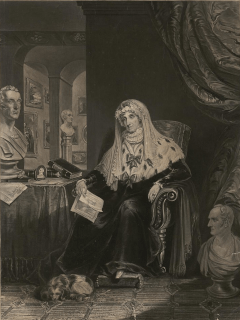
Lord Mornington dies on May 22, 1781, leaving Wellesley and their eldest son Richard, who is 21 years old at the time, to raise the rest of the family. She dislikes Arthur when he is young. She says that he is “food for powder and nothing more” and constantly worries about his future. In 1785, she goes to Brussels to live, as a way to economise. She takes Arthur with her and sends him to the Royal Academy of Equitation at Angers, in Anjou, after she returns to Britain in 1786. She is granted a pension of £600 in 1813 by Parliament after Arthur’s success in the Peninsular War.
Wellesley dies at the age of 89 on September 10, 1831.
(Pictured: Portrait of Anne Wellesley, Countess of Mornington, the mother of Arthur Wellesley, 1st Duke of Wellington, 1839, from the Welsh Portrait Collection at the National Library of Wales)
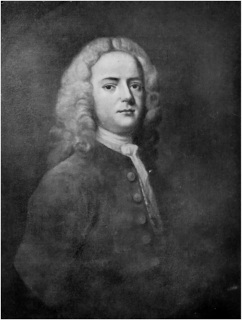
Wesley is the son of Richard Wesley, 1st Baron Mornington, and Elizabeth Sale. He is educated at Trinity College Dublin and is elected its first Professor of Music in 1764. From early childhood he shows extraordinary talent on the violin and soon begins composing his own works. As a composer he is remembered chiefly for glees such as “Here in cool grot” and for a double Anglican chant. His son, Arthur Wellesley, 1st Duke of Wellington, is the only one of his children to inherit something of his musical talent.
Wesley represents Trim in the Irish House of Commons from 1757 until 1758, when he succeeds his father as 2nd Baron Mornington.
Wesley marries Anne Hill-Trevor, eldest daughter of banker Arthur Hill-Trevor, 1st Viscount Dungannon, and his wife Anne Stafford, on February 6, 1759. His godmother, the famous diarist Mary Delany, says the marriage is happy, despite his lack of financial sense and her “want of judgment.” They have nine children, most of whom are historically significant.
In 1759 Wesley is appointed Custos Rotulorum of Meath and in 1760, in recognition of his musical and philanthropic achievements, he is created Viscount Wellesley, of Dangan Castle in the County of Meath, and Earl of Mornington. He is elected Grandmaster of the Grand Lodge of Ireland in 1776, a post he holds until the following year.
Wesley dies at the age of 45 on May 22, 1781. Like his father, he is careless with money, and his early death leaves the family exposed to financial embarrassment, leading ultimately to the decision to sell all their Irish estates.
Four streets in Camden Town, which form part of the estate of Wesley’s son-in-law Henry FitzRoy, are named Mornington Crescent, Place, Street and Terrace after him. Of these, the first has since become famous as the name of a London Underground station.
Hely-Hutchinson enters the Army as a cornet in the 18th Royal Hussars in 1774, rising to a lieutenant the following year. In 1776 he is promoted to become a captain in the 67th (South Hampshire) Regiment of Foot, and a major there in 1781. He moves regiments again in 1783, becoming a lieutenant-colonel in, and colonel-commandant of, the 77th Regiment of Foot, which is, however, disbanded shortly afterwards following an earlier mutiny. He spends the next 11 years on half-pay, studying military tactics in France before serving as a volunteer in the Flanders campaigns of 1793 as aide-de-camp to Sir Ralph Abercromby.
Hely-Hutchinson is second-in-command of the 1801 expedition to Egypt, under Abercromby. Following Abercromby’s death in March after being wounded at the Battle of Alexandria, he takes command of the force. From then he is able to besiege the French firstly at Cairo which capitulates in June and then besieges and takes Alexandria, culminating in the capitulation of over 22,000 French soldiers. In reward for his successes there, the Ottoman SultanSelim III makes him a Knight, 1st Class, of the Order of the Crescent.
On December 18, 1801, Hely-Hutchinson is created Baron Hutchinson in the Peerage of the United Kingdom, gaining a seat in the House of Lords. In recognition of his “eminent services” during the “late glorious and successful campaign in Egypt,” at the request of the King, the Parliament of the United Kingdom settles on Lord Hutchinson and the next two succeeding male heirs of his body an annuity of £2000 per annum, paid out of the Consolidated Fund.
Hely-Hutchinson is promoted lieutenant-general in September 1803 and made a full general in June 1813. In 1806, he becomes colonel of the 57th (West Middlesex) Regiment of Foot, transferring in 1811 to be colonel of the 18th Regiment of Foot, a position he holds until his death. He also holds the position of Governor of Stirling Castle from 1806 until his death.
Hely-Hutchinson sits as Member of Parliament (MP) for Lanesborough from 1776 to 1783 and for Taghmon from 1789 to 1790. Subsequently, he represents Cork City in the Irish House of Commons until the Act of Union 1800 and is then member for Cork City in the after-Union Parliament of the United Kingdom until 1802.
Hely-Hutchinson dies on June 29, 1832, never having married.
In 1866 Monck becomes a peer with the title Baron Monck. When the Canadian colonies become a semi-independent confederation the next year, he becomes the country’s first Governor General. He is also responsible for establishing Rideau Hall as the residence of the Governor General in Ottawa.
In November 1938, Lord Killanin is commissioned into the Queen’s Westminsters, a territorial regiment of the British Army, where he is responsible for recruiting fellow journalists, including future The Daily Telegraph editor Bill Deedes, and friends who are musicians and actors. He reaches the rank of major and takes part in the planning of D-Day and the Invasion of Normandy in 1944, acting as brigade major for the 30th Armoured Brigade, part of the 79th Armoured Division. He is appointed, due to the course of operations, a Member of the Order of the British Empire (MBE). After being demobilised, he goes to Ireland. He resigns his TA commission in 1951.
In 1950, Lord Killanin becomes the head of the Olympic Council of Ireland (OCI) and becomes his country’s representative in the IOC in 1952. He becomes senior vice-president in 1968, and succeeds Avery Brundage, becoming President-elect at the 73rd IOC Session (August 21–24) held in Munich prior to the 1972 Summer Olympics. He takes office soon after the Games.
Lord Killanin serves as Honorary Consul-General of Monaco in Ireland from 1961 to 1984 and as Chairman of the Race Committee for Galway Racecourse from 1970 to 1985. A keen horse racing enthusiast, he also serves as a steward of the Irish Turf Club on two occasions and on the National Hunt Steeplechase Committee. In his business life Lord Killanin is a director of many companies including Irish Shell, Ulster Bank, Beamish & Crawford and Chubb Ireland. He is a founder member of An Taisce (The National Trust for Ireland) and is chairman of the National Monuments Advisory Council until his death.
Lord Killanin dies at his home in Dublin on April 25, 1999, at the age of 84 and, following a bilingual funeral Mass at St. Enda’s Church in Spiddal, County Galway, he is buried in the family vault in the New Cemetery, Galway.
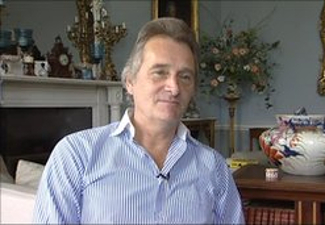
Styled Viscount Slane until 1974 and Earl of Mount Charles from 1974 until 2009, he succeeds his father in the marquessate and other titles in 2009. However, in the Republic of Ireland frequently, and erroneously, he remains referred to as Lord Mountcharles, his former courtesy title. He also inherits the U.K. peerage title Baron Minster, of Minster Abbey in the County of Kent, created in 1821 for his ancestor, the 1st marquess thereby giving the Marquesses Conyngham the automatic right to sit in the British House of Lords until 1999.
Lord and Lady Conyngham divide their time between Beauparc House and Slane Castle in County Meath. The latter is the family’s principal ancestral seat until it is badly damaged by fire in 1992. The castle has now been restored.
The Marquess Conyngham enjoys a high profile in Ireland as the author of a weekly column in the Daily Mirror. He has been dubbed the rock and roll aristocrat or the rock and roll peer owing to the very successful series of rock concerts he has hosted since 1981, held in the natural amphitheatre on the grounds of Slane Castle. These concerts have included performances by The Rolling Stones, Thin Lizzy, Queen, U2, Bob Dylan, Bruce Springsteen, David Bowie, Guns N’ Roses, Oasis, and Madonna. Lord Conyngham receives the Industry Award at the 2010 Meteor Awards. In his autobiography Public Space–Private Life: A Decade at Slane Castle, he describes his business career and the challenges of being an Anglo-Irish peer in modern Ireland, and how being Anglo-Irish has gradually become more accepted there.






 seamus dubhghaill