Power is born to Henry Power, a watchmaker, and Mary (née Atkins), an embroideress. He has one older brother, and one younger sister. He attends a Christian Brothersnational school in North Brunswick Street. As a child he plays in local clay brickyards and sculpts busts of his friends. After finishing his primary school education, he trains with a firm of sculptors run by Edward Smyth. In 1884, he enrolls as an evening pupil at the Dublin Metropolitan School of Art (DMSA), later attending as a full-time student from 1906 to 1911. During his time at the DMSA he is taught and strongly influenced by John Hughes, Oliver Sheppard and William Orpen. He wins a number of prizes during his time at the DMSA, including medals, three scholarships, book prizes, and the national gold medal for the best modeling of a nude figure, in Ireland, Scotland, and the Channel Islands in 1911.
Power marries Agnes Kelly in 1903. The couple has ten children, four daughters and six sons, including May and James who also become sculptors.
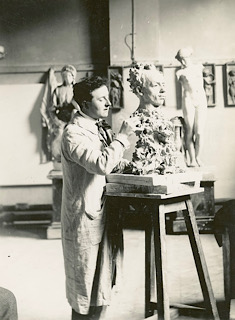
Power establishes his own stone-carving business in 1912 from his new home at 18 Geraldine Street, Phibsborough, Dublin. As the firm grows, it moves to premises nearby at 15 Berkeley Street from 1930. He executes a wide range of works, including monuments and architectural features in bronze, marble, and stone. Among his notable works are the figure of “Science” designed by Sheppard from the façade of the new Royal College of Science for Ireland (later Government Buildings) on Merrion Street, Dublin, carved motifs and sphinxes for the Gresham Hotel, O’Connell Street, and four statues on the dome of Christ the King church, Carndonagh, County Donegal.
Power is considered the leading Irish sculptor of the 1920s and 1930s. He is a nationalist and promotes the use of Irish materials such as limestone from Durrow and Connemara marble. He is noted for his academic realist style. He exhibits regularly with the Royal Hibernian Academy from 1906, becoming an associate member in 1911, and a full member in 1919. Among those he models sculptures for are James Stephens (1913), W. B. Yeats (1918), and Lord Dunsany (1920). Among his patrons are Oliver St. John Gogarty, and through Gogarty he is commissioned to model a number of prominent Irish nationalists. Gogarty asks him to carve a portrait of Terence MacSwiney in 1920, while MacSwiney is on hunger strike in HM Prison Brixton, London. Smuggled into the prison to do a thumbnail sketch, Power then carves a portrait in the form of a life mask.
On Gogarty’s recommendation, Power is commissioned by the Irish Free State government to create portraits of a number of leading politicians including Arthur Griffith (1922), Michael Collins (1936), and Austin Stack (1939). He is also privately commissioned to execute a portrait of Éamon de Valera in 1944. Among his monumental works are sculptures of Tom Kettle (1919) at St. Stephen’s Green, Dublin, Christ the King in Gort, County Galway, (1933), Pádraic Ó Conaire (1935) at Eyre Square, Galway, and W. B. Yeats (1939) at Sandymount Green, Dublin. He is one of the artists invited to submit designs for the new coinage of the Irish Free State in 1928.
Power dies in Dublin on July 10, 1945, following complications from a double hernia. His is buried in Glasnevin Cemetery, Dublin.
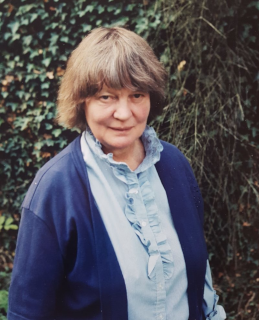
Murdoch is the daughter of Irene Alice (née Richardson) and Wills John Hughes Murdoch. Her father, a civil servant, comes from a mainly Presbyterian sheep farming family from Hillhall, County Down. In 1915, he enlists as a soldier in King Edward’s Horse and serves in France during World War I before being commissioned as a second lieutenant. Her mother trains as a singer before Iris is born and is from a middle-class Church of Ireland family in Dublin. Her parents first meet in Dublin when her father is on leave and are married in 1918. Iris is the couple’s only child. When she is a few weeks old the family moves to London, where her father had joined the Ministry of Health as a second-class clerk. She is a second cousin of the Irish mathematician Brian Murdoch.
From 1947 to 1948 Murdoch studies philosophy as a postgraduate at Newnham College, Cambridge. She meets Ludwig Wittgenstein at Cambridge but does not hear him lecture, as he had left his Trinity College professorship before she arrives. In 1948 she becomes a fellow of St. Anne’s College, Oxford, where she teaches philosophy until 1963. From 1963 to 1967 she teaches one day a week in the General Studies department at the Royal College of Art.
In 1956 Murdoch marries John Bayley, a literary critic, novelist, and from 1974 to 1992 Warton Professor of English at Oxford University, whom she had met in Oxford in 1954. The unusual romantic partnership lasts more than forty years until Murdoch’s death. Bayley thinks that sex is “inescapably ridiculous.” She in contrast has “multiple affairs with both men and women which, on discomposing occasions, Bayley witnesses for himself.”
Murdoch’s first novel, Under the Net, is published in 1954 and is selected in 1998 as one of Modern Library’s 100 best English-language novels of the 20th century. She had previously published essays on philosophy, and the first monograph about Jean-Paul Sartre published in English. She goes on to produce 25 more novels and additional works of philosophy, as well as poetry and drama.
Murdoch’s last novel, Jackson’s Dilemma, is published in 1995. She is diagnosed with Alzheimer’s disease in 1997 and dies on February 8, 1999, in Oxford, England. There is a bench dedicated to her in the grounds of Lady Margaret Hall, Oxford, where she enjoyed walking.
Whelan is the fourth of seven children born to John and Elizabeth Whelan. His father is an accomplished centre half-back for Dublin club Brunswick and is instrumental in winning the FAI Junior Shield in 1924. His mother is an avid Shamrock Rovers supporter. His father dies in 1943 when Whelan is just eight years old.
Whelan begins his career at the age of twelve when he joins Home Farm before joining Manchester United as an 18-year-old in 1953. He is capped four times for the Republic of Ireland national football team, including a surprising 4–1 victory against Holland in Rotterdam in 1956, but does not score. His brother John plays for Shamrock Rovers and Drumcondra and his eldest brother Christy plays for Transport.
Whelan makes his first appearance for Manchester United during the 1954–55 season and quickly becomes a regular first-team player. He goes on to make 98 first-team appearances in four seasons at United, scoring 52 goals. He is United’s top scorer in the 1956–57 season, scoring 26 goals in the First Division and 33 in all competitions as United wins their second successive league title and reaches the semi-finals of the 1957-58 European Cup. He also gives a commanding display in the 1957 FA Cup final despite losing 2–1 to Aston Villa. Such is the strength of the competition in the United first team that he is soon being kept out of the side by Bobby Charlton. He is a traveling reserve for United’s ill-fated European Cup match against Red Star Belgrade in Belgrade on February 6, 1958, and is one of eight players to die in the subsequent air crash that destroys Matt Busby‘s young team and claims twenty-three lives. Fellow Irishman Harry Gregg, United’s goalkeeper and a survivor and hero of the Munich air crash, recalls Whelan’s last words as the plane is attempting take-off for the third and final time as “Well, if this is the time, then I’m ready.”
Thousands attend Whelan’s funeral on February 12 in St. Peter’s Church, Phibsborough, Dublin, and line the streets as the funeral procession makes its way to his burial-place in Glasnevin Cemetery. In December 2006 Dublin Corporation unveils a commemorative plaque on a bridge at Faussagh Road, Cabra, which was renamed Liam Whelan Bridge.
Although of a cheerful disposition, Whelan is also modest and shy by nature, and a quietly devout Catholic. He has a particular dislike of swearing and tends to fix a look of pained disappointment on teammates who use bad language. Nobby Stiles admits that he “would rather be caught swearing by the pope than by Billy Whelan.” His religious devotion regularly fuels rumours that he is considering being a priest, although at the time of his death he is engaged to be married to Ruby McCullough.
Connell is ordained priest by Archbishop John Charles McQuaid on May 19, 1951. He takes up a teaching post at the Department of Metaphysics at the University College Dublin. He is appointed Professor of General Metaphysics in 1972 and in 1983 becomes the Dean of the Faculty of Philosophy and Sociology. The College’s Department of Metaphysics is abolished after his departure.
Connell is appointed Archbishop of Dublin by the Holy See in early 1988. He is consecrated at St. Mary’s Pro-Cathedral, Dublin on March 6, 1988. He is created Cardinal-Priest by Pope John Paul II at the Consistory in Rome on February 21, 2001, with the TitulusS. Silvestri in Capite. Archbishops of Armagh, who hold the higher title of Primate of All Ireland, are more frequently appointed Cardinal than Archbishops of Dublin. The last Archbishop of Dublin to have been a cardinal is Cardinal Edward MacCabe, who was appointed in 1882. A large Irish contingent from Church and State, along with family and friends of the Cardinal, attend the installation which for the first time takes place at the front of the entrance to St. Peter’s Basilica.
On April 26, 2004, Connell retires as archbishop, handing the diocese to the coadjutor bishop, Diarmuid Martin. All bishops submit their resignation to the Pope on their 75th birthday. Connell’s is accepted shortly after his 78th birthday.
It is Connell’s failure, when Archbishop of Dublin in 1988–2004, to address adequately the abuse scandals in Dublin that lead the Vatican to assign Archbishop Martin as his replacement in the country’s largest diocese. The Murphy Report finds that Connell had handled the affair “badly” as he was “slow to recognise the seriousness of the situation.” It does praise him for making the archdiocesan records available to the authorities in 2002 and for his 1995 actions in giving the authorities the names of 17 priests who had been accused of abuse, although it says the list is incomplete as complaints were made against at least 28 priests in the archdiocese.
From 1988 Connell also continues to insure his archdiocese against liability from complainants, while claiming to the Murphy Commission that the archdiocese is “on a learning curve” in regard to child abuse. He arranges for compensation payments to be made from a “Stewardship Trust” that is kept secret from the archdiocese’s parishioners until 2003. In 1996 he refuses to help a victim of Paul McGennis and does not pass on what he knows about McGennis to her, or to the police. He apologises for this in 2002.
Desmond Connell dies in Dublin at the age of 90 on February 21, 2017, exactly sixteen years after his creation as Cardinal.
Boland is the son of Irish Republican Brotherhood member James Boland and Kate Woods. He was active in GAA circles in early life and referees the 1914 All-Ireland Senior Football Championship Final. He joins the IRB at the same time as his older brother Gerald in 1904, following in the footsteps of his father, uncle and probably grandfather. He is educated at the Synge Street CBS, but hads a personality clash with one of the brothers so he refuses to carry on his attendance at the school. He then goes to De la Salle College, County Laois, as a novice.
Boland later joins the Irish Volunteers along with Gerry and his younger brother Ned. They take an active part in the Easter Rising of 1916.
At the 1918 Irish general election, Boland is elected as an MP for South Roscommon. In line with all the Sinn Féin MPs elected at that election, he does not take his seat in the British House of Commons but withdraws to sit in the declared independent Dáil Éireann (the First Dáil) and is named by Éamon de Valera as special envoy to the United States, a role his uncle Jack had played 25 years earlier. He leaves Ireland for the United States along with de Valera as part of a campaign to raise awareness and support for their cause in America. He negotiates a loan of $20,000 from the Irish Republic to the Russian Soviet Federative Socialist Republic through the head of the Soviet Bureau, Ludwig Martens, using some Russian jewelry as collateral. These jewels are transferred to Ireland when he returns. His sister Kathleen and her mother are entrusted with the safekeeping of jewels.
In the 1922 Irish general election, Boland is re-elected to the Dáil representing Mayo South–Roscommon South. Six weeks later, on July 31, he is shot by soldiers of the National Army when they attempt to arrest him at the Skerries Grand Hotel. Two officers enter his room and, although unarmed, he is shot and mortally wounded during a struggle.
Boland’s death affects Collins and possibly spurs him toward peace negotiations with Éamon de Valera.
Boland’s brother, Gerald Boland, is a prominent member of Fianna Fáil and later serves as Minister for Justice. His nephew, Kevin Boland, serves as a Minister until he resigns in solidarity with the two ministers, Charles Haughey and Neil Blaney, who are sacked from the government in May 1970 during the Arms Crisis. Kevin Boland’s resignation from Fianna Fáil and the subsequent loss of his seat marks the end of an era for the Boland political dynasty.
In the 1991 TV movie The Treaty, Boland is portrayed by Malcolm Douglas. In the 1996 film Michael Collins, he is portrayed by American actor Aidan Quinn. The film is criticised for fictionalising both Boland’s death and Collins’ life.
Seóirse Bodley, Irish composer and former associate professor of music at University College Dublin (UCD), is born George Pascal Bodley in Dublin on April 4, 1933. In 2008, he is the first composer to become a Saoi of Aosdána. He is widely regarded as one of the most important composers of twentieth-century art music in Ireland, having been “integral to Irish musical life since the second half of the twentieth century, not just as a composer, but also as a teacher, arranger, accompanist, adjudicator, broadcaster, and conductor.”
Bodley’s father is George James Bodley (1879–1956), an employee in the Dublin office of the London Midland & Scottish Railway Company, and later of the Ports and Docks Board. His mother, Mary (née Gough, 1891–1977), works for the Guinness Brewery. He attends schools in the Dublin suburbs of Phibsborough and Glasnevin before he moves at the age of nine to an Irish-speakingChristian Brothers school at Parnell Square. He later studies at the School of Commerce in Rathmines, where he obtains his Leaving Certificate.
Music is encouraged in his parents’ home, and Bodley receives initial lessons on the mandolin from his father and on the piano from his mother. He studies the piano, harmony and counterpoint at the Royal Irish Academy of Music and obtains a Licentiate in piano from Trinity College London (TCL). From the age of 13, he also enrolls for a time at the Brendan Smith Academy of Acting. While he is still at school, he receives his first lessons in composition privately from the Dublin-based German choral conductor Hans Waldemar Rosen (1904–94), which continues, on and off, until 1956. From his student days he performs as an accompanist to singers and takes part in chamber music performances. An important element in his musical education is the twice-weekly free concerts given by the Radio Éireann Symphony Orchestra in the Phoenix Hall, Dame Court, where he has the opportunity to hear leading Irish and international performers and conductors presenting both classics and modern repertory.
From 1952 Bodley studies for a Bachelor of Music degree from University College Dublin, mainly with Anthony Hughes. He obtains the degree in 1955. From 1957 to 1959 he studies composition (with Johann Nepomuk David) and conducting at the Württembergische Hochschule für Musik in Stuttgart, Germany, and a year later he obtains a Doctorate in Music from UCD. He also takes classes in conducting with Hans Müller-Kray and Karl Maria Zwißler, and in piano with Alfred Kreutz. He returns to Germany several times in the early 1960s to participate in courses at the Darmstädter Ferienkurse, which significantly expands his knowledge of avant-garde techniques.
From 1959 until his retirement in 1998, Bodley lectures at the university’s music department, becoming associate professor in 1984. During the 1960s, he is conductor of the Culwick Choral Society.
Bodley’s development as a composer sees several distinct phases. In the 1970s he merges avant-garde styles with elements from Irish traditional music and becomes a figure of national importance. He receives several prestigious commissions for large-scale works, such as Symphony No. 3 (1981), written for the opening of the National Concert Hall.
In 1982 Bodley becomes a founder-member of Aosdána and PresidentMary McAleese confers the distinction of Saoi on him in November 2008. McAleese says that Bodley “has helped us to recast what it means to be an artist in Ireland.”
Murdoch is born on July 15, 1919, in Phibsborough, Dublin, the daughter of Irene Alice (née Richardson) and Wills John Hughes Murdoch. Her father, a civil servant, comes from a mainly Presbyterian sheep farming family from Hillhall, County Down. In 1915, he enlists as a soldier in King Edward’s Horse and serves in France during World War I before being commissioned as a second lieutenant. Her mother trains as a singer before Iris is born and is from a middle-class Church of Ireland family in Dublin. Her parents first meet in Dublin when her father is on leave and are married in 1918. Iris is the couple’s only child. When she is a few weeks old the family moves to London, where her father had joined the Ministry of Health as a second-class clerk. She is a second cousin of the Irish mathematician Brian Murdoch.
From 1947 to 1948 Murdoch studies philosophy as a postgraduate at Newnham College, Cambridge. She meets Ludwig Wittgenstein at Cambridge but does not hear him lecture, as he had left his Trinity College professorship before she arrives. In 1948 she becomes a fellow of St. Anne’s College, Oxford, where she teaches philosophy until 1963. From 1963 to 1967 she teaches one day a week in the General Studies department at the Royal College of Art.
In 1956 Murdoch marries John Bayley, a literary critic, novelist, and from 1974 to 1992 Warton Professor of English at Oxford University, whom she had met in Oxford in 1954. The unusual romantic partnership lasts more than forty years until Murdoch’s death. Bayley thinks that sex is “inescapably ridiculous.” She in contrast has “multiple affairs with both men and women which, on discomposing occasions, Bayley witnesses for himself.”
Murdoch’s first novel, Under the Net, is published in 1954 and is selected in 1998 as one of Modern Library’s 100 best English-language novels of the 20th century. She had previously published essays on philosophy, and the first monograph about Jean-Paul Sartre published in English. She goes on to produce 25 more novels and additional works of philosophy, as well as poetry and drama.
Murdoch’s last novel, Jackson’s Dilemma, is published in 1995. She is diagnosed with Alzheimer’s disease in 1997 and dies on February 8, 1999, in Oxford. There is a bench dedicated to her in the grounds of Lady Margaret Hall, Oxford, where she enjoyed walking.
Gearóid O’Sullivan, soldier and politician, is born on January 28, 1891, at Coolnagrane, near Skibbereen, County Cork, fourth son among six sons and three daughters of Michael O’Sullivan, farmer, of Loughine, and Margaret Sullivan (née McCarthy) of Coolnagrane.
Christened Jeremiah but known in later life as Gearóid, O’Sullivan is an outstanding pupil at national school and secondary school in Skibbereen. Encouraged by his teachers, he acquires a love of the Irish language. Not yet ten, he joins the Gaelic League in Skibbereen in October 1900. He takes part in the Oireachtas debates of 1909. In 1911 he qualifies at St. Patrick’s College, Dublin, as a national schoolteacher and teaches at Kildorrery, County Cork, but returns to Dublin in 1912 to take up a post at St. Peter’s National School, Phibsborough. He takes an honours degree in Celtic studies at University College Dublin (UCD) (1913), an H.Dip.Ed. (1914), and an M.Ed. (1915). At the same time, he is an organiser and teacher with the Gaelic League, a member of its Keating branch at Parnell Square, Dublin, and a founder of the League’s “fáinne” proficiency badge.
O’Sullivan joins the F Company, 1st Battalion, Dublin Brigade of the Irish Volunteers at their foundation in November 1913, is aide-de-camp to Seán Mac Diarmada during the 1916 Easter Rising and is ordered by Patrick Pearse to raise the flag of rebellion over the General Post Office (GPO) stronghold in Dublin. Interned at Frongoch internment camp in Wales after the rising, he belongs to the Irish Republican Brotherhood (IRB) group of prisoners closely linked with Michael Collins, a proximity that continues throughout the crisis years to follow. Released in the amnesty of December 1916, he intensifies his Volunteer activity, playing a prominent role in Carlow Brigade, for which he is briefly detained while working as a teacher at St. Mary’s Knockbeg College, County Carlow. When the Irish Volunteers become the Irish Republican Army (IRA) in 1919, he is arrested again and goes on hunger strike at Mountjoy Prison, which leads to his release. Active throughout the Irish War of Independence (1919–21) and narrowly avoiding recapture during meetings with Collins, he joins the supreme council of the IRB in November 1921, remaining there for the remainder of his military career.
From February 1920, O’Sullivan replaces Collins as adjutant general of the IRA, a position he retains until the Anglo–Irish Treaty of December 1921 (which he supports), resuming it a month later as a lieutenant general of the new National Army, responsible for personnel and promotions. He is also elected to Dáil Éireann for Carlow–Kilkenny in 1921 and again in 1922, retiring in 1923. His intellectual and organisational abilities guarantee that his position within the army is safe after the death in August 1922 of Collins, to whom he owes much for his initial rise to prominence. On August 28 he is appointed to the newly created army council, whose most draconian prerogative becomes the military execution of republican prisoners.
After the Irish Civil War (1922–23), wholesale demobilisation of officers and other ranks takes place, but O’Sullivan and his council colleagues Richard Mulcahy, Seán Mac Mahon, and Seán Ó Murthuile survive the fiscal axe. Their privileged position angers some officers, led by Major GeneralLiam Tobin, alarmed at the rate of demobilisation and the state’s apparent abandonment of Collins’s republican ideals. Through the Irish Republican Army Organisation, they deplore the devaluation of their pre-treaty IRA service and the retention of certain former British Army officers and instructors. O’Sullivan’s brief time as adjutant general places him in the role of personnel manager. As the Defence Forces (Temporary Provisions) Act, 1923, transforms the National Army into the defence forces of an Irish dominion, he is clearly in the sights of those who disagree with how these forces took shape.
As demobilisation continues and former British personnel become more evident, O’Sullivan and his colleagues become targets of suspicion that a hostile IRB clique had controlled the army council since its formation after the death of Collins. Exaggerated or not, such claims precipitate the army crisis of March 1924, in which O’Sullivan personally orders a raiding party under Colonel Hugo MacNeill to arrest its leaders. To defuse the crisis, he and his army council colleagues are forced to stand down, while the arrested dissidents are summarily retired. The subsequent army inquiry (April–June 1924) absolves him and his colleagues of any wrongdoing, but their active military careers are over. O’Sullivan, however, is for some time secretary of the military service pensions board.
Civilian life treats O’Sullivan well, as he enters a legal career and in 1926 is called to the bar. In 1927 he is appointed Judge Advocate General and remains so until 1932. After the assassination of Minister for JusticeKevin O’Higgins in July 1927, he fills the vacated Dublin County seat in a by-election in August, retaining it at subsequent elections until 1937. In August 1928 he is a Free State delegate to the Empire Parliamentary Association conference in Canada. Openly supporting Gen. Eoin O’Duffy and the short-lived ‘Blueshirts’ vanguard of the fledgling Fine Gael party during 1933–34, he pointedly refuses to surrender his legally held revolver when gardaí demand it as a precaution against a feared Blueshirt coup d’étât. In 1937 he becomes a barrister on the western circuit, and in 1940 commissioner for special purposes of the income tax acts, a post he holds for life.
O’Sullivan lives at St. Kevin’s Park, Dartry, Dublin, where he dies at the age of 57 on March 26, 1948. His military funeral to Glasnevin Cemetery, with his coffin draped in the same flag that had covered the coffin of Michael Collins, reflects his high national profile.
In 1922, O’Sullivan marries Maude Kiernan, sister of Kitty Kiernan and daughter of Peter and Bridget Kiernan, whose family is closely involved with the Irish political leadership, notably Michael Collins and Harry Boland. After Maude’s death he marries Mary Brennan of Belfast. They have three daughters and a son, all of whom survive him. O’Sullivan is commemorated in County Cork by a plaque at Skibbereen town hall.
Martha Nowlan, a cashier in a local restaurant, and James Brennan, a 10-year-old boy of Mary Street, are killed and five others are wounded when soldiers open fire on O’Connell Bridge, where they have been mounting checks for motor vehicle permits and licences. An English journalist who observes the incident says he saw a soldier on a lorry put his rifle to his shoulder and fire. Nowlan, 22, from Phibsborough, is shot through the left lung and is pronounced dead on arrival at Jervis Street Hospital. Brennan is shot through the centre of the forehead with the bullet coming through the top of his skull.
The incident follows an attack on a lorry carrying six Auxiliary cadets the day before on nearby Bachelor’s Walk. According to an official account, four bombs and a number of revolver shots were directed at the lorry, which was heading in the direction of the Phoenix Park. None of the cadets were killed and only one suffered minor injuries. Onlookers view the police officers’ escape as something of a miracle as the attack extended over a distance of 100 yards and involved two separate groups.
Women and men are seen throwing themselves on the path to avoid the bullets and splinters. A tram conductor named J. Doyle is also slightly wounded in the incident.
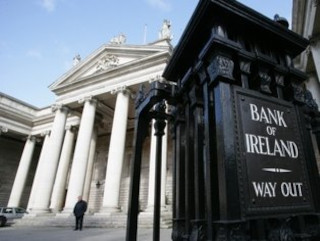
The 2009 Bank of Ireland robbery is a large robbery of cash from the College Green cash centre of the Bank of Ireland in Dublin on February 27, 2009. It is the largest bank robbery in the Republic of Ireland‘s history. Criminals engage in the tiger kidnapping of a junior bank employee, 24-year-old Shane Travers, and force him to remove €7.6 million (US$9 million) in cash from the bank as his girlfriend and two others are held hostage.
Late on the night of February 26, Travers, whose father is a member of the Garda Síochána based at Clontarf, Dublin, is alone watching television at the home of his girlfriend near Kilteel, County Kildare. The woman and her mother are out shopping together. When they arrive home with the five-year-old nephew of Travers, six heavily built masked men, dressed in black and carrying handguns, jump from the bushes.
The family is held overnight by the armed gang, during which time their mobile phones are confiscated, and Travers’ girlfriend is hit across the back of her head with a vase by one of the men. As dawn approaches, the gang orders all but Travers to enter their dark Volkswagen Golf family car. They are then bound together and driven to Ashbourne, County Meath.
The bank employee is given a mobile phone, ordered to collect €20, €50, €100 and €200 bank notes from his workplace, and supplied with a photograph of the rest of the family at gunpoint to convince his colleagues that their lives are under threat. Travers drives to Dublin in his red Toyota Celica, acquires the cash through the assistance of colleagues who viewed the photo, and carries the money out of the building in four laundry bags. He takes it to Clontarf Road railway station, whereupon he surrenders the cash and his sports car to a waiting gang member.
Travers then enters a Garda station, the first point at which Gardaí are notified that the robbery had taken place. One hour after this, the other family members succeed in freeing themselves and walk to a nearby garda station. Travers’ girlfriend requires immediate medical treatment for a head wound she received during a struggle with her captors, and the family are reported to be “traumatised” by their ordeal. Travers’s car is later found burned out in an apartment block near Tolka House Pub in Glasnevin.
Minister for Justice, Equality and Law ReformDermot Ahern says “proper procedures” were not followed during the course of the robbery, saying that Gardaí should have been contacted before the money had left the bank. He also questions how such a large sum of money could be taken as a result of one man being targeted.
The bank’s chief executive, Richie Boucher, appointed just two days earlier, immediately writes to all his staff to remind them that protocol should be followed in the event of future robberies, saying “Our priority is always for the safety and well-being of all staff. I am sure this incident will raise concerns. Our best defence is to follow tried and tested procedures. I would ask everybody to remind themselves of these procedures, which are there to protect you, your families and the bank.”
€1.8 million of the stolen cash is recovered and seven people are arrested by Gardaí in a number of incidents on February 28. A house in Phibsborough is sealed off and ten more houses are searched. A total of five cars and one van are seized by Gardaí. One of the men is arrested following a chase along the M50 motorway near the Navan road, with two bales of packed cash being discovered in his car. Four other men are arrested in a car in Monk Place and in Great Western Square, Phibsborough, and two more are seized in a house on Great Western Villas, Phibsborough. Cash is also found in a car in Phibsborough.
The six men and one woman are believed to be members of a well-known gang from Dublin’s north inner city and have connections to a major Dublin gangland figure. On March 2, those arrested appear before the High Court to challenge the lawfulness of their detention, viewing the warrants issued by the District Court the day before as invalid. That day, two of those arrested are released.
An unidentified bank employee is arrested on January 28, 2010, based on suspicion that the robbery had been an inside job.



 seamus dubhghaill