The 32CSM has been described as the “political wing” of the now defunct Real Irish Republican Army (RIRA), but this is denied by both organisations. The group originates in a split from Sinn Féin over the Mitchell Principles.
Those present at the initial meeting are opposed to the direction taken by Sinn Féin and other mainstream republican groups in the Northern Ireland peace process, which leads to the Belfast Agreement (also known as the Good Friday Agreement) the following year. The same division in the republican movement leads to the paramilitary group now known as the Real IRA breaking away from the Provisional Irish Republican Army at around the same time.
Most of the 32CSM’s founders had been members of Sinn Féin. Some had been expelled from the party for challenging the leadership’s direction, while others felt they had not been properly able to air their concerns within Sinn Féin at the direction its leadership had taken. Bernadette Sands McKevitt, wife of Michael McKevitt and a sister of hunger strikerBobby Sands, is a prominent member of the group until a split in the organisation.
The name refers to the 32 counties of Ireland which are created during the Lordship and Kingdom of Ireland. With the partition of Ireland in 1920–22, twenty-six of these counties form the Irish Free State which is abolished in 1937 and is now known as Ireland since 1949. The remaining six counties of Northern Ireland remain part of the United Kingdom. Founder Bernadette Sands McKevitt says in a 1998 interview with the Irish Mirror that people did not fight for “peace” – “they fought for independence” – and that the organisation reaffirms to the republican position in the 1919 Irish Declaration of Independence.
Before the referendums on the 1998 Good Friday Agreement, the 32CSM lodges a legal submission with the United Nations challenging British sovereignty in Ireland. The referendums are opposed by the 32CSM but are supported by 71% of voters in Northern Ireland and by 94% in the Republic of Ireland. It is reported in February 2000 that the group established a “branch” in Kilburn, London.
In November 2005, the 32CSM launches a political initiative titled Irish Democracy, A Framework for Unity.
On May 24, 2014, Gary Donnelly, a member of the 32CSM, is elected to the Derry City and Strabane District Council. In July 2014, a delegation from the 32CSM travels to Canada to take part in a six-day speaking tour. On arrival the delegation is detained and refused entry into Canada.
In 2015, the 32CSM organises a demonstration in Dundee, Scotland, in solidarity with the men convicted of shooting Constable Stephen Carroll, the first police officer to be killed in Northern Ireland since the formation of the PSNI. The organisation says the “Craigavon Two” are innocent and have been victims of a miscarriage of justice.
The group is currently considered a Foreign Terrorist Organization (FTO) in the United States, because the group is considered to be inseparable from the Real IRA, which is designated as an FTO. At a briefing in 2001, a spokesman for the U.S. Department of State states that “evidence provided by both the British and Irish governments and open-source materials demonstrate clearly that the individuals who created the Real IRA also established these two entities to serve as the public face of the Real IRA. These alias organizations engage in propaganda and fundraising on behalf of and in collaboration with the Real IRA.” The U.S. Department of State’s designation makes it illegal for Americans to provide material support to the Real IRA, requires U.S. financial institutions to block the group’s assets and denies alleged Real IRA members visas into the U.S.
The 32CSM also operates outside of the island of Ireland to some extent. The Gaughan/Stagg Cumann covers England, Scotland and Wales, and has an active relationship of mutual promotion with a minority of British left-wing groups and anti-fascist organisations. The James Larkin Republican Flute Band in Liverpool, and the West of Scotland Band Alliance, the largest section of which is the Glasgow-based Parkhead Republican Flute Band, are also supporters of the 32CSM. As of 2014, the 32CSM’s alleged paramilitary wing, the Real IRA, is reported to have been still involved in attempts to perpetrate bombings in Britain as part of the Dissident Irish Republican campaign, which has been ongoing since 1998.
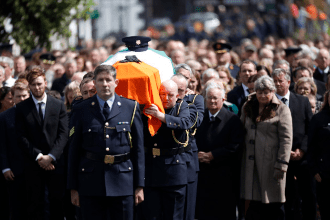
Among the thousands paying their respects are 4,000 serving and retired gardaí, over 2,000 in uniform. Garda Golden is remembered as a happy man, proud to serve, a role model for the community – and by his brother Patrick as a “big gentle giant.”
In his homily, chief celebrant parish priest Father Pádraig Keenan tells the congregation that the killing of Garda Golden was “cold-blooded murder.” He reminds the mourners that Garda Golden is the 88th garda to die in the line of duty. He says, “It is 88 members too many. He like all the others is mourned by the entire nation.”
“His murder brings to mind once again all the families and communities that have been affected on our island.”
Fr. Keenan says, “Garda Tony’s death once again reflects how north Louth and the Cooley Peninsula have been affected by the tragic history of the Troubles on the island of Ireland, and especially the murder of Detective Garda Adrian Donohoe, three years ago at Lordship Credit Union in Bellurgan.”
He says that too many hearts have been broken, and too many lives shattered. There is no place for violence in our society, violence is wrong, always wrong. He refers to Garda Golden as one of life’s gentlemen.
Fr. Keenan begins the funeral mass by saying that Garda Golden quietly let “his light shine in so many ways through his life in a very humble way. Amidst our sadness may we be thankful for the charisma of his beautiful but too short life.”
The stillness of the water across from the churchyard in Dundalk Bay mirrors the silence and sadness that has unfolded on everyone since the weekend, he tells the congregation.
“Tony was so proud to serve the community of Omeath,” he says. “As one person from Omeath put it to me in recent days, he was ‘our garda’, and to a person amongst his family and colleagues, all are immensely proud of Garda Tony and his selfless nature. Proud of everything he lived for, worked for and stood for. Tony Golden was a much-loved role model in our community.”
Symbols including a family photograph are taken to the altar in memory of Garda Golden. A club jersey and hurley from the Stephenites GAA club in his native Ballina, County Mayo, represent his roots and love of sport. A television remote control, a soft drink, a bar of chocolate and packet of crisps were offered to recall his cherished “time out.”
Garda Golden’s final journey begins at the home in the village of Blackrock he shared with his wife Nicola and their three young children, Lucy, Alex and Andrew. The funeral cortège is led by the Garda Commissioner, while thousands of gardaí escort their colleague into his parish church, St. Oliver Plunkett’s, for the funeral mass at noon.
Fr. Keenan is joined on the altar by the vicar general of the Armagh diocese Dean Colum Curry, who represents the Primate of All Ireland, Bishop Eamon Martin. As well as the chaplains to the Garda and the Defence Forces, Bishop John Fleming and Father Gerard O Hora travel to the funeral from Golden’s home county of Mayo.
Screens are erected in the grounds and the village to relay the service to those outside.
Businesses shut down along the route as a mark of respect during the funeral. Roads around the village are sealed off for several hours. Garda Golden is laid to rest at St. Paul’s Cemetery Heynestown.
Golden is killed as he is bringing Siobhan Phillips to her home to retrieve her personal possessions. Phillips is also shot in the incident and is in a critical condition in hospital with her family at her bedside at the time of Garda Golden’s funeral.
President of the Garda Representative Association, Dermot O’Brien, says members of the gardaí from all corners of Ireland traveled to County Louth to pay their respects to their colleague. He says they are grief-stricken and numb.
O’Brien says everyone will reflect in their own way and that the realisation has struck that Garda Golden was murdered doing “a bread-and-butter type call.”
“They are going to ask themselves, those that attended the same type of call on Sunday that it could have been them. These are very similar calls that a lot of members did on Sunday, and they will sit back and reflect on what happened to Tony as they responded to a similar call.”
O’Brien says he had spoken to Garda Golden’s unit in the days leading to the funeral and, while they are coping, they are not well. “They are angry, grieving and disillusioned because today they have to bury a second friend, a murdered friend, a second murdered colleague.”
Father Michael Cusack also speaks of the pain and anger expressed by members of the garda force he met following Garda Golden’s death. Speaking on RTÉ‘s Today with Sean O’Rourke, Fr. Cusack says it is a very difficult day and week for gardaí. He says a lot of care needs to be offered to the members of the force and that there needs to be appropriate follow-up care given.
(From: “Garda Tony Golden ‘mourned by entire nation’,” RTÉ News, http://www.rte.ie, October 15, 2015)
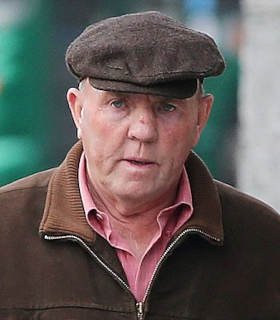
Accused by The Sunday Times of directing an IRA bombing campaign in Britain, in 1987 Murphy unsuccessfully sues the paper for libel in Dublin. The original verdict is overturned by the court of appeal because of omissions in the judge’s summing up and there is a retrial, which he also loses. At the retrial, both Sean O’Callaghan and Eamon Collins, former members of the Provisional Irish Republican Army, testify against Murphy, as do members of the Gardaí, Irish customs officials, British Army and local TDBrendan McGahon. Collins, who had also written a book about his experiences, Killing Rage, is beaten and killed by having a spike driven through his face near his home in Newry eight months later. In 1998, a Dublin court dismisses Murphy’s case after a high-profile trial, during which Murphy states that he has “never been a member of the IRA, no way” and claims not to know where the Maze prison is located. The jury rules, however, that he is an IRA commander and a smuggler.
The Sunday Times subsequently publishes statements given by Adrian Hopkins, the skipper who ferries weapons from Libya to the IRA, to the French authorities who intercept the fifth and final Eksund shipment. Hopkins details how Murphy met a named Libyan agent in Greece, paid for the weapons to be imported, and helped unload them when they arrived in Ireland. According to A Secret History of the IRA by Ed Moloney, Murphy has been the IRA Army Council’s chief of staff since 1997. Toby Harnden’s Bandit Country: The IRA & South Armagh also details Murphy’s IRA involvement.
On September 20, 2016, the BBC‘s Spotlight airs a programme in which an alleged British spy who had infiltrated the IRA claims that in 2006, Murphy had demanded the killing of Denis Donaldson, an IRA member and British informer, in order to maintain discipline. The BBC says it had tried to contact Murphy but had received no reply. He has yet to respond to the allegation. On September 23, 2016, the Donaldson family’s solicitor says that the allegation is “absolute nonsense.”
In October 2005, officers of the British Assets Recovery Agency and the Irish Criminal Assets Bureau carry out raids on a number of businesses in Manchester and Dundalk. It is extensively reported in the media that the investigation is aimed at damaging the suspected multi-million-pound empire of Murphy, who according to the BBC’s Underworld Rich List, has accumulated up to £40 million through smuggling oil, cigarettes, grain and pigs, as well as through silent or partial ownership in legitimate businesses and in property.
A large, purpose-built underground chamber that Gardaí believes the IRA used for interrogation is discovered close to Murphy’s home.
In his first-ever press release, issued on October 12, 2005, Murphy denies he owned any property and denies that he had any links with co-accused Cheshire businessman Dermot Craven. Furthermore, he claims that he had to sell property to cover his legal fees after his failed libel case against The Sunday Times, and that he made a living from farming.
On March 9, 2006, police, soldiers and customs officials from both sides of the Irish border launch a large dawn raid on Murphy’s house and several other buildings in the border region. Three persons are arrested by the Gardaí but are released three days later. A fleet of tankers, computers, documents, two shotguns, more than 30,000 cigarettes and the equivalent of 800,000 euros in sterling bank notes, euro bank notes and cheques are seized. Four diesel laundering facilities attached to a major network of storage tanks, some of which are underground, are also found. The Irish Criminal Assets Bureau later obtains seizure orders to take possession of euro cash and cheques and sterling cash and cheques, together worth around one million Euros.
Sinn Féin President Gerry Adams makes a public statement in support of Murphy following the March 2006 raids. Under political and media pressure over allegations of the IRA’s continued presence in South Armagh, Adams says, “Tom Murphy is not a criminal. He’s a good republican and I read his statement after the Manchester raids, and I believe what he says and also and very importantly he is a key supporter of Sinn Féin’s peace strategy and has been for a very long time.” He adds, “I want to deal with what is an effort to portray Tom Murphy as a criminal, as a bandit, as a gang boss, as someone who is exploiting the republican struggle for his own ends, as a multimillionaire. There is no evidence to support any of that.”
Murphy is arrested in Dundalk, County Louth, on November 7, 2007, by detectives from the Criminal Assets Bureau, on charges relating to alleged revenue offences. The following day, he is charged with tax evasion under the Tax Consolidation Act. He is later released on his own bail of €20,000 with an independent surety of €50,000.
On October 17, 2008, in an agreed legal settlement, Murphy and his brothers pay over £1 million in assets and cash to the authorities in Britain and the Republic in settlement of a global crime and fraud investigation relating to proceeds of crime associated with smuggling and money laundering. After an investigation involving the Irish Criminal Assets Bureau and the UK’s Serious Organised Crime Agency, more than 625,000 euros (£487, 000) in cash and cheques is confiscated by the Republic’s courts, while nine properties in North West England worth £445,000 are confiscated by British courts. Murphy is still fighting a claim in the Republic’s courts for tax evasion, relating to non-completion of tax returns for eight years from 1996. On April 26, 2010, he is further remanded on bail.
In 2011, there are claims that Murphy had become disillusioned with the Northern Ireland peace process and that he had fallen out with Sinn Féin. However, there is no evidence to support he is sympathetic to any dissident republican groups. In March 2013, the Garda and the Police Service of Northern Ireland (PSNI), along with members of the Irish Customs Authority and HM Revenue and Customs (HMRC), raid his farm on the Louth-Armagh border. The Sunday World reports that two hours prior to the raid, at approximately 4:00 a.m., fire is seen coming from Murphy’s yard. There are serious concerns within the Garda and PSNI that a mole may have tipped off Murphy about the raid hours earlier as laptops, computer disks and a large amount of documentation is destroyed in the fires. As a result, an internal Garda investigation takes place.
On December 17, 2015, Murphy is found guilty on nine charges of tax evasion by a three-judge, non-jury Special Criminal Court trial sitting in Dublin, lasting nine weeks. He is tried under anti-terrorist legislation due to the belief by the Director of Public Prosecutions (DPP) that there would not be a fair trial because of the potential of the intimidation of prosecution witnesses and jurors, and the security surrounding the trial.
Murphy is found guilty on all charges of failing to furnish tax returns on his income as a “cattle farmer” between 1996 and 2004. He is prosecuted following a 14-year-long Criminal Assets Bureau investigation, which during a raid of his property uncovers bags with more than €250,000 and more than £111,000 sterling in cash, along with documents, diaries and ledgers. He is remanded on bail until early 2016 for sentencing.
On February 26, 2016, Murphy is sentenced to 18 months in prison. None of the jail term is suspended. Following sentencing, he is immediately transferred from court to Ireland’s highest-security prison, Portlaoise Prison, reserved for terrorists, dissident republicans and serious gangland criminals, under a heavily armed Garda and Irish Army escort due to security concerns.
Murphy appeals the conviction in November 2016. His lawyer, John Kearney, claims that the tax Murphy had not paid had in fact been paid by his brother, Patrick. The Court of Appeal dismisses the appeal on all grounds in January 2017.
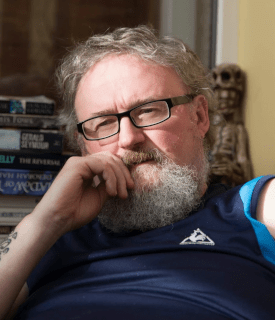
McIntyre is involved with the Boston College oral history project on the Troubles entitled the Belfast Project, conducting interviews with former Provisional IRA members who, like himself, had become disillusioned with the direction the republican movement had taken, such as Brendan Hughes and Dolours Price, and former Ulster loyalistparamilitaries such as David Ervine. The interviews are the basis for the book Voices from the Grave: Two Men’s War in Ireland by Ed Moloney.
In 2011, McIntyre becomes embroiled in controversy when transcripts of the interviews, held by Boston College, are subpoenaed by the Police Service of Northern Ireland (PSNI) in relation to an investigation of the 1972 abduction and killing of Jean McConville. In March 2014, the PSNI announces that it is seeking to question McIntyre over newly released Belfast Project recordings, specifically in reference to the alleged role of Gerry Adams in the kidnapping and murder of Jean McConville.
McIntyre is a prominent critic of modern-day Sinn Féin and its leadership. He has spoken at Republican Sinn Féin party events. He is a co-founder of The Blanket, a journal which casts a critical eye on the Northern Ireland peace process.
McCann grows up in the Falls Road area of West Belfast. He is educated at St. Comgalls Primary School on Divis Street and later at St. Peters Secondary School off the Whiterock Road.
McCann is released from Long Kesh on May 9, 1972, then rearrested in November 1972 and re-interned until December 1975. During this period of internment, he is sentenced to nine months for escaping from Long Kesh through a tunnel. During this escape, IRA volunteer Hugh Coney is murdered by British soldiers.
McCann is arrested again in November 1976 and imprisoned in Crumlin Road Gaol where he spends six months on remand before being sentenced to three years. He joins the blanket protest in Crumlin Road Gaol where he and his comrades are held in solitary confinement until August 1978 when they are moved to the H-Blocks in Long Kesh, joining hundreds more on the blanket protest. He is released on November 22, 1979.
Upon his release, McCann travels throughout Ireland with other ex-prisoner’s highlighting the inhumanity in the H-Blocks. He travels throughout the United States in 1980 during which time he is arrested and spends 17 days in prison in New York. In 1981, he travels to Canada where he helps form H-Block committees and raises awareness about the hunger strike.
On his return to Ireland McCann is elected to sit on the National H-Block Committee and speaks at many events in support of the hunger strike. In the aftermath of the hunger strike he helps reorganise Sinn Féin in the Falls area.
McCann is elected to Belfast City Council in 1987 and sits on the Strategic Policy and Resources Committee and the Parks and Leisure committee. He is elected to the Northern Ireland Assembly representing Belfast West in 2003 and again in 2007, 2012 and 2018. While there he sits on the Finance and Personnel Committee and the Committee for Social Development.
In June 2006, McCann is charged with assault and disorderly behaviour following an incident in west Belfast. The incident occurs as the Police Service of Northern Ireland (PSNI) are attempting to arrest a teenager for attempted robbery. However, he claims heavy-handedness by the police and states, “I tried to put myself between one of the officers and the girl when the police officer radioed for assistance.” He is released on bail.
In October 2021, McCann announces that he would be stepping down as Member of the Legislative Assembly (MLA) for Belfast West and would not be contesting the next election.
To seek to achieve unity among the Irish people on the issue of restoring national sovereignty and to promote the revolutionary ideals of republicanism and to this end involve itself in resisting all forms of colonialism and imperialism.
To seek the immediate and unconditional release of all Irish republican prisoners throughout the world.
The 32CSM does not contest elections but acts as a pressure group, with branches, or cumainn, organised throughout the traditional counties of Ireland. It has been described as the “political wing” of the now defunct Real Irish Republican Army (Real IRA or RIRA), but this is denied by both organisations. The group originates in a split from Sinn Féin over the Mitchell Principles.
The organisation is founded on December 7, 1997, at a meeting of like-minded Irish republicans in the Dublin suburb of Finglas. Those present are opposed to the direction taken by Sinn Féin and other mainstream republican groups in the Northern Ireland peace process, which eventually leads to the Good Friday Agreement, also known as the Belfast Agreement, the following year. The same division in the republican movement leads to the paramilitary group now known as the Real IRA breaking away from the Provisional Irish Republican Army at around the same time.
Most of the 32CSM’s founders had been members of Sinn Féin, with some having been expelled from the party for challenging the leadership’s direction, while others felt they had not been properly able to air their concerns within Sinn Féin at the direction its leadership had taken. Bernadette Sands McKevitt, wife of Michael McKevitt and a sister of hunger strikerBobby Sands, is a prominent member of the group until a split in the organisation.
The name refers to the 32 counties of Ireland which were created during the Lordship of Ireland and Kingdom of Ireland. With the partition of Ireland in 1920–22, twenty-six of these counties form the Irish Free State which is abolished in 1937 and is now known as Ireland since 1949. The remaining six counties of Northern Ireland remain part of the United Kingdom. Founder Bernadette Sands McKevitt says in a 1998 interview with The Mirror that people did not fight for “peace” – “they fought for independence” – and that the organisation reaffirms to the republican position in the 1919 Irish Declaration of Independence.
Before the referendums on the 1998 Good Friday Agreement, the 32CSM lodges a legal submission with the United Nations challenging British sovereignty in Ireland. The referendums are opposed by the 32CSM but are supported by 71% of voters in Northern Ireland and by 94% in the Republic of Ireland. It is reported in February 2000 that the group had established a “branch” in Kilburn, London.
In November 2005, the 32CSM launches a political initiative titled Irish Democracy, A Framework for Unity.
On May 24, 2014, Gary Donnelly, a member of the 32CSM, is elected to the Derry and Strabane super council. In July 2014, a delegation from the 32CSM travels to Canada to take part in a six-day speaking tour. On arrival the delegation is detained and refused entry into Canada.
In 2015, the 32CSM organises a demonstration in Dundee, Scotland, in solidarity with the men convicted of shooting Constable Stephen Carroll, the first police officer to be killed in Northern Ireland since the formation of the PSNI. The organisation says the “Craigavon Two” are innocent and are victims of a miscarriage of justice.
The 32CSM also operates outside of the island of Ireland to some extent. The Gaughan/Stagg Cumann covers England, Scotland and Wales, and has an active relationship of mutual promotion with a minority of British left-wing groups and anti-fascist organisations. The James Larkin Republican Flute Band in Liverpool and the West of Scotland Band Alliance, the largest section of which is the Glasgow-based Parkhead Republican Flute Band, are also supporters of the 32CSM. As of 2014, the 32CSM’s alleged paramilitary wing, the Real IRA, is reported to still be involved in attempts to perpetrate bombings in Britain as part of the dissident Irish republican campaign, which has been ongoing since 1998.
The 32CSM is currently considered a foreign terrorist organization (FTO) in the United States, because it is considered to be inseparable from the Real IRA, which is designated as an FTO. At a briefing in 2001, a spokesman for the U.S. Department of State states that “evidence provided by both the British and Irish governments and open-source materials demonstrate clearly that the individuals who created the Real IRA also established these two entities to serve as the public face of the Real IRA. These alias organizations engage in propaganda and fundraising on behalf of and in collaboration with the Real IRA.” The U.S. Department of State’s designation makes it illegal for Americans to provide material support to the Real IRA, requires U.S. financial institutions to block the group’s assets and denies alleged Real IRA members travel visas into the United States.
Collins is born in 1954 in Camlough, County Armagh, Northern Ireland, the son of Brian Collins, a farmer, livestock trader, and cattle smuggler, and Kathleen Collins (née Cumiskey). His extended family has no history of political involvement, though his upbringing is fervently Catholic and nationalist. He leaves secondary school at age 16 and briefly works as a clerk in the Ministry of Defence in London. He returns home for family reasons and resumes his education in 1971 through a scholarship to St. Colman’s College, Newry, County Down. In 1973 he goes to Queen’s University Belfast (QUB) to study law.
Collins develops ultra-leftist political beliefs in his late teens and supports the Northern Ireland civil rights movement but retains reservations about the use of violence. He is further radicalised by being beaten up by soldiers searching his family’s farm at Easter 1974 and by the downfall of the power sharing executive. He loses interest in his studies, leaves QUB in 1976 without completing his degree, and drifts for two years, joining an anarchist collective in Belfast. He comes back into contact with the republican movement through the blanket protest by Long Kesh inmates; he had known hunger strikerRaymond McCreesh as a teenager. In 1978 he joins the customs service in Newry and begins to pass information to the IRA, which he joins in 1979. He is central to IRA recruitment and intelligence in Newry and south Down. Without firing a shot himself he facilitates at least five murders, including that of a customs colleague.
In 1982 Collins marries and the couple has four children. By 1984 he has developed doubts about his activities. He antagonises the Belfast leadership, which is moving towards political engagement and away from the all-out revolutionary violence that he favours, and while he admires the hardline South Armagh IRA for its military professionalism, he regards its members as political primitives. On February 28, 1985, he is arrested after an IRA mortar attack in which nine Royal Ulster Constabulary (RUC) members are killed. He breaks down after six days of interrogation and is recruited as a “supergrass,” but retracts his evidence a fortnight later and is held on remand on the basis of his confessions.
In January–February 1987 Collins is tried for murder but acquitted after the judge rules his statements inadmissible. He completes an Open University degree while awaiting trial. After his release he is ostracised and is interrogated by the IRA, which in July 1987 orders him to leave Northern Ireland. He engages in youth work in Dublin from 1987 to 1990, taking a diploma in community work at Maynooth. His wife and children remain in Newry and he visits them regularly in defiance of the expulsion order. In 1990 he returns to live in Newry and teaches at the Ulster People’s College in Belfast. From 1992–94 he is a community worker in Edinburgh. His wife and children continue to live on the Barcroft Park estate in Newry.
In 1994 Collins returns permanently to Northern Ireland after securing a job at a youth club in Armagh. In April 1995 he describes his career in a television documentary, admitting the murders for which he had been tried. In 1997 he publishes a memoir, Killing Rage, a powerful account of life as a paramilitary, although it is not entirely reliable. After the 1995 documentary he experiences verbal and physical harassment. This intensifies after May 1998 when he testifies for The Sunday Times in a libel action by Thomas Murphy, whom the paper accuses of being a leading IRA member. Four months after Murphy loses the case, the family farmhouse in Camlough, which Collins is renovating, is burned down. After the Omagh bombing he publishes several articles denouncing the Real IRA, several of whose activists he had recruited into the IRA from the Irish National Liberation Army (INLA) in the early 1980s. Graffiti regularly appears outside his home in Newry denouncing him as a British agent.
Early in the morning of January 27, 1999, Collins paints out the latest graffiti, and is walking his dogs near the Barcroft Park Estate in Newry along a quiet stretch of country lane at Doran’s Hill, just within sight of Sliabh gCuircin (Camlough Mountain). His body also bears marks of having been struck by a car moving at speed. The subsequent police investigation and Coroner’s Inquest comments upon the extremity of weaponed violence to Collins’ head and face used during the attack.
Rumoured reasons behind the murder are that Collins had returned to Northern Ireland in breach of the IRA’s banning order, and further he had detailed IRA activities and publicly criticized in the media a multiplicity of Irish Republican paramilitary splinter groups that had appeared after the Provisional IRA’s 1994 ceasefire, and that he had testified in court against Murphy. Gerry Adams states the murder was “regrettable,” but adds that Collins had “many enemies in many places.”
After a traditional Irish wake, with a closed coffin necessitated due to the damage to his face, and a funeral service at St. Catherine’s Dominican Church in Newry, Collins’ body is buried at the city’s Monkshill Cemetery, not far from the grave of Albert White, a Catholic former Royal Ulster Constabulary Inspector, whose assassination he helped to organise in 1982.
In January 2014 the Police Service of Northern Ireland (PSNI) releases a statement that a re-examination of the evidence from the scene of the 1999 murder had revealed new DNA material of a potential perpetrator’s presence, and makes a public appeal for information, detailing the involvement of a specific car model, a white coloured Hyundai Pony, and a compasspommel that had broken off a hunting knife during the attack and had been left behind at the scene. In February 2014 detectives from the Serious Crime Branch arrest a 59-year-old man at an address in Newry in relation to the murder, but he is subsequently released without charge. In September 2014 the police arrest three men, aged 56, 55 and 42, in County Armagh in relation to inquiries into the murder, all of whom are subsequently released without charges after questioning. In January 2019 the police release a statement regarding the murder that one of the assailants had been seriously injured by an accidentally sustained knife wound during the attack, and had left traces of his own blood at the scene, and that recent scientific advances in DNA evidence had increased the possibility of his identification. In May 2019, three men aged 60 to 62 are arrested and questioned, but then released unconditionally.
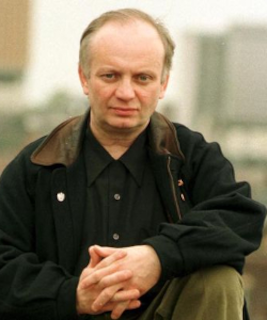
Downey’s offbeat reports of the 1994 FIFA World Cup for The Irish News are subsequently compiled for his first book, Just One Big Party. He spends six years as a BBC news producer in Derry and Belfast, before joining the Derry News as editor in 2001. During his period as editor (2001–2004), the Derry News wins two Newspaper Society awards for Fastest Circulation Growth in the United Kingdom.
Since 2004, Downey has published six comic novels set in the criminal underbelly of post-ceasefire Ireland. His books have been described as “a superb blend of comedy, political dirty tricks, grisly murder and bizarre twists.”
A former deputy-president of the Union of Students in Ireland, Downey is one of the organisers of a student occupation of government offices in Dublin on Budget Day 1988 in protest against education cutbacks.
In 2006, Downey helps establish the new Northern Ireland literary review Verbal and edits the publication for its first six issues.
A lifelong political anorak, in 2007, Downey works as an election pundit for TV3 (Ireland), alongside the Irish comedian Brendan O’Carroll. In 2010, he wins a contest to predict the winners of Northern Ireland’s 18 Westminster constituencies, missing out on just one, Naomi Long, who surprisingly beat First MinisterPeter Robinson in Belfast East. He donates his prize, a framed Ian Knox cartoon, to Long by way of apology.
Downey’s 2010 comedy-thriller The American Envoy is the first novel issued by an Irish publishing house as a Kindlee-book, simultaneously with its paperback release.
In June 2011, Downey is appointed Director of Media for Culture Company 2013, the body tasked with delivering Derry’s UK City of Culture year.
Downey is married to Una McNally, and they have two children.
Price is born in Belfast on December 16, 1950. She and her sister, Marian, also an IRA member, are the daughters of Albert Price, a prominent Irish republican and former IRA member from Belfast. Their aunt, Bridie Dolan, is blinded and loses both hands in an accident handling IRA explosives.
Price becomes involved in Irish republicanism in the late 1960s and she and Marian participate in the Belfast to Derrycivil rights march in January 1969 and are attacked in the Burntollet Bridge incident.
In 1971 Price and her sister join the Provisional Irish Republican Army (IRA). In 1972 she joins an elite group within the IRA called “The Unknowns” commanded by Pat McClure. The Unknowns are tasked with various secretive activities and transport several accused traitors across the border into the Republic of Ireland where they are “disappeared.” She personally states that she had driven Joe Lynskey across the border to face trial. In addition she states that she, Pat McClure and a third Unknown were tasked with killing Jean McConville, with the third Unknown actually shooting her.
Price leads the car bombing attacks in London on March 8, 1973, which injure over 200 people and is believed to have contributed to the death of one person who suffers a fatal heart attack. The two sisters are arrested, along with Gerry Kelly, Hugh Feeney and six others, on the day of the bombing as they are boarding a flight to Ireland. They are tried and convicted at the Great Hall in Winchester Castle on November 14, 1973. Although originally sentenced to life imprisonment, which is to run concurrently for each criminal charge, their sentence is eventually reduced to 20 years. She serves seven years for her part in the bombing. She immediately goes on a hunger strike demanding to be moved to a prison in Northern Ireland. The hunger strike lasts for 208 days because the hunger strikers are force-fed by prison authorities to keep them alive.
On the back of the hunger-striking campaign, Price’s father contests Belfast West at the February 1974 United Kingdom general election, receiving 5,662 votes (11.9%). The Price sisters, Hugh Feeney, and Gerry Kelly are moved to Northern Ireland prisons in 1975 as a result of an IRA truce. In 1980 she receives the royal prerogative of mercy and is freed on humanitarian grounds in 1981, purportedly suffering from anorexia nervosa due to the invasive trauma of daily force feedings.
After her release in 1980, Price marries Irish actor Stephen Rea, with whom she has two sons, Danny and Oscar. They divorce in 2003.
The Price sisters remain active politically. In the late 1990s, Price and her sister claim that they have been threatened by their former colleagues in the IRA and Sinn Féin for publicly opposing the Good Friday Agreement (i.e. the cessation of the IRA’s military campaign). she is a contributor to The Blanket, an online journal, edited by former Provisional IRA member Anthony McIntyre, until it ceases publication in 2008.
In 2001, Price is arrested in Dublin and charged with possession of stolen prescription pads and forged prescriptions. She pleads guilty and is fined £200 and ordered to attend Alcoholics Anonymous meetings.
In February 2010, it is reported by The Irish News that Price had offered help to the Independent Commission for the Location of Victims’ Remains in locating graves of three men, Joe Lynskey, Seamus Wright, and Kevin McKee. The bodies of Wright and McKee are recovered from a singular grave in County Meath in August 2015. It is unclear if Price played a role in their recovery. The remains of Joe Lynskey have not been recovered as of April 2021.
Price is the subject of the 2018 feature-length documentary I, Dolours in which she gives an extensive filmed interview.
In 2010 Price claims Gerry Adams had been her officer commanding (OC) when she was active in the IRA. Adams, who has always denied being a member of the IRA, denies her allegation. She admits taking part in the murder of Jean McConville, as part of an IRA action in 1972. She claims the murder of McConville, a mother of ten, was ordered by Adams when he was an IRA leader in West Belfast. Adams subsequently publicly further denies Price’s allegations, stating that the reason for them is that she is opposed to the Provisional Irish Republican Army’s abandonment of paramilitary warfare in favour of politics in 1994, in the facilitation of which Adams has been a key figure.
Oral historians at Boston College interview both Price and her fellow IRA paramilitary Brendan Hughes between 2001 and 2006. The two give detailed interviews for the historical record of the activities in the IRA, which are recorded on condition that the content of the interviews is not to be released during their lifetimes. Prior to her death in May 2011, the Police Service of Northern Ireland (PSNI) subpoena the material, possibly as part of an investigation into the disappearance of a number of people in Northern Ireland during the 1970s. In June 2011, the college files a motion to quash the subpoena. A spokesman for the college states that “our position is that the premature release of the tapes could threaten the safety of the participants, the enterprise of oral history, and the ongoing peace and reconciliation process in Northern Ireland.” In June 2011, U.S. federal prosecutors ask a judge to require the college to release the tapes to comply with treaty obligations with the United Kingdom. On July 6, 2012, the United States Court of Appeals for the First Circuit agrees with the government’s position that the subpoena should stand. On October 17, 2012, the Supreme Court of the United States temporarily blocks the college from handing over the interview tapes. In April 2013, after Price’s death, the Supreme Court turns away an appeal that seeks to keep the interviews from being supplied to the PSNI. The order leaves in place a lower court ruling that orders Boston College to give the Justice Department portions of recorded interviews with Price. Federal officials want to forward the recordings to police investigating the murder of Jean McConville.
On January 24, 2013 Price is found dead at her Malahide, County Dublin home, from a toxic effect of mixing prescribed sedative and anti-depressant medication. The inquest returns a verdict of death by misadventure. Her body is buried at Milltown Cemetery in West Belfast.
O’Hara joins Na Fianna Éireann in 1970 and, in 1971, his brother Sean is interned in Long Kesh Prison. In late 1971, at the age of 14, he is shot and wounded by a soldier while manning a barricade. Due to his injuries, he is unable to attend the civil rights march on Bloody Sunday but watches it go by him in the Brandywell Stadium, and the events of the day have a lasting effect on him.
In October 1974, O’Hara is interned in Long Kesh Prison, and upon his release in April 1975 he joins the Irish Republican Socialist Party (IRSP) and INLA. He is arrested in Derry in June 1975 and held on remand for six months. In September 1976, he is arrested again and once more held on remand for four months.
On May 10, 1978, O’Hara is arrested on O’Connell Street in Dublin under section 30 of the Offences Against the State Act and is released eighteen hours later. He returns to Derry in January 1979 and is active in the INLA. On May 14, 1979, he is arrested and is convicted of possessing a hand grenade. He is sentenced to eight years in prison in January 1980.
O’Hara becomes Officer Commanding of the INLA prisoners at the beginning of the first hunger strike in 1980, and he joins the 1981 strike on March 22.
On Thursday, May 21, 1981, at 11:29 PM, Patsy O’Hara dies at the age of 23 after 61 days on hunger strike. In accordance with his wishes, his parents do not get him the medical intervention needed to save his life. His corpse is found to be mysteriously disfigured prior to its departure from prison and before the funeral, including signs of his face being beaten, a broken nose, and cigarette burns on his body.




 seamus dubhghaill