seamus dubhghaill

Promoting Irish Culture and History from Little Rock, Arkansas, USA


Leave a comment

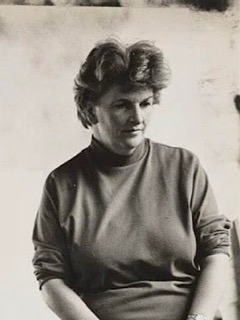
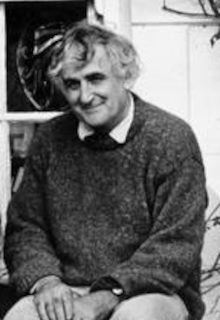
Death of Nancy Wynne-Jones, Welsh & Irish Artist

Nancy Wynne-Jones HRHA, a Welsh and Irish artist, dies in County Wicklow on November 9, 2006.

Mary Esperance (“Nancy”) Wynne-Jones is born on December 10, 1922, in Penmaenucha, Wales, to landowner Charles Llewellyn Wynne-Jones and Sybil Mary Gella Scott. The family spends half the year in Wales and half the year in Thornhill, StalbridgeDorset. She has two brothers, Andrew and Ronald (“Polly”), both of whom die in Africa during World War II.

Wynne-Jones is educated at home. Her skill in art leads to her getting lessons in Sherborne from a children’s book illustrator. Her music is encouraged by the family doctor and she begins to compose and study the violin, receiving lessons in Bournemouth with the first violinist of the symphony orchestra. After the start of World War II, she continues in Aberystwyth. She goes on to study the violin and composition at the Royal Academy of MusicLondon (1940–43). While in London she also serves as a Voluntary Aid Detachment nurse until 1943 and later as a draughtswoman at the Ordnance Survey.

After the war, Wynne-Jones purchases and manages a bookshop on the King’s Road in Chelsea, but it is not a financial success. She returns to painting, studying at the Heatherley School of Fine Art, London, from 1951 to 1952 and the Chelsea School of Art from 1952 to 1955. She travels extensively through Portugal and Italy painting landscapes. An interest in completing landscapes in an abstract manner leads her to study with Peter Lanyon in St. Ives, Cornwall.

Wynne-Jones begins study in Cornwall in 1957 and remains there for fifteen years. Her first public exhibition is in a group show in 1957 at the Pasmore Edwards Gallery, Newlyn. Other group shows are Jefferson Place Gallery, Washington, D.C. (1959) and in Falmouth, Cornwall (1960). Her solo exhibitions are at the New Vision Centre, London (1962 and 1965), Florence (1963) and Dolgellau (1964). From the 1960s through the 1990s she exhibits in Britain, Italy, Belgium, Germany, Ireland, Spain, Holland, South Africa, and the United States.

In 1962, Wynne-Jones purchases Trevaylor House near Penzance and provides accommodation for other artists including renowned Irish painter Tony O’Malley, sculptor Conor Fallon and English poet and writer W. S. ‘Sydney’ Graham. In the 1970s she exhibits in Ireland at the Project Arts Centre, Dublin (1970) and at the Emmet Gallery, Dublin (1975 and 1977). During the 1980s she exhibits at the Lincoln and Hendricks galleries in Dublin before joining the Taylor Gallery, run by John and Patrick Taylor. She is elected an honorary member of the Royal Hibernian Academy (RHA) in 1994 and becomes a member of Aosdána in 1996. Originally an abstract artist, her contact with the Irish countryside slowly transforms her work to that of a landscape artist, albeit with an influence of abstraction attached to it. She becomes well-known in Irish art circles as an eminent Irish landscape artist.

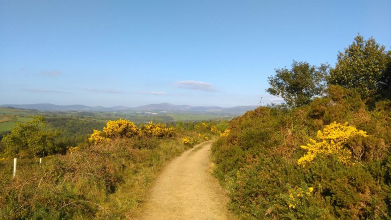
Wynne-Jones is involved with artist Derek Middleton before moving to Cornwall. There she becomes romantically involved with Graham who is in an open marriage, however, it is the death of her mentor Peter Lanyon which devastates her. She meets the sculptor Conor Fallon through their mutual friend, Tony O’Malley. Fallon had arrived in Cornwall ostensibly to meet Lanyon. They marry in 1966. Their honeymoon in Provence is immortalised in expressionist paintings done by her. The couple adopts a boy and a girl, siblings, John and Bridget. In 1972, she moves with her family to Kinsale, County Cork. It is in the area around here that a number of her paintings are created. Later she paints the mountain visible from her Wicklow home after the family moves in the late 1980s. She moves to Ballard House, near Rathdrum, County Wicklow in 1987.

Wynne-Jones dies on November 9, 2006, and is buried in Ballinatone (Church of Ireland), Rathdrum.
2 Comments

The Battle of Deputy’s Pass

The Battle of Deputy’s Pass is fought in County Wicklow on May 29, 1599, during the Nine Years’ War in Ireland. A Gaelic Irish force under Felim McFiach O’Byrne ambushes an English army of about 500, under Sir Henry Harington, which is marching from Rathdrum to Wicklow. The English army is routed and loses about 250 men.

The O’Byrnes had been allied to Hugh O’Neill, Earl of Tyrone, since the outbreak of the Nine Years’ War in 1593. Fiach McHugh O’Byrne had worked together with O’Neill, so much that he is described as the earl’s “right arm in Leinster.” However, when Fiach is killed in 1597, the power of the O’Byrnes seems to wane. When Robert Devereux, 2nd Earl of Essex, is appointed Lord Lieutenant of Ireland in 1599, he orders Harrington into County Wicklow to deal with the O’Byrnes and their allies, the O’Tooles.

Harrington’s force consists of five foot companies, but four of them are inexperienced levies recently raised in England. The only experienced foot company is that of Captain Loftus, whose men are mostly Irish. The companies are organised into a regiment under the command of Sir Alexander Radcliffe. To this is added fifty horsemen commanded by Captain Charles Montague. Harrington wants to take his troops out to scout the Irish fortifications on the ford of the Avonmore River at Rathdrum, and possibly to give his raw troops some experience in fieldcraft. His first attempt to view the Irish position on May 28 fails. Harrington returns to his camp about a mile from the ford. A second effort to view the Irish fortifications is made on May 28, but this is turned back due to poor weather. Harrington orders the men to march back to Wicklow town.

The English army stretches out in a column. In the lead is the van, then the baggage, followed by the battle and then the rear. Captain Atherton, the Sergeant Major of the army, has little doubt that the weight of any Irish attack will fall on the rear of the column. Thus, the horse (cavalry) is placed at the rear. The army has marched little over a mile before the Irish shot (musketeers and caliver-men) begin skirmishing with the rear of Harrington’s force. The Irish try to take a ford to block the advance, but the English secure the crossing, with the shot of the English rear skirmishing with the Irish, allowing the rest of the army to pass unhindered.

The march continues two miles to another ford, with the rear continuing to hold O’Byrne’s Irish shot at bay. Again, the English shot secures the crossing, as Irish fire slackens, possibly due to a shortage of gunpowder. Harrington places 40–50 shot behind an earthen bank on the left flank of the column on the far side of the ford. The Irish bring up a stand of pikemen, but their attack is limited to the English left, as the right of the column is shielded by thick gorse bushes. Atherton gathers 60–80 men to counter-attack the Irish pike. The English shot behind the bank is to hold their fire until Atherton attacks, but instead prematurely fires a single volley at the Irish pike then abandons their position. Without the support from their shot, Atherton’s men refuse to charge the Irish, then withdraw to the main body of the English column.

Atherton finds that the English shot have fled the column, abandoning the main stand of English pike. Now exposed to Irish gunfire, the English pike become disordered as they press to make the river crossing. Exploiting the English confusion, the Irish pike charges into the English rear, killing many without resistance. Montague’s English cavalry charges to support the panicking infantry, but the Irish pike square opens, allowing the horse to pass through. The Irish pike spear the English horse as they pass, including Montague who is wounded by a pike thrust into his side. Despite their officer’s best efforts, the English soldiers’ resistance collapses. The rout continues with the Irish slaughtering Harrington’s men to within one and a half miles of Wicklow town. All the English companies lose their colours, except for Captain Loftus, but they are later recovered by the English horse. After the battle, Radcliffe estimates the English army has lost 250 men killed, missing or deserted.

The first English reports suggest that they lost the battle due to the inexperience of most of their troops. Harrington at first blames the English pikemen for refusing to fight, but at the court-martial in July, Harrington, supported by two of his officers (Captains Linley and Mallory) blames Captain Loftus and his Lieutenant Walsh. This is convenient, as Loftus had died from his wounds and could not refute their accusations. Their version is supported by a map drawn of the battle, possibly by Montague (Harrington’s nephew). Loftus and Walsh are found guilty by the court-martial. Loftus is already dead, but Walsh is executed by firing squad. Mallory and Linley are not found guilty, but they are cashiered, losing command of their foot companies. The men in Loftus’ company are sentenced to death but this is commuted to decimation by drawing lots. Even by Elizabethan standards this is deemed overly harsh. Though Harrington is not charged with misconduct, he is never given command of a force this size again.


Leave a comment

Death of Sculptor Conor Fallon

Irish sculptor Conor Hubert Fallon dies of lung cancer at the Blackrock Clinic, County Dublin, on October 3, 2007.

Fallon is born at Holles Street Hospital, Dublin, on January 30, 1939, the third of six sons of Padraic Fallon, the Irish poet and playwright, and Dorothea Maher. The family moves to Clonard, County Wexford, where he grows up. He has three surviving brothers, Brian, Ivan and Padraic, who have all had journalism careers. His early interest in literature and the arts is nourished by his father and elder brothers, and by contact with the cultured circle of writers, artists, musicians and intellectuals within which his father moves.

Fallon is educated at St. Peter’s College, Wexford, and Trinity College, Dublin. He begins painting in 1957 while at Trinity College, where he is studying natural science but is advised to pay more attention to his art. His interest in painting is probably inspired by the example of Tony O’Malley, a close family friend. As a compromise with his father, who does not see his talent, he also studies accountancy at night.

Largely self-taught in painting, he learns fundamentals of technique from Richard Kingston, to whom he is introduced by O’Malley. He largely paints landscapes in acrylic and gouache, in a manner heavily influenced by that of Jack Butler Yeats.

In 1964, Fallon visits O’Malley in St. Ives, Cornwall, where he had emigrated several years earlier, intending also to meet the Cornish abstract landscape painter Peter Lanyon, the chief creative force in the thriving artists’ colony centred on St. Ives. His arrival, however, coincides with Lanyon’s death from injuries suffered in a gliding accident. A gently sympathetic stranger amid the bereaved artistic community, he finds an immediate empathy and rapport with Nancy Wynne-Jones, a Welsh-born painter sixteen years his senior who had studied under Lanyon. They marry in 1966. They adopt two children in 1970, siblings John and Bridget.

Encouraged to take up sculpture, English sculptor Denis Mitchell becomes Fallon’s mentor in Cornwall, and with Breon O’Casey, he develops his sculpting. He becomes notable for his cast steel and bronze work, especially birds, horses and hares. He has his first solo exhibition in Newlyn in 1972, showing both painting and sculpture.

In May 1972, Fallon moves with his family back to Ireland, settling at Scilly House, on a hillside overlooking the harbour at Kinsale, County Cork. Removed from any centre of artistic activity, he devotes himself fulltime to a solitary development of his sculpture, refining his methodology and technique, and his skills in working various metals, beginning in 1974 to work in steel. In 1975, he first exhibits in Ireland at a solo show at the Emmet Gallery, Dublin, again showing both painting and sculpture, including his first steel sculptures to be exhibited.

Beginning in 1983, Fallon exhibits regularly with the Taylor Galleries, Dublin. Desiring closer proximity to Dublin art activities, and with their children attending university in the city, Fallon and his wife move in 1987 to Ballard House, Ballinaclash, Rathdrum, County Wicklow.

In 1980, Fallon is awarded the Oireachtas gold medal for sculpture. He becomes an honorary associate of the National College of Art and Design in 1993. He is secretary of the Royal Hibernian Academy, becoming a full member in 1989, and on the board of the National Gallery of Ireland. He is also elected to Aosdána in 1984.

In the summer of 2007, some six months after his wife’s death, Fallon wis diagnosed with advanced metastatic lung cancer. He dies on October 3, 2007, at the Blackrock Clinic, County Dublin, and is buried beside his wife in Ballinatone churchyard, Greenan, Rathdrum, County Wicklow.


Leave a comment

Birth of Cecil King, Painter & Collector

Cecil King, painter and collector, is born on February 22, 1921, at Rathdrum, County Wicklow.

King is the son of Henry King, businessman, of Rathdrum, and Susan King (née Crowe). He is educated at the Church of Ireland Ranelagh School, Athlone, and at Mountjoy School, Clontarf, Dublin (1936–39). Subsequently he joins the printing firm of W. & S. McGowan in Dundalk, where he goes on to become a director. During the 1940s his interest in amateur drama leads him to take classes at the Gaiety School of Acting in Dublin, where his fellow students include Milo O’Shea and Eamonn Andrews. Around this time, he is also involved in An Óige (the Irish Youth Hostel Association), in which he serves as honorary national secretary and honorary treasurer. This involvement leads him to travel extensively from the late 1940s around Europe, where he visits many major art museums and galleries.

King begins to acquire works of art, by both European and Irish artists, and by the mid-1950s he has amassed one of the most important collections of modern art in Ireland. Around 1954 he himself begins to paint, under the guidance of Barbara Warren and the English artist Neville Johnson. In his early work he focuses on urban scenes, often based on the area of Ringsend, Dublin, where he uses subdued tones to produce poetic images of a sombre mood. Even here his interest in the formal qualities of painting – such as the flatness of the picture surface and the juxtaposition of areas of colour on it, which becomes a defining feature of his art – is evident. In 1964 he leaves his successful business career behind in order to devote himself entirely to art, a bold move considering the limited audience for modern art that exists in Ireland at the time. In his own words he recalls how “Painting was what I wanted to do, I realised I didn’t need a car. I could do without an awful lot of things.” (Sunday Independent, November 7, 1982)

By this time, King is working in a fully abstract style. However, he still draws his inspiration from the external world, particularly the milieu of the circus. A painting such as Trapeze (1976; Allied Irish Bank collection) shows how he responds to acrobatic performance, not in any literal or figurative sense, but to the tensions and balances inherent within it. The overall effect is to convey to the viewer the essence of anticipation of the performance. Indeed, his works can create an almost physical sense of involvement on the part of the viewer. This is especially true of his Berlin Suite, a series of screen-prints produced as a result of a visit to East Berlin and published by Editions Alecto of London (1970). He is also inspired to produce a number of paintings on this theme of the claustrophobia of the divided city. Ultimately, he aspires to create works which, with their economy and restraint, achieve a meticulously balanced harmony. This concern leads him, in such works as the Baggot Street Series, to move away from even the most veiled figurative references, evidence for the fact that he constantly strives to further his artistic explorations.

King often works seven days a week. This quiet determination contributes in no small part to the international standing he soon achieves, as does his prolific record as an exhibitor. Writing a foreword to an exhibition of his work at Kilkenny in 1975, the critic William Packer finds that King’s art “confounds the expectations we might have of Irish art, for it is far from local in ambition, accomplishment, and seriousness.” He mounts over twenty-five one-man exhibitions and contributes to a large number of group shows in Ireland and abroad. A significant proportion of his output is to be found in galleries in Europe and the United States, including the Museum of Modern Art, New York, and the Tate Gallery, London. He is also represented in the major public and corporate collections in Ireland, such as the Irish Museum of Modern Art, Ulster Museum, Trinity College Dublin (TCD), Crawford Municipal Gallery, Dublin City Gallery The Hugh Lane, Arts Council, Aer Lingus, Bank of Ireland, Allied Irish Bank, and ESB. In fact, King, with his hard-edge abstract style, is one of the very few artists working in Ireland at the time whose work is comparable to that of the major (principally American) international exponents of abstraction. The term “hard-edge,” applied to King’s style, may however belie the subtlety he could achieve in terms of his handling of colour and texture. This is particularly true of his works in the media of pastel and tapestry, while his last paintings show a tendency towards more expressive brushwork and a more complex approach to colour.

King enjoys a happy relationship with Oliver Dowling from 1960 to the time of his death, at Dún Laoghaire, County Dublin, on April 7, 1986, having suffered a heart attack just three days before an exhibition of his work is due to open in Dublin at the Oliver Dowling Gallery. His legacy is not alone artistic: he also makes a significant contribution to the promotion of modern art in Ireland in his capacity as a member of the organising committee for the Rosc exhibition since its inception in the 1960s, where his wide knowledge of international art is much respected. A member of Aosdána, he twice serves as commissioner for the Department of Foreign Affairs cultural committee. He is also generous in his encouragement of young artists, whose work he regularly adds to his own collection.

(From: “King, Cecil” by Rebecca Minch, Dictionary of Irish Biography, http://www.dib.ie, May 2012 | Pictured: Abstract, Oil on Canvas by Cecil King)


Leave a comment

The Battle of Glenmalure

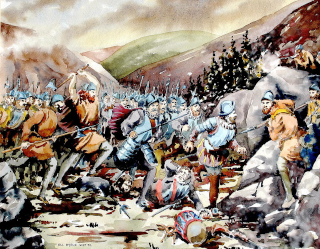
The Battle of Glenmalure (Irish: Cath Ghleann Molúra) takes place in Glenmalure, a steep U-shaped glacial valley in County Wicklow that is surrounded by forests and bogs, on August 25, 1580, during the Desmond Rebellions. A Catholic army of united Irish clans from the Wicklow Mountains led by Fiach MacHugh O’Byrne and James Eustace, 3rd Viscount Baltinglass of the Pale, defeat an English army under Arthur Grey, 14th Baron Grey de Wilton, at Clan O’Byrne‘s mountain stronghold of Glenmalure.

Grey had landed in Ireland with reinforcements from England to put down the rebellion. His strategy is to meet O’Byrne’s threat to the English heartland of Dublin and the Pale by attacking through the highlands to the south of the city. Against the advice of veteran commanders, he chooses to lead his army (around 3,000 strong) through lowland Kildare and into the Wicklow Mountains, with the aim of taking the fastness at Balinacor in the Glenmalure Valley.

While climbing the steep slopes of the valley, the inexperienced English soldiers are ambushed by the Irish who were hiding in the woods. The English are sniped at for a long period of time before their discipline collapses and they turn and flee down the valley. It is at this point that most of their casualties occur, as the Irish leave their cover and fall upon the English with swords, spears, and axes. Hundreds of English soldiers are cut down by the pursuing Irish as they try to escape the field. The remaining English have to fight a rearguard action for several miles until they reach the town of Rathdrum.

Irish sources state that around 800 English soldiers are killed, though the English put their losses at 360 dead. Among those killed is Peter Carew, cousin of his namesake colonist who had made claims to, and won, large tracts of land in southern Ireland. The remainder of the English force retreat to lowland Wicklow and from there to Dublin. However, the following year, when offered terms, most of the Irish soldiers, including O’Byrne, come in and surrender. The exception is Baltinglass, who flees to France.

The battle is commemorated in the folk song “Follow Me Up to Carlow.”

(Pictured: “Battle of Glenmalure 1580 Wicklow,” painting by Val Byrne)


Leave a comment

Birth of Charles Patrick Meehan, Priest & Historian

Charles Patrick Meehan, priest and historian, is born on July 12, 1812, at 141 Great Britain Street (now Parnell Street), Dublin.

Meehan’s father, a native of Manorhamilton, County Leitrim, is a prosperous farmer at Ballymahon, County Longford. He receives his early education in a hedge school and from a local curate at Ballymahon. In 1828 he enters the Pontifical Irish College in Rome, where he is a brilliant student, acquiring fluency in several languages. As a child he had loved to listen to stories of the Flight of the Earls and the Flight of the Wild Geese, and during his time in Rome he discovers the neglected graves of Hugh O’Neill and Hugh O’Donnell in the church of San Pietro in Montorio. He begins his lifelong research on the seventeenth century by locating and transcribing hitherto unstudied documents held in Roman repositories. Ordained in 1835, he is appointed curate at Rathdrum, County Wicklow in August and five months later is transferred to the parish of Saints Michael and John, Dublin. He is an excellent preacher and a strong advocate of temperance, and zealously discharges his parish duties.

A supporter of Daniel O’Connell and the repeal movement, Meehan is particularly attracted by the ideals of Young Ireland and becomes friendly with the principal writers of The Nation, especially Charles Gavan Duffy and James Clarence Mangan. He is Mangan’s confessor and attends his deathbed in 1849. The Young Irelanders often meet in his presbytery in Lower Exchange Street. From 1842 he contributes occasional verse and translations to The Nation using the pseudonym ‘Clericus’ and the initials ‘C. P. M.’ He defends the Young Irelanders from accusations of irreligion. During the debates on physical force in Conciliation Hall in July 1846 he supports the Young Ireland position and is shouted down by O’Connellites.

He secedes with the Young Irelanders from the Repeal Association and becomes a member of their Irish Confederation on its foundation in January 1847. Later that year he becomes president of the St. Patrick’s Confederate Club and delivers lectures to it on Irish history. A strong believer in the importance of history in creating national pride and awareness, he contributes The Confederation of Kilkenny (1846) and a translation of Daniel O’Daly, The Geraldines, their Rise, Increase and Ruin (1847) to The Nation‘s Library of Ireland historical series. He publishes a translation, with a valuable introduction and notes, of John Lynch‘s Latin life of Francis Kirwan, bishop of Killala 1645–61, as Portrait of a Christian Bishop (1848). In 1848 he resigns his presidency of the St. Patrick’s Confederate Club in the hope of becoming librarian or professor of modern languages at Queen’s College Galway but is unsuccessful.

For the rest of his life Meehan devotes himself to parish work and historical research, occasionally publishing articles and poems in the Hibernian Magazine and Irish Catholic Magazine. He also edits six volumes of the second series of James Duffy‘s Duffy’s Hibernian Magazine (1862–65). Having acquired a vast store of anecdotes and curious information from his research, he is an interesting companion who loves the company of poets and scholars and forms friendships with many young nationalist writers, including Denis Florence MacCarthy, John Keegan Casey and John Francis O’Donnell.

Most of Meehan’s research is devoted to Irish history, but he occasionally tackles other subjects, such as his translation from the Italian of Vincenzo Marchese’s Lives of the most eminent sculptors and architects of the order of St Dominic (2 vols, 1852). Although his work is marked by a strong sympathy for Catholicism and Irish nationalism, he is among the more scholarly historians associated with the Young Ireland movement. He is elected Member of the Royal Irish Academy (MRIA) in February 1865. Gavan Duffy lauds his efforts and ranks him with the great patriotic clerical scholars of the past who had devoted their lives to the study of Irish history.

Meehan repeatedly takes the opportunity to amend and expand his published works, producing revised editions of The Geraldines (as The Geraldines, their Rise, Increase and Ruin (reprinted 1878)), Confederation of Kilkenny (1882), and Lynch’s Life of Kirwan (1884). His other important publications are The Fate and Fortunes of the Earls of Tyrone (Hugh O’Neill) and Tyrconnel (Rory O’Donel), their flight from Ireland and death in exile (1868), and Rise and Fall of the Irish Franciscan Monasteries and Memoirs of the Irish Hierarchy in the Seventeenth Century (1870). He edits the essays of the Young Irelanders in The Spirit of the Nation (1882) and publishes editions of the poetry of Mangan in The Poets and Poetry of Munster (1883), with an important biographical memoir. His last scholarly work is to re-edit Literary Remains of the United Irishmen (1887) to include material left in manuscript by Richard R. Madden.

A small man, Meehan always wears a monocle attached to a silk ribbon, a tall silk hat, and a stout blackthorn stick. He suffers badly from indigestion for most of his life, and this aggravates a testy personality and a waspish tongue. He regularly falls out with friends, and few parishioners are foolhardy enough to brave his confessional. He retains strong anti-English views all his life. In the 1880s he encounters the young Arthur Griffith pulling down a union flag from a lamppost in Dublin and astounds the boy by congratulating rather than chastising him. His Young Ireland nationalism and irascible personality ensure that he never progresses beyond the position of curate in his forty-five years at Saints Michael and John. Here, he works alongside Fr. James Healy, a renowned wit, and the two men delight in trading caustic remarks. Healy is present at Meehan’s deathbed and admits to brushing away a tear – the only thing, he remarks, that had been brushed in that room for many years.

Meehan dies on March 14, 1890, at his presbytery in Dublin, and is buried in Glasnevin Cemetery. He is survived by two brothers, one of whom is also a priest. He is commemorated by a mural tablet erected by his parishioners in the church of Saints Michael and John.

(From: “Meehan, Charles Patrick” by James Quinn and Linde Lunney, Dictionary of Irish Biography, http://www.dib.ie)


Leave a comment

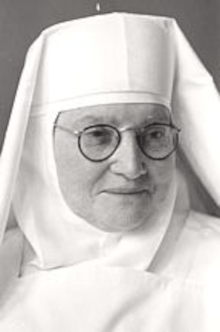
Birth of Teresa Kearney, Teacher, Franciscan Sister & Missionary

Teresa Kearney, better known as Mother Kevin, a teacher, Franciscan Sister, and missionary who founds a new Franciscan order, is born in Knockenrahan, Arklow, County Wicklow, on April 28, 1875.

Kearney is the third daughter of farmer Michael Kearney and Teresa Kearney. Three months prior to her birth, her father dies in an accident. Following his death, her mother remarries and has three more children. When she is ten years old, her mother dies. Her maternal grandmother, Grannie Grenell, then raises her in Curranstown, County Wicklow. Grannie Grenell has a profound impact on her spiritual beliefs and deep faith. When she is 17, Grannie Grenell dies.

Kearney attends the local convent school in Arklow following her mother’s death. In 1889, following her grandmother’s death, she goes to convent of Mercy at Rathdrum, to train as an assistant teacher. She does not have the finances to pay for training, and becomes a Junior Assistant Mistress. A year later, she goes to teach in a school run by the Sisters of Charity in Essex.

Following the death of her grandmother, Kearney turns toward thoughts of religious life. She believes that God is calling her to be a sister, and she applies for admission to the Franciscan Missionary Sisters of the Five Wounds at Mill Hill, London. In 1895, she enters the St. Mary’s Abbey, Mill Hill. On April 21, 1898 she takes the name Sister Mary Kevin of the Sacred Passion. Her motto is “For Thee, Lord.” She volunteers to work with African Americans in London. She waits three years for a posting to the American mission, but when the call from a foreign mission comes, it comes from Africa.

On December 3, 1902, Kearney and five other sisters leave London for Nsambya, Uganda. They are chosen at the request of Bishop Henry Hanlon of the Mill Hill Fathers. The sisters arrive on January 15, 1903 and establish a dispensary and school in the Buganda. Their task is to care for the women and girls and to further weaken the association of Catholicism with French missionaries and Protestantism with British missionaries in the then British Protectorate. Among the sisters are three Irish, one American, one English, and one Scottish woman.

Kearney starts her first clinic under a mango tree near the convent. The first seven years of missionary work are tough for the sisters. Various diseases, from smallpox to malaria, ravage Buganda. The infant mortality rate is also relatively high due to the high frequency of maternal deaths. In 1906, she expands the missionary and sets up a hospital in Nagalama, twenty-three miles away. She is appointed the new superior of the convent following Sister Paul’s illness and return to the United States in 1910. In 1913, three more sisters arrive, which allows her to establish a third mission station in Kamuli, Busoga. All three stations focus on medicine and education for the local population with a focus on primary and secondary education, training of nurses, and the founding of clinics, hospitals and orphanages.

During World War I, the Nsambya Hospital is used to treat the Native Carrier Corp, porters for European troops. At times, Kearney is outraged by the treatment Europeans give to the African porters. She works to uphold the rights of African people caught up in the European war. On December 25, 1918 she is awarded the Member of Order of the British Empire (MBE) for her services to the wounded during the war years.

Kearney is credited for promoting higher education in Catholic African women in her mission. In 1923, she founds the Little Sisters of St. Francis, a community of African nuns for teaching and nursing. This program starts with only eight local girls. A year later, she and Dr. Evelyn Connolly, a lay missionary, found a nursing and midwifery school in Nsambya. Their goal is to promote the education of women throughout Uganda.

In September 1928, Kearney returns to England to establish a novitiate exclusively for training sisters for African missions. The novitiate is officially opened in 1929 in Holme Hall, Yorkshire. Many women from England, Scotland and Ireland travel to Holme Hall to assist the missionary efforts. This creates a shortage for the Mill Hill Fathers, who also need sisters for their school in England and American missions. Upon realization of this divide, Kearney and the Mill Hill Fathers break off from each other. On June 9, 1952 she founds the new congregation of the Franciscan Missionary Sisters for Africa. She is appointed the first superior general. Mount Oliver, Dundalk, becomes the motherhouse for this new congregation. With the formation of the FMSA, she expands the missionary work to Uganda, Kenya, Zambia, the United States, Scotland, and South Africa.

Kearney retires in 1955 at age 80. During retirement, she is appointed Superior of a convent in Boston, Massachusetts and raises funds for African projects. She travels and talks to donors to garner support for projects in Africa.

On October 17, 1957, Kearney dies at the age of 82 in Brighton, Massachusetts. Her remains are flown to Ireland and buried at Mount Oliver. Ugandan Catholics rally to have her body flown to Uganda to be buried. On December 3, 1957, her body is buried in the cemetery at Nkokonjeru, the motherhouse of the Little Sisters of St. Francis.

Kearney’s legacy is evident today. In Uganda, the word Kevina means “hospital” or “charitable institute.” The Mother Kevin Postgraduate Medical School is named after her. The Little Sisters of St. Francis has over 500 members throughout Africa, while the Franciscan Missionary Sisters for Africa currently works in Uganda, Kenya, Zambia, Zimbabwe, and South Africa.


1 Comment

Birth of Nancy Wynne-Jones, Welsh & Irish Landscape Artist

Nancy Wynne-Jones HRHA, Welsh and Irish artist, is born Mary Esperance Wynne-Jones on December 10, 1922, in Penmaenucha, Dolgellau, Wales.

Wynne-Jones is born to landowner Charles Llewellyn Wynne-Jones and Sybil Mary Gella Scott. The family spends half the year in Wales and half the year in Thornhill, Stalbridge, Dorset, England. She has two brothers, Andrew and Ronald (“Polly”), both of whom die in Africa during World War II.

Wynne-Jones is educated at home. Her skill in art leads to her getting lessons in Sherborne from a children’s book illustrator. Her music is encouraged by the family doctor, and she begins to compose and study the violin, receiving lessons in Bournemouth with the first violinist of the symphony orchestra and continues in Aberystwyth after the start of World War II. She goes on to study the violin and composition at the Royal Academy of Music, London (1940–43). While in London she also serves as a Voluntary Aid Detachment nurse until 1943 and later as a draughtswoman at the Ordnance Survey.

After the war Wynne-Jones purchases and manages a bookshop on the King’s Road in Chelsea, but it is not a financial success. She returns to painting, studying at the Heatherley School of Fine Art, London (1951-52) and the Chelsea School of Art (1952–55). She travels extensively through Portugal and Italy painting landscapes. An interest in completing landscapes in an abstract manner leads her to study with Peter Lanyon in St. Ives, Cornwall.

Wynne-Jones begins study in Cornwall in 1957 and remains there for fifteen years. Her first public exhibition is in a group show (1957) at the Pasmore Edwards Gallery, Newlyn. Other group shows are Jefferson Place Gallery, Washington, D.C., (1959), and in Falmouth, Cornwall (1960). Her solo exhibitions are at the New Vision Centre, London (1962 and 1965), Florence (1963) and Dolgellau (1964). From the 1960s through the 1990s she exhibits in Great Britain, Italy, Belgium, Germany, Ireland, Spain, Holland, South Africa, and the United States.

In 1962 Wynne-Jones purchases Trevaylor House near Penzance and provides accommodation for other artists including renowned Irish painter Tony O’Malley, sculptor Conor Fallon, and English poet and writer W. S. ‘Sydney’ Graham. In the 1970s she exhibits in Ireland at the Project Arts Centre, Dublin (1970) and at the Emmet Gallery, Dublin (1975 and 1977). During the 1980s she exhibits at the Lincoln and Hendricks galleries in Dublin before joining the Taylor Galleries, run by John and Patrick Taylor. She is elected honorary member of the Royal Hibernian Academy (RHA) in 1994 and becomes a member of Aosdána in 1996. Originally an abstract artist, her contact with the Irish countryside slowly transforms her work to that of a landscape artist, albeit with an influence of abstraction attached to it. She becomes well known in Irish art circles as an eminent Irish landscape artist.

Wynne-Jones is involved with artist Derek Middleton before moving to Cornwall. There she becomes romantically involved with Graham who is in an open marriage, however it is the death of her mentor Peter Lanyon that devastates her. She meets the sculptor Conor Fallon through their mutual friend Tony O’Malley. Fallon had arrived in Cornwall ostensibly to meet Lanyon. They marry in 1966. Their honeymoon in Provence is immortalised in expressionist paintings done by Wynne-Jones. The couple adopts a boy and a girl, siblings, John and Bridget. In 1972 she moves with her family to Kinsale, County Cork. It is in this area that a number of her paintings are created. She moves to Ballard House, near Rathdrum, County Wicklow in 1987. There she paints the mountain visible from her home.

Wynne-Jones dies at the age of 83 on November 9, 2006. She is buried in Ballinatone (Church of Ireland), Rathdrum.
(Pictured: “Klein Constantia with Table Mountain” by Nancy Wynne-Jones, acrylic on paper, 16 1/2″ x 23″)


Leave a comment

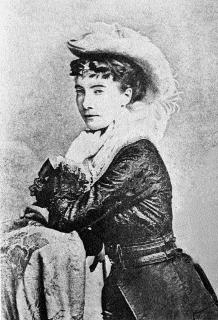
Drowning of Anna Catherine Parnell

anna-catherine-parnell

Anna Catherine Parnell, Irish nationalist and younger sister of Irish Nationalist leader Charles Stewart Parnell, drowns at Ilfracombe, Devon, England on September 20, 1911.

Parnell is born at Avondale House near Rathdrum, County Wicklow, the tenth of eleven children of John Henry Parnell, a landlord, and Delia Tudor Stewart Parnell, an Irish American and daughter of Admiral Charles Stewart of the United States Navy. She has very little formal education as a child, but the family has an extensive library which she is encouraged to read by her mother. After her father dies in 1859, she moves with the family to Dublin. Delia Parnell is an active socialite while in Dublin and exposes her children to a wide variety of political views.

In 1865 the family moves to Paris, but Parnell feels stifled by upper class society rules imposed upon her. She is in Paris when the Franco-Prussian War breaks out in 1870 and is active in the American Ladies’ Committee fundrasing and setting up hospitals. She returns alone to Dublin in 1870 to study art.

Parnell moves to London in 1875 to continue studying art. When her brother Charles is elected as a Member of Parliament (MP) for Meath, she becomes increasingly political. She frequently visits Parliament during debates, sitting in the Ladies’ Gallery. She writes articles about the debates in a column titled Notes From the Ladies’ Cage in the Celtic Monthly. In 1879 she joins her sister, Fanny Parnell, a poet, in New York City where they raise money in support of the Irish National Land League. The sisters work closely with their brother Charles and Michael Davitt but are critical of how the funds raised in America are being used in Ireland. In October 1880 the sisters found the New York Ladies’ Land League with their mother as president. They raised thousands of dollars sent to Ireland.

Parnell returns in Dublin in late 1880. When it seems that the Land League men are likely to be arrested, it is suggested that a women’s league in Ireland could take over the work in their absence. Public opinion at the time is against women in politics, but the Ladies’ Land League is founded on January 31, 1881, with Parnell as its effective leader.

When Charles Parnell and other leaders are imprisoned in 1881, as predicted, the Ladies’ Land League takes over their work. Though it is envisioned as a place holder until the men are released, Parnell organises branches throughout Ireland, encouraging women to play an active role in Land League activities. Offices are given to the ladies but little help. They raise funds for the League and for the support of prisoners and their families. They distribute Land League wooden huts to shelter evicted tenant families and by the beginning of 1882 they have 500 branches, thousands of women members and considerable publicity. They distribute £60,000 in relief aid.

This puts the Ladies’ Land League in serious debt. Parnell approaches her brother Charles, requesting money to settle the debts. Charles, who distrusts her understanding of politics, agrees to provide the money under the condition that the Ladies’ Land League is disbanded. She agrees, disbanding in 1882, but she never forgives Charles.

After her brother’s death in 1891 Parnell lives the rest of her life in the south of England under the assumed name Cerisa Palmer. She writes an angry account of her Land League experiences in Tale of a Great Sham, which is not published until 1986. She makes one last political appearance when she campaigns for a Sinn Féin candidate in a 1907 by-election.

By the summer of 1911, the 59-year-old Parnell is staying in lodgings at Ilfracombe in Devon. An enthusiastic swimmer since childhood, she bathes every day, and on September 20, disregarding a warning of dangerous seas, she goes swimming as usual. She is seen to be in difficulties and the alarm is raised, but by the time rescuers reached her, she is dead. Unlike her brother, whose funeral in Dublin had been the occasion for a massive outpouring of grief and remorse, Anna Parnell was buried quietly in the churchyard of Holy Trinity Church in Ilfracombe, in the presence of just seven strangers, and far away from the scenes of her greatest efforts and notoriety.


Leave a comment

Birth of Anna Catherine Parnell

anna-catherine-parnell

Anna Catherine Parnell, Irish nationalist and younger sister of Irish Nationalist leader Charles Stewart Parnell, is born at Avondale House, near Rathdrum, County Wicklow on May 13, 1852.

Parnell receives her early education at home, later attending the Royal Dublin Society Art School and the South Kensington School of Design.

Following her father’s death in 1859, the family leaves Avondale, living in Dublin, Paris, and London. While studying in London, Parnell attends parliamentary sittings and writes accounts of them for an Irish-American journal. She helps to organize an American fund for the relief of famine in Ireland in 1879–1880.

When it becomes apparent that the men of the Irish National Land League are likely to be arrested, it is suggested that a women’s league in Ireland can take over the work in their absence. Public opinion at the time is against women in politics, but Anna and her sister, Fanny Parnell, establish the Central Land League of the Ladies of Ireland (LLL), of which she becomes organizing secretary and effective leader in January 1881.

When Charles Stewart Parnell and other leaders are imprisoned in 1881, as predicted, the Ladies’ Land League takes over their work. Offices are given to the ladies but they receive very little assistance. The women hold public meetings and encourage country women to be active in withholding rent, in boycotting, and in resisting evictions. They raise funds for the League and for the support of prisoners and their families. They distribute Land League wooden huts for shelter to evicted tenant families and by the beginning of 1882 they have five hundred branches, thousands of women members, and considerable publicity. Fanny Parnell dies in 1882 at the age of thirty three.

After his release from prison, Charles Stewart Parnell dissolves the Ladies’ Land League in August 1882. Anna, whose nationalist fervor exceeds that of her brother, parts with him on bad terms over politics. She lives the rest of her life in the south of England under an assumed name. She writes an angry account of her Land League experiences in Tale of a Great Sham, which is not published until 1986.

Anna Parnell never marries. She drowns at Ilfracombe, Devon, England on September 20, 1911.