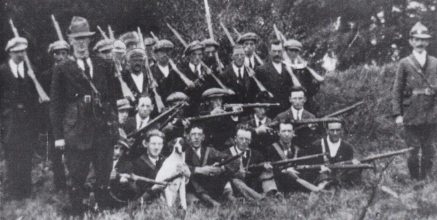
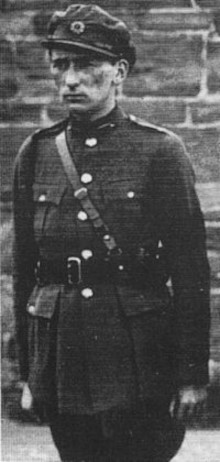
Hurley is born in Baurleigh, County Cork, near the village of Kilbrittain, on March 20, 1893, and is educated in the national school and subsequently passes the civil service examinations at age fifteen. According to his brother James, he is one of seven siblings, “born and reared in a farm of 35 acres.”
In 1918, Hurley is sentenced to five years penal servitude for possession of arms and plans of the British military fortifications at Bere Island. However, he is released in 1919 following a hunger strike. In the same year, his brother Willie, also an IRA Volunteer, dies of typhoid fever. He first becomes vice-commandant of the Volunteers or IRA Bandon Battalion and then in August 1920, after the arrest and imprisonment of Tom Hales, he becomes commander of the Third Cork Brigade of the IRA. One of his most important decisions is to establish a full-time guerrilla unit or flying column, under Tom Barry.
The 3rd Cork Brigade (also known as the West Cork Brigade) goes on to be one of the most active IRA units during the guerrilla war against the British in 1919–21. According to Barry, Hurley leads an ambush of the Royal Irish Constabulary (RIC) at Ahawadda in April 1920, killing three policemen, wounding one and taking their arms and ammunition. In July of that same year, he leads a successful attack on the Coastguard station at Howes Strand, capturing a large number of weapons and ammunition. Barry remarks that Hurley is “a remarkable man and a lovable personality” and “continually urged a fighting army policy.”
Hurley is present at the Tooreen ambush in October 1920 and subsequently is part of an assassination attempt on a judge who gives “harsh sentences” to IRA members. From December 1920 until January 1921, he takes command of the 3rd Cork Brigade’s flying column while Barry is ill. He also tours IRA units to assess the impact of the decree of excommunication on the guerrilla movement issued by CatholicBishop of Cork, Daniel Cohalan.
In February 1921, Hurley leads the disastrous Upton train ambush on February 15, 1921, an attack on a train carrying British troops. In the action, the attacking IRA party is heavily outnumbered and the firefight results in three IRA men and six civilians being killed. He is also badly wounded in the face and ankle. Barry writes of the aftermath of the ambush that “he (Hurley) mourned deeply for his dead comrades and for the dead civilians, whom he did not know.”
Hurley is killed in action by British troops just before the Crossbarry ambush on March 19, 1921. He is staying in a house with a pro-republican family, where he is recuperating from the serious wounds he had received at Upton a month earlier. When he realises that he is surrounded by the British forces, he flees the house, as Barry comments in his book, to reduce the danger to those in the house, and is shot dead by pursuing troops. Barry remarks that he “died in the manner in which we expected.”
The British Army places Hurley’s body at the workhouse in Bandon. However, members of Cumann na mBan surreptitiously take his body and he is given a secret republican funeral in Clogagh. A local ballad exists that commemorates him. In addition, the Gaelic Athletic Association grounds in Bandon is named after him in 1971.
Hales is born on a family farm owned by his father, Robert Hales, an activist in the Irish Land War and a reputed member of the Irish Republican Brotherhood (IRB) and his wife, Margaret (née Fitzgerald). He is the sixth of nine children (five sons and four daughters). He is educated at Ballinadee national school and Warner’s Lane school, Bandon. After leaving school he works at Harte’s timber yard, Bandon.
Hales joins and is involved with the Irish Volunteers movement from its inception in November 1913. Elected a delegate at the Volunteer national convention in the Abbey Theatre in 1915, he is among the majority who vote for the election of the national executive.
Hales is a part of a group of volunteers who are mobilised and plan to rise up in Cork during the 1916 Easter Rising. He sends a number of dispatches to Cork requesting further instructions. However, they receive last minute orders to stand down and there is no uprising in Cork to match that in Dublin. The Volunteers give up their arms and are later arrested.
By May 1916, Hales and his brothers, Seán, Bob, and William, are fighting with the IRA in west Cork during the Irish War of Independence. Terence MacSwiney is arrested in Hales’ home on May 3, 1916, and Hales himself escapes and goes on the run. He states that he was listed as “wanted” in the Hue and Cry police gazette.
In 1918, Hales takes part in a raid on a British gunboat and holds 25 armed Royal Irish Constabulary (RIC) members prisoner at Snugmore Castle. He takes part in a decoy in assisting his elder brother, Seán, to escape after his arrest in connection with the German Plot. He is elected Battalion Commandant of the 1st (Bandon) Battalion (1917–19), and Brigade Commandant of Cork 3rd Brigade, IRA, in January 1919.
In December 1919, Hales takes part in an ambush against the RIC at Kilbrittain and Bandon and is involved in the manufacture of gunpowder for IRA munitions. By this point he is the commander of the Third Cork Brigade of the IRA. In July 1920, he along with Harte is arrested by soldiers from the Essex Regiment.
The pair are taken to a nearby military barracks, where they are severely beaten while being interrogated by officers of the regiment. Hales has his fingernails pulled out, an event that later inspires a scene in the film The Wind That Shakes the Barley. However, neither Hales nor Harte give up any information and are eventually sent to a military hospital to recuperate. Hales is tried and is eventually sentenced to two years’ penal servitude, which he serves in Pentonville and Dartmoor prisons in England. He is commander of the Irish prisoners at Pentonville, but is released following a general amnesty after the Anglo-Irish Treaty in December 1921. According to Tom Barry, Harte suffers brain damage and goes insane before dying in Broadmoor Hospital.
A fifth Hales brother, Donal, settles in Genoa from 1913, and is appointed Irish Consular and Commercial Agent for Italy in February 1919. In this capacity he plays a leading propaganda role. Several letters from Michael Collins to Donal Hales still exist which are used by Hales to promote international awareness of the Irish conflict in Italian publications. Donal oversees a failed attempt to import a substantial number of Austrian weapons and ammunition captured from World War I, from Genoa in the spring of 1921, through the person of Gabriele D’Annunzio.
During the Irish Civil War, Tom and Seán Hales fight on opposite sides, with Hales fighting against the Anglo-Irish Treaty with the Anti-Treaty IRA while Seán joins the newly formed National Army of the Irish Free State. While the bothers end up on opposite sides of the war, they never openly criticise one another for their rival political stances.
Hales is elected to the anti-Treaty IRA executive in March 1922, but resigns in June over a proposal to prevent the Free State’s first general election in June 1922. He resumes his old rank during the Irish Civil War as commander of Cork 3 Brigade.
During the Irish Civil War in July 1922, Hales takes part in the raid and capture of Skibbereen Barracks and Ballineen by anti-Treaty forces. He is also involved in a skirmish with Free State troops at Newcestown. He is arrested in November 1922 and imprisoned first in Cork and then at the Curragh. He is released in December 1923, having taken part in a hunger strike for fourteen days. He mentions in his application for a military pension that he was a member of the Supreme Council of the IRB at this time.
In December 1922, Hales’s brother Seán is assassinated by the anti-Treaty IRA in Dublin, in reprisal for the Free State government’s execution of IRA prisoners. Hales later applies to the Irish government for a service pension under the Military Service Pensions Act, 1934 and is awarded nine years’ service in 1935 at Grade B for his service with the Irish Volunteers and the IRA between April 1, 1917, and September 30, 1923.
Hales makes his living as farmer. A member of the Mallow area board of the beet growers’ association from 1934 to 1942, he is also connected with other farming organisations. He marries Ann Lehane from Tirelton, Macroom, on April 30, 1927. They have five children, Seán, Robert, Thomas, Eileen, and Margaret.
Hales dies on April 29, 1966, at St. Finbarr’s Hospital, Cork, and is buried at St. Patrick’s Cemetery, Bandon.
The Coolavokig ambush (Irish: Luíochán Chúil an Bhuacaigh) is carried out by the Irish Republican Army (IRA) on February 25, 1921, during the Irish War of Independence. It takes place at Coolavokig, on the road between Macroom and Ballyvourney, County Cork. A 60-man flying column of the IRA’s 1st Cork Brigade under Seán O’Hegarty, ambushes a 70-man convoy of the Auxiliary Division under Major Seafield Grant, sparking a four-hour battle. Ten Auxiliaries are killed, including Major Grant, and others wounded. The IRA column leaves the area when British reinforcements arrive. After the ambush, British forces stop carrying out raids and patrols in the area.
The IRA flying column had been attempting to ambush the Auxiliaries for two weeks but had always missed them. As they occupy the ambush position over a few days, their position becomes known and a force of seventy Auxiliaries and seven Royal Irish Constabulary (RIC) constables move against them, heavily armed with rifles, machine guns and grenades. The sixty-two IRA volunteers include units from the 1st, 7th, and 8th battalions of the 1st Cork Brigade, and are divided into four sections. Apart from commander Seán O’Hegarty, the main IRA officers are Dan “Sandow” O’Donovan and Dan Corkery. The IRA is armed with sixty rifles, several shotguns and revolvers, and two Lewis guns, but significantly, no grenades. The British forces, traveling in eight lorries and two cars, also carry four Irish hostages with them.
Around 8:00 a.m. on February 25, IRA scouts signal the approach of the British force. The British are forewarned about the IRA position however, and approach with caution, when a republican leaving his post turns to run back and is seen from the leading lorry. When half of the lorries come into the ambush position the IRA opens fire. According to An Cosantóir, one lorry immediately turns around and speeds back to Macroom.
Rifles and a Lewis machine gun from the IRA’s No. 1 section, and ten rifles from the No. 4 section, open fire, as they are the only republican units that have a field of fire on the lorries. They then drop to the ground to avoid return fire. Sections No. 2 and No. 3 swing around to the east, on a hillside, in an attempt to encircle the British northern flank, but they can get no closer than 500 yards.
The Auxiliaries are quickly losing ground and taking casualties. Major Grant is killed while rallying his forces. The British forces retreat into two nearby cottages. The IRA closes in and as they are preparing to bomb the cottages, large numbers of RIC reinforcements approach and begin encircling the area. After fighting a half-hour rear guard action, the IRA flying column retreats toward the northwest. The engagement at Coolavokig lasts four hours, until soldiers of the Manchester Regiment arrive.
It later transpires that the Auxiliary forces are just part of a large round-up operation planned for that day which includes 600 British Army troops from Cork, Ballincollig, Bandon, Clonakilty, Skibbereen, Bantry, Dunmanway, Millstreet, Macroom, and Killarney. After the ambush, British forces cease raiding and patrolling the area west of Macroom, effectively handing it over to IRA control. They are reluctant to enter the area and only do so later with a strong force of 2,000 men.
The IRA suffers no casualties. However, the number of British casualties has been disputed to this day. The British claim that only Major (Auxiliary Commandant) James Seafield-Grant was killed during the ambush, and that two other Auxiliaries later died of their wounds. The IRA claims that between 14 and 16 members of the British force were killed. The Digest of Service for the 1st Battalion, Manchester Regiment, records that on March 18, 1921, a party proceeds to Coolavokig to destroy houses believed to have been used by the IRA.
In late January, Richard O’Connell, commander of the Mid Limerick Brigadeflying column, along with Captains Sean Lynch and Morgan Portley, begin planning an ambush of an RIC convoy from the Pallas RIC headquarters. Observing their activities for several months, local Volunteer John Purcell, of Caherconlish, finds that the first Thursday of each month they send a convoy to Fedamore with the payroll for RIC constables there, about eleven miles away. They also seem to use the same route each time. Such predictability is often a fatal flaw in a guerrilla war. The ambush is set for February 3.
The ambush is carried out by the flying columns of the East Limerick and Mid Limerick Brigades of the IRA, some forty riflemen, under the command of Donnocha O’Hannigan, commander of East Limerick Brigade flying column, and Richard O’Connell, commander of the Mid Limerick Brigade flying column.
The ambush location is well selected. The lorries are to come from the west. There is a severe right-hand turn at Dromkeen House, where the road turns east for several hundred yards in a straight line, to an intersection that splits to the north and south. O’Hannigan puts D. Guerin, Sean Stapleton, and Maurice Meade, all of East Limerick Brigade, at the corner to be the lookouts for the convoy. There are low stonewalls along both sides of most of the road. About halfway down its length there is a cemetery and an old, ruined church on the south side.
O’Hannigan spreads his men along both sides of the road, behind the walls and in several homes along the road and sets up barricades on the forks on the eastern end of the ambush, set back so the driver will not see them until they get to the intersection. He takes up a command position in an old, ruined cottage at the intersection. In addition to O’Hannigan, John MacCarthy, David Clancy and a few other East Limerick Volunteers are in the ruined cottage.
At approximately 2:30 p.m. the lookouts near Dromkeen House let them know the lorries are approaching. The plan is to let the lead lorry reach the barricade before they open fire, expecting them to be widely spaced. They are closer together than expected, however, and the men lining the road and near Dromkeen House open fire first at the second lorry when it is near the ruins of the old church to prevent it being getting beyond them. Michael Hennessy, of the Kilfinane Company of the East Limerick Brigade, in a spot near one of the walls, later says he killed the driver of the second lorry, Constable Sidney Millin, on his first shot. Millin may have had his foot on the brake at that moment, as the lorry almost immediately stops in the middle of the road.
The sound of the firing causes the lead lorry to speed up. Turning to the left and seeing one barricade, the driver tries to turn to the right, but is going too fast. He runs into the wall and then slams into a donkey cart with a bog of flour in it, sending a cloud of flour into the air and coming to a halt.
The cloud of flour, along with the fact that they are the only RIC members in civilian clothes, apparently saves the lives of two RIC men, Constable Cox and District Inspector Sanson, who was in charge of the convoy, who are thrown clear of the cab. By the time the cloud of flour clears, two men in civilian clothes are seen running through the field. Given that Crown Forces have been known to have civilian hostages in their lorries, O’Hannigan had his men hold their fire for fear of killing a hostage, and the two escape. Many of the Volunteers later speak of Sanson with scorn for abandoning his men.
All the Volunteer participants say the firing only lasts about ten minutes, with the RIC and Black and Tans able to mount very little resistance before all eleven left in the two lorries are either dead or wounded. Of the three remaining in the first lorry, one is apparently killed very quickly by rifle fire and several grenades. The other two manage to get out and take cover but are quickly hit.
Two constables managed to get underneath the second lorry. They put up a short resistance before both are hit and killed by Volunteers Johnny Vaughan and Seán Carroll, who move into positions along the road. The only Volunteer casualty is Liam Hayes, who is later a general in the Free State Army. He has part of his left thumb and part of a finger shot off, probably by friendly fire. As the firing ends, the Volunteers come out from cover to collect the arms from the dead and wounded.
It has been claimed that three of the RIC dead were executed after they had surrendered. Particular suspicion for this alleged killing of prisoners has fallen on Maurice Meade, a former British soldier who was captured by the Germans in World War I and had joined Roger Casement‘s Irish Brigade. In reprisal, British forces burn ten homes and farms in the area.
In February 2009, up to 2,000 people turn out for the unveiling of a memorial to the ambush.
(From: “The Dromkeen Ambush: Down Into the Mire in County Limerick” by Joee Gannon, The Wild Geese, http://www.thewildgeese.irish, November 2017 | Pictured: The East Limerick Flying Column)
After experiencing the political and social turmoil in Ireland after the 1913 Dublin lock-out and the 1916 Easter Rising, Byrne becomes an active member of the Postal Trade Union. In 1918 he loses his position as a telegraph operator in Limerick’s general post office because of his political activities, his attendance at the funeral of John Daly and an anti-conscription meeting at Limerick Town Hall in 1918. In 1919, he holds the rank of battalion adjutant of 2 Battalion, Mid Limerick Brigade of the IRA.
After a raid on Byrne’s home by the Royal Irish Constabulary (RIC), Byrne is arrested and charged for the possession of a revolver with corresponding ammunition and binoculars in front of a court-martial. Because he does not recognize the legitimacy of British Officers holding court over an Irish citizen, he denies entering a plea or even participating in the trial itself. Ignoring his protests, the court finds him guilty and sentences him to twelve months in prison and hard labour. Directly after the verdict is spoken, he is transferred to Limerick Prison to start his sentence.
As a prisoner, Byrne and sixteen other republican prisoners started a campaign, demanding status as political prisoners. As this is denied, they began barricading themselves in their cells, singing republican songs and damaging the interior and furniture of the cells. These protests are so loud that after a short while, onlookers and supporters start gathering outside the prison in support of the prisoners. The RIC reacts to these developments with physical violence and solitary confinement. As a last resort, in February 1919, the prisoners go on hunger strike to continue their protest. After his health deteriorates because of the hunger strike, in mid-March 1919, he is transferred to the Limerick Union Hospital, where he is placed in an ordinary ward under armed guard.
On April 6, 1919, two IRA companies under the lead of John Gallagher (D Company) and Michael Stack (E Company), the only two who bring arms to the rescue attempt, go into the hospital disguised as ordinary visitors and attempt a rescue operation. Around twenty volunteers go to the station on which Byrne is lying and after a signal whistle is blown, attack and attempt to overwhelm the two RIC officers that are posted as guards. The RIC officers quickly realize the attempt and RIC constable James Spillane shoots at Byrne, who wants to stand up from his bed, from close range, hitting him in the lung. Michael Stack, in response, shoots at constable James Spillane, injuring him, and his colleague constable Martin O`Brien, killing him.
The volunteers leave the hospital with the gravely injured Byrne, but the escape car and driver have in the meantime been ordered to another IRA operation. Instead, they stop a horse carriage at Hasset’s Cross. The occupants of the carriage, John Ryan and his wife of Knockalisheen, Meelick, County Clare, bring the bleeding and injured Byrne to their house, put him to bed and call for medical and clerical assistance. Dr. John Holmes arrives and examines Byrne, finding a large bullet wound on the left side of his body, which has perforated his lung and his abdomen. Byrne dies from his wounds in the evening of April 7, 1919.
After Byrne’s body is discovered by the authorities, the RIC place Limerick under martial law and declare it a “Special Military Area.” In response, the trade unions in Limerick start a “general strike against British militarism.” This strike is called the “Limerick Soviet” by foreign journalists who report from Limerick.
On the evening of April 8, 1919, Byrne’s funeral is held. He is not able to be buried in his IRA uniform, because the RIC had removed it from him. Nevertheless, the funeral procession is accompanied by huge crowds and his remains, which lay in state in front of the high altar in St. John’s Cathedral, are visited by thousands from Limerick and surrounding areas.
Tobin is the eldest son of Mary Agnes (nee Butler) and David Tobin, a hardware clerk. He has two younger siblings, Katherine and Nicholas Augustine Tobin, also born in Cork. His family moves to John Street in Kilkenny and then to Dublin. He goes to school in Kilkenny and is an apprentice in a hardware shop at the time of the 1916 Easter Rising. As a participant in the Rising, he fights in the Four Courts garrison under Edward Daly. He is arrested, court martialed, and sentenced to death but his sentence is commuted to life imprisonment. He is a prisoner in Kilmainham, Mountjoy, Lewes, Dartmoor, Broadmoor and Pentonville prisons. He is released in June 1917.
In October 1921, Tobin travels with the Irish Treaty Delegation as part of Collins’ personal staff.
Tim Pat Coogan and James Mackay have examined Tobin’s involvement in the assassination of British Field MarshalSir Henry Wilson. Wilson’s public tirades about Collins is evidence of mutual personal dislike between the two men. In May 1922 Collins tells Tobin “We’ll kill a member of that bunch” to the news of “bloody pogroms” in Belfast. Wilson is intimately involved with the Ulster loyalist cause, including the Curragh Mutiny and the establishment of the Ulster Special Constabulary. Just before the shooting, Coogan places Tobin in London. He meets courier Peig Ni Braonain at Euston Station collecting a document that has been sent from Dublin. Returning to Dublin before the incident, he is jubilant when he tells defence ministerRichard Mulcahy about Wilson’s death. Mulcahy is appalled and threatens to resign.
In October 1922, Tobin’s brother Nicholas, a Free State captain, is accidentally shot dead by his own troops during the raid and capture of a bomb making factory at number 8 Gardiner’s Place, Dublin.
Tobin believes in the steppingstone doctrine which sees the Treaty as a stage towards full independence. With the outbreak of the Irish Civil War he remains loyal to Collins and takes the Pro-Treaty side. He leads in the fight against the Anti-Treaty IRA in the south. Disillusioned with the continuing hostilities and in the aftermath of the death of Collins, he forms an association called the IRA Organisation (IRAO) or “Old Irish Republican Army” to distinguish themselves from the anti-treaty insurgents.
Richard Mulcahy, the new Irish defence minister, proposes to reduce the army from 55,000 to 18,000 men in the immediate post- Civil-War period. Tobin knows his own position is to be affected and shares the perception that the Irish Army treats former British officers better than former IRA officers. On March 7, 1924, Tobin, together with Colonel Charlie Dalton, sends an ultimatum to President of the Executive Council of the Irish Free StateW. T. Cosgrave demanding an end to the army demobilisation. The immediate response is an order for the arrest of the two men on a charge of mutiny. The cabinet, already wary of the Irish Army, orders an inquiry and appoints Garda CommissionerEoin O’Duffy to the army command.
On March 18, the mutineers assemble with hostile intent at a Dublin pub. An order is made to arrest the mutineers and the cabinet demands the resignation of the army council. The generals resign, affirming the subservience of the military to the civilian government of the new state.
In later years, Tobin rebuilds relations with his Civil War foes and joins Éamon de Valera‘s Anti-Treaty Fianna Fáil party. He joins up with Joseph McGrath to form the Irish Hospitals’ Sweepstake in the 1930s. Many other former army comrades find work in this lottery. He leaves the Sweep in 1938. After World War II, he becomes Superintendent of the Oireachtas for the Irish Dáil.
On October 14, 1929, Tobin marries Monica “Mona” Higgins at the Church of the Holy Family, Aughrim Street, Dublin. They have two daughters, Máire and Anne Tobin. Following the death of his father, David, in 1956, Tobin’s health declines, resulting in his death in Dublin on April 30, 1963.
In April 1919, Terence MacSwiney proposes the establishment of a daily paper by the Dáil for the purpose of publicity. His suggestion is not implemented until November, when Desmond FitzGerald decides that some form of printed counterpropaganda is vital to republican aims and to take advantage of the success of Sinn Féin and the increasing international interest in Ireland. Fitzgerald succeeds Laurence Ginnell in the Ministry following the latter’s arrest in April 1919, though he does not take up the position until July. At a Cabinet meeting held on November 7, there is agreement that there should be “A scheme for daily news bulletin to foreign correspondents, weekly lists of atrocities; entertainment of friendly journalists approved, and £500 voted for expenses under Mr. Griffith’s personal supervision.” Four days later the Irish Bulletin makes its debut, in a run consisting of just thirty copies. Five issues of the bulletin are issued each week for the next two years, despite efforts by the British authorities to suppress it.
The Irish Bulletin‘s offices are originally located at No. 6 Harcourt Street, Dublin. FitzGerald is the paper’s first editor, until his arrest and replacement by Erskine Childers. In the early days, the paper is produced mainly by Frank Gallagher and Robert Brennan. Brennan, as Sinn Féin’s Director of Publicity since April 1918, had played a leading role in that party’s success in the 1918 Irish General Election.
Following FitzGerald’s arrest in 1921, Childers is appointed Director of Propaganda taking charge of publicity and thus becoming the paper’s new editor. On May 9, 1921, both Childers and Gallagher are arrested and taken to Dublin Castle. Following the intervention of Sir Alfred Cope, both are released that night and go on the run. The hasty release of the two leads to speculation between Art O’Brien and Michael Collins that there is a rift developing between the British military authorities and the civil administration. Despite the arrests, the Irish Bulletin continues to appear on schedule. Alan J. Ellis, a journalist with The Cork Examiner makes occasional contributions to the paper. Kathleen Napoli McKenna is “a key force behind the daily newssheet.”
In the early days, the Irish Bulletin consists mainly of lists of raids by the security forces and the arrests of suspects. In order to stimulate interest, this is expanded in 1921 at the behest of the Irish President, Éamon de Valera, in his direction to Childers to give more detailed accounts of events. Extracts from foreign publications, particularly sympathetic English papers, are frequently included. A regular feature is accounts from the Dáil Courts, which are reported in detail.
The Irish Bulletin is more graphic in its coverage of violence than is usual for its time. An example is its reporting on the deaths of two prominent Sinn Féin leaders, Henry and Patrick Loughnane, from Shanaglish, Gort, County Galway. The men had been handed over by the Royal Irish Constabulary (RIC) to local members of the Auxiliary Division. On December 6, the bodies are found in a pond. The skulls had been battered in and the flesh was hanging loose on both bodies.The two men were evidently tied by the neck to a motor lorry and dragged behind it until they were dead. Before the bodies were hidden in a pond an effort was made to burn them.
On the night of March 26-27, 1921, the offices of the Irish Bulletin are discovered by the British authorities. Captured typewriters and duplicators are used to fabricate bogus issues of the paper. These are distributed to the usual subscribers using lists found at the office. Lord Henry Cavendish-BentinckMP on receiving some of the counterfeit papers through the post, asks in the House that those responsible “not (to) waste their money in sending me any more of their forgeries.” The initial efforts of the forgers, Captains Hugh Pollard and William Darling, are of poor quality and easily identified as counterfeit.
(Pictured: The “Irish Bulletin” issue of October 12, 1920, National Museum of Ireland)
Crown forces hope to burn the town of Ballinalee as a reprisal for the deaths of several Royal Irish Constabulary (RIC) personnel in the preceding days. This includes the killing of an RIC inspector, Philip St. Johnstone Howlett Kelleher, the previous week and an RIC Constable, Peter Cooney, the previous day. Cooney had been suspected of being a spy and his execution is reputedly ordered by Michael Collins. At the time of his killing, Cooney is allegedly carrying coded dispatches with the names of Longford IRA men.
The Crown forces, numbering 100 men in eleven trucks, are defeated by about twenty-five IRA members, of which four are involved in the main battle. Mac Eoin had placed several groups at the roads leading into the village, including one at a house, Rose Cottage, on the approach to the village centre. This group, referred to in some sources as the “Rose Cottage Four,” engage the much larger RIC force using rifle fire and grenades, and force their retreat after a two and a half hour gunfight.
Ó Brádaigh is born into a middle-class republican family. His father, Matt Brady, is an IRA volunteer who is severely wounded in an encounter with the Royal Irish Constabulary (RIC) in 1919. His mother, May Caffrey, is a Cumann na mBan volunteer and a 1922 graduate of University College Dublin (UCD). His father dies when he is ten and is given a paramilitary funeral led by his former IRA colleagues. His mother, prominent as the Secretary for the County Longford Board of Health, lives until 1974. He is educated at Melview National School at primary level and attends secondary school at St. Mel’s College, leaving in 1950, and graduates from University College Dublin in 1954. That year he takes a job teaching Irish language at Roscommon Vocational School in Roscommon. He is a deeply religious Catholic who refrains from smoking or drinking.
Ó Brádaigh joins Sinn Féin in 1950. While at university, in 1951, he joins the Irish Republican Army. In September 1951, he marches with the IRA at the unveiling of the Seán Russell monument in Fairview Park, Dublin. A teacher by profession, he is also a Training Officer for the IRA. In 1954, he is appointed to the Military Council of the IRA, a subcommittee set up by the IRA Army Council in 1950 to plan a military campaign against Royal Ulster Constabulary (RUC) barracks in Northern Ireland.
On August 13, 1955, Ó Brádaigh leads a ten-member IRA group in an arms raid on Hazebrouck Barracks, near Arborfield, Berkshire, England, a depot for the No. 5 Radar Training Battalion of the Royal Electrical and Mechanical Engineers. It is the biggest IRA arms raid in Britain. Most, if not all, of the weapons are recovered in a relatively short period of time. A van, traveling too fast, is stopped by the police and IRA personnel are arrested. Careful police work leads to weapons that had been transported in a second van and stored in London.
The IRA Border Campaign commences on December 12, 1956. As an IRA General Headquarters Staff (GHQ) officer, Ó Brádaigh is responsible for training the Teeling Column in the west of Ireland. During the Campaign, he serves as second-in-command of the Teeling Column. On December 30, 1956, he partakes in the Teeling Column attack on RUC barracks in Derrylin, County Fermanagh. RUC Constable John Scally is killed in the attack and is the first fatality of the new IRA campaign. Ó Brádaigh and others are arrested by the Garda Síochána across the border in County Cavan the day after the attack. They are tried and jailed for six months in Mountjoy Prison. A leading abstentionist, upon his arrest he refuses to recognize the authority of the Irish government and refuses to renounce violence in exchange for his release.
Upon completing his prison sentence, Ó Brádaigh is immediately interned at the Curragh Camp along with other republicans. On September 27, 1958, he escapes from the camp along with Dáithí Ó Conaill. While a football match is in progress, the pair cuts through a wire fence and escapes from the camp under a camouflage grass blanket. This is an official escape, authorised by the officer commanding (OC) of the IRA internees, Tomás Óg Mac Curtain. He is the first Sinn Féin TD on the run since the 1920s.
In October 1958, Ó Brádaigh becomes the IRA Chief of Staff, a position he holds until May 1959, when Seán Cronin is elected as his replacement. He is arrested in November 1959, refuses to answer questions, and is jailed in Mountjoy Prison under the Offences against the State Act. He is released in May 1960 and, after Cronin is arrested, again becomes Chief of Staff. Although he always emphasises that it is a collective declaration, he is the primary author of the statement ending the IRA Border Campaign in 1962. At the IRA 1962 Convention he indicates that he is not interested in continuing as Chief of Staff.
After Ó Brádaigh’s arrest in December 1956, he takes a leave from teaching at Roscommon Vocational School. He is re-instated and begins teaching again in late 1962, just after he is succeeded by Cathal Goulding in the position of Chief of Staff of the IRA. He remains an active member of Sinn Féin and is also a member of the IRA Army Council throughout the decade.
Ó Brádaigh opposes the decision of the IRA and Sinn Féin to drop abstentionism and to recognise the Westminster parliament in London, the Stormont parliament in Belfast and the Leinster House parliament in 1969/1970. On January 11, 1970, along with Seán Mac Stíofáin, he leads the walkout from the 1970 Sinn Féin Ard Fheis after the majority votes to end the policy of abstentionism, although the vote to change the Sinn Féin constitution fails to receive the required two-thirds majority. The delegates who walk out reconvene at the Kevin Barry Hall in Parnell Square, Dublin, and establish Provisional Sinn Féin.
Ó Brádaigh is voted chairman of the Caretaker Executive of Provisional Sinn Féin. That October, he formally becomes president of the party. He holds this position until 1983. In his presidential address to the 1971 Provisional Sinn Féin Ard Fheis, he says that the first step to achieving a United Ireland is to make Northern Ireland ungovernable. He apparently also serves on the Army Council or the executive of the Provisional Irish Republican Army until he is seriously injured in a car accident on January 1, 1984.
On May 31, 1972, Ó Brádaigh is arrested under the Offences Against the State Act and immediately commences a hunger strike. A fortnight later the charges against him are dropped and he is released. With Dáithí Ó Conaill he develops the Éire Nua policy, which is launched on June 28, 1972. The policy calls for a federal Ireland.
On December 3, 1972, Ó Brádaigh appears on the London Weekend TelevisionWeekend World programme. He is arrested by the Gardaí again on December 29, 1972, and charged in the newly established Special Criminal Court with Provisional IRA membership. In January 1973 he is the first person convicted under the Offences Against the State (Amendment) Act 1972 and is sentenced to six months in the Curragh Camp.
On December 10, 1974, Ó Brádaigh participates in the Feakle talks between the IRA Army Council and Sinn Féin leadership and the leaders of the Protestant churches in Ireland. Although the meeting is raided and broken up by the Gardaí, the Protestant churchmen pass on proposals from the IRA leadership to the British government. These proposals call on the British government to declare a commitment to withdraw, the election of an all-Ireland assembly to draft a new constitution and an amnesty for political prisoners.
The IRA subsequently calls a “total and complete” ceasefire intended to last from December 22, 1974, to January 2, 1975, to allow the British government to respond to proposals. British government officials also hold talks with Ó Brádaigh in his position as president of Sinn Féin from late December to January 17, 1975.
On February 10, 1975, the IRA Army Council, unanimously endorses an open-ended cessation of IRA “hostilities against Crown forces,” which becomes known as the 1975 truce. The IRA Chief of Staff at the time is Seamus Twomey of Belfast. It is reported in some quarters that the IRA leaders mistakenly believe they had persuaded the British Government to withdraw from Ireland and the protracted negotiations between themselves and British officials are the preamble to a public declaration of intent to withdraw. In fact, as British government papers now show, the British entertain talks with the IRA in the hope that this would fragment the movement further and score several intelligence coups during the talks. This bad faith embitters many in the republican movement, and another ceasefire does not happen until 1994.
In late December 1976, along with Joe Cahill, Ó Brádaigh meets two representatives of the Ulster Loyalist Central Co-ordinating Committee (ULCCC), John McKeague and John McClure, at the request of the latter body. Their purpose is to try to find a way to accommodate the ULCCC proposals for an independent Northern Ireland with the Sinn Féin’s Éire Nua programme. It is agreed that if this can be done, a joint Loyalist-Republican approach can then be made to request the British government to leave Ireland. Desmond BoalQC and Seán MacBrideSC are requested and accepted to represent the loyalist and republican positions. For months they have meetings in various places including Paris. The dialogue eventually collapses when Conor Cruise O’Brien, then Minister for Posts and Telegraphs and vociferous opponent of the Provisional IRA, becomes aware of it and condemns it on RTÉ Radio. As the loyalists had insisted on absolute secrecy, they feel unable to continue with the talks as a result.
In the aftermath of the 1975 truce, the Ó Brádaigh/Ó Conaill leadership comes under severe criticism from a younger generation of activists from Northern Ireland, headed by Gerry Adams, who becomes a vice-president of Sinn Féin in 1978. By the early 1980s, Ó Brádaigh’s position as president of Sinn Féin is openly under challenge and the Éire Nua policy is targeted in an effort to oust him. The policy is rejected at the 1981 Sinn Féin Ard Fheis and finally removed from the Sinn Féin constitution at the 1982 Ard Fheis. At the following year’s Ard Fheis, Ó Brádaigh and Ó Conaill resign from their leadership positions, voicing opposition to the dropping of the Éire Nua policy by the party.
On November 2, 1986, the majority of delegates to the Sinn Féin Ard Fheis vote to drop the policy of abstentionism if elected to Dáil Éireann, but not the British House of Commons or the Northern Ireland parliament at Stormont, thus ending the self-imposed ban on Sinn Féin elected representatives from taking seats at Leinster House. Ó Brádaigh and several supporters walk out and immediately assemble at Dublin’s West County Hotel and set up Republican Sinn Féin (RSF). As an ordinary member, he had earlier spoken out against the motion (resolution 162) in an impassioned speech. The Continuity IRA becomes publicly known in 1996. Republican Sinn Féin’s relationship with the Continuity IRA is similar to the relationship between Sinn Féin and the Provisional IRA when Ó Brádaigh was Sinn Féin’s president.
Ó Brádaigh believes RSF to be the sole legitimate continuation of the pre-1986 Sinn Féin, arguing that RSF has kept the original Sinn Féin constitution. RSF readopts and enhances his Éire Nua policy. His party has electoral success in only a few local elections.
Ó Brádaigh remains a vociferous opponent of the Good Friday Agreement, viewing it as a programme to copperfasten Irish partition and entrench sectarian divisions in the north. He condemns his erstwhile comrades in Provisional Sinn Féin and the Provisional IRA for decommissioning weapons while British troops remain in the country. In his opinion, “the Provo sell-out is the worst yet – unprecedented in Irish history.” He condemns the Provisional IRA’s decision to seal off a number of its arms dumps as “an overt act of treachery,” “treachery punishable by death” under IRA General Army Order Number 11.
In July 2005, Ó Brádaigh hands over a portion of his personal political papers detailing discussions between Irish Republican leaders and representatives of the British Government during 1974–1975 to the James Hardiman Library, National University of Ireland, Galway.
In September 2009, Ó Brádaigh announces his retirement as leader of Republican Sinn Féin. His successor is Des Dalton. He is also a long-standing member of the Celtic League, an organization which fosters cooperation between the Celtic people and promotes the culture, identity and eventual self-determination for the people, in the form of six sovereign states, for the Celtic nations – Wales, Cornwall, Brittany, Scotland, Isle of Man and Ireland.
After suffering a period of ill-health, Ó Brádaigh dies on June 5, 2013, at Roscommon County Hospital. His funeral is attended by 1,800 mourners including Fine Gael TD Frank Feighan and is policed by the Garda Emergency Response Unit and Gardaí in riot gear, for “operational reasons,” a show of force believed to have been to deter the republican tradition of firing a three-volley salute of shots over the final place of rest during the graveyard oration. As a result, there are some minor scuffles between gardai and mourners.
McCorley is one of three children born to Roger Edmund McCorley, a meat carver in a hotel, and Agnes Liggett. He has two elder brothers, Vincent and Felix. He joins the Fianna in his teens. His family has a very strong republican tradition, and he claims to be the great-grandson of the United Irishmen folk hero Roddy McCorley, who was executed for his part in the Irish Rebellion of 1798.
McCorley is noted for his militancy, as he is in favour of armed attacks on British forces in Belfast. The Brigade’s leaders, by contrast, in particular, Joe McKelvey, are wary of sanctioning attacks for fear of loyalist reprisals on republicans and the Catholic population in general. In addition, McCorley is in favour of conducting an armed defense of Catholic areas, whereas McKelvey does not want the IRA to get involved in what he considers to be sectarian violence. McCorley writes later that in the end, “the issue settled itself within a very short space of time, when the Orange mob was given uniforms, paid for by the British, and called the Ulster Special Constabulary (USC).” The role of the USC, a temporary police force raised for counter-insurgency purposes, in the conflict is still debated, but republicans maintain that the organization was responsible for the indiscriminate killings of Catholics and nationalists.
On January 26, 1921, McCorley, is involved in the fatal shooting of three Auxiliary Division officers in their beds in the Railway View hotel in central Belfast. Shortly afterwards, he and another IRA man, Seamus Woods, organize an active service unit (ASU) within the first battalion of the Belfast Brigade, with the intention of carrying out attacks, with or without the approval of the Brigade leadership. The unit consists of 32 men. McCorley later writes, “I issued a general order that, where reprisal gangs [State forces] were cornered, no prisoners were to be taken.” In March 1921, he personally leads the ASU in the killing of three Black and Tans in Victoria Street in central Belfast. He is responsible for the deaths of two more Auxiliaries in Donegall Place in April. In reprisal for these shootings, members of the RIC assassinate two republican activists, the Duffin brothers in Clonard Gardens in west Belfast. On June 10, 1921, both and Woods and McCorley units are involved in the killing a RIC man who is suspected in the revenge killings of the Duffin brothers. Two RIC men and a civilian are also wounded in that attack.
Thereafter, there is what historian Robert Lynch has described as a “savage underground war” between McCorley’s ASU and RIC personnel based in Springfield Road barracks and led by an Inspector Ferris. Ferris is accused of murdering the Lord Mayor of Cork Thomas MacCurtain and had been posted to Lisburn for his safety. Ferris himself is among the casualties, being shot in the chest and neck, but surviving. McCorley claims to have been one of the four IRA men who shot Ferris. In addition, his men bomb and burn a number of businesses including several cinemas and a Reform Club. In May 1921, however, thirteen of his best men are arrested when surrounded by British troops during an operation in County Cavan. They are held in Crumlin Road Gaol and sentenced to death.
On June 3, McCorley organizes an attack on Crumlin Road Gaol in an attempt to rescue the IRA men held there before they are executed. The operation is not a success; however, the condemned men are reprieved after a truce is agreed between the IRA and British forces in July 1921. On Bloody Sunday (July 10, 1921), he is a major leader in the defense of nationalist areas from attacks by both the police and loyalists. On that day twenty people are killed before he negotiates a truce beginning at noon on July 11. At least 100 people are wounded, about 200 houses are destroyed or badly damaged – most of them Catholic homes, leaving 1,000 people homeless.
In April 1922, McCorley becomes leader of the IRA Belfast Brigade after Joe McKelvey goes south to Dublin to join other IRA members who are against the Anglo-Irish Treaty. With McKelvey’s departure, Seamus Woods becomes Officer Commanding of the IRA’s 3rd Northern Division, which has up to 1,000 members, with McCorley designated as Vice Officer Commanding. McCorley for his part, supports the Treaty, despite the fact that it provides for the partition of Ireland and the continued British rule in Northern Ireland. The reason for this is that Michael Collins and Eoin O’Duffy have assured him that this is only a tactical move and indeed, Collins sends men, money and weapons to the IRA in the North throughout 1922.
However, McCorley’s command sees the collapse of the Belfast IRA. In May 1922, the IRA launches an offensive with attacks all across Northern Ireland. In Belfast, he carries out an assault on Musgrave Street RIC barracks. He also conducts an arson campaign on businesses in Belfast. His men also carry out a number of assassinations, including that of Ulster Unionist PartyMPWilliam J. Twaddell, which causes the internment of over 200 Belfast IRA men.
To escape from the subsequent repression, McCorley and over 900 Northern IRA men flee south, to the Irish Free State, where they are housed in the Curragh. McCorley is put in command of these men. In June 1922, the Irish Civil War breaks out between Pro and Anti-Treaty elements of the IRA. He takes the side of the Free State and Michael Collins. After Collins is killed in August 1922, his men are stood down. About 300 of them join the National Army and are sent to County Kerry to put down anti-Treaty guerrillas there. In the Spring of 1923, bitterly disillusioned by the brutal counterinsurgency against fellow republicans, he resigns his command.
McCorley later asserts that he “hated the Treaty” and only supported it because it allowed Ireland to have its own armed forces. Both he and Seamus Woods are severe critics of the Irish Free State inertia towards Northern Ireland after the death of Michael Collins. He comments that when Collins was killed “the Northern element gave up all hope.”
In 1936 McCorley is instrumental in the establishment of the All-Ireland Old IRA Men’s Organization, serving as Vice-President with President Liam Deasy (Cork No. 3 Brigade) and Secretary George Lennon (Waterford No. 2 Brigade).