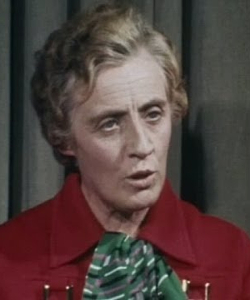
Drumm is born to a staunchly Irish republican family. Drumm’s mother has been active in the Irish War of Independence and the Irish Civil War. Drumm grows up in the village of Killean, County Armagh, where she plays camogie. She is active in the republican movement after meeting her husband, a republican prisoner. She begins to speak at many rallies and protest meetings and is soon elected as Vice President of Sinn Fein. She becomes involved in the Northern Ireland Civil Rights Association in the 1960s and works to rehouse Irish Catholics forced from their homes by loyalist intimidation.
Drumm is jailed twice for seditious speeches. After she is released from HM Prison Armagh, raids on her house by the security forces escalate. She is widely demonised in the British media and is already a target for assassination when she is admitted to Belfast’s Mater Hospital for eye treatment in October 1976.
While recovering from the operation, Drumm is shot at point blank range on October 28, 1976, in a joint operation by the Ulster Volunteer Force and the Ulster Defence Association who are dressed as doctors enabling them to enter and leave the hospital undisturbed. No one has ever been convicted of her murder.
Drumm’s speeches and quotations can be found on murals across Northern Ireland, including:
“The only people worthy of freedom are those who are prepared to go out and fight for it every day, and die if necessary.”
“We must take no steps backward, our steps must be onward, for if we don’t, the martyrs that died for you, for me, for this country will haunt us forever.”
Hume, 61, the Catholic head of the Social Democratic and Labor Party, is cited by the Nobel Committee in Oslo for having been the “clearest and most consistent of Northern Ireland’s political leaders in his work for a peaceful solution.”
Trimble, 54, the Protestant leader of the Ulster Unionist Party, is honored for having demonstrated “great political courage when, at a critical stage in the process, he advocated solutions which led to the peace agreement.”
The accord, signed on April 10 and known as the Good Friday Agreement, gives the 1.7 million residents of Northern Ireland a respite from the sectarian violence that has claimed more than 3,200 lives in the previous 30 years. It also opens the possibility of lasting stability for the first time since the establishment of Northern Ireland with partition from Ireland in 1921.
Forging concessions from fiercely antagonistic populations, the accord seeks to balance the Protestant majority’s wish to remain part of Britain with Catholic desires to strengthen ties to the Republic of Ireland to the south. The committee, seeing in Northern Ireland’s two warring groups a dispute with notable similarities to violent tribal confrontations elsewhere, expresses the hope that the accord will serve “to inspire peaceful solutions to other religious, ethnic and national conflicts around the world.”
Adams, in New York on a fund-raising trip for Sinn Féin, welcomes the Oslo announcement and particularly praises Hume, who is widely seen as having helped persuade the IRA to adopt a cease-fire and having eased Sinn Féin’s entry into the talks. “Indeed, there would be no peace process but for his courage and vision,” Adams says, adding, “No one deserves this accolade more.” He also wishes Trimble well and says the prize imposes on everyone the responsibility to “push ahead through the speedy implementation of the agreement.”
In the unforgiving politics of Northern Ireland, the Unionist dissidents and members of other Protestant parties who do not join in the peace talks attack both Trimble and Hume. Ian Paisley Jr., son of the head of the Democratic Unionist Party, calls the Nobel Committee’s decision a “farce” and says of the winners, “These people have not delivered peace, and they are not peacemakers.”
Trimble says he is “slightly uncomfortable” with the award because so many other people have been involved beside him in reaching the settlement and much remains to be done to put it in place. “We know that while we have the makings of peace, it is not wholly secure yet,” he tells the BBC from Denver, where he is on an 11-city North American tour to spur foreign investment in Ulster. “I hope it does not turn out to be premature.”
Hume receives word of the prize at his home in Londonderry and terms it “an expression of the total endorsement of the work of very many people.” He adds, “This isn’t just an award to David Trimble and myself. It is an award to all the people in Northern Ireland.”
In Washington, D.C., President Clinton says “how very pleased” he is, “personally and as President, that the Nobel Prize Committee has rewarded the courage and the people of Northern Ireland by giving the Nobel Peace Prize to John Hume and to David Trimble.” He adds “a special word of thanks” to George Mitchell, who issues a statement praising Hume and Trimble as “fully deserving of this honor.”
The peace talks began in the summer of 1996. They eventually draw the participation of 8 of the 10 Northern Irish parties, with many of the men around the table convicted murderers and bombers who had emerged from prison with a commitment to peaceful resolution to what for nearly a century have been referred to wearily as “the Troubles.” The paramilitary groups had also made the tactical decision that violence would not secure their goals; a shared conviction that gives these talks a chance for success that past fitful attempts at settlement lacked.
The peace talks move in a desultory manner until Blair takes office in May 1997 and highlights the cause of peace in Northern Ireland as an early commitment. At his and Ahern’s urging, the IRA declares a cease-fire in July, and by September Sinn Féin is permitted to join the talks.
Blair also gives Trimble and Adams unprecedented access to 10 Downing Street, and the Ulster Protestants report that they obtained from Clinton the most sympathetic hearing they ever had from an American President, allaying their longtime suspicions of Washington’s bias in favor of the Catholic minority.
(From: “2 Ulster Peacemakers Win the Nobel Prize,” The New York Times, Warren Hoge, October 17, 1998)
O’Brien shares his primary education with a townsman with whom he is later to have a close political connection, CanonPatrick Augustine Sheehan of Doneraile. He enjoys his secondary education at the Cloyne diocesan college, which results in his being brought up in an environment noted for its religious tolerance. He greatly values having had this experience from an early age, which strongly influences his later views for the need of such tolerance in Irish national life.
A journalist from 1869, O’Brien is appointed editor of the Irish Land League’s weekly United Ireland by Parnell in 1881. In October of that year the British authorities suppress the paper and put O’Brien in Kilmainham Gaol in Dublin, along with Parnell and others. There he draws up a No Rent Manifesto, which, when read at a Land League meeting, results in the outlawing of the League. Released from prison in 1882, he resumes the editorship of United Ireland, and in 1883 he is elected to the British House of Commons, remaining there until 1895. His “plan of campaign” is disavowed by Parnell but nonetheless stirs up fierce agitation. To suppress the movement, the British government passes the Criminal Law and Procedure (Ireland) Act 1887, under which O’Brien is jailed again.
For some time following the O’Shea divorce case (1889–90), in which Parnell is corespondent, O’Brien attempts to mediate between the Parnellites and their opponents, although he sides with the majority in rejecting Parnell’s continued leadership of the Irish Home Rule struggle. In 1902 he supports the Land Conference, which secures agreement between landlords and tenants’ representatives and results in George Wyndham‘s Land Purchase Act (1903), which is designed to turn Irish tenant farmers into occupying owners.
Retiring from political life, O’Brien contents himself with writing and declines Éamon de Valera‘s offer to stand for Fianna Fáil in the 1927 general election. He dies suddenly at the age of 75 on February 25, 1928, while on a visit to London with his wife. His remains rest in Mallow, and one of the principal streets in the town bears his name to this day. His head-bust overlooks the town Council’s Chamber Room and one of his finest portraits hangs in University College Cork.
Between 1932 and 1937 Dillon serves as Teachta Dála (TD) for the Donegal constituency for the National Centre Party and after its merger with Cumann na nGaedheal, for the new party of Fine Gael. He plays a key role in instigating the creation of Fine Gael and becomes a key member of the party in later years. He remains as TD for Monaghan from 1937 to 1969. He becomes deputy leader of Fine Gael under W. T. Cosgrave.
Dillon resigns from Fine Gael in 1942 over its stance on Irish neutrality during World War II. While Fine Gael supports the government’s decision to stay out of the war, he urges the government to side with the Allies. He is a rabid anti-Nazi, proclaiming the Nazi ideology is “the devil himself with twentieth-century efficiency.” His zealousness against the Nazis draws him the ire of the German minister to Ireland, Eduard Hempel, who denounces him as a “Jew” and “German-hater.”
Dillon has a personally eventful 1942. While holidaying in Carna, County Galway he meets Maura Phelan of Clonmel on a Friday. By that Monday the two are engaged and six weeks after that they are married.
Dillon is one of the independents who supports the first inter-party government (1948–1951) and is appointed Minister for Agriculture. As Minister, he is responsible for huge improvements in Irish agriculture. Money is spent on land reclamation projects in the areas of less fertile land while the overall quality of Irish agricultural produce increases.
Dillon rejoins Fine Gael in 1953. He becomes Minister for Agriculture again in the second inter-party government (1954–1957). In 1959 he becomes leader of Fine Gael, succeeding Richard Mulcahy. He becomes president of the party in 1960. In 1965 Fine Gael loses the general election to Seán Lemass and Fianna Fáil. The non-Fianna Fáil parties win 69 seats to Fianna Fáil’s 72. Had the other parties been able to win four more seats between them, they would have been able to form a government. Having narrowly failed to become Taoiseach, Dillon stands down as Fine Gael leader after the election.
Dillon is a colourful contributor to Dáil proceedings and is noted for his high standard of oratory. He remains a TD until 1969, when he retires from politics. He died in Malahide, Dublin on February 10, 1986, at the age of 83.
The Volunteers in County Clare have been active since 1917 and by late 1920 have forced the Royal Irish Constabulary (RIC) to abandon most of its small rural barracks in the county. This gives the IRA greater freedom to move in the countryside. In August 1920, the RIC are reinforced by the British deployment of Black and Tans and Auxiliaries to the county. Five RIC men, eleven IRA volunteers and four civilians have been killed in County Clare during the two years before the ambush.
The Rineen Ambush is ordered by the leadership of the IRA’s Mid-Clare Brigade, who had noticed that a RIC lorry travels every week on the Ennistymon to Milltown Malbay road. John Joe Neylon, leader of the local IRA battalion, is put in charge, although the actual attack is led by Ignatius O’Neill, the Officer Commanding. He is a veteran of World War I who had formerly fought with the Irish Guards. The ambush party has only nine rifles and some grenades, the remainder being armed with shotguns or handguns. They prepare to attack the lorry from a railway bridge that overlooks the road at Rineen.
As the IRA party is lying in wait, Alan Lendrum, the local resident magistrate, drives unwittingly into a roadblock of the IRA’s West Clare Brigade, in an unrelated action. He is stopped at a railway crossing at Caherfeenick near Doonbeg. When the IRA demand he surrender his car, he draws an automatic pistol and the IRA men shoot him twice in the head, fatally wounding him. The IRA weights his body with stones and dumps it in a nearby lake. Even though the British Military inquest establishes that Lendrum had died of gunshot wounds, members of the RIC in Clare spread a false version of events and claim that Lendrum had died of drowning.
Although in strict military sense not related to the ambush, it has serious consequences for the ambush. It is quite quickly noticed that the magistrate is missing and the military in Ennistymon decide to send out a search party of ten lorries of soldiers.
The RIC lorry passes safely through the ambush position, travelling from Ennistymon to Milltown Malbay, due to some confusion among the IRA over the numbers they face. However, when they learn that there is only one lorry, it is attacked on its return journey from Milltown Malbay. The lorry is hit by a grenade and blasted at close range by rifle and shotgun fire. The shooting is over in seconds, with five out of the six RIC men being killed outright. The sixth man manages to run about 300 yards before being shot dead. Five of the dead are Irish RIC officers and one is an English Black and Tan. The IRA take their weapons and burn the lorry.
Not long after the lorry has been set ablaze, the ten-lorry search party arrives on the scene. A running fight develops, as four IRA riflemen keep the troops at bay while the other volunteers make their escape. Two IRA volunteers and several British soldiers are wounded in the firing. Padraic O’Farrell lists the casualties as three British soldiers killed, but this is not confirmed by the other sources.
The British forces, enraged by the ambush and the escape of the IRA force, take out reprisals on civilians in the surrounding area. Immediately after the action ends, they burn the house and farm of the O’Gorman family and shoot a local farmer, Sean Keane, who later dies of his wounds.
That night, a mixed force of police and soldiers raid the Lahinch home of Dan Lehane, whose two sons had taken part in the ambush. They shoot him dead and burn his house. Patrick Lehane, who is hiding in the attic, perishes in the blaze. Several other houses are burned in Lahinch and a further eight are razed in Milltown Malbay. A separate RIC raid takes place in Ennistymon, in which several homes and businesses are burned.
In what may have been a belated reprisal for the ambush, four IRA men are arrested by the Auxiliaries at Killaloe on November 16, beaten, interrogated and then shot dead. Another two are summarily executed in the same manner on December 22 at Kilkee.
The reprisals are condemned in the British, Irish and international press. In the House of Commons, the British Labour Party tables a resolution condemning the reprisals and calling for an investigation. This is defeated by 346 votes to 79. Hamar Greenwood, the Chief Secretary for Ireland, defends the State Forces’ actions, saying that the houses destroyed were those of “notorious Sinn Féiners…I am convinced that the people of those two villages knew of this ambush.”
In Clare itself, according to IRA man Anthony Malone, the ambush has two effects. One is that the RIC becomes careful to travel in convoys of no less than three lorries. The other is that, as a result of the reprisals, the civilian population becomes embittered against the British and adopt a more defiant attitude to the British military and Black and Tans.
The death of Resident Magistrate Alan Lendrum, however, according to pro-republican Catholic priest Sean Gaynor, “was not to our credit.” On October 1, the local IRA remove Lendrum’s body from the lake, put it in a roughly constructed coffin and leave it on the railway tracks at Craggaknock railway station for British forces to find.
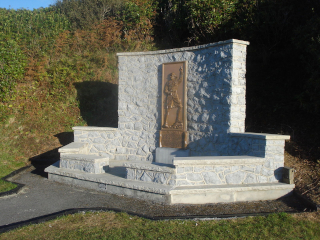
(Pictured: Monument for the attack at Rineen during the Irish War of Independence, designed by Walter Kiernan)
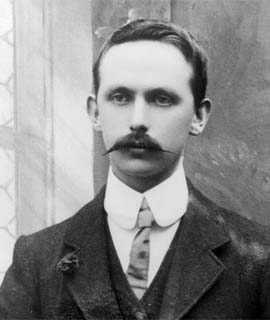
Ceannt, born Edward Thomas Kent, is the sixth of seven children of James Kent and Joanne Galway. His father is a Royal Irish Constabulary officer stationed in Ballymoe. In 1883 he is promoted and transferred to Ardee, County Louth. When his father retires from the force in 1892, the family moves to Dublin. Here he attends the North Richmond Street Christian Brothers School. Two other leaders from the 1916 rising, Seán Heuston and Con Colbert, are educated at the school. Upon finishing school, he goes on to secure a job with the clerical staff of the City Treasurer and Estates and Finances office. He works as an accountant with the Dublin Corporation from 1901-1916.
In 1907 Ceannt joins the Dublin central branch of Sinn Féin and over the following years becomes increasingly determined to see an Independent Ireland. In 1912 he is sworn to the Irish Republican Brotherhood (IRB) by Seán MacDiarmada. This movement is pledged to achieve Irish independence and to do so by using physical force if necessary.
In May 1915, the IRB Military Council, consisting of Joseph Plunkett and Seán MacDiarmada as well as Ceannt, begin plans for a rebellion. Ceannt is one of the seven men to sign the Proclamation of the Irish Republic and is appointed Director of Communications. He is made commandant of the 4th Battalion of the Volunteers and during the Rising is stationed at the South Dublin Union, with more than 100 men under his command, notably his second-in-command Cathal Brugha, and W. T. Cosgrave. The South Dublin Union controls a large area south of Kilmainham around Dolphin’s Barn.
As 3rd Royal Irish come to Mount Brown, a section of Ceannt’s battalion under section commander John Joyce opens fire, killing a number of soldiers. The British cannot break through to Dublin Castle and so bring up more troops from Kilmainham Barracks. A ceasefire allows casualty retrieval. The Volunteers drive back repeated assaults from determined regimental attacks. Ceannt uses a contingent at the Marrowbone Lane Distillery to enfilade the passing soldiers. On Tuesday, April 25, the British could close off the battle but fail to press home the advantage when the 4th Royal Dublin Fusiliers arrive. Ceannt continues to hold out with 20 times fewer men. On Thursday, April 27, a British battalion comes south as far as the Rialto Bridge when Ceannt’s outposts open fire.
The British are forced to tunnel into the buildings and, as Ceannt’s numbers reduce, it is increasingly involved in close quarter fighting. His unit sees intense fighting at times during the week but surrenders when ordered to do so by his superior officer Patrick Pearse.
After the unconditional surrender of the 1916 fighters, Ceannt, along with the other survivors, are brought to Richmond Barracks to be detained. On Monday, May 1, plain clothes detectives known as the “G-men” identify the leaders of the Rising, Ceannt being one of them. He is tried under court martial as demanded by General John Maxwell. Maxwell is determined to afflict the death penalty upon Ceannt and the other leaders of the Rising. However, he faces legal issues which only allow the death penalty to be used if one is found aiding the enemy, being Germany at this time. Not until Maxwell obtains a letter from Patrick Pearse addressed to his mother regarding the communication with the Germans is he legally obliged to deploy the death penalty. From this point Ceannt and his comrades begin facing the prospect of a firing squad. On Tuesday, May 2, he is sent to Kilmainham Gaol to face trial and execution.
Ceannt is held in Kilmainham Gaol until his execution by firing squad on May 8, 1916, aged 34. He is buried at Arbour Hill Prison in Dublin.
Kent is executed after a gun battle with members of the Royal Irish Constabulary (RIC) who come to arrest him and his brothers on May 2, 1916, during the aftermath of the Easter Rising. During the ensuing fight, head constable William Rowe is killed, and Kent’s brother Richard later dies of his wounds. He is executed by firing squad on May 9, 1916, in the Military Detention Barracks, Cork and is buried in an unmarked grave on the grounds.
Apart from Roger Casement, Kent is the only one of the sixteen men executed after the Easter Rising to be executed outside Dublin. In June 2015, his remains are exhumed, and DNA testing confirms their identity.
A ripple of applause breaks through the crowd when the funeral cortege arrives at the church near where Kent was born and raised. The church is unable to accommodate all the visitors, so a marquee is set up on the grounds of the church.
Kent’s funeral “writes the final chapter in a long ordeal for the Kent family,” the Bishop of CloyneWilliam Crean tells the congregation. Delivering the funeral eulogy, Cmdt. Gerry White says Thomas Kent was once known only for being the man who gave his name to Kent Station in Cork. “Today, however, all that is changed. Today, because of the recent discovery of his remains, Thomas Kent has once again become someone who is very much in the present. Today, members of Óglaigh na hÉireann, the Irish Defence Forces, will render the military honours that were denied him 99 years ago. Today, he will no longer be the ‘Forgotten Volunteer.’ Today, after 99 years, Thomas Kent is finally coming home.”
Thomas Kent’s life is represented by a picture of the family home, rosary beads, a pioneer pin and a leabhair gaeilge representing his interests in life. He is buried in the graveyard at Castlelyons. Taoiseach Enda Kenny gives the funeral oration.
(From: “State funeral for executed 1916 rebel Thomas Kent” by Ronan McGreevy and Éanna Ó Caollaí, The Irish Times, September 18, 2015 | Pictured: The remains of Thomas Kent as they are carried into St. Nicholas’ Church, Castlelyons, County Cork, photograph by Alan Betson)
The Freeman’s Journal, the oldest nationalist newspaper in Dublin, is founded by Charles Lucas on September 10, 1763. It is identified with radical 18th-century Protestant patriot politicians Henry Grattan and Henry Flood. This changes from 1784 when it passes to Francis Higgins and takes a more pro-British and pro-administration view. In fact, Higgins is mentioned in the Secret Service Money Book as having betrayed Lord Edward FitzGerald. Higgins is paid £1,000 for information on FitzGerald’s capture.
In the 19th century The Freeman’s Journal becomes more nationalist in tone, particularly under the control and inspiration of Sir John Gray (1815–75).
The Journal, as it is widely known, is the leading newspaper in Ireland throughout the 19th century. Contemporary sources record it being read to the largely illiterate population by priests and local teachers gathering in homes. It is mentioned in contemporary literature as when James Joyce immortalises The Freeman’s Journal as the place of employment of Leopold Bloom in Ulysses. It is seen as symbolising Irish newspapers for most of its time. By the 1880s it becomes the primary media supporter of Charles Stewart Parnell and the Irish Parliamentary Party (IPP).
The Journal is challenged on all sides by rivals. On the nationalist side some prefer The Nation founded by Thomas Davis while others, including radical supporters of Parnell, read the United Irishman. The Anglo-Irish establishment in contrast reads the historically Irish unionistThe Irish Times. With the split in the IPP over Parnell’s relationship with Katharine O’Shea, its readership splits too. While The Journal goes with the majority in 1893 in opposing Parnell, a minority moves to read the Daily Irish Independent. It is also challenged from the turn of the century by William O’Brien‘s The Irish People and the Cork Free Press. With Thomas Sexton becoming Chairman of the Board of Directors (1893–1911), The Journal languishes under his spartanic management.
The collapse of the IPP in 1918, and the electoral success of Sinn Féin, see a more radical nationalism appear that is out of step with the moderation of The Journal. It finds itself overshadowed by the more aggressively marketed Irish Independent, the successor to the Daily Irish Independent. Just prior to the outbreak of the Irish Civil War in March 1922, The Freeman’s Journal printing machinery is destroyed by Anti-Treaty IRA men under Rory O’Connor for its support of the Anglo-Irish Treaty. It does not resume publication until after the outbreak of civil war, when the Irish Free State re-asserts its authority over the country.
The Freeman’s Journal ceases publication in 1924, when it is merged with the Irish Independent. Until the 1990s, the Irish Independent includes the words ‘Incorporating the Freeman’s Journal’ in the masthead over its editorials.
Williams is born in the Beechmount area of Belfast on May 12, 1923. He is the third child in a family of six. After the death of his mother, he and his brother go to live with their grandmother at 46 Bombay Street in the Clonard area of Belfast. The Williams family has to leave the small Catholic enclave in the Shore Road area of Belfast after their house is attacked and burned.
As a child, Williams suffers from asthma and as a result is often very ill. He attends St. Gall’s Primary School but leaves at an early age to obtain work, which at the time is difficult due to discrimination. His work therefore consists of labouring and as a delivery boy.
As soon as Williams is old enough, he joins Na Fianna Éireann, the republican Scout Organisation founded by Constance Markievicz in 1909, becoming a member of the Con Colbert slua in the Clonard area. Alfie Hannaway, a friend of Williams, is his OC in Na Fianna, and assigns him to the rank of Quartermaster for the company. He takes his role in Na Fianna very seriously and all who came to know him are struck by his dedication and maturity, even at this early age.
At the age of 17, Williams is old enough to become a volunteer and joins C Company of the IRA in the Clonard area where he lives. Due to his “dedication and his remarkable ability” he is appointed to the role of Adjutant of C Company.
At Easter 1942 the government of Northern Ireland bans all parades to commemorate the anniversary of the Easter Rising. An IRA unit of six men and two women stage a diversionary action against the RUC to allow three parades to take place in West Belfast, but in this clash a RUC officer is killed, and the six IRA men are captured. The RUC officer, Constable Patrick Murphy, a father of nine children, from the Falls Road area of Belfast, is one of a minority of Catholics serving in the RUC.
There is debate over the years about who actually fired the fatal shot. The six IRA members are convicted and sentenced to death for murder under the law of common purpose. Five have their sentences commuted. The sentence of Williams, who acknowledges that he is the leader of the IRA unit involved and takes full responsibility for the actions of his men, is not commuted.
Williams is hanged in Crumlin Road Gaol in Belfast on the morning of September 2, 1942. The executioner is the official English hangman Thomas Pierrepoint, assisted by his nephew Albert Pierrepoint. Afterwards Williams’ body is interred in unhallowed ground in an unmarked grave within the grounds of the prison. His remains are only released in January 2000 after the closure of the prison in 1996 and a lengthy campaign by the National Graves Association, Belfast.
Williams’s funeral is held on January 19, 2000, and is attended by thousands, with burial at Milltown Cemetery. Joe Cahill, Williams’s cell mate, and John Oliver, sentenced to death with Williams but later reprieved, as well as Madge McConville, who had been arrested with Williams, Greta McGlone, Billy McKee, Eddie Keenan and perhaps least known, Nell Morgan, Williams’s girlfriend at the time of his death, are all present. Six senior Sinn Féin members including Gerry Adams are also present in St. Paul’s Church on the Lower Falls Road for the Mass.
Williams is remembered in a ballad Tom Williams. Various recordings have been made, most notably by the Flying Column and Éire Óg, who preamble their version with the story of the campaign to release his body. The now disbanded, Volunteer Tom Williams Republican Flute Band from Glasgow, Scotland is named in his memory as is the Tom Williams Camogie Club in Belfast.
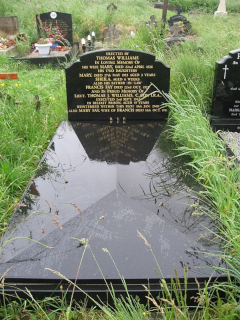
(Pictured: Tom Williams’ headstone at Milltown Cemetery after being reinterred)
In July 2015 there are 4,242 applications submitted by people in Great Britain compared to 7,321 in July 2016. Meanwhile 6,638 passport requests are submitted from Northern Ireland.
Within in a day of the Brexit vote there is a surge in online interest in Irish passports and moving to Ireland. While the UK as a whole vote to leave the EU in the referendum, Northern Ireland votes to remain by a majority of 56 percent to 44 percent. The Department of Foreign Affairs says there is “an increase in queries in respect of entitlements to Irish passports” the very next day. The year-on-year figures for January show a 20 percent increase in applications prior to the vote.
Google Trends says UK searches for “getting an Irish passport” jump more than 100% after the Brexit result comes through. And while the data analysts do not reveal the exact number of searches for information on the Republic of Ireland‘s citizenship rules, they say most interest is shown in Northern Ireland with the normally unionist heartland of Holywood, County Down, taking top spot.
Sinn Féin repeatedly says that Northern Ireland must not be “dragged out of Europe.” Up to this point the British government dismisses calls from its representatives and others for a border poll in Irish unity.






 seamus dubhghaill