seamus dubhghaill

Promoting Irish Culture and History from Little Rock, Arkansas, USA


Leave a comment

Storm Frank Causes Widespread Flooding

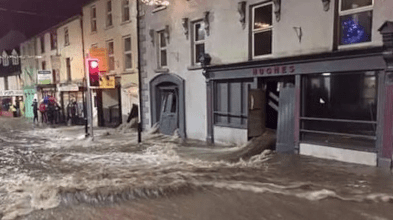
Clean-up operations are underway around Ireland on Wednesday, December 30, 2015, in the wake of Storm Frank, which causes widespread flooding following its landfall in western areas on Tuesday, December 29. Thousands of households and businesses are left without electricity in many areas of the country.

A Met Éireann status orange wind warning is lifted at 2:00 p.m. on Wednesday although the forecasts caution that severe winds of 65-80 km/h and gusts of up 130 km/h are still expected. While the heaviest rainfall from the storm falls overnight, many rivers and lakes have yet to peak meaning further flooding is possible.

According to an ESB Networks spokesman, 7,500 homes are without power in the afternoon, down from the overnight total of 13,000. He says repair crews are working to restore power to those cut off. The biggest single outage overnight is around Bandon and Fermoy in County Cork where 4,000 homes are without power, although it has been restored to almost all homes by the afternoon of December 30.

At 2:00 p.m. on Wednesday, the worst affected areas are County Wicklow with 1,200 houses without power, Macroom in County Cork where 600 are without power and Athlone where 500 homes are cut off. Around 500 homes in Naas, County Kildare, are without power as are 350 houses in Skerries in north County Dublin. It is hoped that power will be restored to all customers by the evening.

County Cork appears to be the worst affected by the storm where 60 mms (almost three inches) of rain falls since the morning of December 29. The threat of further flooding in Cork remains as the ESB increases the flow of water through the Inniscarra Dam to 250 cumecs (cubic metres per second) between 9:00 a.m. and midday which leads to increased flooding downstream. This is higher than the level of flow (180 cumecs) the previous and between December 6 and 12 along the River Lee following Storm Desmond.

Cork County manager Tim Lucey says there has been “extensive flooding” across a range of areas, but that Midleton and Bandon are worst hit with some 90 properties affected in each of the towns. He tells RTÉ Radio that one positive is the fact flood defences in Mallow and Fermoy have done their job. He notes that some five feet of water has built up behind a flood barrier in Mallow and this indicates the damage that could have been done to the town.

South Galway bears the brunt of flooding in the west, with river gauges expected to rise further over the coming days. Overnight rainfall is not as heavy as anticipated in the west, but several properties succumb to the waters. Up to 30 families in the south Galway area are forced to stay with relatives, with several being accommodated in hotels by Galway County Council, as floodwaters cut off access routes to their homes.

In Mayo, the area around the Neale remains underwater and a number of minor roads and thousands of acres of farmland are also affected. With rain continuing to fall across the west, conditions are expected to remain critical over the next few days.

The N11 between Rosslare and Dublin, the N25 from Cork to Waterford, the N71 between Cork and Killarney and the N4 between Dublin and Sligo all have diversions in place. The N25 is closed overnight between Killeagh and Castlemartyr in County Cork due to flooding. The N71 Cork/Bandon Road is also closed overnight at the viaduct due to flooding. There is severe flooding on the N40 South Ring Rd. at J6 Kinsale, particularly on the westbound off-ramp. The N11 Dublin/Wexford Road is impassable through Enniscorthy and also at Kyle’s Cross near Oylegate. The N4 is closed eastbound at Ballynafid in County Westmeath due to flooding. There are also several road closures in Kerry, Waterford and Tipperary.

Midleton is also hit by severe flooding as water levels in the Owenacurra River rise dramatically with up to 30 families having to be evacuated from their homes. Macroom in mid-Cork is also flooded for the first time during the year. Bandon is put on red alert by Cork County Council’s early warning system. Traders and residents are told to take all measures necessary to protect their property and stock. Locals stay up all night preparing the town for the latest round of flooding. Nevertheless, some 20 businesses in Bandon are flooded for the second time in a month after waters start to come up shores and gutters in the town as water levels in the River Bandon rise overnight.

The River Slaney burst its banks in Enniscorthy, County Wexford, causing widespread flooding in the town. Several cars have to be abandoned. High tide in Enniscorthy occurs around 10:30 a.m. on December 30.

Limerick City Council and Limerick County Council say there has been no significant flooding in the county as a result of overnight rainfall but that water levels along the lower River Shannon continue to increase. Water levels on the river rise by some 11cm at Castleconnell and Montpelier.

The ESB says the flow of water through Parteen Weir, which regulates water flow through Ardnacrusha power plant, will remain at 440 (cubic metres per second) on December 30 and that the situation will be reviewed again the following day. “The levels in Lough Derg may reach 2009 levels in the coming days and, as a result, the flow through Parteen Weir may increase to 2009 levels (up to 500 cumecs) in the coming days,” it says.

Clare County Council says water levels on the lower River Shannon at Springfield, Clonlara, have increased by 5-10cm in the last 24 hours and are some 20cm below a peak level recorded on December 13th. It says the Mulkear River in County Limerick, which enters the River Shannon south of Annacotty, is currently in flood and is contributing to increased water levels at Springfield. Council staff are assisted by the Fire Service and Defence Forces at Springfield in their pumping operations and transporting residents of some 12 homes isolated by floodwaters.

Fianna Fáil urges Taoiseach Enda Kenny to call an emergency Cabinet meeting to address the fallout from the storm. The party’s environment spokesman, Barry Cowen, says many communities felt neglected as further significant damage was inflicted on homes and businesses by the rainfall and winds brought by Storm Frank. “The scenes that we are witnessing in communities impacted by the latest storm are truly heart-breaking,” he says. “People feel neglected by the Government. It’s astonishing that the Taoiseach has decided not to interrupt his Christmas holidays in light of the devastation caused by Storm Frank.”

The Government’s National Coordination Group on Severe Weather meets in Dublin on December 30. Sinn Féin MEP Liadh Ní Riada says the Government has displayed “ineptitude in preparing flood defences” and that “more hollow promises” from the Coalition are no substitute for action. “The risk of flooding is increasing and will continue to increase. People across this island need to know that our political leaders have a plan to prevent this happening in the future,” she says.

(From: “Storm Frank causes floods, closes roads and cuts power to thousands” by Ronan McGreevy, Th Irish Times, http://www.irishtimes.com, December 30, 2015 | Pictured: Water flows through buildings and down the street in Graignamanagh, Co Kilkenny on Tuesday night by Paul B via Twitter)


Leave a comment

Birth of Anthony Cronin, Poet, Activist, Critic & Editor

Anthony Gerard Richard Cronin, Irish poet, arts activist, biographer, commentator, critic, editor and barrister, is born in Enniscorthy, County Wexford, on December 28, 1923.

After obtaining a B.A. from the National University of Ireland, Cronin enters the King’s Inns and is later called to the Bar.

Cronin is known as an arts activist as well as a writer. He is Cultural Adviser to Taoiseach Charles Haughey and briefly to Garret FitzGerald. He involves himself in initiatives such as Aosdána, the Irish Museum of Modern Art and the Heritage Council. He is a founding member of Aosdána, and is a member of its governing body, the Toscaireacht, for many years. He is elected Saoi, a distinction for exceptional artistic achievement, in 2003. He is also a member of the governing bodies of the Irish Museum of Modern Art and the National Gallery of Ireland, of which he is for a time Acting Chairman.

With Flann O’Brien, Patrick Kavanagh and Con Leventhal, Cronin celebrates the first Bloomsday in 1954. He contributes to many television programmes, including Flann O’Brien: Man of Parts (BBC) and Folio (RTÉ).

From 1966 to 1968 Cronin is a visiting lecturer at the University of Montana in Missoula, Montana, and from 1968 to 1970 he is poet in residence at Drake University in Des Moines, Iowa. He reads a selection of his poems for the Irish Poetry Reading Archive in 2015. He has honorary doctorates from several institutions, including the University of Dublin, the National University of Ireland and the Adam Mickiewicz University in Poznań, Poland.

Cronin begins his literary career as a contributor to Envoy, A Review of Literature and Art. He is editor of The Bell in the 1950s and literary editor of Time and Tide (London). He writes a weekly column, “Viewpoint,” in The Irish Times from 1974 to 1980. Later he contributes a column on poetry to the Sunday Independent.

His first collection of poems, called simply Poems (Cresset Press, London), is published in 1958. Several collections follow and his Collected Poems (New Island Books, Dublin) is published in 2004. The End of the Modern World (New Island Books, 2016), written over several decades, is his final publication.

Cronin’s novel, The Life of Riley, is a satire on Bohemian life in Ireland in the mid-20th century, while his memoir Dead as Doornails addresses the same subject.

Cronin knows Samuel Beckett from when they do some work for the BBC during the 1950s and 1960s. He gives a prefatory talk to Patrick Magee‘s reading of The Unnamable on the BBC Third Programme. Beckett is not impressed, saying, “Cronin delivered his discourse… It was all right, not very exciting.” Cronin later publishes a biography of him, Samuel Beckett: The Last Modernist (1996), followed on from No Laughing Matter: The Life and Times of Flann O’Brien (1989).

In his later years, Cronin suffers from failing health, which prevents him from traveling abroad, thus limiting his dealings to local matters. He dies in Dublin on December 27, 2016, one day short of his 93rd birthday.

Cronin firstly marries Thérèse Campbell, from whom he separates in the mid-1980s. She dies in 1999. They have two daughters, Iseult and Sarah. Iseult is killed in a road accident in Spain. He secondly marries the writer Anne Haverty who, along with daughter Sarah, survives him.


Leave a comment

Birth of Michael J. Browne, Bishop of Galway and Kilmacduagh

Michael J. Browne, an Irish prelate of the Roman Catholic Church, is born in Westport, County Mayo, on December 20, 1895. He serves as Bishop of Galway and Kilmacduagh for almost forty years from 1937 to 1976.

Browne is an important and outspoken member of the Irish hierarchy. His time as Bishop has been described by the historian James S. Donnelly Jr. as “far-reaching and … controversial,” while the historian of Irish Catholicism John Henry Whyte claims that Browne’s “readiness to put forward his views bluntly is welcome at least to the historian.”

Browne is ordained to the priesthood on June 20, 1920, for the Archdiocese of Tuam. He later serves as professor of moral theology at St. Patrick’s College, Maynooth.

On August 6, 1937, at the relatively young age of 41, Browne is appointed Bishop of Galway and Kilmacduagh by Pope Pius XI, receiving his episcopal consecration from Archbishop Thomas Gilmartin on the following August 10. He supports Taoiseach Éamon de Valera‘s defence of arrests and police searches for cached Irish Republican Army (IRA) arms, declaring, “Any Irishman who assists any foreign power to attack the legitimate authority of his own land is guilty of the most terrible crime against God’s law, and there can be no excuse for that crime – not even the pretext of solving partition or of securing unity.”

In 1939, Browne is selected by Éamon de Valera to chair the Commission on Vocational Organisation.

Browne is attentive to the state of public morality in the diocese, and James S. Donnelly Jr. has noted his role in directing episcopal and clerical censorship of newsagents and county librarians. He is also concerned about public intoxication and other misconduct at the Galway Races, controversies over dancing and the commercial dance halls, as well as immodesty in dress and the closely related issue of so-called “mixed bathing” in Galway and Salthill.

Like other members of the Irish Catholic hierarchy, Browne regularly condemns communism in his pastoral letters. When Cardinal József Mindszenty is detained by Hungary‘s post-war communist government, Browne in 1949 forwards protest resolutions from Galway Corporation, Galway County Council and the University College Galway student body to Pope Pius XII. He also frequently condemns the Connolly Association, an Irish republican socialist group in Britain close to the Communist Party of Great Britain.

In 1957, in response to a growing tension between Catholics and Protestants at Fethard-on-Sea, including the Fethard-on-Sea boycott, Browne says, “non-Catholics do not protest against the crime of conspiring to steal the children of a Catholic father, but they try to make political capital when a Catholic people make a peaceful and moderate protest.”

The most enduring monument or physical legacy of Browne’s time as Bishop is the Cathedral of Our Lady Assumed into Heaven and St Nicholas, commonly known as Galway Cathedral, which is dedicated in 1965 by Cardinal Richard James Cushing of Boston, Massachusetts. The site of the old jail had come into the possession of the diocese in 1941 and Browne leads the campaign to construct a new Cathedral. This includes a 1957 audience with Pope Pius XII where the plans are approved.

Browne attends the Second Vatican Council from 1962 to 1965 and retires in 1976. He dies four years later, at the age of 84, on February 24, 1980.

Browne is parodied in Breandán Ó hÉithir`s novel Lig Sinn i gCathu, which fictionalises late 1940s Galway as “Baile an Chaisil” and Browne as “An tEaspag Ó Maoláin.”

The Irish cabinet minister Noël Browne (no known relation) in his 1986 memoir Against the Tide describes the physical attributes of his episcopal namesake:

“The bishop had a round soft baby face with shimmering clear cornflower-blue eyes, but his mouth was small and mean. Around his great neck was an elegant glinting gold episcopal chain with a simple pectoral gold cross. He wore a ruby ring on his plump finger and wore a slightly ridiculous tiny scullcap on his noble head. The well-filled semi-circular scarlet silk cummerbund and sash neatly divided the lordly prince into two.”


Leave a comment

1993 Fivemiletown Ambush

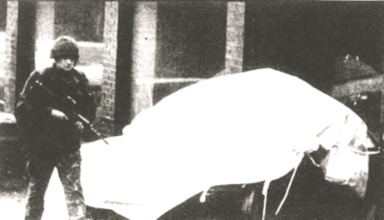
On December 12, 1993, a unit of the Provisional Irish Republican Army‘s (IRA) East Tyrone Brigade ambushes a two-men unmarked mobile patrol of the Royal Ulster Constabulary (RUC) in Fivemiletown, County Tyrone. Two constables, Andrew Beacom and Ernest Smith, are shot and killed instantly. A military helicopter is also fired at by a second IRA unit in the aftermath of the incident, during a follow-up operation launched in the surroundings of the town by both the British Army and the RUC. A number of suspects are questioned, but the perpetrators make good their escape. The action occurs just three days before the Downing Street Declaration.

Fivemiletown lays in the western edge of the Clogher Valley, near the border between County Fermanagh and County Tyrone. No deaths directly related with paramilitary activity has occurred there during the Troubles prior to the 1993 IRA shootings, though there are a number of incidents in the region in the previous months.

On May 7, 1992, members of the IRA South Fermanagh Brigade detonate a 1,000-pound bomb delivered by a tractor after crossing through a hedge outside the local RUC part-time barracks. The huge explosion leaves ten civilians wounded and causes widespread damage to the surrounding property. The security base itself is heavily damaged and the blast is heard 30 miles away. According to a later IRA statement, the destruction of the security base compels the British forces to organise their patrols from the nearby RUC barracks at Clogher, allowing the East Tyrone Brigade to study their pattern and carry out the 1993 ambush at Fivemiletown’s main street.

A secondary incident occurs some hours later, on May 9, when a British soldier kills his company’s sergeant major in a blue-on-blue shooting at the same place while taking part in a security detail around the wrecked facilities.

On January 20, 1993, the RUC base in Clogher is hit and severely damaged by a Mark-15 “barrack buster” mortar bomb launched by the IRA’s East Tyrone Brigade. A number of constables receive minor injuries.

Constable Andrew Beacom and Reserve Constable Ernest Smith are patrolling Fivemiletown’s Main Street in a civilian-type, unmarked Renault 21 on the early hours of December 12, 1993. Both men are part of the RUC Operational Support Unit, which surveils the border along with the British Army. The constables are based at Clogher RUC barracks.

The IRA reports that two active service units from the East Tyrone Brigade had taken up positions in the centre of Fivemiletown and identified the RUC unmarked vehicle before the ambush.

At 1:30 a.m., up to the junction of Main Street and Coneen Street, at least two IRA volunteers open fire from both sides of the road with automatic weapons, hitting the vehicle with more than 20 rounds. Beacom and Smith die on the spot. Constable Beacom lives in Fivemiletown, just a hundred metres from the site of the ambush, where his wife owns a restaurant. She is one of the first persons to arrive to the scene of the shooting. Smith resides with his family at Augher.

According to a colleague in the Operational Support Unit, himself a reserve constable deployed at Lisnaskea and a former Ulster Defence Regiment (UDR) soldier, their deaths “hit the unit very hard.” The men are appreciated for their in-depth knowledge of the area.

A “major” follow-up security operation is mounted between Fivemiletown and the border with the Republic of Ireland, supported by airborne troops and RUC reinforcements, in an attempt to block the attacker’s escape.

Approximately an hour after the ambush, an Army Air Corps (AAC) Westland Lynx helicopter comes upon a number of IRA volunteers in the searching area, just a few miles from the site of the shooting, but the aircraft becomes the target of automatic rifle fire and is forced to disengage. Though the helicopter is not hit, the assailants break contact successfully. The IRA East Tyrone Brigade report claims that the attack on the Westland Lynx is carried out by a second active service unit, which set up a firing position on the predicted path of the British helicopters carrying reinforcements into Fivemiletown after the initial shooting. A number of people are arrested and questioned about the killings, but the perpetrators manage to slip away.

The shootings are widely condemned. RUC Chief Constable Sir Hugh Annesley says that “At a time when the whole community is looking toward peace, the Provisional IRA has yet again shown they have absolutely nothing to offer but deaths and suffering.”

Presbyterian Moderator Rev. Andrew Rodgers calls on the governments to break any contact with Sinn Féin and other “men of blood in both sections of the community.”

A former IRA member cites instead the answer of an IRA volunteer in the area when questioned by him about the futility of the actions at Fivemiletown. He replies that “The war must go on.”

On December 15, 1993, just three days after the attack, the ambush and killing of the two constables at Fivemiletown is mentioned by Member of Parliament Ken Maginnis and Prime Minister John Major during the latter’s speech to the House of Commons right after the joint Downing Street Declaration with Albert Reynolds, the Irish Taoiseach, that sets the basis of the Northern Ireland peace process.

(Pictured: A photograph showing a British Army sentry guarding the scene of the IRA ambush on a Royal Ulster Constabulary mobile patrol, December 12, 1993)


1 Comment

Taoiseach Varadkar Announces Simon Coveney as the New Tánaiste

Taoiseach Leo Varadkar announces Simon Coveney as the new Tánaiste on November 30, 2017, replacing Frances Fitzgerald who resigned two days earlier over the Maurice McCabe controversy. Coveney, who was Varadkar’s rival for the Fine Gael leadership earlier in the year, is to continue to serve as Minister for Foreign Affairs and Trade with responsibility for Brexit.

Varadkar says in appointing Coveney as Tánaiste he is “very conscious of the important role he plays as Minister of Foreign Affairs, as minister responsible for Brexit.” He adds, “I believe his appointment as Tánaiste and deputy prime minister will enhance his position in representing the government overseas in the negotiations currently under way.”

Minister Heather Humphreys is also announced as Minster for Business, Enterprise and Innovation, and Josepha Madigan is announced as Minister for Culture, Heritage and the Gaeltacht.

Frances Fitzgerald steps down from the role of Tánaiste on November 28, after new revelations about what she knew of the garda strategy and aggressive stance towards Maurice McCabe at the O’Higgins inquiry in 2015.

In a statement, Fitzgerald says, “Today I made the decision to tender my resignation to the Taoiseach, stepping down with immediate effect as Tánaiste and Minister for Business, Enterprise and Innovation. It has been the greatest honour of my life to serve in Government, but I believe it is necessary to take this decision to avoid an unwelcome and potentially destabilising general election at this historically critical time.

Fitzgerald adds, “Throughout my career I have always sought to act with integrity and responsibility, and that is why I have decided on this occasion to put the national interest ahead of my own personal reputation. I have always believed in fairness and equality and these principles have guided my work as Minister for Children and Youth Affairs, as Minister for Justice and Equality, and now as Minister for Business, Enterprise and Innovation.’

Fitzgerald concludes, “I would like to thank the Taoiseach for showing the same courage and determination to protect my good name that he displayed three years ago when he stood up and defended the reputation of Maurice McCabe. What I admire most about the Taoiseach is that he has always believed in doing what was right – not what was popular or politically expedient. I will always be grateful for his confidence and support and for giving me the opportunity to serve in a Government that is making a real difference in people’s lives at a critical time in our history.”

(From: “Simon Coveney appointed new Tánaiste after Frances Fitzgerald steps down over Maurice McCabe controversy” by Lauren Kelly and Deborah McAleese, The Irish Sun, November 30, 2017 | Photo Credit: RollingNews.ie)


Leave a comment

28th Summit of the British-Irish Council

The British-Irish Council holds its 28th summit at Cathays Park, Cardiff, Wales, on November 25, 2016, and focuses on the United Kingdom‘s exit from the European Union (EU) and the Council’s Early Years policy.

The meeting is an important opportunity to discuss developments and reflect on the perspectives and priorities of all participants since the last British-Irish Council summit in July 2016. There is specific focus during the EU exit roundtable session on agriculture, agri-food and fisheries, trade, and implications of the UK’s exit from the EU.

UK government ministers also emphasize their continued commitment to work closely with all seven member administrations on the UK’s exit from the EU, using existing structures of bilateral and multilateral engagement.

Secretary of State for Wales, Alun Cairns, says, “The British-Irish Council summit is an important forum as we prepare to leave the European Union. The meeting allows us to maintain and strengthen relations between our governments and ensure we are all in the best position to face challenges and find new opportunities. It’s important to remember the UK is leaving the EU, but we are not leaving Europe. We want the best possible relationship with the EU as a whole. The eight council members will discuss issues including Brexit and provide the best opportunities for our young people as part of Early Years strategy. I look forward to some positive and constructive talks on both topics.”

Secretary of State for Northern Ireland, James Brokenshire, says, “At July’s BIC meeting we established an important commitment to maintain intensive and open dialogue and today’s sessions reflected the kind of mature cooperation that close friends and partners enjoy. There was a strong collective will to continue to work together in order to achieve the best outcomes for the people we represent. The UK wants the strongest possible economic links with our European neighbours, especially with Ireland – our nearest neighbour and the only EU member with which we share a land border. So as we forge a new relationship between the UK and Europe we must also maintain and strengthen the bonds within these islands. The BIC will continue to make a vital contribution to that effort and underlines our commitment to the structures set out in the Belfast Agreement and its successors.”

Minister at the Department for Exiting the European Union, Robin Walker, says, “As we begin the work of leaving the European Union, forums such as the British-Irish Council are an important way of maintaining close cooperation and open dialogue between our governments. This includes maintaining our special and friendly relationship with Ireland which has gone from strength to strength over many years. And we will continue to build on this strong relationship as we make a success of Brexit and maximise the opportunities for both our countries.”

A second session at the council addresses the Early Years policies of the eight administrations and welcomes the latest sector report highlighting progress since the 2012 summit. All in attendance acknowledge the critical importance of investment in early years provision in creating strong foundations for children, families and societies to thrive.

The meeting is hosted by the Welsh government, and First Minister of Wales Carwyn Jones welcomes delegation heads. In addition to the UK government ministerial team, the following representatives attend:

The British-Irish Council is a forum for discussion. It was established by the Belfast Agreement to promote positive, practical relationships among the people of the islands and to provide a forum for consultation and co-operation.

(From: “British-Irish Council Summit: Focus on EU exit and ‘Early Years’ policy” press release by the Government of the United Kingdom, http://www.gov.uk, November 25, 2016)


Leave a comment

Birth of Brendan Corish, Irish Labour Party Politician

Brendan Corish, Irish Labour Party politician who serves as Tánaiste and Minister for Health (1973-77), Leader of the Labour Party, Minister for Social Welfare (1954-57 and 1973-77), Parliamentary Secretary to the Minister for Defence and Parliamentary Secretary to the Minister for Local Government (1948-51), is born in Wexford, County Wexford, on November 19, 1918. He is a Teachta Dála (TD) from 1948 to 1982.

Corish’s father, Richard Corish, a well-known trade union official and Sinn Féin member, had been elected to the Second Dáil shortly after the birth of his son and later joins the Labour Party, serving as a local and national politician until his death in 1945. His mother is Catherine Bergin. He is educated locally at Wexford CBS and, in his youth, is a member of the 1st Wexford Scout troop (Scouting Ireland). At the age of nineteen, he joins the clerical staff of Wexford County Council. He spends several years playing Gaelic football for the Wexford county team. He was married to Phyllis Donohoe, and they have three sons.

Corish is elected to Dáil Éireann as a Labour Party candidate in the Wexford by-election in 1945, necessitated by the death of his father who was the sitting TD. He takes a seat on the fractured opposition benches, as Fianna Fáil‘s grip on power continues.

Corish retains his seat at the 1948 Irish general election in which Fianna Fáil is returned as the largest party in the Dáil once again. However, Fine Gael, the Labour Party, the National Labour Party, Clann na Poblachta, Clann na Talmhan and a number of Independent candidates all come together to form the first inter-party government. Corish is appointed Parliamentary Secretary to the Ministers for Defence and Local Government.

When the Second Inter-party Government is formed after the 1954 Irish general election, Corish is appointed Minister for Social Welfare.

In 1960, Corish succeeds William Norton as Labour Party leader. He introduces new policies which make the party more socialist in outlook and describes the party program as Christian socialist. He considers that the party principles are those endorsed by Pope John XXIII and greatly admires the Pope who he says is “one of the greatest contributors of all changes in Irish attitudes.” However, the party moves carefully because “socialism” is still considered a dirty word in 1960s Ireland. He claims that Ireland will be “Socialist in the Seventies.” To a certain extent he is right because Fine Gael and the Labour Party form a coalition government between 1973 and 1977.

Corish becomes Tánaiste and Minister for Health and Social Welfare. A wide range of social security benefits are introduced during his time as a government minister, including a Deserted Wife’s Benefit and Unmarried Mother’s Allowance, Prisoner’s Wife’s Allowance, Single Woman’s Allowance, and the Supplementary Welfare Allowance, providing supplementary income to individuals and families with low incomes. In 1974, compulsory social insurance is extended to virtually all employees, and that same year short-term social insurance benefits (occupational injury, maternity, unemployment and sickness benefits) become partially index-linked. According to one study, this signals “an extension in the function of the income maintenance system from basic income support to proportional replacement of market earnings for some groups.” The replacement of the existing flat-rate unemployment benefit with an earnings-related benefit means that the average unemployment replacement rate goes up from about 30% to 60%.

Corish is deeply religious, telling the Dáil in 1953 that “I am an Irishman second, I am a Catholic first…if the hierarchy give me any direction with regard to Catholic social teaching or Catholic moral teaching, I accept without qualification in all respects the teaching of the hierarchy and the church to which I belong.”

In 1977, the Taoiseach Liam Cosgrave calls a general election, and Fianna Fáil is returned to power in a landslide victory. Corish resigns as leader of the Labour Party, having signaled his intent to do so before the election. He is succeeded as party leader by Frank Cluskey. He retires from politics completely at the February 1982 Irish general election.

Corish dies in Wexford at the age of 71 on February 17, 1990.


Leave a comment

The State Funeral of Garda Tony Golden

On October 15, 2015, President Michael D. Higgins and Taoiseach Enda Kenny join thousands of mourners and gardaí in Blackrock, County Louth, for the State funeral of Garda Tony Golden. Garda Golden, a father of three, is shot dead on the evening of October 11 as he goes to the aid of Siobhan Phillips, who is the victim of domestic violence.

Among the thousands paying their respects are 4,000 serving and retired gardaí, over 2,000 in uniform. Garda Golden is remembered as a happy man, proud to serve, a role model for the community – and by his brother Patrick as a “big gentle giant.”

In his homily, chief celebrant parish priest Father Pádraig Keenan tells the congregation that the killing of Garda Golden was “cold-blooded murder.” He reminds the mourners that Garda Golden is the 88th garda to die in the line of duty. He says, “It is 88 members too many. He like all the others is mourned by the entire nation.”

“His murder brings to mind once again all the families and communities that have been affected on our island.”

Fr. Keenan says, “Garda Tony’s death once again reflects how north Louth and the Cooley Peninsula have been affected by the tragic history of the Troubles on the island of Ireland, and especially the murder of Detective Garda Adrian Donohoe, three years ago at Lordship Credit Union in Bellurgan.”

He says that too many hearts have been broken, and too many lives shattered. There is no place for violence in our society, violence is wrong, always wrong. He refers to Garda Golden as one of life’s gentlemen.

Fr. Keenan begins the funeral mass by saying that Garda Golden quietly let “his light shine in so many ways through his life in a very humble way. Amidst our sadness may we be thankful for the charisma of his beautiful but too short life.”

The stillness of the water across from the churchyard in Dundalk Bay mirrors the silence and sadness that has unfolded on everyone since the weekend, he tells the congregation.

“Tony was so proud to serve the community of Omeath,” he says. “As one person from Omeath put it to me in recent days, he was ‘our garda’, and to a person amongst his family and colleagues, all are immensely proud of Garda Tony and his selfless nature. Proud of everything he lived for, worked for and stood for. Tony Golden was a much-loved role model in our community.”

Symbols including a family photograph are taken to the altar in memory of Garda Golden. A club jersey and hurley from the Stephenites GAA club in his native Ballina, County Mayo, represent his roots and love of sport. A television remote control, a soft drink, a bar of chocolate and packet of crisps were offered to recall his cherished “time out.”

Garda Golden’s final journey begins at the home in the village of Blackrock he shared with his wife Nicola and their three young children, Lucy, Alex and Andrew. The funeral cortège is led by the Garda Commissioner, while thousands of gardaí escort their colleague into his parish church, St. Oliver Plunkett’s, for the funeral mass at noon.

Other dignitaries attending Garda Golden’s funeral are Garda Commissioner Nóirín O’Sullivan and Police Service of Northern Ireland (PSNI) Chief Constable George Hamilton, as well as political representatives from all parties.

Fr. Keenan is joined on the altar by the vicar general of the Armagh diocese Dean Colum Curry, who represents the Primate of All Ireland, Bishop Eamon Martin. As well as the chaplains to the Garda and the Defence Forces, Bishop John Fleming and Father Gerard O Hora travel to the funeral from Golden’s home county of Mayo.

Screens are erected in the grounds and the village to relay the service to those outside.

Businesses shut down along the route as a mark of respect during the funeral. Roads around the village are sealed off for several hours. Garda Golden is laid to rest at St. Paul’s Cemetery Heynestown.

Golden is killed as he is bringing Siobhan Phillips to her home to retrieve her personal possessions. Phillips is also shot in the incident and is in a critical condition in hospital with her family at her bedside at the time of Garda Golden’s funeral.

President of the Garda Representative Association, Dermot O’Brien, says members of the gardaí from all corners of Ireland traveled to County Louth to pay their respects to their colleague. He says they are grief-stricken and numb.

O’Brien says everyone will reflect in their own way and that the realisation has struck that Garda Golden was murdered doing “a bread-and-butter type call.”

“They are going to ask themselves, those that attended the same type of call on Sunday that it could have been them. These are very similar calls that a lot of members did on Sunday, and they will sit back and reflect on what happened to Tony as they responded to a similar call.”

O’Brien says he had spoken to Garda Golden’s unit in the days leading to the funeral and, while they are coping, they are not well. “They are angry, grieving and disillusioned because today they have to bury a second friend, a murdered friend, a second murdered colleague.”

Father Michael Cusack also speaks of the pain and anger expressed by members of the garda force he met following Garda Golden’s death. Speaking on RTÉ‘s Today with Sean O’Rourke, Fr. Cusack says it is a very difficult day and week for gardaí. He says a lot of care needs to be offered to the members of the force and that there needs to be appropriate follow-up care given.

(From: “Garda Tony Golden ‘mourned by entire nation’,” RTÉ News, http://www.rte.ie, October 15, 2015)


Leave a comment

Birth of Frank Clarke, Former Chief Justice of Ireland

George Bernard Francis Clarke, Irish barrister who is Chief Justice of Ireland from July 2017 to October 2021, is born on October 10, 1951, in Walkinstown, Dublin. He has a successful career as a barrister for many years, with a broad practice in commercial law and public law. He is the chair of the Bar Council of Ireland between 1993 and 1995. He is appointed to the High Court in 2004 and becomes a judge of the Supreme Court of Ireland in February 2012. Following his retirement from the bench, he returns to work as a barrister. Across his career as a barrister and a judge, he is involved in many seminal cases in Irish legal history.

Clarke is the son of a customs officer who dies when he is aged eleven. His mother is a secretary. He is educated at Drimnagh Castle Secondary School, a Christian Brothers secondary school in Dublin. He wins the Dublin Junior High Jump Championship in 1969. He studies Economics and Maths at undergraduate level at University College Dublin (UCD), while concurrently studying to become a barrister at King’s Inns. He is the first of his family to attend third level education and is able to attend university by receiving grants. While attending UCD, he loses an election to Adrian Hardiman to become auditor of the Literary and Historical Society (L&H).

Clarke joins Fine Gael after leaving school. He is a speechwriter for Taoiseach Garret FitzGerald and election agent for George Birmingham. He then subsequently, himself, runs for election to Seanad Éireann. He campaigns against the Eighth Amendment of the Constitution of Ireland in 1983 and in favour of the unsuccessful Tenth Amendment of the Constitution Bill 1986. He chairs a meeting of family lawyers in 1995 supporting the successful second referendum on divorce.

Clarke is called to the Bar in 1973 and to the Inner Bar in 1985. He has a practice in commercial, constitutional and family law. Two years after commencing practice he appears as junior counsel for the applicant in State (Healy) v Donoghue before the Supreme Court, which establishes a constitutional right to legal aid in criminal cases.

Clarke represents Michael McGimpsey and his brother Christopher in a challenge against the constitutionality of the Anglo-Irish Agreement, which is ultimately unsuccessful in the Supreme Court in 1988.

Clarke appears for the plaintiff with Michael McDowell and Gerard Hogan in Cox v Ireland in 1990, where the Supreme Court first introduces proportionality into Irish constitutional law and discovers the right to earn a livelihood. He represents Seán Ardagh and the Oireachtas Subcommittee formed after the death of John Carthy in a constitutional case which limits the powers of investigation of the Oireachtas, which leads to the unsuccessful Thirtieth Amendment of the Constitution. In an action taken by tobacco companies to challenge the legality of bans on tobacco advertising, he appears for the State.

Clarke is twice appointed by the Supreme Court for the purpose of Article 26 references. He argues on behalf of the Law Society of Ireland in a referral regarding the Adoption (No. 2) Bill 1987. He is appointed by the Supreme Court to appear to argue on behalf of the rights of the mother in In re Article 26 and the Regulation of Information (Services outside the State for Termination of Pregnancies) Bill 1995. In 1994, President Mary Robinson requests him to provide her with legal advice on the presidential prerogative to refuse to dissolve Dáil Éireann.

Clarke is external counsel to the Commission to Inquire into Child Abuse and represents the Flood Tribunal in its case against Liam Lawlor and the State in Charles Haughey‘s challenge to the legality of the Moriarty Tribunal. He and George Birmingham also appear for Fine Gael at the Flood Tribunal, and he represents the public interest at the Moriarty Tribunal. He is a legal advisor to an inquiry into the deposit interest retention tax (DIRT) conducted by the Public Accounts Committee, along with future judicial colleagues Paul Gilligan and Mary Irvine.

Clarke is Chairman of the Bar Council of Ireland from 1993 to 1995. Between 1999 and 2004, he acts as chair of Council of King’s Inns. He is a professor at the Kings’s Inns between 1978 and 1985 and is appointed an adjunct professor at University College Cork (UCC) in 2014. He also serves as an adjunct professor at Trinity College Dublin (TCD).

Clarke acts as a chair of the Employment Appeals Tribunal while still in practice. He is also a steward of the Turf Club and the chairman of Leopardstown Racecourse. He was due to take over as senior steward of the Turf Club but does not do so due to his appointment to the High Court.

Clarke is appointed as a High Court judge in 2004. He is chairman of the Referendum Commission for the second Lisbon Treaty referendum in 2009. As a High Court judge he gives a ruling on the Leas Cross nursing home case against RTÉ, that the public interest justifies the broadcasting of material that otherwise would have been protected by the right to privacy. He frequently presides over the Commercial Court during his time at the High Court. He is involved in the establishment of two High Court lists in Cork, Chancery and a Non-Jury List.

Clarke is appointed to the Supreme Court on February 9, 2012, and serves as Chief Justice from October 2017 until his retirement on October 10, 2021, required by law on his 70th birthday. In March 2021, the Cabinet begins the process of identifying his successor. Donal O’Donnell is selected to replace him. His final day in court is October 8, 2021, where judges, lawyers and civil servants make a large number of tributes to him. Mary Carolan of The Irish Times says that under his leadership the Supreme Court is “perhaps the most collegial it had been in some time.”

Following his retirement from the judiciary, Clarke resumes his practice as a barrister and rejoins the Bar of Ireland. Under the rules of the Bar of Ireland, he cannot appear before a court of equal or lesser jurisdiction to that on which he sat as a judge. Given that he was the most senior judge in Ireland, he cannot appear in any court in Ireland. He can appear in the European Union (EU) courts. However, he indicates his intention to focus on mediation and arbitration work.

In June 2022, Clarke is sworn in as judge of the court of appeal of the Dubai International Financial Centre (DIFC) courts but resigns a few days later following criticism from barrister and Labour Party leader, Ivana Bacik.

Clarke has been married to Dr. Jacqueline Hayden since 1977. They have a son and a daughter. He is interested in rugby and horse racing, at one point owning several horses.


Leave a comment

Prime Ministers Meet to Discuss the Ulster Crisis

Edward Heath, Prime Minister of the United Kingdom, Brian Faulkner, Prime Minister of Northern Ireland and Irish Taoiseach Jack Lynch meet at Chequers, the country house retreat of the Prime Minister of the United Kingdom, on September 27, 1971, to talk over the Ulster crisis. They meet for much of the day and continue their sessions the following day.

The meeting is held under conditions of tight secrecy. Each man has only one assistant with him and there is no briefing for the press afterward. No one expects a firm agreement on any issue of substance. The British appear to be satisfied with a promise to meet again and to keep the communication lines open.

The meeting, the first such tripartite conference since the partition of Ireland 50 years earlier, is itself a considerable accomplishment politically. Even six weeks earlier, it is considered an impossibility by most observers.

At that time, Faulkner is widely regarded as being under such heavy pressure from the right-wing of his Ulster Unionist Party (UUP) that he cannot talk with the Taoiseach. Lynch has been saying that he can meet with Faulkner only as the leader of the Unionist party, not as the Prime Minister of Northern Ireland. That is consistent with Dublin‘s view that the six counties of Ulster are part of the Republic of Ireland.

Heath also seems to have retreated from his previous position. In an angry exchange of telegrams in August, he suggests that the situation in Northern Ireland is a British affair and none of Lynch’s business. The exchange follows the decision to intern suspected members of the Irish Republican Army (IRA) in Ulster without trial. Faulkner, backed by the Heath government, begin arrests of suspects on August 9.

The interment policy arouses a bitter reaction among the Roman Catholics of Ulster, where they make up a third of the population. Lynch denounces the policy. The Catholic opposition members in the Ulster Parliament at Stormont say they will boycott all Government matters until the interned men are released.

What has softened the attitudes of the three leaders is the appalling extent of violence in Belfast and other towns in Northern Ireland since the internments began. In those seven weeks, 17 British soldiers, 36 civilians and one policeman are killed, most of them by IRA bullets and bombs.

The British Government and Faulkner offer broad changes in the constitutional setup of the Ulster regime. They talk about bringing Catholics — non‐Unionists — into the Government for the first time. But internment without trial remains an obstacle even to talking about those ideas with the main opposition group, the Social Democratic and Labor Party (SDLP). The SDLP refuses to join in a proposed conference on political reform while internment goes on.

Ideally, the British would like Lynch to use his influence with the opposition leaders. They want him to urge them to talk about political reform in return for some concession on internment, perhaps the release of some of those currently held. But any such concession might get Faulkner in trouble with his own party or arouse Protestant violence. That is always the trouble in Northern Ireland – any gesture toward one side antagonizes the other.

A new and serious problem for Heath is an apparent waning of the British public’s willingness to bear the military and social burden of Northern Ireland. A poll just before the meeting at Chequers shows that 59% want to bring all British troops home from Ulster at once.

Even Lynch, though he is pledged to the principle of a United Ireland, does not want the hasty withdrawal of British troops. That would almost certainly mean an enlargement of the present terror into civil war.

(From: 3 Prime Ministers Confer on Ulster, The New York Times, September 28, 1971)