seamus dubhghaill

Promoting Irish Culture and History from Little Rock, Arkansas, USA


Leave a comment

NI Prime Minister Terence O’Neill Meets Taoiseach Jack Lynch

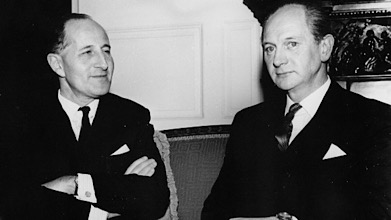
Prime Minister of Northern Ireland Terence O’Neill calls on the Taoiseach Jack Lynch at Iveagh House in Dublin on January 8, 1968. There is no advance publicity, largely to ensure that Ian Paisley is not able to upstage the meeting with his antics. The dozen reporters present are impressed at the friendly informality.

”How are you, Jack?” O’Neill says as he gets out of the car, extending his hand to the Taoiseach.

O’Neill is accompanied by his wife, Jean, and a number of officials. They have lunch in Iveagh House with the Taoiseach and his wife, Maureen, together with a number of official staff, and five of Lynch’s cabinet colleagues and their wives. The ministers are Tánaiste Frank Aiken, Minister for Finance Charles Haughey, Minister for Industry and Commerce George Colley, Minister for Agriculture and Fisheries Neil Blaney, and Minister for Transport and Power Erskine Childers.

The official statement at the end of the four-hour meeting states that progress has been made in “areas of consultation and co-operation.” The Taoiseach says they discussed industry, tourism, electricity supply, and trade, as well as tariff concessions, and “measures taken by both governments to prevent the spread of foot-and-mouth disease from Britain.”

Afterward, O’Neill returns to Northern Ireland by a different route in order to avoid any possible demonstration. Paisley has been developing a high profile for himself with his attacks on O’Neill in recent months. But he misses the opportunity to protest on this occasion. The next day he issues a statement regretting O’Neill’s return home. “I would advise Mr. Lynch to keep him,” Paisley announces.

Five years earlier, in 1963, O’Neill becomes Prime Minister of Northern Ireland. From very early on, he tries to break down sectarian barriers between the two Northern communities. He also seeks to improve relations with the Republic of Ireland by eradicating the impasse in relations that has existed since the 1920s. He invites then-Taoiseach Seán Lemass to meet him at Stormont on January 14, 1965. Lemass courageously accepts the invitation. At their initial meeting, when they are briefly alone, Lemass says to O’Neill, ”I shall get into terrible trouble for this!” The Northern premier replies, ”No, Mr. Lemass, it is I who will get into terrible trouble.”

O’Neill makes his return visit to Dublin on February 9, 1965, and the two leaders agree to co-operate on tourism and electricity. It is Lemass who makes the most significant concessions, because the Constitution of Ireland does not recognise the existence of the North. Article 2 of the Constitution actually claims sovereignty over the whole island. Thus, by formally meeting the Prime Minister of Northern Ireland, O’Neill claims that Lemass accorded him “a de facto recognition.”

The Taoiseach then bolsters this at their follow-up meeting in Iveagh House, Dublin, three weeks later. ”The place card in front of me at Iveagh House bore the inscription, Prime Minister of Northern Ireland,” O’Neill proudly explains. Surely this is tantamount to formal recognition. But many Unionists still have grave reservations about dealing with the Republic of Ireland.

In 1966, Ian Paisley establishes the Protestant Unionist Party (PUP) to oppose O’Neill. He rouses sectarian tension by holding mass demonstrations at which he brands O’Neill as the “Ally of Popery.” Nevertheless, public opinion polls indicate support for O’Neill’s leadership from both communities in the North.

After Jack Lynch replaced Lemass as Taoiseach in late 1966, O’Neill continues with his efforts to improve relations with the Dublin government by inviting Lynch to Stormont Castle. The Taoiseach travels to Belfast by car on December 11, 1967. There is no formal announcement of his visit, but word is leaked to Paisley after the Taoiseach’s car crosses the border.

Paisley arrives at Stormont with his wife and a handful of supporters, just minutes before the Taoiseach. With snow on the ground, two of Paisley’s church ministers, Rev. Ivan Foster and Rev. William McCrea, begin throwing snowballs at Lynch’s car. The Royal Ulster Constabulary (RUC) promptly grabs the two ministers. While they are being bundled into a police car, Paisley is bellowing, “No Pope here!” Lynch asks his traveling companion, T. K. Whitaker, “Which one of us does he think is the Pope?”

Paisley demands to be arrested by the RUC, and actually tries to get into the police car with his two colleagues, but he is pulled away. The two clergymen are taken to an RUC station and quickly released. Lynch ridicules the protest. “It was a seasonal touch,” he says. “It reminds me of what happens when I go through a village at home and the boys come and throw snowballs.”

Paisley says he had come to protest against “the smuggling” of Lynch into Stormont. If he had known about the visit earlier, he says that he would have brought along 10,000 people to protest. Denouncing O’Neill, as a “snake in the grass,” he goes on to accuse Lynch of being “a murderer of our kith and kin.” In an editorial, the Unionist Newsletter proclaims that ”there is no doubt that Capt. O’Neill has the full support of his colleagues and of the country.”

O’Neill’s four formal meetings with Lynch and his predecessor contribute to a thaw in relations at the summit between Belfast and Dublin, but the whole process is exploited by others to fan the flames of Northern sectarianism.

People do not realise it in early 1968, but Northern Ireland is about to explode. On October 5, 1968, people gather in Derry for a civil rights march that has been banned by Stormont. When the march begins, it is viciously attacked by the RUC. This ignites a series of further protests, which ultimately leads to Bloody Sunday, and the eruption of the Troubles for the next quarter of a century.

(From: “Meetings helped thaw relations before the North exploded,” Irish Examiner, http://www.irishexaminer.com, January 8, 2018)


Leave a comment

Birth of Desmond Boal, Unionist Politician & Barrister

Desmond Norman Orr Boalunionist politician and barrister, is born on August 8, 1928, in St. Columb’s Court, Derry, County Londonderry, Northern Ireland.

Boal is the third of five children (and only son) of James Boal, cashier and bakery manager, and his wife Kathleen (nèe Walker). Brought up in the Church of Ireland, he is educated at First Derry Primary School, Cathedral Primary School (Derry), Foyle College (Derry), Portora Royal School In Enniskillen, County Fermanagh, and Trinity College Dublin (TCD), where he graduates BA and Bachelor of Laws (LLB).

During his studies Boal founds an Orange lodge at TCD. He is called to the bar in 1952 at the Inner Temple, London. He travels extensively during his summers, visiting Afghanistan, South America and even China during the Cultural Revolution.

Around 1956, Boal makes the acquaintance of Ian Paisley through friendships with ultra-protestant activists, and for the next half-century is one of Paisley’s closest friends and advisers. He has a legal career before he enters politics in 1960. He was the Ulster Unionist Party (UUP) Member of the Parliament of Northern Ireland for the Belfast Shankill constituency between 1960 and 1972. He is very critical of the leadership under Captain Terence O’Neill, then Prime Minister of Northern Ireland. He opposes the manner, if not the substance, of O’Neill’s attempts at improving relations with both the Irish government and the Roman Catholic/Irish nationalist minority in Northern Ireland, along with many backbenchers.

Discontented with James Chichester-Clark and Brian Faulkner who come to government after O’Neill’s 1969 fall from power, Boal resigns from the UUP in 1971 and joins Ian Paisley in establishing the Democratic Unionist Party (DUP) in order to provide dissident unionist opinion with a viable political alternative. He works as the first chairman and one of the first public representatives of the DUP and continues to sit in Stormont during the years of 1971–1972. He later resumes his practice as a barrister.

While Boal’s interest in federalism diminishes after the 1970s, the federalist Boal scheme of January 1974 is again put forward by liberal protestants such as John Robb as late as 2007. His friendship with Paisley finally breaks when the DUP agrees to enter government with Sinn Féin in 2007. He tells Paisley, who takes the breach very hard, that he had betrayed everything he ever advocated.

Boal dies at his home in Holywood, County Down, on April 23, 2015, aged 86. His funeral is held at Roselawn Crematorium in Belfast.


Leave a comment

Death of Basil Stanlake Brooke, Third Prime Minister of Northern Ireland

Basil Stanlake Brooke, 1st Viscount Brookeborough, KG, CBE, MC, TD, PC (Ire), Ulster Unionist Party (UUP) politician who serves as the third Prime Minister of Northern Ireland from May 1943 until March 1963, dies on August 18, 1973, at Colebrooke Park, Brookeborough, County Fermanagh, Northern Ireland. He has been described as “perhaps the last Unionist leader to command respect, loyalty and affection across the social and political spectrum.” Equally well, he has also been described as one of the most hardline anti-Catholic leaders of the UUP, and his legacy involves founding his own paramilitary group, which feeds into the reactivation of the Ulster Volunteers.

Brooke is born on June 9, 1888, at Colebrooke Park, his family’s neo-Classical ancestral seat on what is then the several-thousand-acre Colebrooke Estate, just outside Brookeborough, a village near Lisnaskea in County Fermanagh. He is the eldest son of Sir Arthur Douglas Brooke, 4th Baronet, whom he succeeds as 5th Baronet when his father dies in 1907. His mother is Gertrude Isabella Batson. He is a nephew of Field Marshal Alan Brooke, 1st Viscount Alanbrooke, Chief of the Imperial General Staff (CIGS) during World War II, who is only five years his senior. His sister Sheelah marries Sir Henry Mulholland, Speaker of the Stormont House of Commons and son of Lord Dunleath. He is educated for five years at St. George’s School in Pau, France, and then at Winchester College (1901–05).

After graduating from the Royal Military College, Sandhurst, Brooke is commissioned into the Royal Fusiliers on September 26, 1908, as a second lieutenant. He transfers to the 10th Royal Hussars in 1911. He is awarded the Military Cross and Croix de guerre with palm for his service during World War I.

Brooke is a very active Ulster Unionist Party member and ally of Edward Carson. He founds his own paramilitary group, Brooke’s Fermanagh Vigilance, from men returning from the war front in 1918. Although the umbrella Ulster Volunteers had been quiescent during the war, it is not defunct. It re-emerges strongly in 1920, subsuming groups like Brooke’s.

In 1920, having reached the rank of captain, Brooke leaves the British Army to farm the Colebrooke Estate, the family estate in west Ulster, at which point he turns toward a career in politics.

Brooke has a very long political career. When he resigns the Premiership of Northern Ireland in March 1963, he is Northern Ireland’s longest-serving prime minister, having held office for two months short of 20 years. He also establishes a United Kingdom record by holding government office continuously for 33 years.

In 1921, Brooke is elected to the Senate of Northern Ireland, but he resigns the following year to become Commandant of the Ulster Special Constabulary (USC) in their fight against the Irish Republican Army (IRA). He is created a Commander of the Order of the British Empire in 1921.

In 1929 Brooke is elected to the House of Commons of Northern Ireland as Ulster Unionist Party MP for the Lisnaskea division of County Fermanagh. In the words of the Oxford Dictionary of National Biography, “his thin, wiry frame, with the inevitable cigarette in hand, and clipped, anglicised accent were to be a feature of Stormont for the next forty years.”

Brooke becomes Minister of Agriculture in 1933. By virtue of this appointment, he also acquires the rank of Privy Councilor of Northern Ireland. From 1941 to 1943 he is Minister of Commerce.

On May 2, 1943, Brooke succeeds John M. Andrews as Prime Minister of Northern Ireland. In 1952, while Prime Minister, was raised to the peerage as Viscount Brookeborough, the title taken from the village named after the Brookes. Although a peer, he retained his seat in the House of Commons at Stormont and remained Prime Minister for another decade.

As the Northern Ireland economy begins to de-industrialise in the mid-1950s, leading to high unemployment amongst the Protestant working classes, Brooke faces increasing disenchantment amongst UUP backbenchers for what is regarded as his indifferent and ineffectual approach to mounting economic problems. As this disenchantment grows, British civil servants and some members of the UUP combine to exert discreet and ultimately effective pressure on Brooke to resign to make way for Captain Terence O’Neill, who is Minister of Finance.

In 1963, his health having worsened, Brooke resigns as Prime Minister. However, he remains a member of the House of Commons of Northern Ireland until the 1969 Northern Ireland general election, becoming the Father of the House in 1965. During his last years in the Parliament of Northern Ireland he publicly opposes the liberal policies of his successor Terence O’Neill, who actively seeks to improve relationships with the Republic of Ireland, and who attempts to address some of the grievances of Catholics and grant many of the demands of the Northern Ireland Civil Rights Association (NICRA).

Brooke is noted for his casual style toward his ministerial duties. Terence O’Neill later writes of him, “he was good company and a good raconteur, and those who met him imagined that he was relaxing away from his desk. However, they did not realise that there was no desk.”

In his retirement Brooke develops commercial interests as chairman of Carreras (Northern Ireland), a director of Devenish Trade, and president of the Northern Ireland Institute of Directors. He is also made an honorary LL.D. of Queen’s University Belfast.

From 1970 to 1973, years in which the Stormont institution comes under its greatest strain and eventually crumbles, Brooke makes only occasional forays into political life. In 1972, he appears next to William Craig MP on the balcony of Parliament Buildings at Stormont, a diminutive figure beside the leader of the Vanguard Unionist Progressive Party (VUPP) who is rallying right-wing Unionists against the Government of Northern Ireland. He opposes the Westminster white paper on the future of Northern Ireland and causes some embarrassment to his son, Captain John Brooke, the UUP Chief Whip and an ally of Brian Faulkner, by speaking against the Faulkner ministry‘s proposals.

Brooke dies at his home, Colebrooke Park, on the Colebrooke Estate, on August 18, 1973. His remains are cremated at Roselawn Cemetery, East Belfast, three days later, and, in accordance with his wishes, his ashes are scattered on the demesne surrounding his beloved Colebrooke Park.


Leave a comment

Death of John McKeague, Northern Irish Loyalist

John Dunlop McKeague, a Northern Irish loyalist and one of the founding members of the paramilitary group the Red Hand Commando (RHC) in 1970, is killed by the Irish National Liberation Army (INLA) in Belfast, Northern Ireland, on January 29, 1982.

McKeague is born in 1930 at Messines Cottage, Bushmills, County Antrim, Northern Ireland, one of six children of Thomas McKeague and his wife, Isabella. The family operates a guesthouse in Portrush before moving to Belfast, where they open a stationer’s shop on Albertbridge Road. It is inherited by McKeague and in the late 1970s it becomes a confectioner’s shop and café.

In the late 1960s, McKeague is active in Ian Paisley‘s Free Presbyterian Church of Ulster and the Willowfield branch of the Ulster Protestant Volunteers (UPV). He is linked to William McGrath and the revived Ulster Volunteer Force (UVF) of the mid-1960s, and he publicises the claims of Gusty Spence that the police had framed him for the murder of a Catholic barman. On November 30, 1968, he participates in a banned demonstration by supporters of Ian Paisley against a civil rights march in Armagh city. Throughout the late 1960s and early 1970s he publishes a magazine, Loyalist News, full of anti-Catholic rhetoric and gossip, sectarian rhymes, Protestant religious material, and illustrated lessons in the use of firearms. He takes part in the bombing campaign of 1969 which leads to the downfall of Prime Minister of Northern Ireland Terence O’Neill and stands unsuccessfully for Belfast Corporation in 1969 as a Protestant Unionist Party (PUP) candidate. McKeague, who never marries, is a promiscuous homosexual. His paramilitary recruitment of young men has homoerotic overtones, and his violence contains elements of sexual perversion.

In 1969, McKeague and his associates take over the nascent Shankill Defence Association (SDA), which had been formed to oppose a destructive redevelopment scheme. He becomes its chairman and, despite his outsider status and eccentricities, is given to strutting around wearing a helmet and brandishing a stick, often seen as offering communal defence against a perceived Catholic threat. The organisation acquires 1,000 members. In August 1969, he orchestrates mob attacks on Catholic enclaves in Belfast, including Bombay Street. He boasts of these activities, becoming a figure of hate for Catholics. In October 1969, he is arrested and charged with conspiracy to cause an explosion but is cleared in February 1970. The sentence is reduced to three months on appeal. He testifies before Justice Leslie Scarman‘s tribunal, appointed to inquire into the unrest. In the course of his evidence, he exults over the August 1969 riots and the tribunal’s report condemns him by name. He later further enrages Catholics by calling the events of Bloody Sunday in January 1972 “Good Sunday” in a television interview.

McKeague seeks publicity and power, but his eccentricity and unwillingness to participate where he cannot command dooms his political ambitions. In the 1970 United Kingdom general election he wins only 441 votes in Belfast North. He is expelled from the UPV after being prosecuted in February–March 1970 over the loyalist bombing campaign of 1969, even though he is acquitted. He and Ian Paisley exchange bitter invective and he subsequently supports William Craig‘s Vanguard movement. In 1971, he and two associates are prosecuted under the new Incitement to Hatred Act for publishing a Loyalist song book, which includes verses, probably composed by McKeague, reveling in the murder of Catholics. The defendants plead that the book is purely a historical record, and their acquittal vitiates the act. After he quarrels with the newly formed Ulster Defence Association (UDA), which is created by a federation of the SDA with other local vigilante groups, his elderly mother is burned alive when the UDA petrol-bombs the family shop on May 9, 1971.

Early in 1972 McKeague is expelled from the SDA. He founds the Red Hand Commandos (RHC), centered on east Belfast and north Down, which perpetrates numerous sectarian murders. As RHC leader, he allegedly participates in murders involving torture and mutilation. He aligns the RHC with the UVF in 1972 and in February 1973 he is one of the first loyalist internees. He is subsequently imprisoned for three years for armed robbery, although he always asserts his innocence of this charge. During his imprisonment he assumes a leadership role among loyalist prisoners, undertaking two short hunger strikes in protest against the Special Powers Act and prison conditions. Later, in December 1981, he acts as an intermediary during a loyalist prison protest. On his release in 1975, the RHC splits and thereafter he denies any connection with the organisation, threatening to sue newspapers that link him with it. Until his death he is co-chair of the Ulster Loyalist Central Co-ordinating Committee (ULCCC), a paramilitary umbrella group established in 1974. On October 6, 1975, a Catholic customer is killed and McKeague’s sister severely injured when his shop is bombed by the Irish Republican Army (IRA).

From the mid-1970s McKeague advocates negotiated independence for Northern Ireland, arguing that this can accommodate republican anti-British feeling and unionist fears of a united Ireland. “The days of the Orange card are gone forever,” he says (Sunday World, January 31, 1982). He is a founder and deputy leader of the minuscule Ulster Independence Association and suggests that the “Londonderry Air” become Ulster‘s national anthem. In talks with nationalists and republicans, he tells the Catholic priest Des Wilson that a united Ireland would be acceptable to Protestants, provided “we enter as a free people, even if we’re only independent for five minutes.” However, his record is an insuperable barrier to these initiatives.

In his last years, McKeague is chairman of the Frank Street–Cluan Place–Stormont Street Housing Association. He lobbies for a security wall to shield this Protestant district of Belfast from the Catholic Short Strand on which it borders. Construction of the wall begins just before his death. He is shot dead by the INLA at his shop on Albertbridge Road on January 29, 1982. Shortly before his death, he is linked to the rape and prostitution of teenage boys at Kincora Boys’ Home in east Belfast. He had apparently been an informer to the security forces, and it is sometimes suggested that his murder is part of an official cover-up. He is buried in Bushmills, with Church of Ireland rites.

McKeague exemplifies the social deviant who can gain prominence during political instability, projecting and legitimising his hatreds and obsessions through extremist politics. In his last years, he accepts that he will die violently. He says that if loyalists kill him, “I want . . . to be left in the Republican area so that they’re blamed” (Sunday World, January 31, 1972).

(From: “McKeague, John Dunlop” by Patrick Maume, Dictionary of Irish Biography, http://www.dib.ie, October 2009)


4 Comments

Anne Letitia Dickson Elected UPNI Leader

Anne Letitia Dickson is elected leader of the Unionist Party of Northern Ireland (UPNI) on September 15, 1976, becoming the first woman to lead a political party in Ireland.

Born in London on April 18, 1928, Dickson moves with her family to Northern Ireland at an early age and is educated at Holywood and Richmond Lodge School. After service as the Chair of the Northern Ireland Advisory Board of the Salvation Army she becomes actively involved in politics for the Ulster Unionist Party (UUP). Elected as chair of the Carrick Division Unionist Association she later becomes a member of the Newtownabbey Urban District Council, serving as Vice-Chair from 1967 to 1969.

Dickson is then elected as an Ulster Unionist politician for the Carrick constituency in the Parliament of Northern Ireland at Stormont as a supporter of Prime Minister Terence O’Neill. After the dissolution of the Stormont Parliament, she is elected in the 1973 Assembly election for South Antrim as an Independent Unionist candidate having resigned from the Ulster Unionist Party in 1972.

After the Ulster Unionist party split in 1974 over the Sunningdale Agreement, Dickson joins the newly formed Unionist Party of Northern Ireland along with other supporters of former Northern Ireland prime minister Brian Faulkner. She retains her seat in South Antrim in the 1975 constitutional convention election. After the retirement of Brian Faulkner in 1976 she becomes leader of the Unionist Party of Northern Ireland, becoming the first woman to lead a major political party in Northern Ireland.

In 1979 Dickson contests the Belfast North constituency in the Westminster election, polling 10% of the vote, the best performance by a UPNI candidate in Northern Ireland, however her intervention is sufficient to split the moderate Unionist vote resulting in the seat being gained by the Democratic Unionist Party (DUP).

The Unionist Party of Northern Ireland disbands in 1981 after poor results in the local government elections and Dickson retires from active politics. Subsequently she is chair of the Northern Ireland Consumer Council from 1985 to 1990.

Dickson is appointed CBE in the 1990 Birthday Honours.


Leave a comment

Birth of Brian Faulkner, Sixth & Last Prime Minister of Northern Ireland

Arthur Brian Deane Faulkner, Baron Faulkner of Downpatrick, the sixth and last Prime Minister of Northern Ireland, is born on February 18, 1921, in Helen’s Bay, County Down.

Faulkner is the elder of two sons of James, owner of the Belfast Collar Company, and Nora Faulkner. His younger brother is Colonel Sir Dennis Faulkner. He is educated initially at Elm Park preparatory school, Killylea, County Armagh, but at 14, preferring to stay in Ireland, is sent to the Church of Ireland-affiliated St. Columba’s College at Whitechurch, County Dublin, although he is Presbyterian. His best friend at the school is Michael Yeats, son of W. B. Yeats. He enters Queen’s University Belfast in 1939 to study law, but, with the advent of World War II, he quits his studies to work full-time in the family shirt-making business. He is the only Prime Minister of Northern Ireland to have been educated in the Irish Free State and one of only two to have been educated in Ireland.

Faulkner becomes involved in unionist politics, the first of his family to do so, and is elected to the Parliament of Northern Ireland as the Ulster Unionist Party (UUP) Member of Parliament (MP) for the constituency of East Down in 1949. His vociferous traditional unionist approach to politics ensures him a prominent backbench position. He is, at the time, the youngest ever MP in the Northern Irish Parliament. He is also the first Chairman of the Ulster Young Unionist Council in 1949. In 1956 he is offered and accepts the job of Parliamentary Secretary to the Ministry of Finance, or Government Chief Whip.

In 1959, Faulkner becomes Minister of Home Affairs and his handling of security for most of the Irish Republican Army‘s border campaign of 1956–62 bolsters his reputation in the eyes of the right wing of Ulster unionism.

When Terence O’Neill becomes Prime Minister in 1963, he appoints Faulkner, his chief rival for the job, as Minister of Commerce. He resigns in 1969 over the technicalities of how and when to bring in the local government reforms which the British Labour government is pushing for. This is a factor in the resignation of O’Neill, who resigns as Prime Minister in the aftermath of his failure to achieve a good enough result in the 1969 Northern Ireland general election.

In the ensuing leadership contest, Faulkner loses out again when O’Neill gives his casting vote to his cousin, James Chichester-Clark. In 1970, he becomes the Father of the House. He comes back into government as Minister of Development under Chichester-Clark and in a sharp turn-around, begins the implementation of the political reforms that were the main cause of his resignation from O’Neill’s cabinet. Chichester-Clark himself resigns in 1971 as the political and security situation and the more intensive British interest proves difficult.

Faulkner is elected leader of the Ulster Unionist Party and Prime Minister. In his initial innovative approach to government, he gives a non-unionist, David Bleakley, a former Northern Ireland Labour Party (NILP) MP, a position in his cabinet as Minister for Community Relations. In June 1971, he proposes three new powerful committees at Stormont which would give the opposition salaried chairmanships of two of them.

However, this initiative (radical at the time) is overtaken by events. A shooting by soldiers of two nationalist youths in Derry causes the Social Democratic and Labour Party (SDLP), the main opposition, to boycott the Stormont parliament. The political climate deteriorates further when, in answer to a worsening security situation, Faulkner introduces internment on August 9, 1971. This is a disaster and causes the situation to worsen.

Despite this, Faulkner continues his radical approach to Northern Irish politics and, following Bleakley’s resignation in September 1971 over the internment issue, appointes Dr. G. B. Newe, a prominent lay Catholic, as Minister of State in the Cabinet Office. His administration staggers on through the rest of 1971, insisting that security is the paramount issue.

In January 1972, an incident occurs during a Northern Ireland Civil Rights Association march in Derry, during which paratroopers shoot and killed thirteen unarmed civilians. A fourteenth civilian dies later. What history has come to know as Bloody Sunday is, in essence, the end of Faulkner’s government. In March 1972, he refuses to maintain a government without security powers which the British government under Edward Heath decides to take back. The Stormont parliament is subsequently prorogued, initially for a period of one year, and following the appointment of a Secretary of State for Northern Ireland, William Whitelaw, direct rule is introduced.

In June 1973, elections are held to a new devolved parliament, the Northern Ireland Assembly. The elections split the UUP. Faulkner becomes chief executive in a power-sharing executive with the SDLP and the centre-ground Alliance Party, a political alliance cemented at the Sunningdale Conference that year. The power-sharing Executive lasts only six months and is brought down by a loyalist Ulster Workers’ Council strike in May 1974. In 1974, he loses the leadership of the UUP to anti-Sunningdale elements led by Harry West. He subsequently resigns from the Ulster Unionist Party and forms the Unionist Party of Northern Ireland (UPNI).

The UPNI fares badly in the Northern Ireland Constitutional Convention elections of 1975, winning only five out of the 78 seats contested. Faulkner wins the final seat. In 1976 he announces that he is quitting active politics. He is elevated to the House of Lords in the 1977 New Year Honours list, being created Baron Faulkner of Downpatrick on February 7, 1977.

Faulkner, a keen huntsman, dies on March 3, 1977, following a riding accident while hunting with the County Down Staghounds at the Ballyagherty/Station Road junction near Saintfield, County Down. He is riding at full gallop along a narrow country road when his horse slips, throwing him off and killing him instantly. He is laid to rest at Magherahamlet Presbyterian Church near Spa, County Down where he had been a regular member of the congregation. His twenty-four-day life peerage is thus the shortest-lived until the death of Lord Heywood of Whitehall in 2018 just nine days after ennoblement.


Leave a comment

Terence O’Neill Becomes Fourth Prime Minister of Northern Ireland

File source: http://en.wikipedia.org/wiki/File:Captain_Terence_O%27Neill.jpg

Terence O’Neill becomes the fourth Prime Minister of Northern Ireland on March 25, 1963, following the resignation of Basil Brooke, 1st Viscount Brookeborough. He plays a significant role in the first year of the Troubles, trying unsuccessfully to stem growing sectarian violence.

O’Neill is born on September 10, 1914, at 29 Ennismore Gardens, Hyde Park, London, the son of Captain Arthur O’Neill of Shane’s Castle, Randalstown, the first member of parliament (MP) to be killed in action in World War I five months later. He is educated in the English public school system at West Downs SchoolWinchester and Eton College, spending his summer holidays at the family estate in Ulster. He is later commissioned in the British Army, rising to the rank of captain and serving with the Irish Guards in World War II. He is wounded in 1944 and opts to resettle permanently in Northern Ireland.

In 1946, O’Neill is elected to the Parliament of Northern Ireland, representing the Unionist stronghold of Bannside. He remains in the parliament at Stormont for almost 25 years. He becomes Northern Ireland’s Minister of Home Affairs in April 1956, Minister of Finance in September 1956 and Prime Minister in March 1963.

As Prime Minister, O’Neill introduces economic reforms to stimulate industrial growth and employment, with mixed results. He also tries narrowing the divide between Protestants and Catholics. He does this with important gestures, like visiting Catholic schools and expressing condolences on the death of Pope John XXIII.

O’Neill also seeks better relations with the Republic of Ireland, and in January 1965 invites Taoiseach Seán Lemass to Belfast. Catholics and moderate Unionists welcome this reconciliation but many conservative Loyalists, like Ian Paisley, condemn it as treachery.

When the civil rights movement erupts in the late 1960s, O’Neill offers a package of reforms and concessions, including changes to the allocation of housing. These proposals, however, anger staunch Unionists and fail to satisfy many Republicans.

In December 1969, O’Neill appears on Northern Ireland television and makes an impassioned plea for unity, warning that “Ulster stands at the crossroads.” His government is reelected in February 1969, though O’Neill himself is almost voted out of his own seat.

With the situation worsening, O’Neill is further embarrassed by Loyalist attempts to sabotage Belfast’s water supply. Fast losing the confidence of his own party, he resigns the prime ministership in April 1969. He remains in the parliament until January 1970.

O’Neill is made Baron O’Neill of the Maine and spends the last decade of his life in Britain’s House of Lords. He dies of cancer on June 12, 1990.


Leave a comment

Death of Erskine Hamilton Childers, 4th President of Ireland

Erskine Hamilton Childers, Fianna Fáil politician who serves as the 4th President of Ireland, dies on November 17, 1974. He also serves as Tánaiste and Minister for Health from 1969 to 1973, Minister for Transport and Power from 1959 to 1969, Minister for Posts and Telegraphs from 1951 to 1954 and 1966 to 1969. He served as a Teachta Dála (TD) from 1938 to 1973.

Childers is born on December 11, 1905, in the Embankment Gardens, London, to a Protestant family originally from Glendalough, County Wicklow. He is educated at Gresham’s School, Holt, and the University of Cambridge. In 1922, when Childers is sixteen, his father, Robert Erskine Childers, is executed by the new Irish Free State on politically inspired charges of gun-possession. After attending his father’s funeral, Childers returns to Gresham’s, then two years later he goes on to Trinity College, Cambridge.

After finishing his education, Childers works for a period in a tourism board in Paris. In 1931, Éamon de Valera invites him to work for his recently founded newspaper, The Irish Press, where Childers becomes advertising manager. He becomes a naturalised Irish citizen in 1938. That same year, he is first elected as a Fianna Fáil Teachta Dála (TD) for Athlone–Longford. He remains in the Dáil Éireann until 1973, when he resigns to become President.

Childers joins the cabinet in 1951 as Minister for Posts and Telegraphs in the de Valera government. He then serves as Minister for Lands in de Valera’s 1957–59 cabinet, as Minister for Transport and Power under Seán Lemass, and, successively, as Transport Minister, Posts and Telegraphs Minister, and Health Minister under Jack Lynch. He becomes Tánaiste in 1969.

Fine Gael TD Tom O’Higgins, who had almost won the 1966 presidential election, is widely expected to win the 1973 election when he is again the Fine Gael nominee. Childers is nominated by Fianna Fáil at the behest of de Valera, who pressures Jack Lynch in the selection of the presidential candidate. He is a controversial nominee, owing not only to his British birth and upbringing but to his Protestantism. However, on the campaign trail his personal popularity proves enormous, and in a political upset, Childers is elected the fourth President of Ireland on May 30, 1973, defeating O’Higgins by 635,867 votes to 578,771.

Childers quickly gains a reputation as a vibrant, extremely hard-working president, and becomes highly popular and respected. However, he has a strained relationship with the incumbent government, led by Taoiseach Liam Cosgrave of Fine Gael. Childers had campaigned on a platform of making the presidency more open and hands-on, which Cosgrave views as a threat to his own agenda as head of government. Childers considers resigning from the presidency but is convinced to remain by Cosgrave’s Minister for Foreign Affairs and Trade, Garret FitzGerald.

Though frustrated about the lack of power he has in the office, Childers’ daughter Nessa believes that he plays an important behind-the-scenes role in easing the Northern Ireland conflict, reporting that former Prime Minister of Northern Ireland Terence O’Neill meets secretly with her father at Áras an Uachtaráin on at least one occasion.

Prevented from transforming the presidency as he desired, Childers instead throws his energy into a busy schedule of official visits and speeches, which is physically taxing. On November 17, 1974, just after making a speech to the Royal College of Physicians of Ireland in Dublin, Childers suffers a heart attack. He dies the same day at Mater Misericordiae University Hospital.

Childers’s state funeral in St. Patrick’s Cathedral, Dublin is attended by world leaders including the Louis Mountbatten, 1st Earl Mountbatten of Burma (representing Queen Elizabeth II), the Prime Minister of the United Kingdom and leader of the Opposition, and presidents and crowned heads of state from Europe and beyond. He is buried in the grounds of the Church of Ireland Derralossary church in Roundwood, County Wicklow.


Leave a comment

Erskine Childers Elected Fourth President of Ireland

In a political upset, Erskine Hamilton Childers defeats Tom O’Higgins by a very narrow margin and is elected as the fourth President of Ireland on May 30, 1973.

Incumbent president Éamon de Valera is 90 years old and constitutionally barred from seeking a third term. His party, Fianna Fáil, seeks to get former Tánaiste Frank Aiken to run for the presidency, but he declines. Under pressure, former Tánaiste Erskine H. Childers agrees to run. The odds-on favourite is Fine Gael deputy leader, Tom O’Higgins, who had come within 1% of defeating Éamon de Valera in the 1966 presidential election.

Childers is a controversial nominee, owing not only to his British birth and upbringing but to his Protestantism. However, on the campaign trail his personal popularity proves enormous. In a political upset, Erskine H. Childers wins the presidency by 635,867 votes to 578,771.

Childers, though 67, quickly gains a reputation as a vibrant, extremely hard-working president, and becomes highly popular and respected. However, he has a strained relationship with the incumbent government, led by Taoiseach Liam Cosgrave of Fine Gael. Childers has campaigned on a platform of making the presidency more open and hands-on, which Cosgrave views as a threat to his own agenda as head of government. He refuses to co-operate with Childers’ first priority upon taking office, the establishment of a think tank within Áras an Uachtaráin to plan the country’s future. Childers considers resigning from the presidency, but is convinced to remain by Cosgrave’s Foreign MinisterGarret FitzGerald. However, Childers remains detached from the government. Whereas previously, presidents had been briefed by taoisigh once a month, Cosgrave briefs President Childers and his successor, Cearbhall Ó Dálaigh, on average once every six months.

Though frustrated about the lack of power he has in the office, Childers plays an important behind-the-scenes role in easing the Northern Ireland conflict as former Northern Ireland Prime Minister Terence O’Neill meets secretly with Childers at Áras an Uachtaráin on at least one occasion.

Prevented from transforming the presidency as he desires, Childers instead throws his energy into a busy schedule of official visits and speeches, which is physically taxing. On November 17, 1974, just after making a speech to the Royal College of Physicians in Dublin, Childers suffers a heart attack. He dies the same day at Mater Misericordiae University Hospital.

Childers’s state funeral in St. Patrick’s Cathedral, Dublin, is attended by world leaders including the Earl Mountbatten of Burma (representing Queen Elizabeth II), the Prime Minister of the United Kingdom and leader of the Opposition, and presidents and crowned heads of state from Europe and beyond. He is buried in the grounds of the Church of Ireland Derralossary church in RoundwoodCounty Wicklow.


Leave a comment

Anne Letitia Dickson Elected UPNI Leader

anne-letitia-dickson

Anne Letitia Dickson is elected leader of the Unionist Party of Northern Ireland (UPNI) on September 15, 1976, becoming the first woman to lead a political party in Ireland.

Born in London on April 18, 1928, Dickson moves with her family to Northern Ireland at an early age and is educated at Holywood and Richmond Lodge School. After service as the Chair of the Northern Ireland Advisory Board of the Salvation Army she becomes actively involved in politics for the Ulster Unionist Party (UUP). Elected as chair of the Carrick Division Unionist Association she later becomes a member of the Newtownabbey Urban District Council, serving as Vice-Chair from 1967 to 1969.

Dickson is then elected as an Ulster Unionist politician for the Carrick constituency in the Parliament of Northern Ireland at Stormont as a supporter of Prime Minister Terence O’Neill. After the dissolution of the Stormont Parliament, she is elected in the 1973 Assembly election for South Antrim as an Independent Unionist candidate having resigned from the Ulster Unionist Party in 1972.

After the Ulster Unionist party split in 1974 over the Sunningdale Agreement, Dickson joins the newly formed Unionist Party of Northern Ireland along with other supporters of former Northern Ireland prime minister Brian Faulkner. She retains her seat in South Antrim in the 1975 constitutional convention election. After the retirement of Brian Faulkner in 1976 she becomes leader of the Unionist Party of Northern Ireland, becoming the first woman to lead a major political party in Northern Ireland.

In 1979 Dickson contests the Belfast North constituency in the Westminster election, polling 10% of the vote, the best performance by a UPNI candidate in Northern Ireland, however her intervention is sufficient to split the moderate Unionist vote resulting in the seat being gained by the Democratic Unionist Party (DUP).

The Unionist Party of Northern Ireland disbands in 1981 after poor results in the local government elections and Dickson retires from active politics. Subsequently she is chair of the Northern Ireland Consumer Council from 1985 to 1990.