After moving to Houston in 1994, Devlin tends bar in Irish pubs and music venues for a number of years before starting his first band. From his perspective behind the bar, he realizes there is a local demand for Irish rock music that nobody is fulfilling. In 1996, to this end he forms a band called On the Dole. Although the band does well for several years, opening for legendary Irish touring acts like The Wolfe Tones and The Saw Doctors, eventually he decides it is time to clear the decks and start again.
In 2003, while hosting a weekly open mic at an Irish pub, Devlin meets bassist and singer Chad Smalley, son of Nobel laureateRichard Smalley and a veteran of the Houston music scene who had recently returned from New York and is looking for a new project. The two of them soon begin singing and performing together every week, developing a tight vocal harmony style.
In July 2004, Devlin and Smalley form Blaggards, along with violinist Turi Hoiseth and drummer Brian Vogel. Hoiseth and Vogel have since left the band, leaving Devlin and Smalley as the only original members.
The song “Big Strong Man” from Blaggards’ first album Standards (2005) appears in the 2010 British film The Kid, directed by Nick Moran.
“Big Strong Man” and “Drunken Sailor” (also from Standards) are both featured in episode 86 of the CBS series The Good Wife, aired on March 24, 2013.
Blaggards’ second album, Live in Texas, is released in 2010. It is a recording of a live performance at Houston’s Continental Club on June 13, 2009. The band’s latest album, Blagmatic, is released on July 14, 2021.
Blaggards, with Arizona-based fiddle player Heide Riggs and drummer Kevin “Turbo” Newton in the current lineup, continue to maintain a rigorous schedule, playing constantly throughout Texas and touring nationally several times a year. Beginning in 2010 (excluding the COVID years), the band does a 10-day Ireland tour every year in the early fall.
On the afternoon of September 8, 1863, Union Navy Lieutenant Frederick Crocker (“Acting Captain”) is in command of the advance squadron composed of four gunboats. Crocker is a veteran officer of considerable recent experience in Union river-gunboat actions and blockade duty. His ship is the USS Clifton, a steam-powered side-wheeler. Besides the USS Clifton, Crocker’s advance squadron includes USS Granite City, USS Sachem, and USS Arizona, all recently commissioned ironclad warships. Less than three miles southeast downriver, well out of range of the Confederate fort’s cannons, are anchored seven U.S. Navy transports carrying most of the Union Army soldiers of the landing force. The USS Suffolk, hosting invasion force commander Union Army Major GeneralWilliam B. Franklin and his staff, heads the seven-vessel squadron. Outside the principal Gulf shore sandbar, an additional two miles downstream of this squadron, lay at anchor the remaining ships of the 22-vessel invasion fleet. The total number of Union infantry assault troops in the landing force is given as 5,000 infantrymen, which includes 500 listed as aboard the USS Granite City, those aboard the six troop transports in the seven-ship squadron headed by USS Suffolk, plus an artillery company somewhere among them. The first wave of 500 men aboard USS Granite City, which steams as close behind USS Clifton as possible but out of range of the fort’s guns, are to land in the open space adjacent to and downstream of the fort. This is a flat, often muddy area already cleared of brush by the Confederate garrison as a clear field of fire for the canister and grapeshot of the fort’s artillery. The Union Army’s invasion plan, therefore, absolutely requires that the Confederate guns be silenced before any troops are debarked. This engagement is to be the largest amphibious assault on enemy territory in the history of the U.S. military to date.
Confederate CaptainLeon Smith, who is at Beaumont, Texas, immediately orders all Confederate troops in Beaumont, some eighty men, aboard the steamer Roebuck and sends them down the river to reinforce Fort Griffin. Smith and a Captain Good ride to the fort on horseback, reaching the fort some three hours before the steamer, arriving just as the Union gunboats USS Clifton and USS Sachem come within range, and assist in the defense of the fort.
Dowling’s well practiced Irish-Texan artillerymen, whose chosen and officially approved unit name is “Jefferson Davis Guards,” had placed range-stakes in the two narrow and shallow river channels. These are the “Texas channel” near the southwest shore and the “Louisiana channel” against the Louisiana shore. The white-painted stakes are for determining accurate range of the fort’s six old smooth-bore cannons. Each “Davis Guards” gun crew during gunnery practice thereby works to predetermine the approximate amount of gunpowder needed for each type of projectile (ball, canister, or grapeshot) available for their specific gun and which specific guns, charges, and loads have the best potential to hit each range-stake.
Crocker’s squadron has no local river pilots, only general knowledge of the river’s channels, no assurance of locations of the constantly varying depths especially of large oystershell “reefs” or “banks” between the river’s two channels. There is no mention in official U.S. Navy reports of whether Union sailors were making observations and taking depth soundings from the gunboats now dangerous top decks, while the Confederate cannon shots pounded and shook their ships. The few maps to which they have access are old and outdated and cannot account for recent changes in river-bottom conditions. On Captain Crocker’s signal the USS Sachem, followed by USS Arizona, advance up the right channel (Louisiana side) as fast as they dare, firing their port-side guns at the fort. USS Clifton approaches in the lead, ascending the Texas channel at full speed. USS Granite City hovers out of range behind USS Clifton, having orders not to risk debarking the 500 assault troops until the fort surrenders or its guns are silenced. As USS Sachem enters among the range-stakes, the Confederates open fire. Then USS Clifton comes into range, followed by USS Arizona. Despite their old smoothbore cannon, one of which has just become inoperable, after only a few rounds it is obvious the Confederate artillerymen’s months of training and target practice is an astounding success as their aim is deadly accurate.
The Confederates capture USS Clifton and USS Sachem with a total of 13 heavy cannon, including at least two new potent Parrott rifles, which are handed over to Leon Smith’s Texas Marine Department. The Union casualties amount to two dozen killed and badly wounded, about 37 missing, and 315 Navy men captured. The combined Union Army and Navy invasion force withdraw and return to New Orleans. The Confederates have no casualties.
In recognition of the victory, the Confederate States Congress passes a resolution of special thanks to the officers and men of the Davis Guard. In addition, Houston residents raise funds to provide medals to the Guard. The Davis Guards Medals are made from silver Mexican pesos by smoothing off the coins, then hand-stamping and hand-engraving on one side the battle name and date and on the other side the initials “D G” and a cross pattée. The medals are hung on green ribbons and presented to the members of the Davis Guard. The official Confederate silver medals are presented in a public ceremony a year later and are the only such medal ever awarded by that government.
The Battle of Sabine Pass is of moderate tactical or strategic significance to the American Civil War. It is successful in ensuring that the anticipated overland Union invasion of Texas is delayed indefinitely. A Confederate supply line from Mexico to Texas had existed out of the Port of Bagdad since the outbreak of the war but is held by the increasingly isolated Mexican Republicans. By the time Imperial French and Mexican forces capture Baghdad in 1864, a supply line to anywhere in the Confederacy east of the Mississippi River is no longer feasible on account of the Union victory at Vicksburg in July 1863. The Confederacy is therefore forced to continue its reliance on blockade running to import valuable materials and resources.
In 1937 a statue of Dowling is unveiled on the site of the fort. In 1998 a bronze plaque honoring Dowling is unveiled at the TuamTown Hall in County Galway.
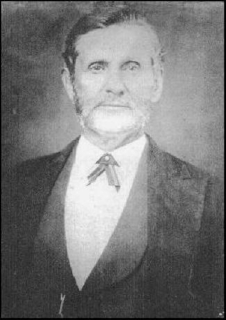
(Pictured: Richard William “Dick” Dowling, circa 1865)
Over 12 million immigrants are processed at the station that eventually closes in 1954. Third class and steerage passengers are processed at the Ellis Island station. First- and Second-class passengers are generally processed on the boats they arrive on as they are seen to be of lesser “risk.”
Moore arrives from County Cork aboard the Guion LinesteamshipNevada in 1892. Her brothers, Anthony and Philip, who journey with her, have just turned 15 and 12, respectively. As the first person to pass inspection at the newly opened facility, she is presented with an American $10 gold piece from an American official.
Moore’s parents, Matthew and Julia, had come to the United States in 1888 and were living at 32 Monroe Street in Manhattan. Annie marries a son of German Catholic immigrants, Joseph Augustus Schayer (1876-1960), a salesman at Manhattan’s Fulton Fish Market, with whom she has eleven children, five of whom survive to adulthood. The rest all die before the age of three.
Moore dies of heart failure on December 6, 1924, at age 47 and is buried in Calvary Cemetery, Queens. Her previously unmarked grave is identified in August 2006. On October 11, 2008, a dedication ceremony is held at Calvary which celebrates the unveiling of a marker for her grave, a Celtic cross made of Irish blue limestone.
A woman named “Annie Moore” who died near Fort Worth, Texas, in 1924 had long been thought to be the one whose arrival marked the beginning of Ellis Island. Further research, however, establishes that the Annie Moore in Texas was born in Illinois.
The Irish American Cultural Institute presents an annual Annie Moore Award “to an individual who has made significant contributions to the Irish and/or Irish American community and legacy.” She is also honored by two statues sculpted by Jeanne Rynhart. One stands at Cobh Heritage Centre (formerly Queenstown), her port of departure, and another at Ellis Island, her port of arrival. The image is meant to represent the millions who pass through Ellis Island in pursuit of the American dream.
(Pictured: Statue of Annie Moore and her brothers on the quayside in Cobh, County Cork)
Cleburne is born on March 17, 1828 at Bride Park Cottage in Ovens, County Cork, just outside Cork city. He is extremely loyal to his adopted country, saying, “if this [Confederacy] that is so dear to my heart is doomed to fail, I pray heaven may let me fall with it, while my face is toward the enemy and my arm battling for that which I know to be right.” Sadly, he ultimately receives his wish.
Cleburne begins his military career in an unlikely manner. When he fails the entrance exam at Trinity College, Dublin, he cannot face his family. He enlists in the 41st Regiment of Foot in the British Army. In 1849 he purchases his discharge and leaves for the United States, eventually settling in Helena, Arkansas in June 1850 and earning his citizenship in 1855. He loves his new country, taking part in many community projects, and even being one of the few volunteers to care for the sick during a yellow fever outbreak.
In January 1861 Cleburne joins the local militia company, the Yell Rifles. He leads the company in the seizure of the U.S. Arsenal in Little Rock in January 1861. When Arkansas secedes from the Union, the Yell Rifles become part of the 1st Arkansas Infantry Regiment. By fall of 1861 he has risen to command the 2nd Brigade, Hardee’s Division, in the Army of Central Kentucky. His first major battle is at the Battle of Shiloh, April 6-7, 1862. At the Battle of Richmond (Kentucky) in August 1862, he is wounded in the mouth and loses several of his teeth. Still, he earns the thanks of the Confederate States Congress for his actions there. During the October 1862 Battle of Perryville he is wounded again – twice, yet stays in command during the battle. In December 1862 he is promoted to Major General.
At the December 1862 Battle of Stones River, Cleburne and his division earn the praise of General Braxton Bragg for their incredible skill and valor. Cleburne’s actions and character play a large role in his men’s determination during battle.
In 1863 Cleburne faces off against Union General George Henry Thomas at the Battle of Chickamauga. His and General John C. Breckinridge’s assaults force General Thomas to call repeatedly for reinforcements. In November 1863 the Confederate army is forced to retreat after the Chattanooga Campaign. However, Cleburne has defeated every assault against his men eventually charging his attackers. After the battle, he and his men are charged with covering the retreat.
On January 2, 1864, Cleburne makes his most controversial decision ever. He gathers the corps and division commanders in the Army of Tennessee to present his proposal. The Confederacy is unable to fill its ranks due to a lack of manpower. He states that slavery is their “most vulnerable point, a continued embarrassment, and in some respects an insidious weakness.” His proposed solution is for the Confederacy to arm slaves to fight in the army. In time, these soldiers would receive their freedom. The proposal is not well received at all. In fact, Jefferson Davis, President of the Confederate States of America, directs that the proposal be suppressed.
General Hood hopes to stop Union General John Schofield and his men before they can reach Nashville to reinforce General Thomas. Due to poor communications and nightfall, Schofield slips past the Army of Tennessee into Franklin.
The November 30, 1864 Battle of Franklin is a tragic loss for the Confederacy. Hood throws his men into well-fortified Union troops. The results are disastrous. About 6,000 men are killed or wounded including six generals who are killed or mortally wounded. Cleburne is one of these six, killed while attacking Union breastworks. He is last seen advancing on foot toward the Union line with his sword raised, after his horse had been shot out from under him. Accounts later say that he is found just inside the Federal line and his body is carried back to an aid station along the Columbia Turnpike. Confederate war records indicate he died of a shot to the abdomen, or possibly a bullet that went through his heart. When Confederates find his body, he has been picked clean of any valuable items, including his sword, boots and pocket watch.
Cleburne’s remains are first laid to rest at Rose Hill Cemetery in Columbia, Tennessee. At the urging of Army Chaplain Bishop Quintard, Judge Mangum, staff officer to Cleburne and his law partner in Helena, his remains are moved to St. John’s Episcopal Church near Mount Pleasant, Tennessee, where they remain for six years. In 1870, he is disinterred and returned to his adopted hometown of Helena, Arkansas, with much fanfare, and buried in the Helena Confederate Cemetery located in the southwest corner of the Maple Hill Cemetery, overlooking the Mississippi River.
Four years after his birth, Scully’s family moves to London where they live in a working-class part of South London, moving from lodging to lodging for a number of years. By the age of 9, he knows he wants to become an artist. From the age of 15 until he is 17, he is apprenticed at a commercial printing shop in London as a typesetter, an experience that greatly influences his future artwork.
Over the years, Scully develops and refines his own recognisable style of geometric abstraction and most notably his characteristic motif of the ‘stripe.’ Although he is predominately known for his monumental paintings, he is also a gifted printmaker who has made a notable body of woodcuts and etchings.
Kennedy meets his future wife, Jacqueline Lee “Jackie” Bouvier (1929–1994), while he is a congressman. Charles L. Bartlett, a journalist, introduces the pair at a dinner party. They are married a year after he is elected senator, on September 12, 1953. Following a miscarriage in 1955 and a stillbirth in 1956, they produce three children, Caroline, John, Jr., and Patrick, who dies of complications two days after birth.
In the 1960 presidential election, Kennedy narrowly defeats Republican opponent Richard Nixon, who is the incumbent vice president. His humor, charm, and youth in addition to his father’s money and contacts are great assets in the campaign. His campaign gains momentum after the first televised presidential debates in American history. He is the first Catholic elected president of the United States.
Kennedy’s administration includes high tensions with communist states in the Cold War. As a result, he increases the number of American military advisors in South Vietnam. The Strategic Hamlet Program begins in Vietnam during his presidency. In April 1961, he authorizes an attempt to overthrow the Cuban government of Fidel Castro in the failed Bay of Pigs Invasion. He authorizes the Cuban Project, also known as Operation Mongoose, in November 1961. He rejects Operation Northwoods, plans for false flag attacks to gain approval for a war against Cuba, in March 1962. However, his administration continues to plan for an invasion of Cuba in the summer of 1962.
In October 1962, U.S. spy planes discover Soviet missile bases have been deployed in Cuba. The resulting period of tensions, termed the Cuban Missile Crisis, nearly results in the breakout of a global thermonuclear conflict. He also signs the first nuclear weapons treaty in October 1963.
After Kennedy’s death, Congress enacts many of his proposals, including the Civil Rights Act of 1964 and the Revenue Act of 1964. Despite his truncated presidency, he ranks highly in polls of U.S. presidents with historians and the general public. His personal life has also been the focus of considerable sustained interest following public revelations in the 1970s of his chronic health ailments and extramarital affairs. He is the last U.S. President to have been assassinated as well as the last U.S. president to die in office.
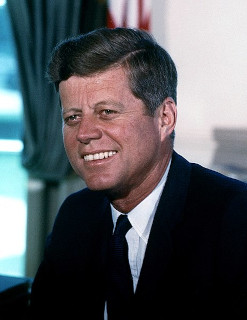
(Pictured: John F. Kennedy, photograph in the Oval Office, July 11, 1963)
Once when confronted with black men being thrown out of a white railroad car by the conductor, Busteed pulls his pistol and defends the black men allowing them to stay.
Alabamians generally consider Busteed corrupt and pro-Northern. In December 1867, he is shot on the street in Mobile, Alabama by United States Attorney Lucien V. B. Martin, who fires two more shots into him after he falls. Martin goes to Texas and is never prosecuted, while Busteed recovers rapidly.
Busteed is nominated by President Ulysses S. Grant to the Supreme Court of the District of Columbia (now the United States District Court for the District of Columbia) on January 13, 1873. At the same time, President Grant nominates Judge David Campbell Humphreys, an Alabama native serving on the Supreme Court of the District of Columbia, to assume Busteed’s seat, each nomination made contingent on the other’s resignation. The Senate returns the nominations to the President as irregular in form on February 13, 1873.
In 1873, Busteed is the subject of an impeachment inquiry by the United States House of RepresentativesJudiciary Committee. The Committee recommends his impeachment on charges of failing to maintain a residence in his judicial district, failing to hold scheduled terms of court, and using his official position to promote his personal interests, specifically, by remitting a fine due to the Federal government in order to obtain release from a personal judgment against him in a State court. He resigns before the full House can vote on the recommendation.
Following his resignation from the federal bench, Busteed resumes private practice in New York City starting in 1874. He dies on September 14, 1898, in New York City and is interred in Woodlawn Cemetery in the Bronx, New York.
The Provisional Congress of the Confederate States is a congress of deputies and delegates called together from the Southern States which become the governing body of the Provisional Government of the Confederate States from February 4, 1861, to February 17, 1862. It sits in Montgomery until May 21, 1861, when it adjourns to meet in Richmond, Virginia, on July 20, 1861. It adds new members as other states secede from the Union and directs the election on November 6, 1861, at which a permanent government is elected.
The Second Session of the Provisional Congress is held at Montgomery from April 29, 1861, to May 21, 1861. It includes the members of the First Session with the additions of Virginia and Arkansas. John Tyler, the tenth president of the United States (1841–1845), serves as a delegate from Virginia in the Provisional Confederate States Congress until his death in 1862.
North Carolina and Tennessee join the Third Session of the Provisional Congress, which is held at Richmond from July 20, 1861, to August 31, 1861. Membership remains unchanged for the Fourth Session on September 3, 1861.
The Fifth Session of the Provisional Congress is held at Richmond from November 18, 1861, to February 17, 1862. All previous members are present with the additions of Missouri and Kentucky. One non-voting member is present from the Arizona Territory.
In 1846 Lane joins the First Regiment, Texas Mounted Riflemen, as a first lieutenant to fight in the Mexican American War. He fights with honors at the Battle of Monterey and is later given the rank of major and command of his own battalion. After the Mexican American War, he wanders about doing various things in Arizona, California, and Peru before opening a mercantile business in Marshall, Texas, in 1858.
After the Civil War, Lane returns to Marshall where he helps to establish the Texas Veterans Association. After Reconstruction, he and his brother George, a local judge, found the first White Citizens Party in Texas and run Republicans and African Americans out of Marshall. With Democratic white hegemony brutally reestablished in Marshall and Harrison County, he declares the city and county “redeemed.”
Lane dies in Marshall, Texas on January 28, 1892, and is buried in the Marshall Cemetery near downtown Marshall. His memoirs, The Adventures and Recollections of General Walter P. Lane, are published posthumously in 1928.
Eileen Evelyn Greer Garson, motion picture actress best known as Greer Garson, is born on September 29, 1904, in Manor Park, London, England. Her classic beauty and screen persona of elegance, poise, and maternal virtue make her one of the most popular and admired Hollywood stars of the World War II era.
Garson often claims to have been born in County Down, Ireland, where her grandparents lived and which she happily visited as a child, but she is, in fact, born and raised in London. Although she wanted to study acting, she wins a scholarship to the University of London and her practical-minded family encourage her to pursue a teaching career. After graduating with honours, she works briefly for Encyclopædia Britannica and a London advertising firm but continually tries to get her foot into a backstage door.
After suffering through a discouraging first year in Hollywood, Garson returns to England to film the small role of Mrs. Chips in MGM’s Goodbye, Mr. Chips (1939). She receives her first Oscar nomination for the role but loses to Vivien Leigh for Gone with the Wind. Her portrayal of the beloved schoolteacher’s charming wife endears her to the American public and sets her career in motion. It is the first in a series of roles in which she plays women of great loyalty, refinement, and wifely or motherly strength.
Garson’s other significant films of the period include Pride and Prejudice (1940), Blossoms in the Dust (1941), her first appearance with her frequent costar Walter Pidgeon, Random Harvest (1942), and Madame Curie (1943). The film that cements her reputation and image, however, is Mrs. Miniver (1942). Filmed during World War II and tailor-made for the times, Mrs. Miniver extolls the strength and spirit of the British home front and is one of the year’s biggest hits. Her grace-under-pressure portrayal of a courageous wife and mother, the personification of British fortitude, not only wins her an Academy Award but is credited with bolstering American support for the war.
Following the war Garson’s career falters. The public rejects her attempts to reforge her image to that of a more fun-loving, less noble heroine in such films as Adventure (1945) and Julia Misbehaves (1948). During the 1950s she appears in several unexceptional films and television dramas and stars on Broadway in Auntie Mame. Her remarkably convincing portrayal of Eleanor Roosevelt in Sunrise at Campobello (1960) is widely praised and earns her a seventh Oscar nomination, but she performs only occasionally thereafter, devoting most of her time to philanthropic causes, including the endowment of scholarships for theatre students at Southern Methodist University in University Park, Texas and the construction of a campus theatre.




 seamus dubhghaill