Coogan’s particular focus is on Ireland’s nationalist/independence movement in the 20th century, a period of unprecedented political upheaval. He blames the Troubles in Northern Ireland on “Paisleyism.”
In 2000, Irish writer and editor Ruth Dudley Edwards is awarded £25,000 damages and a public apology by the High Court in London against Coogan for factual errors in references to her in his book Wherever Green is Worn: The Story of the Irish Diaspora (2000). In the book, he writes that Dudley Edwards had “groveled to and hypocritically ingratiated herself with the English establishment to further her writing career.” He also alleges that Dudley Edwards “had abused the position of chairwoman of the British Association for Irish Studies (BAIS) by trying to impose her political views on it” and that her commission to write True Brits had been awarded because of political favouritism.
When TaoiseachEnda Kenny causes confusion following a speech at Béal na Bláth by incorrectly claiming Michael Collins had brought Lenin to Ireland, Coogan comments, “Those were the days when bishops were bishops and Lenin was a communist. How would that have gone down with the churchyard collections?”
Coogan has been criticised by the Irish historians Liam Kennedy and Diarmaid Ferriter, as well as Cormac Ó Gráda, for a supposed lack of thoroughness in his research and bias:
“Well, I waited in this book to hear some great revelation, and it just isn’t there. It’s anticlimactic. I could not see the great plot, and indeed there is no serious historian who … I can’t think of a single historian who has researched the Famine in depth – and Tim Pat has not researched it in depth” (The Famine Plot).
“Coogan is not remotely interested in looking at what others have written on 20th-century Irish history…. he does not appear interested in context and shows scant regard for evidence. He does not attempt to offer any sustained analysis in relation to the challenges of state building, the meaning of sovereignty, economic and cultural transformations, or comparative perspectives on the evolution of Irish society. There is no indication whatsoever that Coogan has engaged with the abundant archival material relating to the subject matter he pronounces on. There is no rhyme or reason when it comes to the citation of the many quotations he uses; the vast majority are not referenced. For the 300-page text, 21 endnotes are cited and six of them relate to Coogan’s previous books, a reminder that much of this tome consists of recycled material…. Tim Pat Coogan… he is a decent, compassionate man who has made a significant contribution to Irish life. But he has not read up on Irish history; indeed, such is the paucity of his research efforts that this book amounts to a travesty of 20th-century Irish history” (1916: The Mornings After).
Ó Brádaigh is born into a middle-class republican family. His father, Matt Brady, is an IRA volunteer who is severely wounded in an encounter with the Royal Irish Constabulary (RIC) in 1919. His mother, May Caffrey, is a Cumann na mBan volunteer and a 1922 graduate of University College Dublin (UCD). His father dies when he is ten and is given a paramilitary funeral led by his former IRA colleagues. His mother, prominent as the Secretary for the County Longford Board of Health, lives until 1974. He is educated at Melview National School at primary level and attends secondary school at St. Mel’s College, leaving in 1950, and graduates from University College Dublin in 1954. That year he takes a job teaching Irish language at Roscommon Vocational School in Roscommon. He is a deeply religious Catholic who refrains from smoking or drinking.
Ó Brádaigh joins Sinn Féin in 1950. While at university, in 1951, he joins the Irish Republican Army. In September 1951, he marches with the IRA at the unveiling of the Seán Russell monument in Fairview Park, Dublin. A teacher by profession, he is also a Training Officer for the IRA. In 1954, he is appointed to the Military Council of the IRA, a subcommittee set up by the IRA Army Council in 1950 to plan a military campaign against Royal Ulster Constabulary (RUC) barracks in Northern Ireland.
On August 13, 1955, Ó Brádaigh leads a ten-member IRA group in an arms raid on Hazebrouck Barracks, near Arborfield, Berkshire, England, a depot for the No. 5 Radar Training Battalion of the Royal Electrical and Mechanical Engineers. It is the biggest IRA arms raid in Britain. Most, if not all, of the weapons are recovered in a relatively short period of time. A van, traveling too fast, is stopped by the police and IRA personnel are arrested. Careful police work leads to weapons that had been transported in a second van and stored in London.
The IRA Border Campaign commences on December 12, 1956. As an IRA General Headquarters Staff (GHQ) officer, Ó Brádaigh is responsible for training the Teeling Column in the west of Ireland. During the Campaign, he serves as second-in-command of the Teeling Column. On December 30, 1956, he partakes in the Teeling Column attack on RUC barracks in Derrylin, County Fermanagh. RUC Constable John Scally is killed in the attack and is the first fatality of the new IRA campaign. Ó Brádaigh and others are arrested by the Garda Síochána across the border in County Cavan the day after the attack. They are tried and jailed for six months in Mountjoy Prison. A leading abstentionist, upon his arrest he refuses to recognize the authority of the Irish government and refuses to renounce violence in exchange for his release.
Upon completing his prison sentence, Ó Brádaigh is immediately interned at the Curragh Camp along with other republicans. On September 27, 1958, he escapes from the camp along with Dáithí Ó Conaill. While a football match is in progress, the pair cuts through a wire fence and escapes from the camp under a camouflage grass blanket. This is an official escape, authorised by the officer commanding (OC) of the IRA internees, Tomás Óg Mac Curtain. He is the first Sinn Féin TD on the run since the 1920s.
In October 1958, Ó Brádaigh becomes the IRA Chief of Staff, a position he holds until May 1959, when Seán Cronin is elected as his replacement. He is arrested in November 1959, refuses to answer questions, and is jailed in Mountjoy Prison under the Offences against the State Act. He is released in May 1960 and, after Cronin is arrested, again becomes Chief of Staff. Although he always emphasises that it is a collective declaration, he is the primary author of the statement ending the IRA Border Campaign in 1962. At the IRA 1962 Convention he indicates that he is not interested in continuing as Chief of Staff.
After Ó Brádaigh’s arrest in December 1956, he takes a leave from teaching at Roscommon Vocational School. He is re-instated and begins teaching again in late 1962, just after he is succeeded by Cathal Goulding in the position of Chief of Staff of the IRA. He remains an active member of Sinn Féin and is also a member of the IRA Army Council throughout the decade.
Ó Brádaigh opposes the decision of the IRA and Sinn Féin to drop abstentionism and to recognise the Westminster parliament in London, the Stormont parliament in Belfast and the Leinster House parliament in 1969/1970. On January 11, 1970, along with Seán Mac Stíofáin, he leads the walkout from the 1970 Sinn Féin Ard Fheis after the majority votes to end the policy of abstentionism, although the vote to change the Sinn Féin constitution fails to receive the required two-thirds majority. The delegates who walk out reconvene at the Kevin Barry Hall in Parnell Square, Dublin, and establish Provisional Sinn Féin.
Ó Brádaigh is voted chairman of the Caretaker Executive of Provisional Sinn Féin. That October, he formally becomes president of the party. He holds this position until 1983. In his presidential address to the 1971 Provisional Sinn Féin Ard Fheis, he says that the first step to achieving a United Ireland is to make Northern Ireland ungovernable. He apparently also serves on the Army Council or the executive of the Provisional Irish Republican Army until he is seriously injured in a car accident on January 1, 1984.
On May 31, 1972, Ó Brádaigh is arrested under the Offences Against the State Act and immediately commences a hunger strike. A fortnight later the charges against him are dropped and he is released. With Dáithí Ó Conaill he develops the Éire Nua policy, which is launched on June 28, 1972. The policy calls for a federal Ireland.
On December 3, 1972, Ó Brádaigh appears on the London Weekend TelevisionWeekend World programme. He is arrested by the Gardaí again on December 29, 1972, and charged in the newly established Special Criminal Court with Provisional IRA membership. In January 1973 he is the first person convicted under the Offences Against the State (Amendment) Act 1972 and is sentenced to six months in the Curragh Camp.
On December 10, 1974, Ó Brádaigh participates in the Feakle talks between the IRA Army Council and Sinn Féin leadership and the leaders of the Protestant churches in Ireland. Although the meeting is raided and broken up by the Gardaí, the Protestant churchmen pass on proposals from the IRA leadership to the British government. These proposals call on the British government to declare a commitment to withdraw, the election of an all-Ireland assembly to draft a new constitution and an amnesty for political prisoners.
The IRA subsequently calls a “total and complete” ceasefire intended to last from December 22, 1974, to January 2, 1975, to allow the British government to respond to proposals. British government officials also hold talks with Ó Brádaigh in his position as president of Sinn Féin from late December to January 17, 1975.
On February 10, 1975, the IRA Army Council, unanimously endorses an open-ended cessation of IRA “hostilities against Crown forces,” which becomes known as the 1975 truce. The IRA Chief of Staff at the time is Seamus Twomey of Belfast. It is reported in some quarters that the IRA leaders mistakenly believe they had persuaded the British Government to withdraw from Ireland and the protracted negotiations between themselves and British officials are the preamble to a public declaration of intent to withdraw. In fact, as British government papers now show, the British entertain talks with the IRA in the hope that this would fragment the movement further and score several intelligence coups during the talks. This bad faith embitters many in the republican movement, and another ceasefire does not happen until 1994.
In late December 1976, along with Joe Cahill, Ó Brádaigh meets two representatives of the Ulster Loyalist Central Co-ordinating Committee (ULCCC), John McKeague and John McClure, at the request of the latter body. Their purpose is to try to find a way to accommodate the ULCCC proposals for an independent Northern Ireland with the Sinn Féin’s Éire Nua programme. It is agreed that if this can be done, a joint Loyalist-Republican approach can then be made to request the British government to leave Ireland. Desmond BoalQC and Seán MacBrideSC are requested and accepted to represent the loyalist and republican positions. For months they have meetings in various places including Paris. The dialogue eventually collapses when Conor Cruise O’Brien, then Minister for Posts and Telegraphs and vociferous opponent of the Provisional IRA, becomes aware of it and condemns it on RTÉ Radio. As the loyalists had insisted on absolute secrecy, they feel unable to continue with the talks as a result.
In the aftermath of the 1975 truce, the Ó Brádaigh/Ó Conaill leadership comes under severe criticism from a younger generation of activists from Northern Ireland, headed by Gerry Adams, who becomes a vice-president of Sinn Féin in 1978. By the early 1980s, Ó Brádaigh’s position as president of Sinn Féin is openly under challenge and the Éire Nua policy is targeted in an effort to oust him. The policy is rejected at the 1981 Sinn Féin Ard Fheis and finally removed from the Sinn Féin constitution at the 1982 Ard Fheis. At the following year’s Ard Fheis, Ó Brádaigh and Ó Conaill resign from their leadership positions, voicing opposition to the dropping of the Éire Nua policy by the party.
On November 2, 1986, the majority of delegates to the Sinn Féin Ard Fheis vote to drop the policy of abstentionism if elected to Dáil Éireann, but not the British House of Commons or the Northern Ireland parliament at Stormont, thus ending the self-imposed ban on Sinn Féin elected representatives from taking seats at Leinster House. Ó Brádaigh and several supporters walk out and immediately assemble at Dublin’s West County Hotel and set up Republican Sinn Féin (RSF). As an ordinary member, he had earlier spoken out against the motion (resolution 162) in an impassioned speech. The Continuity IRA becomes publicly known in 1996. Republican Sinn Féin’s relationship with the Continuity IRA is similar to the relationship between Sinn Féin and the Provisional IRA when Ó Brádaigh was Sinn Féin’s president.
Ó Brádaigh believes RSF to be the sole legitimate continuation of the pre-1986 Sinn Féin, arguing that RSF has kept the original Sinn Féin constitution. RSF readopts and enhances his Éire Nua policy. His party has electoral success in only a few local elections.
Ó Brádaigh remains a vociferous opponent of the Good Friday Agreement, viewing it as a programme to copperfasten Irish partition and entrench sectarian divisions in the north. He condemns his erstwhile comrades in Provisional Sinn Féin and the Provisional IRA for decommissioning weapons while British troops remain in the country. In his opinion, “the Provo sell-out is the worst yet – unprecedented in Irish history.” He condemns the Provisional IRA’s decision to seal off a number of its arms dumps as “an overt act of treachery,” “treachery punishable by death” under IRA General Army Order Number 11.
In July 2005, Ó Brádaigh hands over a portion of his personal political papers detailing discussions between Irish Republican leaders and representatives of the British Government during 1974–1975 to the James Hardiman Library, National University of Ireland, Galway.
In September 2009, Ó Brádaigh announces his retirement as leader of Republican Sinn Féin. His successor is Des Dalton. He is also a long-standing member of the Celtic League, an organization which fosters cooperation between the Celtic people and promotes the culture, identity and eventual self-determination for the people, in the form of six sovereign states, for the Celtic nations – Wales, Cornwall, Brittany, Scotland, Isle of Man and Ireland.
After suffering a period of ill-health, Ó Brádaigh dies on June 5, 2013, at Roscommon County Hospital. His funeral is attended by 1,800 mourners including Fine Gael TD Frank Feighan and is policed by the Garda Emergency Response Unit and Gardaí in riot gear, for “operational reasons,” a show of force believed to have been to deter the republican tradition of firing a three-volley salute of shots over the final place of rest during the graveyard oration. As a result, there are some minor scuffles between gardai and mourners.
To seek to achieve unity among the Irish people on the issue of restoring national sovereignty and to promote the revolutionary ideals of republicanism and to this end involve itself in resisting all forms of colonialism and imperialism.
To seek the immediate and unconditional release of all Irish republican prisoners throughout the world.
The 32CSM does not contest elections but acts as a pressure group, with branches, or cumainn, organised throughout the traditional counties of Ireland. It has been described as the “political wing” of the now defunct Real Irish Republican Army (Real IRA or RIRA), but this is denied by both organisations. The group originates in a split from Sinn Féin over the Mitchell Principles.
The organisation is founded on December 7, 1997, at a meeting of like-minded Irish republicans in the Dublin suburb of Finglas. Those present are opposed to the direction taken by Sinn Féin and other mainstream republican groups in the Northern Ireland peace process, which eventually leads to the Good Friday Agreement, also known as the Belfast Agreement, the following year. The same division in the republican movement leads to the paramilitary group now known as the Real IRA breaking away from the Provisional Irish Republican Army at around the same time.
Most of the 32CSM’s founders had been members of Sinn Féin, with some having been expelled from the party for challenging the leadership’s direction, while others felt they had not been properly able to air their concerns within Sinn Féin at the direction its leadership had taken. Bernadette Sands McKevitt, wife of Michael McKevitt and a sister of hunger strikerBobby Sands, is a prominent member of the group until a split in the organisation.
The name refers to the 32 counties of Ireland which were created during the Lordship of Ireland and Kingdom of Ireland. With the partition of Ireland in 1920–22, twenty-six of these counties form the Irish Free State which is abolished in 1937 and is now known as Ireland since 1949. The remaining six counties of Northern Ireland remain part of the United Kingdom. Founder Bernadette Sands McKevitt says in a 1998 interview with The Mirror that people did not fight for “peace” – “they fought for independence” – and that the organisation reaffirms to the republican position in the 1919 Irish Declaration of Independence.
Before the referendums on the 1998 Good Friday Agreement, the 32CSM lodges a legal submission with the United Nations challenging British sovereignty in Ireland. The referendums are opposed by the 32CSM but are supported by 71% of voters in Northern Ireland and by 94% in the Republic of Ireland. It is reported in February 2000 that the group had established a “branch” in Kilburn, London.
In November 2005, the 32CSM launches a political initiative titled Irish Democracy, A Framework for Unity.
On May 24, 2014, Gary Donnelly, a member of the 32CSM, is elected to the Derry and Strabane super council. In July 2014, a delegation from the 32CSM travels to Canada to take part in a six-day speaking tour. On arrival the delegation is detained and refused entry into Canada.
In 2015, the 32CSM organises a demonstration in Dundee, Scotland, in solidarity with the men convicted of shooting Constable Stephen Carroll, the first police officer to be killed in Northern Ireland since the formation of the PSNI. The organisation says the “Craigavon Two” are innocent and are victims of a miscarriage of justice.
The 32CSM also operates outside of the island of Ireland to some extent. The Gaughan/Stagg Cumann covers England, Scotland and Wales, and has an active relationship of mutual promotion with a minority of British left-wing groups and anti-fascist organisations. The James Larkin Republican Flute Band in Liverpool and the West of Scotland Band Alliance, the largest section of which is the Glasgow-based Parkhead Republican Flute Band, are also supporters of the 32CSM. As of 2014, the 32CSM’s alleged paramilitary wing, the Real IRA, is reported to still be involved in attempts to perpetrate bombings in Britain as part of the dissident Irish republican campaign, which has been ongoing since 1998.
The 32CSM is currently considered a foreign terrorist organization (FTO) in the United States, because it is considered to be inseparable from the Real IRA, which is designated as an FTO. At a briefing in 2001, a spokesman for the U.S. Department of State states that “evidence provided by both the British and Irish governments and open-source materials demonstrate clearly that the individuals who created the Real IRA also established these two entities to serve as the public face of the Real IRA. These alias organizations engage in propaganda and fundraising on behalf of and in collaboration with the Real IRA.” The U.S. Department of State’s designation makes it illegal for Americans to provide material support to the Real IRA, requires U.S. financial institutions to block the group’s assets and denies alleged Real IRA members travel visas into the United States.
On March 16, 2015, the eve of Saint Patrick’s Day, two ascendant politicians—one from Ireland, one from the United States—meet in a ballroom at the Essex House, in New York City. Hillary Clinton is there to be inducted into the Irish America Hall of Fame, in recognition of her “outstanding leadership” in bringing peace to Northern Ireland during the 1990s, when her husband was president of the United States. Gerry Adams, the president of the Irish Republican political party Sinn Féin, is there because for many Americans he is a living symbol of that peace. One of the architects of the Good Friday Agreement, which brought an end to the decades-long conflict in Northern Ireland that is known as the Troubles, he is very popular in the United States and makes regular trips here to raise funds for his party. According to a report in The Irish Times, Sinn Féin has raised twelve million dollars in the United States over the prior two decades, from construction companies, labor unions, and movie stars like Anjelica Huston and Martin Sheen.
Adams, however, remains a polarizing figure in Ireland. Though he is a longtime figurehead of the Republican movement, he insists that he was never a member of the Irish Republican Army (IRA) and that he played no role in the violence of the Troubles. Some people in Ireland do not actually believe this story, and, in recent years leading up to this meeting, some of his former compatriots in the Republican movement have said that he authorized a series of wartime atrocities, including the murder and secret burial of Jean McConville, a mother of ten. Adams denies these claims, and generally derides those who ask questions about his past as political foes with an agenda or opponents of the peace process.
“I remember very well when the request came, back in 1993, that my husband approve a visa for Gerry Adams,” Clinton told the crowd at the Essex House. Bill Clinton granted the visa, which was a controversial move at the time, because of Adams’s alleged association with the IRA, but also a crucial moment in the peace process, because it helped cement Adams’s transformation from a revolutionary to a statesman. “Absent that first step, that first risk, we might not have had the momentum to move forward, to get to the Good Friday accords and all that has followed,” Clinton said.
There is no way of knowing whether Clinton, dressed in Kelly green, felt any distaste at the prospect of sharing a table with Adams. There is some thirty-five million Irish Americans, a great many of whom regard Adams as a kind of Nelson Mandela, and no prospective presidential candidate can decline a Saint Patrick’s Day invitation. And to be sure, the IRA is not alone in standing accused of atrocities during the Troubles. Loyalistparamilitary groups and British government forces also perpetrated war crimes for which they have not been brought to account. But Clinton does indicate, obliquely, that the transition in Northern Ireland is not entirely complete. “There is still work to be done,” Clinton acknowledges. “You cannot bring peace and security to people just by signing an agreement.” The question for the people of Northern Ireland, and for Adams’s supporters in the United States, is whether you can bring enduring peace and security without some reckoning—by all parties in the conflict—with the crimes of the past.
(From: “Gerry Adams and Hillary Clinton in New York” by Patrick Radden Keefe, The New Yorker, http://www.new yorker.com, March 17, 2015 | Photo: Hillary Clinton at a previous meeting with Gerry Adams at the State Department in 2009. Photograph by Mark Wilson/Getty)
On December 9, 1994, Sinn Féin, the political wing of the Irish Republican Army (IRA), holds its first formal talks with the British Government in over 70 years. The negotiations take place in Belfast, almost one year after Britain and Ireland began an uncertain program to try to resolve the conflict in Northern Ireland. The first session is held at Stormont, a gigantic, columned edifice on top of a hill on the outskirts of Belfast that houses the old Northern Ireland parliament.
Although the announcement of the negotiations is not a surprise, it still sets off an exciting ripple that history is in the making. British officials have conducted secret talks with Sinn Féin leaders in the past, but never before have they sat down openly at the same table with them.
In both a letter to the Sinn Féin leader, Gerry Adams, and in a three-paragraph statement, Downing Street pointedly refers to the meeting as “exploratory dialogue.” This is in keeping with London‘s position that it is simply joining in “talks about talks,” not a full negotiating session, which must involve all parties to the conflict.
For 25 years the IRA has been fighting in the name of the Roman Catholic minority of 650,000 in Northern Ireland. It wants to link Ulster, the six counties of Northern Ireland that remain British after partition, to the Irish Republic, a move opposed by most of the province’s 950,000 Protestants.
The announcement of talks evoke a predictable pattern of responses across Northern Ireland’s political spectrum. Adams, who works to persuade the IRA to go along with a unilateral cease-fire that was declared on September 1, welcomes it. “The opportunity to realize a lasting peace, which will benefit all of the people of Ireland, has never been greater,” he says in a statement. Adams had been accusing London of foot-dragging on the peace effort. Now, he says, it is time to move on to “the next phase of dialogue — multilateral talks led by both Governments.”
The Ulster Unionist Party (UUP), the main Protestant political group in Northern Ireland, is skeptically accepting, as it has been all along. John Taylor, a UnionistMember of Parliament, says the talks will at least establish whether “Sinn Féin really is to become a normal political party.”
The Rev. Ian Paisley, a Member of Parliament whose Democratic Unionist Party (DUP) has become a rejectionist front, continues to oppose talks or any move smacking of compromise. He tells the House of Commons that “a vast majority of people” resent the decision to talk to “the men of blood.”
Sinn Féin is represented at the talks by Martin McGuinness, a veteran IRA political leader who took part in secret contacts that broke up the previous year. In 1972, together with Adams, he was flown to London for a meeting with William Whitelaw, who was then Secretary of State for Northern Ireland. Those talks eventually failed.
Adams is in Washington, D.C. on Wednesday, December 7. He attends a meeting at the White House, his first one there, with Anthony Lake, President Bill Clinton‘s National Security Advisor. Seven weeks earlier, Britain protests vigorously at the thought of Adams visiting the White House. But events moved so swiftly that he gains a kind of legitimacy that is hard for Whitehall to deny. His visa to the United States, good for three months, allows several visits.
The Government team of civil servants, in contrast to higher-level ministers, are led by Quentin Thomas, deputy secretary of the British administration called the Northern Ireland Office.
Going into the negotiations, the key question is what will be discussed. On the British side, the top of the agenda is how to get the IRA to turn over its considerable stash of 100 tons of arms and explosives. There is nothing, of course, that Sinn Féin is less likely to agree to at the outset. So should the British make this a condition for multilateral talks to begin, the two sides will meet an obstacle right away.
McGuinness says that the issue of IRA weapons has to be considered “in the context of us removing the causes of conflict, the reason why people use armed force in our society.”
From its side, Adams says Sinn Féin wants to discuss being treated with “a parity of esteem” with the other parties, and “the release of all political prisoners.”
The British Government says that it will soon hold talks with the so-called loyalist paramilitaries on the Protestant side. And it indicates it will have no objection if elected Sinn Féin councillors attend a major international investment conference in Belfast on December 13 and 14.
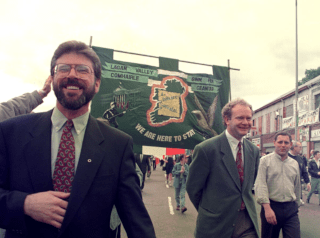
(From: “Britain and I.R.A. Group to Begin Talks in Northern Ireland” by John Darnton, The New York Times, December 2, 1994 | Pictured: Gerry Adams and Martin McGuinness lead a Republican parade in Belfast, commemorating 25 years of British troops on the streets of Northern Ireland in 1994)
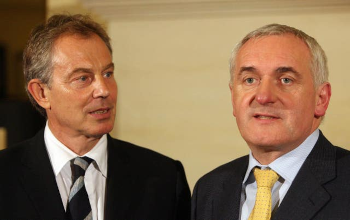
Leading the way in a return to the past is Ahern’s Dublin government, which has introduced the toughest anti-terrorist legislation in the history of the Irish Republic. He concedes that the measures are draconian but says that his government is determined to do everything in its power, “working closely with the British government to defeat and suppress this murderous conspiracy against the people of Ireland.”
Prime Minister Blair promises that he too plans to introduce extreme measures. “We will bring in similar measures to those proposed by the Irish government, so we will then have the toughest anti-terrorist measures for the whole of Ireland, the Republic and Northern Ireland, that we have ever seen.”
With no plans to recall the British parliament, it is thought that existing legislation will be applied, since it already includes measures similar to those announced by the Irish government.
Oppressive British legislation has sustained British rule in Ireland for decades. This includes internment without trial, non-jury courts, entry and search of homes without a warrant, seven-day detention with unrecorded and unsupervised interrogation, denial of access to lawyers, exclusion orders and more. Most of these are still in use in 1998.
The Ahern package includes withdrawal of a suspect’s right to silence — refusal to answer questions can be used as evidence that a suspect is a member of an illegal organisation, the seizure of property that has been used for storing weapons or making bombs, and the creation of a new offence of directing an unlawful organisation. This is expected to carry the penalty of life imprisonment.
Omagh is 75% nationalist, with good cross-community relations, and has largely escaped the worst of the conflict. Although Republican dissidents have carried out a spate of similar bombings in the previous year, the towns targeted are mainly Unionist and further east.
The group that claims responsibility for the Omagh bombing is the Real IRA, which was formed in protest at the IRA’s 1997 cease-fire. Irish police have insisted that the Real IRA is the military wing of the recently formed 32 County Sovereignty Movement (32CSM), although this is denied by that organisation.
Although both the INLA and the Real IRA have declared a unilateral cease-fire since the Omagh bombing, media focus has settled on Bernadette Sands McKevitt, sister of the 1980s IRA hunger strikerBobby Sands, who is a leading figure in the 32 County Sovereignty Movement. Sands-McKevitt has condemned the Omagh bombing, but her home in Blackrock, County Louth, has since been targeted by local townspeople who have staged protests against her and her family. She has also been denied a visa to enter the United States on a speaking tour.
The Omagh bombing could not have come at a better time for Britain. With the war formally over and Sinn Féin penned, the bombing delivers an opportunity to smash the Republican left once and for all and wrench it from any semblance of ongoing support in Ireland.
All nationalist opponents of the Good Friday Agreement must now cope with being stained by the blood of Omagh. With the massive referendum vote in favour of peace to back them up, the British and Irish governments can be satisfied that the Good Friday Agreement now looks more in place than at any other time. As one nationalist describes the situation, “If the Good Friday Agreement was a defeat for the cause of Irish nationalism, the Omagh bombing has turned it into a rout.”
(From: “Blair, Ahern make the most of Omagh bomb” by Dave Riley, Green Left (www.greenleft.org), August 26, 1998)



 seamus dubhghaill