seamus dubhghaill

Promoting Irish Culture and History from Little Rock, Arkansas, USA


Leave a comment

Birth of Noël Christopher Browne, Irish politician

Noël Christopher Browne, Irish politician who serves as Minister for Health from 1948 to 1951 and Leader of the National Progressive Democrats from 1958 to 1963, is born at Bath Street in Waterford, County Waterford, on December 20, 1915. He holds the distinction of being one of only seven TDs to be appointed to the cabinet on the start of their first term in the Dáil.

Browne grows up in the Bogside area of Derry. The Browne family also lives in Athlone and Ballinrobe for a period of time. His mother Mary Therese (née Cooney) is born in 1885 in Hollymount, County Mayo. His father Joseph Brown, a Royal Irish Constabulary (RIC) sergeant, later works as an inspector for the National Society for the Prevention of Cruelty to Children and, partly as a result of this work, all of the Browne family becomes infected with tuberculosis. Both parents die of the disease during the 1920s. His father is the first to die, leaving only £100 behind to support a wife and seven children. Fearing that if she and the children remain in Ireland they will be forced into a workhouse, Mary sells all their possessions and takes the family to London. Within two days of their arrival, Mary is dead, later buried in a pauper’s grave. Of her seven children, six contract tuberculosis. Noël is only one of two Browne children to survive into adulthood after those bouts with TB.

In 1929, Browne is admitted free of charge to St. Anthony’s, a preparatory school in Eastbourne, England. He then wins a scholarship to Beaumont College, the Jesuit public school near Old Windsor, Berkshire, where he befriends Neville Chance, a wealthy boy from Dublin. Neville’s father, the eminent surgeon Arthur Chance, subsequently pays Browne’s way through medical school at Trinity College Dublin.

In 1940, while still a student, Browne suffers a serious relapse of tuberculosis. His treatment at a sanatorium in Midhurst, Sussex is paid for by the Chance family. He recovers, passes his medical exams in 1942, and starts his career as a medical intern at Dr. Steevens’ Hospital in Dublin, where he works under Bethel Solomons. He subsequently works in numerous sanatoria throughout Ireland and England, witnessing the ravages of the disease. He soon concludes that politics is the only way in which he can make an attack on the scourge of tuberculosis.

The poverty and tragedy that had shaped Browne’s childhood deeply affects him. He considers both his survival and his level of education a complete fluke, a stroke of random chance that saved him when he was seemingly destined to die unknown and in poverty like the rest of his family. He finds this completely distasteful and is moved to enter politics as a means to ensure no one else would suffer the same fate that had befallen his family.

Browne joins the new Irish republican party Clann na Poblachta and is elected to Dáil Éireann for the Dublin South-East constituency at the 1948 Irish general election. To the surprise of many, party leader, Seán MacBride, chooses him to be one of the party’s two ministers in the new government. He becomes one of the few TDs appointed a Minister on their first day in Dáil Éireann, when he is appointed Minister for Health.

A ‘White Paper’ on proposed healthcare reforms had been prepared by the previous government, and results in the 1947 Health Act. In February 1948, Browne becomes Minister for Health and starts the reforms advocated by the Paper and introduced by the Act.

The health reforms coincide with the development of a new vaccine and of new drugs (e.g., BCG and penicillin) that help to treat a previously untreatable group of medical conditions. Browne introduces mass free screening for tuberculosis sufferers and launches a huge construction program to build new hospitals and sanitoria, financed by the income and accumulated investments from the Department of Health-controlled Hospital Sweeps funds. This, along with the introduction of Streptomycin, helps dramatically reduce the incidence of tuberculosis in Ireland.

As Minister for Health Browne comes into conflict with the bishops of the Catholic Church and the medical profession over the Mother and Child Scheme. This plan, also introduced by the 1947 Health Act, provides for free state-funded healthcare for all mothers and children aged under 16, with no means test, a move which is regarded as radical at the time in Ireland, but not in the rest of Europe. Virtually all doctors in private practice oppose the scheme, because it would undermine the “fee for service” model on which their income depended.

The Church hierarchy, which controls many hospitals, vigorously opposes the expansion of “socialised medicine” in the Irish republic. They claim that the Mother and Child Scheme interferes with parental rights, and fear that the provision of non-religious medical advice to mothers will lead to birth control contrary to Catholic teaching. They greatly dislike Browne, seeing him as a “Trinity Catholic,” one who has defied the Church’s ruling that the faithful should not attend Trinity College Dublin, which had been founded by Protestants and for many years did not allow Catholics to study there.

Under pressure from bishops, the coalition government backs away from the Mother and Child Scheme and forces Browne’s resignation as Minister for Health. Following his departure from government, he embarrasses his opponents by arranging for The Irish Times to publish Taoiseach John A. Costello‘s and MacBride’s correspondence with the Catholic hierarchy, which details their capitulation to the bishops.

The controversy over the Mother and Child Scheme leads to the fall of the coalition government in which Browne had served as a Minister. But Church opposition to socialised medicine continues under the subsequent Fianna Fáil-led government. The hierarchy does not accept a no-means-test mother-and-infant scheme even when Fianna Fáil reduces the age limit from sixteen years to six weeks, and the government again backs down.

After his resignation as Minister for Health, Browne leaves Clann na Poblachta, but is re-elected to the Dáil as an Independent TD from Dublin South-East in the subsequent election.

Browne joins Fianna Fáil in 1953 but loses his Dáil seat at the 1954 Irish general election. He fails to be selected as a candidate for the 1957 Irish general election and he resigns from the party. He is re-elected at that election for Dublin South-East as an Independent TD.

In 1958, Browne founds the National Progressive Democrats with Jack McQuillan. He holds onto his seat at the 1961 Irish general election, but in 1963, he and McQuillan join the Labour Party, disbanding the National Progressive Democrats. However, he loses his seat at the 1965 Irish general election.

Browne is re-elected as a Labour Party TD at the 1969 Irish general election, again for Dublin South-East. He does not seek a nomination by the Labour Party for the 1973 Irish general election but instead wins a seat in Seanad Éireann for Dublin University. He remains in the Seanad until the 1977 Irish general election, when he gains the Dublin Artane seat as an Independent Labour TD, having again failed to get the Party nomination.

In 1977 Browne is the first Irish parliamentarian to call for law reforms in regard to homosexuality, which is illegal at the time, and in 1979 is one of the few Irish politicians to attend the opening of the Hirschfeld Centre, Dublin’s first full-time LGBT community space.

Upon its formation, Browne joins the new Socialist Labour Party and is briefly its only TD, securing election for Dublin North-Central at the 1981 Irish general election. He retires from politics at the February 1982 Irish general election.

In 1990, a number of left-wing representatives within the Labour Party, led by Michael D. Higgins, approach Browne and suggest that he should be the party’s candidate in the presidential election due later that year. Though in failing health, Browne agrees. However, the offer horrifies party leader Dick Spring and his close associates for two reasons. Firstly, the leadership had secretly decided to run Mary Robinson, a barrister and former senator. Secondly, many around Spring are “appalled” at the idea of running Browne, believing he has “little or no respect for the party” and is “likely in any event to self-destruct as a candidate.” When Spring informs Browne by telephone that the party’s Administrative Council has chosen Robinson over him, Browne hangs up the telephone.

Browne spends the remaining seven years of his life constantly criticising Robinson who had gone on to win the election, thus becoming the seventh President of Ireland, and who is considered highly popular during her term. During the campaign he also indicates support for the rival Fine Gael candidate, Austin Currie.

After retiring from politics, Browne moves with his wife Phyllis to Baile na hAbhann, County Galway. He dies at the age of 81 in the Regional Hospital, Galway, on May 21, 1997. He is buried in a small graveyard near Baile na hAbhann.


Leave a comment

Birth of Jerome de Bromhead, Composer & Classical Guitarist

Jerome de Bromhead, Irish composer, classical guitarist, and member of Aosdána, is born in Waterford, County Waterford, on December 2, 1945.

De Bromhead studies with A. J. Potter and James Wilson at the Royal Irish Academy of Music in Dublin, with further studies with Seóirse Bodley in 1975 and Franco Donatoni in 1978. He holds an M.A. in music, art history and English from Trinity College Dublin. As a guitarist, he studies with Elspeth Henry (1967–68) and at the Guitar Centre, London (1969).

De Bromhead’s compositions include works for solo guitar as well as orchestral, choral and chamber music. His Symphony No. 1 (1986) represents Ireland at the International Rostrum of Composers at UNESCO‘s headquarters in Paris. He describes his style as “neither a Postmodernist nor a deaf-as-a-postmodernist. Above all I am suspicious of anything that seems like dogma.”

De Bromhead’s harpsichord piece Flux (1981) is performed at the ISCM World Music Days in Germany in 1987 and is now published by Tonos Verlag of Darmstadt.

According to guitarist John Feeley, de Bromhead’s solo guitar composition Gemini (1970) is “a sophisticated work, both technically and compositionally. It has the dynamism of youth, with a sense of freshness and it projects an attractive, driving energy […] It is an effective concert work, which speaks well on the instrument and is particularly gratifying for the performer.”

De Bromhead works at RTÉ as a television news director and announcer, as well as a senior music producer for radio, until a serious accident forces him to retire in 1996. He currently lives in Dublin.

The Contemporary Music Centre (www.cmc.ie) provides scores and sample recordings of a selection of de Bromhead’s works, available here.


Leave a comment

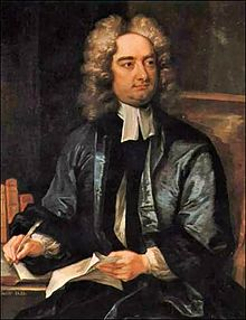
Birth of Jonathan Swift, Essayist, Pamphleteer, Poet & Cleric

Jonathan Swift, satirist, essayist, political pamphleteer, poet and cleric who becomes Dean of St. Patrick’s Cathedral, Dublin, is born in Dublin on November 30, 1667.

Swift’s father, an attorney, also named Jonathan Swift, dies just two months before he is born. Without steady income, his mother struggles to provide for her newborn. Moreover, he is a sickly child. It is later discovered that he suffers from Ménière’s disease, a condition of the inner ear that leaves the afflicted nauseous and hard of hearing. In an effort to give her son the best upbringing possible, Swift’s mother gives him over to Godwin Swift, her late husband’s brother and a member of the respected professional attorney and judges group Gray’s Inn. Godwin Swift enrolls his nephew with one of his cousins in Kilkenny College, which is perhaps the best school in Ireland at the time. He arrives there at the age of six, where he is expected to have already learned the basic declensions in Latin. He has not and thus begins his schooling in a lower form. He graduates in 1682, when he is 15. His transition from a life of poverty to a rigorous private school setting proves challenging. He does, however, make a fast friend in William Congreve, the future poet and playwright.

In 1682, Swift commences his undergraduate studies at Trinity College, Dublin. In 1686, he receives a Bachelor of Arts degree and goes on to pursue a master’s degree. Not long into his research, huge unrest breaks out in Ireland. The king of Ireland, England and Scotland is soon to be overthrown. What becomes known as the Glorious Revolution of 1688 spurs him to move to England and start anew. For 10 years, Swift works in Surrey‘s Moor Park and acts as an assistant to Sir William Temple, 1st Baronet.

During his Moor Park years, Swift meets the daughter of Temple’s housekeeper, an 8-year-old named Esther Johnson, known as “Stella.” They become lovers for the rest of their lives until Johnson’s death in 1728. It is rumored that they marry in 1716, and that Swift keeps of lock of Johnson’s hair in his possession at all times.

During his decade of work for Temple, Swift returns to Ireland twice. On a trip in 1695, he takes all necessary requirements to become an ordained priest in the Anglican tradition. Under Temple’s influence, he also begins to write, first short essays and then a manuscript for a later book. Temple dies in 1699. Swift completes the task of editing and publishing Temple’s memoirs. He then leans on his priestly qualifications and finds work ministering to a pea-sized congregation just 20 miles outside of Dublin. For the next ten years, he gardens, preaches and works on the house provided to him by the church. He also returns to writing. His first political pamphlet is titled A Discourse on the Contests and Dissentions in Athens and Rome.

In 1704, Swift anonymously releases A Tale of a Tub and The Battle of the Books. Tub, although widely popular with the masses, is harshly disapproved of by the Church of England. Ostensibly, it criticizes religion, but Swift means it as a parody of pride. Nonetheless, his writings earn him a reputation in London and when the Tories come into power in 1710, they ask him to become editor of The Examiner, their official paper. After a time, he becomes fully immersed in the political landscape and begins writing some of the most cutting and well-known political pamphlets of the day, including The Conduct of the Allies, an attack on the Whigs. Privy to the inner circle of Tory government, he lays out his private thoughts and feelings in a stream of letters to his beloved Stella. They are later published as The Journal to Stella.

When he sees that the Tories will soon fall from power, Swift returns to Ireland. In 1713, he takes the post of Dean at St. Patrick’s Cathedral, Dublin. While leading his congregation at St. Patrick’s, he begins to write what would become his best-known work. In 1726, at last finished with the manuscript, he travels to London and benefits from the help of several friends, who anonymously publish it as Travels into Several Remote Nations of the World, in Four Parts. By Lemuel Gulliver, First a Surgeon, and then a Captain of Several Ships, more simply known as Gulliver’s Travels. The book is an immediate success and has not been out of print since its first run.

Not long after the celebration of this work, Esther Johnson, falls ill. She dies in January 1728. Her death moves Swift to write The Death of Mrs. Johnson.

In 1742, Swift suffers a stroke and loses the ability to speak. He dies on October 19, 1745. He is laid to rest next to Esther Johnson inside Dublin’s St. Patrick’s Cathedral.


Leave a comment

Birth of Feargal Quinn, Businessman, Politician & TV Personality

Feargal Quinn, Irish businessman, politician and television personality, is born in Dublin on November 27, 1936. He is the founder of the Superquinn supermarket chain and serves as a Senator in Seanad Éireann representing the National University of Ireland constituency from 1993 to 2016.

Quinn’s father, Eamonn, founds a grocery brand and later the Red Island resort in Skerries, Dublin. He is a first cousin of Labour Party politician Ruairi Quinn and of Lochlann Quinn, former chairman of Allied Irish Banks (AIB). He is educated at Newbridge College and is a commerce graduate of University College Dublin (UCD). He builds a career in business and later takes on a range of public service roles.

Quinn founds the national supermarket chain Superquinn (originally Quinn’s Supermarkets), of which he remains non-executive president for some years after his family sells out their interest in August 2005 for over €400 million. Superquinn is known for its focus on customer service and pioneers a number of innovations, including Ireland’s first supermarket loyalty card in 1993, SuperClub. It also introduces self-scanning of goods by customers in a number of its outlets. Superquinn becomes the first supermarket in the world to guarantee the absolute traceability of all its beef from pasture to plate, using DNA TraceBack, a system developed at Trinity College, Dublin by IdentiGEN.

Quinn becomes the chairman of the Interim Board for Posts and serves as chairman of its successor An Post (the Irish postal administration) until 1989. He also serves on several other public authorities and boards. From 1993 to 1998, he chairs the steering committee which oversees the development of the Leaving Certificate Applied. In 2006, he is appointed an Adjunct Professor in Marketing at National University of Ireland Galway. He is also chairman of Springboard Ireland.

Quinn is a former President of EuroCommerce, the Brussels-based organisation which represents the retail, wholesale and international trade sectors in Europe. He also serves on the board of directors of CIES, the Food Business Forum based in Paris, as well as the American-based Food Marketing Institute.

In 2009, Quinn works with independent shops and helps them to revamp, modernise and stave off stiff competition from multi-national retailers. It airs as RTÉ‘s six-part television series, Feargal Quinn’s Retail Therapy. A second series airs in 2011, and a third series airs in 2012. In 2011, he fronts RTÉ’s Local Heroes campaign in Drogheda, County Louth, which is an assembled team of experts to kick-start the local economy. It airs as RTÉ One‘s six-part television series, Local Heroes – A Town Fights Back.

Quinn is first elected as a senator in 1993 from the National University of Ireland constituency and is re-elected in 1997, 2002, 2007 and 2011. He is a member of the Joint Oireachtas Committee on European Affairs, the Joint Committee on Finance and Public Service and is an Oireachtas member of the National Economic and Social Forum, along with the Joint Committee on Jobs and Innovation.

Quinn is one of the co-founders and is a driving force behind Democracy Matters – a civil society group that is formed to oppose the Government’s plans to abolish Seanad Éireann. In May 2013, with Senators Katherine Zappone and Mary Ann O’Brien, he introduces the Seanad Bill 2013 to reform the system of electing the elected members of Seanad Éireann (as provided for in Article 18.10 of the Constitution of Ireland) through a one-person, one vote franchise. The Seanad Bill 2013 succeeds in being passed at Second Stage in the Seanad. During the Seanad abolition referendum campaign, the Bill demonstrates to the electorate, in a very palpable way, that reform of the Seanad is achievable if they vote for its retention. In a referendum held in October 2013 on the Abolition of Seanad Éireann, the people vote to retain the Seanad by 51.7%.

In 2014, Quinn reveals that since being first elected to Seanad Éireann, he has donated his entire salary to charity and in more recent years he has refused to accept any salary. In March 2015, he opposes the Marriage Equality bill in the Seanad, and votes ‘No’ in the referendum. He serves as Chairman of the Independent Alliance. He does not contest the 2016 Seanad election.

Quinn is the recipient of five honorary doctorates from education institutions, including NUI Galway in 2006, a papal knighthood along with a fellowship and the French Ordre National du Mérite. He shares with Oprah Winfrey the 2006 “Listener of the Year” award of the International Listening Association.

Quinn dies peacefully at his home in Howth, County Dublin, on April 24, 2019, following a short illness. His funeral Mass takes place at St. Fintan’s Church in Sutton, north County Dublin. In attendance is President Michael D. Higgins, a representative for Taoiseach Leo Varadkar, Minister for Children Katherine Zappone, Senator Michael McDowell, and a host of other current and former politicians, business figures, and past colleagues of the “Superquinn family.” Fittingly, the coffin is carried from the church to the tune of Frank Sinatra’s “My Way.”


Leave a comment

Birth of Marina Carr, Irish Playwright

Irish playwright Marina Carr is born in Dublin on November 17, 1964. She has written almost thirty plays, including By the Bog of Cats (1998) which is revived at the Abbey Theatre in 2015.

Carr spends the majority of her childhood in Pallas Lake, County Offaly, adjacent to the town of Tullamore. Her father, Hugh Carr, is a playwright and studies music under Frederick May, while her mother, Maura Eibhlín Breathnach, is the principal of the local school and writes poetry in Irish. It is said that “there were a lot of literary rivalries.” As a child, she and her siblings build a theater in their shed.

Carr attends University College Dublin (UCD), studying English and philosophy. She graduates in 1987. In 2011, she receives an honorary degree of Doctorate of Literature from her alma mater.

Carr has held posts as writer-in-residence at the Abbey Theatre and has taught at Trinity College Dublin, Princeton University, and Villanova University. She lectures in the English department at Dublin City University in 2016. She is considered one of Ireland’s most prominent playwrights and is a member of Aosdána.

The Mai wins the Dublin Theatre Festival‘s Best New Irish Play award (1994-1995) and Portia Coughlan wins the nineteenth Susan Smith Blackburn Prize (1996-1997). Other awards include The Irish Times Playwright award 1998, the E. M. Forster Award from the American Academy of Arts and Letters and The American Ireland Fund Award, the Macaulay Fellowship and The Hennessy Award. Carr is named a recipient of the Windham-Campbell Literature Award, administered by the Beinecke Rare Book & Manuscript Library at Yale University. The award, which includes a financial prize of $165,000 (or €155,000), is formally presented in September 2017. She is the second Irish author to receive the prize, following playwright Abbie Spallen in 2016.


Leave a comment

Death of Abraham Colles, Professor & President of the RCSI

Abraham Colles, Professor of Anatomy, Surgery and Physiology at the Royal College of Surgeons in Ireland (RCSI) and the President of RCSI in 1802 and 1830, dies on November 16, 1843. A prestigious Colles Medal & Travelling Fellowship in Surgery is awarded competitively annually to an Irish surgical trainee embarking on higher specialist training abroad before returning to establish practice in Ireland.

Descended from a Worcestershire family, some of whom had sat in Parliament, Colles is born to William Colles and Mary Anne Bates of Woodbroak, County Wexford, on July 23, 1773. The family lives near Millmount, a townland near Kilkenny, County Kilkenny, where his father owns and manages his inheritance which is the extensive Black Quarry that produces the famous Kilkenny black marble. His father dies when he is 6 years old, but his mother takes over the management of the quarry and manages to give her children a good education. While at Kilkenny College, a flood destroys a local physician’s house. He finds an anatomy book belonging to the doctor in a field and returns it to him. Sensing the young man’s interest in medicine, the physician lets him keep the book.

Colles goes on to enroll in Trinity College Dublin in 1790 and is indentured to Philip Woodroffe, studying at Dr. Steevens’ Hospital, The Foundlings’ Hospital and the House of Industry hospitals. He receives the Licentiate Diploma of the Royal College of Surgeons in 1795 and goes on to study medicine at the University of Edinburgh Medical School, receiving his MD degree in 1797. Afterward, he lives in London for a short period, working with the famous surgeon Sir Astley Cooper in his dissections of the inguinal region.

Following his return to Dublin, in 1799, Colles is elected to the staff at Dr. Steevens’ Hospital where he serves for the next 42 years. In October 1803, he is appointed Surgeon to Cork-street Fever Hospital, and subsequently becomes Consulting Surgeon to the Rotunda Hospital, City of Dublin Hospital, and Victoria Lying-in Hospital. He is a well-regarded surgeon and is elected as president of the Royal College of Surgeons in Ireland (RCSI) in 1802 at the age of 28 years, subsequently also serving as president in 1830. In 1804, he is appointed Professor of Anatomy, Physiology, and Surgery at RCSI.

In 1811, Colles writes an important treatise on surgical anatomy and some terms he introduces have survived in surgical nomenclature until today. He is remembered as a skillful surgeon and for his 1814 paper On the Fracture of the Carpal Extremity of the Radius. This injury continues to be known as Colles’ fracture. This paper, describing distal radial fractures, is far ahead of its time, being published decades before X-rays come into use. He also describes the membranous layer of subcutaneous tissue of the perineum, which comes to be known as Colles’ fascia. He also extensively studies the inguinal ligament, which is sometimes called Colles’ ligament. He is regarded as the first surgeon to successfully ligate the subclavian artery.

In 1837, Colles writes “Practical observations on the venereal disease, and on the use of mercury” in which he introduces the hypothesis of maternal immunity of a syphilitic infant when the mother has not shown signs of the disease. His principal textbook is the two-volume Lectures on the theory and practice of surgery. His writings are important, though not voluminous. Some of his papers are collected and edited by his son, William Colles, and published in the Dublin Journal of Medical Science. Selections from the works of Abraham Colles, chiefly relative to the venereal disease and the use of mercury, comprise Volume XOII. of the Library of the New Sydenham Society, published in 1881. They are edited and annotated by one of the most distinguished Fellows of the RCSI, Robert McDonnell. His Lectures on Surgery are edited by Simon McCoy and published in 1850. In tribute to his distinguished career, he is awarded a baronetcy in 1839, which he refuses.

Upon Colles’s retirement as Professor of Surgery, the Members of RCSI pass a resolution which includes “We have also to assure you that it is the unanimous feeling of the College, that the exemplary and efficient manner in which you have filled this chair for thirty-two years, has been a principal cause of the success and consequent high character of the School of Surgery in this country.”

Colles dies on November 16, 1843, from gout. He is buried in Mount Jerome Cemetery, Dublin.

In 1807, Colles marries Sophia Cope. His son William follows in his footsteps, being elected to the Chair of Anatomy in the Royal College of Surgeons in Ireland in 1863. Another of his sons, Henry, marries Elizabeth Mayne, a niece of Robert James Graves. His grandson is the eminent music critic and lexicographer H. C. Colles. His granddaughter Frances marries the judge Lord Ashbourne, and her sister Anna marries his colleague Sir Edmund Thomas Bewley.


Leave a comment

Birth of Michael O’Riordan, Founder of the Communist Party of Ireland

Michael O’Riordan, the founder of the Communist Party of Ireland who also fights with the Connolly Column in the International Brigades during the Spanish Civil War, is born at 37 Pope’s Quay, Cork, County Cork, on November 12, 1917.

O’Riordan is the youngest of five children. His parents come from the West Cork Gaeltacht of BallingearyGougane Barra. Despite his parents being native speakers of the Irish language, it is not until he is interned in the Curragh Camp during World War II that he learns Irish, being taught by fellow internee Máirtín Ó Cadhain, who goes on to lecture at Trinity College, Dublin.

As a teenager, O’Riordan joins the Irish nationalist youth movement, Fianna Éireann, and then the Irish Republican Army (IRA). The IRA at the time is inclined toward left-wing politics and socialism. Much of its activity concerns street fighting with the quasi-fascist Blueshirt movement and he fights Blueshirt fascism on the streets of Cork in 1933–34. He is friends with left-wing inclined republicans such as Peadar O’Donnell and Frank Ryan, and in 1934, he follows them into the Republican Congress, a short-lived socialist republican party.

O’Riordan joins the Communist Party of Ireland in 1935 while still in the IRA and works on the communist newspaper The Irish Workers’ Voice. In 1937, following the urgings of Peadar O’Donnell, several hundred Irishmen, mostly IRA or ex-IRA men, go to fight for the Spanish Republic in the Spanish Civil War with the XVth International Brigade. They are motivated in part by enmity towards the 800 or so Blueshirts, led by Eoin O’Duffy who go to Spain to fight on the “nationalist” side in the Irish Brigade. He accompanies a party led by Frank Ryan. In the Republic’s final offensive of July 25, 1938, he carries the flag of Catalonia across the River Ebro. On August 1, he is severely injured by shrapnel on the Ebro front. He is repatriated to Ireland the following month, after the International Brigades are disbanded.

In 1938 O’Riordan is offered an Irish Army commission by the Irish Free State but chooses instead to train IRA units in Cork. As a result of his IRA activities during World War II, or the Emergency as it is known in neutral Ireland, he is interned in the Curragh internment camp from 1939 until 1943 where he is Officer Commanding of the Cork Hut and partakes in Máirtín Ó Cadhain’s Gaelic League classes as well as publishing Splannc (Irish for “Spark,” named after Vladimir Lenin‘s newspaper).

In 1944 O’Riordan is founding secretary of the Liam Mellows Branch of the Labour Party and in 1945 is a founding secretary of the Cork Socialist Party, whose other notable members include Derry Kelleher, Kevin Neville and Máire Keohane-Sheehan.

O’Riordan subsequently works as a bus conductor in Cork and is active in the Irish Transport and General Workers Union (ITGWU). In 1946 he stands as a Cork Socialist Party candidate in the Cork Borough by-election and afterwards moves to Dublin where he lives in Victoria Street with his wife Kay Keohane of Clonakilty, continues to work as a bus conductor and remains active in the ITGWU.

In 1947, O’Riordan is a founding secretary of the Irish Workers’ League and general secretary thereafter, and of its successor organisation the Irish Workers’ Party from 1962–70.

In the 1960s, O’Riordan is a pivotal figure in the Dublin Housing Action Committee which agitates for clearances of Dublin’s slums and for the building of social housing. There, he befriends Fr. Austin Flannery, leading Minister for Finance and future Taoiseach Charles Haughey to dismiss Flannery as “a gullible cleric” while the Minister for Local Government, Kevin Boland, describes him as a “so-called cleric” for sharing a platform with O’Riordan.

In all O’Riordan runs for election five times, campaigning throughout for the establishment of a socialist republic in Ireland but given Ireland’s Catholic conservatism and fear of communism, he does so without success. He does, however, receive playwright Sean O’Casey‘s endorsement in 1951.

O’Riordan’s participation in the Spanish Civil War is always an important part of his political identity. In 1966 he attends the International Brigades’ Reunion in Berlin and is instrumental in having Frank Ryan’s remains repatriated from Germany to Ireland in 1979.

O’Riordan is a member of the Irish Chile Solidarity Committee and attends the 1st Party Congress of the Communist Party of Cuba in 1984. He also campaigns on behalf of the Birmingham Six and attends their Appeal trial in 1990. He serves as General Secretary of the Communist Party of Ireland (1970–83) and as National Chairman of the party (1983–88). He publishes many articles under the auspices of the CPI.

O’Riordan’s last major public outing comes in 2005 at the re-dedication of the memorial outside Dublin’s Liberty Hall to the Irish veterans of the Spanish Civil War. He and other veterans are received by President of Ireland Mary McAleese. He is also presented with Cuba’s Medal of Friendship by the Cuban Consul Teresita Trujillo to Ireland on behalf of Cuban President Fidel Castro.

In 1969, according to Soviet dissident Vasili Mitrokhin, O’Riordan is approached by IRA leaders Cathal Goulding and Seamus Costello with a view to obtaining guns from the Soviet KGB to defend Irish republican areas of Belfast during the communal violence that marks the outbreak of the Troubles. Mitrokhin alleges that O’Riordan then contacts the Kremlin, but the consignment of arms does not reach Ireland until 1972. The operation is known as Operation Splash. The IRA splits in the meantime between the Provisional IRA and the Official IRA and it is the latter faction who receives the Soviet arms. Mitrokhin’s allegations are repeated in Boris Yeltsin‘s autobiography.

O’Riordan’s book, Connolly Column – The Story of the Irishmen who fought for the Spanish Republic 1936–1939, is published in 1979 and deals with the Irish volunteers of the International Brigade who fought in support of the Spanish Republic against Francisco Franco in the Spanish Civil War (1936–1939). An updated version of the book is reprinted in 2005 and is launched by the Lord Mayor of Dublin, Cllr. Michael Conaghan at a book launch at SIPTU headquarters, Liberty Hall. The book is the inspiration for Irish singer-songwriter Christy Moore‘s famous song “Viva la Quinta Brigada.”

In 1991, O’Riordan’s wife dies at the age of 81 at their home. He continues to live in their family home before moving to Glasnevin in 2000 to be close to his son Manus who lives nearby. He lives there until falling ill in November 2005 and is taken to the Mater Hospital. His health rapidly deteriorates, and he quickly develops Alzheimer’s disease. Soon afterwards he is moved to St. Mary’s Hospital in the Phoenix Park where he spends the final few months of his life, before his death at the age of 88 on May 18, 2006.

O’Riordan’s funeral at Glasnevin Crematorium is attended by over a thousand mourners. Following a wake the previous night at Finglas Road, hundreds turn up outside the house of his son Manus and traffic grounds to a halt as family, friends and comrades – many of whom are waving the red flag of the Communist Party of Ireland – escort O’Riordan to Glasnevin Cemetery. A secular ceremony takes place led by Manus O’Riordan, Head of Research at SIPTU, with contributions from O’Riordan’s family, Communist Party general secretary Eugene McCartan and IBMT representative Pauline Frasier.

The funeral congregation includes politicians such as Labour Party leader Pat Rabbitte, his predecessor Ruairi Quinn, party front-bencher Joan Burton, Sinn Féin TD Seán Crowe and councillor Larry O’Toole, ex-Workers’ Party leader Tomás Mac Giolla and former Fianna Fáil MEP Niall Andrews. Also in attendance are union leaders Jack O’Connor (SIPTU), Mick O’Reilly (ITGWU) and David Begg (ICTU). Actors Patrick Bergin, Jer O’Leary, singer Ronnie Drew, artist Robert Ballagh, and newsreader Anne Doyle are also among the mourners. Tributes are paid by President of Ireland Mary McAleese, Taoiseach Bertie Ahern, Sinn Féin leader Gerry Adams and Labour Party TDs Ruairi Quinn and Michael D. Higgins.


Leave a comment

Death of Sir James Charles Mathew, Barrister & Judge

Sir James Charles Mathew, barrister and judge, dies in London on November 9, 1908.

Mathew is born on July 10, 1830, at Lehenagh House, County Cork, eldest son of Charles Mathew, gentleman, of Lehenagh House and Castlelake, County Tipperary, and his wife Mary, daughter of James Hackett of Cork. He is of a Roman Catholic family and his uncle is Fr. Theobald Mathew, the temperance movement campaigner. His initial education is at a private school in Cork. He enters Trinity College Dublin (TCD) in July 1845, graduating BA (1850) as a gold medalist and senior moderator. In Hilary term 1850 he is admitted to the King’s Inns in Dublin. He moves to London, entering Lincoln’s Inn on June 1, 1851, and is called to the English bar in Hilary term 1854.

Mathew is a founding member of the Hardwicke Society, a legal debating society, and builds up a substantial practice as a junior barrister, being much in demand as counsel for jury cases in the Guildhall sittings. Despite being highly regarded by his peers, a certain lack of confidence holds him back and even when vacancies arise, he does not apply to be made a Queen’s Counsel (QC). In 1873, however, he represents the treasury as a junior counsel in the prosecution of the Tichborne claimant, Arthur Orton, in one of the most celebrated legal cases of the day. He is the only counsel for the treasury who does not get into heated arguments in court with Orton’s leading council, Dr. Edward Vaughan Hyde Kenealy.

Mathew possesses an encyclopedic knowledge of legal procedure and in 1881 is made a bencher at Lincoln’s Inn and awarded an honorary doctorate by TCD. Although still only a junior counsel he is appointed a judge in the Queen’s Bench Division in March 1881 and knighted. After the return to office of the Liberal Party in August 1892 he becomes chairman of the commission established to investigate the state of evicted tenants in Ireland. His appointment is perhaps unfortunate, as he is a home ruler in politics and the home rule MP John Dillon is his son-in-law. When the commission begins its hearings on November 7, 1892, he announces that he will not allow witnesses to be cross-examined. This provokes protests from Edward Carson, who had recently been replaced as solicitor general for Ireland. Counsel is ordered to withdraw and eventually two members of the commission resign, while the landlords refuse to cooperate with the proceedings. Despite severe criticism, many of the commission’s recommendations are incorporated in the Wyndham Land Purchase Act of 1903.

Throughout his legal career, Mathew argues for the establishment of a separate commercial court and eventually succeeds in convincing the other members of the bench and also Lord Russell of Killowen, who is appointed Lord Chief Justice in 1894, that such a court be established. As a result of this, he is appointed as the first judge of the Commercial Court when it is set up in 1895. In 1901 he is made a privy councilor and appointed judge in the Court of Appeal.

On December 6, 1905, Mathew is seized with a paralytic stroke at the Athenaeum Club in London, and his resignation is announced on the following day. On November 9, 1908, he dies at his London home, 46 Queen’s Gate Gardens. His remains are returned to Ireland, where they are interred in St. Joseph’s Cemetery, Cork.

Mathew marries Elizabeth Blackmore, eldest daughter of the Rev. Edwin Biron, JP and vicar of Lympne near Hythe, Kent, in December 1861. They have two sons and three daughters. His eldest daughter, Elizabeth Mathew, marries John Dillon. A portrait of Sir James Charles Mathew, by Frank Holl, is in the possession of the family. In 1896 a cartoon portrait of him by ‘Spy’ appears in Vanity Fair.

(From: “Mathew, Sir James Charles” by David Murphy, Dictionary of Irish Biography, http://www.dib.ie | Pictured: Sir James Charles Mathew by Alexander Bassano, half-plate glass negative, 1883, National Portrait Gallery, London)


Leave a comment

Death of Composer Brian Patrick Boydell

Brian Patrick Boydell, Irish composer whose works include orchestral pieces, chamber music, and songs, dies on November 8, 2000. He is Professor of Music at Trinity College Dublin for 20 years, founder of the Dowland Consort, conductor of the Dublin Orchestral Players, and a prolific broadcaster and writer on musical matters. He was also a prolific musicologist specialising in 18th-century Irish musical history.

Boydell is born on March 17, 1917, in Howth, County Dublin, into a prosperous Anglo-Irish family. His father James runs the family maltings business while his mother, Eileen Collins, is one of the first women graduates of Trinity College. Following their son’s birth, the Boydells move from Howth and live in a succession of rented houses before settling in Shankill, County Dublin. The young Boydell begins his formal education at Monkstown Park in Dublin and is subsequently sent to the Dragon School at Oxford, England. From there he goes to Rugby School, where he comes under the influence of Kenneth Stubbs, the music master. Although he later speaks of his resentment at the anti-Irish attitude he experiences at Rugby, he appreciates the very good education in science and music he receives there.

Having completed his secondary education, Boydell spends the summer of 1935 developing his musical knowledge at Heidelberg, Germany, where he writes his first songs and also studies organ. He wins a choral scholarship to Clare College, Cambridge, where, perhaps through parental pressure, he studies natural science, graduating in 1938 with a first-class degree.

However, his love of music leads him next to the Royal College of Music where he studies composition under Patrick Hadley, Herbert Howells and Vaughan Williams. Already a good pianist, he also becomes a proficient oboe player during this time.

Upon the outbreak of World War II, Boydell returns to Dublin and achieves further academic success in 1942 with a Bachelor of Music degree from Trinity College. He also takes further lessons in composition from John F. Larchet.

Boydell’s busy working life combines teaching, performing and composing. Following a brief stint in his father’s business, he plunges himself into Dublin’s classical music scene. In 1943, he succeeds Havelock Nelson as conductor of the Dublin Orchestral Players, beginning an association with the amateur orchestra that endures for a quarter of a century (until 1966). In 1944, he is appointed Professor of Singing at the Royal Irish Academy of Music, a position he holds for eight years. Along with fellow composers Edgar M. Deale, Aloys Fleischmann, and Frederick May he founds the Music Association of Ireland in 1948 as a vehicle to promote classical music throughout the country.

Boydell’s interest in Renaissance music, in particular the madrigal, leads in 1959 to founding the Dowland Consort, a vocal ensemble with which he performs for many years and records an LP. In 1962, having obtained a Doctorate in Music, he is appointed Professor of Music at Trinity College, a position he holds until 1982. He immediately revamps the course making it more relevant to the second half of the twentieth century. He also finds time to sit on the Arts Council throughout the 1960s, 70s, and early 80s.

Boydell’s communication skills combined with his infectious enthusiasm makes him a natural broadcaster. The appeal of his programmes on the history and performance of music, first on RTÉ Radio 1 and later on Telefís Éireann, go beyond a specialist audience and are, for many people, their introduction to a new world of aural pleasure.

Boydell has many interests beyond music. As a surrealist painter in the 1940s, having taken lessons from Mainie Jellett, he is a member of The White Stag Group. He is also passionate about cars and photography.

Following retirement from Trinity as Fellow Emeritus, Boydell devotes himself to musical scholarship, writing two books on the music of 18th century Dublin. He also contributes to The New Grove Dictionary of Music and Musicians.

Boydell dies at his home in Howth on November 8, 2000, at the age of 83 and in the company of his wife of 56 years, Mary (née Jones) and their sons, Cormac and Barra. A third son, Marnac, predeceases him.

Boydell is awarded several honorary titles in recognition of his services to music, including the Honorary Doctorate of Music from the National University of Ireland (1974), the Order of Merit of the Italian Republic (1983), the election to Aosdána, Ireland’s academy of creative artists (1984), and Honorary Fellowship of the Royal Irish Academy of Music (1990).


Leave a comment

Birth of Thomas Steele, Engineer & Political Activist

Thomas (Tom) Steele, engineer and political activist, is born on November 3, 1788, at Derrymore, County Clare, the son of William Steele, gentleman, and Catherine Steele (née Bridgeman).

In July 1805 Steele enters Trinity College Dublin, graduating BA in the spring of 1810. He then studies at Magdalene College, Cambridge, where he graduates MA in 1820, becoming an associate member of the Institution of Civil Engineers in the same year. In 1821 he inherits Cullane House, near Craggaunowen, County Clare, on the death of his uncle. Of an enthusiastic and adventurous nature, in 1823 he decides to support the cause of the liberals in Spain who had rebelled against the autocratic rule of Ferdinand VII in 1820. Mortgaging the house and lands at Cullane, he purchases a large quantity of arms and ships them to Spain on board the ship Iris. Commissioned in the Legion Estrenjera of the liberal army, he distinguishes himself in the Battle of Trocadero and the defence of Madrid. He later publishes an account of his experiences, Notes on the war in Spain (London, 1824).

Returning from Spain with his fortunes ruined, Steele begins experiments with underwater diving apparatus, patenting “Steele’s improved diving-bell” in 1825. In the same year he becomes a partner in the Vigo Bay Co., which attempts to recover gold and silver bullion from Spanish ships which sank in Vigo Bay in 1702. After extensive diving operations using Steele’s diving-bell, the company is wound up at an acrimonious meeting of shareholders in September 1826. Despite claims by some of the shareholders that bullion had been found, the scheme is a total failure.

Steele is involved in the Catholic Association and, a close friend of Daniel O’Connell, is active in the emancipation campaign although himself a protestant. In 1828 he seconds O’Connell’s nomination for Clare in the general election of that year. Appointed by O’Connell as ‘Head Pacificator,’ he tours the country collecting weapons and discouraging the rural population from engaging in faction fighting. There is a certain irony in this appointment, as Steele’s own volatile temper is well known. A noted duelist, he fights an inconclusive duel in 1829 with William Smith O’Brien, who had opposed O’Connell’s second candidature for County Clare. In 1828 he is a founder of the Limerick Independent Club.

An associate of the diving pioneers John and Charles Deane, Steele dives on the wreck of the Intrinsic, off the Clare coast in January 1836, using their new diving helmet. He then begins developing equipment to provide underwater illumination, and in 1840 dives with the Deane brothers off Plymouth on the wreck of Henry VIII‘s ship, the Mary Rose. Yet he is in serious financial difficulties, which are not helped by some of his more eccentric building projects. It is said of him that “he seemed utterly incapable of rationally estimating the value of money in his own case.” He begins renovating, at great expense, a ruined castle that stands on his land at Cullane. He also later has a large standing stone, known as the ‘Umbilicus Hiberniae’ (‘Navel of Ireland’), removed from Birr, King’s County (now County Offaly), and taken to his house. At Cullane it is set up as an altar and used for mass whenever O’Connell or members of the Catholic Association visit. It is not returned to Birr until 1974.

Known as “Honest Tom Steele,” Steele is deeply devoted to O’Connell, and is one of his key lieutenants during the repeal campaigns of the 1830s and 1840s. He takes his title and responsibilities as O’Connell’s “Head Pacificator” so seriously and generally expresses himself with such long-winded pomposity that he becomes something of a figure of fun for opponents of O’Connell and for many of the younger men in the Repeal Association. Tried on conspiracy charges after the prohibition of the Clontarf monster meeting, he is one of the six “traversers” imprisoned with O’Connell in Richmond jail from May to September 1844. Strongly supporting O’Connell’s repudiation of physical force, he chairs and takes a prominent part in the peace resolution debates of July 1846 in which the Young Ireland group walks out of the Repeal Association.

After the death of O’Connell on May 15, 1847, Steele falls into a deep depression and, financially ruined, jumps from Waterloo Bridge in London on April 19, 1848. Pulled from the river by a Thames boatman, he survives for a number of weeks. Former political opponents, including Lord Brougham, offer financial help but he refuses. He dies on June 15, 1848, and his remains are taken to Dublin, where he is waked at Conciliation Hall, the headquarters of the Repeal Association, on Burgh Quay. He is buried in Glasnevin Cemetery, beside O’Connell’s tomb. He appears as one of the figures on the O’Connell memorial in O’Connell Street, Dublin.

Steele never marries but harbours an unrequited passion for a Miss Eileen Crowe of Ennis, County Clare, and is often to be seen standing on a large rock, which comes to be known as “Steele’s Rock,” on the banks of the River Fergus in Ennis as he tries to catch a glimpse of Miss Crowe, who lives across the river.

(From: “Steele, Thomas (Tom)” by David Murphy, Dictionary of Irish Biography, http://www.dib.ie | Pictured: (L to R) Thomas Steele, Daniel O’Connell and O’Gorman Mahon by Joseph Patrick Haverty)