Brady is a zealous promoter of the Glorious Revolution and suffers for his beliefs in consequence. When the Williamite War in Ireland breaks out in 1690, he, by his influence, thrice prevented the burning of the town of Bandon, after James II gives orders for its destruction following the Capture of Bandon. The same year he is employed by the people of Bandon to lay their grievances before the Parliament of England. He soon afterward settles in London, where he obtains various preferments. At the time of his death, he holds the livings of Clapham and Richmond.
Brady’s best-known work, written with his collaborator Nahum Tate, is New Version of the Psalms of David, a metrical version of the Psalms. It is licensed in 1696 and largely ousts the old Sternhold and Hopkins Psalter. His ode Hail! Bright Cecilia, based on a similar ode by John Dryden, is written in 1692 in honour of the feast day of Saint Cecilia, patron saint of musicians. It is set to music by Henry Purcell in 1697. Like Dryden, he also translates Virgil‘s Aeneid, and writes several smaller poems and dramas, as well as sermons.
Brady marries Letitia Synge and has four sons and four daughters. He dies on May 20, 1726, and is buried in the church at Richmond, London. Notable descendants of Brady include Maziere Brady, Lord Chancellor of Ireland.
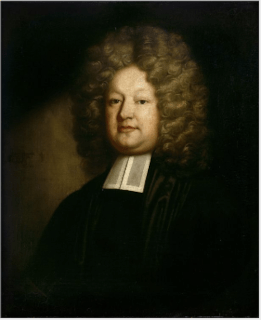
(Pictured: “Portrait of Nicholas Brady (1659-1726),” oil on canvas by Hugh Howard (1675-1737), circa 1715, National Gallery of Ireland)
Griffith purchases and drains the bogland at Pollagh, part of the Bog of Allen. A peat fueled power station is built which drives an excavator, with excess peat being taken by the Grand Canal for sale in Dublin. The site is sold to the Turf Development Board in 1936 who uses it as a basis for all of their later peat fueled power stations. The area is now a nature reserve.
Griffith receives a knighthood in 1911 and becomes vice-president of the Royal Dublin Society in 1922. He serves as Honorary Professor of Harbour Engineering in Trinity College, his alma mater, and receives an honorary M.A.I. degree from the University of Dublin in 1914. From 1922 he is an elected member of the Seanad Éireann, the Irish senate, until its abolition in 1936. In the 1930s he and his niece, Sarah Purser, endow the Purser Griffith Travelling Scholarship and the Purser Griffith Prize to the two best performing students in European Art History at University College Dublin.
Griffith dies at Rathmines Castle in Dublin on October 21, 1938, having rightly earned the epithet ‘Grand Old Man of Irish engineering.’ A portrait in oils by his niece Sarah Purser, RHA, hangs in the Museum Building in Trinity College Dublin.
Potter is born to a Presbyterian family who, oddly, lives on the Falls Road, a republican (Catholic) stronghold. His father is a church organist and piano tuner who has been blind since childhood. His mother is, in Potter’s own words, “a raging alcoholic.” He escapes a rather grim childhood when he goes to live with an aunt in Kent, England.
Potter had already started composing chamber and vocal music before the war. Now, established in Dublin, he chooses the orchestra as his principal means of expression. His early pieces, such as Rhapsody under a High Sky and Overture to a Kitchen Comedy, show that he has absorbed Vaughan Williams’ pastoral style and his love of folk music. In 1952, both pieces are awarded Radio Éireann‘s “Carolan Prize” for orchestral composition by the adjudicatorArnold Bax. A year later Potter repeats this success when his Concerto da Chiesa, a concerto for piano and orchestra, also wins the Carolan Prize.
In 1955 Potter is appointed Professor of Composition at the Royal Irish Academy of Music, where he becomes an effective administrator and inspiring teacher.
In the 1960s, Potter turns to ballet, writing four orchestral scores for the Cork Ballet company. The first of these, Careless Love, becomes the composer’s own favourite of all his compositions. Several years later, following a successful battle with alcoholism, he writes what some regard as his magnum opus, Sinfonia “de Profundis” (1969). The première is given at the Gaiety Theatre, Dublin on March 23, 1969 in a performance by the RTÉ Symphony Orchestra under the baton of Albert Rosen. The Irish Times refers to the concert as a “major national event.” In December 1969, he receives a Jacob’s Award for the composition.
Potter’s last substantial work, an opera entitled The Wedding, receives its first public performance in Dublin in 1981, almost a year after his death.
Potter dies suddenly at his home in Greystones, County Wicklow on July 5, 1980, at the age of 61. He is buried in the nearby Redford cemetery.
Dillon is born on May 5, 1814, in the town of Ballaghaderreen, on the border of counties Mayo and Roscommon. He is a son of Anne Blake and her husband Luke Dillon (d. 1826), who had been a land agent for his cousin Patrick Dillon, 11th Earl of Roscommon. His niece is Anne Deane, who helps to raise his family after his death.
Dillon is educated at St. Patrick’s College, Maynooth, leaving after only two years there, having decided that he is not meant for the priesthood. He later studies law at Trinity College, Dublin, and in London, before being called to the Irish Bar. It is during his time at Trinity College that he first meets and befriends Thomas Davis.
The young wing of the party, of which they are key members with William Smith O’Brien and Thomas Francis Meagher, come to be known as Young Ireland and advocate the threat of force to achieve repeal of the Act of Union. This is in contrast to the committed pacifism of O’Connell’s “Old Ireland” wing. This posturing eventually leads to the Young Ireland rebellion of 1848 where a countryside devastated by the Great Famine fails to rise up and support the rebels.
According to fellow Irish nationalist, Justin McCarthy, “…it has been said of him that while he strongly discouraged the idea of armed rebellion and had no faith in the possibility of Ireland’s succeeding by any movement of insurrection, yet when Smith O’Brien risked Ireland’s chances in the open field, he cast his lot with his leader and stood by his side in Tipperary.”
After the failure of Young Ireland’s uprising, Dillon flees Ireland, escaping first to France and, eventually, to the United States, where he serves the New York Bar.
Dillon is a member of the British House of Commons during 1880–1883 and 1885–1918. For his vigorous work in the Irish National Land League, which seeks fixed tenure, fair rents, and free sale of Irish land, he is imprisoned twice between May 1881 and May 1882. He is Parnell’s fellow inmate in Kilmainham Gaol in Dublin from October 1881. For six months in 1888 he is imprisoned for aiding William O’Brien, author of the “plan of campaign” against high rent charges by English absentee landlords in Irish farming districts.
When Parnell is named co-respondent in Captain William Henry O’Shea’s divorce suit in 1890, Dillon and O’Brien at first affirm their support of him, but they finally decide that he will thenceforth be a liability as party leader. The party then splits, the anti-Parnellite majority forming the Irish National Federation, of which Dillon serves as chairman from 1896. In 1900, however, he agrees to join a reunited party under the Parnellite John Redmond.
During the prime ministry of Arthur James Balfour (1902–1905), Dillon comes to believe that the British Conservative government intends to grant Irish reforms without independence, thereby “killing Home Rule by kindness.” In 1905 he advises Irishmen to vote for Liberal Party candidates for Parliament, and, after the Liberals had taken office that year, he supports their reform program.
Throughout World War I Dillon vehemently opposes the extension of British military conscription to Ireland, both because that measure would strengthen the agitation by the more extreme nationalist Sinn Féin party and because he never accepted the view that British imperial interests necessarily coincided with those of Ireland. After the Easter Rising in Dublin in 1916, he protests against the harsh measures that ensue and, in the House of Commons, makes a passionate speech in defense of the Irish rebels.
Upon Redmond’s death on March 6, 1918, Dillon, who had broken with him over Irish support for the British war effort, succeeds him as Irish Parliamentary Party leader. By that time, however, the party has been discredited and in the 1918 Irish general election Sinn Féin wins easily. On losing his House of Commons seat to Éamon de Valera, the future president of the Republic of Ireland, he retires from politics.
Hamilton is born in Dublin on August 4, 1805, the fourth of nine children born to Sarah Hutton (1780–1817) and Archibald Hamilton (1778–1819). He is part of a small but well-regarded school of mathematicians associated with Trinity College, Dublin, which he enters at age eighteen. He is said to have shown immense talent at a very early age. Astronomer Bishop Dr. John Brinkley remarks of the 18-year-old Hamilton, “This young man, I do not say will be, but is, the first mathematician of his age.”
Trinity College awards him two Optimes, or off-the-chart grades. He studies both classics and mathematics and is appointed Professor of Astronomy just prior to his graduation. He then takes up residence at Dunsink Observatory where he spends the rest of his life.
Although Hamilton regards himself as a pure mathematician rather than a physicist, his work is of major importance to physics, particularly his reformulation of Newtonian mechanics, now called Hamiltonian mechanics. This work has proven central to the modern study of classical field theories such as electromagnetism, and to the development of quantum mechanics. In pure mathematics, he is best known as the inventor of quaternions.
Hamilton’s scientific career includes the study of geometrical optics, classical mechanics, adaptation of dynamic methods in optical systems, applying quaternion and vector methods to problems in mechanics and in geometry, development of theories of conjugate algebraic couple functions, solvability of polynomial equations and general quintic polynomial solvable by radicals, the analysis on Fluctuating Functions, linear operators on quaternions and proving a result for linear operators on the space of quaternions, which is a special case of the general theorem which today is known as the Cayley–Hamilton theorem. He also invents Icosian calculus, which he uses to investigate closed edge paths on a dodecahedron that visit each vertex exactly once.
Hamilton retains his faculties unimpaired to the very last, and steadily continues the task of finishing the Elements of Quaternions which occupies the last six years of his life. He dies in Dublin on September 2, 1865, following a severe attack of gout precipitated by excessive drinking and overeating. He is buried in Mount Jerome Cemetery in Dublin.
Lever is the second son of James Lever, an architect and builder, and is educated in private schools. His escapades at Trinity College, Dublin (1823–1828), where he earns a degree in medicine in 1831, are drawn on for the plots of some of his novels. The character Frank Webber in the novel Charles O’Malley is based on a college friend, Robert Boyle, who later becomes a clergyman. He and Boyle earn pocket-money singing ballads of their own composing in the streets of Dublin and play many other pranks which he embellishes in the novels Charles O’Malley, Con Cregan and Lord Kilgobbin.
Before seriously embarking upon his medical studies, Lever visits Canada as an unqualified surgeon on an emigrant ship. Arriving in Canada, he journeys into the backwoods, where he is affiliated to a tribe of Native Americans but has to flee because his life is in danger, as later his character Bagenal Daly does in his novel The Knight of Gwynne.
Back in Europe, Lever pretends he is a student from the University of Göttingen and travels to the University of Jena and then to Vienna. He loves German student life and several of his songs, such as “The Pope He Loved a Merry Life,” are based on student-song models. His medical degree earns him an appointment to the Board of Health in County Clare and then as a dispensary doctor in Portstewart, County Londonderry, but his conduct as a country doctor earns him the censure of the authorities.
In 1833 Lever marries his first love, Catherine Baker, and in February 1837, after varied experiences, he begins publishing The Confessions of Harry Lorrequer in the recently established Dublin University Magazine. Before Harry Lorrequer appears in volume form (1839), he has settled on the strength of a slight diplomatic connection as a fashionable physician in Brussels.
In 1842 Lever returns to Dublin to edit the Dublin University Magazine and gathers round him a typical coterie of Irish wits. In June 1842 he welcomes William Makepeace Thackeray, the author of The Snob Papers, to Templeogue, four miles southwest of Dublin, on his Irish tour. The O’Donoghue and Arthur O’Leary (1845) make his native land an impossible place for Lever to continue in. Thackeray suggests London, but Lever requires a new field of literary observation and anecdote. His creative inspiration exhausted, he decides to renew it on the continent. In 1845 he resigns his editorship and goes back to Brussels, whence he starts upon an unlimited tour of central Europe in a family coach. Now and again, he halts for a few months and entertains to the limit of his resources in some ducal castle or other which he hires for an off season.
Depressed in spirit as Lever is, his wit is unextinguished. He is still the delight of the salons with his stories, and in 1867, after a few years’ experience of a similar kind at La Spezia, he is cheered by a letter from Lord Derby offering him the more lucrative consulship of Trieste. The $600 annual salary does not atone to Lever for the lassitude of prolonged exile. Trieste, at first “all that I could desire,” became with characteristic abruptness “detestable and damnable.”
Lever’s depression, partly due to incipient heart disease, partly to the growing conviction that he is the victim of literary and critical conspiracy, is confirmed by the death of his wife on April 23, 1870, to whom he is tenderly attached. He visits Ireland in the following year and seems alternately in high and low spirits. Death had already given him one or two runaway knocks, and, after his return to Trieste, he fails gradually, dying suddenly, however, and almost painlessly, from heart failure on June 1, 1872, at his home, Villa Gasteiger. His daughters, one of whom, Sydney, is believed to have been the real author of A Rent in a Cloud (1869), are well provided for.
Parsons also performs some preliminary work in association with the practices of the electrodeposition of copper sulfate upon silver films circa 1865 while in search of the design for a truly flat mirror to use in a telescope. However, he finds it impossible to properly electroplate copper upon these silver films, as the copper contracts and detaches from the underlying glass substrate. His note has been cited as one of the earliest confirmations in literature that thin films on glass substrates experience residual stresses. He revives discussion in his work Nature’s August 1908 edition after witnessing similar techniques used to present newly devised searchlights before the Royal Society.
Although overshadowed by his father (when astronomers speak of “Lord Rosse”, it is almost always the father that they refer to), Parsons nonetheless pursues some astronomical observations of his own, particularly of the Moon. Most notably, he discovers NGC 2, a spiral galaxy in the constellationPegasus.
Ó Dónaill is the olderst of the six children of Tarlach Ó Dónaill and Éilis Nic Ruairí from Grial, Loughanure. They own a little land and a few cows. His father spends June to November working in Scotland and dies when he is 13 years old. He himself spends summers working in the tunnels in Scotland.
Ó Dónaill receives his education at Scoil Loch an Iúir in Loughanure before gaining a scholarship to St. Eunan’s College in Letterkenny. Another scholarship takes him to University College Dublin to study Irish, English and History. During his time in university Ó Dónaill spends his summers teaching at Coláiste Bhríde in Rann na Feirste, County Donegal.
Ó Dónaill writes the book Bruigheann Féile which is based on stories of pastimes in the Gaeltacht town Loughanure and its surrounding area. His book Na Glúnta Rosannacha is first published in 1952.
Ó Dónaill is most famous for his work as editor of the 1977 Irish-English dictionary Foclóir Gaeilge-Béarla, which is still widely used today.
Purser is the son of John Tertius Purser (1809–1893), the general manager of the well known A Guinness, Son & Co. brewery, and Anna Benigna Fridlezius (1803-1881). He is educated in a wealthy family, which includes artists, as his cousin Sarah Purser, or engineers, as his brother-in-law John Purser Griffith. He is the brother of mathematician Frederick Purser. He receives his early education at the private boarding school run by his uncle, Dr. Richard W. Biggs, at Devizes, Wiltshire. He completes his schooling at Devizes and begins his university studies at Trinity College, Dublin, graduating BA in mathematics in 1856. He is the best mathematician of his year at the University and in 1855 he gains the Lloyd Exhibition.
Purser becomes a tutor to the four sons of William Parsons, 3rd Earl of Rosse (1800-1867) in 1857. Lord Rosse’s 72-inch reflecting telescope, built in 1845 and colloquially known of as the “Leviathan of Parsonstown,” is the world’s largest telescope when it is built and continues to hold this distinction until the early 20th century. As well as acting as tutor to the children, Purser does become involved in Lord Rosse’s interest in astronomy but never does any observing.
In 1863, Purser is appointed professor of mathematics at Queen’s College, Belfast, a position he maintains until his retirement in 1901.
Purser never marries. When his father dies on April 5, 1893, Rathmines Castle passes to him. He dies at Rathmines Castle on October 18, 1903, a very wealthy man. In his will he leaves £100,000 to his brother Frederick Purser, £40,000 to his sister Anna Griffith and £5,000 to each of her children. In addition to the money, he owns property in Blessington Street, Essex Street and Eustace Street which he leaves to his brother-in-law John Purser Griffith. Other properties and interests that he owns he divides between his brother Frederick and his sister Anna. After his death, his sister Anna and her husband John Purser Griffith move into Rathmines Castle although, at this time, its ownership has gone to Frederick Purser. After Frederick dies in August 1910, the Castle and his considerable wealth passes to Anna.
(Pictured: Portrait of John Purser painted by the artist Sarah Purser, daughter of Tertius Purser’s brother Benjamin Purser. The portrait hangs in Queen’s College, Belfast.)