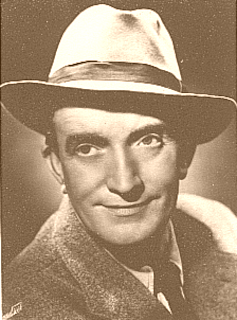
The following year, Doherty comes very close to breaking the Crucible curse, which refers to the fact that every first-time snooker world champion has failed to retain the title the following year. He reaches the final of the 1998 World Snooker Championship where he loses out to John Higgins of Scotland. He reaches his third final at the 2003 World Snooker Championship but is narrowly defeated by Mark Williams of Wales. In other Triple Crown events, he is a three-time UK Championship runner-up (1994, 2001, 2002) and a two-time Masters runner-up (1999, 2000).
An intelligent tactician and prolific break-builder, Doherty has compiled more than 300 century breaks in professional competition. Since 2009, he has combined his playing career with commentating and punditry work.
Doherty currently represents an Irish poker site, appearing on radio commercials, and regularly playing in tournaments, where the players on the site receive a bonus for knocking him out.
In partnership with Sean Francis O’Donoghue and Karl Leon Paul, Doherty set up an online cue sports equipment-marketing company.
Francis ‘Francie’ McPeake II, uilleann piper and singer, dies in Belfast on July 7, 1986. He is a crucial figure in preserving the great Ulster piping tradition.
McPeake is born on January 20, 1917 at 43 Malcolmson Street, Belfast, the son of Francis J. McPeake (1885–1971), piper and tram conductor, and Mary McPeake (née Loney). His father, a staunch nationalist, wins the Feis piping competition in Belfast in 1909 and represents Ireland together with a Welsh harper, John Page, at the Pan-Celtic Congress in Brussels in 1911. In July 1912 he wins first prize in the learners’ class when he attends the foundation of the Pipers’ Club in Dublin. He represents Ireland in many instances as one of relatively few pipers from Northern Ireland at the time.
McPeake continues the strong musical tradition in the family. He also plays the pipes and father and son are recorded by Peter Kennedy in 1952. They appear at the Royal Albert Hall in 1956 and later form the McPeake Trio along with his brother James, who plays the fiddle, the piano accordion, and later a harp made by McFall in Belfast. The trio comes to be known as The McPeakes. They sing in Irish and in English and are closely identified with particular songs, such as “The Jug of Punch,” “The Lament of Aughrim,” and “The Verdant Braes of Skreen,” though the one most associated with them is “Will You Go, Lassie, Go?”
The McPeakes win first prize at the international Eisteddfod in Wales in the late 1950s and acquire a strong international reputation with Bob Dylan being among their fans. The trio is later augmented by members of the next generation, recorded by Peter Kennedy again, and make several recordings, including Irish Folk (1964) and Welcome Home (1967), which is a cassette reissue of a 1962 album for the Topic Records label. Some of Kennedy’s recordings of the McPeake family are released on the compact disc Traditional Songs of Ireland (CD-SDL 411) in 1995. A fourth-generation family group follows, Clan McPeake, inheriting the commitment, much of the repertoire, and the verve of the earlier generations.
McPeakes’s gift for teaching is employed at the Francis McPeake School of Music, which is established in 1977, and he writes a well-reviewed tin whistle tutor entitled Smash the Windows, published by Appletree Press in 1981. He also forms the Clonard Traditional Music Society.
McPeake dies on July 7, 1986. The McPeake family remains closely associated with traditional music and with Belfast. The Francis McPeake International Summer School is established in 2004.
Clarence Patrick O’Connor, British singer of Irish heritage known professionally as Cavan O’Connor, is born on July 1, 1899 in Carlton, Nottinghamshire, England. He is most popular in the 1930s and 1940s, when he is billed as “The Singing Vagabond” or “The Vagabond Lover.”
O’Connor is born to parents of Irish origin. His father dies when he is young, and he leaves school at an early age to work in the printing trade. He serves in World War I as a gunner and signaler in the Royal Artillery, after first being rejected by the Royal Navy when it is discovered that he had pretended to be three years older than his real age. He is wounded in the war, aged 16, while serving with the Royal Artillery. After the war he returns to Nottingham where he works in a music shop. He starts singing in clubs and at concerts, before deciding to turn professional in the early 1920s.
O’Connor wins a scholarship to the Royal College of Music in London, where he meets his wife, Rita Tate (real name Margherita Odoli), a niece of the opera singer Maggie Teyte. He makes his first recordings, as Cavan O’Connor, for the Vocalion label in 1925, including “I’m Only a Strolling Vagabond” from the operetta The Cousin from Nowhere, which becomes his signature song. Noted for his fine tenor voice, well suited for recording, he appears on many British dance band recordings in the 1920s and 1930s, and uses a wide variety of pseudonyms, including Harry Carlton, Terence O’Brien, and Allan O’Sullivan. He also joins Nigel Playfair‘s revue company at the Lyric Theatre in Hammersmith, before moving on to playing lead roles in opera productions at The Old Vic, often performing in French, Italian and Spanish.
O’Connor turns increasingly toward light entertainment, largely for financial reasons. He starts appearing in variety shows around the country, often performing Irish folk songs. Having made his first radio broadcasts for BBC Radio in 1926, he continues to feature occasionally, but makes his breakthrough when he is billed, initially anonymously, as “The Strolling Vagabond” and “The Vagabond Lover” on a series of radio programmes produced by Eric Maschwitz in 1935. This is the first British radio series based around a solo singer, and when it becomes known that he is the performer, makes him a star, “one of Britain’s highest paid radio personalities.” The series continues for over ten years. From 1946, his Sunday lunchtime radio series, The Strolling Vagabond, is heard by up to 14 million listeners.
O’Connor consistently tours and continues to broadcast regularly. During World War II he settles in Bangor, Gwynedd, north Wales, and regularly appears on the Irish Half Hour radio programmes. His most popular songs include “The World Is Mine Tonight,” written for O’Connor by Maschwitz and George Posford, “Danny Boy” and “I’ll Take You Home Again, Kathleen,” an American song widely assumed to be Irish. He records frequently for at least 15 record labels over his career, including Decca Records, at one point recording 40 songs in five days. He makes over 800 recordings in total, both under his own name and pseudonyms, and also appears in two films, Ourselves Alone (1936) and Under New Management (known in the U.S. as Honeymoon Hotel, 1946).
After the war, O’Connor returns to live in London, and tours in Australia and South Africa as well as in Don Ross‘s Thanks for the Memory tours. He retires at one point to set up an electrical goods business, but then resumes his music career in the Avonmore Trio with his wife and son, to give occasional performances and make recordings, the last in 1984.
O’Connor dies at the age of 97 in London on January 11, 1997.
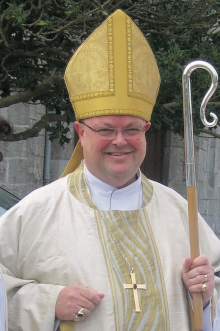
In 2013 Colton completes, and is conferred with, a PhD in Law also at Cardiff University. His academic areas of interest are church law, the law of the Church of Ireland, law within Anglicanism, the interface between the laws of religious communities and the laws of States (particularly in Ireland and Europe), human rights, education law, and charity law. In 2014 he is appointed as an honorary research fellow at the Cardiff School of Law and Politics of Cardiff University, and its Centre for Law and Religion.
Colton is married to Susan Colton, who is deputy principal of a primary school, and they have two adult sons. He is the first Church of Ireland bishop to openly support same-sex marriage. He is involved in education debates and in charity work. He chairs the board of directors of Saint Luke’s Charity, Cork, which focuses on the elderly and dementia sufferers. He is also chairman of the board of governors of Midleton College.
At the episcopal ordination of Bishop Fintan Gavin as Catholic bishop of Cork and Ross in June 2019, Colton presents the crosier at Bishop Gavin’s own request.
As of June 2020, Colton is the longest-serving bishop of Cork, Cloyne and Ross since bishop William Lyon in 1617 and also the longest serving bishop still in office in the Anglican churches of Ireland, England, Scotland and Wales. He is the author of almost a dozen book chapters, mostly in the area of the interface between religion and law.
Dennis Taylor, former professional snooker player and commentator, is born on January 19, 1949, in Coalisland, County Tyrone, Northern Ireland. He is most well-known for winning the 1985 World Snooker Championship, where he defeats Steve Davis with the final ball of the 35th frame in the final to seal an 18-17 win. During his playing career he wears distinctive specially designed glasses manufactured for snooker, often described as looking upside-down, giving him a unique look on the circuit.
Taylor is the son of a lorry driver and has six siblings. As an amateur, he wins the 1968 British Junior Billiards Championship. He turns professional in 1972. That season he makes his debut in the World Snooker Championship debut in the 1973 event, losing 8–9 to Cliff Thorburn in the first round. Over the next few years, he reaches the semi-finals at the event in 1975 and 1977. Two years later he reaches the 1979 final but loses 16–24 to qualifier Terry Griffiths. He reaches his highest world ranking for the following season, second behind Steve Davis.
Taylor reaches the semi-final for a third time in 1984, losing to Davis. His mother dies as he is beginning the new season at the 1984 Jameson International Open. He retires from the event before his quarter-final match against Silvino Francisco. However, he wins the first ranking event of his career at the 1984 Rothmans Grand Prix later that year defeating Thorburn 10–2 in the final.
Following his first ranking tournament victory, Taylor, seeded 11th, plays in the 1985 World Championship and reaches the final. In the final, he plays three-time winner and world number one Steve Davis. Never being ahead, he takes the match to a deciding frame with the scores tied at 17–17. Trailing 62–44 in the deciding frame with five coloured balls remaining, he pots a long brown ball, which he says is one of his best ever shots under pressure. He also pots the blue and pink to bring the score to 62–59 with one ball, worth seven points, remaining. Both players miss a shot on the black, but it is finally potted by Taylor to win the championship.
The final is considered by many to be the greatest snooker match in history and is broadcast to a peak audience of 18 million viewers in the United Kingdom. As of 2020 this is the highest viewership of any broadcast after midnight in the country, and a record for any programme shown on BBC Two. On his return to Northern Ireland, he is awarded the key to the city of Coalisland and receives a victory parade that 10,000 attend.
At the 1990 Snooker World Cup, Taylor teams with Alex Higgins and Tommy Murphy to form a Northern Irish team. After failing to win the tournament, Higgins threatens Taylor saying, “if you ever come back to Northern Ireland, I’ll have you shot.” Shortly afterwards they meet in the quarterfinals of the 1990 Irish Masters, and a determined Taylor wins 5–2. In the next decade, his form drops, and he falls out of the top 16 in the world rankings in 1995. He retires as a professional in 2000.
Following the end of his professional career, Taylor plays on the WPBSA World Seniors Tour and is featured as a commentator on BBC snooker broadcasts. He appears on the third series of Strictly Come Dancing, finishing eighth alongside dance partner Izabela Hannah. He currently lives in Llay near Wrexham, Wales.
An Aer Lingus aeroplane, the St. Kevin, crashes into Moel Siabod, a 2,860-foot mountain in Wales, during a blinding rainstorm on January 10, 1952, and burns out with the loss of all twenty passengers and a crew of three. It is Aer Lingus’s first fatal crash in fifteen years of service. Tragically the only item to survive intact is a child’s doll, belonging to a four-year-old passenger.
The plane is flying en route from LondonNortholt to Dublin leaving at 5:25 p.m. and is due to land at Collinstown at 8:10 p.m. The last message received is a report to the Nevin Radio Station, south of Anglesey, which says that the plane is flying normally. The plane is piloted by Captain J. R. Keohane, from Whitehall, Dublin, with W. A. Newman, from Dundrum, Dublin, as First Officer and Deirdre Sutton as air hostess.
The crash is believed to have occurred within the next half-hour during a gale. The first news of the disaster comes from two people who telephone Caernarvon police at 7:10 p.m. and report that they had heard the sound of an aircraft overhead, then the sound of a crash and saw a big glow in the sky near the mountains. Police and scores of Royal Air Force (RAF) men and soldiers are involved in the tortuous rescue mission in torrential rain.
When the first rescue party has struggled 1,000 feet up the steep slope of the mountain, they find the smouldering debris embedded in the earth. Most of the passengers had been buried in the bog by the impact. By midnight about 100 helpers are directed to the desolate mountain top and they work by torch light to extricate the bodies from the wreckage and the bog.
The cause of the crash is never established, although it is believed that the atrocious weather conditions may have led to mechanical failure.
On a lonely hillside in Snowdonia, Wales, a simple stone commemorates the victims of Ireland’s first air disaster.
(From: “Night 23 killed on a Welsh hillside,” Independent.ie, January 8, 2012)
Fay attends Belvedere College in Dublin. He works for a time in the 1890s with a touring theatre company in Ireland, Scotland, and Wales. When he returns to Dublin, he works with his brother Frank, staging productions in halls around the city. Finally, they form W. G. Fay’s Irish National Dramatic Company, focused on the development of Irish acting talent.
The brothers participate in the founding of the Abbey Theatre and are largely responsible for evolving the Abbey style of acting. After a falling-out with the Abbey directors in 1908, the brothers emigrate to the United States to work in theatre there.
Fay moves to London in 1914, working as an actor on stage and in films. One of his most notable film roles is as Father Tom in Carol Reed‘s Belfast-set Odd Man Out (1947), whose cast is dense with actors from the Abbey Theatre. His memoir, The Fays of the Abbey Theatre, appears in 1935.
Willie Fay dies in London on October 27, 1947, at the age of 74.
(Pictured: William George Fay 1903, Dublin City Council Image Galleries, http://www.dublincity.ie)
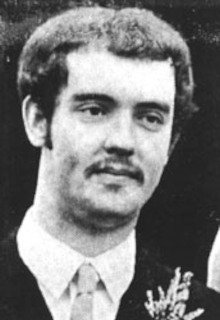
Unlike most Protestants in Northern Ireland, Bunting becomes a militant republican. His father, by contrast, was a committed Ulster loyalist. Despite their political differences, they remain close.
Bunting joins the Official Irish Republican Army (OIRA) around 1970 as he is attracted to their left-wing and secular interpretation of Irish republicanism and believes in the necessity of armed revolution. The other wing of the IRA, the Provisional Irish Republican Army, is seen to be more Catholic and nationalist in its outlook. At this time, the communal conflict known as the Troubles is beginning and the Official IRA is involved in shootings and bombings. He is interned in November 1971 and held in Long Kesh until the following April.
In 1974, Bunting follows Seamus Costello and other militants who disagree with the Official IRA’s ceasefire of 1972, into a new grouping, the Irish National Liberation Army (INLA). Immediately, a violent feud breaks out between the Official IRA and the INLA.
In 1975, Bunting survives an assassination attempt when he is shot in a Belfast street. In 1977, Costello is killed by an Official IRA gunman in Dublin. Bunting and his family hide in Wales until 1978, when he returns to Belfast. For the remaining two years of his life, he is the military leader of the INLA. The grouping regularly attacks the British Army and Royal Ulster Constabulary (RUC) in Belfast. He calls in claims of responsibility to the media by the code name “Captain Green.”
At about 4:30 AM on October 15, 1980, several gunmen wearing balaclavas storm Bunting’s home in the Downfine Gardens area of Andersonstown. They shoot Bunting, his wife Suzanne and another Protestant INLA man and ex-member of the Red Republican Party, Noel Lyttle, who has been staying there after his recent release from detention.
Both Bunting and Lyttle are killed. Suzanne Bunting, who is shot in the face, survives her serious injuries. The attack is claimed by the Ulster Defence Association (UDA), but the INLA claims the Special Air Service are involved.
Upon his death, Bunting’s body is kept in a funeral parlour on the Newtownards Road opposite the headquarters of the UDA. On the day of the funeral, as the coffin is being removed, UDA members jeer from their building. The Irish Republican Socialist Party wants a republican paramilitary-style funeral for Bunting but his father refuses and has his son buried in the family plot of a Church of Ireland cemetery near Donaghadee.
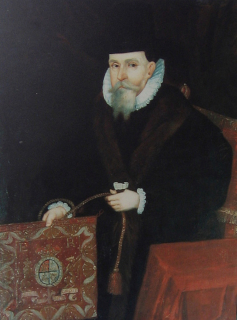
Loftus is born in 1533, the second son of a monastic bailiff, Edward Loftus, in the heart of the English Yorkshire Dales. He embraces the Protestant faith early in his development. He is an undergraduate at Trinity College, Cambridge, where he reportedly attracts the notice of the young Queen Elizabeth, as much by his physique as through the power of his intellect. Although this encounter may never have happened, Loftus certainly meets with the Queen more than once, and she becomes his patron for the rest of her reign. At Cambridge Loftus takes holy orders as a Catholic priest and is appointed rector of Outwell St. Clement in Norfolk. He comes to the attention of the Catholic Queen Mary, who names him vicar of Gedney, Lincolnshire. On Elizabeth’s accession in 1558 he declares himself Anglican.
Loftus makes the acquaintance of the Queen’s favourite Thomas Radclyffe, 3rd Earl of Sussex and serves as his chaplain in Ireland in 1560. In 1561 he becomes chaplain to Alexander Craike, Bishop of Kildare and Dean of St. Patrick’s Cathedral in Dublin. Later that year he is appointed rector of Painstown in Meath and evidently earns a reputation as a learned and discreet advisor to the English authorities in Dublin. In 1563, he is consecrated Archbishop of Armagh at the unprecedented age of 28 by Hugh Curwen, Archbishop of Dublin.
Following a clash with Shane O’Neill, the real power in Ulster during these years, he comes to Dublin in 1564. To supplement the meager income of his troubled archbishopric he is temporarily appointed to the Deanery of St. Patrick’s Cathedral by the queen in the following year. He is also appointed president of the new commission for ecclesiastical causes. This leads to a serious quarrel with the highly respected Bishop of Meath, Hugh Brady.
In 1567 Loftus, having lobbied successfully for the removal of Hugh Curwen, who becomes Bishop of Oxford, and having defeated the rival claims of the Bishop of Meath, is appointed Archbishop of Dublin, where the queen expects him to carry out reforms in the Church. On several occasions he temporarily carries out the functions of Lord Keeper of the Great Seal, and in August 1581 he is appointed Lord Chancellor of Ireland after an involved dispute with Nicholas White, Master of the Rolls in Ireland. He is constantly occupied in attempts to improve his financial position by obtaining additional preferment and is subject to repeated accusations of corruption in public office.
In 1582 Loftus acquires land and builds a castle at Rathfarnham, which he inhabits from 1585. In 1569–1570 the divisions in Irish politics take on a religious tinge with the First Desmond Rebellion in Munster and Pope Pius V‘s 1570 papal bullRegnans in Excelsis. The bull questions Elizabeth’s authority and thereafter Roman Catholics are suspected of disloyalty by the official class unless they are discreet.
Loftus takes a leading part in the execution of Dermot O’Hurley, Archbishop of Cashel. When O’Hurley refuses to give information, Francis Walsingham suggests he should be tortured. Although the Irish judges repeatedly decide that there is no case against O’Hurley, on June 19, 1584, Loftus and Sir Henry Wallop write to Walsingham “We gave warrant to the knight-marshal to do execution upon him, which accordingly was performed, and thereby the realm rid of a most pestilent member.”
Between 1584 and 1591 Loftus has a series of clashes with Sir John Perrot on the location of an Irish University. Perrot wants to use St. Patrick’s Cathedral, Dublin as the site of the new University, which Loftus seeks to preserve as the principal place of Protestant worship in Dublin, as well as a valuable source of income for himself. The archbishop wins the argument with the help of his patron, Queen Elizabeth I, and Trinity College, Dublin is founded at its current location, named after his old college at Cambridge, leaving the Cathedral unaffected. Loftus is named as its first Provost in 1593.
The issue of religious and political rivalry continues during the two Desmond Rebellions (1569–83) and the Nine Years’ War (1594–1603), both of which overlap with the Anglo-Spanish War (1585–1604), during which some rebellious Irish nobles are helped by the Papacy and by Elizabeth’s arch-enemy Philip II of Spain. Due to the unsettled state of the country Protestantism makes little progress, unlike in Celtic Scotland and Wales at that time. It comes to be associated with military conquest and is therefore hated by many. The political-religious overlap is personified by Loftus, who serves as Archbishop and as Lord Chancellor of Ireland. An unlikely alliance forms between Gaelic Irish families and the Norman “Old English“, who had been enemies for centuries but who now mostly remain Roman Catholic.
Adam Loftus dies in Dublin on April 5, 1605, and is interred in the building he had helped to preserve for future generations, while many of his portraits hang today within the walls of the University which he helped found. Having buried his wife Jane (Purdon) and two sons (of their 20 children) in the family vault at St. Patrick’s, Loftus dies at his Episcopal Palace in Kevin Street “worn out with age” and joins his family in the same vault. His zeal and efficiency are commended by James I upon the king’s accession.
A charter incorporates Derry as the city of Londonderry on March 29, 1613 and also creates the new county of Londonderry. Despite the official name, the city is more usually known as simply Derry, which is an anglicisation of the Old IrishDaire, which in modern Irish is spelled Doire, and translates as “oak-grove/oak-wood.” The name derives from the settlement’s earliest references, Daire Calgaich (“oak-grove of Calgach”). The name is changed from Derry in 1613 during the Plantation of Ulster to reflect the establishment of the city by the London guilds.
Ulster is finally brought under the control of Elizabeth I’s government at the beginning of the 17th century following a long struggle between the Tudor monarchy and the Gaelic chieftains. This follows the defeat of the chieftains at the Siege of Kinsale in 1601 after a war lasting nine years. Although the Gaelic chieftains are allowed to remain on their land, their positions have been weakened. A group of them leave Ireland for the continent in 1607, never to return. The “Flight of the Earls”, as it is known, is seen as treason by James I’s government and their lands are confiscated. This important event opens the way for James I to further increase his control over Ulster by settling tens of thousands of settlers from England, Scotland and Wales on the confiscated lands.
Surveying and planning for the plantation take place during 1608 and 1609 and the plantation proper begins in 1610. The towns of Derry and Coleraine, as well as much of the lands that are to become County Londonderry, are granted to the City of London Corporation, which is charged with planting them.
The Society of the Governor and Assistants, London, of the New Plantation in Ulster, within the realm of Ireland, known after the Restoration as the Irish Society, is formed in 1609 by the City of London, to manage the estates which it has been obliged very reluctantly to take on. The Irish Society takes charge of the overall management of the Irish estates, with direct control of the new city of Derry and of the town of Coleraine.
The City of Londonlivery companies are required to take on estates in the surrounding County of Londonderry. The Great Twelve livery companies bear the heaviest financial burden. The county is divided among them into twelve “proportions,” distributed by the drawing of lots. The Great Twelve are in turn supported by a number of minor companies, so that thirty livery companies in all have Irish estates derived from their participation in James I’s scheme for the plantation of Ulster.
However, the first phase of the existence of the Irish Society is short-lived. The Great Parchment Book is compiled in the late 1630s when Charles I claims the estates as forfeit after a politically motivated case in Star Chamber rules that the Londoners have not fulfilled their obligations of plantation.
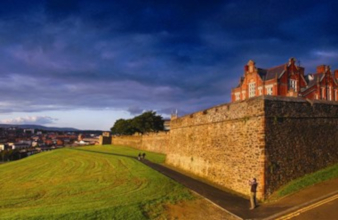
The City of Londonderry is very much a product of the plantation and plays a pivotal role in safeguarding the plantation. Its walls, which are still intact today, repulse sieges in 1641, 1649 and 1689.
By the end of the 17th century, Ulster, which had been the most Gaelic part of Ireland, has become the most “British.” The plantation creates Ulster we know today with its socio-economic base, its religious and political diversity, and its shared heritage.