seamus dubhghaill

Promoting Irish Culture and History from Little Rock, Arkansas, USA


Leave a comment

The Milltown Cemetery Attack

milltown-cemetery-attack

The Milltown Cemetery attack, also known as the Milltown Cemetery killings or the Milltown Massacre, takes place on March 16, 1988 at Milltown Cemetery in Belfast, Northern Ireland.

On March 6, 1988, Provisional Irish Republican Army members Daniel McCann, Seán Savage and Mairéad Farrell are shot dead by the Special Air Service (SAS) in Gibraltar, in Operation Flavius. The three were allegedly preparing a bomb attack on British military personnel there, but their deaths outrage republicans as the three are unarmed and shot without warning. Their bodies arrive in Belfast on March 14 and are taken to their family homes.

The “Gilbraltar Three” are scheduled to be buried in the republican plot at Milltown Cemetery on March 16. For years, republicans had complained about heavy-handed policing of IRA funerals, which had led to violence. In a change from normal procedure, the security forces agree to stay away from the funeral in exchange for guarantees that there will be no three-volley salute by IRA gunmen. The British Army and Royal Ulster Constabulary (RUC) would instead keep watch from the sidelines. This decision is not made public.

Present at the funeral are thousands of mourners and top members of the IRA and Sinn Féin, including Sinn Féin leader Gerry Adams and Martin McGuinness. Two RUC helicopters hover overhead.

Michael Stone, a loyalist and member of the Ulster Defence Association (UDA), learns there are to be no police or armed IRA members at the cemetery. As the third coffin is about to be lowered into the ground, Stone throws two grenades, which have a seven-second delay, toward the republican plot and begins shooting. The first grenade explodes near the crowd and about 20 yards from the grave. There is panic and confusion, and people dive for cover behind gravestones.

As Stone runs towards the nearby motorway, a large crowd begins chasing him and he continues shooting and throwing grenades. Some of the crowd catches Stone and begin beating him, but he is rescued by the police and arrested. Three people are killed and more than 60 wounded in the attack. The “unprecedented, one-man attack” is filmed by television news crews and causes shock around the world.

Three days later, two British Army corporals drive into the funeral procession of one of the Milltown victims. The non-uniformed soldiers are dragged from their car by an angry crowd, beaten and then shot dead by the IRA, in what becomes known as the corporals killings.

In March 1989, Stone is convicted for the three murders at Milltown, for three paramilitary murders before, and for other offences, receiving sentences totaling 682 years. He is released after serving 13 years as a result of the Good Friday Agreement.

(Pictured: The funeral at Milltown Cemetery in Belfast moments before the attack by Michael Stone)

Leave a comment

Birth of Lady Gregory, Writer & Playwright

lady-gregory

Isabella Augusta, Lady Gregory (née Isabella Augusta), Irish playwright, folklorist and theatre manager, is born on March 15, 1852, at Roxborough, County Galway. Her translations of Irish legends, her peasant comedies and fantasies based on folklore, and her work for the Abbey Theatre, play a considerable part in the late 19th-century Irish Literary Revival.

Augusta is the youngest daughter of the Anglo-Irish gentry family Persse. Her mother, Frances Barry, is related to Standish O’Grady, 1st Viscount Guillamore, and her family home, Roxborough, is a 6,000-acre estate located between Gort and Loughrea, the main house of which is later burned down during the Irish Civil War. She is educated at home, and her future career is strongly influenced by the family nanny, Mary Sheridan, a Catholic and a native speaker of the Irish language, who introduces the young Augusta to the history and legends of the local area.

In 1880 Augusta marries Sir William Henry Gregory, a neighbouring landowner who had previously served as a Member of Parliament and as governor of Ceylon. He is a well-educated man with many literary and artistic interests, and his estate at Coole Park houses a large library and extensive art collection, both of which Lady Gregory is eager to explore. He also has a house in London, where the couple spends a considerable amount of time.

Lady Gregory’s literary career does not begin until after Sir Gregory’s death in 1892. In 1896 she meets William Butler Yeats and becomes his lifelong friend and patron. She takes part in the foundation of the Irish Literary Theatre in 1899 and becomes a director of the Abbey Theatre in 1904, which owes much of its success to her skill at smoothing the disputes among its highly individualistic Irish nationalist founders. As a playwright, she writes pleasant comedies based on Irish folkways and picturesque peasant speech, offsetting the more tragic tones of the dramas of Yeats and John Millington Synge.

Lady Gregory writes or translates nearly forty plays. Seven Short Plays (1909), her first dramatic works, are among her best, vivid in dialogue and characterization. The longer comedies, The Image and Damer’s Gold, are published in 1910 and 1913 and her strange realistic fantasies, The Golden Apple and The Dragon, in 1916 and 1920. She also arranges and makes continuous narratives out of the various versions of Irish sagas, translating them into an Anglo-Irish peasant dialect that she labels “Kiltartan.” These are published as Cuchulain of Muirthemne (1902) and Gods and Fighting Men (1904).

Lady Gregory returns to live in Galway after ill health forces her retirement from the Abbey Theatre board in 1928, although she continues to visit Dublin regularly. The house and demesne at Coole Park are sold to the Irish Forestry Commission in 1927, with Lady Gregory retaining life tenancy. Her Galway home had long been a focal point for the writers associated with the Irish Literary Revival, and this continues after her retirement. On a tree in what were the grounds of the house, one can still see the carved initials of Synge, Æ, Yeats and his artist brother Jack, George Moore, Seán O’Casey, George Bernard Shaw, Katharine Tynan and Violet Martin.

Lady Gregory, whom Shaw once described as “the greatest living Irishwoman,” dies at the age of 80 on May 22, 1932, at home from breast cancer. She is buried in the New Cemetery in Bohermore, County Galway. The entire contents of Coole Park are auctioned three months after her death, and the house is demolished in 1941.


Leave a comment

Liam Cosgrave Elected Taoiseach of Ireland

liam-cosgrave

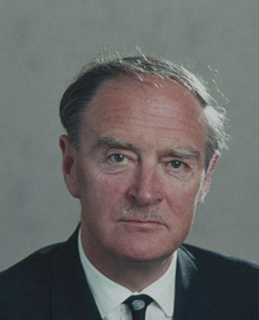
Liam Cosgrave is elected the sixth Taoiseach of Ireland on March 14, 1973. He serves in the position from March 1973 to July 1977.

Cosgrave is born on April 13, 1920, in Castleknock, County Dublin. His father, William Thomas Cosgrave, was the first President of the Executive Council and head of the government of the Irish Free State during the first 10 years of its existence (1922–32). The eldest son, he is educated at Synge Street CBS, Castleknock College, Dublin, studies law at King’s Inns and is called to the Irish bar in 1943. In that same year he enters Dáil Éireann (the lower house of the Oireachtas, the Irish parliament), and he retains his seat until his retirement from politics in 1981.

In 1948, when the first inter-party government replaces Éamon de Valera’s Fianna Fáil regime, which had been in power for the previous 16 years, Cosgrave becomes parliamentary secretary to the Taoiseach and to the Minister for Industry and Commerce. It is a short-lived administration, going out of power in 1951 after three years of rule. But in a second inter-party government (1954–57), he becomes Minister for External Affairs and leads the first Irish delegation to the United Nations General Assembly in 1956.

Cosgrave succeeds James Dillon as leader of the Fine Gael party in 1965. Eight years later, as leader of a coalition government in which Fine Gael combines forces with the Labour Party, he becomes Taoiseach. He and British Prime Minister Edward Heath are the main participants in the intergovernmental conference at Sunningdale in December 1973 that gives birth to Northern Ireland’s first, though short-lived, power-sharing executive (1973–74).

A devout Roman Catholic, Cosgrave is intensely conservative on social issues and shocks his cabinet colleagues by voting against his own government’s bill on liberalizing the sale of contraceptives in 1974. The National Coalition is defeated in the general election of June 1977, largely on the economic issues of inflation and unemployment.

In 1981, Cosgrave retires as Dáil Deputy for Dún Laoghaire to be replaced by his son, Liam T. Cosgrave. He reduces his involvement in public life, but he makes occasional appearances and speeches. In October 2010 he attends the launch of The Reluctant Taoiseach, a book about former Taoiseach John A. Costello written by David McCullagh. He also appears in public for the Centenary of the Easter Rising in 2016, watching from a car as the military parade marches through Dublin. On May 8, 2016, in a joint appearance with the grandsons of Éamonn Ceannt and Cathal Brugha, he unveils a plaque commemorating the 1916 Rising at St. James’s Hospital, the former site of the South Dublin Union.

Liam Cosgrave dies on October 4, 2017, at the age of 97 of natural causes. He had been at Tallaght Hospital for several months prior to his death there. His funeral is held on October 7, 2017, after which he is interred alongside his father at Inchicore‘s Goldenbridge Cemetery.

Taoiseach Leo Varadkar says “Liam Cosgrave was someone who devoted his life to public service; a grateful country thanks and honours him for that and for always putting the nation first. Throughout his life he worked to protect and defend the democratic institutions of our State and showed great courage and determination in doing so. He always believed in peaceful co-operation as the only way of achieving a genuine union between the people on this island, and in the 1970s he celebrated that this country had embarked, in his own words, ‘on a new career of progress and development in the context of Europe’. I had the honour on a few occasions to meet and be in the presence of Liam Cosgrave, and I was always struck by his commanding presence and great humility, which in him were complementary characteristics.”


Leave a comment

Birth of Patrick Nally, Athlete & Member of the Irish Republican Brotherhood

CREATOR: gd-jpeg v1.0 (using IJG JPEG v62), quality = 100

Patrick William Nally, a member of the Supreme Council of the Irish Republican Brotherhood and well known Connacht athlete from Balla, County Mayo, is born on March 13, 1857.

Nally is the eldest son and one of six brothers, of a prosperous farmer of “advanced nationalist” views. From an early age he is a Fenian, and by the late 1870s is a leading organiser of the Irish Republican Brotherhood.

Nally is also present at the founding meeting in August 1879, of the Land League of Mayo, later becoming the Irish National Land League. He is elected a joint secretary. By 1880, he has become a member of the IRB’s Supreme Council.

In 1879, Michael Cusack, credited with founding the Gaelic Athletic Association, meets Nally, who had in 1877 attempted to start a nationalist athletics association but it never got off the ground. Cusack finds that Nally’s views on the influence of British landlordism on Irish athletics are the same as his.

Cusack recalls how both Nally and himself while walking through the Phoenix Park in Dublin and seeing only a handful of people playing sports in the park so depressed them that they agree it is time to “make an effort to preserve the physical strength of our race.” Nally organises a National Athletics Sports meeting in County Mayo in September 1879 which is a success, with Cusack organising a similar event which is open to ‘artisans’ in Dublin the following April.

In 1881, Nally is sentenced to ten years imprisonment in Mountjoy Prison, Dublin, for what becomes known as the “Crossmolina Conspiracy,” where he is reportedly subjected to harsh treatment. He dies in prison on November 8, 1891. His funeral is organised by James Boland, with whom he had conspired in Manchester.

The resultant Nally GAA Club in Dublin would be closely associated with working class nationalists and republicans during the 1890s and beyond. One of the stands in Croke Park is named after Nally, and is unique for being the only stand in the stadium named after a person who had no connection to the Gaelic Athletic Association.


Leave a comment

Birth of Fr. Michael Patrick O’Hickey

michael-patrick-o-hickey

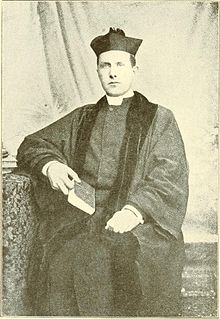
Michael Patrick O’Hickey, Irish Catholic priest and professor of Irish at St. Patrick’s College, Maynooth and an Irish language campaigner, is born in Carrickbeg, County Waterford on March 12, 1860. Sometimes his name appears as Michael Hickey rather than Micheal O’Hickey, or even in Irish as An tAthair Micheál Ó hIcí.

O’Hickey’s mother dies at an early age and his father remarries. He has an older brother Martin, and a younger half-brother Maurice. He studies for the priesthood in St. John’s College, Waterford, and is ordained a priest in 1884. He is an active member of the Conradh na Gaeilge and studies under the noted Irish scholar Sean Plemion.

In 1896 O’Hickey is appointed Professor of Irish in Maynooth College, succeeding Fr. Eugene O’Growney. After clashing with the bishops and establishment, he is dismissed in 1909 from his position as Professor of Irish, for his conduct in the controversy over Irish as a matriculation subject for the new National University of Ireland.

O’Hickey receives support from many Irish nationalists (including Patrick Pearse whom he earlier had disagreements with), Irish language activists, and some of his colleagues including Maynooth’s Theology Professor, Walter McDonald. He appeals his dismissal to the Vatican, but his appeal is refused.

Michael O’Hickey dies in Portlaw, County Waterford on November 19, 1916, and is buried in the Hickey family plot in the Friary Cemetery in Carrickbeg, County Waterford.


Leave a comment

Birth of Erskine B. Childers, Writer, Correspondent & Civil Servant

erskine-barton-childers

Erskine Barton Childers, Irish writer, BBC correspondent and United Nations senior civil servant, is born in Dublin on March 11, 1929.

Childers is born to Erskine Hamilton Childers (Ireland’s fourth President) and his first wife Ruth Ellen Dow. He grows up in a multi-cultural atmosphere which influences his whole life. From an early age, he has an obvious fascination with history and world affairs. He studies at Newtown School, Waterford and much later on at Trinity College, Dublin and Stanford University. At Stanford he is actively involved with the National Student Association and rises to Vice-President of the organisation by 1949.

By 1960, Childers is in London working for the BBC in both radio and television. His broadcasts from the BBC World Service range on varying topics from the Suez Crisis and Palestine to the John F. Kennedy assassination in 1963. He is one of the first presenters at the start of the BBC TV show The Money Programme in 1966. The Suez Canal and Palestine issues later form the basis of his writing on the subjects.

Childers is distinguished as one of the first mainstream writers in the West to systematically challenge the contention that Palestinian Arab refugees of the 1947–1948 Civil War in Mandatory Palestine and the 1948 Arab–Israeli War fled their homes primarily from Arab broadcast evacuation orders, rather than from the use of force and terror by armed forces of the newly forming state of Israel.

Childers specialises in UN issues, even serving as a periodic consultant including a special mission in the Congo for Secretary-General U Thant. In 1967, under the leadership of Henry Richardson Labouisse, Jr., he is hired to lead a United Nations, UNICEF and United Nations Development Programme (UNDP) programme called Development Support Communication. In 1968 he co-authors a paper with United Nations colleague Mallica Vajrathon called “Project Support Communication,” later published in an important anthology about social change.

From 1975 to 1988, Childers is based in New York as Director of Information for UNDP. By his retirement in 1989 after 22 years of service as Senior Advisor to the UN Director General for Development and International Economic Co-operation, Childers had worked with most of the organisations of the UN system, at all levels and in all regions.

After his retirement, Childers continues to strive relentlessly for the ideals for which he had worked so hard. He co-authors several notable books for the Ford Foundation and the Dag Hammarskjöld Foundation on the reform of the United Nations with his colleague and equally devoted United Nations civil servant, Sir Brian Urquhart. The best known of these publications is A World in Need of Leadership. He continues writing on United Nations matters while traveling constantly and lecturing on the Organisation and the many challenges confronting it, such as globalisation and democracy, conflict prevention and peacekeeping, humanitarian assistance, human rights, famine, ageing and development, health, financial arrangement of the United Nations, citizen’s rights, female participation, design and perceptions, education, the North South divide and world economy. In 1995 he co-authors a paper with his international law colleague Marjolijn Snippe called The Agenda for Peace and the Law of the Sea, for Pacem in Maribus XXIII, the Annual Conference of the International Ocean Institute, that is held in Costa Rica, December 1995.

Childers becomes Secretary General of the World Federation of United Nations Associations in March 1996. Having served for only five months, he dies on August 25, 1996, during the organisation’s fiftieth anniversary congress. He is buried in Roundwood, County Wicklow.


Leave a comment

Birth of Writer Pádraig Ó Siochfhradha

padraig-o-siochfhradha

Pádraig Ó Siochfhradha, writer under the pseudonym An Seabhac and promoter of the Irish language, is born in the Gaeltacht near Dingle, County Kerry on March 10, 1883. His brother, Mícheál Ó Siochfhradha is also a writer, teacher, and Irish language storyteller.

Ó Siochfhradha becomes an organiser for Conradh na Gaeilge, cycling all over the countryside to set up branches and promote the Irish language. As a writer, he takes the penname An Seabhac, the Hawk, writing books including An Baile Seo Gainne (1913) and Jimín Mháire Thaidhg (1921), both of which draw on his Dingle youth and are later published in one volume as Seoda an tSeabhaic (1974).

Ó Siochfhradha is a prominent and influential figure of early 20th century Irish culture, a key populariser of the Irish Revival. He is an author, storyteller, folklorist, activist and politician.

Ó Siochfhradha’s nickname is thought to be a consequence of his years as a travelling teacher, when he adopts it as a pseudonym for the writing of his most famous book Jimín Mháire Thaidhg. This book, known in its English translation as Jimeen, is a fictionalised account of life growing up in the country, which follows the tribulations and misadventures of a young boy who cannot stay out of trouble.

Ó Siochfhradha works as a teacher from 1910 until 1922 in Kildare and in the Fermoy region of Kerry. He also works as an editor of The Light, a bilingual magazine which lasts six years, from 1907 to 1913. He is a member of Conradh na Gaeilge from early in his life and a frequent member of the League of Employment, which is an outgrowth of Conradh na Gaeilge. In 1911, a resolution, proposed by him and a colleague, is adopted that helps set the agenda for the ongoing revival of the Irish language. The proposal is to teach Irish to children of secondary school age as a living language rather than an antique one. This strategy persists to the present day.

Ó Siochfhradha becomes an active organiser for the Irish Volunteers in 1913 and is imprisoned three times for his activities. He spends time in Durham Prison in England and on Bere Island, County Cork.

In 1922 Ó Siochfhradha moves to Dublin under the auspices of the Department of Education. It is around this time that he is thought to have taken up residence in 119 Morehampton Road, Donnybrook, where he remains for the rest of his life. He continues to stay active in a large number of writing and political projects. He is secretary to the Irish Manuscripts Commission from October 1928 to October 1932.

During the Irish Civil War, it is said Ó Siochfhradha does his best to reconcile the opposing sides of the conflict. His political sympathies are primarily republican, and he spends a great deal of energy in the 1920s establishing Irish-speaking schools in Dublin. He is a member of Seanad Éireann from 1946–1948, 1951–1954 and 1957–1964, being personally nominated by his friend Taoiseach Éamon de Valera, on each occasion.

Ó Siochfhradha dies on November 19, 1964. His personal papers are on loan to Tralee Library and his archive has been digitised and stored by the University of Limerick.

(From: Stair na hÉireann/History of Ireland (https://stairnaheireann.net), “Pádraig Ó Siochfhradha – An Seabhac”)


Leave a comment

Killing of PSNI Officer Stephen Carroll

stephen-carroll

Stephen Carroll, a Police Service of Northern Ireland (PSNI) officer, is killed by the Continuity Irish Republican Army on March 9, 2009 in Craigavon, County Armagh, Northern Ireland. Carroll’s killing marks the first time a serving police officer has been killed since the Good Friday Agreement in 1998.

Two days prior to the attack the Real Irish Republican Army shoots dead two British soldiers outside the Massereene Barracks in Antrim, County Antrim. This period marks a significant escalation in the campaign by dissident republicans.

The Continuity IRA smashes a window with a brick knowing the PSNI would respond. At about 9:45 PM two police vehicles arrive at the scene. The officers are fired upon as they attempt to exit their vehicles. A gunman shoots Carroll from 50 metres away with an AK-47 while in his patrol car. Carroll is shot in the head.

The Continuity IRA claims responsibility saying their North Armagh Battalion is responsible for the attack and that “As long as there is British involvement in Ireland, these attacks will continue.”

On March 10 there is a one-minute silence in the Northern Ireland Assembly. Prime Minister Gordon Brown states that “These are murderers who are trying to distort, disrupt and destroy a political process that is working for the people of Northern Ireland.” Chief Constable Sir Hugh Orde calls it a “sad day” and says the gunmen are “criminal psychopaths.”

Richard Walsh, the spokesman for Republican Sinn Féin, a party linked to the Continuity IRA, says the killings are “an act of war” rather than murder. “We have always upheld the right of the Irish people to use any level of controlled and disciplined force to drive the British out of Ireland. We make no apology for that.” He also describes the PSNI as “an armed adjunct of the British Army.”

Deputy First Minister of Northern Ireland Martin McGuinness says those responsible are “traitors to the island of Ireland” and that “they have betrayed the political desires, hopes and aspirations of all of the people who live on this island.”


Leave a comment

Death of William III, King of England, Scotland & Ireland

Kneller, Godfrey, 1646-1723; King William III (1650-1702)

William III, also widely known as William of Orange, dies at Kensington Palace on March 8, 1702, following a fall from his horse when it stumbles on a molehill. Upon his death, Anne accedes to the throne of Britain and Ireland.

William is sovereign Prince of Orange from birth, Stadtholder of Holland, Zeeland, Utrecht, Gelderland and Overijssel in the Dutch Republic from 1672 and King of England, Ireland and Scotland from 1689 until his death in 1702. As King of Scotland, he is known as William II. He is sometimes informally known in Northern Ireland and Scotland as “King Billy.”

William is born on November 4, 1650, at Binnenhof, The Hague, Dutch Republic. He inherits the Principality of Orange from his father, William II, who dies a week before William’s birth. His mother, Mary, is the daughter of King Charles I of England. In 1677, William marries his fifteen-year-old first cousin, Mary, the daughter of his maternal uncle James, Duke of York.

A Protestant, William participates in several wars against the powerful Catholic King of France, Louis XIV, in coalition with Protestant and Catholic powers in Europe. Many Protestants herald him as a champion of their faith. In 1685, William’s Catholic uncle and father-in-law, James, becomes king of England, Scotland and Ireland. James’s reign is unpopular with the Protestant majority in Britain. William, supported by a group of influential British political and religious leaders, invades England in what becomes known as the Glorious Revolution. On November 5, 1688, he lands at the southern English port of Brixham. James is deposed and William and his wife become joint sovereigns in his place.

William’s reputation as a staunch Protestant enables him to take power in Britain when many are fearful of a revival of Catholicism under James. William’s victory at the Battle of the Boyne in 1690 is still commemorated by loyalists in Northern Ireland and Scotland.

William and Mary reign together until Mary’s death from smallpox on December 28, 1694, after which William rules as sole monarch. Despite his conversion to Anglicanism, his popularity plummets during his reign as a sole monarch. His reign in Britain marks the beginning of the transition from the personal rule of the House of Stuart to the more Parliament-centred rule of the House of Hanover.

On March 8, 1702, William dies of pneumonia, a complication from a broken collarbone following a fall from his horse, Sorrel. The horse had been confiscated from Sir John Fenwick, one of the Jacobites who had conspired against William. Because his horse had stumbled into a mole’s burrow, many Jacobites toast “the little gentleman in the black velvet waistcoat.” Years later, Winston Churchill, in his A History of the English-Speaking Peoples, states that the fall “opened the door to a troop of lurking foes.” William is buried in Westminster Abbey alongside his wife. His sister-in-law, Anne, becomes queen regnant of England, Scotland and Ireland.

William’s death means that he would remain the only member of the Dutch House of Orange to reign over England.


Leave a comment

Frederick A. Sterling’s Ambassadorship to Ireland Ends

frederick-a-sterling

Frederick Augustine Sterling, United States diplomat and first U.S. Ambassador to Ireland, completes his mission in Ireland on March 7, 1934. He later serves as U.S. minister to Bulgaria and Sweden.

Sterling is born in St. Louis, Missouri on August 13, 1876 and is an 1898 graduate of Harvard University. After working on a ranch in Texas and manufacturing woolen goods, he becomes a career Foreign Service Officer in 1911. Assignments include work in Peru, China, Russia, and England.

On July 27, 1927, Sterling is the first person appointed U.S. minister to the Irish Free State. After confirmation by the United States Senate, and presentation of his credentials to Irish leaders W. T. Cosgrave and Timothy Healy in July, he holds the formal title of Envoy Extraordinary and Minister Plenipotentiary.

Sterling’s post in Ireland ends on March 7, 1934, when he becomes U.S. minister to Bulgaria, a position he remains in until 1936. In 1937, he is appointed to minister roles for both Latvia and Estonia, however he does not accept the post. In 1938, he becomes U.S. minister to Sweden and remains in that role until 1941.

For years Sterling owns a summer house in Newport, Rhode Island, which he shares with his wife, two sons and one daughter. He dies in Washington, D.C., on August 21, 1957, and is buried in Falls Church, Virginia.