Hobart marries firstly Margaretta, daughter of Edmund Bourke, in 1792. They have one son, who dies in infancy, and a daughter, Lady Sarah, who marries Prime Minister Lord Goderich and is the mother of George Robinson, 1st Marquess of Ripon. After Margaretta’s death in 1796 he marries secondly the Hon. Eleanor Agnes, daughter of William Eden, 1st Baron Auckland, in 1799. There are no children from this marriage.
Robert Hobart dies at Hamilton Place, London, on February 4, 1816 at the age of 55, after falling from his horse. He is succeeded in the earldom by his nephew, George. Lady Buckinghamshire dies in October 1851, at the age of 74.
In the 17th century, parliament settles at Chichester House, a town house in Hoggen Green (later College Green) formerly owned by Sir George Carew, Lord President of Munster and Lord High Treasurer of Ireland, which had been built on the site of a nunnery disbanded by King Henry VIII at the time of the dissolution of the monasteries. Carew’s house, named Chichester House after its later owner Sir Arthur Chichester, is a building of sufficient importance to have become the temporary home of the Kingdom of Ireland’s law courts during the Michaelmas law term in 1605. Most famously, the legal documentation facilitating the Plantation of Ulster is signed there on November 16, 1612.
Chichester House is in a dilapidated state, allegedly haunted and unfit for official use. In 1727 parliament votes to spend £6,000 on a new building on the site. It is to be the world’s first purpose-built two-chamber parliament building.
The then ancient Palace of Westminster, the seat of the English before 1707 and, later, British Parliament, is a converted building. The House of Commons‘s odd seating arrangements is due to the chamber’s previous existence as a chapel. Hence MPs face each other from former pews.
The original, domed House of Commons chamber is destroyed by fire in the 1790s, and a less elaborate new chamber, without a dome, is rebuilt in the same location and opened in 1796, four years before the Parliament’s ultimate abolition.
Pearce’s designs come to be studied and copied both at home and abroad. The Viceregal Apartments in Dublin Castle imitate his top-lit corridors. The British Museum in Bloomsbury in London copies his colonnaded main entrance. His impact reaches Washington, D.C., where his building, and in particular his octagonal House of Commons chamber, is studied as plans are made for the United States Capitol building. While the shape of the chamber is not replicated, some of its decorative motifs are, with the ceiling structure in the Old Senate Chamber and old House of Representatives chamber (now the National Statuary Hall) bearing a striking resemblance to Pearce’s ceiling in the House of Commons.
(Pictured: Architectural drawing of the front of Parliament House by Peter Mazell based on the drawing by Rowland Omer, 1767)
Joyce is one of the ten children of Mary Jane “May” Murray and John Stanislaus Joyce, a professional singer and later rate-collector from a bourgeois Catholic family. He attends Clongowes Wood College, a Jesuit boarding school, until 1891, when his father’s financial worries mean they can no longer afford to send him there. He is temporarily home-schooled and spends a short time at a Christian Brothers school, before starting at Belvedere College, a Jesuit day school run by his old Clongowes headmaster, Father John Conmee.
Much of Joyce’s childhood is influenced by his charismatic, but increasingly alcohol-dependent and difficult father, whose ongoing financial troubles led to regular domestic upheaval. However, John Joyce’s passions, eccentricities, as well as his gift as a singer are celebrated in his son’s work. The death of the Irish Home Rule movement leader Charles Stewart Parnell in 1891 is a watershed moment in Joyce’s life and is the subject of an inflammatory argument during a Christmas dinner, in which John Joyce and his friend John Kelly passionately defend Parnell from the accusations of the pious Elizabeth Conway. Joyce recreates the scene in A Portrait of the Artist as a Young Man, portraying Kelly’s character, Mr. Casey, crying loudly with a “sob of pain,” “Poor Parnell! … My dead king!”
Joyce attends University College Dublin in 1899-1902, where he studies modern languages, with Latin and logic. In 1902 he goes to Paris with an intent of studying medicine but discovers, on arrival, that he does not have the necessary qualifications. He constantly struggles for money, relying on irregular work as a teacher, bank employee, cinema-owner and tweed-importer, and on patrons and supporters such as Harriet Shaw Weaver and Ezra Pound.
Joyce returns to Ireland in 1903 after his mother falls ill. She dies in August 1903. He refuses to take the sacraments or kneel at her deathbed, and the guilt he later feels is depicted in Ulysses when the ghost of Stephen’s mother returns to haunt him. On June 16, 1904, he meets Nora Barnacle, the woman with whom he spends the rest of his life. By autumn, he is convinced of the impossibility of remaining in Ireland and persuades Nora to travel with him. They arrive in Paris on October 9, 1904. He would not return to Ireland to live. He cultivates a sense of himself as an exile, living in Trieste, Zürich, Rome and Paris.
Joyce’s first publication in 1907 is the poetry collection Chamber Music. When he sends Pound a revised first chapter of Portrait of an Artist as a Young Man, along with the manuscript of his short story collection Dubliners, Pound arranges for Portrait to be published serially in the modernist magazine The Egoist between 1914 and 1915. His short story collection, Dubliners, had been delayed by years of arguments with printers over its contents, but is also published in 1914.
Joyce then begins work on Ulysses, an experimental account of a single day in Dublin. The novel is serialised between 1918 and 1920, but full publication is delayed due to problems with American obscenity laws. The work is finally published in book form by his friend Sylvia Beach in Paris in 1922. His play Exiles is first performed in German in 1919, and English in 1926. His last novel, Finnegans Wake (1939), is an innovative language experiment that contains over 40 languages and a huge variety of popular and arcane references.
On January 11, 1941, Joyce undergoes surgery in Zürich for a perforated duodenal ulcer. He falls into a coma the following day. He awakes at 2:00 AM on January 13, 1941, and asks a nurse to call his wife and son, before losing consciousness again. They are en-route when he dies 15 minutes later, less than a month short of his 59th birthday. He is buried in the Fluntern Cemetery, Zürich.
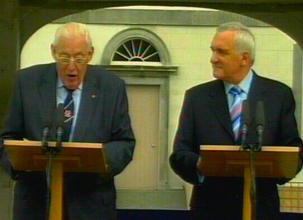
Ahern and Paisley discuss political and economic developments in Northern Ireland and increasing cross-Border co-operation. The Taoiseach says he is honoured to visit the north Antrim heartland of the Democratic Unionist Party (DUP) leader.
“I do not believe even a year back it could have been envisaged we would have been together here,” Ahern says. “It is an honour to be here with the First Minister to talk about progress.”
Paisley jokes that Ahern and his entourage had held a prayer meeting in their helicopter hoping that they would not be pelted with snowballs by him, a reference to his famous protest when former Taoiseach Seán Lemass visited Stormont in 1965.
When asked about welcoming the Fianna Fáil leader to his constituency Paisley quips, “What I am saying is he is in under my control. This is a good day for work. It is a good day for our province. It is a good day for the whole of Ireland because we need help from outside. We cannot live on our own.”
Ahern and Paisley meet again the following week at the Dublin Chamber of Commerce AGM dinner where Paisley has been invited to be a guest speaker.
The engagement is the latest visit to the Republic by the DUP leader since the Assembly was restored in Stormont the previous May. The Taoiseach invites Paisley to the historic Battle of the Boyne battle site in County Louth in July where the DUP leader presents a 17th-century musket to Ahern.
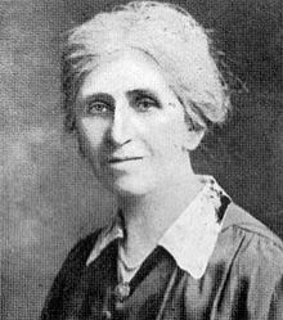
Knowles’ early interest in botany is encouraged by her father, William James Knowles, himself an amateur scientist who takes Matilda and her sister to meetings of the Belfast Naturalists’ Field Club. This is where she first meets Robert Lloyd Praeger who continues to be a lifelong influence. In 1895 she is introduced to the Derry botanist Mary Leebody and together they work on a supplement to Samuel Alexander Stewart‘s and Thomas Hughes Corey‘s 1888 book the Flora of the North-east of Ireland.
Knowles then volunteers to help with the crowdsourcing of material about the plants of County Tyrone. While completing this work Knowles publishes her own first paper about Tyrone’s flowering plants in 1897. She eventually sends in over 500 examples that are considered for inclusion in the Irish Topographical Botany, which Praeger publishes in 1901.
In 1902, after attending the Royal College of Science for Ireland for a year, Knowles is appointed a temporary assistant in the then Botanical Section of the National Science and Art Museum. She works closely with Professor Thomas Johnson to continue the development of the Herbarium collection. She also co-authors with him the Hand List of Irish Flowering Plants and Ferns (1910).
One of Knowles’ first works is The Maritime and Marine Lichens of Howth, which the Royal Dublin Society publishes in 1913. Knowles had gathered the knowledge and experience to do this while diligently assisting with a survey of Clare Island as suggested by Praeger. This novel survey involves not only Irish but also several European scientists including prominent UK lichenologist, Annie Lorrain Smith. This is claimed as the most extensive piece of field work at the time. As a result, Knowles is able to create a foundation for her later specialism in lichens.
Knowles publishes more than thirty scientific papers on a wide range of botanical subjects between 1897 and 1933. It is while studying the lichens of Howth that she discovers how lichens by the shore grow in distinct tidal zones that can be distinguished by their colour: black, orange and grey.
Her major work is The Lichens of Ireland which adds over 100 species of lichen to the Irish List and records the distribution of the eight hundred species identified in Ireland. She achieves this task with the collaboration of thirty other natural scientists. It is published in 1929 and includes twenty lichens that had previously not been identified as Irish.
Professor Thomas Johnson retires in 1923, allowing Knowles to take over curatorship, working with Margaret Buchanan. As she becomes older Knowles’ hearing begins to fail such that she has to rely on an ear trumpet. Despite her deafness she still attends meetings. She cares for and adds to the National Museum Herbarium collection although never gets the credit she deserves. In 1933 she plans to retire but pneumonia ends her life before she ends her career. Knowles dies in Dublin on April 27, 1933.
Knowles is honoured with a commemorative plaque by the Irish National Committee for Science and Engineering in October 2014 to mark the 150th anniversary of her birth.
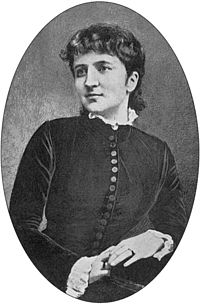
Katharine O’Shea (née Wood), English woman of aristocratic background, whose decade-long secret adultery with Charles Stewart Parnell leads to a widely publicized divorce in 1890 and his political downfall, is born in Braintree, Essex on January 30, 1846.
Katharine marries Captain William O’Shea in 1867, a Catholic Nationalist MP for Clare from whom she separates around 1875. She first meets Parnell in 1880 and begins a relationship with him. Three of her children are fathered by Parnell. Although Captain O’Shea keeps publicly quiet for several years, he is aware of the relationship. He challenges Parnell to a duel in 1881 and initially forbids his estranged wife to see him, although she says that he encouraged her in the relationship. Although their relationship is a subject of gossip in London political circles from 1881, later public knowledge of the affair in an England governed by “Victorian morality” with a “nonconformist conscience” creates a huge scandal, as adultery is prohibited by the Ten Commandments.
Out of her family connection to the Liberal Party, Katharine acts as liaison between Parnell and Gladstone during negotiations prior to the introduction of the First Irish Home Rule Bill in April 1886. Parnell moves to her home in Eltham, close to the London-Kent border, that summer.
Captain O’Shea files for divorce in 1889 and his reasons are a matter for speculation. Some say he may have political motives. Alternatively, it is claimed that he has been hoping for an inheritance from Katharine’s rich aunt whom he had expected to die earlier, but when she dies in 1889 her money is left in trust to cousins. After the divorce the court awards custody of Katharine O’Shea and C.S. Parnell’s two surviving daughters to her ex-husband.
Katharine’s November divorce proceedings from Captain O’Shea, in which Parnell is named as co-respondent, leads to Parnell’s being deserted by a majority of his own Irish Parliamentary Party and to his downfall as its leader in December 1890. Catholic Ireland feels a profound sense of shock when Katharine breaks the vows of her previous Catholic marriage by marrying Parnell on June 25, 1891. With his political life and his health essentially ruined, Parnell dies at the age of 45 in Hove on October 6, 1891 in her arms, less than four months after their marriage. The cause is stomach cancer, possibly complicated by coronary artery disease inherited from his grandfather and father, who also died prematurely.
Though to her friends Katharine is known as Katie O’Shea, Parnell’s enemies, in order to damage him personally, call her “Kitty O’Shea” because at that time “kitty,” as well as being an Hiberno-English version of Catherine/Katherine/Katharine, is also a slang term for a prostitute. She lives the rest of her life in relative obscurity. She dies on February 5, 1921, at the age of 75, and is buried in Littlehampton, Sussex, England, apparently never once setting foot on Irish soil.
Captain Henry Harrison, MP, who had acted as Parnell’s bodyguard and aide-de-camp, devotes himself after Parnell’s death to the service of his widow. From her he hears a completely different version of the events surrounding the divorce issue from that which had appeared in the press, and this is to form the seed of his later two books defending Parnell published in 1931 and 1938. They have a major impact on Irish historiography, leading to a more favourable view of Parnell’s role in the O’Shea affair.
At least seven bombs explode in Central London on January 29, 1977. One person is injured. The Irish Republican Army (IRA) later claims responsibility.
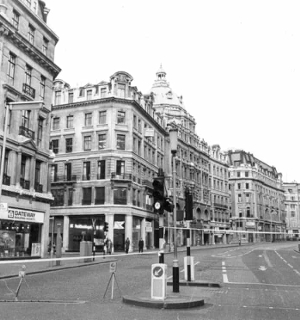
Hundreds of police seal off the Oxford Street area as Selfridges department store is set ablaze and one man is injured. The explosions occur over a two-mile area within 50 minutes. The bombs wreck buildings in Oxford Street, Regent Street, and Wardour Street, causing hundreds of thousands of pounds worth of damage and burying a taxi under the rubble, injuring the driver. Another man is trapped in a basement in Selfridges after the blast.
The attacks come less than 72 hours before the IRA commemoration of the Bloody Sunday massacre in Londonderry and, according to the police, bear all the hallmarks of the IRA. The bombs, left in doorways of shops and offices, are similar to those used in firebomb attacks on the centre of Belfast and Londonderry over the previous four years.
Hundreds of police are drafted into the Oxford Street area within minutes of the first blast, shortly after midnight. Police using sniffer dogs examine hundreds of cars stretched along Oxford Street and residents are warned to evacuate by police and fire officers using bullhorns. Dozens of fire engines respond to the resulting blaze in the huge department store.
A two-mile area around Oxford Street is cordoned off by police roadblocks shortly after the first explosions. Scotland Yard and the Fire Brigade are unable to keep pace with the bombs and fires as news reports flood in.
The first explosions occur in Wardour Street where two bombs blow out the front of a publishing office and a travel agency, hurling glass and furniture into the street. Within 20 minutes, three other bombs explode in Oxford Street, Regent Street, Poland Street and in the side-streets of Soho. The fire brigade simultaneously fights two major fires within a mile of each other, in Selfridges and in a building in Berwick Street, Soho. Debris from the bombs is littered around as bomb squad officers and police patrols begin examining all suspicious cars and packages in the area. Several bomb squad officers are standing within yards of a building when the fourth bomb, fortunately a small one, goes off.
The Assistant Commissioner for Crime, Jock Wilson, joins Bomb Squad officers in a special mobile control unit. A senior police officer says that many of the bombs are crammed through letterboxes in the business premises. However, the bomb at Selfridges is placed in the basement, police believe, on previous afternoon.
(Pictured: Police cordon off Regent Street following IRA bombs in the West End, London, January 1977. Photograph: ANL/REX/Shutterstock)
Brennan moves to Melbourne, Australia in 1861 with his parents. He starts his career as a watchmaker and a few years later is articled to Alexander Kennedy Smith, a renowned civil and mechanical engineer of the period. He serves as a sergeant in the Victorian Engineers under the command of Captain John James Clark. He invents the idea of a steerable torpedo in 1874, from observing that if a thread is pulled on a reel at an angle with suitable leverage, the reel will move away from the thread side. He spends some years working out his invention and receives a grant of £700 from the Victorian government towards his expenses. He patents the Brennan torpedo in 1877. The idea is trialed at Camden Fort near Crosshaven, County Cork.
Brennan goes to England in 1880 and brings his invention before the War Office. Sir Andrew Clarke alerts the authorities to the possibilities of the torpedo if used in the defence of harbours and channels, and the patent is eventually bought for a sum believed to be more than £100,000 (£ 9,331,100 in 2019). In 1887 he is appointed superintendent of the Brennan torpedo factory and is consulting engineer from 1896 to 1907.
Brennan does much work on a gyro monorail locomotive which is kept upright by a gyrostat. In 1903 he patents a gyroscopically balanced monorail system that he designs for military use. He successfully demonstrates the system on November 10, 1909, at Gillingham, England, but fears that the gyroscopes might fail prevents adoption of the system for widespread use.
From 1916 to 1919 Brennan serves in the munition invention department. From 1919 to 1926 he is engaged by the air ministry in aircraft research work at the Royal Aircraft Establishment, Farnborough, and gives much time to the invention of a helicopter. The government spends a large sum of money on it, but in 1926 the air ministry gives up working on it, much to Brennan’s disappointment.
Brennan marries Anna Quinn on 10 September 10, 1892. The marriage results in a son and a daughter. He is created a Companion of the Order of the Bath in 1892 and is foundation member of the National Academy of Ireland in 1922.
In January 1932 Brennan is knocked down by a car at Montreux, Switzerland, and dies on January 17, 1932. He is buried at St. Mary’s Catholic Cemetery, Kensal Green, London, in an unmarked plot numbered 2454 that is opposite the Chapel record office. On March 11, 2014, TaoiseachEnda Kenny unveils a new gravestone for Brennan at St. Mary’s in a ceremony honouring the inventor’s life and career.
Gillingham Library retains the archive of his papers.
Although Maguire from a young age earns her living as a secretary, she also is from her youth a member of the Legion of Mary, a lay Catholic welfare organization, and through it she becomes deeply involved in voluntary social work among children and teenagers in various Catholic neighbourhoods of Belfast. She is stirred to act against the growing violence in Northern Ireland after witnessing in August 1976 an incident in which a car being driven by an Irish Republican Army (IRA) terrorist goes out of control when the IRA man is shot by British troops. The car strikes and kills three children of Maguire’s sister.
Within days each woman publicly denounces the violence and calls for mass opposition to it. Marches of Catholic and Protestant women, numbering in the thousands, are organized, and shortly afterward the Peace People is founded based on the conviction that genuine reconciliation and prevention of future violence are possible, primarily through the integration of schools, residential areas, and athletic clubs. The organization publishes a biweekly paper, Peace by Peace, and provides a bus service to and from Belfast’s jails for families of prisoners.
In October 2012, Maguire travels to New York City to serve on the Russell Tribunal on Israel/Palestine alongside writer Alice Walker, activist Angela Davis, former Congresswoman Cynthia McKinney, and Pink Floyd’s Roger Waters. The Russell Tribunal’s findings and conclusions challenge governments and civil society to have courage and act by implementing sanctions, thereby refusing to be silent and complicit in the face of Israel ’s violation of International Laws.
In March 2018, Maguire and two Nobel peace laureates, Shirin Ebadi and Tawakkol Karman, visit rohingya camps in Cox’s Bazar and share opinion on the crisis. After returning to Dhaka, they discuss the Rohingya crisis with members of the civil society of Bangladesh.
Maguire is a proponent of the belief that violence is a disease that humans develop but are not born with. She believes humankind is moving away from a mindset of violence and war and evolving to a higher consciousness of nonviolence and love. Among the figures she considers spiritual prophets in this regard are Jesus, Francis of Assisi, Mahatma Gandhi, Abdul Ghaffār Khān, Fr. John L. McKenzie, and Martin Luther King, Jr. She professes to reject violence in all its forms.
Du Cros is the third of seven sons of Harvey du Cros. He is brought up in modest circumstances. His father, later a well-known manufacturer, is at the time only a bookkeeper with an income of £170 a year. He attends a national school in Dublin and then enters the civil service at the lowest grade. In 1892 he joins the Pneumatic Tyre and Booth’s Cycle Agency Ltd, of which his father is now the chairman, and is made a joint managing director in 1896 when it is floated as a public company.
In 1895 du Cros marries Maude Gooding, the daughter of a Coventry watch manufacturer. They have two sons and two daughters before a divorce in 1923.
In 1901 du Cros founds the Dunlop Rubber Company, converting 400 acres of land in Birmingham to produce and manufacture tires, with the area henceforth being known as Fort Dunlop. The firm eventually diversifies into making other rubber products as well as tires, and du Cros selects plantations in Malaya and Sri Lanka for the company, which by 1917 owns 60,000 acres of rubber-producing land.
In 1906 du Cros enters politics, unsuccessfully contesting the seat of Bow & Bromley as a Conservative Party candidate, a seat his brother is elected to in 1910. In 1908 he is elected Member of Parliament for Hastings, a position his father had held immediately before.
In 1909 du Cros forms, and is director of, the Parliamentary Aerial Defence Committee to ensure funding for military aeronautical development, of which he is a strong proponent. During World War I he works for the Ministry of Munitions on an honorary basis, buying two motorised ambulance convoys out of his own money and helping raise an infantry battalion, being a former captain of the Royal Warwickshires and for some years being the honorary colonel of the 8th battalion of the Royal Warwickshire Regiment. In 1916 he is created a baronet. He continues to represent Hastings until 1918, when he is elected as a Member of Parliament for Clapham, a position he resigns four years later.
His later career is awash with financial impropriety. He finds it difficult to distinguish between personal and company assets, using company funds to sponsor family investments and appointing family members to senior position with no regard for merit. He also participates in financial manipulation, being a close associate of James White, a financial expert who specialises in share rigging and whose actions leave Dunlop, had already lost influence within the company, close to collapse in 1921. He is quietly removed after the 1921 crash.


 seamus dubhghaill