The party demands for Ireland “one and indivisible as of right the full status of a sovereign State. We aim at restoring the unity of her territory and the union of all her people under one central supreme government.” The party advocates the abolition of the Oath of Allegiance to the British King. It also calls for lower taxes and less legislation. In policies like trade protectionism and the abolition of the Oath of Allegiance, it agrees with the agenda of Sinn Féin leader Éamon de Valera. An attempt to lure de Valera and his followers into the party fail. After de Valera creates the Fianna Fáil party in March 1926, Clann Éireann grows closer to that group.
The party attracts little support, and it fails to win any seats in Dáil Éireann at the June 1927 general election. Its seven candidates only attract a few thousand first-preference votes. Seven of them are last in their constituencies and forfeit their deposits. On August 28, 1927, the party issues a statement supporting Fianna Fáil, and ceases political activity.
(Pictured: (L to R) Pádraic Ó Máille, William Magennis, Maurice George Moore who are amongst the most prominent members of the party)
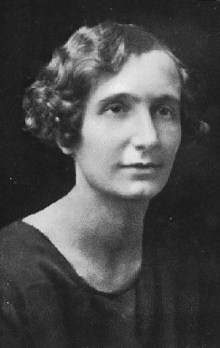
Geraldine Dorothy Cummins, spiritualist medium, novelist and playwright, is born in Cork, County Cork, on January 24, 1890. She began her career as a creative writer, but increasingly concentrates on mediumship and “channelled” writings, mostly about the lives of Jesus and Saint Paul, though she also publishes on a range of other topics. Her novels and plays typically document Irish life in a naturalist manner, often exploring the pathos of everyday life.
Cummins is the daughter of the physician Ashley Cummins, professor of medicine at the National University of Ireland and sister to Mary Hearn and Iris Cummins. In her youth she is an athlete, becoming a member of the Irish Women’s International Hockey Team. She is also active as a suffragette. Her desire to follow her father in a medical career is vetoed by her mother, so she begins a literary career as a journalist and creative writer. From 1913 to 1917 she writes three plays for the Abbey Theatre in collaboration with Suzanne R. Day, the most successful of which is the comedy Fox and Geese (1917). She publishes the novel The Land they Loved in 1919, a naturalistic study of working class Irish life.
As she concentrates on mediumship, Cummins’s literary work tails off. However, she continues to publish creative literature in her later years. Her solo-written play, Till Yesterday Comes Again, is produced by the Chanticleer Theatre, London, in 1938. She also publishes another novel, Fires of Beltane (1936) and a short-story collection Variety Show (1959).
Literary critic Alexander G. Gonzalez says that Cummins work tries to encompass the full range of Irish social life, from the aristocracy to the lower classes. In this respect she is influenced by Somerville and Ross. Gonzalez considers her short story The Tragedy of Eight Pence to be the “finest” of her writings, the tale of a “happily married woman trying to shield her ill husband from the knowledge that his death will leave her penniless.”
Cummins begins to work as a medium following prompting from Hester Dowden and E. B. Gibbes. She receives alleged messages from her spirit-guide “Astor” and is an exponent of automatic writing. Her books are based on these communications. In 1928 she publishes The Scripts of Cleophas, which provides channelled material on early Christian history complementing Acts of the Apostles and St. Paul’s writings, supposed to have been communicated by the spirit of Cleophas, one of Paul’s followers. This is later supplemented by Paul in Athens (1930) and The Great Days of Ephesus (1933).
Cummins’s next work describes human progress through spiritual enlightenment. The Road to Immortality (1932) provides a glowing vision of the afterlife. Its contents are purportedly communicated from the “other side” by the psychologist and psychic researcher Frederic W. H. Myers. Unseen Adventures (1951) is a spiritual autobiography. She also publishes several books of spiritually-derived knowledge about details of the life of Jesus.
During World War II Cummins allegedly works as a British agent, using her personal contacts to identify pro-Nazi factions within the Irish Republican movement. She also employs her psychic activities to support the Allied cause, sending channelled messages from sympathetic spirits to Allied leaders to support the war effort. This includes information from Theodore Roosevelt, Arthur Balfour and Sara Roosevelt, Franklin D. Roosevelt‘s mother.
In the 1940s and 50s Cummins works with psychiatrists to develop a model for using spiritualism to treat mental illness, ideas she explores in Perceptive Healing (1945) and Healing the Mind (1957). She collaborates with a psychiatrist who uses the pseudonym R. Connell on both books. Their method is for her to “read” an object associated with the patient and thus identify either childhood traumas or experiences of ancestors which have created the problem. This includes treating a patient who is concerned about his homosexual desires by discovering that this derives from the fact that his Huguenot ancestors were humiliated by Catholics in the 18th century.
Cummins’s biography of writer and spiritualist Edith Somerville is published in 1952. She also writes The Fate of Colonel Fawcett (1955) which offers her psychic insights into the disappearance of the explorer Percy Fawcett in Brazil in 1925. She claims she had received psychic messages from Fawcett in 1936. He was still alive at that time, informing her that he had found relics of Atlantis in the jungle, but was ill. In 1948 she has a message from Fawcett’s spirit reporting his death. Her last book is an account of her conversations with the spirit of Winifred Coombe Tennant, Swan on a Black Sea; a Study in Automatic Writing; the Cummins-Willett Scripts (1965).
The automatic writing and alleged channeled material from Cummins have been examined and have been described by some psychical researchers to be the product of her own subconscious. For example, Harry Price, who studies various mental mediums including Cummins, writes that “there is no question that most of the automatic writing which has been published is the product of the subconscious.” Paranormal researcher Hilary Evans notes that unlike most spiritualists, Cummins does not accept the phenomena at face value and questions the source of the material.
According to the psychical researcher Eric Dingwall information published in Cummins’ scripts allegedly from Winifred Coombe Tennant are discovered to be erroneous. Biographer Rodger Anderson writes that although spiritualists consider Cummins completely honest “some suspected that she occasionally augmented her store of knowledge about deceased persons by normal means if by doing so she could bring comfort to the bereaved.”
Cummins’ book The Fate of Colonel Fawcett (1955), contains her automatist scripts allegedly from the spirit of Colonel Fawcett. Spiritualists claim the scripts are evidence for survival. However, the psychical researcher Simeon Edmunds notes that before his disappearance Fawcett had written articles for The Occult Review. Cummins also contributes articles to the same review and Edmunds suggests it is likely she had read the work of Fawcett. Edmunds concludes the scripts are a case of subliminal memory and unconscious dramatization.
Other researchers such as Mary Rose Barrington have suspected fraud as Cummins had long standing connections with friends and families of the deceased that she claimed to have contacted and could have easily obtained information by natural means. The classical scholar E. R. Dodds writes that Cummins worked as a cataloguer at the National Library of Ireland and could have taken information from various books that would appear in her automatic writings about ancient history. Her writings were heavily influenced by literature and religious texts. Dodds also studies her book Swan on a Black Sea which was supposed to be an account of spirit conversation but writes there is evidence suggestive of fraud as Cummins had received some of the information by natural means.
In 1940, Kerins is sworn into the IRA and is appointed to the GHQ staff in May 1942. At the time, the Fianna Fáil government of Éamon de Valera is determined to preserve Irish neutrality during World War II. Therefore, the IRA’s bombing campaign in England, its attacks against targets in Northern Ireland, and its ties to the intelligence services of Nazi Germany are regarded as severe threats to Ireland’s national security. IRA men who are captured by the Gardaí are interned for the duration of the war by the Irish Army in the Curragh Camp in County Kildare.
On the morning of September 9, 1942, Garda Detective Sergeant Denis O’Brien is leaving his home in Ballyboden, Dublin. He is between his front gate and his car when he is cut down with Thompson submachine guns. O’Brien, an Anti-Treaty veteran of the Irish Civil War, had enlisted in the Garda Síochána in 1933. He is one of the most effective Detectives of the Special Branch division, which has its headquarters at Dublin Castle. The shooting greatly increases public feeling against the IRA, particularly as the murder is carried out in full view of his wife.
Following the arrest of Hugh McAteer in October 1942, Kerins is named Chief of Staff of the IRA. Despite a massive manhunt by Gardaí, he remains at large for two years. He stays at a County Waterford home for two weeks while he is on the run, having given his name as Pat Carney. He is captured several months after he leaves the home.
Kerins had previously left papers and guns hidden at Kathleen Farrell’s house in the Dublin suburb of Rathmines. He telephones the house, as he intends to retrieve them. However, Farrell’s telephone had been tapped by the Gardaí. On June 15, 1944, he is arrested in an early morning raid. He is sleeping when the Gardaí enter his bedroom and does not have an opportunity to reach the Thompson submachine gun which is hidden under his bed.
At a trial before the Special Criminal Court in Collins Barracks, Dublin, Kerins is formally charged on October 2, 1944, for the “shooting at Rathfarnham of Detective Dinny O’Brien.” At the end of his trial, the president of the Military Court delays sentence until later in the day to allow Kerins, if he wishes, to make an application whereby he might avoid a capital sentence. When the court resumes, he says, “You could have adjourned it for six years as far as I am concerned, as my attitude towards this Court will always be the same.” He thus deprives himself of the right to give evidence, to face cross-examination, or to call witnesses.
Kerins is the last IRA member to be executed in the Republic of Ireland. He is buried in the prison yard. In September 1948, his remains are exhumed and released to his family. He is buried in the Republican plot at Rath Cemetery, Tralee, County Kerry.
Godley is the eldest son of Rev. James Godley, rector of Carrigallen, County Leitrim, and Eliza Frances Godley (née La Touche). After attending Tilney Basset’s preparatory school in Dublin, he goes to Harrow College and Balliol College, Oxford, graduating BA in 1878. At Oxford he becomes known for his classical scholarship and wins several prizes, including the Craven scholarship and the Gaisford Prize for Greek Verse. In 1879 he is appointed assistant classical master at Bradfield College. He returns to Oxford in 1883 as tutor and fellow of Magdalen College (1883–1912). Serving as deputy public orator of Oxford (1904–06), he is elected public orator in 1910, a post he holds until his death.
Godley also enjoys renown as a writer of satiric verse and prose, beginning his literary career as a contributor to The Oxford Magazine in 1883. In 1890 he becomes its editor, and two years later publishes his first book of poems, Verses to Order (1892). Later publications include Lyra Frivola (1899), Second Strings (1902) and The Casual Ward (1912). His work is very popular and two volumes, Reliquiae (1926) and Fifty Poems (1927), are published posthumously. He also publishes numerous works of serious scholarship including Socrates and Athenian Society in His Day (1896) and Oxford in the Eighteenth Century (1908). Noted as a translator of Herodotus, Tacitus, and Horace, he serves as joint-editor of The Classical Review (1910–20). He also edits and publishes volumes of the poetry of Thomas Moore and Winthrop Mackworth Praed.
Active in political life, Godley serves as an alderman on Oxford City Council. During the Second Boer War (1899–1901) he organises volunteer forces, commanding a battalion of the 4th Oxfordshire Light Infantry (1900–05). He serves in this capacity again during World War I and is lieutenant-colonel of the Oxfordshire Volunteer Corps (1916–19). A staunch unionist, during the Home Rule Crisis, he supports the formation of the Ulster Volunteer Force (UVF) and writes some political verse, notably The Arrest, which is popular among unionists. A pioneer in the sport of mountaineering, he is a founding member of the Alpine Club and a committee member (1908–11). He is also a member of the governing body of Harrow School. Towards the end of his career he is awarded honorary doctorates from Princeton (1913) and Oxford (1919).
In 1925 Godley goes on a tour of the Levant and contracts a fever which ultimately leads to his death on June 27, 1925, at his Oxford home, 27 Norham Road. He is buried at Wolvercote Cemetery.
Moore is born in Moore Hall, near Lough Carra, County Mayo on February 24, 1852. He comes from a distinguished Catholic family of Irish landholders. When he is 21, he leaves Ireland for Paris to become a painter. His Reminiscences of the Impressionist Painters (1906) vividly describes the Café Nouvelle-Athènes and the circle of Impressionist painters who frequent it. He is particularly friendly with Édouard Manet, who sketches three portraits of him. Another account of the years in Paris, in which he introduces the younger generation in England to his version of fin de siècle decadence, is his first autobiography, Confessions of a Young Man (1888).
Deciding that he has no talent for painting, Moore returns to London in 1882 to write. His first novels, A Modern Lover (1883) and A Mummer’s Wife (1885), introduce a new note of French Naturalism into the English scene, and he later adopts the realistic techniques of Gustave Flaubert and Honoré de Balzac. Esther Waters (1894), his best novel, deals with the plight of a servant girl who has a baby out of wedlock. It is a story of hardship and humiliation illumined by the novelist’s compassion. It is an immediate success, and he follows it with works in a similar vein: Evelyn Innes (1898) and Sister Teresa (1901).
In 1901 Moore moves to Dublin, partly because of his loathing for the South African War and partly because of the Irish Literary Revival spearheaded by his friend, the poet William Butler Yeats. In Dublin he contributes notably to the planning of the Abbey Theatre. He also produces The Untilled Field (1903), a volume of fine short stories reminiscent of Ivan Turgenev’s writing that focuses on the drudgery of Irish rural life, and a short poetic novel, The Lake (1905). The real fruits of his life in Ireland, however, come with the trilogy Hail and Farewell (Ave, 1911; Salve, 1912; Vale, 1914). Discursive, affectionate, and satirical by turns, it reads like a sustained monologue that is both a carefully studied piece of self-revelation and an acute, though not always reliable, portrait gallery of his Irish acquaintance, which included Yeats, George William Russell, and Lady Gregory. Above all it is a perfectly modulated display of the comic spirit.
The increasing narrowness of the Irish mind, politics, and clericalism sends Moore back to England in 1911. After Hail and Farewell, he makes another literary departure. Aiming at epic effect he produces The Brook Kerith (1916), an elaborate and stylish retelling of the Gospel story that is surprisingly effective despite some dull patches. He continues his attempts to find a prose style worthy of epic theme in Héloïse and Abélard (1921). His other works include A Story-Teller’s Holiday (1918), a blend of autobiography, anecdote, Irish legend, and satire, Conversations in Ebury Street (1924), autobiography, The Pastoral Loves of Daphnis and Chloe (1924) and Ulick and Soracha (1926), an Irish legendary romance.
George Moore dies at his home at Ebury Street in the London district of Belgravia on January 21, 1933, leaving a fortune of £70,000. He is cremated in London at a service attended by Ramsay MacDonald among others. An urn containing his ashes is interred on Castle Island in Lough Carra in view of the ruins of Moore Hall, which had been burned by anti-treaty forces in 1923, during the final months of the Irish Civil War.
O’Malley is born in Callan, County Kilkenny, on September 25, 1913. He is a self-taught artist, having drawn and painted for pleasure from childhood. He works as a bank officìal until contracting tuberculosis in the 1940s. He begins painting in earnest while convalescing and, though he does at first return to bank work, he continues to paint and in 1951 he begins exhibiting his work.
In 1955 O’Malley holidays in St. Ives, Cornwall, England, then an important center of abstract art, and home to the artists Peter Lanyon, Patrick Heron, and Bryan Wynter, who he meets and works with. He returns again in 1957 and in 1958 retires from the bank to paint full-time. Prompted by a mixture of frustration at the indifference shown in Ireland to his work, an attraction to the sense of freedom he feels among the artists in Cornwall, and an engagement with the attempt to represent natural forms current in their abstraction, he settles in St. Ives in 1960. While he is strongly influenced by the St. Ives artistic community, his relationship is one of engagement rather than direct participation. His painting never completely assimilates the rigour and formality of the British abstract painters. It retains a muscular extravagance which is central to his artistic identity. O’Malley explains:
“Not so much abstract as essence. I could not paint for the sake of the pigment of whatever, but I like abstract form in the painting which instills it with meaning and power. Abstraction does enable you to get under the surface, to get beyond appearance, and to express the mind. But abstraction for its own sake does not interest me.”
O’Malley adopts a sombre palette in the second half of the 1960s and many of his paintings are dedicated to the memory of his friend and mentor, Peter Lanyon, who is killed when the glider he is piloting crashes in 1964.
In 1973 O’Malley marries Jane Harris, and through the mid-70s they spend time in the Bahamas and in O’Malley’s native Callan. During this period, his paintings become less sombre and the Bahamas paintings are extremely colourful and vibrant. In 1990 they move back to Ireland. In 1993 he is elected a Saoi of Aosdána.
O’Malley dies at his home in Physicianstown, County Kilkenny, on January 20, 2003. At the time he is regarded as one of Ireland’s leading painters.
The Irish Museum of Modern Art (IMMA) displays a major retrospective of his work in 2005, a selection from which is exhibited at the Tate St. Ives in 2006. The Butler Gallery, Kilkenny, stages posthumous exhibitions of his visual diaries in 2005, and his constructions in 2010.
In 2010 under the guidance of Jane O’Malley the Royal Hibernian Academy (RHA) establishes an artist’s residency in the house where O’Malley grew up in Callan, County Kilkenny. The studio residency is awarded to artists who work primarily in paint. Previous recipients of the Tony O’Malley Studio Residency Award include Magnhild Opdøl, Ciaran Murphy, Ramon Kassan, Mollie Douthit, David Quinn and Paraic Leahy.
Wolfe is the eighth of nine sons born to John Wolfe (1700–60) and his wife Mary (d. 1763), the only child and heiress of William Philpot, a successful merchant at Dublin. One of his brothers, Peter, is the High Sheriff of Kildare, and his first cousin Theobald is the father of the poet Charles Wolfe.
Wolfe is educated at Trinity College Dublin, where he is elected a Scholar, and at the Middle Temple in London. He is called to the Irish Bar in 1766. In 1769, he marries Anne Ruxton (1745–1804) and, after building up a successful practice, takes silk in 1778. He and Anne have four children, John, Arthur, Mariana and Elizabeth.
Appointed Attorney-General for Ireland in 1789, Wolfe is known for his strict adherence to the forms of law, and his opposition to the arbitrary measures taken by the authorities, despite his own position in the Protestant Ascendancy. He unsuccessfully prosecutes William Drennan in 1792. In 1795, Lord Fitzwilliam, the new Lord Lieutenant of Ireland, intends to remove him from his place as Attorney-General to make way for George Ponsonby. In compensation, Wolfe’s wife is created Baroness Kilwarden on September 30, 1795. However, the recall of Fitzwilliam enables Wolfe to retain his office.
After the Irish Rebellion of 1798, Wolfe becomes notable for twice issuing writs of habeas corpus on behalf of Wolfe Tone, then held in military custody, but these are ignored by the army and forestalled by Tone’s suicide in prison. In 1795 he had also warned Tone and some of his associates to leave Ireland to avoid prosecution. Tone’s godfather, Theobald Wolfe of Blackhall (the father of Charles Wolfe), is Wolfe’s first cousin, and Tone may have been Theobald’s natural son. These attempts to help a political opponent are unique at the time.
In 1802 Wolfe presides over the case against Town Major Henry Charles Sirr in which the habitual abuses of power used to suppress rebellion are exposed in court.
In the same year Wolfe orders that the well-known Catholic priest Father William Gahan be imprisoned for contempt of court. In a case over the disputed will of Gahan’s friend John Butler, 12th Baron Dunboyne, the priest refuses to answer certain questions on the ground that to do so would violate the seal of the confessional, despite a ruling that the common law does not recognize the seal of the confessional as a ground for refusing to give evidence. The judge apparently feels some sympathy for Gahan’s predicament, as he is released from prison after only a few days.
During the Irish rebellion of 1803, Wolfe, who had never been forgiven by the United Irishmen for the execution of William Orr, is clearly in great danger. On the night of July 23, 1803, the approach of the Kildare rebels induces him to leave his residence, Newlands House, in the suburbs of Dublin, with his daughter Elizabeth and his nephew, Rev. Richard Wolfe. Believing that he will be safer among the crowd, he orders his driver to proceed by way of Thomas Street in the city centre. However, the street is occupied by Robert Emmet‘s rebels. Unwisely, when challenged, he gives his name and office, and he is rapidly dragged from his carriage and stabbed repeatedly with pikes. His nephew is murdered in a similar fashion, while Elizabeth is allowed to escape to Dublin Castle, where she raises the alarm. When the rebels are suppressed, Wolfe is found to be still alive and is carried to a watch-house, where he dies shortly thereafter. His last words, spoken in reply to a soldier who called for the death of his murderers, are “Murder must be punished; but let no man suffer for my death, but on a fair trial, and by the laws of his country.”
Wolfe is succeeded by his eldest son John Wolfe, 2nd Viscount Kilwarden. Neither John nor his younger brother Arthur, who dies in 1805, have male issue, and on John’s death in 1830 the title becomes extinct.
(Pictured: Portrait of Lord Chief Justice of Ireland, Arthur Wolfe (later Viscount Kilwarden) by Hugh Douglas Hamilton, between 1797 and 1800, Gallery of the Masters)
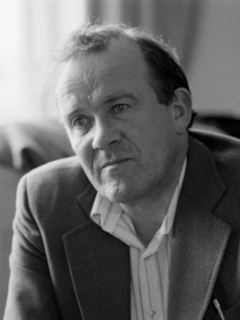
Ó hEithir’s parents are national school teachers, Pádraic Ó hEithir and Delia Ní Fhlaithearta. He is a nephew of Aran Islands authors Liam Ó Flaithearta and Tom Maidhc Ó Flaithearta, the brothers of his mother. He attends the Kilronan national school where his parents teach. He receives his secondary school education at Coláiste Éinde (St. Enda’s College), Galway. He attends University College Galway for three years, finishing his university course in 1952 but leaves without sitting his final examinations. He writes in both Irish and English and is highly regarded for the originality and liveliness of his journalism, especially his work in Irish.
Ó hEithir marries Catherine von Hildebrand, a young student recently arrived in Dublin from Colombia, in 1957 and they have five children: Ruairí, Máirín, Brian, Aindriú, and Rónán. Catherine is born in Paris, the daughter of Deirdre Mulcahy from Sligo and Franz von Hildebrand from Munich, son of the noted philosopher and theologian Dietrich von Hildebrand.
After college, Ó hEithir spends a number of years working as an itinerant bookseller for Comhdháil Náisiúnta na Gaeilge. He serves as an editor at Sáirséal agus Dill, the Irish language publishing house, and as Irish language editor for The Irish Press from 1957 to 1963. He also writes a column for The Sunday Press. He is a regular columnist with the journal Comhar and also contributes a weekly column to The Irish Times. He also serves as a staff journalist with Raidió Teilifís Éireann (RTÉ), working on the current affairs programmes Cúrsaí and Féach.
In 1975 the Irish American Cultural Institute awards Ó hEithir a scholarship of £2,000 to allow him to devote more time to writing. The following year his first novel, Lig sinn i gcathú (1976), loosely based on his student days in Galway, becomes a best-seller. He and Catherine move to Paris in 1986, where most of his second novel, Sionnach ar mo Dhuán (1988), is written. Hopes of having produced his definitive novel are soon dashed by a series of devastating reviews.
Ó hEithir visits Colombia with his wife in the summer of 1990. On his return, he is presented with the Butler literary award of $10,000 in further recognition of his writing in Irish. A month later, after a very short illness, he dies of cancer in St. Vincent’s University Hospital in Dublin on October 26, 1990. He is survived by his wife, Catherine, daughter Máirín, and sons Ruairí, Brian, and Aindriú.
Aengus Fanning, Irish journalist and editor of the Sunday Independent from 1984 until his death, dies on January 17, 2012, following a battle with lung cancer. He is also a former editor of farming for the Irish Independent. He is listed at number 31 on a list of “most influential people” in Irish society compiled for Village magazine.
Fanning is born on April 22, 1944, in the family home at Cloonbeg Terrace, Tralee, County Kerry, the fourth child among five sons and one daughter of Arnold (‘Paddy’) Fanning, a teacher, and his wife Clara (née Connell). Originally from Rostrevor, County Down, his mother is born a Presbyterian and converts to Catholicism to marry his father, though neither is religious. His father is a noted organiser of local theatrical productions, having written a one-act play, Vigil, which is staged in the Abbey Theatre in 1929.
Fanning has a keen interest in sport, having represented Kerry in Gaelic football in his youth. He is also passionate about cricket. He also plays the clarinet and is a jazz fan. He is a graduate of University College Cork (UCC).
In May 1964 Fanning is hired as a reporter by his uncle, James Fanning, the owner of the Midland Tribune in Birr, County Offaly, and pursues an unglamorous beat covering court sittings, local authority meetings and GAA matches. Needing a better salary to start a family, he joins Independent Newspapers (IN) in Dublin as a general reporter in May 1969, and soon after marries Mary O’Brien from Streamstown, County Offaly. They settle in Dún Laoghaire, County Dublin, and have three sons.
Fanning covers the Northern Irelandtroubles during 1969–70, before reporting increasingly on farming matters, becoming the IN group’s agricultural correspondent in 1973, as Ireland’s European Economic Community (EEC) accession sparks a farming boom. He is made head of news analysis at the Irish Independent in 1982, improving the op-ed page and using it to advocate more market-driven economic policies.
Fanning is appointed editor of the mid-to-upmarket Sunday Independent in 1984 from. Under his leadership, the newspaper adopts what Irish newspaper historian John Horgan calls a “new emphasis on pungent opinion columns, gossip and fashion” which results in the paper overtaking its main rival, The Sunday Press. For a time, his deputy editor is journalist Anne Harris.
In a 1993 interview with Ivor Kenny in the book Talking to Ourselves, Fanning describes himself as a classical liberal who is opposed to both Ulster loyalist and Provisional Irish Republican Army terrorism. He also expresses a strong advocacy of the free market, arguing that the goal of a good newspaper is to be as commercially successful as possible:
“If three or four papers out of 15 are successful and the others are not, they might say they’re not driven by the market, they have some higher vocation: to serve the public interest or some pompous stuff like that. That’s how they feel good about themselves. Fair enough, if that’s how they want to explain the world. It’s a grand excuse for relative failure… I think we live or die by the market, it will always win through.”
Fanning recruits a number of noted writers to contribute to the newspaper, including historians Conor Cruise O’Brien and Ronan Fanning, journalists Shane Ross and Gene Kerrigan, poet Anthony Cronin and novelist Colm Tóibín. However, his editorship is not without controversy. The columns published by Eamon Dunphy and Terry Keane draw criticism. Michael Foley notes some Irish commentators criticised Fanning’s Sunday Independent, claiming the newspaper was publishing “a mix of sleaze and prurience.”
Fanning also defends the controversial Mary Ellen Synon, who calls the Paralympics games “perverse.” One of the more bizarre incidents occurs in 2001 when he is involved in fisticuffs with a colleague at the newspaper – operations editor Campbell Spray.
Diagnosed with lung cancer in April 2011, Fanning spends his last months undergoing treatment in St. Vincent’s University Hospital, Dublin, dying there on January 17, 2012, at the age of 69. His remains are cremated at Mount Jerome Crematorium.
Anne Harris, Fanning’s second wife, succeeds him as editor and lasts three years. As well as pioneering changes in the domestic print media’s role, Fanning’s Sunday Independent led Irish society’s turn towards free market hedonism, catching the public mood better than its more conventionally liberal rivals by rendering this cultural transformation in an exuberant, somewhat parodied form, and without regard for lingering post-Catholic inhibitions.
Elizabeth Corbet Yeats, known as Lolly, Anglo-Irisheducator and publisher, dies on January 16, 1940. She works as an art teacher and publishes several books on art and is a founder of Dun Emer Press which publishes several works by her brother, W. B. Yeats. She is the first commercial printer in Ireland to work exclusively with hand presses.
Yeats is born at 23 Fitzroy Road, London, on March 11, 1868. She is the daughter of the Irish artist John Butler Yeats and Susan Yeats (née Pollexfen). She is sister to W. B., Jack and Susan Mary “Lily” Yeats. From the age of four she lives in Merville, Sligo, at the home of her grandfather William Pollexfen. In November 1874 her family moves to 14 Edith Villas, West Kensington, London. Her governess is Martha Jowitt from 1876 until 1879 before the family moves to Bedford Park, Chiswick, in 1878.
The family moves to Eardley Crescent, South Kensington, London, in 1886. While there Yeats starts to write fiction and publishes a homemade magazine, The Pleiades, with six friends, contributing “Story without a plot” to the Christmas 1888 issue. In addition, she publishes “Scamp and three friends” in The Vegetarian.
Yeats also attends the Chiswick School of Art with her sister Susan and brother Jack Butler Yeats, learning “Freehand drawing in all its branches, practical Geometry and perspective, pottery and tile painting, design for decorative purposes.”
In the 1890s Yeats lives at 3 Blenheim Road, Bedford Park, London, and trains as a kindergarten teacher at the Froebel College in Bedford, Bedfordshire. She undertakes her teaching practice at the Bedford Park High School. In 1892, when her training is completed, she teaches as a visiting art mistress at the Froebel Society, Chiswick High School and the Central Foundation School.
Yeats earns a good income from lecturing and publication of four popular painting manuals: Brushwork (1896), Brushwork Studies of Flowers, Fruits and Animals (1898), Brushwork Copy Book (1899), and Elementary Brushwork Studies (1900).
Yeats trains and works as an art teacher and is a member of William Morris‘s circle in London before her family returns to Dublin in 1900. She writes and creates the artwork for Elementary Brush-Work Studies (1900), an educational book that teaches young children the technique of painting flowers and plants using her simple method. At the suggestion of Emery Walker, who works with Morris on the Kelmscott Press, she studies printing with the Women’s Printing Society in London.
In Dublin, Yeats accepts the invitation to join Evelyn Gleeson to form the Dun Emer Guild along with Lily, who is an embroiderer. She manages the Dun Emer Press from 1902 with a printing press acquired from a provincial newspaper. The Press is located at Runnymede, the house of Evelyn Gleeson. This is set up with the intention of training young women in bookbinding and printing as well as embroidery and weaving. In 1903 she starts printing and Dun Emer’s first book is W. B. Yeats’s In the Seven Woods (1903).
Despite being a gifted printer, the costings exceed the quality of work that Yeats produces with the result that the press is often at risk financially. Eleven books, decorated with pastels by George William Russell, appear under the Dun Emer imprint produced from a first-floor room. She has several disagreements with her brother William over his directions as literary editor. She also dislikes Evelyn Gleeson. In October 1906 she travels to New York to advertise her products but publishes Dun Emer’s last book, William’s Discoveries (1907), in late November when she returns to Dublin.
After many years of strained relations between the Yeats sisters and Evelyn Gleeson, their business relationship is finally ended. Subsequently, in 1908, Lolly and her brother William start the Cuala Press, publishing over 70 books including 48 by the poet. Yeats manages the press while her sister Lily controls the embroidery section. Cuala continues to be a family strain. Their father, John Butler Yeats, has to castigate his son William for sending overtly critical letters to his sisters about the press. However, Cuala produces magnificent books: W. B. Yeats’ The Green Helmet and Other Poems (1910) and a series of Broadsides (published 1908–15, with illustrations from Jack Yeats).
Yeats works with Cuala Press until just before her death in Dublin on January 16, 1940, after a diagnosis of high blood pressure and heart trouble.
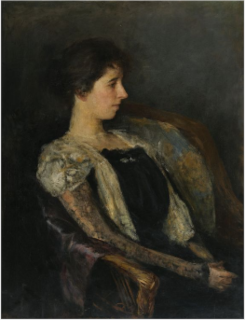
(Pictured: “Elizabeth Corbet Yeats” by Jack Butler Yeats, oil on canvas, circa 1899, National Gallery of Ireland)





 seamus dubhghaill