Holmes appears to be a stern judge, who does not suffer fools gladly and often imposes exceptionally severe sentences in criminal cases. Although the story is often thought to be apocryphal, Maurice Healy maintains that Holmes did once sentence a man of great age to 15 years in prison, and when the prisoner pleaded that he could not do 15 years, replied “Do as much of it as you can.” His judgments do however display some good humour and humanity, and the sentences he imposes often turned out to be less severe in practice than those he announces in Court.
The quality of his judgments is very high and Holmes, together with Christopher Palles and Gerald FitzGibbon, is credited with earning for the Irish Court of Appeal its reputation as perhaps the strongest tribunal in Irish legal history. His retirement, followed by that of Palles (FitzGibbon had died in 1909), causes a loss of expertise in the Court of Appeal from which its reputation never recovers. Among his more celebrated remarks is that the Irish “have too much of a sense of humour to dance around a maypole.” His judgment in The SS Gairloch remains the authoritative statement in Irish law on the circumstances in which an appellate court can overturn findings of fact made by the trial judge.
Hutchinson’s father, Harry Hutchinson, a Scottish printer whose own father had left Dublin to find work in Scotland, is Sinn Féin treasurer in Glasgow and is interned in Frongoch internment camp in 1919–21. His mother, Cathleen Sara, is born in Cowcaddens, Glasgow, of emigrant parents from County Donegal. She is a friend of Constance Markievicz. In response to a letter from Cathleen, Éamon de Valera finds work in Dublin for Harry as a clerk in the Labour Exchange, and later he holds a post in Stationery Office.
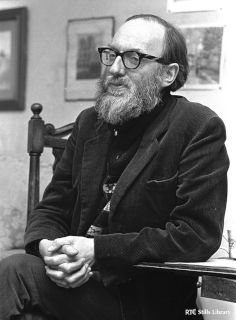
Hutchinson is five years old when the family moves to Dublin and is the last to be enrolled in St. Enda’s School before it closes. He then goes to school at Synge Street CBS where he learns Irish and Latin. One of his close friends there is the poet and literary critic John Jordan. In 1948 he attends University College Dublin (UCD) where he spends a year and a half, learning Spanish and Italian.
Having published some poems in The Bell in 1945, Hutchinson’s poetic development is greatly influenced by a 1950 holiday in Spain and Portugal. A short stop en route at Vigo brings him into contact for the first time with the culture of Galicia. Later, in Andalusia, he is entranced by the landscape and by the works of the Spanish poets Federico García Lorca, Emilio Prados and Luis Cernuda.
In 1951 Hutchinson leaves Ireland again, determined to live in Spain. Unable to get work in Madrid, as he had hoped, he travels instead to Geneva, where he gets a job as a translator with the International Labour Organization, which brings him into contact with Catalan exiles, speaking a language then largely suppressed in Spain. An invitation by a Dutch friend leads to a visit to the Netherlands, in preparation for which he teaches himself the Dutch language.
Hutchinson returns to Ireland in 1953 and becomes interested in the Irish language poetry of writers such as Piaras Feiritéar and Aonghus Fionn Ó Dálaigh and publishes a number of poems in Irish in the magazine Comhar in 1954. The same year he travels again to Spain, this time to Barcelona, where he learns the Catalan and Galician languages, and gets to know Catalan poets such as Salvador Espriu and Carles Riba. With the British poet P. J. Kavanagh, he organises a reading of Catalan poetry in the British Institute.
Hutchinson goes home to Ireland in 1957 but returns to Barcelona in 1961 and continues to support Catalan poets. An invitation by the publisher Joan Gili to translate some poems by Josep Carner leads to the publication of his first book, a collection of thirty of Carner’s poems in Catalan and English, in 1962. A project to publish his translation of Espriu’s La Pell de brau (The Bull-skin), falls through some years later. Some of the poems from this project are included in the collection Done into English.
In 1963, Hutchinson’s first collection of original poems in English, Tongue Without Hands, is published by Dolmen Press in Ireland. In 1967, having spent nearly ten years altogether in Spain, he returns to Ireland, making a living as a poet and journalist writing in both Irish and English. In 1968, a collection of poems in Irish, Faoistin Bhacach (A Lame Confession), is published. Expansions, a collection in English, follows in 1969. Friend Songs (1970) is a new collection of translations, this time of medieval poems originally written in Galician-Portuguese. In 1972 Watching the Morning Grow, a new collection of original poems in English, comes out, followed in 1975 by another, The Frost Is All Over.
In October 1971, Hutchinson takes up the Gregory Fellowship in Poetry at the University of Leeds, on the recommendation of Professor A. Norman Jeffares. There is some controversy around the appointment following accusations, later retracted, that Jeffares had been guilty of bias in the selection because of their joint Irish heritage. He holds tenure at the University for three years, and during that time contributes to the University’s influential poetry magazine Poetry & Audience.
From 1977 to 1978 Hutchinsonn compiles and presents Oró Domhnaigh, a weekly radio programme of Irish poetry, music and folklore for Ireland’s national network, RTÉ. He also contributes a weekly column on the Irish language to the station’s magazine RTÉ Guide for over ten years. A collaboration with Melita Cataldi of Old Irish lyrics into Italian is published in 1981. Another collection in English, Climbing the Light (1985), which also includes translations from Irish, Italian and Galician, is followed in 1989 by his last Irish collection, Le Cead na Gréine (By Leave of the Sun). The Soul that Kissed the Body (1990) is a selection of his Irish poems translated into English. His most recent English collection is Barnsley Main Seam (1995). His Collected Poems is published in 2002 to mark his 75th birthday. This is followed in 2003 by Done into English, a selection of many of the translated works he produced over the years.
A co-editor and founder of the literary journal Cyphers, Hutchinson receives the Butler Award for Irish writing in 1969. He is a member of Aosdána, the state-supported association of artists, from which he receives a cnuas (stipend) to allow him to continue writing. He describes this as “a miracle and a godsend” as he is fifty-four when invited to become a member and is at the end of his tether. A two-day symposium of events is held at Trinity College Dublin, to celebrate his 80th birthday in 2007, with readings from his works by writers including Macdara Woods, Eiléan Ní Chuilleanáin, Paul Durcan and Sujata Bhatt. His most recent collection, At Least for a While (2008), is shortlisted for the Poetry Now Award.
Hutchinson lives in Rathgar, Dublin, and dies of pneumonia in Dublin on January 14, 2012.
According to a study of the region, Cork is “by far the most violent county in Ireland” during the War of Independence and has several active guerrilla brigades. Of these, the 3rd Cork Brigade is one of the most effective and it is a unit from this Brigade that carries out the Upton ambush.
Up until the end of 1920, the British had been unable to move troops by train, due to a nationwide boycott by railway workers of trains carrying the British military. However, the strike is lifted in December 1920. While this helps the British military’s mobility, it also gives the IRA a new target: trains carrying soldiers. A week before the Upton ambush, the local IRA had made a successful attack on a train travelling from Killarney to Millstreet near Drishanbeg, killing one sergeant and wounding five more soldiers.
Five days after the Drishanbeg ambush, plans are made for an attack at Upton and Innishannon railway station on a train traveling between Cork city and Bandon. The ambushers, led by Charlie Hurley, are thirteen strong. Seven are armed with rifles and the remainder with revolvers or semi-automatic pistols. They take up position at the station ten minutes before the train pulls in, imprisoning the station master, clearing the station and taking cover behind sacks of grain and flour taken from a store.
The train is carrying approximately 50 British soldiers of the Essex Regiment, who are mingled with civilian passengers throughout the train’s carriages. The IRA party is therefore quite heavily outnumbered and out-gunned, but are unaware of this, as two IRA scouts, who were supposed to have been on the train and signaled to them the British numbers, never turn up. They also wrongly believe that the British troops are all in the central carriage. As a result, when the IRA opens fire on the train, there are heavy civilian casualties, including two commercial travelers killed by the first volley. The New York Times reports that “a shower of bullets was rained on the train, practically every compartment being swept.”
The firefight lasts only ten minutes, but in that time six civilian passengers are killed and ten wounded. Six British soldiers are injured, three of them seriously. Two IRA volunteers are killed outright and another is fatally wounded. Two more are badly wounded but survive. Charlie Hurley, who had led the ambush, is struck in the face by a bullet. IRA leader Tom Barry later writes, “Through some miracle, the nine unwounded and two wounded got away across country, in small parties, with the British following close behind.” Three civilian passengers, one unwounded and two wounded, are detained by the British on suspicion of belonging to the ambush party.
The Upton ambush is part of what Tom Barry describes as “twelve dark days” for the 3rd Cork Brigade of the IRA. Between February 4 and February 16, eleven members of the Brigade are killed. One is shot dead by British troops when they raid a safehouse on February 4, another dies in an accidental shooting on February 7, two more (brothers James and Timothy Coffey) are assassinated in their beds on February 14 by Black and Tans or Auxiliaries, three die at Upton on February 15 and four are killed on February 16 when they are arrested by the Essex Regiment in Kilbrittain while digging a trench and shot dead. Of the eleven dead, only those at Upton are killed in combat.
The Upton attack also highlights the dangers, and particularly the risk to civilians, of attacking trains carrying troops. Only a month later at the Headford Ambush in neighbouring County Kerry, an IRA column successfully attacks a train-load of troops, but again, there are civilian casualties alongside the IRA and British Army losses. One of the three men captured by the British at Upton is reported to give information leading to the 3rd Cork Brigade’s main column of over 100 fighters almost being encircled at the Crossbarry Ambush. Hurley is killed in this action.
The Upton ambush is later made famous in a popular 1960s Irish ballad titled “The Lonely Woods of Upton.”
(Pictured: A portion of the cover of an Italian magazine from 1921 that reported on the Upton ambush)
Rosen’s mother is Czech, while his father’s family is Austrian-Jewish. After Anschluss of Austria in 1938 they move to Bratislava, and after the Slovak version of Nuremberg Laws comes to force in September 1941, he escapes discrimination and genocide via the Danube and the sea to Israel (then Mandatory Palestine). There he works in the Shaʽar_HaGolankibbutz, manually and as an amateur chorus master, until 1945, when he returns to Bratislava.
In 1946–47 Rosen studies piano, composition and conducting at the Vienna Academy of Music with Joseph Marx and Hans Swarowsky, and continues to study conducting at the Prague Conservatory under Pavel Dědeček and Alois Klíma (1947–48). He starts his career in J. K. Tyl Theatre in Plzeň (Pilsen) as a correpetiteur, assistant conductor and chorus master (1949–52) and conductor (1953–59), participating on the production of 11 operas, 19 ballets and, as the composer of stage music, 17 dramas. In 1960 he is engaged by National Theatre in Prague, to be appointed in 1964 the chief conductor of Smetana Theatre, the National Theatre’s opera stage. He holds this position until 1971, conducting 11 ballets and 9 opera productions.
In 1965 Rosen comes to Ireland for the first time to conduct the National Symphony Orchestra (under its former name, the Radio Telefís Éireann Symphony Orchestra) at the Wexford Festival. This leads to regular appearances at the festival until 1994, conducting 18 Wexford productions, more than anyone else. In 1969 he becomes the orchestra’s chief conductor, until he becomes principal guest conductor in 1981. In 1994 he is honoured with the title Conductor Laureate of the orchestra.
In October 1978, in Dublin and Cork, Rosen conducts the National Symphony Orchestra in only the second and third performances of André Tchaikowsky‘s 2nd Piano Concerto, Op. 4, which are the first performances with the composer as soloist. He is to record the work in 1982, again with Tchaikowsky at the piano, but the composer becomes ill, and the recording is cancelled. His other work with the NSO includes standard orchestral repertoire as well as major pieces such as Olivier Messiaen‘s Turangalîla-Symphonie and Gustav Mahler‘s Symphony No. 8 (Symphony of a Thousand). In 1992, the orchestra tours ten cities in Germany, having a major success with Die Fledermaus in Stuttgart.
Cowley is born September 8, 1923, in Ardbraccan, Navan, County Meath, the third child of Patrick Cowley, a small farmer, and his wife Margaret. Educated at the local national school, he leaves at the age of thirteen to work on the family farm. He also works with a horse and cart drawing stones from a local quarry. He is an enthusiastic amateur actor and learns his trade in the fit ups of the forties and fifties. Moving to England, he gets parts in television shows such as Z-Cars and No Hiding Place. During the 1950s and 60s, he is also very active in theatre, and has a long association with the Globe theatre company in Dún Laoghaire, which he joins in 1956. He also plays in the Abbey, Gate and Olympia theatres, travels Europe in 1960–61 with John Millington Synge‘s The Playboy of the Western World, and stars in the early Hugh Leonard play I Loved You Last Summer.
Cowley is best known for his portrayal of the bluff countryman Tom Riordan in RTÉ’s rural drama, The Riordans. First airing on January 4, 1965, it runs until May 28, 1979. One of RTÉ’s most successful programmes, it has a huge audience and a considerable social impact through its treatment of controversial topics such as divorce, contraception, and mixed marriages. When it ends in 1979 Cowley is bitterly disappointed and accuses RTÉ of throwing him on the scrap heap. After this he continues to work in theatre and has occasional appearances on screen, including a part in Jim Sheridan‘s The Field (1991) and the British espionage television series, The Avengers.
Cowley also writes poetry and a play, A Fool and His Money. His other hobbies include a passion for history (particularly the 1798 period), hurling, Gaelic football, boxing, and swimming. A patron and a founder member of the Irish Council Against Blood Sports in 1967, he is a leading opponent of hare coursing, popularising the cause through an appearance on The Late Late Show in 1967.
In 1953 Cowley marries Annie D’Alton, an actor who later appears with him in The Riordans, two years after the death of her first husband, the dramatist Louis D’Alton. They have one son.
Cowley dies in Navan on February 13, 1998. His wife precedes him in death in March 1983.
Morrissey is the only son among eight children of Timothy Morrissey, factory worker, and Julia (or Mary) Morrissey. In 1834 the family emigrates to Canada and then the United States, settling at Troy, New York. From the age of ten he works, first in a mill, and then as an iron worker due to his size and strength. He becomes involved in various street gangs, developing a reputation as a pugilist of great strength and resolve. As leader of the Down-Town gang, he defeats six members of the rival Up-Town gang in a single afternoon in 1848. He takes work on a Hudson River steamer and marries Sarah Smith, daughter of the ship’s captain, around 1849. They have one child who dies before reaching adulthood.
In a New York saloon Morrissey challenges Charley ‘Dutch’ Duane to a prize fight and, when he is not to be found, with typical bravado he extends the challenge to everyone present. This impresses the owner, Isaiah Rynders, the Tammany Hall politician, and he employs Morrissey to help the Democratic Party, which involves intimidating voters at election time. A fistfight with gang rival Tom McCann earns him the nickname ‘Old Smoke.’ Mid-fight he is forced onto a bed of coals, but despite having his flesh burned, refuses to concede defeat. He fights his way back and beats McCann into unconsciousness. Stowing away to California to challenge other fighters, he begins a gambling house to raise money and embarks on a privateering expedition to the Queen Charlotte Islands in a quixotic attempt to make his fortune.
In his first professional prize fight on August 21, 1852, Morrissey defeats George Thompson at Mare Island, California, in dubious circumstances, and begins calling himself the ‘champion of America.’ However, it is only on October 12, 1853, that he officially earns this title, when he wins the heavyweight championship of America in a bout at Boston Corner, New York, against Yankee Sullivan. The fight lasts thirty-seven rounds, and Morrissey has the worst of most of them, but he is awarded the contest after a free-for-all in the ring.
Increasingly involved in New York politics, Morrissey and his supporters fight street battles against the rival gang of William Poole, known as ‘Bill the Butcher,’ a Know Nothing politician later fictionalised in the film Gangs of New York (2002). On July 26, 1854, the two men fight on the docks, but Morrissey is beaten badly and forced to surrender. This marks the beginning of a bitter feud between the two parties, with heavy casualties on both sides, which climaxes on March 8, 1855, when Poole is murdered. Morrissey is indicted as a conspirator in the crime but is soon released because of his political connections.
On October 20, 1858, Morrissey fights John C. Heenan (1835–73) in another heavyweight championship bout. Heenan breaks his hand early in the fight and is always at a disadvantage. After taking much punishment Morrissey finally makes his dominance count. There is a rematch on April 4, 1859, which Morrissey again wins, and after this he retires from the ring. Investing his prize money, he runs two saloons and a gambling house in New York. With the huge profits from his gambling empire, he invests in real estate in Saratoga Springs, New York, opening the Saratoga Race Course there in 1863 which has endured to become America’s oldest major sports venue.
A political career beckons as a reward for Morrissey’s consistent support for the Democratic Party. He is elected to the United States House of Representatives in 1866 representing New York’s fifth district, is re-elected the following year, and serves until March 3, 1871. He supports PresidentAndrew Johnson against demands for his impeachment and is skeptical about the Radicals’ plans for reconstruction in the south. In his final years he serves in the New York State Senate (1875–78).
After contracting pneumonia, Morrissey dies at the Adelphi Hotel, Saratoga Springs, on May 1, 1878, and is buried at Saint Peter’s Cemetery, Troy. On the day of his funeral, flags at New York City Hall are lowered to half-mast, while the National Police Gazette declares on May 4, 1878, that “few men of our day have arisen from beginnings so discouraging to a place so high in the general esteem of the community.” His name is included in the list of ‘pioneer’ inductees in the International Boxing Hall of Fame in Canastota, New York, and each year the John Morrissey Stakes are held at Saratoga Race Course in honour of its founder.
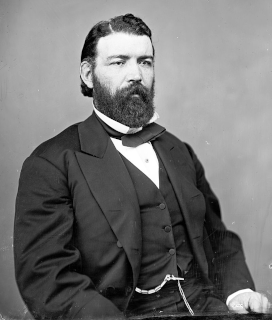
(Pictured: John Morrissey, U.S. Representative from New York, circa 1870s, source Library of Congress)
Gallagher is commissioned to write essays for The Irish Times, the Irish Medical Times and various journals. She takes up writing screenplays and stage plays. The result is a prolific list of productions which have been staged around the world as well as broadcast by RTÉ and the BBC.
Gallagher varies work from plays to speech therapy, as well as working with prisoners, and this leads her to be a visiting lecturer at universities across the globe. She is deeply involved in the organisations of her craft, leading her to being a member of Irish PEN, both on its committee and as vice president, on the Irish Writers’ Union committee as well as a council member of the Society of Irish Playwrights. Over the years she wins a number of awards including the Arts Council and European Script Fund Awards, the MHA TV Script Award, and the EU Theatre Award.
Gallagher’s husband is Gerhardt Gallagher. They live in Dublin and have three children, Mia, Donnacha, and Etain. In 2012 she is diagnosed with cancer and kidney disease. She dies on January 15, 2018.
Hope is born in Templepatrick, County Antrim, on August 25, 1764 to a Presbyterian family originally of Covenanter stock. He is apprenticed as a linen weaver but attends night school in his spare time. Influenced by the American Revolution, he joins the Irish Volunteers, but upon the demise of that organisation and further influenced by the French Revolution, he joins the Society of the United Irishmen in 1795.
Hope quickly establishes himself as a prominent organiser and is elected to the central committee in Belfast, becoming close to leaders such as Samuel Neilson, Thomas Russell, and Henry Joy McCracken. He is almost alone among the United Irish leaders in targeting manufacturers as well as landowners as the enemies of all radicals. In 1796, he is sent to Dublin to assist the United Irish organisation there to mobilise support among the working classes, and he is successful in establishing several branches throughout the city and especially in The Liberties area. He also travels to counties in Ulster and Connacht, disseminating literature and organizing localities.
Upon the outbreak of the 1798 rebellion in Leinster, Hope is sent on a failed mission to Belfast by Henry Joy McCracken to brief the leader of the County Down United Irishmen, Rev. William Steel Dickson, with news of the planned rising in County Antrim, unaware that Dickson had been arrested only a couple of days before. He manages to escape from Belfast in time to take part in the Battle of Antrim where he plays a skillful and courageous role with his “Spartan Band,” in covering the retreat of the fleeing rebels after their defeat.
Hope manages to rejoin McCracken and his remaining forces after the battle at their camp upon Slemish mountain, but the camp gradually disperses, and the dwindling band of insurgents are then forced to go on the run. He successfully eludes capture, but his friend McCracken is captured and executed on July 17. Upon the collapse of the general rising, he refuses to avail of the terms of an amnesty offered by Charles Cornwallis, 1st Marquess Cornwallis on the grounds that to do so would be “not only a recantation of one’s principles, but a tacit acquiescence in the justice of the punishment which had been inflicted on thousands of my unfortunate associates.”
Hope lives the years following 1798 on the move between counties Dublin, Meath and Westmeath but is finally forced to flee Dublin following the failure of Robert Emmet‘s rebellion in 1803. He returns to the north and evades the authorities attentions in the ensuing repression by securing employment with a sympathetic friend from England. He is today regarded as the most egalitarian and socialist of all the United Irish leadership.
After suffering poor health for some years, Hope dies on February 10, 1847 at his son Henry’s home, 1 Lancaster St., Belfast. He is buried in the Mallusk Cemetery, Newtownabbey, County Antrim. The headstone is raised by his friends, Henry Joy McCracken’s sister Mary Ann, and the Shankill Road United Irishman Isreal Milliken. The historian Richard Robert Madden, who had encouraged Hope to write his memoirs, supplies the inscription. The headstone features the outline of a large dog, which supposedly brought provisions to him and his compatriots when they were hiding following the Battle of Antrim.
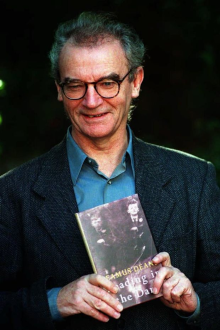
Deane is the fourth child of Frank Deane and Winifred (Doherty) and is brought up as part of a Catholicnationalist family. He attends St. Columb’s College in his hometown, where he befriends fellow student Seamus Heaney. He then attends Queen’s University Belfast (BA and MA) and Pembroke College, Cambridge (PhD). Although he too becomes noted for his poetry, he chooses to go into academia instead. He workws as a teacher in Derry, with Martin McGuinness being one of his students. McGuinness later recalls how Deane was “gentle, kind and never raised his voice at all, an ideal teacher who was very highly thought of.”
Deane is the co-editor of Field Day Review, an annual journal of Irish studies. He also serves as general editor of the Penguin Classic James Joyce series and of Critical Conditions, a series in Irish Studies which is jointly published by the University of Notre Dame Press and Cork University Press. He co-founds the book series Field Day Files, which contains key works by David Lloyd, Joe Cleary, Marjorie Howes, and Kerby A. Miller.
The first collection of Deane’s poetry, Gradual Wars, is published in 1972 and receives the AE Memorial Award for Literature. His first novel, Reading in the Dark, is published in 1996 and is partly autobiographical. It wins the 1996 Guardian Fiction Prize and the 1996 South Bank Show Award for Literature, is a New York Times Notable Book, wins The Irish Times International Fiction Prize and the Irish Literature Prize in 1997, besides being shortlisted for the Booker Prize in 1996. The novel is translated into more than twenty languages. He is also the general editor of the monumental Field Day Anthology of Irish Writing, which is 4,000 pages long and whose first volumes are released in 1990. It is later criticised for excluding the voices and experiences of Irish women. He responds to this by stating, “To my astonishment and dismay, I have found that I myself have been subject to the same kind of critique to which I have subjected colonialism … I find that I exemplify some of the faults and erasures which I analyse and characterize in the earlier period.”
Deane’s first marriage is to Marion Treacy. Together, they have four children. He is in a civil partnership with Emer Nolan until his death. They have one child together.
Following a short illness, Deane dies at the age of 81 on May 12, 2021 at Beaumont Hospital in Dublin.
Murdoch is born on July 15, 1919, in Phibsborough, Dublin, the daughter of Irene Alice (née Richardson) and Wills John Hughes Murdoch. Her father, a civil servant, comes from a mainly Presbyterian sheep farming family from Hillhall, County Down. In 1915, he enlists as a soldier in King Edward’s Horse and serves in France during World War I before being commissioned as a second lieutenant. Her mother trains as a singer before Iris is born and is from a middle-class Church of Ireland family in Dublin. Her parents first meet in Dublin when her father is on leave and are married in 1918. Iris is the couple’s only child. When she is a few weeks old the family moves to London, where her father had joined the Ministry of Health as a second-class clerk. She is a second cousin of the Irish mathematician Brian Murdoch.
From 1947 to 1948 Murdoch studies philosophy as a postgraduate at Newnham College, Cambridge. She meets Ludwig Wittgenstein at Cambridge but does not hear him lecture, as he had left his Trinity College professorship before she arrives. In 1948 she becomes a fellow of St. Anne’s College, Oxford, where she teaches philosophy until 1963. From 1963 to 1967 she teaches one day a week in the General Studies department at the Royal College of Art.
In 1956 Murdoch marries John Bayley, a literary critic, novelist, and from 1974 to 1992 Warton Professor of English at Oxford University, whom she had met in Oxford in 1954. The unusual romantic partnership lasts more than forty years until Murdoch’s death. Bayley thinks that sex is “inescapably ridiculous.” She in contrast has “multiple affairs with both men and women which, on discomposing occasions, Bayley witnesses for himself.”
Murdoch’s first novel, Under the Net, is published in 1954 and is selected in 1998 as one of Modern Library’s 100 best English-language novels of the 20th century. She had previously published essays on philosophy, and the first monograph about Jean-Paul Sartre published in English. She goes on to produce 25 more novels and additional works of philosophy, as well as poetry and drama.
Murdoch’s last novel, Jackson’s Dilemma, is published in 1995. She is diagnosed with Alzheimer’s disease in 1997 and dies on February 8, 1999, in Oxford. There is a bench dedicated to her in the grounds of Lady Margaret Hall, Oxford, where she enjoyed walking.







 seamus dubhghaill