Anne Harris, the former editor of the Sunday Independent, is born on August 25, 1947. She is the former wife of Eoghan Harris who was an opinion columnist for the newspaper. Her daughter, Constance Harris, writes for the newspaper as a fashion writer.
In 1972, Harris writes a controversial article defending the 1972 Aldershot Bombing, an article she later expresses regret for. She also works for The Irish Press, as well as the political magazine Hibernia and the fashion magazine Image.
Harris lives with Sunday Independent editor Aengus Fanning until his death on January 17, 2012. On February 5, 2012, the Sunday Independent announces that she will succeed Fanning as the publication’s editor.
On the evening of Saturday, July 19, 2014, group editor of INM newspaper publishers, Stephen Rae, orders the presses to be stopped to amend a column written by Harris, the Sunday Independent editor, which features references to Denis O’Brien. Copies of the original article do however appear, allowing comparisons between the two. Harris originally writes: “Denis O’Brien is the major shareholder in INM. In theory, with 29% of the shares, he does not control it. In practice, he does.” Rae has the last sentence deleted. She also writes: “The question is whether he understands newspapers. In order to confront the truths in our society, we must have a free press. With the restrictive charter for journalists proposed last year, and some garrotive (sic) new structures, Denis O’Brien does not make this easy.” This is changed to: “The question is whether he understands newspapers. In order to confront the truths in our society, we must have a free press. If the restrictive charter for journalists proposed last year, along with some other structural changes, are anything to go by, it might be instructive for him to listen to journalists, troublesome and all as they are.“
Harris leaves the newspaper some months later, with The Irish Times noting her departing speech to staff as follows: “She is understood to have spoken only about journalists and journalism and not about newspapers and their owners, a subject matter she has previously addressed in several columns.”
McMaster is born as Andrew McMaster on December 24, 1891, the son of Liverpool-born Andrew McMaster, a master stevedore, and Alice Maude (née Thompson). A number of sources make the erroneous claims, based on details supplied by McMaster himself, that he is born in 1893 or 1894 or even 1895 in County Monaghan in Ireland, but according to the Birth Register and the 1901 Census he is actually born in 1891 in Birkenhead, England. Like his future brother-in-law, Micheál Mac Liammóir, who is born in London as Alfred Willmore but who claims to have been born in Cork to Gaelic-speaking parents, McMaster reinvents himself as Irish and claims for himself the town of Monaghan as his birthplace, and Warrenpoint, County Down, as the scene of his earliest memories.
At the age of 19, McMaster gives up a career in banking to pursue one on the stage. He moves to Ireland and tours the country with the O’Brien-Ireland theatrical company from 1910 to 1914. Success quickly follows with his appearance as Jack O’Hara in Paddy the Next Best Thing at the Savoy Theatre in 1920. From 1921 he tours Australia in this and other plays, and in 1925 forms his own company, the McMaster Intimate Theatre Company, a “fit-up” company to tour in the works of Shakespeare, mainly in Ireland but also in Britain and Australia, touring with his theatrical company until 1959. One of the last actor-managers “of the old school – and an epitome of the type,” on occasions McMaster persuades a “big name” to act with his company as a draw for audiences, and Frank Benson (1928), Sara Allgood (1929) and Mrs. Patrick Campbell appear with him.
In 1933 at the Shakespeare Memorial Theatre in Stratford-upon-Avon McMaster appears as Hamlet opposite Esme Church as Gertrude, Coriolanus, Macduff in Macbeth, Leonato in Much Ado About Nothing, Prince Escalus in Romeo and Juliet, and Petruchio in The Taming of the Shrew. His greatest roles are as Othello and as Shylock in The Merchant of Venice, to which he adds King Lear in 1952. Just before World War II he and his company appear at the Chiswick Empire in a Shakespeare season. He tours the United States as James Tyrone in Eugene O’Neill‘s Long Day’s Journey into Night in 1956. Having “a great organ voice,” Harold Pinter, who acts in his company in Ireland from 1951 to 1953 and calls him “Perhaps the greatest actor-manager of his time,” later describes McMaster as “evasive, proud, affectionate, shrewd, merry.” In his brief biography Mac (1968), Pinter recalls, “Mac gave about a half dozen magnificent performances of Othello while I was with him… At his best he was the finest Othello I have seen. [He] stood dead in the centre of the role, and the great sweeping symphonic playing would begin, the rare tension and release within him, the arrest, the swoop, the savagery, the majesty and repose.”
McMaster’s only film role is an uncredited appearance as the Judge in Sword of Sherwood Forest (1960).
In 1924 McMaster marries the actress and designer Marjorie Willmore, the sister of Micheál Mac Liammóir. They have two children, the actors John Christopher McMaster and Mary-Rose McMaster.
McMaster dies at the age of 70 at his home in Dublin on August 24, 1962. He is buried with his wife in Dean’s Grange Cemetery in County Dublin.
McMaster’s biography, A Life Remembered: A Memoir of Anew McMaster, by his daughter Mary-Rose McMaster, is published in 2017. Harold Pinter also publishes a short biography, Mac, in 1968.
MacEntee is the son of James McEntee, a publican, and his wife, Mary Owens, both of whom are from Monaghan. James McEntee is a prominent Nationalist member of Belfast Corporation and a close friend of Joseph DevlinMP.
MacEntee is educated at St. Mary’s Christian Brothers’ Grammar School, St. Malachy’s College and the Belfast Municipal College of Technology where he qualifies as an electrical engineer. His early political involvement is with the Irish Socialist Republican Party in Belfast. He quickly rises through the ranks of the trade union movement becoming junior representative in the city’s shipyards. Following his education, he works as an engineer in Dundalk, County Louth, and is involved in the establishment of a local corps of the Irish Volunteers in the town. He mobilises in Dundalk and fights in the General Post Office garrison in the Easter Rising in 1916. He is sentenced to death for his part in the rising. This sentence is later commuted to life imprisonment. He is released in the general amnesty in 1917 and is later elected a member of the National Executives of both Sinn Féin and the Irish Volunteers in October 1917. He is later elected Sinn Féin Member of Parliament (MP) for South Monaghan at the 1918 Irish general election.
An attempt to develop MacEntee’s career as a consulting engineer in Belfast is interrupted by the Irish War of Independence in 1919. He serves as Vice-Commandant of the Belfast Brigade of the Irish Republican Army (IRA). He is also a member of the Volunteer Executive, a sort of Cabinet and Directory for the Minister for Defence and the HQ Staff, however, he remains one of the few Sinn Féiners from the north. On August 6, 1920, he presents ‘a Memorial’ lecture to the Dáil from the Belfast Corporation. He tells the Dáil it is the only custodian of public order, that a Nationalist pogrom is taking place, and he advises them to fight Belfast. The Dáil government’s policy is dubbed Hibernia Irredenta or “Greening Ireland.” He is asked to resign his South Monaghan seat after voting against a bunting celebration in Lurgan to mark the signing of the Anglo-Irish Treaty.
In April 1921 MacEntee is transferred to Dublin to direct a special anti-partition campaign in connection with the May general election. It remains Michael Collins‘s policy, he declares, that the largely Protestant shipyard workers of Belfast are being directed by the British, urging all Irishmen to rejoin the Republic. Correspondingly the Ulster Unionist Council rejects the call for a review of the boundary commission decision made on Northern Ireland. But when Ulstermen choose James Craig as Premier, Collins denounces democracy in the north as a sham. It is on the partition of Ireland issue that MacEntee votes against the Anglo-Irish Treaty of 1921. During the subsequent Irish Civil War, he commands the IRA unit in Marlboro Street Post Office in Dublin. He later fights with Cathal Brugha in the Hamman Hotel and is subsequently interned in Kilmainham and Gormanstown until December 1923.
After his release from prison, MacEntee devotes himself more fully to his engineering practice, although he unsuccessfully contests the Dublin Countyby-election of 1924. He becomes a founder-member of Fianna Fáil in 1926 and is eventually elected a TD for Dublin County at the June 1927 Irish general election.
MacEntee founds the Association of Patent Agents in 1929, having gained his interest in Patents when he worked as an assistant engineer in Dundalk Urban District Council. He values his status as a Patent Agent as he maintains his name on the Register for over 30 years while he holds Ministerial rank in the Irish Government, although he is not believed to have taken any active part in the patent business, which is carried on by his business partners.
In 1932, Fianna Fáil comes to power for the very first time, with MacEntee becoming Minister for Finance. In keeping with the party’s protectionist economic policies his first budget in March of that year sees the introduction of new duties on 43 imports, many of them coming from Britain. This sees retaliation from the British government, which in turn provokes a response from the Irish government. This is the beginning of the Anglo-Irish Trade War between the two nations, however, a treaty in 1938, signed by MacEntee and other senior members brings an end to the issue.
In 1939, World War II breaks out and a cabinet reshuffle results in MacEntee being appointed as Minister for Industry and Commerce, taking over from his rival Seán Lemass. During his tenure at this department, he introduces the important Trade Union Act (1941). In 1941, another reshuffle of ministers takes place, with him becoming Minister for Local Government and Public Health. The Health portfolio is transferred to a new Department of Health in 1947. Following the 1948 Irish general election, Fianna Fáil returns to the opposition benches for the first time in sixteen years.
In 1951, Fianna Fáil are back in government, although in minority status, depending on independent deputies for survival. MacEntee once again returns to the position of Minister for Finance where he feels it is vital to deal with the balance of payments deficit. He brings in a harsh budget in 1951 which raises income tax and tariffs on imports. His chief aim is to cut spending and reduce imports, however, this comes at a cost as unemployment increases sharply. The increases are retained in his next two budgets in 1952 and 1953. It is often said that it is his performance during this period that costs Fianna Fáil the general election in 1954. The poor grasp on economics also does his political career tremendous damage as up to that point he is seen as a likely successor as Taoiseach. Seán Lemass, however, is now firmly seen as the “heir apparent.”
In 1957, Fianna Fáil returns to power with an overall majority with MacEntee being appointed Minister for Health. The financial and economic portfolios are dominated by Lemass and other like-minded ministers who want to move away from protection to free trade. He is credited during this period with the reorganisation of the health services, the establishment of separate departments of health and social welfare, and the fluoridation of water supplies in Ireland. In 1959, he becomes Tánaiste when Seán Lemass is elected Taoiseach.
Following the 1965 Irish general election, MacEntee is 76 years old and retires from the government. He re-emerges in 1966 to launch a verbal attack on Seán Lemass for deciding to step down as party leader and Taoiseach. The two men, however, patch up their differences shortly afterwards. MacEntee retires from Dáil Éireann in 1969 at the age of 80, making him the oldest TD in Irish history.
MacEntee dies in Dublin on January 9, 1984, at the age of 94. He is buried in Glasnevin Cemetery, Dublin. At the time of his death, he is the last surviving member of the First Dáil.
From 1969 to 1973, during the 12th Seanad, Yeats serves as Cathaoirleach (chair).
While a senator, Yeats serves as a Member of the European Parliament from 1973 to 1979, being appointed to Ireland’s first, second and third delegations. He stands at the first direct elections in 1979 for the Dublin constituency but is not elected. He is Director General of the EEC Council of Ministers in Brussels in the 1980s.
Yeats marries Gráinne Ni hEigeartaigh, a singer and Irish harpist. They have four children – three daughters and a son.
Nugent is born in Ballinacor, a townland in the civil parish of Killare, County Westmeath, on November 3, 1777. He is the son of Count Michael Anton Nugent von Westmeath, Governor of Prague.
In 1793, Nugent joins the Austrian Army, becoming Colonel in 1807, and Chief of Staff of the Army Corps of Archduke John of Austria in 1809. In 1813, he leads the campaign against Viceroy Eugène de Beauharnais, separating French units in Dalmatia and simultaneously joining the British fleet, thus conquering Croatia, Istria and the Po Valley. In 1815, during the Neapolitan War, he commands the right wing of the Austrian Army in Italy, liberates Rome, and defeats Joachim Murat at the Battle of Ceprano and the Battle of San Germano.
In recognition of his achievements, Nugent is created in addition to a Roman Prince, an Austrian Imperial Count and a Knight of the Golden Fleece. Later, in 1860, he is appointed titular Prior of Ireland of the Sovereign Military Order of St. John of Jerusalem of Rhodes of Malta.
Nugent dies on August 21, 1862, in the Bosiljevo Castle, near Karlovac, and his body is later transferred to a sarcophagus in the Doric temple “Peace for the Hero,” in Trsat above Rijeka, next to the sarcophagus of his wife.
An exhibition of Nugent’s life in terms of his art collecting as well as his military career is curated at the University of Galway in 2019.
The 1710 Spanish campaign opens on May 15 when the Spanish Bourbon army commanded by Philip V in person and Francisco Castillo Fajardo, Marquis of Villadarias, advance on the town of Balaguer. Guido Starhemberg, commander of the Allied forces in Catalonia, halts this attempt by preventing the Spanish from fording the Segre River, a success in which the officers of the British contingent have a leading role.
Having received reinforcements, in June Philip makes another attempt upon Balaguer with 20,000 infantry and 6,000 cavalry but is defeated at Almenar on July 27. The allied troops take up a strong defensive position and repel the Spanish attacks until the British commander, James Stanhope, leading their vanguard, breaks the Spanish lines. Philip is forced to withdraw to Zaragoza, capital of Aragon, while Villadarias is replaced by the French general Alexandre Maître, Marquis de Bay.
On August 9, the Spanish army reaches Zaragoza and de Bay positions his troops with the river Ebro on his left and the Torrero heights to the right. On August 15, an Allied cavalry attack is repulsed, followed by five days of minor skirmishes before the Allies cross the Ebro in force on August 19 and are allowed to deploy during the night.
The two forces are roughly equal in strength, the allies having thirty-seven battalions of infantry and forty-three squadrons opposed to the Spanish-Bourbon army of thirty-eight battalions and fifty-four squadrons. The Allied left, composed of Catalonian and Dutch troops, is led by Pedro Manuel de Ataíde, 5th Count of Atalaia, the right by Stanhope, made up of British, Portuguese and Austrian cavalry, with Starhemberg in charge of the centre, mainly German, Austrian and Spanish infantry.
On August 20 at 8:00 a.m., an artillery-duel starts which lasts four hours before Stanhope charges the Bourbon-Spanish left. At first the Spanish and Walloon troops of the Bourbon army seem to gain the advantage, having defeated a body of eight Portuguese squadrons, which they chased from the field. This opens a gap in the Bourbon lines, which opens a gap for Stanhope who scatters the disorganized Spanish soldiers, while at the centre and the right their attacks are repulsed.
The battle follows the same pattern as at Almenar, with the allies repulsing fierce Bourbon cavalry charges before counter-attacked with their infantry and pushing the Spanish back. In less than three hours, the Allies army wins a comprehensive victory, capturing the Bourbon artillery along with 73 standards. Between 5,000 and 6,000 Spanish soldiers are killed or wounded, and another 7,000 captured, with Allied losses estimated as 1,500 men dead or wounded.
Archduke Charles enters Zaragoza the next day. The defeat of the army of Philip V of Spain is severe, the way to Madrid is open. Philip V abandons Madrid on September 9 and goes to Valladolid. Archduke Charles enters a very hostile and almost empty Madrid on September 28. Charles comments, “This city is a desert!” In the winter of 1710, Archduke Charles and the allied troops have to abandon Madrid, due to the great opposition of the people of Madrid and the dangerous strategic situation. After this, the British army suffers a defeat at the Battle of Brihuega, and the rest of the allied army is defeated at the Battle of Villaviciosa.
Lawless is the only surviving son of Nicholas Lawless, wool merchant, brewer, and banker, who becomes 1st Baron Cloncurry in 1789, and Margaret Lawless (née Browne), only daughter and heiress of Valentine Browne of Mount Browne, County Limerick. He is educated privately at Portarlington, Queen’s County (now County Laois), and at Blackrock, County Dublin. He enters Trinity College Dublin (TCD) in 1789, graduating BA in 1792. After completing a tour of Europe (1792–95) he returns to Ireland, where he joins the Society of United Irishmen and the loyalistyeomanry. Pressurized by his father, he decides to study law, and is at Middle Temple from 1795 to 1798. He later claims that at a dinner party in the spring of 1797 he hears the prime minister, William Pitt, discuss his plans for a legislative union with Ireland, prompting him to write an anti-union pamphlet in response. Like many of the claims in his published recollections, the story is unreliable.
During 1797 Lawless helps Arthur O’Connor form his United Irishman newspaper The Press, and Leonard McNally informs Dublin Castle that Lawless is its principal shareholder. In October 1797 Lawless attends a meeting of the executive directory of the United Irishmen, of which he is elected a member. Throughout this period and after his return to London he is carefully watched by the British secret service. His friendship with O’Connor, and the fact that he provides funds for Fr. James Coigly, arouse deep suspicion. After the outbreak of open rebellion in Ireland he is arrested at his lodgings in Pall Mall on May 31, 1798, on suspicion of high treason, and imprisoned for six weeks in the Tower of London. Arabella Jefferyes, sister of the Earl of Clare, apparently tries to extort money from Lawless in return for pleading his case to the Duke of Portland. He refuses the offer. On his release he tours England on horseback but is rearrested on April 14, 1799, and held until March 1801. His father votes for the Act of Union, hoping to secure his son’s release, and dies on August 28, 1799. Lawless succeeds him as 2nd Baron Cloncurry. His grandfather and his fiancée, Mary Ryal, also die while he is imprisoned.
Embittered by his experience, Lawless tours the Continent from 1801 to 1805 before returning to his family estate at Lyons Hill, Ardclough, County Kildare. Throwing himself into improving his estates and into local concerns, he founds the County Kildare Farming Society in 1814. He is also involved in canal developments and agricultural improvements in the country. Opposed to the rural constabulary bill of 1822, he supports Catholic emancipation and the attempts of Daniel O’Connell to repeal the Act of Union. He breaks with O’Connell in the 1830s when his friend, Henry Paget, 1st Marquess of Anglesey, is viceroy, because he believes repeal can now be achieved through official means. The rift is never healed.
In 1831, Lawless is admitted to the Privy Council of Ireland (PC) and an English peer but rarely attends the House of Lords. Involved in anti-tithe campaigns, he retires from politics in 1840. Travelling on the Continent in 1841 and 1842, he returns to defend O’Connell’s planned Clontarf meeting in the privy council but refuses to attend any further meetings after his advice on dealing with the Great Famine is ignored in 1846. In 1849 he publishes his personal reminiscences, which appear to have been ghost-written.
Lawless’s health begins to fail in 1851. He dies at the older family home, Maretimo House, Blackrock, on October 28, 1853, and is buried in the family vault at Lyons Hill.
Lawless first marries Elizabeth Georgiana, youngest daughter of Lieutenant-GeneralCharles Morgan, at Rome on April 16, 1803. They have one son and one daughter. The marriage ends in divorce in 1811 after her adultery with Sir John Piers. In 1811, he then marries Emily, daughter of Archibald Douglas of England, and widow of Joseph Leeson. They have two sons and a daughter. The elder son, Edward, succeeds as 3rd Baron Cloncurry. He commits suicide in 1869 by throwing himself out of a third-floor window at Lyons Hill. The younger, Cecil-John, is an MP, but catches a chill at his father’s funeral and dies on November 5, 1853.
(From: “Lawless, Valentine Browne” by Patrick M. Geoghegan, Dictionary of Irish Biography, http://www.dib.ie, October 2009 | Pictured: Lyons House, Lyons Hill, Ardclough, County Kildare)
Murphy is an active Irish republican paramilitary from his late teens. In March 1972, he is arrested in Dundalk regarding an assault and is sentenced to two years in prison after the Garda Síochána find a loaded revolver in his car. He is imprisoned in the Curragh Camp but escapes in October 1972 and is not recaptured until May 1973. In June 1976, he is imprisoned again, receiving a three-year sentence for firearms offences and a one-year sentence for Provisional Irish Republican Army membership, both sentences to run concurrently. In July 1983, he is arrested in the United States after attempting to buy a consignment of M60 machine guns to be shipped to Ireland for use by the Irish National Liberation Army (INLA). He receives a five-year prison sentence but returns to Ireland in December 1985 after being released early.
In the late 1980s, Murphy begins investing in property and forms a company named Emerald Enterprises in 1990. He purchases the Emerald Bar public house in Dundalk for IR£100,000, and it later becomes a meeting place for dissident republicans. Other investments included 30 acres of land in Drogheda bought for IR£52,000 in 1995, and his company wins contracts for an IR£11 million development at Dublin City University (DCU) and the multi-million-pound International Financial Services Centre in the Dublin Docklands.
Murphy is arrested by the Gardaí on February 21, 1999, for questioning under anti-terrorist legislation. On February 24, he becomes the first person to be charged in connection with the Omagh bombing, when he appears before Dublin‘s Special Criminal Court and is charged with conspiring to cause an explosion under the terms of Ireland’s Offences Against the State Act, between August 13-16, 1998. He is also charged with membership in an illegal organisation, the Real Irish Republican Army (RIRA).
On October 10, 2000, the BBC television show Panorama names Murphy as one of four people connected with the Omagh bombing, along with Seamus Daly and Liam Campbell. In 2001, he undertakes legal action against the BBC and Daily Mail publishers Associated Newspapers for contempt of court. The action against Associated Newspapers is settled on July 31, 2001, and the newspaper releases a statement saying Murphy is entitled to be presumed innocent of the charges against him until proven guilty.
Murphy’s trial begins at Special Criminal Court in Dublin on October 12, 2001. The court hears that Murphy had supplied two mobile phones which were used during the bombing. One witness, Murphy’s second cousin, retracts his evidence and the judge calls the conduct of two detectives outrageous, saying they had persistently lied under cross-examination. Despite this, on January 22, 2002, he is convicted of conspiring to cause the Omagh bombing, and on January 25 is sentenced to 14 years imprisonment with the judge describing him as a long-time republican extremist.
On January 21, 2005, Murphy’s conviction is overturned and a new trial ordered, due to the invasion of Murphy’s presumption of innocence, and alteration of Gardaí interview notes and evidence presented by two officers. A week later, his legal case against the BBC is resolved, with the BBC issuing a statement that Murphy “was fully entitled to maintain his innocence of the charges against him and to test the evidence against him at his trial.”
On October 23, 2006, two Gardaí officers are found not guilty of perjuring themselves during Murphy’s trial. On May 23, 2007, it is announced that Murphy is suffering from short-term memory loss resulting from a car accident in 1988. His lawyers attempt to prevent a retrial taking place, on the grounds that his condition interferes with his right to a fair hearing. The Court of Criminal Appeal is scheduled to hear his case again in October 2008. Following a retrial held in January 2010, he is acquitted on February 24, 2010.
In 2009, Murphy is one of four men found by a civil court to be liable for the Omagh bombing in a case taken by relatives of the victims. On July 7, 2011, in Belfast High Court, Lord Justice Malachy Higgins directs a retrial of the civil claims against Murphy. He questions evidence surrounding emails from U.S. undercover agent David Rupert while overturning the judgment on Murphy. The paucity of the email evidence, the lack of consistency in the emails or at least ambiguity, the possibility of initials referring to someone other than Murphy and the fact that they refer on occasions to double hearsay considerably weaken the emails as evidence, he says. Following a civil retrial on March 20, 2013, Murphy and Seamus Daly are found liable for involvement in the bombing.
Dillon is born in Glanmire, County Cork, in 1830. As a child, he is injured in a heavy fall which results in curvature of the spine and general ill health. His family moves to a house near the corner of Old Youghal Road and Ballyhooly Road. He attends the School of Art for several years and becomes quite talented with brush and pencil. He lives through the Great Famine and becomes an ardent nationalist.
Dillon is appointed a Fenian leader in Cork by James Stephens, the head of the Irish Republican Brotherhood. Under his supervision the Fenian recruits drill on the Fair Field and at Rathpeacon and are hoping for a rebellion in 1865 when the Fenians are at their strongest. He often associates with other Cork Fenians such as John J. Geary, James Mountaine and John Lynch. He chairs the Fenian meetings at Geary’s pub.
In September 1865, police arrest Fenian leaders James Stephens and Jeremiah O’Donovan Rossa in Dublin, and Dillon in Cork. The police search his home and find a pair of field glasses, some drawings and some incriminating letters sewn into the mattress of his bed. He is remanded in Cork City Gaol until his trial.
On December 18, Dillon and another Cork Fenian, John Lynch, are tried together in the dock in Cork Courthouse by Judge Keogh. The charges are primarily based on information provided by an informer named John Warner, an ex-military pensioner. Isaac Butt and Mr. Waters represent the defendants. The charges are “in one indictment with having conspired to depose the Queen, &c., and with illegally drilling and being drilled in furtherance of that design.” Both are found guilty, based primarily on the testimony of informants, although John Warner’s account is very weak and unsatisfactory under cross-examination. The defendants are sentenced to ten years’ penal servitude.
Dillon is brought under armed guard by train from Cork to Dublin and then thrown into Mountjoy Gaol. He spends nearly a month there and suffers from lack of sleep. In January 1866, he and John Sarsfield Casey are handcuffed together on the tough and rough sea crossing between Kingstown and Holyhead. On arrival at Holyhead, they are then taken by train to Pentonville Prison. This is a very cold prison, and he becomes seriously ill in May 1866. He is transferred to the hospital wing of Woking Convict Invalid Prison, and this is to be his home for the next four-and-a-half years. Here he becomes Convict Number 2658.
In 1870, after five years imprisonment, a commission is set up to investigate the Fenian prisoners, and on account of his bad health, this commission recommends that Dillon be allowed home to Cork. In January 1871 he is transferred to Millbank PrisonLondon and is set free two weeks later on February 8. The following day he arrives in Dublin and after a few days’ rest, he returns to Cork by train. All along the route thousands of people wait on the platforms to greet him and read special addresses of welcome. The train reaches Cork at 8:00 p.m. and even though a carriage and pair are waiting, he is glad to seek refuge in the first covered car he can find, so dense is the crowd all around him wanting to shake his hand. The triumphal procession from the station to his home then begins and the hills all along the route are lighted with tar barrels.
Amid emotional scenes Dillon meets his family and afterwards appears at one of the windows of the house and thanks the people of Ireland for the great reception he has received everywhere on his journey home to Cork. He is now in very poor health and his mother begins the task of nursing him back to health. Everything that loving care and money could do is done, and from New York comes a cheque for £50 from the generous-hearted O’Donovan Rossa. Other friends also contribute, but all to no avail. On Saturday, August 17, 1872, he dies at his home surrounded by his sorrowing relatives.
Dillon’s funeral is one of the biggest ever seen in Cork. The cortege is headed by the Barrack Street Band, and at least ten other bands take part. All have their instruments dressed in sombre black. On Monday, August 18, his remains are privately borne to St. Joseph’s cemetery, to a temporary resting place, as it has been decided to build a vault in the family burial ground in Rathcooney which will not be ready for a few days. Later the funeral route travels from Turners Cross along Anglesea Street, South Mall, Grand Parade, Patrick Street, McCurtain Street and St. Luke’s. The funeral procession stops outside his home and prayers are recited for the repose of his soul. The procession then moves on toward Ballyvolane and up the steep hill toward the graveyard at Rathcooney. On arrival at the newly built tomb, so dense is the crowd milling around the hearse that considerable difficulty is experienced in getting the coffin to the grave. The priests then read the burial service, and, in a hushed silence, Canon Freeman asks the entire assembly to kneel and recite the Lord’s Prayer aloud. He blesses the grave, and the mortal remains of Brian Dillon are lowered to rest. The coffin is then covered, and after Colonel Ricard O’Sullivan Burke‘s oration, the crowd quietly disperses.
Today Dillon’s name is inscribed in the National Monument on the Grand Parade and in street names like Dillon’s Cross, Brian Dillon Park and Brian Dillon Crescent. The Brian Dillons GAA club in the same area of Cork city is also named after him.
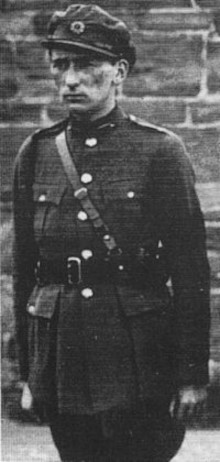
Mac Thomáis comes from a staunch Republican family. He is born Edward Patrick Thomas in the Dublin suburb of Rathmines on January 13, 1927. His father, a fire-brigade officer, dies when he is five years old and his family moves to Goldenbridge, Inchicore. He leaves school at thirteen to work as delivery boy for White Heather Laundry, learning Dublin neighbourhoods with great thoroughness. He says he found work to help his mother pay the rent. He later works as a clerk and is appointed credit controller for an engineering firm.
At the November 1959 Ardfheis Mac Thomáis is elected to the Ardchomhairle of Sinn Féin and edits and contributes to the Sinn Féin newspaper United Irishman. He is a close friend of Tomás Mac Giolla and is deeply affected by the 1970 split in Sinn Féin. He takes the Provisional side, opposing Mac Giolla.
Mac Thomáis takes over as editor of An Phoblacht in 1972. In July 1973, he is arrested and charged with IRA membership at the Special Criminal Court in Dublin. He refuses to recognise the court, but he gives a lengthy address from the dock. The following month he is sentenced to 15-months imprisonment. Within two months of completing his sentence he is again before the court on the same charge and again receives a 15-month sentence. Editors of six left-wing and Irish-language journals call for his release, as do a number of writers, and hundreds attend protest meetings – to no avail. He serves his full sentence.
Tim Pat Coogan, editor of The Irish Press, claims the charges against Mac Thomáis are politically motivated to a large degree as his activities are confined strictly to the newspaper An Phoblacht. Under Section 31 of the Broadcasting Act, due to his membership in Sinn Féin in the 1970s he is removed from his position in making some of the RTÉ historical programmes. As a historian he makes numerous contributions to various historical publications such as the Dublin Historical Review.
From 1974 Mac Thomáis writes a number of books on old Dublin. They sell well and remain in print for over 20 years. He also starts a number of walking tours of Dublin, which prove very popular.