Although accepted to study at Trinity College, Dublin, circumstances force Ervine to leave school at the age of 15 to begin working in an insurance office.
Two years later, Ervine immigrates to London, where he discovers a love for the theatre. He begins his writing career with Mixed Marriage (1911), an Ulster tragedy, and produces three plays between 1911 and 1915. In 1915, after a meeting with William Butler Yeats in London, he becomes the director of the Abbey Theatre in Dublin. It is, however, not a happy appointment as his personality and politics clash with the management of the theatre.
Ervine then joins the Royal Dublin Fusiliers and fights in Flanders, losing a leg in the conflict. Returning home, he feels increasingly alienated by nationalism and more attracted to the unionism of his family background. He becomes a vehement detractor of the south, describing Ireland in a letter to George Bernard Shaw as brimming with “bleating Celtic Twilighters, sex-starved Daughters of the Gael, gangsters and gombeen men.”
Ervine is a distinctively Ulster orientated writer, focusing on a naturalistic portrayal of rural and urban life. His most famous and popular work amongst his Northern Irish audience is Boyd’s Shop (1936), which becomes one of the Ulster Group Theatre’s stalwart productions. The play is a classic of the homely yet sincere Ulster genre and centres around the struggles of the folk that Ervine grew up with in his grandmother’s shop on the Albertbridge Road. Ervine creates in Boyd’s Shop a template for Ulster theatre that is to dominate until the advent of Samuel Thompson‘s Over the Bridge.
Ervine’s reactionary unionism and anti-southern hatred becomes more pronounced as he ages and eclipses his more subtle characteristics and abilities as a writer. Although many of his novels and plays are at times clouded by his prejudices, they are also very often capable of tremendous feeling and humanity showing he is a writer of note.
St. John Greer Ervine dies at the age of 87 in London on January 24, 1971.
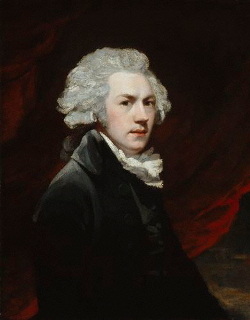
Shee is born into an old Irish Catholic family, the son of Martin Shee, a merchant, who regards the profession of a painter as an unsuitable occupation for a descendant of the Shees. He nevertheless studies art in the Royal Dublin Society and comes to London. There, in 1788, he is introduced by Edmund Burke to Joshua Reynolds, on whose advice he studies in the schools of the Royal Academy of Arts.
In 1789 Shee exhibits his first two pictures, the “Head of an Old Man” and “Portrait of a Gentleman.” Over the next ten years he steadily increases in practice. In 1798 he is chosen an associate of the Royal Academy and in 1800 he is elected a Royal Academician. He moves to George Romney‘s former house at 32 Cavendish Square and sets up as his successor.
Shee continues to paint with great readiness of hand and fertility of invention, although his portraits are eclipsed by more than one of his contemporaries, and especially by Thomas Lawrence. His earlier portraits are carefully finished, easy in action, with good drawing and excellent discrimination of character. They show an undue tendency to redness in the flesh painting, a defect which is still more apparent in his later works, in which the handling is less square, crisp and forcible. In addition to his portraits, he executes various subjects and historical works, such as Lavinia, Belisarius, his diploma picture “Prospero and Miranda,” and the “Daughter of Jephthah.”
In 1805 Shee publishes a poem consisting of Rhymes on Art, and a second part follows in 1809. Lord Byron speaks well of it in his English Bards and Scotch Reviewers. He publishes another small volume of verse in 1814, entitled The Commemoration of Sir Joshua Reynolds, and other Poems, but this is less successful. He also produces a tragedy, Alasco, set in Poland. The play is accepted at Covent Garden, but is refused a licence, on the grounds that it contains treasonable allusions, and Shee angrily resolves to make his appeal to the public. He carries out his threat in 1824, but Alasco is still on the list of unacted dramas in 1911. He also publishes two novels – Oldcourt (1829, in three volumes) and Cecil Hyde (1834).
On the death of Sir Thomas Lawrence in 1830, Shee is chosen president of the Royal Academy in his stead and shortly afterwards receives a knighthood. In 1831 he is elected a Fellow of the Royal Society. In an examination before the parliamentary committee of 1836 concerning the functions of the Royal Academy, he ably defends its rights. He continues to paint until 1845, when illness makes him retire to Brighton. He is deputised for at the Academy by J. M. W. Turner, who had appointed him a trustee of the projected Turner almshouse.
Martin Archer Shee dies in Brighton, Sussex, England on August 13, 1850, and is buried in the western extension to St. Nicholas’ Churchyard in Brighton. His headstone remains but has been laid flat and moved to the perimeter of the site.
O’Brien is the youngest child of “a strict, religious family.” From 1941 to 1946 she is educated by the Sisters of Mercy, a circumstance that contributes to a “suffocating” childhood. “I rebelled against the coercive and stifling religion into which I was born and bred. It was very frightening and all pervasive. I’m glad it has gone.” She is fond of a nun as she deeply misses her mum and tries to identify the nun with her mother.
In 1950, O’Brien is awarded a licence as a pharmacist. In Ireland, she reads such writers as Leo Tolstoy, William Makepeace Thackeray, and F. Scott Fitzgerald. In 1954, she marries, against her parents’ wishes, the Irish writer Ernest Gébler and the couple moves to London. They have two sons, but the marriage is dissolved in 1964. Gébler dies in 1998.
In London, O’Brien purchases Introducing James Joyce, with an introduction written by T. S. Eliot. When she learns that James Joyce‘s A Portrait of the Artist as a Young Man is autobiographical, it makes her realise where she might turn, should she decide to write herself. In London she starts work as a reader for Hutchinson, where on the basis of her reports she is commissioned, for £50, to write a novel. Her first novel, The Country Girls (1960), is often credited with breaking silence on sexual matters and social issues during a repressive period in Ireland following World War II.
This novel is the first part of a trilogy of novels which includes The Lonely Girl (1962) and Girls in Their Married Bliss (1964). Shortly after their publication, these books are banned and, in some cases burned, in her native country due to their frank portrayals of the sex lives of their characters. Her novel A Pagan Place (1970) is about her repressive childhood. Her parents are vehemently against all things related to literature and her mother strongly disapproves of her daughter’s career as a writer.
O’Brien is a panel member for the first edition of the BBC‘s Question Time in 1979. In 2017, she becomes the sole surviving member.
Other works include a biography of James Joyce, published in 1999, and one of the poet Lord Byron, Byron in Love (2009). House of Splendid Isolation (1994), her novel about a terrorist who goes on the run, marks a new phase in her writing career. Down by the River (1996) concerns an under-age rape victim who seeks an abortion in England, the “Miss X case.” In the Forest (2002) deals with the real-life case of Brendan O’Donnell, who abducts and murders a woman, her three-year-old son, and a priest, in rural Ireland.
Daniel Francis Noel O’Donnell, singer, television presenter and philanthropist affectionately known as “Wee Daniel,” is born in Kincasslagh, County Donegal on December 12, 1961. After rising to public attention in 1983 he has since become a household name in Ireland and Britain. He has also had considerable success in the United States and Australia. In 2012, he becomes the first artist to have a different album in the British charts every year for 25 consecutive years.
Known for his close relationship with his fanbase, and his charismatic and engaging stage presence, O’Donnell’s music has been described as a mix of country and Irish folk. He has had twenty UK Top 40 albums as well as fifteen Top 40 singles and has sold 10 million records to date. He is widely considered a “cultural icon” in Ireland, and is often parodied in the media.
During his school years, O’Donnell considers pursuing a career in banking. Despite this, a career in music is also always a possibility. As a youngster, O’Donnell performs in the local religious choir. In 1980, he goes to Galway to pursue business studies, however, he never settles down and by Christmas he is in his sister Margo‘s band.
Not getting enough opportunities to perform solos with the band, in 1983 O’Donnell decides to record his own record. On February 9, 1983, he records his first single, Johnny McCauley‘s My Donegal Shore, with £1,200 of his own money, selling all the copies himself. Later that year, he forms his own musical group, Country Fever. After the group disbands, he forms The Grassroots. In 1985, the manager of the Ritz label, Mick Clerkin, sees him perform and introduces him to Sean Reilly, who remains as his manager to this day.
Under Reilly’s management, O’Donnell starts to sell concerts out in England on a regular basis. By January 1992, he has hit rock bottom with exhaustion. After a three-month recovery break, he returns to the stage, this time at the Point Theatre, Dublin.
By the mid-1990s, O’Donnell has become a household name across Ireland and Great Britain. He appears on popular television shows in both countries and wins various awards. Among the accolades, he is named Donegal Person of the Year in 1989, which he still rates as the best award. He is given the Irish Entertainer of the Year award in 1989, 1992 and 1996. His first chart hit single in the UK is in 1992 with I Just Want to Dance With You (later covered by George Strait). This also leads to his first-ever appearance on Top of the Pops.
During his lengthy career, O’Donnell has made friends with his childhood idols, including Cliff Richard and Loretta Lynn. He has also forged a close professional relationship with the Irish songstress Mary Duff, who regularly tours with O’Donnell.
On November 4, 2002, O’Donnell marries Majella McLennan from Thurles, whom he had met on holiday in Tenerife three years previously. The couple lives in Meenbanad, County Donegal, and spend time at their second home in Tenerife.
Christie Hennessy, Irish folk singer-songwriter, dies in London on December 11, 2007. Although Hennessy is unable to read or write due to severe dyslexia, he still writes his own songs such as “Roll back the Clouds” and “All the lies that you told me.”
Hennessy is born in Tralee, County Kerry on November 19, 1945. His first guitar is made, especially for him, from a tea chest when he is six years old by his friend Jerry Quirke. He leaves school at the age of eleven.
Hennessy’s first job is as a messenger boy, and it is then that he discovers that it is important to be able to read. He is unable to read or write due to severe dyslexia, but still enjoys his library of books. He later works on building sites in London.
In 1972 Hennessy releases his first record, The Green Album, on Westwood, a small label. With scant publicity or promotion, the album makes little impact and only 500 copies of the record are pressed. He returns to labouring on building sites in the UK and does not release another album for twenty years. When he does, his 1992 release The Rehearsal outsells U2 in Ireland, eventually attaining triple platinum status. His following albums, A Year in the Life and Box also sell extremely well in Ireland.
A renowned songwriter as well as performer, Hennessy writes several songs that become hits for other singers including Don’t Forget your Shovel, made famous by Christy Moore, and All the Lies that You Told Me, recorded by Frances Black. He also composes the theme tune and incidental music for the BBC TV series Get Well Soon written by Ray Galton (of Steptoe & Son fame) and composes and writes a musical/feature film about his native Ireland, Two Stops to Paradise.
In 2005, Christy Moore’s rendition of Hennessy’s Don’t Forget Your Shovel is referenced in a UK Number One single JCB by Nizlopi. It is further referenced in the video for the same song. As the line is sung, the characters in the JCB pass a shop called “Christie’s Shovels.”
Hennessy returns to the studio in 2007, one final time to record an album with both Luka Bloom and Christy Moore sharing vocals on one of the tracks.
Christie Hennessy dies on December 11, 2007 in a London hospice, at the age of 62. He is reported to have died from pleuralmesothelioma, a rare form of lung cancer, which has been attributed to his younger years spent working on building sites in London where he was exposed to asbestos dust. Just before he dies he had been touring in Ireland but had to cancel due to the illness. His ashes are buried in Old Rath Cemetery, Tralee. A commemorative statue of Christie is erected in Central Plaza, just off the town square in Tralee in November 2009.
MacDonagh is still a young child when his father is executed in 1916 for his part in the Easter Rising. Tragedy strikes again when his mother dies of a heart attack a year afterwards while swimming at Skerries to Lambay Island, County Dublin on July 9, 1917. He and his sister are then cared for by their maternal aunts, in particular Catherine Wilson.
His parents’ families then engage in a series of child custody lawsuits as the MacDonaghs are Roman Catholic and the Giffords are Protestant. In the climate of Ne Temere, the MacDonaghs are successful.
He and his sister Barbara, who later marries actor Liam Redmond, live briefly with their paternal aunt Eleanor Bingham in County Clare before being put into the custody of strangers until their late teens when they are taken in by Jack MacDonagh.
MacDonagh publishes three volumes of poetry: Veterans and Other Poems (1941), The Hungry Grass (1947) and A Warning to Conquerors (1968). He also edits the Oxford Book of Irish Verse (1958) with Lennox Robinson. He also writes poetic dramas and ballad operas. One play, Happy As Larry, is translated into a number of languages. He has three other plays produced: God’s Gentry (1951), Lady Spider (1959) and Step in the Hollow, a piece of situation comedy nonsense.
MacDonagh also writes short stories. He publishes Twenty Poems with Niall Sheridan, stages the first Irish production of “Murder in the Cathedral” with Liam Redmond, later his brother-in-law, and is a popular broadcaster on Radio Éireann.
MacDonagh is married twice, to Maura Smyth and, following her death after she drowns in a bath whilst having an epileptic seizure, to her sister, Nuala Smyth. He has four children, Iseult and Breifne by Maura and Niall and Barbara by Nuala.
Donagh MacDonagh dies in Dublin on January 1, 1968, and is buried at Deans Grange Cemetery.
Cash-strapped Aer Lingus auctions its collection of paintings on November 20, 2001. Most money goes on By Merrion Strand by Jack Butler Yeats, an oil-on-canvas, which sells for £290,000.
Aer Lingus, already in difficulties, is left in an even more perilous position by the effects of the September 11 terrorist attacks in the United States. The airline decides to realise some of its assets by selling 25 paintings from the company art collection. Members of the public are given an opportunity to buy part of Aer Lingus well ahead of any possible share flotation. The paintings are handed over to Dublinauctioneer John de Vere White and are offered at the Royal Hibernian Academy Gallagher Gallery on November 20 with the expectation of bringing around £500,000 (€635,000).
Visitors to Dublin Airport or Aer Lingus’s various offices notice very little change as in recent years only two of the paintings are on display, both of them in the chairman’s office. The remainder have been in storage which is one reason why the group are now being sold as part of Aer Lingus’s efforts to raise additional revenue.
One of the pictures removed from the chairman’s office is also both the longest-owned by the organisation and is ultimately the highest earner at auction. Jack Butler Yeats’s By Merrion Strand, which dates from 1929 and shows a woman standing before an expanse of the south Dublin coastline, is acquired by Aer Lingus in 1940, just four years after the company’s founding. According to company lore, it was spotted in London by a member of staff who left a £5 deposit on the painting.
Two paintings by Nathaniel Hone also have reasonably strong pre-sale estimates, Children on the Rocks valued at £25,000-£35,000 and Cattle in a Field at Malahide believed to be worth £10,000-£15,000. Other artists represented in the Aer Lingus collection being sold include Louis Le Brocquy, Patrick Collins, Norah McGuinness, Gerard Dillon and George Campbell.
Five other works in the collection, all acquired by the airline between the 1940s and the 1960s, are bought by the Irish state ahead of the auction.
(Pictured: By Merrion Strand, an oil-on-canvas painting by Jack B. Yeats, dating from the late 1920s)
Luke Kelly, singer, folk musician and actor, is born into a working-class family in Lattimore Cottages at 1 Sheriff Street, Dublin on November 17, 1940. He is noted as a founding member of the band The Dubliners.
After Dublin Corporation demolished Lattimore Cottages in 1942, the Kellys become the first family to move into the St. Laurence O’Toole flats, where Luke spends the bulk of his childhood, although the family is forced to move by a fire in 1953 and settles in the Whitehall area.
Kelly is interested in music during his teenage years and regularly attends cèilidh with his sister Mona and listens to American vocalists including Fats Domino, Al Jolson, Frank Sinatra and Perry Como. He also has an interest in theatre and musicals, being involved with the staging of plays by Dublin’s Marian Arts Society. The first folk club he comes across is in the Bridge Hotel, Newcastle upon Tyne in early 1960. Having already acquired the use of a banjo, he starts memorising songs.
Kelly befriends Sean Mulready in Birmingham and lives in his home for a period. Mulready is a teacher who is forced from his job in Dublin because of his communist beliefs. Mulready’s brother-in-law, Ned Stapleton, teaches Kelly “Rocky Road to Dublin.” During this period he studies literature and politics under the tutelage of Mulready, his wife Mollie, and Marxist classicist George Derwent Thomson.
In 1961 there is a folk music revival or “ballad boom,” as it is later termed, in waiting in Ireland. Kelly returns to Dublin in 1962. A concert John Molloy organises in the Hibernian Hotel leads to his “Ballad Tour of Ireland” with the Ronnie Drew Ballad Group. This tour leads to the Abbey Tavern and the Royal Marine Hotel and then to jam-packed sessions in the Embankment, Tallaght. Ciarán Bourke joins the group, followed later by John Sheahan. They rename themselves The Dubliners at Kelly’s suggestion, as he is reading James Joyce‘s book of short stories, entitled Dubliners, at the time. Kelly is the leading vocalist for the group’s eponymous debut album in 1964, which includes his rendition of “Rocky Road to Dublin.”
In 1964 Kelly leaves the group for nearly two years and is replaced by Bob Lynch and John Sheahan. Kelly goes with Deirdre O’Connell, founder of the Focus Theatre, to whom he marries the following year, back to London and becomes involved in Ewan MacColl‘s “gathering.”
When Bob Lynch leaves The Dubliners, John Sheahan and Kelly rejoin. The ballad boom in Ireland is becoming increasingly commercialised with bar and pub owners building ever larger venues for pay-in performances. Ewan MacColl and Peggy Seeger on a visit to Dublin express concern to Kelly about his drinking.
Kelly’s health deteriorates in the 1970s. During a concert in the Cork Opera House on June 30, 1980 he collapses on the stage. He had already suffered for some time from migraines and forgetfulness which had been ascribed to his intense schedule, alcohol consumption, and “party lifestyle.” A brain tumor is diagnosed. Although he tours with the Dubliners after enduring an operation, his health deteriorates further. He forgets lyrics, has to take longer breaks in concerts due to weakness and becomes more withdrawn. In the autumn of 1983 he has to leave the stage in Traun, Austria and again in Mannheim, Germany. Shortly after this, he has to cancel the tour of southern Germany and, after a short stay in hospital in Heidelberg, he is flown back to Dublin.
After another operation Kelly spends Christmas with his family but is taken to hospital again in the New Year, where he dies on January 30, 1984. His funeral in Whitehall attracts thousands of mourners from across Ireland. His gravestone in Glasnevin Cemetery, Dublin, bears the inscription: Luke Kelly – Dubliner.
Hugh Leonard, Irish dramatist, television writer and essayist, is born in Dublin on November 9, 1926. In a career that spans 50 years, he writes nearly 30 full-length plays, 10 one-act plays, three volumes of essays, two autobiographies, three novels and numerous screenplays and teleplays, as well as writing a regular newspaper column.
After birth, Leonard is put up for adoption. Raised in Dalkey, a suburb of Dublin, by Nicholas and Margaret Keyes, he changes his name to John Keyes Byrne. For the rest of his life, despite the pen name of “Hugh Leonard” which he later adopts and becomes well known by, he invites close friends to call him “Jack.”
Leonard is educated at the Harold Boys’ National School, Dalkey, and Presentation College, Glasthule, winning a scholarship to the latter. He works as a civil servant for fourteen years. During that time, he both acts in and writes plays for community theatre groups. His first play to be professionally produced is The Big Birthday, which is mounted by the Abbey Theatre in Dublin in 1956. His career with the Abbey Theatre continues until 1994. After that his plays are produced regularly by Dublin’s theatres.
Leonard moves to Manchester for a while, working for Granada Television before returning to Ireland in 1970. There he settles in Dalkey.
During the 1960s and 1970s, Leonard is the first major Irish writer to establish a reputation in television, writing extensively for television including original plays, comedies, thrillers and adaptations of classic novels for British television. He is commissioned by RTÉ to write Insurrection, a 50th anniversary dramatic reconstruction of the Easter Rising of 1916. His Silent Song, adapted for the BBC from a short story by Frank O’Connor, wins the Prix Italia in 1967. He writes the script for the RTÉ adaptation of Strumpet City by James Plunkett.
Three of Leonard’s plays have been presented on Broadway: The Au Pair Man (1973), which stars Charles Durning and Julie Harris, Da (1978) and A Life (1980). Of these, Da, which originates off-off-Broadway at the Hudson Guild theatre before transferring to the Morosco Theatre, is the most successful, running for 20 months and 697 performances, then touring the United States for ten months. It earns Leonard both a Tony Award and a Drama Desk Award for Best Play. It is made into a film in 1988, starring Martin Sheen and Barnard Hughes, who reprises his Tony Award-winning Broadway performance.
Leonard writes two volumes of autobiography, Home Before Night (1979) and Out After Dark (1989). Some of his essays and journalism are collected in Leonard’s Last Book (1978) and A Peculiar People and Other Foibles (1979). In 1992 the Selected Plays of Hugh Leonard is published. Until 2006 he writes a humorous weekly column, “The Curmudgeon,” for the Irish Sunday Independent newspaper. He has a passion for cats and restaurants, and an abhorrence of broadcaster Gay Byrne.
Even after retiring as a Sunday Independent columnist, Leonard displays an acerbic humour. In an interview with Brendan O’Connor, he is asked if it galls him that Gay Byrne is now writing his old column. His reply is, “It would gall me more if he was any good at it.” He is a patron of the Dublin Theatre Festival.
In 1994, Leonard appears in a televised interview with Gerry Adams, president of Sinn Féin, an Irish political party associated with the Provisional Irish Republican Army. He has long been an opponent of political violence and a critic of the IRA. However, on the show and afterwards he is criticised for being “sanctimonious and theatrical” towards Adams. At one point he refers to Sinn Féin as “dogs.”
Hugh Leonard – Odd Man In, a film on his life and work is shown on RTÉ in March 2009. Leonard’s final play, Magicality, is not performed during his lifetime. A rehearsed reading of the second act is staged at the Dalkey Castle and Heritage Centre in June 2012.
Hugh Leonard dies after a long illness on February 12, 2009, in his hometown of Dalkey at the age of 82, leaving €1.5 million in his will.
Bax is encouraged by his parents to pursue a career in music, and his private income enables him to follow his own path as a composer without regard for fashion or orthodoxy. Consequently, he comes to be regarded in musical circles as an important but isolated figure.
While still a student at the Royal Academy of Music, Bax becomes fascinated with Ireland and Celtic culture, which become a strong influence on his early development. In the years before World War I he lives in Ireland and becomes a member of Dublin literary circles, writing fiction and verse under the pseudonym Dermot O’Byrne. Later, he develops an affinity with Nordic culture, which for a time supersedes his Celtic influences in the years after World War I.
Between 1910 and 1920 Bax writes a large amount of music, including the symphonic poem Tintagel, his best-known work. During this period he forms a lifelong association with the pianist Harriet Cohen – at first an affair, then a friendship, and always a close professional relationship. In the 1920s he begins the series of seven symphonies which form the heart of his orchestral output.
In 1942 Bax is appointed Master of the King’s Music, but composes little in that capacity. In his last years he maintains a contented retirement for much of the time but finds his music regarded as old-fashioned, and after his death it is generally neglected.
Celebrations are planned by the Hallé Orchestra and others to celebrate Bax’s seventieth birthday in November 1953. However, the celebrations become memorials as while visiting Cork in October 1953 he dies suddenly of heart failure. He is interred in St. Finbarr’s Cemetery, Cork.
From the 1960s onwards, mainly through a growing number of commercial recordings, his music is gradually rediscovered, although little of it is heard with any frequency in the concert hall. In more recent years, his music has been rediscovered enthusiastically by a new generation via online distribution services such as YouTube.