Katy Ellen French, Irish socialite, model, writer, television personality and charity worker, dies on December 6, 2007, in Navan, County Meath, after collapsing at a friend’s house on December 2. According to the BBC, “in the space of less than two years, she had become one of Ireland’s best-known models and socialites.” Her cause of death is given as hypoxic ischemic brain injury caused by cocaine and ephedrine.
French studies psychology and marketing before working for the Assets Modelling Agency and later writing articles for several Dublin magazines and newspapers. She represents Sony Ericsson and Suzuki among many other brands, becoming more famous in 2007 as a result of her fiancé, restaurateur Marcus Sweeney, ending their relationship in a very public fashion after she is photographed for a lingerie shoot for the Sunday Independent in his restaurant in January of that year. As a result of this publicity, her image appears more regularly in daily Irish tabloid newspapers, and she makes numerous television appearances on shows such as RTÉ‘s The Podge and Rodge Show in April 2007 and Tubridy Tonight a week before her death.
French is known for deliberately courting controversy to promote her career. On Tubridy Tonight she speaks of her appearance on Celebrities Go Wild as well as her relationship break up with Sweeney. Mention is also made of her birthday party which she is to celebrate the following week, having missed her birthday due to Celebrities Go Wild. Host Ryan Tubridy is invited to the event. Footage is shown of the charity single “Down in the Bog” which is to be released as a Christmas single. She works for several Irish charities including Our Lady’s Children’s Hospital, Crumlin and GOAL in Calcutta, India. She writes a column for Social & Personal magazine.
In an interview with Hot Press‘s Jason O’Toole, French says that she would consider having an abortion if she became pregnant during the peak of her career, a controversial statement in Ireland where abortion is at that time effectively illegal, and that she loves fur despite being a “massive animal lover.” She also airs her religious beliefs, being a member of the Church of England as well as a practising Catholic and speaks highly of Islam and her Muslim friends saying, “When you read the Koran, you realise that Islam is a beautiful religion.” In the same interview she is asked if she has ever used cocaine and denies ever having done so. In November 2007, she tells an Irish tabloid that she has used cocaine but has stopped. A week before she dies, she celebrates her 24th birthday with celebrity and media friends.
French dies on the evening of December 6, 2007, in Our Lady’s Hospital, Navan, County Meath, having collapsed at a house in Kilmessan, County Meath, in the early hours of Sunday, December 2. There is widespread speculation in the media that her death is the result of a drug overdose. A postmortem finds she has suffered brain damage, and that traces of cocaine are found in her body. A senior Garda states, “We strongly suspect that drugs contributed to her death. This was a previously healthy person being brought to hospital in a collapsed state.” In 2010 two people are charged with supplying cocaine to French and in failing to get medical assistance in a timely fashion. She is buried in her hometown of Enniskerry, County Wicklow, on December 10. TaoiseachBertie Ahern‘s aide de camp, Captain Michael Tracey, attends her funeral.
On November 13, 2012, two friends of French, Kieron Ducie and Ann Corcoran, plead guilty to possession of cocaine with intent to supply on the weekend of French’s death. Trim Circuit Court is told that a second charge against the pair is not being pursued, that they had intentionally or recklessly engaged in behaviour relating to the supply of cocaine to French and failed to get medical assistance in a timely fashion. In July 2013 the pair are sentenced to a 2-1⁄2 year suspended sentence and three-year good behaviour bond, and a two-year suspended sentence and two-year good behaviour bond respectively. At the verdict, French’s cause of death is given as hypoxic ischemic brain injury caused by cocaine and ephedrine.
On November 24, 1972, the Fianna Fáil government fires the RTÉ Authority after it broadcast a recorded radio interview on November 19 by Kevin O’Kelly with Seán Mac Stíofáin, then Chief of Staff of the Provisional Irish Republican Army, on the RTÉ This Week radio programme. Mac Stíofáin is arrested on the same day, charged with IRA membership, and the interview is used as evidence against him. He is sentenced to six months imprisonment on November 25 by the Special Criminal Court in Dublin.
The announcement of dismissal comes shortly before 10:00 p.m. in a statement from Gerry Collins, Minister for Posts and Telegraphs. It is an abrupt but not unexpected climax to a week of conflict and speculation after the broadcast of the Mac Stíofáin interview.
Collins reads the announcement on RTÉ but does not make any further comments. He also announces the appointment of the new Authority. The Taoiseach, Jack Lynch, who is in London for his meeting with British Prime MinisterEdward Heath, is kept fully informed of developments during the day.
Lynch says at the London airport before his departure for Dublin that the dismissal is an exercise in democracy. The action is taken because the Government sees the need for “protecting our community.”
Lynch speaks to reporters just after midnight after arriving at the airport from his dinner with the Prime Minister at 10 Downing Street. He says that the Cabinet had decided its course of action in regard to RTÉ on Tuesday, November 21, and that he had been in touch by phone throughout the day with his colleagues in Dublin.
The RTÉ Authority, the Taoiseach says, is controlled by Acts of Parliament and is subject to the democratic process.
It is the obligation of the Government to ensure that their terms of reference are adhered to. The Authority breached a directive given under the Broadcasting Act, ordering them “not to project people who put forward violent means for achieving their purpose.”
In the opinion of the Government, the interview with Mac Stíofáin is a breach of that directive. When Lynch is asked by a reporter how the Government knew that the RTÉ interview with Mac Stíofáin was taking place, he says that they have their own way of knowing things.
The comments of the members of the dismissed Authority reflect indignation, hurt and relief.
Phyllis O’Kelly, widow of the late Seán T. O’Kelly, former President of Ireland, says that it was “a strange thing to happen.” She does not accept that the station was deliberately trying to outwit the Government. The interviewer, Kevin O’Kelly, had listed various people that he wished to interview, and they seemed all right to her.
The Authority’s letter to the Minister makes it abundantly clear that the Authority appreciates his right to issue the direction. It also makes clear its anxiety to abide by that direction.
Liam Redmond, Irish character actor known for his stage, film and television roles, dies in Dublin on October 28, 1989, following a lengthy illness.
Redmond is born in Limerick, County Limerick, on July 27, 1913, one of four children born to cabinet-maker Thomas and Eileen Redmond. Educated at the Christian Brothers schools in Dublin, he later attends University College Dublin (UCD) and initially reads medicine before moving into drama.
While Director of the Dramatic Society, Redmond meets and marries the society’s secretary, Barbara MacDonagh, sister of Donagh MacDonagh and daughter of 1916 Easter Rising leader Thomas MacDonagh and Muriel Gifford. They have four children.
Redmond is invited to join the Abbey Theatre in 1935 as a producer by William Butler Yeats, the Irish poet. Yeats writes his play Death of Cú Chulainn for Redmond to star as Cú Chulainn, hero of one of Ireland’s foundational myths.
Redmond makes his acting debut at the Abbey Theatre in 1935 in Seán O’Casey‘s The Silver Tassie. His first stage appearance is in 1939 in New York City in The White Steed. After returning to Britain at the outbreak of World War II he is a regular on the London stage. He is one of the founders of the Writers’, Artists’, Actors’ and Musicians’ Association (WAAMA), a precursor of the Irish Actors’ Equity Association. His insistence that “part-time professionals” – usually civil servants who act on the side – should be paid a higher rate than professional actors for both rehearsal time and performance, effectively wiping out this class, raising the wages and fees of working actors.
Lee is married to Mary Lee (née Kitson) and they have two children, Alison and Harry, and live in Cabinteely. He famously travels to work at RTÉ using a Segway, once giving it a test ride live on Tubridy Tonight.
Lee joins the civil service as an executive officer in the Central Statistics Office (CSO). Two years later he enters University College Dublin where he studies economics under academics such as Brendan Walsh and Peter Neary.
Prior to his move into broadcasting, Lee lectures at NUI Galway and then works as a journalist with The Sunday Business Post. He is also a Senior Economist at Riada Stockbrokers. He also works as Treasury Economist with FTI and as a research economist with the Central Bank of Ireland.
From 1992 to 2009 Lee worked at RTÉ, the public broadcasting service of Ireland. He is appointed Economics Editor with RTÉ in 1996. He is named Irish Journalist of the Year, along with Charlie Bird, in 1998 after they uncover a major tax evasion and overcharging scandal at National Irish Bank. He has devised, researched and presented several television series, including Moneybox, More to Do, Winds of Change, and Beyond the Berlin Wall. He is thought of as an “economics guru.” He leaves RTÉ in the late 1990s to work for BCP Stockbrokers. He leaves the job and returns to his RTÉ post the next day.
Before embarking on his political career, Lee films a four-part series based on the fall of the Berlin Wall in 2008. It is aired on RTÉ One in November 2009.
Lee is parodied in the 1990s comedy Bull Island, where he is seen “menacingly staring down the lens of a camera,” and is also featured on RTÉ 2fm‘s Nob Nation.
On May 5, 2009, on RTÉ News at One on RTÉ Radio 1, Lee announces that he is resigning as Economic Editor with RTÉ and announces his intention to seek the Fine Gael nomination for the Dublin Southby-election in 2009. He takes a year’s unpaid leave from RTÉ in May 2009. On May 6, 2009, he is chosen as the Fine Gael candidate for the by-election. He is the only candidate for the nomination.
Lee is elected on the first count to represent Dublin South on June 6, 2009. He receives over 53% of the 1st preference vote. In total he receives 27,768 1st preference votes. When elected, he is referred to as a “Celebrity TD.” His RTÉ position is filled by Europe editor Sean Whelan, but only as correspondent. Instead, David Murphy is promoted to Business Editor.
Lee highlights the failure of EMPG, the holding company for U.S. publisher Houghton Mifflin Harcourt, and the potential impact on the Irish taxpayers of the loans given by Anglo Irish Bank to the investors in EMPG on January 13, 2010. He sees this as another example for the urgent need of an investigation into the Irish banking crisis.
On February 8, 2010, Lee announces his resignation from Fine Gael and from Dáil Éireann, due to having “virtually no influence or input” into shaping Fine Gael’s economic policies at a time of economic upheaval. It emerges that on February 2, he met with the Fine Gael leader Enda Kenny and told him of his intention to resign. Kenny then offered Lee the frontbench position as spokesman on economic planning. Speaking to reporters outside Leinster House soon after his announcement, Lee says it would have been dishonest of him to accept the position. “I had absolutely no input for nine months. I think I had to be honest with myself and honest with the electorate about that and not pretend.” Asked if his resignation is a vote of no confidence in Kenny, he says there are “certainly lots of large mutterings at the moment in relation to the leader’s position.” He says he had “minimal involvement” with Fine Gael finance spokesman Richard Bruton.
Kenny notes Lee had been appointed chair of the party’s committee on economic policy and also its forum. “I had anticipated a very important role for [George Lee] in the coming period with Fine Gael.” Kenny’s spokesman later dismisses the proposition that the resignation had implications for his leadership. He cited the public endorsement of Kenny by 20 Dáil deputies over the course of the weekend. Former Fine Gael leader Michael Noonan says he is surprised at the decision. “I thought that George Lee was fitting in well,” adding that he believes he would have been a cabinet member in a Fine Gael-led government.
Lee is criticised after his resignation by Senator Eoghan Harris, who is speaking on the Lunchtime programme of Newstalk Radio. Harris suggests financial considerations and long working hours of politicians are the reasons for Lee’s resignation. Fine Gael TDBrian Hayes, who is Lee’s campaign manager in the Dublin South by-election, says that in discussions with Lee, the latter had complained about “a major reduction in his income” since leaving RTÉ to become a Dáil backbencher. Lee denies that financial considerations had anything to do with his decision to quit politics.
RTÉ receives a letter from Lee confirming his intentions to return after his leave of absence. The Sunday Tribune says on February 14, 2010, that he will have to wait for three months before returning to RTÉ. Exactly a year after leaving RTÉ, he returns to the broadcaster on May 5, 2010. He works as an advisor on the RTÉ business desk. He presents Mind Your Business on RTÉ Radio 1 on Saturday Mornings as a summer replacement for The Business.
When John Murray moves to present his own programme, Lee takes over The Business slot on September 4, 2010, on Saturday mornings on RTÉ Radio 1. In addition to the radio edition, he has presented a televised version on RTÉ One, also titled The Business.
Lee has been Environment Correspondent for RTÉ since June 27, 2019.
Hammond is born on December 5, 1928, in Miss Kells’s nursing home on the Castlereagh Road in Belfast, the son of Leslie Hammond, a tram driver, and his wife Annie (née Lamont). His parents are not city people; his mother grew up near Ballybogy in the Ballymoney area of County Antrim, and his father, though from a family with roots in south County Londonderry, had lived in Ballymoney as a boy, and had been apprenticed to a blacksmith there. Both have a strong sense of their rural identity and maintain the Ulster Scots dialect of their childhood. They are never quite at home in the Belfast suburb of Cregagh, and in particular do not share the sectarian attitudes that are much more present in 1930s Belfast than they had been in north Antrim, one of the last strongholds of Presbyterian radicalism. Even as a boy, Hammond is interested in the old songs that his mother sang and realises that the traditions in which his parents had been nurtured are disappearing quickly in an increasingly urbanising and modernising world. When he encounters the work of Emyr Estyn Evans in the early 1940s, he is encouraged to document both rural tradition and the street life of the city, and he and a couple of friends, though still just teenagers, ride off on their bicycles to look for folklore in the hinterland of Belfast.
After primary school, Hammond wins a scholarship in 1941 to Methodist College Belfast, where he does well in examinations, and then goes to Stranmillis University College to train as a teacher. In his first job, in Harding Memorial primary school in east Belfast, he proves to be a popular, idealistic teacher, and is remembered by his pupils fifty years later as a fine singer and a teller of ghost stories, who had taken the class on memorable youth-hosteling trips to the Mourne Mountains. Youth hosteling and folklore collecting increases his awareness and understanding of the rich traditions of the whole community in the north of Ireland, and he is never constrained by political or religious barriers. His early career mirrors closely that of James Hawthorne, and their paths are to cross in later life.
Hammond is friendly with many others active in the cultural life of Northern Ireland and makes a name for himself as a song collector and eventually as an expert on all aspects of traditional singing. In 1956, he is awarded a scholarship to travel in the United States to meet the important pioneers of folk-music collecting and performance there. He records his first LP record of Ulster songs, I Am The Wee Falorie Man (1958), in the United States, and becomes friends with Pete Seeger, the Appalachian singer Jean Ritchie, with old blues singers, and notably with Liam Clancy, one of the three Clancy brothers who as a quartet with Tommy Makem are to popularise Irish folk music in the United States and elsewhere.
On returning to Belfast, Hammond takes a job in 1958 in Orangefield secondary school in the east of the city, where the highly regarded headmaster John Malone encourages new approaches to education. Among his pupils at Orangefield is George Ivan “Van” Morrison, who credits him with inspiring his interest in Irish traditional music. Hammond enjoys teaching but is increasingly drawn to folk-song performance and recording. He appears regularly on radio programmes of the BBC and Radio Éireann, and in 1964 joins the school’s department in BBC Northern Ireland. There, with colleagues like Sam Hanna Bell, James Hawthorne and others, he works on programmes such as Today and Yesterday in Northern Ireland, which for the first time introduces pupils (and many adults) to local history and to aspects of tradition. In 1968, with two friends, the poets Seamus Heaney and Michael Longley, he puts on poetry and traditional music events in schools all over the province. The Arts Council funds the Room to Rhyme project, which is immensely influential and inspiring, and is still talked about many years later by those who attended as children.
Hammond is creatively involved with hundreds of hours of broadcasting, in television as well as radio, and eventually for adults as well as children. He writes scripts, produces documentary series such as Ulster in Focus and Explorations, and brings an artistic sensibility to filming, as well as working sympathetically with traditional singers and craftspeople. Dusty Bluebells, a sensitively made film of Belfast children’s street games, wins the prestigious Golden Harp award in 1972. After he leaves the BBC to work as a freelance, and founds Flying Fox Films in 1986, he continues making documentaries on many aspects of Ulster life and heritage. His film called Steel Chest, Nail in the Boot and the Barking Dog (1986), about working in the Belfast shipyards, also wins a Golden Harp award. A companion book of the same name is published. Another book is Belfast, City of Song (1989), with Maurice Leyden. In 1979, he edits a volume of the songs of Thomas Moore. His documentary programmes include films about singers from Boho, County Fermanagh, and about the big houses of the gentry in Ireland. The Magic Fiddle (1991/2) examines the role of the instrument in the folk music of Ireland, Scandinavia, Canada, and the American south, while Another Kind of Freedom (1993) is about the experiences of a former Orangefield pupil, the Beirut hostage Brian Keenan. He also produces and directs the films Something to Write Home About (1998), Where Are You Now? (1999), and Bogland (1999), all of which explore Seamus Heaney’s home region and experiences.
The first poem in Heaney’s collection Wintering Out (1972) is entitled “For David Hammond and Michael Longley.” Their lifelong friendship leads to several other creative collaborations. In particular, after a distressing evening in 1972 when Hammond, affected by the despair and terror unleashed by Irish Republican Army (IRA) bombing of his city, is for once unable to sing, Heaney meditates on the experience in an essay and in an important poem, “The singer’s house” (subsequently included in his 1979 Field Work collection). The poem urges the singer to keep singing, to defend the values of art and friendship in a hostile time. Hammond collaborates with Dónal Lunny and other traditional musicians to bring out an LP also called The Singer’s House (1978), which includes Heaney’s poem on the album sleeve, and features some of the songs that he had made famous, such as “My Aunt Jane” and “Bonny Woodgreen,” from his vast repertoire of songs from Ulster. The album is reissued in 1980.
In 1995, Hammond is one of Heaney’s personal guests at the award of his Nobel prize in Stockholm, characteristically wearing his usual, mustard-yellow, cattle-dealer boots with evening dress. On another formal occasion, when he is awarded an honorary doctorate by Dublin City University in November 2003, he surprises the audience by standing up in his academic robes to sing “My Lagan love,” instead of giving an address. His unique, light mellow voice is an ideal vehicle for the traditional ballads which he knows so well. He records a number of records in the 1960s, including Belfast Street Songs, and publishes the book Songs of Belfast (1978). He also encourages traditional musicians like Arty McGlynn, and collaborates with them on various recording projects. He is well known for live and often impromptu performances at festivals and venues in Ireland and the United States. He also performs at the John F. Kennedy Center for the Performing Arts in Washington, D.C.
Hammond is also a notable collaborator with poets and dramatists, especially in the important Field Day Theatre Company project, of which he is a director, along with Seamus Heaney, Tom Paulin, Seamus Deane, Thomas Kilroy, and the project’s founders, Brian Friel and Stephen Rea. He supports the Field Day search for a “fifth province,” where history and community and culture can intersect, believing that to speak unthinkingly of “two traditions” is to perpetuate superficial political divisions. As he says in an interview in The Irish Times on July 4, 1998, songs can “take you out of yourself” and become bridges to unite people.
Hammond receives many honours. In 1994, he receives the Estyn Evans award for his contribution to mutual understanding, and his work is featured in several major events in his honour: in the University of North Florida (1999), in the Celtic Film Festival in Belfast (2003), and in Belfast’s Linen Hall Library (2005). A Time to Dream, a film about his life and work, is broadcast on BBC Northern Ireland in December 2008.
Hammond dies in hospital in Belfast, after a long illness, on August 25, 2008, survived by his wife Eileen (née Hambleton), whom he marries on July 19, 1954, and by their son and three daughters. His funeral in St Finnian’s church is a major cultural event, where friends sing, play and speak in his honour.
In Seamus Heaney’s last collection of poetry, Human Chain (2010), he includes a poignant farewell to Hammond. The poet imagines (or perhaps dreams) of another visit to the singer’s house, but this time “The door was open, and the house was dark.”
(From: “Hammond, David Andrew (‘Davy’)” by Linde Lunney, Dictionary of Irish Biography, http://www.dib.ie, December 2014)
Ó Muircheartaigh grows up on the family farm and is educated locally in Dingle. In September 1945, he begins studying at Coláiste Íosagáin in Ballyvourney in the County CorkGaeltacht where he trains to be a teacher. It is at this all-Irish language school that his name changes from Michael Moriarty to the Irish version Mícheál Ó Muircheartaigh. He says that Irish is his stronger language. In September 1948, he begins the final year of his teacher training at St. Patrick’s College of Education in Drumcondra, Dublin.
In early March 1949, Ó Muircheartaigh, along with ten other students from the college, and several from other colleges, do a test commentary on a hurling match at Croke Park. Each student has to commentate for five minutes in Irish and the most successful is to be selected for further commentary work. Up to this point, he has never seen a game of hurling before in his life. He is the one selected and his first assignment is to provide an all-Irish commentary on the 1949 Railway Cup final on Saint Patrick’s Day.
Ó Muircheartaigh graduates from St. Patrick’s College a little later and also completes a Bachelor of Arts degree from University College Dublin (UCD) in 1952. He also completes a Higher Diploma in Education in 1953. He teaches economics, accountancy and Irish in both primary and secondary schools throughout Dublin, the majority of which are run by the Christian Brothers. He continues teaching up until the 1980s, when he becomes a full-time broadcaster with RTÉ.
For the early part of his broadcasting career, Ó Muircheartaigh commentates on Minor GAA matches, in the Irish language. He also replaces the legendary Michael O’Hehir when he is not available to commentate. Eventually when O’Hehir is forced to retire in the mid-1980s Ó Muircheartaigh takes over as the station’s premier radio commentator. He develops his own inimitable style of commentary, and his accent is unmistakably that of a native Irish speaker. He is a true lover of Gaelic Athletic Association, and it is reflected in the enthusiasm he brings to matches. His unusual turn of phrase makes him a much-loved broadcaster and often imitated character. He becomes particularly famous in Ireland for his unusual turns of phrase in the heat of the moment while commentating. Towards the end of his life, he commentates on RTÉ Radio 1. In 2004, he publishes his autobiography, From Dún Sion to Croke Park.
On March 5, 1988, Ó Muircheartaigh presents the Saturday Live show on RTÉ 1. In 1990, he holds an impromptu interview with Britain’s Prince Edward, after his greyhound had won at the English Greyhound Derby qualifier when he was commentating.
Ó Muircheartaigh’s commentaries for RTÉ Radio 1’s Sunday Sport show win him a Jacob’s Award in 1992. He is also the Parade Grand Marshal for the 2007 St. Patrick’s Festival, having been given the honour by the chairman of the festival in recognition and appreciation of his unique contribution to Irish culture. He is the Parade Grand Marshal for the 2011 St. Patrick’s Parade in Toronto, Ontario, Canada, also in recognition and appreciation of his unique contribution to Irish culture.
On September 16, 2010, Ó Muircheartaigh announces his retirement from broadcasting. The last All-Ireland he commentates on is the 2010 All-Ireland Senior Football Championship Final on September 19, 2010.
On October 29, 2010, it is announced that the 2nd International Rules test at Croke Park would be Ó Muircheartaigh’s final broadcast as commentator on RTÉ Radio 1. The following day he commentates his final commentary alongside RTÉ’s pundit and former Meath footballer Bernard Flynn.
Ó Muircheartaigh is contracted to officiate at the 2011–2012 Volvo Ocean Race finish in Galway where he commentates on the finish to the round-the-world race, giving it a uniquely Irish conclusion. Sailing is his longtime hobby.
Ó Muircheartaigh writes a weekly sports column for Foinse, the Irish-language newspaper free with the Irish Independent each Wednesday. He is invited to read out a piece in Irish and in English at an event called “Laochra” in Croke Park on April 24, 2016, to commemorate the 100th anniversary of the Easter Rising.
In 2007, Ó Muircheartaigh is awarded the UCD Foundation Day Medal. His nephew by marriage, John McGuire, has presented several programmes on RTÉ.
Ó Muircheartaigh dies in hospital in Dublin at the age of 93 on June 25, 2024.
Ó Muircheartaigh is awarded an honorary doctorate by NUI Galway in 1999 for his lifetime service to broadcasting. Shortly after his 90th birthday, he is awarded the only GAA GPA All Stars Award of 2020. No further All Stars can be awarded as competition is suspended due to the COVID-19 pandemic and only completed that December.
Dunphy grows up in Drumcondra, Dublin, in what he describes as “a one-room tenement flat [with] no electricity, no hot water.” He attends Saint Patrick’s National School, Drumcondra. In 1958, he gets a one-year government scholarship to Sandymount High School but has to work as a messenger at the tweed clothing shop Kevin and Howlin.
A promising footballer, Dunphy leaves Dublin while still a teenager to join Manchester United as an apprentice. He does not break into the first team at United, and subsequently leaves to play for York City, Millwall, Charlton Athletic, Reading and Shamrock Rovers. It is at Millwall that he makes the most impact. He is considered an intelligent and skillful player in the side’s midfield. He is a member of “The Class of ’71,” the Millwall side that fails by just one point to gain promotion to the Football League First Division.
Dunphy accompanies Johnny Giles back to Ireland to join Shamrock Rovers in 1977. Giles wants to make the club Ireland’s first full-time professional club and hopes to make Rovers into a force in European football by developing talented young players at home who would otherwise go to clubs in England. Dunphy is originally intended to be in charge of youth development. However, despite an FAI Cup winners medal in 1978, his only medal in senior football, and two appearances in the UEFA Cup Winners’ Cup, he becomes disillusioned with the Irish game and drops out of football altogether to concentrate on a career in journalism.
Since the 1980s, Dunphy has written a number of books. His first and most widely praised book is Only a Game? The Diary of a Professional Footballer, which is an autobiographical account of his days playing for Millwall. Written in diary form, it records events from the dressing room of his 1973–74 season, which begins well for him at Millwall but subsequently ends in disillusionment: after being substituted in an October 27, 1973, home loss to eventual league winners Middlesbrough, he does not play another game all season, the club finishing mid-table.
In 1985, rock band U2 and manager Paul McGuinness commission Dunphy to write the story of their origins, formation, early years and the time leading up to their highly successful album The Joshua Tree. His book Unforgettable Fire – Past, Present, and Future – The Definitive Biography of U2 is published in 1988. It receives some favourable reviews, but critics close to the band speak of many inaccuracies. A verbal war erupts in the press during which he calls lead singer Bono a “pompous git.”
Dunphy also writes a biography of long-serving Manchester United manager Matt Busby and in 2002 ghost writes the autobiography of Republic of Ireland and Manchester United player Roy Keane.
Since the mid-1980s, Dunphy has regularly appeared as an analyst during football coverage on Raidió Teilifís Éireann (RTÉ). Since RTÉ acquired the rights to show English football, he has been a regular contributor to Premier Soccer Saturday. He also contributes to analysis of UEFA Champions League games and, in international football, RTÉ’s coverage of FIFA World Cups, UEFA European Football Championships and qualifying matches involving the Republic of Ireland national football team.
In 2001, Dunphy becomes the first male host of the quiz show The Weakest Link, which airs on TV3, for just one series. In 2003, he is hired again by TV3 to host their new Friday night chat show, entitled The Dunphy Show. Pitted head-to-head with RTÉ’s long-running flagship programme, The Late Late Show, Dunphy’s show loses what is a highly publicised “ratings war,” and is cancelled before its original run concludes.
Dunphy is the first presenter of a made-for-mobile television show on the 3 mobile network in Ireland. His rants and “Spoofer of the Week” are watched by thousands of 3 Mobile customers. The shows are awarded “Best Entertainment Show” at Ireland’s Digital Media Awards. He admits he never uses a mobile himself but enjoys filming for a mobile audience from his living room in Ranelagh.
In July 2018, Dunphy announces that he is leaving RTÉ after 40 years with the broadcaster, and that he intends to focus on his podcastThe Stand with Eamon Dunphy.
Dunphy has also has a prominent radio career with several stations, including Today FM, Newstalk and RTÉ Radio 1. He is the original host in 1997 of the popular current affairs show The Last Word on Today FM. In September 2004, he takes over The Breakfast Show slot on the Dublin radio station Newstalk 106 from David McWilliams. The show tries to court controversy and listeners in equal measure. He fails to attract the large listenership predicted, with only a few additional thousand tuning in. He announces in June 2006 his intention to leave Newstalk 106, citing an inability to sustain the demands of an early morning schedule. After his departure from Newstalk 106, he confirms he is suffering from a viral illness from which he later recovers.
In July 2006, RTÉ announces that Dunphy will present a new weekly programme as part of the new RTÉ Radio 1 autumn schedule.
Dunphy rejoins Newstalk but leaves again in 2011 “due to interference from management and a push to put a more positive spin on the news.” On his last show he accuses his boss, Denis O’Brien, of “hating journalism.” He quits after Sam Smyth is sacked from Today FM (also owned by O’Brien) and says management at Newstalk is trying to remove “dissenting voices” like Constantin Gurdgiev from the airwaves.
Dunphy is a daily Mass-goer until he is preparing for marriage to his first wife, Sandra from Salford, when he is 21. He is Catholic and she is Protestant. The priest instructing them for marriage disapproves strongly of the mixed couple, saying that he should not marry her because she is “not a proper person.” Dunphy’s observance is already weakening but he quits his daily Mass-going at this point. He and Sandra have two children, a boy and a girl, and he is now a grandfather. His first marriage ends, and he moves to Castletownshend in County Cork for two years in the early 1990s. He lives with another partner, Inge, before meeting his second wife, RTÉ commissioning editor Jane Gogan, in the Horseshoe Bar in Dublin in 1992. They marry at the Unitarian Church on St. Stephen’s Green on September 24, 2009.
In an interview with An Phoblacht, Dunphy, who had previously written highly critical articles on the Provisional IRA and Sinn Féin, states that he is now a Sinn Féin supporter and declares he had voted for them in the 2011 Irish general election. He describes their representatives as “incredibly hard-working and incredibly intelligent.”
Dunphy publishes his autobiography entitled The Rocky Road in October 2013.
Today, Dunphy generally resides at his home near Ranelagh in Dublin. He also owns a holiday home in Deauville, France.
(Pictured: Éamon Dunphy at the Sinn Féin Summer School, 2013)
As a teenager, Foster is on a school bus that is bombed by the IRA, the vehicle targeted because its driver is a soldier in the Ulster Defence Regiment (UDR). A girl sitting near her is seriously injured. She is a pupil at Enniskillen Collegiate Grammar School in Enniskillen from 1982 to 1989, and attends Queen’s University Belfast (QUB), where she graduates with an LLB degree. Her political career begins at QUB when she joins the Queen’s Unionist Association, part of the Ulster Unionist Party (UUP). She serves as the association’s chair from 1992 to 1993.
After leaving QUB Foster remains active in the UUP, chairing its youth wing, the UYUC, in 1995. In 1996, she becomes an Honorary Secretary of the UUP’s ruling body, the Ulster Unionist Council, a position which she holds until her resignation from the UUP on December 18, 2003. She is a councillor on Fermanagh District Council representing Enniskillen from 2005 to 2010.
McGuinness resigns as deputy First Minister in January 2017 amid the Renewable Heat Incentive scandal, which involves a green energy scheme that Foster set up during her time as Minister for Enterprise and Investment. The scheme is set to cost the taxpayer £490 million and there are allegations of corruption surrounding her role in implementing the scheme. McGuinness asks her to step aside as First Minister while her involvement in the scheme is investigated, but she refuses to step aside or resign and says that the voices calling for her resignation are those of “misogynists and male chauvinists.” Under the terms of the Northern Ireland power-sharing agreement, the First and deputy First Ministers are equal and, therefore, she cannot remain in her post as First Minister and is subsequently removed from office. McGuinness’s resignation causes a 2017 snap assembly election to be held, in which the DUP loses ten seats. After no party receives an outright majority in the 2017 United Kingdom general election, the DUP enters into an agreement with the Conservative Party to support Prime MinisterTheresa May‘s government. In January 2020, she becomes First Minister of Northern Ireland again after the Executive is reinstated under the terms of the New Decade, New Approach agreement.
On April 28, 2021, after more than twenty DUP MLAs and four DUP MPs sign a letter “…voicing no confidence in her leadership,” Foster announces that she will resign as party leader and as First Minister. She is succeeded by Edwin Poots as DUP leader on May 28, 2021. She leaves office as First Minister on June 14, 2021, and is succeeded by Paul Givan as First Minister on June 17, 2021. She resigns from the Northern Ireland Assembly in October 2021 and becomes a presenter on GB News.
In May 2024, it is confirmed that Foster will be appointed chairperson of Intertrade UK, a new body to promote trade within the UK which is announced as part of the UK government package to restore devolution.
Foster and her husband, Brian, have three children. They live on the outskirts of Brookeborough, a village in the east of County Fermanagh. In 2008, she is recognised as Assembly member of the year at the Women in Public Life Awards.
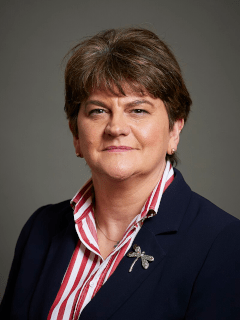
(Pictured: Official portrait of Baroness Foster of Aghadrumsee, January 30, 2024)
Gibney works as a civil servant in the Irish tax office for seven years and then joins the Bank of Ireland. She studies for a drama degree while at the bank and joins the company’s amateur dramatics group. She trains to be an actress at Dublin Oscar Theatre School.
Gibney’s first professional acting role comes in 1996, with a minor part in Some Mother’s Son, a film starring Helen Mirren. In 1999, she appears in the film Agnes Browne as Winnie the Mackerel. In 2007, she appears in Prosperity as Linda.
Gibney’s most prominent role is her portrayal of Cathy Brown, the daughter of Agnes Brown, played by her real-life husband, Brendan O’Carroll, a part she begins playing in the 1990’s in the original Mrs. Browne, and subsequently the BBC sitcom Mrs. Brown’s Boys since 2011. She also appears as Cathy in the film adaption Mrs. Brown’s Boys D’Movie and the talk show All Round to Mrs. Brown’s between 2017 and 2020. She and O’Carroll reprise their roles as the characters in the Netflix film A Madea Homecoming (2022).
In 2014, Gibney takes part in the twelfth series of Strictly Come Dancing. She is partnered with Irish professional Tristan MacManus. She and MacManus are the second couple to be eliminated in week three of the competition after dancing to ABBA‘s “Mamma Mia” on Movie Week. She competes in the bottom two against Blue star Simon Webbe and his partner Kristina Rihanoff.
Gibney has been married to Brendan O’Carroll since 2005 and has three stepchildren, Fiona and Danny, who also appear in Mrs. Brown’s Boys, and Eric.
Flanagan is born to Patrick and Elizabeth (née Mulligan) Flanagan, who are strongly nationalist and republican, and support the Republican Anti-Treaty during the Irish Civil War, both serving as Lord Mayor of Sligo. Her paternal family, originally from County Fermanagh, are driven out by anti‐Catholicpogroms and resettle in Sligo, where her parents manage a retail business. She is good friends with fellow Irish actresses Joan O’Hara and Paddy Croft. She spends much of the early 1950s touring with Anew McMaster, where she meets Harold Pinter at the Gate’s Pinter Festival.
In 1997, Flanagan wins the Barclays Theatre Awards for Best Actress in a Supporting Role for her role in Jennifer Johnston‘s The Desert Lullaby: A Play in Two Acts, at the Lyric Theatre, Belfast. The Barclays Theatre Awards are for outstanding regional theatre (including opera and dance) in the United Kingdom.
A resident of Glen Rock, New Jersey, Flanagan dies at The Valley Hospital in Ridgewood, New Jersey, on June 28, 2003, one day before her 78th birthday, of heart failure following a battle with lung cancer. She is survived by her husband, George Vogel (whom she married in 1958), a sister, Maura McNally, and her daughters Melissa Brown and Jane Holtzen.






 seamus dubhghaill