seamus dubhghaill

Promoting Irish Culture and History from Little Rock, Arkansas, USA


Leave a comment

Birth of Composer Siobhán Cleary

Siobhán Cleary, composer, is born in Dublin on May 10, 1970. Her most successful compositions are her orchestral works Alchemy and Cokaygne and her choral piece Theophilus Thistle and the Myth of Miss Muffett. Her opera Vampirella is first performed in Dublin in March 2017. She is a member of Aosdána.

Cleary starts to compose from an early age, often writing pieces while she is supposed to be practising at the piano. When she begins to study music at Maynooth University, she is initially inspired by Luciano Berio‘s Sinfonia, and soon afterwards by the works of the Irish composer Gerald Barry, the Frenchman Olivier Messiaen and the Hungarian György Ligeti. She continues her studies at Queen’s University Belfast and Trinity College, Dublin. In addition, she follows courses in composition with the Italian composer Franco Donatoni and the Dutchman Louis Andriessen and receives private tuition from the American Tom Johnson and the South African Kevin Volans. She also studies film scoring with the Italian composer Ennio Morricone and the American Don Brandon Ray.

Inspired by the alchemists’ Opus Alchymicum which describes how cheaper metals are transmuted into gold, Cleary’s orchestral work Alchemy (2001) is, like the stages in the Opus, presented in four parts: it evolves from the slow nigrendo, the moderate albedo, the strong citronatus, and the burning rubedo. The work is performed by the RTÉ National Symphony Orchestra in January 2002.

Cleary’s tone poem Cokaygne (2009), which, like Alchemy, is commissioned by RTÉ for the National Symphony Orchestra, is based on a poem and old sources which evoke a land of extreme luxury and contentment. The elaborately orchestrated piece is performed by the RTÉ National Symphony Orchestra in November 2009, Vladimir Altschuler conducting. It is performed by the RTÉ National Symphony Orchestra once again in June 2016, this time under the baton of Alan Buribayev.

Cleary’s choral work Theophilus Thistle and the Myth of Miss Muffett (2010), commissioned by the Cork International Choral Festival, is first performed in April 2011 by Chamber Choir Ireland directed by Paul Hillier. The work is based on a series of tongue twisters and other strange combinations of words popular in various European languages and dialects, moving from Italy, through Germany and Spain, finishing in Ireland. In 2013, it is performed twice by Chamber Choir Ireland in Dublin and Cork in connection with Ireland’s presidency of the European Union. The journalist and music critic Terry Blain comments on the choir’s “dazzingly virtuosic performance” in Belfast in 2013, qualifying the piece as “a tour de force of 21st century vocal chicanery, a clever and richly entertaining composition.” Theophilus Thistle is also performed the same year in the United States as part of the “Imagine Ireland” festival.

The chamber opera Vampirella with a libretto by Katy Hayes is first performed by students from the Royal Irish Academy of Music and the Lir National Academy of Dramatic Art at Dublin’s Smock Alley Theatre in March 2017. Based on a short story by Angela Carter telling how a young English soldier is seduced by a vampire countess, it is directed by Conor Hanratty and conducted by Andrew Synnott. Michael Dervan of The Irish Times finds the electronic sounds in the score particularly effective, commenting, “Perhaps this is a case of a genuinely electronic opera trying to break out of a more conventional mold.”

In 1996, Cleary receives a young artists award from Pépinières européennes pour jeunes artistes, followed in 1997 by the first prize in the Arklow Music Festival Composers’ Competition. In 2008, she is invited to become a member of Aosdána, an Irish association of creative artists.

Leave a comment

Passage of the Constitution (Removal of Oath) Act 1933

The Constitution (Removal of Oath) Act 1933 (act no. 6 of 1933, previously bill no. 2 of 1932), an Act of the Oireachtas of the Irish Free State amending the Constitution of the Irish Free State and the Constitution of the Irish Free State (Saorstát Eireann) Act 1922, is passed on May 3, 1933. The Act removes the Oath of Allegiance required of members of the Oireachtas and of non-Oireachtas extern ministers.

The oath, pledging allegiance to the Constitution and fidelity to George V as King of Ireland, is required by the Anglo-Irish Treaty signed in 1921, and has been the symbolic focus of Irish republican opposition to the Treaty in the 1922–23 Irish Civil War. When Fianna Fáil is founded in 1926 by veterans of the losing anti-Treaty side in the Civil War, abolishing the oath is a core aim. It is a main item in the manifesto for its successful 1932 Irish general election campaign, after which it forms a minority government whose first action is to introduce the Constitution (Removal of Oath) Bill 1932. Seanad Éireann has more ex-unionists and others conciliatory towards the United Kingdom and vote to reject the bill unless the Treaty can be amended by agreement. After the 1933 Irish general election, the Fianna Fáil majority government is able to override the Seanad and enact the law.

As well as amending the Constitution, the 1933 act also amends the Constitution of the Irish Free State (Saorstát Eireann) Act 1922, which had both created the Constitution in Irish law and also prohibited any Constitutional amendment incompatible with the Treaty. Since the Free State cannot unilaterally amend the Treaty, Fianna Fáil amends the 1922 act to remove the Treaty’s precedence over the Constitution. Later constitutional amendments are also incompatible with the terms of the Treaty, in particular by weakening and ultimately abolishing the office of Governor-General of the Irish Free State. There is legal controversy over whether the Oireachtas has the power to amend the 1922 act, because it had been passed by the Third Dáil sitting as a constituent assembly before the Oireachtas had come into being. In 1935 the Judicial Committee of the Privy Council (JCPC) in London rules that, in British law, the Oireachtas does have the power, under the Statute of Westminster 1931. Irish jurisprudence takes issue with many of the assumptions underlying the 1935 decision.

The question is rendered moot with the adoption of the Constitution of Ireland in 1937 which repeals the Free State Constitution. The 1933 act is itself repealed as spent by the Statute Law Revision Act 2016.

(Pictured: Great Seal of the Irish Free State)


Leave a comment

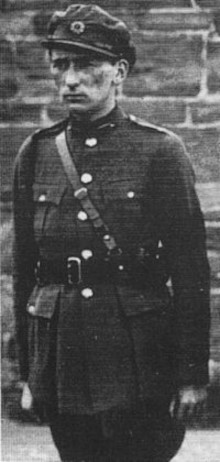
Death of Liam Tobin, Irish Army Officer & IRA Intelligence Officer

Liam Tobin, officer in the Irish Army and the instigator of the Irish Army Mutiny in March 1924, dies in Dublin on April 30, 1963. During the Irish War of Independence, he serves as an Irish Republican Army (IRA) intelligence officer for Michael CollinsSquad.

Tobin is born William Joseph Tobin at 13 Great Georges Street in Cork, County Cork, on November 15, 1895, the eldest son of Mary Agnes (nee Butler) and David Tobin, a hardware clerk. He has two younger siblings, Katherine and Nicholas Augustine Tobin, also born in Cork. His family moves to John Street in Kilkenny and then to Dublin. He goes to school in Kilkenny and is an apprentice in a hardware shop at the time of the 1916 Easter Rising. As a participant in the Rising he fights in the Four Courts garrison under Edward Daly. He is arrested, court martialed, and sentenced to death but his sentence is commuted to life imprisonment. He is a prisoner in Kilmainham, Mountjoy, Lewes, Dartmoor, Broadmoor and Pentonville prisons. He is released in June 1917.

In early 1919 Tobin becomes Collins’ chief executive in the Intelligence Directorate handling the many spies in Dublin Castle, including double agent David Neligan. Nancy O’Brien works for Under-Secretary for Ireland James Macmahon, decoding messages sent from London. Each day between 2:30 and 3:30 she passes any information acquired to either Tobin, Joseph McGrath, or Desmond FitzGerald. Tobin is involved in planning the assassinations of British soldiers, informants, members of the Royal Irish Constabulary, the Dublin Metropolitan Police, and operatives of MI5. He constructs detailed profiles of everyone remotely connected to the British government, often using Who’s Who, The Morning Post, and The Times, a newspaper that describes him as “one of the most formidable of [the] Twelve Apostles.”

In October 1921, Tobin travels with the Irish Treaty Delegation as part of Collins’ personal staff.

Tim Pat Coogan and James Mackay have examined Tobin’s involvement in the assassination of British Field Marshal Sir Henry Wilson. Wilson’s public tirades about Collins is evidence of mutual personal dislike between the two men. In May 1922 Collins tells Tobin “We’ll kill a member of that bunch” to the news of “bloody pogroms” in Belfast. Wilson is intimately involved with the Ulster loyalist cause, including the Curragh Mutiny and the establishment of the Ulster Special Constabulary. Just before the shooting, Coogan places Tobin in London. He meets courier Peig Ni Braonain at Euston Station collecting a document that has been sent from Dublin. Returning to Dublin before the incident, he is jubilant when he tells defence minister Richard Mulcahy about Wilson’s death. Mulcahy is appalled and threatens to resign.

Following the Anglo-Irish Treaty, Tobin is appointed deputy director of intelligence in the new state and assigned to the Criminal Investigation Department based at Oriel House. However Collins soon replaces him with Joseph McGrath. Tobin is placed on the Army Council and is Director of Intelligence from September 1922 until his appointment as Senior Aide-de-Camp to the new GovernorGeneral of the Irish Free State, Tim Healy, in November 1922. The position provides an apartment in Viceregal Lodge.

In October 1922, Tobin’s brother Nicholas, a Free State captain, is accidentally shot dead by his own troops during the raid and capture of a bomb making factory at number 8 Gardiner’s Place, Dublin.

Tobin believes in the stepping stone doctrine which sees the Treaty as a stage towards full independence. With the outbreak of the Irish Civil War he remains loyal to Collins and takes the Pro-Treaty side. He leads in the fight against the Anti-Treaty IRA in the south. Disillusioned with the continuing hostilities and in the aftermath of the death of Collins, he forms an association called the IRA Organisation (IRAO) or “Old Irish Republican Army” to distinguish themselves from the anti-treaty insurgents.

Richard Mulcahy, the new Irish defence minister, proposes to reduce the army from 55,000 to 18,000 men in the immediate post- Civil-War period. Tobin knows his own position is to be affected and shares the perception that the Irish Army treats former British officers better than former IRA officers. On March 7, 1924, Tobin, together with Colonel Charlie Dalton, sends an ultimatum to President of the Executive Council of the Irish Free State W. T. Cosgrave demanding an end to the army demobilisation. The immediate response is an order for the arrest of the two men on a charge of mutiny. The cabinet, already wary of the Irish Army, orders an inquiry and appoints Garda Commissioner Eoin O’Duffy to the army command.

On March 18, the mutineers assemble with hostile intent at a Dublin pub. An order is made to arrest the mutineers and the cabinet demands the resignation of the army council. The generals resign, affirming the subservience of the military to the civilian government of the new state.

In later years, Tobin rebuilds relations with his Civil War foes and joins Éamon de Valera‘s Anti-Treaty Fianna Fáil party. He joins up with Joseph McGrath to form the Irish Hospitals’ Sweepstake in the 1930s. Many other former army comrades find work in this lottery. He leaves the Sweep in 1938. After World War II, he becomes Superintendent of the Oireachtas for the Irish Dáil.

On October 14, 1929, Tobin marries Monica “Mona” Higgins at the Church of the Holy Family, Aughrim Street, Dublin. They have two daughters, Máire and Anne Tobin. Following the death of his father, David, in 1956, Tobin’s health declines, resulting in his death in Dublin on April 30, 1963.

Tobin is portrayed by actor Brendan Gleeson in Neil Jordan‘s biopic Michael Collins.


Leave a comment

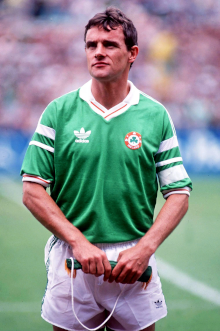
Birth of Kevin Moran, Gaelic & Association Footballer

Kevin Bernard Moran, Irish footballer who excels at the top levels of Gaelic and association football, is born in Dublin on April 29, 1956. In Gaelic football, he is known for his time at senior level with the Dublin county football team, winning two All-Ireland Senior Football Championships with them, and in association football for his career with Manchester United F.C. and the Republic of Ireland national football team. In 1985 he becomes the first man to be sent off in an FA Cup Final.

Moran grows up in Rialto, Dublin until his early teens, before he moves to the Long Mile Road in Walkinstown. While there, he attends James’s Street CBS and Drimnagh Castle Secondary School where Gaelic football is the dominant sport although association football proves to be the sport he plays on the streets while growing up. During the period in which he plays Gaelic football for Good Counsel GAA and association football for Rangers A.F.C., Bohemian F.C. and Pegasus A.F.C., he has divided loyalties between the two sports, as both sports are then played on Saturday.

In his native Ireland, Moran plays at senior level for the Dublin county football team. A former Dublin under-21 player, he is called up to the senior panel for the first time in 1976. He wins two All-Ireland Championship medals with Dublin in 1976 and 1977. In the 1976 final, he helps Dublin to defeat (by 3–8 to 0–10) Kerry, the winner over Dublin in the 1975 final, and again in the 1977 semi-final, aided by new tactics which manager Kevin Heffernan introduces, and which hinders Kerry’s tactic of pulling defenders forward and taking full advantage of the space behind the half-back line. The 1977 final results in a 5–12 to 3–6 victory over Armagh at Croke Park. He is awarded a GAA GPA All-Stars Award for his performance in the 1976 championship.

Moran is also part of the 1976–77 side that wins the National Football League for Dublin with a win over Derry in the final. He plays his club football for Dublin-based GAA club Good Counsel.

With Bohemian F.C. winning everything bar the FAI Cup in the 1974-75 League of Ireland season, 18-year-old Moran does not have an opportunity for much game time and only makes one League of Ireland appearance in the last game of the season on April 17, 1975. After Bohs he moves to University College Dublin A.F.C. where in December 1975 he wins the Collingwood Cup. In February 1976 he wins the Universities Championship when he scores the winner for the Irish Universities against their Scottish counterparts. He plays for Pegasus A.F.C. from 1976-78.

Moran is spotted by Billy Behan, a Manchester United F.C. scout, who reports to United manager Dave Sexton, and Moran signs for Manchester United in February 1978. He makes his senior debut on April 20, 1979, against Southampton F.C., and is a regular player in the first team by the time Ron Atkinson succeeds Sexton as manager in June 1981. Despite not being the tallest of defenders, he is known for his strong aerial ability and is a threat in the box from corners and set pieces. Playing as a centre-back, he wins FA Cup medals with the club in 1983 and 1985.

Moran is notable for being sent off in the 1985 FA Cup Final against Everton F.C., the first player ever to be sent off in an FA Cup final. TV cameras reveal that he had gone for the ball, and not for Peter Reid in the offending tackle. He is later presented with the winner’s medal that had at first been withheld.

After 10 years with United, Moran leaves Old Trafford as a 32-year-old in the summer of 1988, having played his final 18 months at the club under the management of Alex Ferguson. His first team opportunities are limited since the arrival of Steve Bruce in December 1987.

Moran transfers to Sporting Gijón, where he remains for two seasons, making 33 appearances without scoring. During his time at Sporting Gijón, he rooms with promising youngster and future Real Madrid CF and FC Barcelona star Luis Enrique.

In 1990, Moran returns to England to join Second Division Blackburn Rovers F.C. He is an automatic choice in the first team but endures a disappointing first season at Ewood Park as Rovers finishes 19th in the Second Division. The following season is a huge success, however, as playoff victory ends the club’s 26-year exile from the top division and secures their place in the new Premier League. He continues in his role as club captain as Rovers finishes fourth in 1992–93 and runners-up in 1993–94. He retires at the end of the 1993–94 season, one year before Rovers wins their first league title in 81 years. In both seasons preceding his retirement, Rovers are beaten to the title by his old club, Manchester United.

Moran makes his debut for the Republic of Ireland against Switzerland in 1980 and plays a key role in Ireland’s unsuccessful attempt to qualify for the 1982 FIFA World Cup finals in Spain. He plays 71 times for Ireland between 1980 and 1994, including UEFA Euro 1988 in Germany and the 1990 FIFA World Cup in Italy, and scores 6 goals. He is also a member of the Irish squad at the 1994 FIFA World Cup in the United States, despite being 38 years old and about to retire from playing completely but does not play due to an injury he picks up before the tournament starts.

After retiring from football, Moran makes a career in business. In 1994, he forms a football agency, Proactive Sports Management, with Paul Stretford and Jesper Olsen. His own clients include John O’Shea and Steve Finnan. He also works as a pundit on Irish television channel TV3.

Moran’s brother Ray is a knee specialist known as “Dr. Cruciate” and as a “surgeon to the stars,” with clients including rock star Jon Bon Jovi and numerous athletes (such as Bernard Brogan, Colm Cooper, Brendan Maher, Alan Quinlan and Josh van der Flier). Moran sits on the board of his brother’s Sports Surgery Clinic (SSC) in Santry, Dublin, which opens in 2007.


Leave a comment

Birth of Gerry Rafferty, Singer, Songwriter & Musician

Gerald Rafferty, Scottish singer, songwriter, musician, and record producer, is born in Paisley, Renfrewshire, Scotland, on April 16, 1947. His solo hits in the late 1970s include “Baker Street,” “Right Down the Line” and “Night Owl,” as well as “Stuck in the Middle with You,” which is recorded with his band Stealers Wheel in 1973.

Rafferty is the third son of Irish miner and lorry driver Joseph Rafferty and his Scottish wife Mary Skeffington. His abusive alcoholic father dies when Gerry is only sixteen years old. He grows up in a council house on the town’s Glenburn estate and attends St. Mirin’s Academy. Inspired by his Scottish mother, who teaches him both Irish and Scottish folk songs, and the music of Bob Dylan and the Beatles, he starts writing his own material. In 1963 he leaves St. Mirin’s Academy and works in a butcher’s shop and as a civil service clerk while also playing with the local group Maverix on weekends.

In the mid-1960s Rafferty earns money busking on the London Underground. In 1966 he meets fellow musician Joe Egan and they are both members of the pop band the Fifth Column. In 1969 he becomes the third member of the folk-pop outfit the Humblebums, which also features comedian Billy Connolly and Tam Harvey. He and Connelly record two well-received albums on the Transatlantic Records label as a duo.

Rafferty releases his first solo album, Can I Have My Money Back?, in 1972. That same year he and Egan form the group Stealers Wheel. Stealers Wheel has a huge hit with the jaunty and witty song “Stuck in the Middle with You,” which peaks at #6 on the Billboard pop charts. Stealers Wheel has a lesser Top 40 hit with “Star” ten months later and eventually breaks up in 1975.

In 1978 Rafferty hits pay dirt with his second solo album, City to City, which soars to #1 on the Billboard album charts and sells over five million copies worldwide. The album also begets the hit song “Baker Street.” This haunting and poetic ballad is an international smash that goes to #2 in the United States, #3 in the United Kingdom, #1 in Australia, and #9 in the Netherlands.

Rafferty’s third album, Night Owl, likewise does well. Moreover, he has additional impressive chart successes with the songs “Right Down the Line,” “Home and Dry,” “Days Gone Down,” and “Get It Right Next Time.” Alas, a handful of albums he records throughout the 1980s and 1990s all prove to be commercial flops. He sings the vocal on the song “The Way It Always Starts” for the soundtrack of the movie Local Hero.

Rafferty is married to Carla Ventilla from 1970 to 1990. He records his last album, Another World, in 2000 and releases the compilation CD, Life Goes On, in 2009.

Rafferty has problems with alcoholism that directly contributes to his untimely death. In November 2010, he is admitted to the Royal Bournemouth Hospital where he is put on a life support machine and treated for multiple organ failure. After being taken off life support, he rallies for a short time, and doctors believe he might recover. He dies, however, of liver failure at the home of his daughter Martha in Stroud, Gloucestershire, on January 4, 2011.

A requiem mass is held for Rafferty at St. Mirin’s Cathedral in Paisley on January 21, 2011. The mass is streamed live over the Internet. Politicians in attendance are the First Minister of Scotland Alex Salmond MSP, Wendy Alexander MSP, Hugh Henry MSP, and Robin Harper MSP. The musicians present include Craig and Charlie Reid of The Proclaimers, former bandmates Joe Egan and Rab Noakes, Barbara Dickson, and Graham Lyle. The eulogy is given by Rafferty’s longtime friend John Byrne. His remains are then cremated at the Woodside Crematorium in Paisley and his ashes scattered on Iona. He is survived by his daughter, granddaughter Celia, and brother Jim.


Leave a comment

Death of Patrick Hillery, Sixth President of Ireland

Patrick John Hillery, Irish politician and the sixth President of Ireland, dies in Glasnevin, Dublin, at the age of 84 on April 12, 2008, following a short illness. He serves two terms in the presidency and, though widely seen as a somewhat lacklustre President, is credited with bringing stability and dignity to the office. He also wins widespread admiration when it emerges that he has withstood political pressure from his own Fianna Fáil party during a political crisis in 1982.

Hillery is born in Spanish Point, County Clare on May 2, 1923. He is educated locally at Milltown Malbay National school before later attending Rockwell College. At third level he attends University College Dublin where he qualifies with a degree in medicine. Upon his conferral in 1947 he returns to his native town where he follows in his father’s footsteps as a doctor.

Hillery is first elected at the 1951 Irish general election as a Fianna Fáil Teachta Dála (TD) for Clare and remains in Dáil Éireann until 1973. During this time, he serves as Minister for Education (1959–1965), Minister for Industry and Commerce (1965–1966), Minister for Labour (1966–1969) and Minister for Foreign Affairs (1969–1973).

Following Ireland’s successful entry into the European Economic Community in 1973, Hillery is rewarded by becoming the first Irishman to serve on the European Commission, serving until 1976 when he becomes President. In 1976 the Fine GaelLabour Party National Coalition under Liam Cosgrave informs him that he is not being re-appointed to the Commission. He considers returning to medicine; however, fate takes a turn when Minister for Defence Paddy Donegan launches a ferocious verbal attack on President Cearbhall Ó Dálaigh, calling him “a thundering disgrace” for referring anti-terrorist legislation to the courts to test its constitutionality. When a furious President Ó Dálaigh resigns, a deeply reluctant Hillery agrees to become the Fianna Fáil candidate for the presidency. Fine Gael and Labour decide it is unwise to put up a candidate in light of the row over Ó Dálaigh’s resignation. As a result, Hillery is elected unopposed, becoming President of Ireland on December 3, 1976.

When Hillery’s term of office ends in September 1983, he indicates that he does not intend to seek a second term, but he changes his mind when all three political parties plead with him to reconsider. He is returned for a further seven years without an electoral contest. After leaving office in 1990, he retires from politics.

Hillery’s two terms as president, from 1976 to 1990, end before the 1998 Good Friday Agreement, which sets terms for an end to violence in Northern Ireland. But he acts at crucial moments as an emollient influence on the republic’s policies toward the north and sets a tone that helps pave the way for eventual peace.

Patrick Hillery dies on April 12, 2008, in his Dublin home following a short illness. His family agrees to a full state funeral for the former president. He is buried at St. Fintan’s Cemetery, Sutton, near Dublin. In the graveside oration, Tánaiste Brian Cowen says Hillery was “A humble man of simple tastes, he has been variously described as honourable, decent, intelligent, courteous, warm and engaging. He was all of those things and more.”


2 Comments

Death of Nelly O’Brien, Miniaturist, Artist & Activist

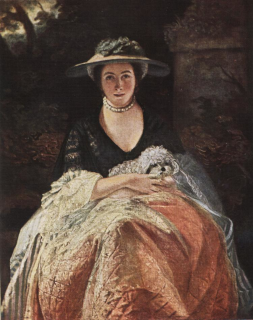
Ellen Lucy or Nelly O’Brien, Irish miniaturist, landscape artist, and Gaelic League activist, dies suddenly on April 1, 1925, while visiting her brother Dermod at 66 Elm Park Gardens, London.

O’Brien is born Ellen Lucy O’Brien on June 4, 1864, at Cahirmoyle, County Limerick. She is the eldest child of Edward William O’Brien and Mary O’Brien (née Spring Rice). Her siblings are Lucy and Dermod, with Dermod also becoming an artist. Her father is a landowner, and her mother is a sculptor and painter and sister of Thomas Spring Rice. Her grandfather is William Smith O’Brien.

While a young child, O’Brien spends two years living on the French Riviera from 1866 to 1868. Her mother later dies of tuberculosis, and the three children are raised by their aunt, the writer and nationalist, Charlotte Grace O’Brien. Their father remarries in 1880, to Julia Marshall, with whom he has two sons and two daughters.

O’Brien attends school in England from 1879, and later enrolls to study painting at the Slade School of Fine Art. She meets Walter Osborne through her brother Dermod, and considers herself engaged to him, but Osborne dies on April 24, 1903. A portrait of O’Brien by Osborne is held in the Hugh Lane Gallery.

O’Brien returns to Ireland and begins to paint miniatures on ivory using a magnifying glass. She also paints watercolour landscapes. Her first exhibition with the Royal Hibernian Academy (RHA) is in 1896, where she shows three works including Sketch near Malahide. She exhibits with the RHA on and off until 1922. During some of her time in Dublin, she lives with her half-brother, Edward Conor Marshall O’Brien, on Mount Street.

As part of an exhibition of Irish painters, O’Brien exhibits a number of portrait miniatures at the London Guildhall in 1904. The 1906 Oireachtas na Gaeilge features a number of her paintings, and in the same year she becomes honorary secretary of a newly established art committee. At the MunsterConnacht exhibition in Limerick of 1906, she exhibits a miniature of William Smith O’Brien amongst her 12 works on show. She produces many portraits, including one of Douglas Hyde, which is exhibited by the RHA in 1916.

O’Brien is an early member of the Gaelic League, being present at its first Oireachtas na Gaeilge in 1897 and founding the Craobh na gCúig gCúigí (Branch of the Five Provinces). In 1905, she writes a long letter in defence of Douglas Hyde and the Gaelic League in The Church of Ireland Gazette. She holds meetings of Craobh na gCúig gCúigí in her flat at 7 St. Stephen’s Green every Saturday night in 1907. In 1911, she founds Coláiste Eoghain Uí Chomhraí (O’Curry Irish College) in Carrigaholt, County Clare, which is named in honour of Eugene O’Curry, with the help of her cousin and friend Mary Spring Rice.

One of her ultimate goals is to create a national Irish church, which would unite Protestants and Catholics through the Irish language. To this end, she establishes the Irish Guild of the Church with Seoirse de Rút in 1914. The aim of the organisation is to provide a communal union for members of the Church of Ireland who are dedicated to “Irish Ireland” ideals.

Acting as a representative for the Gaelic League, she travels to the United States with Fionan MacColuim in 1914 to 1915, to fund raise and promote Irish art and industries. At Coláiste Eoghain Uí Chomhraí, she stresses the importance of the Irish language in the home, as well as the skills of housewives and those in domestic service in strengthening the language and Irish culture.

O’Brien notes that she initially thought that the 1916 Easter Rising was “in the nature a demonstration against conscription as it had been announced that the volunteers would resist disarmament.” She is staying with the Hydes at 1 Earlsfort Place during the Rising, as her flat at College Park Chambers had been destroyed. She protests the conscription bill in Ireland as a mass meeting of women at the Mansion House in 1918. She launches the Gaelic Churchman in 1919 as the official publication of the Irish Guild of the Church. In one article entitled A plea for the Irish services, she promotes her campaign for Irish language services in Protestant churches. In her capacity of vice-president of the guild, she invites Éamon de Valera to attend one of their meetings in 1921.

O’Brien dies suddenly on April 1, 1925, while visiting Dermod at 66 Elm Park Gardens, London. She is buried at the family plot in Cahirmoyle.

(Pictured: Nelly O’Brien by Sir Joshua Reynolds, 1723-1792)


Leave a comment

Birth of Kevin Myers, Journalist & Writer

Kevin Myers, English-born Irish journalist and writer, is born in Leicester, England on March 30, 1947. He has contributed to the Irish Independent, the Irish edition of The Sunday Times, and The Irish Times‘s column An Irishman’s Diary. He is known for his controversial views on a number of topics, including single mothers, aid for Africa, and the Holocaust.

Myers grows up in England. His father, an Irish GP, dies when he is 15 and away at Ratcliffe College, a Catholic boarding school. His father’s early death creates financial difficulties, though he manages to stay at the school with the help of both the school and the Local Education Authority (LEA). He moves to Ireland to go to university, and graduates from University College Dublin (UCD) in 1969.

Myers subsequently works as a journalist for Irish broadcaster RTÉ, and reports from Northern Ireland during the height of the Troubles. He later works for three of Ireland’s major newspapers, The Irish Times, the Irish Independent, and the Irish edition of The Sunday Times. In 2000, a collection of his An Irishman’s Diary columns is published, with a second volume following in 2007. He is also a presenter of the Challenging Times television quiz show on RTÉ during the 1990s.

In 2001, Myers publishes Banks of Green Willow, a novel, which is met with negative reviews. In 2006, he publishes Watching the Door, about his time as a journalist in Northern Ireland during the 1970s. The book receives positive reviews in The Times, The Guardian, and the New Statesman, while The Independent publishes a more mixed review that wonders whether there is “an element of hyperbole” in Myers’ account.

Myers is a regular contributor to radio programmes on News Talk 106, particularly Lunchtime with Eamon Keane and The Right Hook. He regularly appears on The Last Word on Today FM. He is also a member of the Film Classification Appeals Board, formerly known as the Censorship Board.

Myers is a fervent critic of physical-force Irish republicanism. In 2008, he writes a column condemning the anniversary commemorations of the 1916 Easter Rising. He describes the Larne gun-running by Ulster Volunteers in 1914 as “high treason, done in collaboration with senior figures in the British army and the Conservative Party.” He has also written that it is a “myth” to say, when discussing Irish republicanism and Ulster loyalism, that “one side is as bad as the other.”

In 2005, Myers attracts considerable criticism for his column, An Irishman’s Diary, in which he refers to children of unmarried mothers as “bastards.” Former Minister of State Nuala Fennell describes the column as “particularly sad.” She says the word “bastard” is an example of pejorative language that is totally unacceptable. Myers issues an unconditional apology two days later. The Irish Times editor, Geraldine Kennedy, also apologises for having agreed to publish the article.

In July 2008, Myers writes an article arguing that providing aid to Africa only results in increasing its population, and its problems. This produces strong reactions, with the Immigrant Council of Ireland making an official complaint to the Garda Síochána alleging incitement to hatred. Hans Zomer of Dóchas, an association of NGOs, and another complainant, take a complaint to the Press Council on the grounds that it breaches four principles of the Council’s Code of Practice: accuracy, fairness and honesty, respect for rights, and incitement to hatred.

At the end of July 2017, Myers contributes an article entitled “Sorry, ladies – equal pay has to be earned” to the Irish edition of The Sunday Times about the BBC gender-pay-gap controversy. He further alleges that Claudia Winkleman and Vanessa Feltz are higher paid than other female presenters because they are Jewish. The editor of the Irish edition, Frank Fitzgibbon, issues a statement saying in part “This newspaper abhors anti-Semitism and did not intend to cause offence to Jewish people.” Martin Ivens, editor of The Sunday Times, says the article should not have been published. Ivens and Fitzgibbon apologise for publishing it. After complaints from readers and the Campaign Against Antisemitism, the article is removed from the website. The newspaper announces that Myers will not write for The Sunday Times again. Myers is defended by the chair of the Jewish Representative Council of Ireland, Maurice Cohen, who states, “Branding Kevin Myers as either an antisemite or a Holocaust denier is an absolute distortion of the facts.”

Myers is married to Rachel Nolan and lives in County Kildare. He is the brother-in-law of TV presenter, producer and UK Big Brother housemate Anna Nolan.


1 Comment

Death of Joseph McGrath, Politician & Businessman

Joseph McGrath, Irish politician and businessman, dies in Ballsbridge, Dublin, on March 26, 1966. He is a Sinn Féin and later a Cumann na nGaedheal Teachta Dála (TD) for various constituencies: Dublin St James’s (1918–1921), Dublin North-West (1921–1923) and Mayo North (1923–1924), and develops widespread business interests.

McGrath is born in Dublin on August 12, 1888. By 1916 he is working with his brother George at Craig Gardiner & Co., a firm of accountants in Dawson Street, Dublin. He works with Michael Collins, a part-time fellow clerk and the two strike up a friendship. In his spare time he works as secretary for the Volunteer Dependents’ Fund.

McGrath soon joins the Irish Republican Brotherhood. He fights in Marrowbone Lane in the 1916 Easter Rising. He is arrested after the rising, and jailed in Wormwood Scrubs and Brixton prisons in England. In the 1918 Irish general election, he is elected as Sinn Féin TD for the Dublin St. James’s constituency, later sitting in the First Dáil. He is also a member of the Irish Republican Army (IRA), and successfully organises many bank robberies during the Irish War of Independence (1919–1921), where a small percentage of the proceeds is retained as a reward by him and his fellow-soldiers. During this time he is interred briefly at Abercorn Barracks but escapes by dressing in army uniform and walking out of the gate with soldiers going on leave. He is eventually recaptured and spends time in jail in Belfast.

In October 1921 McGrath travels with the Irish Treaty delegation to London as one of Michael Collins’ personal staff. When the Provisional Government of Ireland is set up in January 1922, he is appointed Minister for Labour. In the Irish Civil War of 1922–1923, he takes the pro-Treaty side and is made Director of Intelligence, replacing Liam Tobin. In a strongly worded letter, written in red ink, he warns Collins not to take his last, ill-fated trip to County Cork.

McGrath is later put in charge of the police Intelligence service of the new Irish Free State, the Criminal Investigation Department (CID). It is modelled on the London Metropolitan Police department of the same name, but is accused of the torture and killing of a number of republican (anti-Treaty) prisoners during the civil war. It is disbanded at the war’s end with the official reason given that it is unnecessary for a police force in peacetime. He goes on to serve as Minister for Labour in the Second Dáil and the Provisional Government of Ireland. He also serves in the 1st and 2nd Executive Councils holding the Industry and Commerce portfolio.

In September 1922 McGrath uses strikebreakers to oppose a strike by Trade Unionists in the Post Office service, despite having threatened to resign in the previous March of the same year when the government threatened to use British strikebreakers.

In December 1922 McGrath is a reluctant supporter of the government’s decision to execute four high profile IRA prisoners: Liam Mellows, Dick Barrett, Rory O’Connor, and Joe McKelvey.

McGrath resigns from office in April 1924 because of dissatisfaction with the government’s attitude to the Army Mutiny officers and as he says himself, “government by a clique and by the officialdom of the old regime.” By this he means that former IRA fighters are being overlooked and that the Republican goals on all Ireland has been sidelined. He and eight other TDs, who had resigned from Cumann na nGaedheal, resign their seats in the Dáil and form a new political party, the National Party. However, the new party does not contest the subsequent by-elections for their old seats. Instead, Cumann na nGaedheal wins seven of the seats and Sinn Féin wins the other two.

In 1927, McGrath takes a libel case against the publishers of The Real Ireland by poet Cyril Bretherton, a book that claims he is responsible for the abduction and murder of Noel Lemass, the brother of Seán Lemass, in June 1923 during the civil war, as well as a subsequent coverup. He wins the court case. During the 1930s, he and Seán Lemass reconcile and regularly play poker together.

Following his political career, McGrath goes on to become involved in the building trade. In 1925 he becomes labour adviser to Siemens-Schuckert, German contractors for the Shannon hydroelectric scheme near Limerick. He founds the Irish Hospitals’ Sweepstake in 1930, and the success of its sweepstakes makes him an extremely wealthy man. He has other extensive and successful business interests always investing in Ireland and becomes Ireland’s best-known racehorse owner and breeder, winning The Derby with Arctic Prince in 1951.

McGrath dies at his home, Cabinteely House, in Ballsbridge, Dublin on March 26, 1966. Cabinteely House is donated to the state in 1986 and the land is developed as a public park. His son, Patrick W. McGrath, inherits many of his father’s business interests, and also serves as Fine Gael Senator from 1973 to 1977.

(Pictured: Screenshot of a film of Irish politician Joseph McGrath shot in 1922)


Leave a comment

Birth of Philip Ó Ceallaigh, Short Story Writer & Translator

Philip Ó Ceallaigh, Irish short story writer and translator, is born in Ireland on March 23, 1968. He wins the 2006 Rooney Prize for Irish Literature and is shortlisted for the Frank O’Connor International Short Story Award. He speaks six languages.

One of Ó Ceallaigh’s classmates in school is Sinéad O’Connor. He once tells an interviewer, “She told me she wanted to become famous and I tried to talk her out of it.”

Ó Ceallaigh graduates from University College Dublin (UCD) with a degree in philosophy. After receiving his degree, he travels the world, doing a variety of jobs, including waiter, newspaper editor, freelance journalist and volunteer for clinical trials. He moves to Bucharest, Romania, so that he can live cheaply and pursue his desire to write.

Ó Ceallaigh has spent much of his adult life in Eastern Europe, starting in Russia in the early 1990s. Since 1995 he has lived mostly in Bucharest, Romania. He has also lived for a while in the United States.

Ó Ceallaigh has published over 40 short stories, as well as essays and criticism. His work has appeared in Granta, The Irish Times and the Los Angeles Review of Books and has been translated into more than a dozen languages. In 2010, he edits Sharp Sticks, Driven Nails, an anthology of new short stories by twenty-two Irish and international writers, for The Stinging Fly Press. He translates Mihail Sebastian‘s autobiographical novel For Two Thousand Years. It tells the story of the author’s early years as a Jew in Romania during the 1920s. It is published in 2016.

Ó Ceallaigh has written an unpublished novel but reduces it to a long short story and believes “if you’ve got something to say and you can say it with less, that’s the way to go.”

The first story in Ó Ceallaigh’s third collection, Trouble, involves a security guard and the theft of sum of money from a gangster. He uses time he spent as a security guard in Dublin to form the basis of this fiction.

Ó Ceallaigh eschews the prevailing style of Irish short story writing in that his works are rarely set in Ireland, and instead are set in a variety of locations across the world, predominately in Romania. His stories generally feature solitary men, with women playing more incidental roles. He acknowledges being influenced in his writing style by Charles Bukowski, Anton Chekhov, Fyodor Dostoyevsky, Ernest Hemingway, Jack Kerouac, and Ivan Turgenev.

Ó Ceallaigh wins the Hennessy Award for his first published work in 1998. He wins the Rooney Prize for Irish Literature and the Glen Dimplex New Writers’ Award for his collection Notes from a Turkish Whorehouse in 2006. His second collection, The Pleasant Light of Day, is shortlisted for the Frank O’Connor International Short Story Award. He is the first Irish writer to receive this honour.