Born to Irish emigrants in Scotland, McCabe moves with his family to Ireland in the early 1940s. He lives on a farm near Lackey Bridge, just outside Clones, County Monaghan. He is educated at Castleknock College.
McCabe’s play King of the Castle causes a minor scandal when first staged in 1964, and is protested by the League of Decency. He writes his award-winning trilogy of television plays, consisting of Cancer, Heritage and Siege, because he feels he has to make a statement about the Troubles. His 1992 novel Death and Nightingales is hailed by Irish writer Colm Tóibín as “one of the great Irish masterpieces of the century” and a “classic of our times” by Kirkus Reviews.
McCabe defends fellow novelist Dermot Healy, who had been negatively reviewed by Eileen Battersby in The Irish Times in 2011, using the Joycean invective “shite and onions”, provoking controversy in the Irish literary community.
Fintan O’Toole notes how living in Monaghan, just across the border from County Fermanagh, informed McCabe’s writing, and described him as “the great laureate of…indeterminacy, charting its inevitably tragic outcomes while holding somehow to the notion that it might someday become a blessing.”
McCabe dies at the age of 90 on August 27, 2020, in Cavan, County Cavan. He is survived by his wife Margot, his four children, Ruth, Marcus, Patrick and Stephen, and thirteen grandchildren.
On July 3, Father John Patrick Dunn of the Church of St. Philip Neri in the Southwark District is warned that the church might be attacked during an upcoming parade held by the Native American Party. The Native American Party, a nativist political party, plans to hold a large parade the next day on Independence Day.
Five of the muskets placed in St. Philip Neri’s Church are discovered to be defective and are sent back to the Frankford Arsenal to be repaired. No violence occurs before or during the parade, but on July 5, a nativist mob numbering in the thousands gathers at the church after some observe five defective muskets being returned to the church. They then demand that the sheriff remove the weapons, while Father Dunn and volunteers rally to protect the church. Sheriff Morton McMichael and two aldermen search the church and remove twelve muskets. After leaving the church, the sheriff urges the crowd to disperse and leaves a volunteer posse to guard the church. The mob remains, and a man injured in the May riots makes a speech to the crowd, calling for a second search of the church. The sheriff, an alderman, and seventeen nativists enter the church and find three armed men, fifty-three muskets, ten pistols, a keg of gunpowder and ammunition. To avoid inciting the mob, the sheriff decides not to remove the armaments, and the search party stays in the church. Just after midnight, July 6, Major General Patterson orders a company of city guards to clear the streets. After the crowd disperses, the arms found within the church are removed.
By midday, the crowds return around St. Philip Neri’s Church. GeneralGeorge Cadwalader orders the crowds to disperse, but they do not. By the evening, the sheriff arrives with a 150-strong posse. Throughout the evening, the military presence grows, and three cannons are stationed on the streets. The soldiers clear the streets near the church, despite being pelted with rocks by the mob. Responding to the rock throwers, General Cadwalader orders a cannon to be fired at the crowd on Third Street. Former U.S. CongressmanCharles Naylor begs the general not to fire. He and several others are arrested and held within the church. By the morning of July 7, most of the soldiers have left, but the crowds, led by an alderman and the sheriff, return and demand that the remaining guard release Naylor. Everyone except Naylor is released. The crowds grow, and a cannon is brought from a nearby wharf and used to threaten the church. After further negotiations, Naylor is released and carried home to cheers on people’s shoulders.
After Naylor is brought home, the mob attacks the church, damaging a wall with the cannon. A second cannon is brought from the wharfs and fired at the church, after which the mob pelts the building with rocks and break in through a side door. The soldiers fire on the men breaking into the church, who promptly retreat. After retreating, the nativists negotiate with the guard, who agrees to withdraw, allowing the nativists to guard the church. The crowd pelts the soldiers with rocks and some soldiers fire back, which only incites the mob further. The mob forces its way into the church, causing extensive damage to the interior. After about an hour, a group of twenty men organizes themselves to guard St. Philip Neri’s, and the mob leaves the church.
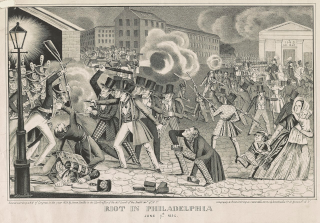
By the evening, a large number of soldiers arrive with orders to clear the streets, only to be stoned in the process. After a captain is attacked, the order is given to fire on the mob, which results in seven fatalities and nine injuries. Not long after, people with muskets and cannons arrive and fierce fighting breaks out between the soldiers and the mob. The fighting lasts for several hours, with the soldiers being fired upon from alleyways and the windows of nearby buildings. The soldiers bring in two cannons of their own and fire on the mob. The mob returns fire using their own cannons, armed with items such as nails, chains, knives and broken bottles. In an attempt to capture the mob’s cannons, soldiers charge one cannon’s position, only to be knocked off their horses by a rope tied across the street. The cannons are all eventually captured, and by early morning on July 8, the fighting has ended.
At least fifteen people, including rioters and soldiers, are killed in the riot, and at least fifty people are injured. Under Governor Porter’s orders, state troops continue to arrive in the city in the days afterward, but no further violence takes place. An estimated 5,000 militia are used to stop violence. Troops begin to withdraw from the city on July 10, and the church takes over responsibility from the district of Southwark of protecting the church on July 11. As with the May riots, a grand jury blames the Irish Catholics for the riots but supports the military’s response to the violence.
The riots gain national attention and condemnation. The riots are used as an issue in the 1844 U.S. Presidential election, the Democratic Party condemning the growing Native American Party and the Whig Party, which the Democrats accuse of involvement in the nativist movement. In Philadelphia, the Native American Party ends up making a strong showing in the city’s October election.
On July 11, 1844, Philadelphia passes an ordinance that gives the city a battalion of artillery, a regiment of infantry, and at least one full troop of cavalry to preserve peace within the city when necessary. The difficulty of quelling the riots and other crime leads the Pennsylvania General Assembly to pass an 1845 act that requires Philadelphia, the township of Moyamensing and the unincorporated districts of Spring Garden, Northern Liberties, and Penn to maintain a police force of one man per 150 taxable inhabitants. In 1850, another act is passed that establishes that the Philadelphia police force will police the city and seven surrounding districts. The inability to maintain order effectively in Philadelphia’s suburbs is an important argument for the consolidation of the city in 1854.
After the riots, Bishop Kenrick ends his efforts to influence the public education system and begins encouraging the creation of Catholic schools, with 17 being founded by 1860. The friars of the Church of St. Augustine sue the city of Philadelphia for not providing the church with adequate protection, claiming $80,000 in damages. The city argues that the friars cannot claim their civil rights were violated, as the Order of Saint Augustine is a foreign organization under the Pope. Furthermore, the city argues that the friars took a vow of poverty and cannot be property owners. The Augustinians end up proving the Order is incorporated in 1804 and is awarded $45,000. The church is rebuilt in 1848.
(Pictured: “Riot in Philadelphia,” lithograph by H. Bucholzer, 1844, Library of Congress)
Following an early career as an economist, working with the Irish Sugar Company until 1967, Halligan becomes involved in politics. In that year, he becomes General Secretary of the Labour Party.
The party leader, Brendan Corish, relies on Halligan’s intellectual and political skills in his new role. Under Halligan, the party undergoes an energetic reorganisation. New structures and policies are put in place, coinciding with the party’s leftward policy shift and an acute anti-coalition stance. He strongly supports both approaches, but is instrumental in securing the party’s eventual, somewhat unwilling, reversal of its anti-coalition stance after its disappointing result in the 1969 Irish general election. The 1973 Irish general election results in a Fine Gael-Labour Party coalition government coming to power.
Halligan continues to serve as General Secretary of the party until 1980, and is appointed a Member of the European Parliament (MEP) from 1983 until 1984, replacing Frank Cluskey, where he specialises in economic affairs and energy policy.
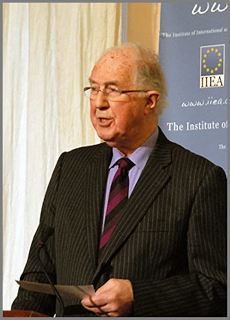
In 1980, Halligan sets up CIPA, his own public affairs consultancy based in Dublin, and becomes a lecturer in Economics at the University of Limerick. He is also chairman of European Movement Ireland during the late 1980s. In 1985, he is appointed as Chairman of Bord na Móna, the Irish Peat Development Authority, a position he holds for ten years. In 1989 he founds the Institute of European Affairs (IEA), which later becomes the IIEA. He is Director of CIPA until 2014.
Resulting from his keen interest and experience in energy policy and renewable energy, Halligan serves as Chair of the Sustainable Energy Authority of Ireland from 2007 until 2014. He is President of the IIEA, and he is also a Board Member of Mainstream Renewable Energy.
In later years Halligan also works on the foundation and development of the Ireland China Institute (ICI), which, with its maxim bridging the gap between knowledge and understanding, seeks to strengthen Irish-Chinese diplomatic relations, developing cultural links and fostering a deeper understanding of the respective cultural norms and values between the two nations. He is also President of ICI.
Halligan dies on August 9, 2020, after a long illness. On his death, TaoiseachMicheál Martin describes him as “a man who gave his life to politics and the public service with a deep commitment to the institutions of the state.” European Commissioner for TradePhil Hogan states that “Brendan was a committed European to his fingertips. He was a pragmatic European intellectual, in the tradition of Spinelli, Monnet and Schuman.”
Duffy is born in 1809 probably in County Cavan, at either Shercock or Kingscourt, and is educated locally at a hedge school. He has at least two brothers and two sisters. He first makes a living as a pedlar in County Cavan and County Meath, dealing with Bryan Geraghty, a bookseller in Anglesea Street, Dublin, with whom he exchanges Irish manuscripts for Catholicprayer books. He also buys up Bibles distributed in Ireland by Protestant missionaries for resale in Great Britain. When aged about thirty he sets up in business in Anglesea Street as a publisher, printer and bookseller, specialising in low-priced Catholic books, such as A pocket missal for the use of the laity (1838) and a new edition of the Catechism (1848) by Andrew Donlevy, made possible by the invention of the stereotype. He moves his business to Wellington Quay in 1846. He also prints and distributes public statements by Catholic prelates, and is able to call himself “bookseller to the cardinal archbishop of Dublin.”
At the request of the editor of The Nation, Charles Gavan Duffy (to whom he is not related), he republishes an anthology of nationalistic ballads, The spirit of the nation (1843; 59th ed., 1934), a successful venture that links him to the Young Ireland movement and expands into the publication of numerous popular historical writings, beginning with Gavan Duffy’s Library of Ireland series. He publishes several periodicals for Catholic readers, which combine pietism and patriotism with hagiography: Duffy’s Irish Catholic Magazine (1847–8), Duffy’s Fireside Magazine (1850–54), and Duffy’s Hibernian Magazine (1860–64).
Judged by the distinction of his authors (who include William Carleton, Thomas Davis, John Mitchel, James Clarence Mangan and Richard Robert Madden, the number and popularity of his productions, and their formative influence on Catholic popular opinion, he can be considered the most important Irish publisher in the middle decades of the nineteenth century. He is particularly significant in providing the Young Ireland movement with a cheap and reliable publisher for the dissemination of their writings. Charles Gavan Duffy describes him as “a man of shrewd sense and sly humour but without cultivation or judgment in literature.” He never takes a holiday and, though a kindly employer, never allows his staff to take holidays. The Irish American newspaper Irish American Weekly credits him with providing employment for 500 people and with having bought enough land to give him an income of £5,000 a year. It also notes that his ruthlessness had made him unpopular within his trade.
In 1840 Duffy marries Frances Lynch in Kingscourt, County Cavan. They have five sons and five daughters. The family susceptibility to pulmonary illnesses takes a dreadful toll: none of the sons live beyond the age of twenty-three, three dying from tuberculosis, while one of his daughters dies of pneumonia at the age of fourteen and another two daughters succumb as relatively young adults to tuberculosis.
Duffy dies at the age of 62 on July 4, 1871, at his home at Clontarf, Dublin. He is buried at Glasnevin Cemetery. His will, which disposes of an estate worth almost £25,000, is contested unsuccessfully in court by the younger of his two surviving sons. His son-in-law, Edmund Burke, becomes managing director of James Duffy and Company Limited, but after his death in 1901 the company passes out of the control of its founder’s family.
(From: “Duffy, James” by C. J. Woods, Dictionary of Irish Biography, http://www.dib.ie, October 2009)
Seán MacManus, Sinn Féin politician, is elected Mayor of Sligo on July 3, 2000. He is the national chairperson of the party from 1984 to 1990.
MacManus is born in 1950 near Blacklion, County Cavan, and moves to London in the 1960s to find work. There he meets and marries Helen McGovern, a native of Glenfarne, County Leitrim. In 1976, he returns to Ireland and settled in the Maugheraboy area of Sligo, County Sligo, so that their family of two boys can be educated in Ireland.
Still based in Maugheraboy, MacManus is involved in Irish Republican politics since the early 1970s and is secretary of the County Sligo Anti-H-Block Committee which campaigns in support of the republican prisoners hunger strikes of 1980/81. He becomes a member of the Sinn Féin Ard Comhairle (National Executive) in 1982 and remains there for over twenty years. He is elected as the first Sinn Féin National Chairperson from 1984 until 1990. After the Irish Republican Army (IRA) ceasefire in 1994 he is part of the first Sinn Féin delegation to meet with the British government in over seventy years. He is also involved in the protracted negotiations leading to the Good Friday Agreement.
First elected to Sligo Corporation (now Sligo Borough Council) in 1994, MacManus remains until its abolition in May 2014. He is also elected to Sligo County Council in 1999 and is re-elected in 2004, 2009 and 2014. He steps down from elected politics in February 2017 being replaced by his son, Chris MacManus.
On July 3, 2000, MacManus is elected Mayor of Sligo, the first Sinn Féin Mayor in the Republic of Ireland since the beginning of the Troubles in 1969. He is also elected mayor in 2003. Sinn Féin PresidentGerry Adams says the election of McManus is a sign of “Sinn Féin’s rise as an active campaigning alternative in politics in the 26 counties”.
MacManus has two sons. Chris MacManus, the youngest, is also an elected member of Sligo Borough Council (1999–2014) and Sligo County Council (2017–2020) and is an MEP since March 2020. His eldest son, Joseph MacManus, was an IRA volunteer who was killed in a firefight against an off-duty Ulster Defence Regiment (UDR) soldier in Belleek, County Fermanagh, in February 1992.
Kathleen Cox, Irish artist, sculptor, and mystic, is born Christina Mary Kathleen Cox in Wo-Sung, China, on July 2, 1904. Cox is considered a pioneer of contemporary Irish pottery.
Cox is the eldest daughter of Dr. R. H. Cox, originally from Dundalk, County Louth, and the port health officer in Shanghai. He is also an amateur geologist and models in clay. In his retirement, he invents a periscope later used during World War I by the Royal Navy. The years living in China leave an impression on the young Cox, visually and culturally. The family returns to Ireland in 1911, first moving to Listowel, County Kerry, and later to Howth, County Dublin. She attends Alexandra College, and later the Dublin Metropolitan School of Art in 1921. While there she studies sculpture under Oliver Sheppard and is considered one of his most talented students, winning the Royal Dublin Society Taylor prize for modelling in 1925, 1926, and 1927. The money from these prizes allows Cox to travel to Paris in 1929.
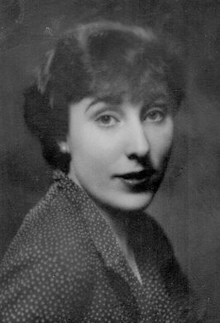
Cox exhibits in 1924 at the Tailteann exhibitions, and in 1925 submits textile designs to the Arts and Crafts Society of Ireland. She establishes a pottery studio at 7 Schoolhouse Lane, Dublin, with college friend Stella Rayner in 1929. The studio has the first electric kiln in Ireland. The first exhibited piece by Cox shown by the Royal Hibernian Academy (RHA) is in 1930, with a pair of Madonna bookends, and portrait masks of the daughter of Dermod O’Brien, Brigid O’Brien, and writer Norris Davidson. Davidson is a friend and neighbour, who commissions her to design the poster for his 1929 film, Suicide. She exhibits with the RHA from 1931 to 1933, and the Tailteann 1932, while also holding exhibitions in her studio. During this period Hilda Roberts paints her portrait, Strange Spirit. Kathleen Cox in her studio. The theme of womanhood is prominent in her work, including in the sign of her studio.
In 1932, Cox begins producing a line of more commercial figurines, drawing influence from the Royal Doulton Burslem factory, where she works for a time. One such figurine is The Lavender Man (pictured), modelled on Michael Clifford, a Dublin street trader. In the mid 1930s, she develops a frustration with her work and with her lack of impact on the wider world. In attending the Chinese exhibition in London in 1935, it is confirmed to her that pottery should be practical rather than ornamental. It spurs her to destroy all her moulds and sell her kiln upon her return to Dublin.
Cox marries Alan Palmer in 1937, the couple has two daughters and relocate to England. Palmer is a conscientious objector during World War II, with the couple running a farm at Meopham, Kent, returning to London after the war.
Cox dies in early September 1972 in London. Some of her work is held in the collections of the National Museum of Ireland and with four works featured in the exhibition Not Just Pots: Contemporary Irish Ceramics of the 21st Century.
It is during the 1920s that Cox begins to question mainstream religion and becomes a vegetarian. Finding that her personal philosophy is similar to that of theosophy, she joins the movement and speaks at meetings. She is heavily influenced by the founder of the Order of the Great Companions, the Rev. William Hayes, who is living in Dublin in the 1930s. She writes and illustrates a children’s book on world religions, A story of stories, which she publishes under the pseudonym C.M. Kay in 1970.
Meagher is born on August 3, 1823, at Waterford, County Waterford, in what is now the Granville Hotel on the Quay. He is educated at Roman Catholicboarding schools. When he is eleven, his family sends him to the Jesuits at Clongowes Wood College in County Kildare. It is at Clongowes that he develops his skill of oratory, becoming at age 15 the youngest medalist of the Debating Society. After six years, he leaves Ireland for the first time, to study in Lancashire, England, at Stonyhurst College, also a Jesuit institution. He returns to Ireland in 1843, with undecided plans for a career in the Austrian army, a tradition among a number of Irish families.
Meagher becomes a member of the Young Ireland Party in 1845 and in 1847 is one of the founders of the Irish Confederation, dedicated to Irish independence. In 1848 he is involved, along with William Smith O’Brien, in an abortive attempt to mount an insurrection against English rule. Arrested for high treason, he is condemned to death, but his sentence is commuted to life imprisonment in Van Diemen’s Land, now Tasmania.
Meagher escapes in 1852 and makes his way to the United States. After a speaking tour of U.S. cities, he settles in New York City, studies law and is admitted to the bar in 1855. He soon becomes a leader of the Irish in New York and, from 1856, edits the Irish News.
At the close of the war, Meagher is appointed secretary of Montana Territory where, in the absence of a territorial governor, he serves as acting governor.
In the summer of 1867, Meagher travels to Fort Benton, Montana, to receive a shipment of guns and ammunition sent by General William Tecumseh Sherman for use by the Montana Militia. On the way to Fort Benton, the Missouri River terminus for steamboat travel, he falls ill and stops for six days to recuperate. When he reaches Fort Benton, he is reportedly still ill.
Sometime in the early evening of July 1, 1867, Meagher falls overboard from the steamboat G. A. Thompson, into the Missouri River. His body is never recovered. Some believe his death to be suspicious and many theories circulate about his death. Early theories included a claim that he was murdered by a Confederate soldier from the war, or by Native Americans. In 1913 a man claims to have carried out the murder of Meagher for the price of $8,000 but then recants. In the same vein, American journalist and novelist Timothy Egan, who publishes a biography of Meagher in 2016, claims Meagher may have been murdered by Montana political enemies or powerful and still active vigilantes. On the frontier men are quick to kill rather than adjudicate. A similar theory shown on Death Valley Days (1960) has him survive the assassination attempt because his aide had been mistakenly murdered when he accepted one of his trademark cigars, and Meagher uses his apparent death as leverage over his political opponents.
Raised in Dublin, Manning goes to school in Morehampton House and Alexandra College, Dublin. She gets her theatre training in Sara Allgood‘s teaching class in the Abbey Theatre.
Prior to her career as a writer and filmmaker, Manning works as a film critic throughout the 1920s and 30s. She works as a film critic for TheIrish Statesman for a year during that time until it goes out of business. She is known to disapprove of Hollywood‘s “unimaginable stories and its stereotypical portrayal of Ireland and the Irish.” She also works as a writer for the Gate Theatre. She adapts the short story “Guests of the Nation” for a film directed by Denis Johnston. She also helps found the Dublin Film Society in 1930 and co-founds the Gate Theatre arts magazine Motley in 1932.
From 1914 to 1926, Ireland experiences a surge of new film styles being produced, consisting of historical melodramas and romantic comedies. Following this, 1930 to 1935 births a second wave of industry produced silent films that are intended to be less cliche compared to the first wave. The films produced under the second wave are much more experimental and deal less with the commercial appeals of the first wave. There’s minimal information on how Manning specifically contributed to the second wave, however, it is stated that she plays an important role producing five out of the six films to come out of that wave.
Manning is a founder of the Poets’ Theatre in Cambridge, Massachusetts, and works as drama director at Radcliffe College during World War II. She marries Faneuil Adams of Boston, Massachusetts, in 1980.
Manning dies at the age of 93 on June 27, 1999, at Mt. Auburn Hospital in Cambridge, Massachusetts.
Edward Bruce is proclaimed the last High King of Ireland on June 29, 1315. He is crowned in 1316. He reigns between 1315 and 1318. The English colonists in Ireland vehemently oppose him.
Bruce, the brother of the King of Scots, Robert the Bruce, leads a three-year military campaign, known as the Bruce campaign, against the Anglo-Norman lordship of Ireland. This invasion, which lasts from 1315 to 1318, ultimately gives rise to the two nations we recognize now as Ireland and Scotland.
In May 1315, a Scots army of up to six thousand soldiers lands on the Antrim coast. That June, near Carrickfergus, many Gaelic lords led by Donnell O’Neill of Ulster join Bruce. “All the Gaels of Ireland agreed to grant him lordship and they called him King of Ireland,” declares the Irish annals.
The invasion coincides with the Great European Famine (1315-1317), which brings hardship and disillusionment among Bruce’s followers. The annals ruefully comment, “falsehood and famine and homicide filled the country, and undoubtedly men ate each other in Ireland.”
In February 1317, Dublin, the capital of the English royal administration in Ireland, comes close to being captured by the Bruce brothers. The brothers encamp at Castleknock within sight of the city walls. The panicking Dubliners burn the suburbs of the city. In order to re-fortify the city walls, they dismantle the Dominicanpriory north of the River Liffey and tear down the bridge across the river. The Bruce brothers do not lay siege to the city and instead move south to Munster.
In 1318, the invasion is brought to an end when, after marching south from Ulster for one last push, Bruce risks an open battle with an English army north of Dundalk at Faughart and is killed. His corpse is dismembered, and portions of it hung over the gates of various Irish towns. His decapitated head is brought to King Edward II of England by the victor, John de Bermingham, a minor Anglo-Irish baron who is elevated to the status of “Earl of Louth” for bringing the Bruce campaign in Ireland to an end.
A conference at Trinity College Dublin, in 2015, entitled The Irish-Scottish World in the Middle Ages, explores this key moment in the history of Ireland and Scotland. “The Bruce Invasion was a watershed moment in that story,” says Seán Duffy, Professor of Medieval Irish History and one of the organizers of the conference.
“Although Edward Bruce was defeated and killed in 1318, the effect of the invasion was far-reaching. The tide of Anglo-Norman expansion in Ireland turned back and the late Middle Ages saw the flowering of a Gaelic literary and cultural revival. Scotland, meanwhile, was galvanized by its victory over the English at Bannockburn which secured its path to independent nationhood.”
“Few peoples have as much in common as the Irish and the Scots. The very name Scotland is an ever-present reminder of that connection, because, in the Latin of the early Middle Ages, a Scotus was an Irishman, and the homeland of the Scoti was Ireland. That the name came to be applied to the northern part of Britain is testament to the strength of Irish influence on what we now know today as Scotland.”
(From: “On This Day: Edward Bruce, the last High King of Ireland, dies in 1318” by IrishCentral Staff, http://www.irishcentral.com, October 2022 | Pictured: Grave of Edward de Bruce, High King of Ireland, in Faughart Cemetery, County Louth)
An Taisce – The National Trust for Ireland – a non-governmental organisation (NGO) active in the areas of the environment and built heritage in the Republic of Ireland, is established on June 28, 1948. It considers itself the oldest environmental and non-governmental organisation in the Republic of Ireland. NaturalistRobert Lloyd Praeger is its first president.
An Taisce is a membership organisation and charity, not a state or semi-state organisation. However, it receives government funding for specific programmes, such as Blue Flag beaches, Green Schools and the annual National Spring Clean, and it has a statutory role in certain planning and environmental processes in the country.
An Taisce’s range of expertise extends across the Republic of Ireland’s natural, built, and social heritage. It seeks to educate, inform, and lead public opinion on the environment, to advocate and influence policy, and to manage a small portfolio of heritage properties. It does not operate in Northern Ireland.
The Planning Acts provide for An Taisce, and about twenty other prescribed bodies, to be informed of all planning applications in areas of scenic beauty or high amenity significance or where architectural, archaeological or environmental issues need to be considered. Local authorities are required, in certain defined circumstances under the Planning & Development Regulations, to consult An Taisce on development proposals.
The organisation is split into three operational divisions:
The Environmental Advocacy Unit monitors roughly 5% of all planning (local authority development approval) applications made annually, making submissions on a small number of those received, and appealing about 300 decisions a year to An Bord Pleanála, the statutory planning appeals board. The Advocacy Unit also monitors environmental standards and co-ordinates policy formation from the elected advocacy committees amongst the membership.
The Properties Unit takes ownership of and looks after properties that have either historical significance or are environmentally sensitive. The trust properties are taken care of by both professional staff and volunteers who are involved with the day-to-day management of income generating properties such as Tailors’ Hall, which it also makes available for private hire, and the restoration of important resources such as the Boyne Navigation.
The organisation comprises over 5,000 members, with a range of membership fees. Some members are also organised in local organisations. Overall steering of the organisation is in the hands of a council, which in turn elects a board of management, and other internal policy and operational committees.