Once the Treaty is signed and ratified by Dail Eireann on January 7, the British quickly prepare to leave the Irish Free State and hand over this sprawling monument to British rule in Ireland. The new rulers of Ireland are advised to be ready to take over Dublin Castle in mid-January. The turn over symbolizes the end of British rule in Ireland, although the Irish Free State remains part of the Commonwealth until 1949.
Dublin Castle is first founded as a major defensive work by Meiler Fitzhenry on the orders of King John of England in 1204 and is largely complete by 1230. For centuries Ireland has been governed from “The Castle.” Everything British that moves and has its being in Ireland has emanated from the Castle.
It was from the Bermingham Tower in the Castle that the legendary escape of Red Hugh O’Donnell and Art O’Neill takes place in January 1592. Art O’Neill perishes in the Dublin Mountains but O’Donnell manages to make his way to the sanctuary of the O’Byrnes in Glenmalure, County Wicklow.
Just over two hundred years later, in 1907, the Insignia of the Order of St.Patrick, known as the Irish Crown Jewels, are stolen from the Bedford Tower in an audacious robbery that has never been solved.
The Castle could have fallen during the upheavals of 1641 but it did not succumb to rebel control. Robert Emmett could have taken it in 1803 but failed to do so. The Castle was even more vulnerable during the 1916 Easter Rising but the Volunteers failed to capitalize on it.
Considering the 700-year history of the Castle, Michael Collins, dressed impressively in his military uniform, must have savoured the moment when his staff car drives into the precincts of the complex of buildings whose fabric he has successfully managed to infiltrate during the Anglo-Irish war while, all the while managing to keep himself out of the clutches of its more sinister and homicidal operatives.
When Collins steps out of his staff car at the Castle, Lord Lieutenant FitzAlan-Howard is reported to say, “You are seven minutes late, Mr. Collins” to which Collins replies, “We’ve been waiting over seven hundred years, you can have the extra seven minutes.”
Due to public outcry for clemency, the men’s sentences are commuted to deportation for life. MacManus, along with O’Brien, Thomas Francis Meagher, and Patrick O’Donoghue, is transported to Van Diemen’s Land in Tasmania, Australia in 1849. They are assigned to different settlements to reduce their collaboration in the new land; however, the Irish men continue to meet secretly.
In 1852 MacManus and Meagher escape from Australia and make their way to San Francisco, California, where MacManus settles. Meagher goes on to New York City. Like other immigrants, the Irish revolutionaries carry their issues to the United States. A Captain Ellis, of a ship that is supposed to carry O’Brien to freedom, also emigrates to San Francisco. MacManus holds a lynch court of Ellis among Irish emigrants for his betrayal of O’Brien in his escape attempt from Van Diemen’s Land. The court-martial acquits Ellis for lack of evidence.
Failing to re-establish his career as a shipping agent, MacManus lives in San Francisco and dies in poverty in 1861. It is after his death, however, that he performs his most valuable service to the cause of Irish freedom. On learning of his death, American Fenian leaders decide to return his body to Ireland for burial. This foreshadows the treatment given to Jeremiah O’Donovan Rossa at his famous funeral in 1915. Crowds of Irish gather in New York as Archbishop John Hughes, like MacManus born in Ulster, blesses MacManus’ body. Thousands greet his body when it arrives in Cork and crowds gather at rail stations all the way to Dublin.
The church, in the person of Archbishop of DublinPaul Cullen, refuses permission for his body to lie-in-state at any church in Dublin. Thus, for a week MacManus’ body lies in the Mechanics’ Institute, while thousands pass by paying their respects. But Father Patrick Lavelle, a Fenian supporter, defies Cullen and performs the funeral ceremony on November 10, 1861. A crowd estimated at 50,000 follow the casket to Dublin’s Glasnevin Cemetery, and hundreds of thousands line the streets. The MacManus funeral is a seminal moment for the Fenian movement. It invigorates the nationalist movement in Ireland, just as Rossa’s funeral does 54 years later.
MacManus is notable for his statement in court in 1848 where he explains his actions by saying, “It was not because I loved England less, but because I loved Ireland more.”
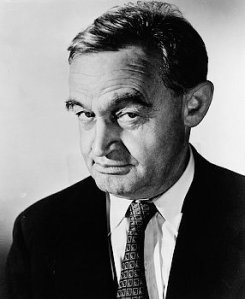
Unknown to many, Fitzgerald is also a patriot. In 1916 he is a member of the Irish Volunteers and is prepared to fight in the Easter Rising on Easter Sunday when the orders are countermanded. On Easter Monday the revolution is on again, and Shields goes to the Abbey Theatre and retrieves his rifle from under the stage. He goes around the corner to Liberty Hall and joins with James Connolly’s Irish Citizen Army.
Fitzgerald goes to Hollywood to star in another O’Casey work, The Plough and the Stars (1936), directed by John Ford. He has a successful Hollywood career in such films as The Long Voyage Home (1940), How Green Was My Valley (1941), And Then There Were None (1945), The Naked City (1948), and The Quiet Man (1952). Fitzgerald achieves a feat unmatched in the history of the Academy Awards. He is nominated for both the Best Actor Oscar and the Best Supporting Actor Oscar for the same performance, as Father Fitzgibbon in Going My Way (1944). He wins the Best Supporting Actor Award. This feat will likely never be matched as the Academy Award rules have since been changed to prevent this. During World War II, Oscar statues are made of plaster rather than gold due to wartime metal shortages. Being an avid golfer, Fitzgerald later breaks the head off his Oscar statue while practicing his golf swing.
Fitzgerald has two stars on the Hollywood Walk of Fame, one for films located at 6220 Hollywood Blvd. and one for television located at 7001 Hollywood Blvd.
Fitzgerald returns to live in Dublin in 1959. He dies of heart failure on January 14, 1961, and is buried at Deansgrange Cemetery in Dublin.
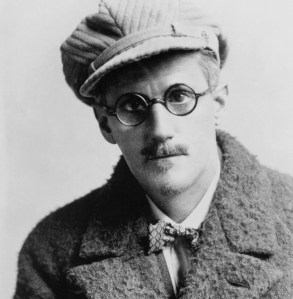
Joyce is born on February 2, 1882, in the wealthy Rathgar suburb of Dublin. The family is initially well off as Dublin merchants with bloodlines that connected them to old Irish nobility in the country. James’ father, John Stanislaus Joyce, is a fierce Irish Catholic patriot and his political and religious influences are most evident in Joyce’s two key works A Portrait of the Artist as a Young Man (1916) and Ulysses (1922).
The Joyce family is repeatedly forced to move to more modest residences due to their steadily diminishing wealth and income. John Joyce’s habitual unemployment as well as his drinking and spending habits make it difficult for the Joyces to retain their social standing. As a young man, Joyce is sent away to the renowned Clongowes Wood College in County Kildare in 1888, a Jesuit institution regarded as the best preparatory school in Ireland. The Clongowes school figures prominently in Joyce’s work, specifically in the story of his recurring character Stephen Dedalus. Joyce earns high marks both at the Clongowes School and at Belvedere College in Dublin where he continues his education. At this point in his life, it seems evident that Joyce is to enter the priesthood, a decision that would please his parents. However, as Joyce makes contact with various members of the Irish Literary Renaissance, his interest in the priesthood wanes. Joyce becomes increasingly critical of Ireland and its conservative elements, especially the Church.
Against his mother’s wishes, Joyce leaves Ireland in 1902 to pursue a medical education in Paris and does not return until the following year upon receiving news of his mother’s debilitation and imminent death. After burying his mother, Joyce continues to stay in Ireland, working as a schoolteacher at a boys’ school, another autobiographical detail that recurs in the story of Stephen Dedalus. After barely spending a year in Dublin, Joyce returns to the Continent, drifting in and out of medical school in Paris before taking up residence in Zurich. It is during this period that Joyce begins writing professionally.
In 1905, Joyce completes a collection of eight stories entitled Dubliners, although it is not actually printed until 1913. During these frustrating and impoverished years, Joyce heavily relies upon the emotional support of Nora Barnacle, his unmarried Irish lover, as well as the financial support of his younger brother, Stanislaus Joyce. Both Nora and Stanislaus remain as protective, supporting figures for the duration of Joyce’s life. During the eight years between Dubliners‘ completion and publication, Joyce and Barnacle have two children, a son named Giorgio, and a daughter named Lucia.
Joyce’s next major work, A Portrait of the Artist as a Young Man, appears in serialized form in 1914 and 1915. Joyce is “discovered” by Ezra Pound and the complete text is printed in New York City in 1916, and in London in 1917. It is with the assistance of Pound, a prominent literary figure of the time, that Joyce comes into contact with Harriet Shaw Weaver, who serves as both editor and patron while Joyce writes Ulysses.
When Ulysses is published in Paris in 1922, many immediately hail the work as genius. With his inventive narrative style and engagement with multiple philosophical themes, Joyce has established himself as a leading Modernist. The novel charts the passage of one day, June 16, 1904, as depicted in the life of an Irish Jew named Leopold Bloom, who plays the role of a Ulysses by wandering through the streets of Dublin. Despite the fact that Joyce is writing in self-imposed exile, living in Paris, Zurich, and Trieste while writing Ulysses, the novel is noted for the incredible amount of accuracy and detail regarding the physical and geographical features of Dublin.
Similar in theme to Joyce’s previous works, Ulysses examines the relationship between the modern man and his myth and history, focusing on contemporary questions of Irish political and cultural independence, the effects of organized religion on the soul, and the cultural and moral decay produced by economic development and heightened urbanization. While Joyce is writing it, there is serious doubt as to whether Ulysses will be completed. Midway through his writing, Joyce undergoes the first of eleven eye operations to salvage his ever-worsening eyesight. At one point, a disappointed Joyce casts the bulk of his manuscript into the fire, but Nora Barnacle immediately rescues it.
While Ulysses is hailed by some, the novel is banned in both the United Kingdom and the United States on obscenity charges. It is not until 1934 that Random House wins a court battle that grants permission to print and distribute Ulysses in the United States. The novel is legalized in Britain two years later.
By this time, Joyce is approaching the end of his public career and has concluded work on his final novel, Finnegan’s Wake (1939). Considered to be far more baffling and convoluted than Ulysses, Finnegan’s Wake is a critical failure. At the outbreak of World War II, Joyce remains in Paris until he is forced to move, first to Vichy, and then to Switzerland. On January 13, 1941, Joyce dies of a stomach ulcer at the age of 58 and is buried in Zurich’s Fluntern Cemetery.
Ashe plays a major part in the 1916 Easter Rising outside the capital city commanding the Fingal battalion of the Irish Volunteers. Ashe is commandant of the 5th battalion of the Dublin brigade, a force of 60–70 men engaging British forces around north County Dublin during the rising. They are armed only with a few rounds, about a dozen service rifles, a dozen Mausers, and a dozen Martini-Henry carbines. Some of Ashe’s men are armed only with a shotgun against the well-equipped army regulars.
Ashe’s battalion wins a major victory in Ashbourne, County Meath, where they engage a much larger force. They capture a significant quantity of arms and up to twenty Royal Irish Constabulary (RIC) vehicles. Eleven RIC members, including County Inspector Alexander Gray, and two volunteers are killed during the 5-1/2-hour battle. Twenty-four hours after the rising collapses, Ashe’s battalion surrenders on the orders of Patrick Pearse. On May 8, 1916, Ashe and Éamon de Valera are court-martialled and sentenced to death. The sentences are commuted to penal servitude for life. Ashe is imprisoned in Lewes Prison in Lewes, East Sussex, England.
De Valera, Ashe, and Thomas Hunter lead a prisoner hunger strike on May 28, 1917. With accounts of prison mistreatment appearing in the Irish press and mounting protests in Ireland, Ashe and the remaining prisoners are freed on June 18, 1917, by David Lloyd George as part of a general amnesty.
Upon his release, Ashe returns to Ireland and begins a series of speaking engagements. In August 1917, he is arrested and charged with sedition for a speech that he makes in Ballinalee, County Longford, where Michael Collins is also speaking. He is detained at the Curragh but is then transferred to Mountjoy Prison in Dublin. He is convicted and sentenced to two years hard labour. Ashe and other prisoners, including Austin Stack, demand prisoner of war status. On September 20, 1917, Ashe again goes on hunger strike. He dies at the Mater Hospital on September 25, 1917, after being force fed by prison authorities. At the inquest into his death, the jury condemns the staff at the prison for the “inhuman and dangerous operation performed on the prisoner, and other acts of unfeeling and barbaric conduct.” His body lies in state at Dublin City Hall and is buried in Glasnevin Cemetery in Dublin.
Ashe is a relative of Catherine Ashe, the paternal grandmother of American actor Gregory Peck, who emigrates to the United States in the 19th century. The Ashe Memorial Hall built in 1928, housing the Kerry County Museum, in Tralee, County Kerry, is named after him while Nelson Street, also in Tralee, is renamed Ashe Street.
On January 11, 1970, at Sinn Féin‘s Ard Fheis at the Intercontinental Hotel in Ballsbridge, Dublin, the proposal to end abstentionism and take seats, if elected, in the Dáil, the Northern Ireland Parliament, and the Parliament of the United Kingdom is put before the members. A similar motion had been adopted at an Irish Republican Army (IRA) convention the previous month, leading to the formation of a Provisional Army Council by Seán Mac Stíofáin and other members opposed to the leadership.
There are allegations of malpractice and that some supporters cast votes to which they are not entitled. In addition, the leadership has also refused voting rights to a number of Sinn Féin cumainn (branches) known to be in opposition, particularly in the north and in County Kerry. The motion is debated all of the second day, and when it was put to a vote at 5:30 PM the result is 153:104 in favour of the motion, failing to achieve the necessary two-thirds majority.
The Executive attempts to circumvent this by introducing a motion in support of the IRA Army Council, led by Tomás Mac Giolla, which only requires a simple majority. In protest of the motion, Ruairí Ó Brádaigh and his minority group walks out of the meeting. These members reconvene at a hall in 44 Parnell Square, which they had already booked in anticipation of the move by the leadership. They appoint a Caretaker Executive, and pledged allegiance to the Provisional Army Council.
The Caretaker Executive declares itself in opposition to the ending of abstentionism, the drift towards Marxism, the failure of the leadership to defend the nationalist people of Belfast during the 1969 Northern Ireland riots, and the expulsion of traditional republicans by the leadership during the 1960s. At the October 1970 Ard Fheis, it is announced that an IRA convention has been held and has regularised its structure, bringing the “provisional” period to an end.
At the end of 1970 the terms “Official IRA” and “Regular IRA” are introduced by the press to differentiate the two factions. During 1971, the rival factions play out their conflict in the press with the Officials referring to their rivals as the Provisional Alliance, while the Provisionals refer to the Officials (IRA and Sinn Féin) as the National Liberation Front (NLF).
The Falls Road Curfew, coupled with internment in August 1971, and Bloody Sunday in Derry in January 1972, boosts the Provisionals in Belfast. These events produce an influx into the Provisionals on the military side, making them the dominant force and finally eclipsing the Officials everywhere. Despite becoming the dominant group and the dropping of the word “provisional” at the convention of the IRA Army Council in September 1970, they are still known to the mild irritation of senior members as Provisionals, Provos, or Provies.
Roach is born on December 25, 1815, at Mitchelstown, County Cork, Ireland, the first of seven children to Patrick Roche, a retail salesman, and his wife Abigail Meany. In 1832, at the age of sixteen, he emigrates together with his cousin to the United States. Arriving in New York City, he is at first unable to find regular work, but eventually gains secure employment at the Howell Works of James P. Allaire on the recommendation of a former employee of his father.
In 1852, after 20 years in the employment of Allaire, Roach and three partners purchase the Etna Iron Works, a small New York City ironworks which has fallen into receivership. Roach soon becomes sole proprietor, and during the American Civil War transforms the Etna Iron Works into a major manufacturer of marine engines. He continues to prosper after the war and in 1867 he purchases the Morgan Iron Works on New York’s East River and relocates his business there.
In 1871, Roach purchases the Reaney, Son & Archbold shipyard in Chester, Pennsylvania, which has fallen into receivership and renames it the Delaware River Iron Ship Building and Engine Works. This becomes his main facility. Over the next few years, he founds a network of new companies in Chester to support the shipyard’s operations. To give his sons a stake in the business, Roach founds the firm of John Roach & Sons, which becomes the overall parent and marketing company. He also attempts to create his own shipping line with the establishment of the United States and Brazil Mail Steamship Company, but this venture is a costly failure.
From 1871 until 1885, John Roach & Sons is easily the largest and most productive shipbuilding firm in the United States, building more tonnage of ships than its next two chief competitors combined. In the mid-1880s the firm runs into trouble when a series of U.S. Navy contracts become the subject of political controversy. Roach signed the contracts under a Republican administration, but when the Democratic administration of Grover Cleveland comes to power, it voids one of the contracts. Doubts over the validity of the remaining three contracts make it impossible for John Roach & Sons to obtain loans and, in 1885, the Roach shipbuilding empire is forced into receivership.
During the contract disputes, Roach falls ill with a chronic mouth infection which is diagnosed as cancer in 1886. Roach undergoes surgery in the spring of 1886, but it provides only temporary relief. He dies at the age of 71 on January 10, 1887, while his business is still in the hands of receivers. Roach’s eldest son, John Baker Roach, assumes control of the business which continues for another 20 years, although it never regains the pre-eminent position in American shipbuilding that it had enjoyed under Roach Sr.
During its existence between 1871 and 1907, the shipyard established by Roach builds 179 iron ships, 98 under Roach’s own management and an additional 81 under that of John Baker Roach.
The Anglo-Irish Treaty is introduced to replace the Republic with a dominion of the British Commonwealth with the King represented by a Governor-General of the Irish Free State. The Treaty is finally signed on December 6, 1921.
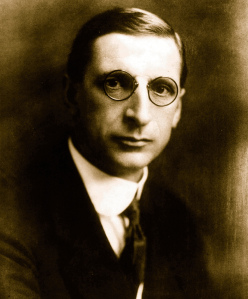
Éamon de Valera does not join in on the negotiations. His opponents say that he does so because he knows that the British will only allow an Irish dominion, not a republic, and does not want to be blamed for giving up the idea of a republic. De Valera says he is angry because the delegates working out the treaty had not asked him before signing the treaty. But at a secret session of the Dáil during the Treaty debates and publicised in January 1922, de Valera’s ideas for a treaty include dominion status, the “Treaty Ports,” a veto by the parliament in Belfast, and the king as head of the Commonwealth. Ireland would pay a share of the imperial debt.
On January 9, 1922, when the Treaty is accepted by a vote of 64 to 57, de Valera resigns as President of the Republic and a large minority of Sinn Féin Teachta Dálas (TDs) leave Dáil Éireann. De Valera states, “In view of the vote that was taken here on Saturday and which I had definitely to oppose as one that was tending to subvert the Republic which I was elected to my present position to defend and maintain; and as it appeared to me also to be a vote which would tend to subvert the independence of the country, I could no longer continue— as I was beaten in that — I could no longer continue in my present office feeling I did not have the confidence of the House. I therefore wish to place my resignation in the hands of the Assembly.”
A motion to re-elect De Valera as President is defeated along pro and anti-treaty lines by 60 votes to 58. Arthur Griffith, de Valera opponent and former colleague, is elected President of Dáil Éireann in his place.
Following the vote, Griffith says, “Before another word is spoken I want to say: I want the Deputies here to know, and all Ireland to know, that this vote is not to be taken as against President de Valera. It is a vote to help the Treaty, and I want to say now that there is scarcely a man I have ever met in my life that I have more love and respect for than President de Valera. I am thoroughly sorry to see him placed in such a position. We want him with us.”
The explosion and resulting fire claim the lives of 50 people including 42 French nationals, 7 Irish nationals, and 1 United Kingdom national. Only 27 bodies are recovered. A further fatality occurs during the salvage operation with the loss of a Dutch diver.
On November 24, 1978, the Betelgeuse leaves Ras Tanura in the Persian Gulf bound for Leixões, Portugal, with a full cargo of crude oil. Originally the Betelgeuse is to call at Sines, Portugal, to lighten the load of the ship but poor weather conditions prevent the vessel from entering the harbour. Plans are further frustrated at Leixões as a ship has run aground across the harbour entrance preventing the Betelgeuse from berthing there to discharge her cargo. The Betelgeuse is then instructed to sail for Whiddy Island, Ireland.
The Betelgeuse first puts in at Vigo, Spain, to change some of her crew and then sails for Whiddy Island on December 30, 1978. During the passage the vessel encounters heavy weather in the Bay of Biscay and, after reporting a leakage of oil, is instructed to head towards Brest, France, at reduced speed. However, the origin of the leak is discovered and stopped. The vessel proceeds on its original planned course, arriving in Bantry Bay on January 4, 1979.
On the evening of January 6, 1979, the Betelgeuse has completed berthing at the offshore jetty in around 98 feet of water. At 11:30 PM the vessel commences discharging its 114,000 tonnes of mixed Arabian crude oil. This process is expected to take about 36 hours.
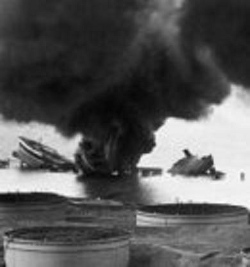
At about 1:00 AM on Monday, January 8, a rumbling noise is heard from the vessel followed shortly by a huge explosion within its hull. The force of the explosion blows men from the jetty into the sea. Local residents report seeing the Betelgeuse engulfed in a ball of fire a few moments later. A series of further explosions follow, breaking the vessel in half. Much of the oil cargo still on board ignites. The concrete unloading jetty crumbles and firefighters, arriving on the scene from several neighbouring towns, are unable to get near the vessel. The firefighters concentrate their efforts on preventing the fire from spreading to the tanks of the storage farm and on containing the oil spillage.
About 12 hours after the explosion the Betelgeuse sinks at her moorings in 130 feet of water, which largely extinguishes the main body of the fire. In spite of this, rescue workers are not able to approach the wreck for two weeks due to clouds of toxic and inflammable gas surrounding it. After two weeks, it is possible to start recovering bodies from the wreck and pumping off the remainder of the oil cargo that is still on board.
A number of memorial services have been held to commemorate anniversaries of the incident. A memorial sculpture, incorporating the ship’s bell which was recovered from the wreck, has been erected in the hillside graveyard overlooking the harbor. The bodies of two unidentified casualties from the incident are interred nearby.
Major Thomas Buchanan McGuire, Jr., the second highest scoring United States ace of World War II and winner of the Medal of Honor, is shot down and killed over the Pacific on January 7, 1945.
McGuire is an Irish American born in Ridgewood, New Jersey on August 1, 1920. He spends most of his childhood in Sebring, Florida, where he and his mother move after his parents are divorced.
McGuire enlists in the army as a aviation cadet in July 1941 and earns his pilot’s wings in February 1942. Sent to Alaska, McGuire bristles at the lack of combat and requests a transfer to a combat squadron. In December he is sent to California to learn to fly the twin-engine P-38 Lightning in which he earns his fame. In March 1943 he ships out to the Pacific, joining the 49th Fighter Group. One of the veteran combat pilots in the 49th is Richard Bong, who becomes the highest scoring ace of World War II.
In just his second mission, on August 18, McGuire is credited with shooting down three Japanese planes. On his next mission, on the 21st, he shoots down two more, making him an ace after just three missions. In October he is shot down but manages to bail out over the ocean and is rescued by a PT boat. When he takes off from his base in the Philippines on Christmas day 1944, he has thirty-one kills. In the next two days he shoots down seven enemy planes to bring his total to thirty-eight, putting him only two behind Bong, who has been sent home for a fund-raising tour. McGuire is anxious to pass him.
Early on the morning of January 7, McGuire leads a flight of four P-38s over Japanese airbases on Negros Island. The group is confronted by a lone Ki-43 “Oscar.” As the Japanese fighter approaches from behind, McGuire makes an extremely sharp turn to the left. This extremely dangerous maneuver, performed at an altitude of only 300 feet, causes McGuire’s P-38 to stall. It snap rolls inverted and noses down into the ground. Despite the low altitude, McGuire nearly pulls out successfully. Had he jettisoned his drop tanks at the start of the dogfight, he might have managed it, however McGuire is killed on impact.
A memorial, placed by aviation archaeologist and former fighter pilot David Mason in 2007, stands at McGuire’s fatal crash site on Negros Island as a tribute. McGuire is posthumously awarded the Medal of Honor for his seven kills in two days in December. He is memorialized by the renaming of Fort Dix Army Air Force Base in Burlington County, New Jersey, to McGuire Air Force Base in 1948.

 Michael Collins, the Chairman of the Provisional Government of Ireland created under the Anglo-Irish Treaty, accepts control of Dublin Castle from Lord Lieutenant Edmund Bernard FitzAlan-Howard on January 16, 1922.



 The Anglo-Irish Treaty is introduced to replace the Republic with a dominion of the British Commonwealth with the King represented by a Governor-General of the Irish Free State. The Treaty is finally signed on December 6, 1921.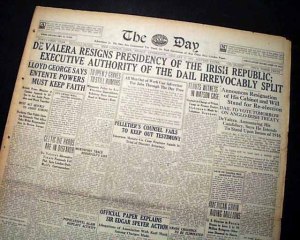


 seamus dubhghaill