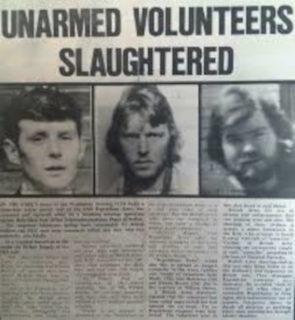
McDonnell is born on Slate Street in the lower Falls Road of Belfast, Northern Ireland on September 14, 1951, as one of ten children. He attends a nearby Roman Catholic school. He marries Goretti in 1970 and moves into her sister’s house in Lenadoon. There are only two Catholic houses in this predominantly Ulster Protestanthousing estate, and their house is attacked on numerous occasions.
McDonnell agrees with the goals of the Irish hunger strike, namely: the right not to wear a prison uniform; the right not to do prison work; the right of free association with other prisoners; the right to organise their own educational and recreational facilities and the right to one visit, one letter and one parcel per week.
Although McDonnell is not involved in the first hunger strike in 1980, he joins Bobby Sands and the others in the second hunger strike the following year. During the strike he fights the general election in the Republic of Ireland, and only narrowly misses election in the Sligo–Leitrim constituency. He goes 61 days without food before dying on July 8, 1981. He has two children. His wife takes an active part in the campaign in support of the hunger strikers.
McDonnell is buried in the grave next to Bobby Sands at Milltown Cemetery in west Belfast. John Joe McGirl, McDonnell’s election agent in Sligo–Leitrim, gives the oration at his funeral. Quoting Patrick Pearse, he states, “He may seem the fool who has given his all, by the wise men of the world; but it was the apparent fools who changed the course of Irish history.”
Reid is the youngest son of a Protestant family of twelve, six of whom survive. His mother, his father’s second wife, comes from an aristocratic Shropshire family. Although proud of this ancestry, he finds the strict Protestant ethics of his immediate family constricting. He is educated at the Royal Belfast Academical Institution, after which he is initially apprenticed into the Belfast tea-trade before going to Christ’s College, Cambridge, where he reads medieval and modern languages, and is influenced by the novelist E. M. Forster. His first book, The Kingdom of Twilight, is published in 1904. Following graduation in 1908, he returns to Belfast to pursue a writing career.
As well as his fiction, Reid also translates poems from the Greek Anthology. His study of the work of W. B. Yeats, W. B. Yeats: A Critical Study, has been acclaimed as one of the best critical studies of that poet. He also writes the definitive work on the English woodcut artists of the 1860s, Illustrators of the Sixties (1928). His collection of original illustrations from that time is housed in the Ashmolean Museum, Oxford.
Reid is a close friend of Walter de la Mare, whom he first meets in 1913, and about whose fiction he publishes a perceptive book in 1929. He is also an influence on novelist Stephen Gilbert and has good connections to the Bloomsbury Group of writers. He is a founding member of the Imperial Art League (later the Artists League of Great Britain) and is also a close friend of Arthur Greeves, the artist known to be C. S. Lewis‘s best friend. Greeves paints several portraits of Reid, now all in the possession of the Royal Belfast Academical Institution.
Reid publishes articles in many magazines, including Uladh, The Westminster Review and the Ulster Review, and he reviews books for The Manchester Guardian. Apostate, an autobiography, is published in 1926, and its sequel, Private Road, is published in 1940. He is a founder member of the Irish Academy of Letters.
Though Reid’s books are not necessarily well known today, he has been labelled “the first Ulster novelist of European stature,” and comparisons have been drawn between his own coming of age novel of Protestant Belfast, Following Darkness (1912), and James Joyce‘s seminal novel of growing up in CatholicDublin, A Portrait of the Artist as a Young Man (1914). Reid’s fiction, which often uses submerged narratives to explore male beauty and love, can be placed within the historical context of the emergence of a more explicit expression of homosexuality in English literature in the 20th century.
A ‘Forrest Reid Collection’ is held at the University of Exeter, consisting of first editions of all Reid’s works and books about him. Many of his original manuscripts are in the archives of the Belfast Central Library. In 2008, Queen’s University Belfast catalogues a large collection of Forrest Reid documentary material including many letters from E. M. Forster.
In 1952 Forster travels to Belfast to unveil a plaque commemorating Forrest Reid’s life at 13 Ormiston Crescent.
Annesley attends the Royal College of Defence Studies in 1980 and the following year returns to the Metropolitan Police as Deputy Assistant Commissioner (Central & North West London). In 1983 he becomes Deputy Assistant Commissioner (Personnel) and in 1984 is director of the Force Re-organisation Team.
In April 1985, under the new organisational structure, Annesley is appointed Assistant Commissioner Personnel and Training (ACPT) and in 1987 becomes Assistant Commissioner Specialist Operations (ACSO). In 1986 he graduates from the FBI National Executive Institute in the United States. In 1989 he takes up command of the RUC, despite the post being widely expected to go to Geoffrey Dear. He holds the post until his retirement in 1996.
Annesley is awarded the Queen’s Police Medal (QPM) in the 1986 New Year Honours and is knighted in the 1992 New Year Honours.
William Hanna is walking home with friend David Graham shortly after midnight. He is killed instantly when shooting breaks out between the British army and IRA gunmen. The three other men who die, William Mailey, Dennis Brown and James Mulvenna, are all members of the Provisional IRA.
It is believed the IRA men are challenged as they walk into a trap set up following recent bomb attacks at post office depots. Four petrol bombs are found by the army after the shootings. Three of the bombs are defused while the other is safely detonated.
Local residents, who say more and more soldiers have been seen around the premises in recent weeks, are moved out during the hour-long shooting in which more than 200 rounds are fired.
The Provisional IRA claims its men were not armed. The army does not find any weapons at the scene, but reports suggest accomplices carrying guns may have escaped.
Graham, who is not hurt, describes how shooting broke out when he and Hanna are halfway down the lane by the depot, “We hit the ground. The two of us rolled into the bushes and lay there.”
Roadblocks are immediately set up and a man is shot in the arm when he fails to stop. Police ultimately determine he is not connected with the post office attack.
After playing for the Shamrock Rovers F.C. under-18 squad at the age of 11, Jennings concentrates on Gaelic football until he is sixteen years old, when he makes his soccer comeback with his hometown Newry City F.C. After impressing with the team, he moves to English Third DivisionWatford F.C. in May 1963. He again impresses in his first season in England, playing every league game for his club, and making two international appearances that season. He is signed by Tottenham Hotspur F.C. for £27,000 in June 1964.
Jennings spends thirteen years at White Hart Lane, where he plays in 472 league games for the Spurs, and 591 in all competitions. He wins the FA Cup in 1967, the League Cup in 1971 and 1973, and the UEFA Cup in 1972. In 1973 the Football Writers’ Association name him as its footballer of the year. Three years later he wins the Professional Footballers’ Association‘s (PFA) version of the award, the first goalkeeper to receive this accolade.
In August 1977, Jennings is transferred to Tottenham’s arch-rivals, Arsenal F.C., with Tottenham thinking he is nearing the end of his career. However, Jennings plays for Arsenal for another eight years where he helps Arsenal to the FA Cup final in 1978, 1979, and 1980, as well as the UEFA Cup Winners’ Cup final that year. However, Arsenal only manages to win the second of these finals, a 3–2 victory against Manchester United F.C. In total, Jennings makes 327 appearances for Arsenal between 1977 and his eventual retirement from first-team club football in 1985. On February 26, 1983, he becomes the first player in English football to make 1,000 senior appearances, celebrating this milestone with a clean sheet in a goalless league draw for Arsenal at West Bromwich Albion F.C.
After his retirement, Jennings returns to Tottenham Hotspur, playing mostly in their reserve side to maintain his match sharpness for Northern Ireland’s 1986 FIFA World Cup campaign. His final appearance for Tottenham is in the Football League Super Cup against Liverpool F.C. in January 1986. He also plays briefly for Everton F.C., having been signed as goalkeeping cover for the 1986 FA Cup Final against Liverpool.
Despite retiring from club football in 1985, Jennings plays his final international game at the 1986 FIFA World Cup, on his 41st birthday, making him at the time the World Cup’s oldest ever participant. The match is Northern Ireland’s final group game, a 3–0 defeat against Brazil. In total, he participates in the qualifying stages of six World Cups between 1966 and 1986.
Eight Provisional Irish Republican Army prisoners escape from Crumlin Road Gaol in Belfast, one of the most heavily guarded prisons in Europe, on June 10, 1980. Using handguns that had been smuggled into the prison, they take prison officers hostage and shoot their way out of the building and exit through the front gate.
The regime inside Crumlin Road Gaol on that day is just like any other. The prison had been the scene of several protests regarding strip-searching shortly beforehand, but the rules had been somewhat relaxed. On A and C Wings the remand prisoners are outside in the yard for exercise. As usual, several men from each wing are called for visits. Some of these visits are from solicitors and an area of the prison is set aside to allow legal teams and the accused a place to discuss their business in private.
When warders come to return one set of prisoners to their wing, the operation begins. One of the Volunteers produces a gun, forces the warders to release the other prisoners and then locks about ten warders in the cell. They then make their way to B wing’s visiting area and arrest all the warders, visitors and solicitors who are there, before locking about thirty up in a room. One warder named Killen reaches for his baton, is disarmed and hit over the head.
Two warders and a solicitor are ordered to strip and three of the IRA Volunteers, dress in two uniforms and a suit respectively, calmly walk to the main gate which is opened for them. They then pull guns on the real warders in this key security area and make them lie on the ground until their five comrades run across a small courtyard to join them.
Once outside however, the alarm is set off and British Army sentries pour a hail of automatic fire at the prisoners from a watch tower before they are able to reach the front gate. Undeterred, the prisoners dash through the bullets, weaving from side to side to throw off their attackers.
As the men make their escape, clearly visible to republican prisoners in cells on the top landing of A wing, loud cheers go up and makeshift flags are flown from the windows.
Outside the prison, cars have been parked by the IRA’s Belfast Brigade in the car park of the health clinic beside the courthouse, their ignition keys hidden under the floor mats. The prisoners run across the road towards the health centre, dodging bullets as they run. The escapees head towards the loyalistShankill area where they commandeer cars to help their getaway.
Stunned by the daring escapees, the crown forces erect checkpoints across Belfast and along all border routes.
All eight men reach safe houses within an hour and, after a lying low for a short while, are spirited over the border to begin new lives “on the run.”
One week later, at the annual pilgrimage to the graveside of Wolfe Tone, the father of republicanism, which is always a source of renewed strength for its participants, the crowd is given an added morale boost when at the closing ceremony, one of the escapees, Paul ‘Dingus’ Magee, makes a dramatic appearance on the platform.
There are many more attempts to break free from Crumlin Road Gaol before it finally closes its doors in April 1995, having been used as a weapon in the attempted suppression of the Irish freedom struggle for 151 years.
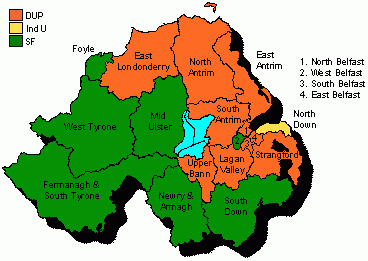
As Sinn Féin maintains a policy of abstentionism in regard to the Parliament of the United Kingdom, the 2017 election marks the first parliament since 1964 without any Irish nationalist MPs who take their seats in the House of Commons in Westminster.
Nationally, the governing Conservative Party falls eight seats short of a parliamentary majority after the election, reduced to four if the absence of Sinn Féin is taken into account. The DUP thus holds the balance of power and announces on June 10 that it will support the Conservative government on a “confidence and supply” basis.
Five seats change hands in Northern Ireland. The SDLP loses its seats in Foyle and South Down to Sinn Féin and the constituency of Belfast South to the DUP. Meanwhile, the UUP loses South Antrim to the DUP and Fermanagh and South Tyrone to Sinn Féin. The number of unionist and nationalist representatives, eleven and seven respectively, remain unchanged from the 2015 United Kingdom general election, although none of the nationalist members are participating in the current Parliament.
Gaughan, the eldest of six children, is born in Ballina, County Mayo, on October 5, 1949. He grows up at Healy Terrace and is educated at St. Muredach’s College, Ballina. After finishing his schooling, he emigrates from Ireland to England in search of work.
While in London, Gaughan becomes a member of the Official Irish Republican Army through Official Sinn Féin‘s English wing Clann na hÉireann and becomes an IRA volunteer in a London-based Active Service Unit. In December 1971, he is sentenced at the Old Bailey to seven years imprisonment for his part in an IRA fundraising mission to rob a bank in Hornsey, north London, which yields just £530, and for the possession of two revolvers.
Gaughan is initially imprisoned at Wormwood Scrubs, where he spends two years before being transferred to the top security HM Prison Albany on the Isle of Wight. While at Albany Prison, he requests political status, which is refused, and he is then placed in solitary confinement. He is later transferred to Parkhurst Prison, where four of the Belfast Ten are on hunger strike for political status.
On March 31, 1974, Gaughan, along with current Sinn Féin MLA Gerry Kelly, Paul Holme, Hugh Feeney and fellow Mayoman Frank Stagg, go on hunger strike to support the fight of Dolours and Marion Price to obtain political status and to be transferred to a jail in Ireland. The prisoners’ demands are as follows:
The right to political status
The right to wear their own clothes
A guarantee that they would not be returned to solitary confinement
The right to educational facilities and not engage in penal labour
The setting of a reasonable date for a transfer to an Irish prison
British policy at this time is to force-feed hunger strikers. According to the National Hunger Strike Commemoration Committee, “six to eight guards would restrain the prisoner and drag him or her by the hair to the top of the bed, where they would stretch the prisoner’s neck over the metal rail, force a block between his or her teeth and then pass a feeding tube, which extended down the throat, through a hole in the block.”
After visiting Gaughan in jail, his brother John describes his condition, “His throat had been badly cut by force feeding and his teeth loosened. His eyes were sunken, his cheeks hollow and his mouth was gaping open. He weighed about six stone.”
During his hunger strike, Gaughan’s weight drops from 160 lbs. to 84 lbs. He is force-fed for the first time on April 22, and this occurs 17 times during course of his hunger strike. The last time he is force-fed is the night before his death. After a hunger strike that lasts 64 days, Michael Gaughan dies on Monday, June 3, 1974, at the age of 24.
The cause of Gaughan’s death is disputed. The British government states that he died of pneumonia. The Gaughan family state that he died after prison doctors injured him fatally when food lodged in a lung punctured by a force-feeding tube. His death causes controversy in English medical circles, as some forms of treatment can be classed as assault if given without the express permission of the patient.
The timing of Gaughan’s death comes just one week after the British Government had capitulated to the demands of Ulster loyalist hunger strikers. After his death, the British government’s policy of force-feeding ends and the remaining hunger strikers are given assurances that they will be repatriated to Irish prisons. However, these promises are reneged on by the British government.
Gaughan’s body is initially removed from London and on June 7-8 over 3,000 mourners line the streets of Kilburn and march behind his coffin, which is flanked by an IRA honour guard, to a Requiem Mass held in the Church of the Sacred Heart of Jesus.
Following the Requiem Mass, his body is transported to Dublin, where again it is met by mourners and another IRA honour guard who bring it to the Church of the Immaculate Conception on Merchant’s Quay, where thousands file past as it lay in state. The following day, his body is removed to Ballina, County Mayo. A funeral mass takes place on June 9, at St. Muredach’s Cathedral, and the procession then leads to Leigue Cemetery. Gaughan is given a full IRA funeral and is laid to rest in the republican plot, where Frank Stagg would join him after being reburied in November 1976. His funeral is attended by over 50,000 people and is larger than the funeral of former president Éamon de Valera the following year.
Waddell is the tenth and youngest child of Hugh Waddell, a Presbyterian minister and missionary who is lecturing in the Imperial University. She spends the first eleven years of her life in Japan before her family returns to Belfast. Her mother dies shortly afterwards, and her father remarries. Hugh Waddell himself dies and leaves his younger children in the care of their stepmother. Following the marriage of her elder sister Meg, she is left at home to care for her stepmother, whose health is deteriorating by this time.
Waddell is educated at Victoria College for Girls and Queen’s University Belfast, where she studies under Professor Gregory Smith, graduating in 1911. She follows her BA with first class honours in English with a master’s degree, and in 1919 enrolls in Somerville College, Oxford, to study for her doctorate. A traveling scholarship from Lady Margaret Hall in 1923 allows her to conduct research in Paris. It is at this time that she meets her life-long friend, Maude Clarke.
Waddell is best known for bringing to light the history of the medieval goliards in her 1927 book The Wandering Scholars and translating their Latin poetry in the companion volume Medieval Latin Lyrics. A second anthology, More Latin Lyrics, is compiled in the 1940s but not published until after her death. Her other works range widely in subject matter. For example, she also writes plays. Her first play is The Spoiled Buddha, which is performed at the Opera House, Belfast, by the Ulster Literary Society. Her The Abbe Prevost is staged in 1935. Her historical novel Peter Abelard is published in 1933. It is critically well received and becomes a bestseller.
A serious debilitating neurological disease puts an end to her writing career in 1950. She dies in London on March 5, 1965, and is buried in Magherally churchyard, County Down, Northern Ireland. A prize-winning biography of her by the Benedictine nun DameFelicitas Corrigan is published in 1986.
Drennan is son the son of ReverendThomas Drennan (1696–1768), minister of Belfast’s First Presbyterian Church on Rosemary Street. Thomas Drennan is an educated man from the University of Glasgow and is ordained to the congregation of Holywood, County Down in 1731. Drennan is heavily influenced by his father, whose religious convictions serve as the foundation for his own radical political ideas. His sister, Martha, marries fellow future United Irishman Samuel McTier in 1773.
In 1769 Drennan follows in his father’s footsteps by enrolling in the University of Glasgow where he becomes interested in the study of philosophy. In 1772 he graduates in arts and then in 1773 he commences the study of medicine at Edinburgh. After graduating in 1778 he sets up practice in Belfast, specialising in obstetrics. He is credited with being one of the earliest advocates of inoculation against smallpox and of hand washing to prevent the spread of infection. He also writes much poetry, coining the phrase “Emerald Isle” and is the founder and editor of a literary periodical, Belfast Magazine. He moves to Newry in 1783 but eventually moves to Dublin in 1789 where he quickly becomes involved in nationalist circles.
Like many other UlsterPresbyterians, Drennan is an early supporter of the American Colonies in the American Revolution and joins the Volunteers who had been formed to defend Ireland for Britain in the event of French invasion. The Volunteer movement soon becomes a powerful political force and a forum for Protestant nationalists to press for political reform in Ireland eventually assisting Henry Grattan to achieve legislative independence for the Irish parliament in 1782. However, Drennan, like many other reformers, quickly becomes dismayed by the conservative and sectarian nature of the Irish parliament and in 1791 he co-founds the Society of United Irishmen with Wolfe Tone and Thomas Russell.
Drennan writes many political pamphlets for the United Irishmen and is arrested in 1794 for seditious libel, a political charge that is a major factor in driving the United Irishmen underground and into becoming a radical revolutionary party. Although he is eventually acquitted, he gradually withdraws from the United Irishmen but continues to campaign for Catholic Emancipation.
On February 8, 1800, Drennan marries Sarah Swanwick, “an English lady of some wealth” from Shropshire. They have one daughter and four sons.
Drennan settles in Belfast in 1807. In 1810 he co-founds the non-denominational Royal Belfast Academical Institution. As a poet, he is best remembered for his poem The Wake of William Orr, written in memory of a United Irishman executed by the British. Despite his links with revolutionary republicans, he gradually becomes alienated from the post-Union nationalism of the period. His abiding concern for Liberalism and post union realities make him contemplate his political ideas anew.
Drennan dies on February 5, 1820. He directs that his coffin be carried by an equal number of Catholics and Protestants with clergy from different denominations in attendance.