Ó Dálaigh, one of four children, is born on February 12, 1911, in Bray, County Wicklow. His father, Richard O’Daly, is a fishmonger with little interest in politics. His mother is Una Thornton. His birth name is registered in English as Carroll O’Daly, which he uses during his legal career, and which is recorded by some publications.
Ó Dálaigh is a committed Fianna Fáil supporter who serves on the party’s National Executive in the 1930s. He becomes Ireland’s youngest Attorney General in 1946, under TaoiseachÉamon de Valera, serving until 1948. Unsuccessful in Dáil and Seanad elections in 1948 and 1951, he is re-appointed as Attorney General of Ireland in 1951. In 1953, he is nominated as the youngest-ever member of the Supreme Court by his mentor, de Valera. Less than a decade later, he becomes Chief Justice of Ireland, on the nomination of Taoiseach Seán Lemass. He is a keen actor in his early years and becomes a close friend of actor Cyril Cusack. It is commonly stated that Ó Dálaigh and Cusack picketed the Dublin launch of Disney‘s Darby O’Gill and the Little People in 1959, for what they felt was the film’s stereotyping of Irish people. However, there is no known contemporary reference to this having occurred.
In 1972, Taoiseach Jack Lynch suggests to the opposition parties that they agree to nominate Ó Dálaigh to become President of Ireland when President de Valera’s second term ends in June of the following year. Fine Gael, confident that its prospective candidate, Tom O’Higgins, will win the 1973 presidential election, having almost defeated de Valera in 1966, turn down the offer. Fianna Fáil’s Erskine H. Childers goes on to win the election that follows.
When Ireland joins the European Economic Community (EEC), Lynch appoints Ó Dálaigh as Ireland’s judge on the European Court of Justice. When President Childers dies suddenly in 1974, all parties agree to nominate Ó Dálaigh to replace him.
Ó Dálaigh’s tenure as president proves to be contentious. While popular with Irish language speakers and with artists, and respected by many republicans, he has a strained relationship with the Government of the 20th Dáil, particularly with Minister Conor Cruise O’Brien and Taoiseach Liam Cosgrave.
Ó Dálaigh’s decision in 1976 to exercise his power to refer a bill to the Supreme Court to test its constitutionality brings him into conflict with the Fine Gael-Labour National Coalition. Following the assassination of the British Ambassador to Ireland, Christopher Ewart-Biggs, by the Provisional Irish Republican Army (IRA), on July 23, 1976, the government announces its intention to introduce legislation extending the maximum period of detention without charge from two to seven days.
Ó Dálaigh refers the resulting bill, the Emergency Powers Bill, to the Supreme Court. When the court rules that the bill is constitutional, he signs the bill into law on October 16, 1976. On the same day, an IRA bomb in Mountmellick, County Laois, kills Michael Clerkin, a member of the Garda Síochána, the country’s police force. Ó Dálaigh’s actions are seen by government ministers to have contributed to the killing of this Garda. On the following day, Minister for DefencePaddy Donegan, visiting a barracks in Mullingar, County Westmeath, to open a canteen, attacks the President for sending the bill to the Supreme Court, calling him a “thundering disgrace.”
Ó Dálaigh’s private papers show that he considered the relationship between the President (as Commander-in-Chief of the Defence Forces) and the Minister for Defence had been “irrevocably broken” by the comments of the Minister in front of the army Chief of Staff and other high-ranking officers. Donegan offers his resignation, but Taoiseach Liam Cosgrave refuses to accept it. This proves the last straw for Ó Dálaigh, who believes that Cosgrave had additionally failed to meet his constitutional obligation to regularly brief the President. He resigns from the presidency on October 22, 1976, “to protect the dignity and independence of the presidency as an institution.” He is succeeded as President of Ireland by Patrick Hillery.
Ó Dálaigh dies of a heart attack on March 21, 1978, less than two years after resigning the presidency. He is buried in Sneem, County Kerry.
On March 16, 2015, the eve of Saint Patrick’s Day, two ascendant politicians—one from Ireland, one from the United States—meet in a ballroom at the Essex House, in New York City. Hillary Clinton is there to be inducted into the Irish America Hall of Fame, in recognition of her “outstanding leadership” in bringing peace to Northern Ireland during the 1990s, when her husband was president of the United States. Gerry Adams, the president of the Irish Republican political party Sinn Féin, is there because for many Americans he is a living symbol of that peace. One of the architects of the Good Friday Agreement, which brought an end to the decades-long conflict in Northern Ireland that is known as the Troubles, he is very popular in the United States and makes regular trips here to raise funds for his party. According to a report in The Irish Times, Sinn Féin has raised twelve million dollars in the United States over the prior two decades, from construction companies, labor unions, and movie stars like Anjelica Huston and Martin Sheen.
Adams, however, remains a polarizing figure in Ireland. Though he is a longtime figurehead of the Republican movement, he insists that he was never a member of the Irish Republican Army (IRA) and that he played no role in the violence of the Troubles. Some people in Ireland do not actually believe this story, and, in recent years leading up to this meeting, some of his former compatriots in the Republican movement have said that he authorized a series of wartime atrocities, including the murder and secret burial of Jean McConville, a mother of ten. Adams denies these claims, and generally derides those who ask questions about his past as political foes with an agenda or opponents of the peace process.
“I remember very well when the request came, back in 1993, that my husband approve a visa for Gerry Adams,” Clinton told the crowd at the Essex House. Bill Clinton granted the visa, which was a controversial move at the time, because of Adams’s alleged association with the IRA, but also a crucial moment in the peace process, because it helped cement Adams’s transformation from a revolutionary to a statesman. “Absent that first step, that first risk, we might not have had the momentum to move forward, to get to the Good Friday accords and all that has followed,” Clinton said.
There is no way of knowing whether Clinton, dressed in Kelly green, felt any distaste at the prospect of sharing a table with Adams. There is some thirty-five million Irish Americans, a great many of whom regard Adams as a kind of Nelson Mandela, and no prospective presidential candidate can decline a Saint Patrick’s Day invitation. And to be sure, the IRA is not alone in standing accused of atrocities during the Troubles. Loyalistparamilitary groups and British government forces also perpetrated war crimes for which they have not been brought to account. But Clinton does indicate, obliquely, that the transition in Northern Ireland is not entirely complete. “There is still work to be done,” Clinton acknowledges. “You cannot bring peace and security to people just by signing an agreement.” The question for the people of Northern Ireland, and for Adams’s supporters in the United States, is whether you can bring enduring peace and security without some reckoning—by all parties in the conflict—with the crimes of the past.
(From: “Gerry Adams and Hillary Clinton in New York” by Patrick Radden Keefe, The New Yorker, http://www.new yorker.com, March 17, 2015 | Photo: Hillary Clinton at a previous meeting with Gerry Adams at the State Department in 2009. Photograph by Mark Wilson/Getty)
Kenny holds a meeting with U.S. PresidentBarack Obama. This is President Obama’s last Saint Patrick’s Day in the White House and, pending government formation negotiations, it may also be Kenny’s last as Taoiseach. Obama criticises the vicious nature of the current U.S. political cycle and pledges to continue to push for immigration reform while he is still in office. He is speaking as he attends several engagements with Kenny to mark Saint Patrick’s Day.
Earlier in the day at a breakfast reception at Number One Observatory Circle, the official residence of the vice president of the United States, Kenny tells Vice President Joe Biden that Ireland will be able to put together a stable government during the next “short period ahead.” The recent General Election is mentioned several times during speeches from both men. Biden says that he is surprised at the outcome saying, “he did a hell of a job, is still the most popular guy, and he lost.” Biden says Kenny had assured him that it was “going to work out.”
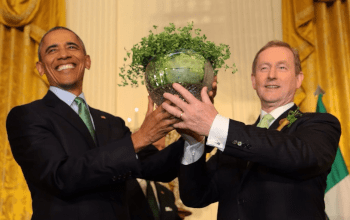
In the evening, Kenny presents the traditional bowl of shamrock to Obama at a reception at the White House. The bowl is mouth-blown and hand-cut at the House of Waterford Crystal factory in Ireland. The piece is designed by Tom Cooke and inspired by the General Post Office (GPO) in Dublin. It features the five themes of the Irish 2016 Centenary Programme – Remembering, Reconciling, Presenting, Imagining and Celebrating – which are inscribed on the piece.
Kenny also presents Obama with a pair of cufflinks modeled on the buttons of the coat Michael Collins was wearing when he was killed, and a limited-edition, fine-press collection of poetry and art, to celebrate the centenary of the 1916 Easter Rising, published by Stoney Road Press, in association with An Post and Poetry Ireland. First LadyMichelle Obama receives a ring designed by Paul Kelly, inspired by the Ring of Kerry, and a hamper of Irish food items. Daughters Malia and Sasha Obama are given two Newbridge Silverware compact mirrors.
Speaking to reporters after visiting the Oval Office, Kenny says Fine Gael is talking to like-minded parties and individuals on government formation and is working on drawing-up a set of priorities. “We’re actually determining our set of priorities that will be important in the discussions that Fine Gael will have in putting together a government. Some of that comes from our own programme, some of it comes from the parties and the alliances that we’ve been talking to. And some of it clearly comes from the concerns raised by people during the course of the election, like housing and homelessness, health issues and so on.”
Kenny adds, “We expect to have that finalised next week and that gives us really the basis for negotiations and for discussions about putting a government together.”
The following day, Kenny returns to Ireland for a short time before traveling to Brussels for a European Council meeting on Saint Patrick’s Day.
(From: “Kenny meets Obama and Biden in Washington,” RTÉ News, http://www.rte.ie, March 15, 2016)
O’Hegarty is born Jeremiah Stephen Hegarty on December 26, 1892, in Lowertown, Skibbereen, County Cork, the eldest of seven children of Jeremiah Hegarty (1856–1934) and his wife Eileen (née Barry), both teachers. He is educated at the Christian Brothers school, St. Patrick’s Place, Cork, joins the Dublin civil service in 1910 and is posted to the Department of Agriculture and Technical Instruction, acquiring invaluable administrative experience as private secretary to T. P. Gill, secretary of the department.
O’Hegarty is a member of the Keating branch of the Gaelic League and the closely associated Teeling circle of the Irish Republican Brotherhood (IRB). In 1913 he becomes secretary and stage manager of a troupe of Gaelic players, Na hAisteoirí, which includes several who later become prominent revolutionaries: Piaras Béaslaí, Gearóid O’Sullivan, Fionán Lynch, and Con Collins. As second lieutenant of F Company, 1st Battalion, Dublin Brigade, Irish Volunteers, during the Easter Rising, he is in charge of barricades in Church Street, Mary Lane, Mary’s Abbey, and Jameson Distillery, an area which sees fierce fighting. Imprisoned in Knutsford (May 1-18), he is released in error and returns to his post in the civil service. On his return he is a key figure in the reorganisation of the Volunteers and IRB, becoming a member of the executive of the IRB’s supreme council along with Michael Collins and Seán Ó Murthuile. He also becomes a central figure in Kathleen Clarke‘s prisoner support group, the Irish Volunteer Dependents Fund, and when it amalgamates with the more moderate Irish National Aid Association to form the INA&VDF in August 1916, he helps to ensure that it is dominated by republicans.
O’Hegarty is very close to Michael Collins and Harry Boland and in 1918 this IRB triumvirate exercises considerable control in the nomination of Sinn Féin candidates for the 1918 Irish general election. In the same year he is dismissed from the civil service for refusing to take the oath of allegiance, but his administrative talents find ample outlet in the secretariat of the revolutionary Dáil and later in the service of the Irish Free State to such an extent that he has been called ‘the civil servant of the revolution’ and ‘the Grey Eminence of the Free State Government.’ As clerk of the First Dáil and secretary to the Dáil cabinet (1919–21), he is largely responsible for its success, organising meetings of the clandestine parliament and coordinating the work of various departments from his offices on the corner of O’Connell Street and Abbey Street and later in Middle Abbey Street. He is determined that the Dáil will demonstrate its worth by ‘functioning as any progressive government would be expected to function.’ He records the minutes and handles all correspondence of the Dáil cabinet. As the conduit through which the Dáil’s ministers communicate, his role is central to the effective operation of government on the run. The influence this gives him within the revolutionary movement is bolstered by his senior role within the IRB and the positions of military significance which he occupies. He is a member of the Volunteer Executive (Jun 1916–Nov 1921), Irish Republican Army (IRA) Director of Communications (Jul 1918–Mar 1920), and Director of Organisation (Mar 1920–Apr 1921). When convicted of illegal assembly and jailed in Mountjoy Prison (Nov 1919–Feb 1920), he immediately wields power within the prison, ordering Noel Lemass off a hunger strike.
O’Hegarty resigns his military duties in April 1921 to concentrate on his work in the Dáil secretariat and serves as secretary to the Irish delegation during the Anglo–Irish Treaty negotiations in London (Oct–Dec 1921). He is a vital voice for the Treaty within the IRB and is appointed secretary to the cabinet of the Provisional Government in 1922, participating in the unsuccessful army unification talks of May 1922. During the Irish Civil War, he is briefly seconded from his civil service post to serve as military governor of Mountjoy Prison (Jul-Aug 1922), where he threatens that prisoners who persist in leaning out of windows and talking to the public outside the prison will be shot. Peadar O’Donnell, who is a prisoner there at the time, remembers him as the focus of much “republican bitterness.” A member of the army council during the Irish Civil War, he serves as Director of Organisation (Jul–Dec 1922) and Director of Intelligence (Dec 1922–May 1923), leaving the army with the rank of lieutenant general on May 1, 1923, to resume his civil service career.
O’Hegarty is secretary to the Executive Council of the Irish Free State (1923–32) and principal private secretary to its president, W. T. Cosgrave. Again, he records the cabinet minutes and is the administrative pivot upon which government turns. He serves as secretary to numerous governmental delegations and is widely praised for his work in this role at the 1926 Imperial Conference and the 1930 Imperial Conference. In 1927 he goes to New York to represent the government at a hearing into the fate of republican funds in the United States. His career is the prime example of the influence of revolutionary veterans within the higher civil service in the early years of the state. After the change of government following the 1932 Irish general election, he is one of the very few senior civil servants who is effectively removed from his position. He is appointed to be a commissioner of public works, becoming chairman in 1949, a position he holds until his retirement in 1957. In 1939–40 he serves on the Economy Committee established by the government to advise on wartime spending, and in 1941 is a member of a tribunal of inquiry into public transport, which is principally concerned with the poor financial state of Great Southern Railways.
On April 27, 1922, with Michael Collins as his best man, O’Hegarty marries Claire Archer, daughter of Edward Archer, a post office telegraph inspector from Dublin, and Susan Archer (née Matthews). Her brother is William (Liam) Archer. They live at 9 Brendan Road, Donnybrook, Dublin.
Byrne is born on March 17, 1882, the second of seven children born to Thomas Byrne, an engineer, and Fanny Dowman. His childhood home is at 36 Seville Place, a terraced house with five rooms just off the North Strand in Dublin. He drops out of school at the age of thirteen and is soon juggling jobs as a grocer’s assistant and a bicycle mechanic. Eventually he uses his savings to buy a pub on Talbot Street. He marries Elizabeth Heagney in 1910.
Byrne becomes an Alderman on Dublin Corporation in 1914. He is a member of the Dublin Port and Docks Board, a significant position for a politician from the Dublin Harbour constituency. In the records of the Oireachtas his occupation is given as company director. He is elected as MP for Dublin Harbour as a candidate of the Irish Parliamentary Party (IPP) in a by-election on October 1, 1915, following the death of William Abraham. The Easter Rising in 1916 is followed by the rapid decline of the Irish Parliamentary Party and the rise of Sinn Féin. At the 1918 Irish general election he is defeated by a Sinn Féin candidate, Philip Shanahan.
Byrne is elected as an Independent TD supporting the Anglo-Irish Treaty for the Dublin Mid constituency at the general election to the Third Dáil in 1922. From 1923 to 1928 he represents Dublin City North. In 1928 he is elected for a six-year term as a member of Seanad Éireann. He vacates his Dáil seat on December 4, 1928. He resigns from the Seanad on December 10, 1931, and returns to the Dáil in 1932. He remains a TD until his death in 1956, representing Dublin City North (1932–37) and Dublin North-East (1937–56). In several elections he secures more votes than any other politician in the country.
Byrne is elected as Lord Mayor of Dublin in 1930, serving in the post for nine consecutive years. When cycling or walking around the city he dispenses lollipops to children, who are often seen chasing him down the street. With a handshake and a few words for all, his eternal canvassing soon earns him the first of his nicknames: the Shaking Hand of Dublin. Married with eight children, he treats the people of Dublin as his second family. Every morning, he finds up to fifty people waiting for him in the Mansion House. None have appointments. All are met. He answers 15,000 letters in his first year as Lord Mayor. Many are from Dubliners looking for a job, a house, some advice or a reference. One morning in 1931 a journalist watches the Lord Mayor attend to his correspondence. Within an hour he accepts “seventeen invitations to public dinners, one invitation to a public entertainment and eight invitations to public functions.” Then he dictates forty-three sympathetic letters to men and women looking for employment.
In 1937, children between the ages of eight and eleven years old are being sentenced to spend up to five years in Industrial Schools. Their crime is stealing a few apples from an orchard. When Byrne says such sentences are “savage,” a judge responds with a defence of the Industrial School system, urging an end to “ridiculous Mansion House mummery.” He stands firm: “For the punishment of trifling offences the home of the children is better than any institution.” In 1938, he is favoured by the press for the presidency of Ireland, a ceremonial role created in the new Constitution, but he is outgunned by the political establishment.
When, in 1935, Byrne becomes the first Lord Mayor of Dublin to visit North America in 40 years, he is granted the freedom of Toronto, and The New York Times hails the arrival of a “champion showman.” He often extends a hand of friendship to Britain. He also improves relations between Dublin, until recently the centre of British authority, and the rest of the country. One night Dublin Fire Brigade gets an urgent call for assistance from Clones, County Monaghan. As Lord Mayor, he feels obliged to join the men on top of the fire engine as they set off on the 85-mile journey in the middle of the night.
In August 1936, Byrne addresses the inaugural meeting of the anti-communistIrish Christian Front, some of whose members later express anti-Semitic views. In 1938, as Lord Mayor, he presents a gift of a replica of the Ardagh Chalice to Italian naval cadets visiting Dublin on board two warships, who had been welcomed by the Irish government despite the protests of Dubliners. A photograph exists of Byrne giving a fascist salute along with Eoin O’Duffy, commander of the Blueshirts, around 1933.
In 1954, Byrne is elected as Lord Mayor for a record tenth time. This time he does not live in the Mansion House, but stays in Rathmines with his family, taking the bus to work each morning. He is just as devoted to the job. When flooding damages 20,000 houses in Fairview and North Strand, he rises from his sick bed to organise a relief fund. His final term as Lord Mayor comes to an end in 1955. Shortly afterwards, Trinity College Dublin awards him an honorary Doctor of Law, describing him as a “champion of the poor and needy, and a friend of all men.”
Byrne dies on March 13, 1956. His funeral is the largest seen in Dublin for many years. TheEvening Herald reports that “Traffic in O’Connell Street was held up for almost 20 minutes to allow the cortege of over 150 motor cars to pass, and at all the junctions along the route to Glasnevin people silently gathered to pay tribute to one of Dublin’s most famous sons.” The members of the Dáil stand and observe a short silence as a mark of respect. A telegram is sent to his widow from the Mayor of New York City, Robert F. Wagner Jr., expressing deepest sympathy, and stating “that Ald. Byrne had attained high office of Lord Mayor many times, but he never lost contact with the poor and the underprivileged, whose champion he was.”
The by-election caused by Byrne’s death, is won by his son, Patrick Byrne. Two other sons, A. P. Byrne and Thomas Byrne, are also TDs for various Dublin constituencies. Alfie Byrne Road in Clontarf is named after him. The Dublin Bay North branch of Young Fine Gael is renamed “Alfie Byrne YFG.”
Ben Briscoe, former Fianna Fáil politician, is born on March 11, 1934, in Dublin. He is a Teachta Dála (TD) for 37 years, representing constituencies in the south Dublin city area.
At the 1992 Irish general election Briscoe is involved in a marathon recount battle with Democratic Left‘s Eric Byrne to decide the fate of the final seat in Dublin South-Central. He is declared the victor after ten days of re-counting and re-checking ballot papers, leading to him describing the long count as being like “the agony and the ex-TD.”
Briscoe is sometimes critical of the leader of Fianna Fáil in the 1980s, once describing Charles Haughey‘s leadership as a “Fascist Dictatorship.” He fronts a quietly discontented anti-Haughey faction within the Parliamentary Party, which includes Charlie McCreevy, during Haughey’s time as Taoiseach.
In 1988–1989 Briscoe is Lord Mayor of Dublin, a post previously held by his father. His term covers the second half of Dublin’s Millennium Year 1988. After the Dublin City Council makes him Lord Mayor, he describes his selection for the honour as “one of the proudest moments of my life.”
The Molly Malone statue, previously at the bottom end of Grafton Street and now outside the Dublin Tourist Information Office around the corner, is unveiled by Briscoe during the Dublin Millennium celebrations in 1988, and he declares June 13 as Molly Malone Day in Dublin.
Briscoe is one of Ireland’s most famous Jewish politicians. The small Irish Jewish community have been enthusiastic and active participants in the country’s political and legal world. His father is one of several Jews involved in the Irish War of Independence and Sinn Féin movements. In his time, each of the three main political parties have a Jewish member in Ireland’s 166-member Dáil.
In a March 4, 2008, announcement, the Rev. Ian Paisley signals the end of an era by announcing he will retire as First Minister of Northern Ireland. He also confirms he is stepping down as leader of the Democratic Unionist Party (DUP), the party he founded in the early 1970s. The news represents a huge moment in the politics and recent history of Northern Ireland, removing from the scene as it does one of its most striking figures.
The 81-year-old announces he will quit both posts following an international investment conference in Belfast in May 2008 but will remain as an MP and Assembly member.
“I came to this decision a few weeks ago when I was thinking very much about the conference and what was going come after the conference,” Paisley tells Ulster Television. “I thought that it is a marker, a very big marker and it would be a very appropriate time for me to bow out.”
Paisley denies he is leaving in part over allegations that his son, Ian Paisley Jr., lobbied Downing Street on behalf of a wealthy party member. He says his son has been “wrongly accused.” He is also weakened over defeat in a recent by-election – an indication that a section of the DUP’s electorate is uneasy about his historic decision to share power with Sinn Féin.
Significantly, Paisley does not back any contender in the DUP leadership contest to succeed him. “This is not the Church of Rome. I have no right to say who will succeed me. I will not be like Putin in Russia saying to the president – ‘this is the way you have to go.’ When I make a break it will be [a] break.”
Paisley defends his decision to enter into government with Sinn Féin. “It was the right thing to do because it was the only thing to do to save us from a united Ireland. We were threatened that we would be more Irish in our rulership, that there would be more Dublin say in government. That was what the British government threatened. We managed to put that to a rest.”
“We have laid to rest that and republicans have come to see that they have to put up with Paisley and his clan. We took what was meant for our destruction and turned it into our salvation.”
Speaking from Dubai the previous night, the deputy First Minister, Martin McGuinness, says, “It wasn’t unexpected. It was the right decision to go into sharing power with Sinn Féin which changed the politics of Ireland forever.”
The Sinn Féin MP describes Paisley as “courageous” for agreeing to enter into the power-sharing government. “We have had a positive and constructive working relationship,” McGuinness said.
Paisley’s fiercest critic within unionism, the ex-DUP MEP, Jim Allister, claims opposition to his power-sharing with Sinn Féin and his relationship with McGuinness means that Paisley “jumped before he was pushed.”
Allister’s new party, Traditional Unionist Voice (TUV), split the DUP vote in a by-election in February 2008 and cost the party a council seat in County Down. It was Paisley’s first electoral test since he agreed to share power with Sinn Féin following the St. Andrews Agreement at the end of 2006.
In April 2008, Peter Robinson is chosen to succeed Paisley as leader of the Democratic Unionist Party. The 36 DUP members of the Northern Ireland Assembly unanimously select Robinson, who has been MP for Belfast East since 1979 and Paisley’s deputy since 1980. He is the Minister of Finance and Personnel in the Northern Ireland Executive – Northern Ireland’s power-sharing government – for the previous year.
(From: “Paisley to step down as Ulster’s first minister” by Henry McDonald, Ireland correspondent, The Guardian, March 4, 2008)
Pery is born in Limerick, County Limerick on April 8, 1719, into one of Limerick’s most politically influential families, the elder son of the Rev. Stackpole Pery and Jane Twigge. His maternal grandfather is William Twigge, Archdeacon of Limerick.
A trained barrister, Pery becomes a member of the Irish House of Commons for the Wicklow Borough constituency in 1751. On the dissolution of the house following the death of George II, he is elected for the constituency of Limerick City and serves from 1761 until 1785, becoming Speaker of the House in 1771. In 1783, he stands also for Dungannon, however chooses to sit for Limerick City. He is considered one of the most powerful politicians in Ireland in his time, leading a faction which includes his nephew, the future Earl of Limerick, and his relatives by marriage, the Hartstonges. Following his resignation, he is created Viscount Pery, of Newtown Pery, near the City of Limerick, in the Peerage of Ireland, entitling him to a seat in the Irish House of Lords. As he has no male heirs, his title becomes extinct on his death in 1806.
Pery is also noted for his part in the history of the architecture of Limerick. In 1765, he commissions the engineer Davis Ducart to design a town plan for land that he owns on the southern edge of the existing city, which leads to the construction of the Georgian area of the city later known as Newtown Pery. He is also commemorated in the naming of Pery Square.
Pery marries Patricia (Patty) Martin of Dublin in 1756, who dies a year later, and secondly Elizabeth Vesey, daughter of John Vesey, 1st Baron Knapton, and Elizabeth Brownlow. He and Elizabeth have two daughters:
In his early years, Devlin is active in various local debating societies, where his associates include Cathal O’Byrne, who he retains a personal friendship despite later political differences. A committee member of the Belfast branch of the Irish National League (INL) in 1890, he joins the anti-Parnellite faction during the O’Shea divorce scandal (1891), becoming local secretary of the Irish National Federation (INF). His political model at this time is Thomas Sexton, MP for Belfast West, whose campaign he organises at the 1892 United Kingdom general election.
Although Healyism is strong in CatholicUlster, Devlin aligns himself with the faction led by John Dillon and, from 1899, with the United Irish League (UIL), founded by William O’Brien. From the late 1890s this brings Devlin into conflict with the Belfast Catholic Association of Dr. Henry Henry, bishop of Down and Connor (1895–1908). This organisation, though sometimes regarded as Healyite, is essentially based on the view that mass nationalist political mobilisation in Belfast can only bring trouble and ostracism, and that Catholic interests are best represented by allowing a small group of lay and clerical notables to broker concessions from the unionist majority. After a series of local election contests in Catholic wards and controversies between the pro-Devlin weekly Northern Star and the clerically controlled The Irish News, Devlin succeeds in marginalising the politically maladroit Henry by 1905. In the process, however, he takes on some of the qualities of his “Catholic establishment” opponents. At the same time, he moves onto the national political stage.
Returned unopposed for North Kilkenny (1902–06), Devlin is appointed secretary of the United Irish League of Great Britain in 1903, and of the parent body in Dublin in 1904. A speaking tour of the United States in 1902–03 convinces him of the organisational potential of Catholic fraternal organisations, and in 1905 he takes over the presidency of the Board of Erin faction of the Ancient Order of Hibernians (AOH), a specifically Catholic body which he proceeds to develop as an organisational arm of the Nationalist Party. Under his tutelage the AOH expands from 10,000 members in 1905 to 60,000 in 1909, despite opposition from some Catholic bishops who distrust it because of its close affiliation to Dillonism, its secrecy, and its habit of staging dances and other entertainments without paying what they regard as due deference to local priests. His AOH also faces opposition from a rival separatist body, the Irish-American Alliance AOH. Though far less numerous, this group is able to draw on the support of separatists within the American AOH and hinder Devlin’s attempts to mobilise the American organisation in his support. The AOH expands further after 1910 and is strengthened by becoming an approved society under the National Insurance Act 1911.
Belfast is where Devlin’s political career begins and where it ends. Organisational skill contributes substantially to his hold on the largely working-class seat of Belfast West, which he wins in 1906 on a platform that seeks to transcend religious boundaries by combining labour issues with the home rule demand. A lifelong bachelor, though short in stature, he is apparently highly attractive to women, and takes a special interest in their problems, no doubt mindful of the influence they might have on the political behaviour of their spouses. He founds a holiday home for working-class women. When the scholar Betty Messenger interviews former Belfast linen workers in the late 1960s and early 1970s, she is startled to discover the extent to which Devlin is remembered as a champion of the workers decades after his death. This image persists among Protestant workers as well as Catholics, and he is generally credited with various ameliorations of workplace conditions even when he had not been responsible for them.
Possessed of great oratorical skills and even greater organisational ability, Devlin effectively becomes the key organiser of the Nationalist Party from the early years of the twentieth century, relieving the party leader, John Redmond, of a great deal of the administrative burden of party affairs, and becoming well known abroad through fund-raising trips, especially in North America. His personal geniality makes him a great favourite at Westminster, and Irish socialists are dismayed at the willingness of British Labour Party MPs to accept him as an authentic Labour representative. Several MPs elected after 1906 can be identified as his protégés, and groups of Hibernian strong-arm men uphold the party leadership in such contests as the 1907 North Leitrimby-election and the 1909 “baton convention” which witnesses the final departure of William O’Brien and his supporters from the UIL. He is the only post-Parnellite MP to be admitted to the tight leadership group around Redmond. In 1913 he is a leading organiser of the National Volunteers.
When William O’Brien embarks on his personal initiative to deal with the Ulster problem through conciliation in the early Edwardian period, he finds a stern critic in Devlin and in turn demonises the “Molly Maguires” as sectarian corruptionists. Personally non-sectarian, Devlin, like other party leaders, endorses the shibboleth that home rule will prove a panacea for Ireland’s problems, including Ulster, and uses his credentials as a labour representative to dismiss popular unionism as a mere product of elite manipulation. In a period when the Vatican‘s Ne Temere decree on religiously mixed marriages is heightening Protestant fears about the “tyranny” of Rome, he seems to be oblivious to how his integration of Hibernianism and nationalism is exacerbating that problem. As the third home rule bill passes through Parliament and the Ulster Volunteer Force (UVF) mobilises, he encourages the Irish party leaders in the view that the Ulster unionist campaign is a gigantic bluff, dismissing contrary opinions even when held by other nationalist MPs. During these years the AOH clashes with the Irish Transport and General Workers’ Union (ITGWU) during the Dublin lock-out, and from late 1913 the AOH spearheads the Redmondite attempt to take over and dominate the Irish Volunteers.
Devlin endorses Redmond’s support for the British war effort and engages in extensive recruiting activity. He seems to be motivated, at least in part, by the belief that after the war nationalist ex-soldiers can be used to overawe the Ulster unionists by the threat of force. According to Stephen Gwynn, Devlin wishes to apply for an officer’s commission but is asked not to do so by Redmond on the grounds that the party needs his organisational skills.
Devlin’s career is decisively shaped by his decision to use his influence to persuade northern nationalists to accept temporary partition, in fulfilment of the flawed agreement arrived at between David Lloyd George, Sir Edward Carson, and Redmond in the aftermath of the 1916 Easter Rising. He later claims he has been decisively influenced by the prospect that under this agreement the excluded area would be governed directly from Westminster, rather than by a local, Orange-dominated parliament. He forces the agreement through a Belfast-based convention despite protests from west Ulster nationalists, but the proposal collapses after it transpires that Lloyd George has made incompatible commitments to nationalists and unionists. Northern nationalism immediately splits between west and south Ulster dissidents and Devlin’s loyalists predominant in Belfast and east Ulster, and the next year sees massive secessions of AOH members outside Ulster to Sinn Féin. Although he retains a core of loyal supporters, he is reduced from a national to a sectional leader. As a member of the Irish convention (1917–18) he sides with Bishop Patrick O’Donnell against Redmond on the issue of seeking a compromise settlement with southern unionists on the basis of home rule without fiscal autonomy. He is offered the leadership of the Nationalist Party on Redmond’s death in 1918, but concedes the honour to his long-standing mentor, John Dillon.
Devlin holds Belfast West until 1918 and easily sweeps aside an attempt by Éamon de Valera to displace him from the Falls division of Belfast at the general election of that year, though the electoral decimation of the Nationalist Party elsewhere leaves him leading a rump of only seven MPs. In the ensuing parliament he is an outspoken critic of government policy towards Ireland and highlights sectarian violence against northern nationalists. Clearly discouraged and with boundary changes militating against retention of the Falls seat, he unsuccessfully contests the Liverpool Exchange constituency as an Independent Labour candidate in 1922. Elected for Antrim and Belfast West to the Parliament of Northern Ireland in 1921, he eventually takes his seat in 1925, holding it until 1929, when he combines representation for Belfast Central with that for Fermanagh and South Tyrone at Westminster.
Only after the boundary commission ends the border nationalists’ hopes of speedy incorporation in the Irish Free State is Devlin able to assert leadership of northern nationalism as a whole on the basis of attendance at the northern parliament. Even then he is considerably handicapped by recriminations over the events of 1916–25. He embarks on his last significant political campaign in 1928, when he seeks to unite minority politics through the agency of the National League of the North (NLN). The initiative, emphasising social reform, is unsuccessful. His own political baggage is a hindrance to the unity of the factions that minority politics had thrown up over the previous ten years, while the minority community itself is politically demoralised by the fate that has overtaken it, and the unionist government shows itself unwilling to make concession to him. The project, moreover, coincides with the onset of the gastric illness, exacerbated by heavy smoking, that takes his life on January 18, 1934. For some time before his death he ceases to attend the Northern Ireland parliament.
Devlin’s political career is one of great promise only partially fulfilled, its ultimate realisation undermined firstly by the fallout from the Easter Rising that destroyed the vehicle of his political ambitions, and secondly by the sequence of events that led to the creation of a constitutional entity so constructed that all nationalist politicians, regardless of talent, were effectively denied a route to power. Only at his death does the unionist regime adequately acknowledge his political stature. His funeral is attended by at least three Northern Ireland cabinet ministers, together with representatives of the government of the Irish Free State. Northern nationalism never again produces a leader of his ability in the Stormont era. His ability to use Westminster to promote the interests of Ulster nationalists is comparable to John Hume‘s use of Europe for the same purpose from the mid 1970s. After his death the nationalist party in Belfast grows increasingly reliant on middle-class leadership and is eventually displaced by nationalist labour splinter groups, some of whose prominent activists, such as Harry Diamond, had begun their careers as election workers for Devlin.
Mary Lou McDonald is ratified as the new president of Sinn Féin at a special party Ardfheis on February 10, 2018. Approximately 2,000 party delegates gather for the meeting in Dublin. After almost 35 years, Gerry Adams officially steps down as party leader, a role he has held since November 1983.
McDonald takes the helm with a sweeping speech that touches on everything from abortion to Brexit and promises a united Ireland “in our time.”
McDonald, 48, is the first woman to lead the party, and the first Sinn Féin leader with no direct connection to Ireland’s period of violence known as the Troubles. “We must only agree that the past is never again repeated,” she says. “On other things, we can agree to disagree. The poet Maya Angelou put it well: ‘History, despite its wrenching pain, cannot be unlived. But if faced with courage, need not be lived again.’”
McDonald takes over for Adams, a divisive politician who was the face of the Irish republican movement as it shifted from violence to peace. The end of Adams’ tenure marks a new era for the party, which wants to unite the United Kingdom’s Northern Ireland with the Republic of Ireland to the south.
Adams, who announced in November 2017 he was stepping down after almost 35 years, was the key figure in the peace process that saw the signing of the 1998 Good Friday Agreement and the formation of a power sharing government between Northern Ireland’s pro-British and republican factions. But many believe Sinn Féin’s popularity among voters has been hindered by the presence of leaders linked to the Troubles, which killed over 3,600 people.
McDonald immediately puts her own stamp on the future, trying to infuse new energy into the movement that has lawmakers on both sides of the Irish border. But she also focuses on Sinn Féin’s founding principle: a united Ireland. “We are the generation of republicans who will see the rising of the moon,” she says. “Sinn Féin in government, both North and South. Irish unity in our time.”
McDonald also lays out her positions on the key issues of the day.
On the United Kingdom’s upcoming departure from the European Union, or Brexit, she says Sinn Féin will not accept any deal that reinstates border controls between Northern Ireland and the Republic. Brexit represents a threat to the prosperity of Ireland as a whole.
McDonald also says the party will campaign for women’s right to an abortion in Ireland’s upcoming referendum on the issue and says she is committed to reaching an agreement that will restore Northern Ireland’s power sharing government on the basis of “respect and integrity for all.”
Northern Ireland’s last government collapsed more than a year earlier amid a corruption scandal.
(From: “Mary Lou McDonald takes over as Sinn Féin party leader” by Danica Kirka, AP News, apnews.com, February 10, 2018)




 seamus dubhghaill