Raised in Dublin, Devlin first develops his badminton skills in the family garden during his childhood with his friend Gordon “Curly” Mack. The two childhood friends graduate from the garden to win an impressive six titles together in men’s doubles at the All England Open Badminton Championships.
Devlin is the second most successful player ever in the All England Open Badminton Championships with 18 titles between 1925 and 1931, including three triple championships in 1926, 1927 and 1929. He dominates the 1920s with six titles at the Irish Open and two titles at the Scottish Open.
Despite being Irish Devlin is part of the English team that tours Canada in 1925 to promote the sport on behalf of the Canadian Badminton Association which had recently been formed in 1921. He is also part of a second English touring team that visits Canada during 1930. A match is held at the Granite Club in Toronto which England wins 7-2.
When his playing career comes to an end in 1931, Devlin moves to North America to become the first known full-time badminton coach. He first sets foot in Winnipeg and then in Baltimore. After spending time coaching in North America, he returns to Ireland and teaches his skills to the next generations until he is well into his eighties.
Adding to his success with the racket, Devlin earns a solid reputation as a writer. Over four decades, he authors many books on the technical and tactical aspects of badminton. He is a strong believer in sound technique and becomes the first known player to use the overhead backhand clear.
Frank Devlin dies on October 27, 1988, at 88 years of age.
Two of Devlin’s daughters, Judy and Susan, become badminton legends in their own right, and win six All England women’s doubles titles together as partners. Judy, who also wins ten All England titles in women’s singles, is inducted with her late father into the Badminton Hall of Fame in 1997.
(Pictured (L to R): Sir George Thomas of England and Frank Devlin of Ireland)
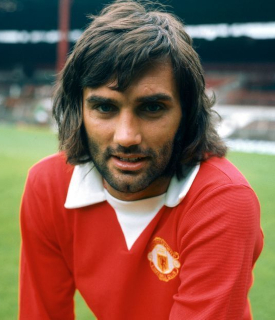
Best is born on May 22, 1946 and grows up in Cregagh, east Belfast. In 1957, he passes the eleven-plus and goes to Grosvenor High School, but he soon plays truant as the school specialises in rugby. He then moves to Lisnasharragh Secondary School, reuniting him with friends from primary school and allowing him to focus on football. He plays for Cregagh Boys Club. He grows up supporting Glentoran F.C. and Wolverhampton Wanderers F.C..
Best spends most of his club career at Manchester United. Named European Footballer of the Year in 1968, he is regarded as one of the greatest players of all time. A highly skillful winger, considered by several pundits to be one of the greatest dribblers in the history of the sport, he receives plaudits for his playing style, which combines pace, skill, balance, feints, two-footedness, goalscoring and the ability to get past defenders.
In international football, Best is capped 37 times for Northern Ireland between 1964 and 1977. A combination of the team’s performance and his lack of fitness in 1982 means that he never plays in the finals of a major tournament. He considers his international career as being “recreational football,” with the expectations placed on a smaller nation in Northern Ireland being much less than with his club. He is regarded as one of the greatest players never to have played at a World Cup. The Irish Football Association describes him as the “greatest player to ever pull on the green shirt of Northern Ireland.”
With his good looks and playboy lifestyle, Best becomes one of the first media celebrity footballers, earning the nickname “El Beatle” in 1966, but his extravagant lifestyle leads to various personal problems, most notably alcoholism, which he suffers from for the rest of his life. These issues affect him on and off the field, often causing controversy. Although conscious of his problems, he is publicly not contrite about them. He says of his career, “I spent a lot of money on booze, birds [women] and fast cars – the rest I just squandered.” After football, Best spends some time as a football analyst, but his financial and health problems continue into his retirement.
Best is diagnosed with severe liver damage in March 2000. His liver is said to be functioning at only 20%. In 2001, he is admitted to hospital with pneumonia. In August 2002, he has a successful liver transplant at King’s College Hospital in London.
On October 3, 2005, Best is admitted to intensive care at the private Cromwell Hospital in London, suffering from a kidney infection caused by the side effects of immunosuppressive drugs used to prevent his body from rejecting his transplanted liver. In the early hours of November 25, 2005, treatment is stopped. Later that day he dies, aged 59, as a result of a lung infection and multiple organ failure. He is interred beside his mother in a private ceremony at Roselawn Cemetery, overlooking east Belfast.
The IFA’s first decisions are to elect its first President, Major Spencer Chichester, and to form an annual challenge cup competition similar to the FA Cup and Scottish Cup competitions, called the Irish Cup. Two years later, Ireland plays its first international against England, losing 13–0, which remains a record for both teams, a record win for England and a record loss for Ireland.
Shortly after the partition of Ireland in 1921, the Football Association of Ireland (FAI) is established as a rival association to regulate the game in what is to become the Irish Free State. The immediate cause of the split lay in a bitter dispute over the venue for the replay of an Irish Cup match in 1921 involving Glentoran F.C. of Belfast and Shelbourne F.C. of Dublin. When the first cup match is drawn in Belfast, because of the Irish War of Independence, the IFA reneges on a promise to play the replay in Dublin and schedules the rematch again for Belfast. Shelbourne refuses to comply and forfeits the Cup.
Such is the anger over the issue that the Leinster Football Association breaks away from the IFA and forms its own national association. Those behind the FAI believe that football should be regulated by a federation based in the Irish Free State’s capital, Dublin. They also accuse the IFA of neglecting the development of the game in the South. The IFA’s supporters argue that the federation should be based where the game is primarily played – namely Ulster, and its principal city Belfast.
Both associations claim to represent the whole of the island, each competing internationally under the name “Ireland” and selecting players from both the rival national leagues, which also split at this time. Interventions by FIFA give the FAI de jure organising rights over the 26 counties of the Republic, with the IFA restricted to Northern Ireland. From the 1950s onwards, the IFA no longer claims it is the association for the whole of Ireland.
In 1960, the association moves to its present location on Windsor Avenue in south Belfast, in a building once occupied by Thomas Andrews. The IFA continues to regulate the game in Northern Ireland, and all results obtained by the Irish national side and records in the Irish Football League and the cup competition stand as Northern Irish records.
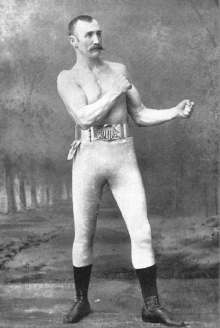
Mike Donovan, middleweight boxer of the bare-knuckle era also known as Professor Mike Donovan and Mike O’Donovan, is born in Chicago, Illinois on September 27, 1847, to Irish-born parents. He later becomes one of the foremost teachers of the sport.
The first of many memorable events in Donovan’s life comes when he fights for the Union Army in the American Civil War, serving in William Tecumseh Sherman‘s army in its march through Georgia. After the war, he begins a boxing career that associates him with some of the best-known people of his age, in and out of the ring.
In 1868, Donovan defeats John Shanssey in a bout in Cheyenne, Wyoming, refereed by famous Western lawman Wyatt Earp. He wins the middleweight title in 1887 in San Francisco. He also fights the most famous Irish boxing champion in history, John L. Sullivan, fighting two four-round fights with him in 1880 and 1881.
After his active boxing career ends, Donovan becomes a boxing instructor at the New York Athletic Club and works with several famous Irish fighters. He is in Jake Kilrain‘s corner when he loses to John L. Sullivan in the last bare-knuckle heavyweight championship fight, and also helps James Corbett when he defeats Sullivan for the title in 1892.
Donovan spars with PresidentTheodore Roosevelt, who loves boxing, on several occasions. He earns the sobriquet “Professor” for his scientific approach to his own career and in his later teaching of the sport. The “Professor” leaves a legacy, as well. His son Arthur is a famous boxing referee in the 1930s and 1940s and is enshrined in the International Boxing Hall of Fame along with the “Professor,” the only father-son combination so honored. His grandson, also Art, plays for the Baltimore Colts in the National Football League and is enshrined in the Pro Football Hall of Fame in Canton, Ohio.
Donovan dies on March 24, 1918, at St. Francis Hospital in the Bronx, New York from complications from a bout with pneumonia he develops while teaching a boxing class. He is survived by his wife, Cecilia, and eight children, all who are at his bedside when he dies. After his death, his will indicates that his last name is actually O’Donovan.
Cusack becomes a national school teacher, and after teaching in various parts of Ireland becomes a professor in 1874 at Blackrock College, then known as the French College. In 1877, he establishes his own Civil Service Academy, Cusack’s Academy, in Dublin which proves successful in preparing pupils for the civil service examinations.
A romantic nationalist, Cusack is also “reputed” to have been associated with the Fenian movement. He is active in the Gaelic revival as a member of the Society for the Preservation of the Irish Language which is founded in 1876, and later the Conradh na Gaeilge who in 1879 breaks away from the Society. Also in 1879, he meets Pat Nally, who is a member of the Irish Republican Brotherhood and a leading nationalist and athlete. He finds that Nally’s views on the influence of British landlordism on Irish athletics are the same as his. He recalls how both Nally and himself while walking through the Phoenix Park in Dublin seeing only a handful of people playing sports in the park so depressed them that they agreed it was time to “make an effort to preserve the physical strength of [their] race.” Nally organises a National Athletics Sports meeting in County Mayo in September 1879 which is a success, with Cusack organising a similar event which is open to ‘artisans’ in Dublin the following April.
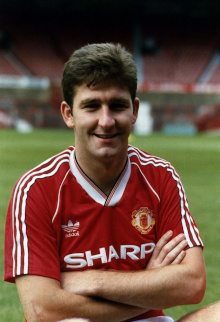
Cantwell plays as a full-back for Western Rovers, Cork Athletic F.C., West Ham United F.C. and Manchester United F.C. While at West Ham, he features in the London XI side that competes in the 1955–58 Inter-Cities Fairs Cup final on May 1, 1958. He captains the Hammers to winning the Division Two championship in the 1957–58 season and thereby leads the club into the topflight for the first time since 1932.
In November 1960, Cantwell joins Manchester United for £29,500 which at the time is a record for a full-back. He helps the club win the 1965 and 1967 league titles and captains United when winning the 1963 FA Cup Final, just as his fellow countryman Johnny Carey had done in United’s previous FA Cup win 15 years earlier. He also serves as Chairman of the Professional Footballers’ Association.
Cantwell wins 36 full International caps for the Republic of Ireland national football team, typically playing at left full-back and on several occasions at centre-forward. He makes his debut against Luxembourg in October 1953 with his final appearance coming away to Turkey in February 1967. He scores 14 goals including 5 from penalties and also captains the Republic on several occasions including a match against England at Wembley Stadium.
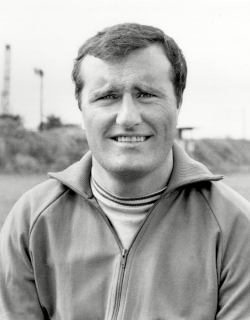
In his first managerial role at Coventry City F.C. he has the onerous task of following Jimmy Hill who had taken the club into the Football League First Division for the first time in their history. He narrowly keeps the Sky Blues in the top in his first two seasons before taking them to a sixth-place finish in 1969–70, earning them qualification for the Inter-Cities Fairs Cup, a year before it was replaced by the UEFA Cup.
Cantwell departs from Highfield Road on March 12, 1972, to take charge of the New England Tea Men in the United States, but within seven months is back in English football as manager of Peterborough United F.C. He helps Peterborough win the Football League Fourth Division title in his first full season as manager, before leaving on May 10, 1977, for a second spell with the Tea Men. This time he spends a year in the United States.
Cantwell returns to Peterborough on November 19, 1986, for a second spell as manager, remaining in this role until he becomes general manager on July 12, 1988. He is general manager at London Road for a year until he quits football to become licensee of the New Inn at Peterborough, where he remains for 10 years until he retires in 1999. He also is landlord of the Bull and Swan in Stamford, Lincolnshire.
Cantwell also plays cricket for Cork Bohemians Cricket Club and Ireland as a left-handed batsman and a right-arm medium bowler. He plays five times for Ireland making his debut in what is his sole first-class match versus Scotland at Edinburgh in 1956, scoring 31 and 17. His last match for Ireland is against Lancashire in July 1959.
Cantwell dies on September 8, 2005, from cancer at the age of 73, leaving a widow and two children. His former teams each hold a minute of silence for him before their next matches.
Behan makes his Rovers debut on February 8, 1931, in a 5–1 win over Bray Unknowns F.C. at Glenmalure Park. In his first season, he wins the FAI Cup. He signs with Manchester United in September 1933, along with fellow Irishman David Byrne, becoming the first players from the south of Ireland to play for the club in over a decade.
Behan makes his United debut in a Football League Second Division home game against Bury F.C. on March 3, 1934. The following July, he briefly returns to Shelbourne before again returning to the Rovers. Over the next two seasons, he wins another FAI Cup and a League of Ireland Shield. His last game for the Rovers is on August 23, 1936, in a Shield win over Drumcondra F.C..
After his retirement as a player, Behan becomes a respected referee and is in charge of the 1943 FAI Cup Final. He then manages Drumcondra F.C. in the 1950s where he wins the FAI Cup again.
Behan’s father, William Sr., is one of the founder members of Shamrock Rovers. His brothers John and Paddy also play for the Rovers. His son William junior keeps goal for the Rovers side also for a time. His second cousin is Bob Fullam.
Behan’s grandson, Philip Behan, is the former Head of International Football at the Football Association of Ireland and is now a UEFA and FIFA agent organising friendly international matches and tournaments around the world.
Billy Behan dies on November 12, 1991, at the age of 80.
Local laws have to be adjusted, ergo the ‘Light Locomotives (Ireland) Bill’ is passed on March 27, 1903. Kildare and other local councils draw attention to their areas, while Queen’s County (now County Laois) declares that every facility will be given and the roads placed at the disposal of motorists during the proposed race. Eventually Kildare is chosen, partly on the grounds that the straightness of the roads will be a safety benefit. As a compliment to Ireland the British team chooses to race in Shamrock green which thus becomes known as British racing green, although the winning Napier of 1902 had been painted Olive green.
There is considerable public concern about safety after the 1901 Paris-Bordeaux Rally, in which at least eight people had been killed, and severe crashes during the May 24, 1903 Paris-Madrid race where more than 200 cars competed over a distance of 800 miles but which had to be halted at Bordeaux because there had been so many fatalities. To allay these fears, the 1903 race is held over a closed course which is carefully prepared for the event, and is marshaled by 7,000 police officers assisted by troops and club stewards, with strict instructions to keep spectators off the roads and away from corners. The route consists of two loops that comprise a figure of eight, the first being a 52-mile loop that includes Kilcullen, the Curragh, Kildare, Monasterevin, Ballydavis (Port Laoise), Stradbally and Athy, followed by a 40-mile loop through Castledermot, Carlow, and Athy again. The race starts at the Ballyshannon cross-roads near Calverstown.
The official timekeeper of the race is T. H. Woolen of the Automobile Club of Great Britain and Ireland. Ninety one chronographs for timing the race are supplied by the Anglo-Swiss firm Stauffer Son & Co. of La Chaux-de-Fonds and London. Competitors are started at seven-minute intervals and have to follow bicycles through the “control zones” in each town. The 328-mile race is won by the famous Belgian Camille Jenatzy, driving a Mercedes in German colours.
After playing for the Shamrock Rovers F.C. under-18 squad at the age of 11, Jennings concentrates on Gaelic football until he is sixteen years old, when he makes his soccer comeback with his hometown Newry City F.C. After impressing with the team, he moves to English Third DivisionWatford F.C. in May 1963. He again impresses in his first season in England, playing every league game for his club, and making two international appearances that season. He is signed by Tottenham Hotspur F.C. for £27,000 in June 1964.
Jennings spends thirteen years at White Hart Lane, where he plays in 472 league games for the Spurs, and 591 in all competitions. He wins the FA Cup in 1967, the League Cup in 1971 and 1973, and the UEFA Cup in 1972. In 1973 the Football Writers’ Association name him as its footballer of the year. Three years later he wins the Professional Footballers’ Association‘s (PFA) version of the award, the first goalkeeper to receive this accolade.
In August 1977, Jennings is transferred to Tottenham’s arch-rivals, Arsenal F.C., with Tottenham thinking he is nearing the end of his career. However, Jennings plays for Arsenal for another eight years where he helps Arsenal to the FA Cup final in 1978, 1979, and 1980, as well as the UEFA Cup Winners’ Cup final that year. However, Arsenal only manages to win the second of these finals, a 3–2 victory against Manchester United F.C. In total, Jennings makes 327 appearances for Arsenal between 1977 and his eventual retirement from first-team club football in 1985. On February 26, 1983, he becomes the first player in English football to make 1,000 senior appearances, celebrating this milestone with a clean sheet in a goalless league draw for Arsenal at West Bromwich Albion F.C.
After his retirement, Jennings returns to Tottenham Hotspur, playing mostly in their reserve side to maintain his match sharpness for Northern Ireland’s 1986 FIFA World Cup campaign. His final appearance for Tottenham is in the Football League Super Cup against Liverpool F.C. in January 1986. He also plays briefly for Everton F.C., having been signed as goalkeeping cover for the 1986 FA Cup Final against Liverpool.
Despite retiring from club football in 1985, Jennings plays his final international game at the 1986 FIFA World Cup, on his 41st birthday, making him at the time the World Cup’s oldest ever participant. The match is Northern Ireland’s final group game, a 3–0 defeat against Brazil. In total, he participates in the qualifying stages of six World Cups between 1966 and 1986.
Born in Magherafelt, County Londonderry on June 5, 1913, Doherty begins his career with Glentoran F.C. in the Irish League. After helping Glentoran to the 1933 Irish Cup, early in the 1933–1934 season he joins English club Blackpool F.C., at the age of 19. He then joins Manchester City on February 19, 1936 for a then-club record of £10,000. Blackpool needs the money urgently, and Doherty is summoned from his lunch to report to Bloomfield Road. He tries hard to persuade Blackpool directors that he does not wish to leave the club, for he is due to marry a local girl and has just bought a new house in the town. The fee is an exceptionally high transfer fee for the period, coming within £1,000 of the British record. Doherty’s Manchester City debut, against Preston North End F.C., is not a successful one. Tightly man-marked by Bill Shankly throughout, he fails to make an impact. He later describes the remainder of his first Manchester City season as “uneventful,” however his second is anything but.
Manchester City starts the 1936–1937 season poorly and are in the bottom half of the table until December. Occasional big wins, including a 6–2 defeat of West Bromwich Albion F.C. and a 4–1 defeat of Everton F.C., are mixed with extended barren runs. At one point the club gains just one win in twelve matches. However, Doherty scores goals regularly. A goal in a 5–3 Christmas day loss to Grimsby Town F.C. is his twelfth of the season. Christmas proves to be a turning point for the club, as a win against Middlesbrough F.C. the following day is the start of a long unbeaten run. By April, Manchester City is second in the table and faces a fixture against Arsenal F.C., league leaders and the dominant club of the period. Doherty scores the first goal in a 2–0 win, and City reaches the top of the table. The unbeaten run continues until the end of the season, and City secures their first league championship with a 4–1 win over Sheffield Wednesday F.C.. Doherty, with 30 league goals, is the club’s leading scorer, helped by a run of eleven goals in seven games as the season draws to a close.
Doherty scores 79 goals in 130 appearances during his time at Maine Road. During the World War II years of 1939–1945, Doherty serves in the Royal Air Force. He remains registered as a Manchester City player, scoring 60 goals in 89 wartime matches, though wartime games are not generally included in official records. He also guests for numerous clubs across the country. During a guest appearance for Port Vale F.C. in 1945, he famously goes to take a penalty but instead of shooting he lays it off to a teammate who scores.
After the conclusion of the war, Doherty transfers to Derby County F.C., with whom he wins the FA Cup, scoring a goal in the final itself. He also goes on to play for Huddersfield Town A.F.C., scoring 33 goals in 83 league appearances.
Doherty’s coaching techniques are revolutionary at the time. He emphasises ball practice and instead of endless laps of the pitch, suggests volleyball “to promote jumping, timing and judgement,” basketball “to encourage split-second decision-making and finding space,” and walking football “to build up calf muscles.”