seamus dubhghaill

Promoting Irish Culture and History from Little Rock, Arkansas, USA


1 Comment

Official Irish Republican Army Declares Ceasefire

official-ira-ceasefire-1972The Official Irish Republican Army (IRA) announces a ceasefire on May 29, 1972. This marks the end of the Official IRA’s paramilitary campaign. The organization, however, reserves the right of self-defence against attacks by the British Army and sectarian groups. The Provisional Irish Republican Army dismisses the truce as having “little effect” on the situation.

Secretary of State for Northern Ireland, William Whitelaw, welcomes the move and a spokesperson says it is “a step in the right direction.”

A statement is read out from Dublin after the previous night’s meeting of the executive of the Northern Republican Clubs, a political movement allied to the IRA. It states, “The overwhelming desire of the great majority of all the people of the north is for an end to military actions by all sides.”

It goes on to say that a suspension of activities will be a chance to prevent all-out civil war in Ulster. The group insists it will continue a campaign of civil disobedience and the political struggle until its demands are met, namely:

The Royal Ulster Constabulary (RUC) and British Army are the first to benefit from such a ceasefire as they have been the primary targets of the IRA. Residents of Belfast in particular have been worn down by the four-year campaign of violence and this news is very welcome there.

Father Hugh O’Neill, who leads a Londonderry peace movement, says, “Please God, everyone will now sit down and begin to talk.”


Leave a comment

The Battle of Enniscorthy

battle-of-enniscorthy

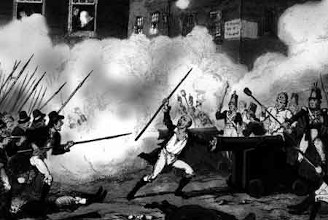
The Battle of Enniscorthy is a land battle fought on May 28, 1798, during the Irish Rebellion of 1798, when an overwhelming force of rebels assails the town of Enniscorthy, County Wexford, which is defended only by a 300-strong garrison supported by loyalist civilians. On the previous day at nearby Oulart, several thousand rebels led by Fr. John Murphy had massacred a detachment of the North Cork militia, amounting to 110 officers and men, in the Battle of Oulart Hill.

The attack on Enniscorthy begins at about 1:00 PM, when the rebels drive a herd of cattle through the town’s Duffry gate, creating disorder, and set the town’s buildings on fire. The troops defending the gate withdraw to a stone bridge over the River Slaney. After a determined defence of about three hours, the loyalist forces have expended their ammunition. They are also flanked by rebels wading across the river’s low water. However, after having driven all the rebels out of town they are ordered to abandon the town and withdraw to Wexford, which they do alongside a terrified multitude of men, women and children fleeing the burning town. In the action, the garrison and yeomanry had killed up to 500 insurgents at a cost of 90 of their own dead.

According to the historian Maxwell, the town’s Protestants see a merciless night attack as almost certain. Throughout the fight, Catholic residents support the rebels by shooting loyalists from their windows. Of the many fugitives, the weakest are carried on cavalry horses or otherwise abandoned to their fate, including infants and the elderly.

The rebels are brutal and vengeful in occupying their captured town. They set up a formidable encampment of 10,000 men on the nearby heights of Vinegar Hill and are able to roster forces to garrison Enniscorthy, whose streets are littered with dead and dying while flames continued to rage. Four hundred seventy-eight dwelling houses are destroyed in addition to commercial premises.


Leave a comment

The Dunlavin Green Executions

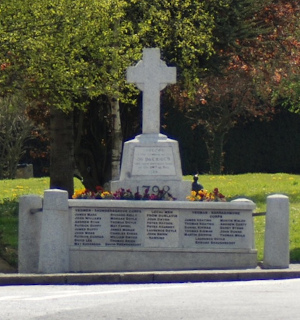
dunlavin-green-monumentThe Dunlavin Green executions, the summary execution of 36 suspected rebel prisoners in County Wicklow by the British military shortly after the outbreak of the Irish Rebellion of 1798, take place on May 26, 1798. There are several accounts of the events, recorded at differing times and differing in detail.

The British government had begun raising yeomanry forces from the local Irish population in 1796. The force, composed of both Catholics and Protestants, was raised to help defend against a possible French invasion of Ireland and to aid in the policing of the country. The Society of United Irishmen have long threatened a rebellion in Ireland, which finally occurs in late May 1798. Major uprisings of the rebellion only occur in Ulster, Wicklow and Wexford, a county in the province of Leinster. For several months prior to May 1798, Wicklow and many other areas of the country have been subject to martial law which had been imposed in an effort to prevent the long threatened rebellion.

The campaign extends against the military itself as some corps of yeomen and militia, especially those with Catholic members, are suspected as United Irish infiltrators who have joined to get training and arms. Several days after the outbreak of the rebellion, the yeomanry and militia at Dunlavin are called out on parade and informed by their commanding officer that he has information on the identities of those in the corps who are affiliated with the United Irishmen among them. The British do not actually have such information, but twenty-eight fall for their bluff and come forward in hopes of receiving clemency.

Those who come forward are immediately arrested and imprisoned while several are subjected to flogging in an effort to extract information about the rebels plans and organization. Those who are outed as affiliates of the United Irishmen are imprisoned in the Market House of Dunlavin, while the British officers decide what to do with them.

The following day, Captain William Ryves of the Rathsallagh yeomanry has his horse shot from under him by rebels while on patrol. Ryves rides to Dunlavin the next day and brings eight suspected rebels imprisoned by his corps with him. There he meets with Captain Saunders of the Saunders-grove yeomanry. It is decided that their prisoners, a total of 36 men, should be put to death. On May 26, Market Day, the 36 are taken to the green, lined up and shot in front of the townspeople, including, in some cases, their own families.

The firing squad returns to the Market House where others are flogged or hanged. Before the bodies of the shot men are removed, soldiers’ wives loot them of valuables. The bodies are either removed for burial by their families or interred in a common grave at Tournant cemetery. One man survives, despite grievous wounds, and lives to “an advanced age.” Two more men, either hanging or about to be, are saved by the intervention of a “respectable Protestant” and escape.

One loyalist account details the events leading up to the execution differently. According to this account, Captain Ryves, a yeomanry commander at Dunlavin, receives word that a large number of rebels are set to attack Dunlavin and he observes that many Protestant houses have been set on fire in the surrounding countryside. Under the circumstances, he expects that the rebels’ intention is a pogrom of Protestants and loyalists in the town and its environs. A foray by the troops into the countryside fails and the garrison’s officers are aware that they are outnumbered by the prisoners held in the Market House.

The executions appear to have been motivated by simple revenge and intimidation, rather than fear of the prisoners and the ongoing rebellion. Though the public exhibition may have been designed to intimidate and discourage rebels in the immediate area from taking to the field, news of the executions, as well as those at Carnew spread rapidly and play a part in the rapid mobilization of rebels in northern County Wexford over the next few days.

The story of Dunlavin Green is quickly commemorated in the famous balladDunlavin Green,” which tells the story from the view of a sympathetic local eyewitness. In 1998, a commemorative stone was installed in St. Nicholas of Myra Roman Catholic church, adjacent to the green.


Leave a comment

The Battle at Springmartin

kelly-bar-bombing

The Battle at Springmartin, a series of gun battles in Belfast, Northern Ireland, begins on May 13, 1972, and continues into the following day. It involves the British Army, the Provisional Irish Republican Army (IRA), and the Ulster Volunteer Force (UVF).

The night before the bombing, snipers from the UVF West Belfast Brigade take up position along the second floor of an abandoned row of flats at the edge of the Ulster Protestant Springmartin estate. The flats overlooked the Catholic Ballymurphy estate. Rifles, mostly World War II stock, are ferried to the area from dumps in the Shankill Road.

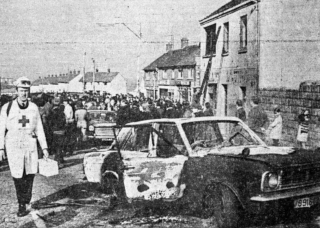
The violence begins shortly after 5:00 PM on Saturday, May 13, 1972, when a car bomb, planted by Ulster loyalists, explodes without warning outside the crowded Kelly’s Bar, at the junction of the Springfield Road and Whiterock Road. The pub is in a mainly Irish Catholic and nationalist area of Ballymurphy and most of its customers are from the area. At the time of the blast, the pub is crowded with men watching an association football match between England and West Germany on colour television. Following the blast, the UVF snipers open fire on the survivors. This begins the worst fighting in Northern Ireland since the suspension of the Parliament of Northern Ireland and the imposition of direct rule from London.

Sixty-three people are injured, eight of them seriously. John Moran, age 19, who had been working at Kelly’s as a part-time barman, dies of his injuries on May 23.

For the rest of the night and throughout the next day, local IRA units fight gun battles with both the UVF and British Army. Most of the fighting takes place along the interface between the Catholic Ballymurphy and Ulster Protestant Springmartin housing estates, and the British Army base that sits between them. Five civilians (four Catholics, one Protestant), a British soldier and a member of the IRA Youth Section are killed in the violence. Four of the dead are teenagers.

At first, the British Army claims that the blast had been an “accident” caused by a Provisional IRA bomb. The Secretary of State for Northern Ireland, William Whitelaw, tells the House of Commons on May 18 that the blast is caused by a Provisional IRA bomb that exploded prematurely. However, locals suspect that the loyalist Ulster Defence Association (UDA) had planted the bomb. Republican sources say that IRA volunteers would not risk storing such a large number of explosives in such a crowded pub. It later emerges that the bomb had indeed been planted by loyalists.

A memorial plaque on the site of the former pub names three members of staff who lost their lives as a result of the bomb and the gun battles that followed. It reads:

This plaque marks the spot
where Kelly’s Bar once stood
and here on 13th May 1972
a no warning Loyalist car bomb exploded.
As a result, 66 people were injured
and three innocent members of staff
of Kelly’s Bar lost their lives.
They were:
Tommy McIlroy (died 13th May 1972)
John Moran (died from his injuries 23rd May 1972)
Gerard Clarke (died from his injuries 6th September 1989)
Ar dheis Dé go raibh a namacha”


Leave a comment

The Battle of Fontenoy

battle-of-fontenoy

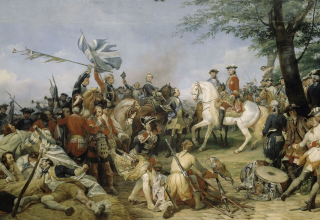
The Irish Brigade of France, a brigade in the French Royal Army composed of Irish exiles most commonly identified in Irish history as The Wild Geese, achieve its most glorious victory at the Battle of Fontenoy on May 11, 1745, during the War of the Austrian Succession.

The battle takes place in the Belgian municipality of Antoing, near Tournai. A French army of 50,000 commanded by Marshal Maurice de Saxe defeats a slightly larger Pragmatic Army of 52,000 consisting of the Dutch Republic, Great Britain, Hanover and the Holy Roman Empire, led by Prince William, Duke of Cumberland. The Irish Brigade is led by Justin McCarthy, Viscount Mountcashel and is comprised of six regiments.

Despite setbacks elsewhere, at the end of 1744 the French hold the initiative in the Austrian Netherlands, and their leaders consider this theatre offers the best opportunity for a decisive victory. In late April, they besiege Tournai, which controls access to the upper Scheldt basin, which makes it a vital link in the North European trading network and the Allies march to its relief.

Leaving 22,000 men in front of Tournai, Saxe places his main force five miles away in the villages of St. Antoine, Vezin and Fontenoy, along a naturally strong feature which he strengthens with defensive works. After a series of unsuccessful flank assaults, the Allies attack the French centre with a column of 15,000 men.

Colonel Arthur Dillon‘s regiment, which had already been badly shot up earlier in the fight, along with the brigade’s other five, charge the British as they seem on the verge of breaking the French line. Fifty years of Irish frustration and British betrayal now come back to haunt the British. As the men of the Irish Brigade close through a hail of British bullets, their shouts are heard above the din: “Cuimhnígí ar Luimneach agus ar fheall na Sasanach!” (Remember Limerick and the Saxon Faith).

Nothing can withstand the wave of hatred and revenge that breaks on the hapless British line that day. The victory is won but the cost is high. Colonel Dillon is dead, and Lord Clare is wounded twice. The brigade suffers 656 casualties in all, the highest percentage of all the French units.

Although the Allies retreat in good order, Tournai falls shortly afterwards, followed by Ghent, Oudenaarde, Bruges and Dendermonde. The withdrawal of British forces in October to deal with the Jacobite Rising facilitates the capture of Ostend and Nieuwpoort. By the end of 1745, France controls much of the Austrian Netherlands, threatening British links with Europe.

However, by early 1746, France is struggling to finance the war and begins peace talks at the Congress of Breda in May. Despite victories at Rocoux in October 1746 and Lauffeld in July 1747, the war continues until the Treaty of Aix-la-Chapelle in 1748.

It is a day never to be forgotten by the Irish worldwide. At Manassas, Virginia, 116 years later, Thomas Francis Meagher cries out to the 69th New York, another regiment of Irishmen, “Remember Fontenoy!”

(Pictured: The Irish Brigade, presenting a captured British colour to Louis XV and the Dauphin)


Leave a comment

Execution of Major Geoffrey Lee Compton-Smith

geoffrey-lee-compton-smith

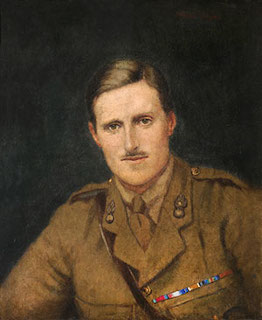
Major Geoffrey Lee Compton-Smith (DSO) of the 2nd Battalion of the Royal Welch Fusiliers is captured and executed by the Irish Republican Army (IRA) on April 30, 1921, during the Irish War of Independence.

Compton-Smith was born in 1889 in South Kensington, London. After finishing school, he decides not to follow the family tradition of studying law. He actually wants to become an artist, but his father insists that he join the army. He studies at the Royal Military College at Sandhurst and during World War I his regiment is sent to France. In 1917 he is wounded at the Battle of Arras, but he continues to fight on. He is awarded the Distinguished Service Order (DSO). In 1919 he is sent to serve in Ireland during the Irish War of Independence.

In 1919 Compton-Smith is commander of the British Army base at Ballyvonane, near Buttevant, but he is also an intelligence officer. As an officer he also sometimes presides over courts martial. In January 1921, for instance, three IRA volunteers are tried by him for involvement in the ambush at Shinanagh, near Charleville, and he sentences them each to six months.

February 1921 is a bad time for the IRA in County Cork. They suffer major losses at the ambushes at Clonmult and Mourne Abbey, and several volunteers are taken prisoner, four of whom are sentenced to death. The IRA believes that these death sentences might be commuted if a British officer is held as a hostage. This leads to the capture of Compton-Smith. On April 16, 1921, he travels to Blarney, supposedly on a sketching trip but actually to meet a nurse in Victoria Barracks with whom he is having an affair. The IRA has spies in Victoria Barracks who likely tip off the IRA that Compton-Smith is coming to Blarney. A squad led by Frank Busteed easily capture him after he gets off the train.

Busteed then meets with Jackie O’Leary, the IRA battalion commander. It is decided that Donoughmore is the perfect place to keep a hostage, because parts of the parish are remote and the IRA is strong there.

On April 18, under the cover of darkness, Compton-Smith is transferred by car to Knockane House, an abandoned big house in Donoughmore. The following night he is moved again, this time by pony and trap, to Barrahaurin, a remote townland in the Boggeragh Mountains. He is kept there for the last eleven days of his life, on the small farm of Jack and Mary Moynihan. He is held prisoner in a shed, always under guard. Every evening he is brought into the house, where he eats and stays at the fireside. He and his guards have conversations about history and politics.

The four IRA prisoners are executed on April 28, 1921. On April 30, O’Leary informs Compton-Smith that he is going to be executed. He then writes a final letter to his wife. He tells her that he will die with her name on his lips and her face before his eyes and that he will “die like an Englishman and a soldier.” He also writes a letter to his regiment and one to Lt. General Strickland.

After finishing his letters, Compton-Smith is led up into Barrahaurin bog behind the Moynihan house, to a place where his grave had already been dug and is given a final cigarette. In his witness statement Maurice Brew writes, “When removed to the place of execution he placed his cigarette case in his breast pocket of his tunic … He then lighted a cigarette and said that when he dropped the cigarette it could be taken as a signal by the execution squad to open fire.”

It is not until late May, following the discovery of the cache of letters in a Dublin raid, that the Compton-Smith family is informed of his death. His father, William, then starts a campaign to find his son’s body. He wrote letters to MPs and to the British Army, seeking information and help. He also writes to Erskine Childers but gets no reply. He offers a reward of £500 for information, but only The Irish Times agrees to print his advertisement.

In November 1921 a cousin of Compton-Smith’s wife, Gladys, meets Michael Collins in London and asks him for help in finding the body. Correspondence between Collins and the Compton-Smith family suggests that Collins is trying to help in 1922, but he fails to get any results before he is assassinated at Béal na Bláth later that same year.

On March 3, 1926, Compton-Smith’s grave is discovered by the Gardaí. The newspapers report that the remains, because of the conditions of the bog, “were not so badly decomposed as to render identification impossible.” The body is brought to Collins Barracks in Cork. On March 5 the Gardaí send a telegram to the Compton-Smiths, informing them that the body has been located.

The reburial of Compton-Smith is carried out with great dignity on March 19, 1926. The Irish Army escorts the coffin from Collins Barracks to Penrose Quay, where British forces from Spike Island take the coffin on board a boat. While the boat travels down the River Lee, the Irish Army’s guard of honour presents arms and sounds the “Last Post.” The British then bring the coffin to Carlisle Fort, near Whitegate, where it was buried in the in the British Military Cemetery with full military honours.


2 Comments

Death of Michael Joseph O’Rahilly

michael-joseph-o-rahilly

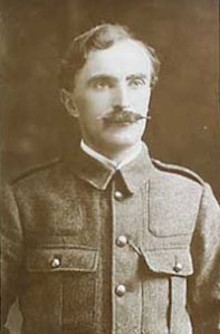
Michael Joseph O’Rahilly, Irish republican and nationalist known as The O’Rahilly, dies in Dublin on April 29, 1916, during the Easter Rising. He is a founding member of the Irish Volunteers in 1913 and serves as Director of Arms. Despite opposing the rising, he takes part and is killed in a charge on a British machine gun post covering the retreat from the General Post Office (GPO) during the fighting.

O’Rahilly is born in Ballylongford, County Kerry to Richard Rahilly, a grocer, and Ellen Rahilly (née Mangan). He has two siblings who live to adulthood, Mary Ellen “Nell” Humphreys (née Rahilly) and Anno O’Rahilly, both of whom are active in the Irish revolutionary period. He is educated in Clongowes Wood College (1890–1893). As an adult, he becomes a republican and a language enthusiast. He joins the Gaelic League and becomes a member of An Coiste Gnotha, its governing body. He is well traveled, spending at least a decade in the United States and in Europe before settling in Dublin.

In 1913 O’Rahilly is a founding member of the Irish Volunteers, who organize to work for Irish independence and resist the proposed Home Rule. He serves as the IV Director of Arms. He personally directs the first major arming of the Irish Volunteers, the landing of 900 Mausers at the Howth gun-running on July 26, 1914.

O’Rahilly is not party to the plans for the Easter Rising, nor is he a member of the Irish Republican Brotherhood (IRB), but he is one of the main people who trains the Irish Volunteers for the coming fight. The planners of the Rising go to great lengths to prevent those leaders of the Volunteers who are opposed to unprovoked, unilateral action from learning that a rising is imminent, including its Chief-of-Staff Eoin MacNeill, Bulmer Hobson, and O’Rahilly. When Hobson discovers that an insurrection is planned, he is kidnapped by the Military Council leadership.

Learning this, O’Rahilly goes to Patrick Pearse‘s school, Scoil Éanna, on Good Friday. He barges into Pearse’s study, brandishing his revolver as he announces, “Whoever kidnaps me will have to be a quicker shot!” Pearse calms him down, assuring him that Hobson is unharmed and will be released after the rising begins.

O’Rahilly takes instructions from MacNeill and spends the night driving throughout the country, informing Volunteer leaders in Cork, Kerry, Tipperary, and Limerick that they are not to mobilise their forces for planned manoeuvres on Sunday.

Arriving home, O’Rahilly learns that the Rising is about to begin in Dublin on the following day, Easter Monday, April 24, 1916. Despite his efforts to prevent such action, he sets out to Liberty Hall to join Pearse, James Connolly, Thomas MacDonagh, Tom Clarke, Joseph Plunkett, Countess Markievicz, Seán Mac Diarmada, Éamonn Ceannt and their Irish Volunteers and Irish Citizen Army troops. Arriving in his De Dion-Bouton motorcar, he gives one of the most quoted lines of the rising – “Well, I’ve helped to wind up the clock…I might as well hear it strike!” His car is used to fetch supplies during the siege and later as part of a barricade on Prince’s Street, where it is burned out.

O’Rahilly fights with the GPO garrison during Easter Week. One of the first British prisoners taken in the GPO is Second Lieutenant AD Chalmers, who is bound with telephone wire and lodged in a telephone box by the young Volunteer Captain and IRB activist, Michael Collins. Chalmers later recalls O’Rahilly’s kindness to him. In a statement to a newspaper reporter, he says that he was taken from the phone box after three hours and brought up to O’Rahilly, who ordered, “I want this officer to watch the safe to see that nothing is touched. You will see that no harm comes to him.”

On Friday, April 28, with the GPO on fire, O’Rahilly volunteers to lead a party of men along a route to Williams and Woods, a factory on Great Britain Street, now Parnell Street. A British machine gun at the intersection of Great Britain and Moore streets cuts him and several of the others down. He slumps into a doorway on Moore Street, wounded and bleeding badly but, hearing the English marking his position, makes a dash across the road to find shelter in Sackville Lane, now O’Rahilly Parade. He is wounded diagonally from shoulder to hip by sustained fire from the machine-gunner.

According to ambulance driver Albert Mitchell in a witness statement more than 30 years later, O’Rahilly still clung to life 19 hours after being severely wounded, long after the surrender had taken place on Saturday afternoon.

Desmond Ryan‘s The Rising: The Complete Story of Easter Week maintains that it “was 2:30 PM when Miss O’Farrell reached Moore Street, and as she passed Sackville Lane again, she saw O’Rahilly’s corpse lying a few yards up the laneway, his feet against a stone stairway in front of a house, his head towards the street.”


Leave a comment

Phillip O’Reilly Surrenders to the Cromwellian Conquest of Ireland

settlement-of-ireland-1653

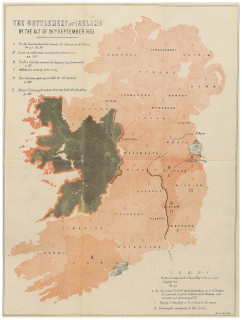
The last major body of Irish Catholic troops under Phillip O’Reilly surrender to the Cromwellian conquest of Ireland at Cloughoughter in County Cavan on April 27, 1653. This marks the end of the Irish Confederate Wars which began in 1641.

Colonel Philip O’Reilly is a member of parliament (MP) for County Cavan in the Parliament of Ireland from 1639 to 1641, and a leading member of the Irish Rebellion of 1641.

O’Reilly’s father, grandfather and several other ancestors are chiefs of the O’Reilly clan and Lords of Breifne O’Reilly. His mother is Catherine MacMahon. He resides at Bellanacargy Castle in the barony of Tullygarvey, near to present day village of Drung. Bellanacargy castle, anciently referred to as Ballynacarraig because it was built on a carraig (rock island) situated in the middle of the River Annalee, is destroyed in May 1689 by Williamite forces led by Thomas Lloyd.

As a young man O’Reilly serves for some time in the Spanish army but returns to Ireland. He is appointed Commissioner of the Peace in 1625 and High Sheriff of Cavan in 1629. He is elected as MP for County Cavan in 1639.

During the Parliamentary session of 1640 O’Reilly is enlisted by Rory O’Moore in the plot to start a rebellion against English rule in Ireland. O’Moore is a distant relation as his sister Cecilia O’Moore is married to O’Reilly’s first cousin, Tirlagh O’Neill. On the outbreak of the Irish Rebellion in October 1641 he is elected chief of the O’Reillys. As a result, the Irish Parliament expels him on November 16, 1641. On November 6, 1641 he orders a general gathering of his clansmen from 16 to 60 years of age, to be held at Virginia, and on December 11, 1641 he has possession of the whole county, except the Killeshandra castles of Keelagh and Croghan which are defended by Sir Francis Hamilton and Sir James Craig. He raises a brigade of twelve hundred men, composed chiefly of his name and family, and serves with distinction as lieutenant-general in the service of the Confederate Catholics of Ireland. The Assembly of Kilkenny appoints him Lord President of Ulster. His second cousin Myles O’Reilly is High Sheriff of Cavan in 1641 at the outbreak of the Rebellion.

O’Reilly is detained for treason by the English government in 1642. In his diary for June 3, 1644, the historian Sir James Ware II states, “Intelligence came to Dublin that Roger Moore and Philip O’Reilly, two of the first incendiaries were committed to prison at Kilkenny.” O’Reilly is further denounced by the Act for the Settlement of Ireland 1652 at the end of the rebellion. Following the collapse of the Irish confederacy, he formally surrenders to Oliver Cromwell at Cloughoughter Castle on April 27, 1653, being the last Irish garrison to do so. He secures favourable terms and is obliged to leave Ireland. He retires with his brigade into Spain and thence to the Netherlands, where he serves in the Spanish army for about two years and dies in 1655. He is buried in the Irish monastery of St. Dominick in Leuven, Belgium.


Leave a comment

Martial Law Declared in Ireland

martial-law-april-1916

The United Kingdom declares martial law in Ireland for one month on April 25, 1916, the day after the commencement of the Easter Rising. A curfew is imposed from 8:30 PM until 5:00 AM. Anyone spotted on the streets during the hours of darkness are to be shot on sight. The trams stop running at 7:00 PM and the theatres and cinemas close by 8:00 PM. Those rushing for trams leaving the city centre have to pass through a stop-and-search military cordon.

The Easter Rising, also known as the Easter Rebellion, is an armed insurrection in Ireland during Easter Week, 1916. The Rising is mounted by Irish republicans in an attempt to end British rule in Ireland, secede from the United Kingdom of Great Britain and Ireland and establish an independent Irish Republic. This takes place while the United Kingdom is heavily engaged in World War I. It is the most significant uprising in Ireland since the Irish Rebellion of 1798.

Organized by seven members of the Military Council of the Irish Republican Brotherhood (IRB), the Rising begins on Easter Monday, April 24, 1916, and lasts for six days. The following day the British Government immediately declares martial law in Ireland. Members of the Irish Volunteers, led by schoolmaster and Irish language activist Patrick Pearse and joined by the smaller Irish Citizen Army of James Connolly and 200 members of Cumann na mBan, seize key locations in Dublin and proclaim the Irish Republic independent of the United Kingdom. There are actions in other parts of Ireland, however, except for the attack on the Royal Irish Constabulary barracks at Ashbourne in County Meath, they are minor.

With vastly superior numbers and artillery, the British army quickly suppresses the Rising and Pearse agrees to an unconditional surrender on Saturday, April 29, 1916. Most of the leaders are executed following courts-martial, but the Rising succeeds in bringing physical force republicanism back to the forefront of Irish politics. Support for republicanism continues to rise in Ireland in the context of the ongoing war in Europe and the Middle East and revolutions in other countries, and especially as a result of the Conscription Crisis of 1918 and the failure of the British-sponsored Irish Convention.

In the 1918 Irish general election, republicans, by then represented by Sinn Féin, secure an overwhelming victory, winning 73 Irish seats out of 105 to the British Parliament, on a policy of abstentionism and Irish independence. The following year Éamon de Valera escapes from Lincoln Gaol to become party leader. On January 21, 1919, they convene the First Dáil and declare the independence of the Irish Republic. Later that same day the Irish Republican Army, organised by Minister for Finance and IRB president Michael Collins, begins the Irish War of Independence with the Soloheadbeg ambush.

(Pictured: Rebel prisoners are marched out of Dublin by the British Army)


Leave a comment

The Battle of Culloden

culloden-moor-memorial

The Battle of Culloden, the final confrontation of the Jacobite rising of 1745 known in Scotland as simply “The ’45,” is fought on April 16, 1746. The Jacobite army of Charles Edward Stuart, also known as Bonnie Prince Charlie, is decisively defeated by a British government force under William Augustus, Duke of Cumberland, on Drummossie Moor near Inverness in the Scottish Highlands. It is the last pitched battle fought on British soil.

Charles is the eldest son of James Francis Edward Stuart, the exiled Stuart claimant to the British throne. Believing there is support for a Stuart restoration in both Scotland and England, he lands in Scotland in July 1745. The Jacobite Army is often assumed to have been largely composed of Gaelic-speaking Catholic Highlanders. In reality nearly a quarter of the rank and file are recruited in Aberdeenshire, Forfarshire and Banffshire, with another 20% from Perthshire. Although the army is predominantly Scots it contains a few English recruits plus significant numbers of Irish, Scottish and French professionals in French service with the Irish Brigade and Garde Écossaise.

After amassing his army of Scots Jacobite supporters, Charles takes Edinburgh by September and defeats a British government force at Prestonpans. The government recalls 12,000 troops from the Continent to deal with the rising. A Jacobite invasion of England reaches as far as Derby before turning back, having attracted relatively few English recruits.

The Jacobites, with limited French military support, attempt to consolidate their control of Scotland, whereby early 1746 they are opposed by a substantial government army. A scrambled Jacobite victory at Falkirk fails to change the strategic situation. With supplies and pay running short and with the government troops resupplied and reorganised under the Duke of Cumberland, son of British monarch George II, the Jacobite leadership has few options left other than to stand and fight. The two armies eventually meet at Culloden, on terrain that gives Cumberland’s larger, well-rested force the advantage.

The battle lasts only an hour, with the Jacobites suffering a bloody defeat with between 1,500 and 2,000 killed or wounded. Approximately 300 government soldiers are killed or wounded. While perhaps as many as 6,000 Jacobites remain in arms in Scotland, the leadership takes the decision to disperse, effectively ending the rising. The men of the combined Irish regiments, under the command of Brigadier Walter Stapleton, are the last off the field, covering the retreat of Prince Charles and the remnants of his army. The Irish had given their blood to the cause of a Stuart King for the last time. Most of the surviving Irish surrender at Inverness. The prince himself eventually manages to make his escape to France.

Culloden and its aftermath continue to arouse strong feelings. The University of Glasgow awards the Duke of Cumberland an honorary doctorate, but many modern commentators allege that the aftermath of the battle and subsequent crackdown on Jacobite sympathisers were brutal, earning Cumberland the sobriquet “Butcher.” Efforts are subsequently made to further integrate the comparatively undeveloped Scottish Highlands into the Kingdom of Great Britain. Civil penalties are introduced to undermine the Scottish clan system, which had provided the Jacobites with the means to rapidly mobilise an army.

Today, a visitor centre is located near the site of the battle. This centre is first opened in December 2007, with the intention of preserving the battlefield in a condition similar to how it was on April 16, 1746. One difference is that it currently is covered in shrubs and heather. During the 18th century, however, the area was used as common grazing ground, mainly for tenants of the Culloden estate. Those visiting can walk the site by way of footpaths on the ground and can also enjoy a view from above on a raised platform. Possibly the most recognisable feature of the battlefield today is the 20-foot-tall memorial cairn, erected by Duncan Forbes in 1881. In the same year Forbes also erects headstones to mark the mass graves of the clans.