seamus dubhghaill

Promoting Irish Culture and History from Little Rock, Arkansas, USA


Leave a comment

Birth of Januarius MacGahan, Journalist & Correspondent

januarius-macgahan

Januarius Aloysius MacGahan, American journalist and war correspondent for the New York Herald and The Daily News, is born near New Lexington, Ohio on June 12, 1844. His articles describing the massacre of Bulgarian civilians by Turkish soldiers and irregular volunteers in 1876 creates public outrage in Europe and are a major factor in preventing Britain from supporting Turkey in the Russo–Turkish War of 1877–78, which leads to Bulgaria gaining independence from the Ottoman Empire.

MacGahan’s father is an immigrant from Ireland who had served on the Northumberland, the ship which took Napoleon into exile on Saint Helena. He moves to St. Louis, where he briefly works as a teacher and as a journalist. There he meets his cousin, General Philip Sheridan, an American Civil War hero also of Irish parentage, who convinces him to study law in Europe. He sails to Brussels in December 1868.

MacGahan does not get a law degree, but he discovers that he has a gift for languages, learning French and German. He runs short of money and is about to return to America in 1870 when the Franco-Prussian War breaks out. Sheridan happens to be an observer with the German Army, and he uses his influence to persuade the European editor of the New York Herald to hire MacGahan as a war correspondent with the French Army.

MacGahan’s vivid articles from the front lines describing the stunning defeat of the French Army win him a large following, and many of his dispatches to the Herald are reprinted by European newspapers. When the war ends, he interviews French leader Léon Gambetta and Victor Hugo and, in March 1871, he hurries to Paris and is one of the first foreign correspondents to report on the uprising of the Paris Commune. He is arrested by the French military and nearly executed and is only rescued through the intervention of the U.S. Minister to France Elihu B. Washburne.

In 1871 MacGahan is assigned as the Herald‘s correspondent to Saint Petersburg. He learns Russian, mingles with the Russian military and nobility, covers the Russian tour of General William Tecumseh Sherman and meets his future wife, Varvara Elagina, whom he marries in 1873. In 1874 he spends ten months in Spain, covering the Third Carlist War.

In 1876 MacGahan quarrels with James Gordon Bennett Jr., the publisher of the New York Herald, and leaves the newspaper. He is invited by his friend, Eugene Schuyler, the American Consul-General in Constantinople, to investigate reports of large-scale atrocities committed by the Turkish Army following the failure of an attempted uprising by Bulgarian nationalists in April 1876. He obtains a commission from The Daily News, then the leading liberal newspaper in England, and leaves for Bulgaria on July 23, 1876.

MacGahan reports that the Turkish soldiers have forced some of the villagers into the church, then the church is burned, and survivors tortured to learn where they have hidden their treasures. He says that of a population of seven thousand, only two thousand survive. According to his account, fifty-eight villages in Bulgaria are destroyed, five monasteries demolished, and fifteen thousand people in all massacred. These reports, published first in The Daily News, and then in other papers, cause widespread popular outrage against Turkey in Britain. The government of British Prime Minister Benjamin Disraeli, a supporter of Turkey, tries to minimize the massacres and says that the Bulgarians are equally to blame, but his arguments are refuted by the newspaper accounts of MacGahan.

In the wake of the massacres and atrocities committed by the Ottoman forces during the suppression of the April Uprising, as well as centuries-long conflicts between Russia and Turkey in Crimea, the Russian Government, stirred by anti-Turkish and Pan-Slavism sentiment, prepare to invade the Ottoman Empire, and declare war on it on April 24, 1877. The Turkish Government of Sultan Abdul Hamid II appeals for help to Britain, its traditional ally against Russia, but the British government responds that it cannot intervene “because of the state of public feeling.”

MacGahan is assigned as a war correspondent for The Daily News and, thanks to his friendship with General Skobelev, the Russian commander, rides with the first units of the Russian Army as it crosses the Danube into Bulgaria. He covers all the major battles of the Russo–Turkish War, including the Siege of Plevna and the Battle of Shipka Pass. He reports on the final defeat of the Turkish armies and is present at the signing of the Treaty of San Stefano, which ends the war.

MacGahan is in Constantinople, preparing to travel to Berlin for the conference that determines the final borders of Bulgaria, when he catches typhoid fever. He dies on June 9, 1878, and is buried in the Greek cemetery, in the presence of diplomats, war correspondents, and General Skobelev. Five years later his body is returned to the United States and reburied in New Lexington and a statue is erected in his honor by a society of Bulgarian Americans.


1 Comment

The Battle of New Ross

battle-of-new-ross

The Battle of New Ross takes place in County Wexford in southeastern Ireland on June 5, 1798, during the Irish Rebellion of 1798. It is fought between the Irish Republican insurgents called the United Irishmen and British Crown forces composed of regular soldiers, militia and yeomanry. The attack on the town of New Ross on the River Barrow, is an attempt by the recently victorious rebels to break out of County Wexford across the River Barrow and to spread the rebellion into County Kilkenny and the outlying province of Munster.

On June 4, 1798, the rebels advance from their camp on Carrigbyrne Hill to Corbet Hill, just outside the town of New Ross. The battle, the bloodiest of the 1798 rebellion, begins at dawn on June 5 when the Crown garrison is attacked by a force of almost 10,000 rebels, massed in three columns outside the town. The attack has been expected since the fall of Wexford to the rebels on May 30 and the British garrison of 2,000 has prepared defences both outside and inside the town. Trenches are dug and manned by skirmishers on the approaches to the town while cannon are stationed facing all the rapidly falling approaches and narrow streets of the town to counter the expected mass charges by the rebels, who are mainly armed with pikes.

Bagenal Harvey, the United Irish Leader recently released from captivity following the rebel seizure of Wexford, attempts to negotiate surrender of New Ross but the rebel emissary Matt Furlong is shot down by Crown outposts while bearing a flag of truce. His death provokes a furious charge by an advance guard of 500 insurgents led by John Kelly who has instructions to seize the Three Bullet Gate and wait for reinforcements before pushing into the town. To aid their attack, the rebels first drive a herd of cattle through the gate.

Another rebel column attacks the Priory Gate but the third pulls back from the Market Gate intimidated by the strong defences. Seizing the opportunity, the garrison sends a force of cavalry out the Market Gate to attack and scatter the remaining two hostile columns from the flanks. However, the rebel rump has not yet deployed and upon spotting the British manoeuvre, rally the front ranks who stand and break the cavalry charge with massed pikes.

The encouraged rebel army then sweeps past the Crown outposts and seizes the Three Bullet Gate causing the garrison and populace to flee in panic. Without pausing for reinforcement, the rebels break into the town attacking simultaneously down the steeply sloping streets but meet with strong resistance from well-prepared second lines of defence of the well-armed soldiers. Despite horrific casualties the rebels manage to seize two-thirds of the town by using the cover of smoke from burning buildings and force the near withdrawal of all Crown forces from the town. However, the rebels’ limited supplies of gunpowder and ammunition force them to rely on the pike and blunts their offensive. The military manages to hold on and, following the arrival of reinforcements, launches a counterattack before noon which finally drives the exhausted rebels from the town.

No effort to pursue the withdrawing rebels is made but when the town has been secured, a massacre of prisoners, trapped rebels and civilians of both sympathies alike begins which continues for days. Hundreds are burned alive when rebel casualty stations are torched by victorious troops. More rebels are believed to have been killed in the aftermath of the battle than during the actual fighting. Reports of such atrocities brought by escaping rebels are believed to have influenced the retaliatory murder of over 100 loyalists in the flames of Scullabogue Barn.

Casualties in the Battle of New Ross are estimated at 2,800 to 3,000 Rebels and 200 Garrison dead. Most of the dead Rebels are thrown in the River Barrow or buried in a mass grave outside the town walls a few days after the Battle. The remaining rebel army reorganises and forms a camp at Sliabh Coillte some five miles to the east but never attempts to attack the town again. They later attack General John Moore‘s invading column but are defeated at the Battle of Foulksmills on June 20, 1798.

(Pictured: The 1845 illustration “The Battle of Ross” by George Cruikshank)


Leave a comment

The Battle of Ridgeway

battle-of-ridgeway

The Battle of Ridgeway, sometimes called the Battle of Lime Ridge or Limestone Ridge, is fought on June 2, 1866, in the vicinity of the town of Fort Erie across the Niagara River from Buffalo, New York between Canadian troops and an irregular army of Irish American invaders, the Fenians.

The Fenian insurgents, led by Brigadier General John O’Neill, a former Union cavalry commander who had specialized in anti-guerrilla warfare in Ohio, secures boats and transfers some 800 men across the Niagara River, landing above Fort Erie, before dawn on June 1, 1866. An additional 200–400 Fenians and supplies cross later in the morning and early afternoon until the U.S. Navy gunboat, the USS Michigan, begins intercepting Fenian barges at 2:20 PM.

O’Neill spends the first day trying to rally the local citizenry to the Fenian cause and to commandeer supplies for his mission, but his force is plagued by desertions almost from the outset. An additional column of 200 Fenians join his group, bringing his total strength at Ridgeway to at least 650 men.

Meanwhile, the British are mobilizing both local Canadian militia and British garrison troops to defend against the impending invasion of Canada. The Fenians night-march north across Black Creek through a cedar swamp, then turn inland on Ridge Road on the morning of June 2, taking up a defensive position on Limestone Ridge near the present Canadian town of Ridgeway. There, they clash with 850 advancing Canadian militia commanded by Lieutenant-Colonel Alfred Booker of the 13th Battalion.

In the first hour of the battle, the Canadians appear to prevail, driving Fenian skirmishers back across Bertie Road. Then the tide turns, and to this day, it is not clear what causes the impending chaos. O’Neill, observing the chaos breaking out in the Canadian ranks, quickly orders a bayonet charge that completely routs the inexperienced Canadians. The Fenians take and briefly hold the town of Ridgeway. Then, expecting to be overwhelmed by British reinforcements, they quickly turn back to Fort Erie where they fight a second battle, the Battle of Fort Erie, against a small but determined detachment of Canadians holding the town.

The Canadian loss is nine killed on the field, four dying of wounds in the immediate days following the battle, 22 dying of wounds or disease later and 37 are wounded, some severely enough to require amputation of their limbs. O’Neill says that four or five of his men are killed, but Canadians claim to have found six Fenian bodies on the field. The relatively low casualty figures make this an interesting battle for proponents of theories about soldiers’ reluctance to shoot to kill but might also be accounted for by the fact that the Fenians had deployed only their skirmishers in an attempt to lure the Canadians towards their main force which did not advance until the last minutes of the battle when they launched a bayonet attack that broke Canadian lines.

The battlefield is designated a National Historic Site of Canada in 1921 and is the last battle fought in the province of Ontario against a foreign invasion. The action at Ridgeway has the distinction of being the only armed victory for the cause of Irish independence between the Irish Rebellion of 1798 and the Irish War of Independence (1919).

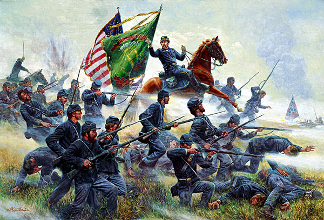
(Pictured: An 1869 illustration of the battle: Charge of General O’Neill’s Fenians upon the Canadian troops, causing their rout.)


Leave a comment

Death of Charles O’Brien, 5th Viscount Clare

charles_o_brien

Charles O’Brien, 5th Viscount Clare, is mortally wounded in the Battle of Ramilles on May 23, 1706. He is the son of Daniel O’Brien, 3rd Viscount Clare and Philadelphia Lennard. He marries Charlotte Bulkeley, daughter of Henry Bulkeley and Sophia Stuart, on January 9, 1696, at Saint-Germain-en-Laye, France. Henry Bulkeley is the “Master of the Household” for Kings Charles II and James II. Charles O’Brien and Charlotte Bulkeley have two children, Charles O’Brien, 6th Viscount Clare (March 27, 1699 – September 9, 1761) and Henry O’Brien (born February 12, 1701).

The family fights as part of the Jacobite Irish Army during the War of the Two Kings, before going into exile in the Flight of the Wild Geese. Charles succeeds his brother, Daniel O’Brien, 4th Viscount Clare, to the title as 5th Viscount Clare in the Jacobite Peerage on his brother’s death from a mortal wound received in the Battle of Marsaglia in Italy on October 4, 1693. Charles is transferred from the Queen’s Dismounted Dragoons where he is a colonel, to the command of O’Brien’s Regiment on April 6, 1696. Later in the year he leads the regiment in the siege of Valenza in Lombardy, and the next year they are stationed with the army at Meuse.

By 1698 over one third of King James’ army is either dead or crippled, and when the Treaty of Ryswick ends the war between Louis and William, James’ soldiers are disbanded, unemployed, and homeless. Many become beggars but others join the Irish Brigade in the Spanish army, while others travel to Austria and enter the Catholic Corps.

Hostilities are renewed and Clare’s Regiment is assigned to the Army of Germany for two years in 1701-02. At the Battle of Cremona in 1702, the Irishmen defend the town against Prince Eugene and the imperial army. The attack is to be a surprise, but the Wild Geese foil the attempt. The following year Lord Clare is promoted to brevet Brigadier of Infantry on April 2, 1703. A few months later on September 20, 1703, the unit takes part in the successful Battle of Hochstedt, better known as the Battle of Blenheim. A year later the unit is involved with the unsuccessful battle on August 13, 1704, at the second Battle of Blenheim. Although Clare’s Regiment experiences ups and downs, they are always admired. Two months after Blenheim, Charles rises to the brevet rank of Marshal-de-Camp on October 26, 1704, and a year later he is assigned to the Army of the Moselle under the Marshel de Villars. Clare’s Regiment fights in the disastrous Battle of Ramillies on May 23, 1706, where they distinguish themselves with great glory, but Lord Clare is mortally wounded and dies at Brussels, Belgium.

Due to the great service the O’Brien family has given to France, and having risked all, King Louis XIV makes sure that the regiment is kept in the family and appoints Lt. Col. Murrough O’Brien (of the Carrigonnell O’Brien’s) as its commander until the minor Charles comes of age.


Leave a comment

Death of Joseph Holt, United Irish General

joseph-holt

Joseph Holt, United Irish general and leader of a large guerrilla force which fights against British troops in County Wicklow from June–October 1798, dies at Kingstown, now Dún Laoghaire, near Dublin on May 16, 1826.

Holt is one of six sons of John Holt, a farmer in County Wicklow. He joins the Irish Volunteers in the 1780s and holds a number of minor public offices but becomes involved in law enforcement as a sub-constable, billet master for the militia and a bounty hunter. He is involved in the Battle of Vinegar Hill which is an engagement during the Irish Rebellion of 1798 on June 21, 1798, when over 15,000 British soldiers launch an attack on Vinegar Hill outside Enniscorthy, County Wexford.

Despite Holt’s apparent loyalism, he becomes a member of the Society of United Irishmen in 1797 and gradually begins to attract suspicion until finally in May 1798, his house is burned down by the militia of Fermanagh. He then takes to the Wicklow mountains, gradually assuming a position of prominence with the United Irish rebels. The defeat of the County Wexford rebels at Vinegar Hill on June 21 sees surviving rebel factions heading towards the Wicklow Mountains to link up with Holt’s forces.

Emerging to meet them, Holt is given much of the credit for the planning of the ambush and defeat of a pursuing force of 200 British cavalry in the Battle of Ballyellis on June 30, 1798. However, the subsequent Midlands campaign to revive the rebellion is a disaster, and he is lucky to escape with his life back to the safety of the Wicklow Mountains.

Holt largely holds out in expectation of the arrival of French aid but news of the defeat of the French in the Battle of Ballinamuck together with his ill-health brought about by the hardships of his fugitive life, age and family considerations prompt him to initiate contact with the Dublin Castle authorities with a view to a negotiated surrender. Dublin Castle is eager to end the rebellion in Wicklow and allows him exile after incarceration in the Bermingham Tower without trial in New South Wales.

Holt goes out on the Minerva and meets Captain William Cox who has been appointed paymaster of the New South Wales Corps. The ship arrives at Sydney on January 11, 1800, and shortly afterwards Holt agrees to manage Captain Cox’s farm. He always claims in Australia that he is a political exile and not a convict. In 1804 when the Castle Hill uprising occurs Holt, who is not involved, has been warned that evening that it is about to happen. During the night he sets up a defense of Captain Cox’s house. He is nonetheless afterwards hounded by Governor Philip Gidley King and many false witnesses are brought against him. Although there is no plausible evidence at all against him, he is exiled by King to Norfolk Island in April 1804, and there put to hard labour.

Holt is officially pardoned on January 1, 1811, and in December 1812, with his wife and younger son, takes passage to Europe on the Isabella. The ship is wrecked by a reef, so the passengers and crew are landed at Eagle Island, one of the Falkland Islands. He shows great resolution and ingenuity in making the best of the conditions on the island. He is rescued on April 4, 1813, but does not reach England until February 22, 1814, as he travels via the United States. He retires to Ireland where he lives for the rest of his life but regrets he had left Australia.

Joseph Holt dies at Kingstown, now Dún Laoghaire, near Dublin on May 16, 1826, and is buried in Carrickbrennan Churchyard at Monkstown.


1 Comment

Execution of D.I. Gilbert Potter, R.I.C.

gilbert-norman-potter

Gilbert Norman Potter, a District Inspector of the Royal Irish Constabulary, is executed by the Irish Republican Army (IRA) on April 27, 1921, in reprisal for the British execution of Irish republican Thomas Traynor.

Born in Dromahair, County Leitrim on July 10, 1887, Potter receives his commission as District Inspector on April 27, 1901, having completed his cadetship at the Depot, Phoenix Park, Dublin. His first assignment is to Castlepollard, County Westmeath. During the 1909 ITGWU strike in Cork, he is temporarily posted there from Dublin and is also involved in policing the August 14 marches in Portadown. Having had charge of No. 4 Company at the Depot, he is assigned to Cahir in 1912.

On April 23, 1921, District Inspector Potter is captured by the 3rd Tipperary Brigade, IRA, following the Hyland’s Cross Ambush. This occurs near Curraghcloney, close to the village of Ballylooby. The ambush party is initially made up of a combination of the 1st and 2nd Flying Columns 3rd Tipperary Brigade. This is the largest force assembled to date by the Tipperary IRA in anticipation of a major battle. However, the convoy of military lorries that is expected never materialises. Dan Breen and Con Moloney return to Battalion Headquarters, while Seán Hogan‘s Column withdraws northward in the direction of the Galtee Mountains.

As Dinny Lacey‘s No.1 Column prepares to leave towards the south, a small party of British soldiers accompanying two horse-drawn carts unexpectedly approaches from Clogheen and are immediately fired upon. Amid some confusion Lacey’s scattered men withdraw southwards towards the Knockmealdown Mountains. One British soldier, Frank Edward Conday, is fatally wounded and two others from the relieving party are wounded.

By chance, Potter, who is returning by car from police duties at Ballyporeen, drives into a section of the withdrawing No.1 Column. Although in civilian attire, he is recognised by one of the IRA Volunteers and taken prisoner. As part of a new strategy, he is held as a hostage for the safe release of Thomas Traynor, an IRA volunteer and father of ten young children, then under sentence of death at Mountjoy Gaol. The IRA offers to release Potter in exchange for Traynor’s release. Traynor is executed. Traynor has since been honoured by the Irish state as one of “The Forgotten Ten.”

The Column, under sporadic fire from soldiers, alerted at the nearby Clogheen barracks, follow the contours of the mountains to the village of Newcastle. Losing their pursuers, they stay for a period of time at the townland of Glasha. Here Potter is detained in an out-building of a farm which is regularly used by the IRA as a safe house. From there the party is guided into the Nire Valley by a contingent of local Waterford Volunteers and on to the Comeragh Mountains.

Accounts from Rathgormack, County Waterford suggest he is kept for at least one night at a nearby Ringfort before being taken down the hill to a field then owned by Powers of Munsboro, where he meets his ultimate fate. At 7:00 PM, on April 27, following news of Traynor’s execution by hanging, he is shot to death, and hastily buried in a shallow grave on the banks of the River Clodiagh. A diary he kept during his period of captivity and some personal effects and farewell letters, are returned anonymously to his wife. It is the first confirmation she has that he has been killed. The artifacts are later lost when his son’s ship is torpedoed in 1942, during World War II.

(Pictured: Photo of District Inspector Gilbert Potter R.I.C. that appeared in the Press during his time in captivity)


Leave a comment

The Siege of Derry Begins

siege-of-derry

The Siege of Derry, the first major event in the Williamite War in Ireland, begins on April 18, 1689. The siege lasts nearly three and a half months, ending on July 30, 1689, when relief ships bringing the English Army sail down Lough Foyle.

The Glorious Revolution of 1688 is a relatively bloodless revolution in which James II, King of England, Ireland and Scotland and a Roman Catholic convert, is ousted from power by the Parliament of England. The English throne is then offered to his Protestant daughter Mary and her husband William III of England, also known as William of Orange. In Scotland, the privy council asks William III to assume responsibility for the government in January 1689, and he and Mary are formally offered the Scottish throne in March. The situation is different in Ireland where most of the population are Catholics. Irish Catholics are hoping that James will re-grant them lands, which had been seized from them after the Cromwellian conquest of Ireland (1649–53). James thus looks to Ireland to muster support in regaining his kingdoms just as his father, Charles I, had done in the English Civil War of the 1640s.

On December 10, James flees London. He is caught but flees a second time on December 23 and makes his way to France. On March 12, James I lands in Kinsale with 6,000 French soldiers. He takes Dublin and marches north with an army of Irish and French Catholics.

In April 1689 reinforcements from England arrive under the command of Colonel John Cunningham, who is a native of the city. He is under instructions to take his orders from the Derry City Governor, Lieutenant Colonel Robert Lundy. Lundy advises Colonel Cunningham to leave as arrangements have been made for the city to be surrendered. Lundy calls a meeting with several of his most loyal supporters to discuss surrender. News of the meeting spread, angering many of the citizens. That night, Lundy and many others leave the city aboard a ship to Scotland. The city’s defence is overseen by Major Henry Baker, Colonel Adam Murray, and Major George Walker, also an Anglican priest. Their slogan is “No Surrender.”

As the Jacobite army nears, all the buildings outside the city walls are set alight by the defenders to prevent them being used as cover by the besiegers.

The Jacobite army reaches Derry on April 18. James and his retinue ride to within 300 yards of Bishop’s Gate and demand the surrender of the city. He is rebuffed with shouts of “No surrender!” and some of the city’s defenders fire at him. James asks for surrender three more times but is refused each time. This marks the beginning of the siege. Cannon and mortar fire are exchanged, and disease takes hold within the city. James returns to Dublin and leaves his forces under the command of Richard Hamilton.

Royal Navy warships under Admiral George Rooke arrive in Lough Foyle on June 11 but initially decline to ram through the heavily defended defensive boom across the River Foyle at Culmore.

On July 28, two armed merchant ships, Mountjoy and Phoenix, sail toward the boom, protected by the frigate HMS Dartmouth under Captain John Leake. Mountjoy rams and breaches the boom, and the ships move in, unloading many tons of food to relieve the siege. The city had endured 105 days of siege during which some 4,000 Protestants of a population of 8,000 are said to have died.

The siege is commemorated yearly by the Protestant Apprentice Boys of Derry who stage the week-long Maiden City Festival culminating in a parade around the walls of the city by local members, followed by a parade of the city by the full Association. Although violence has attended these parades in the past, those in recent years have been largely peaceful.

The song “Derry’s Walls” is written to commemorate the siege.


1 Comment

The Battle of Kilrush

james-butler-earl-of-ormonde

The Battle of Kilrush, a battle at the start of the Irish Confederate Wars in Ireland, takes place on April 15, 1642, soon after the Irish Rebellion of 1641.

The battle is fought between a Royalist army under the James Butler, 12th Earl of Ormonde, and Richard Butler, 3rd Viscount Mountgarret, who leads Confederate Irish troops raised during the Irish Rebellion of 1641. Ormonde and Mountgarret are cousins, both being members of the Butler dynasty.

Ormonde’s troops leave Dublin on April 2 and march unopposed from Naas to Athy and on to Maryborough, now Portlaoise, arriving on April 8. There they resupply the royalist garrisons and send cavalry forces to support those at Carlow and Birr, before returning to Athy on April 13. Setting out at 6:00 AM on April 15, and having decided to avoid a battle on their return march to Dublin, the government troops are blocked by Mountgarret’s rebel militias at Kilrush, two miles south of Suncroft, between Kilcullen and Moone in southeastern County Kildare.

The land is remarkably flat, with the exception of two ridges that run nearly parallel northward from a castle, with a marsh lying between. The army of Ormonde, consisting of 2,500 foot soldiers and 500 horses, assembles on the high grounds of Ardscull, Fontstown, and Kilrush, while the rebel army under Mountgarret, consisting of 8,000 foot soldiers and 400 horses, proceeds in the same direction along the heights of Birtown, Ballyndrum, Glasshealy, and Narraghmore. Mountgarret, having the advantage in numbers, and anxious for battle, outmarches Ormonde’s forces, and posts himself on Bull Hill and Kilrush, completely intercepting Ormonde’s further progress to Dublin. A general engagement becomes unavoidable. The left wing of the Irish is broken by the first charge. The right wing, animated by their leaders, maintains the contest for some time, but eventually falls back to neighbouring Battlemount. Here they break, flee and are pursued with great slaughter across the grounds they had marched over the previous day. Ormonde’s army then marches on to Dublin, arriving on April 17.

Ormonde’s army suffers twenty fatalities and approximately forty wounded in the Battle of Kilrush. Mountgarret’s rebel army loses more than 700, among which are several colonels. The victory is considered of such consequence that Ormonde is presented with a jewel valued at £50 by the Irish Government.

(Pictured: Sir Peter Lely’s oil painting of James Butler, 12th Earl of Ormonde)


Leave a comment

The Headford Ambush

headford-ambush

The Headford Ambush is carried out by the Irish Republican Army (IRA) on March 21, 1921, during the Irish War of Independence. The battle lasts almost an hour and fourteen people are killed – nine British soldiers, two IRA volunteers and three civilians.

The guerrilla war in County Kerry escalates rapidly in the spring of 1921. The county is occupied by the British Army, Auxiliary Division and Black and Tans paramilitary police, as well as the Royal Irish Constabulary (RIC). For the previous several months they have been burning suspected Republicans’ property and shooting suspected IRA sympathisers. By early 1921, they have begun rounding up male inhabitants of nearby towns and villages and searching for IRA suspects.

On January 23, in response to the IRA’s assassination of RIC District Inspector Sullivan, 1,000 soldiers and armed police surround Ballymacelligott, arrest 240 men and march them to Tralee for questioning. British forces, especially the Auxiliaries, also carry out a number of reprisal shootings of local civilians. The IRA sets up full-time guerrilla units, known as flying columns, to avoid arrest and to assemble units capable of taking on British patrols. IRA GHQ in Dublin also sends an organizer, Andy Cooney, to Kerry to oversee the setting up of flying columns. On March 2, under Cooney’s direction, the 2nd Kerry Brigade sets up its own flying column under Dan Allman and Tom McEllistrim. On March 5, McEllistrim leads 20 volunteers from the column to a successful ambush at Clonbanin, in which they co-operate with Cork IRA units, killing four British soldiers including Brigadier General Hanway Robert Cumming. Buoyed by their success in Cork, the 2nd Kerry Brigade tries on a number of occasions to ambush British forces in Kerry itself.

On March 21, an IRA party of the 2nd Kerry Brigade is billeted about four miles from the Headford railway junction when they hear that British troops are returning by train from Kenmare to Tralee. As the train does not go directly to Tralee, the British have to change trains at Headford, making them vulnerable to ambush. Allman, commanding 30 volunteers, reaches the junction only 12 minutes before the train, which is carrying 30 soldiers of the 1st Royal Fusiliers. The railway staff just has time to flee before the train pulls into the platform, where its passengers have to change trains for Tralee. Alongside the soldiers, the train is packed with cattle and pig farmers on their way back from the market in Kenmare. Most of the civilians have already got off when the British soldiers begin to disembark. Allman himself tries to disarm a Fusilier but shoots him when he resists. This is the signal for the IRA to open fire on the British troops.

One of the first British casualties is Lieutenant CE Adams DCM, who is shot dead when he appears at the carriage door, as are several other soldiers who are standing in front of the engine. The surviving British troops open fire from the train while those who have got off scramble underneath it for cover. In the ensuing close-quarter firefight, conducted at a range of just 20 yards, three civilians and two IRA volunteers, including Allman, are killed. Two-thirds of the British force is estimated to have been killed or wounded. Most of those killed are hit in the initial firing. Afterwards, the IRA gunmen have no direct field of fire into the troops who are hidden under the train.

MacEllistrim calls on the survivors to surrender and when they refuse, the IRA begins to move in to finish off those who keep shooting by throwing hand grenades under the train. Just as they are doing so, another train pulls into the junction carrying another party of British troops. The IRA column has used most of its ammunition and is forced to retreat, escaping toward the hills in the south.

(Pictured: British soldiers searching a train in County Kerry, 1921)


Leave a comment

The Assassination of Tomás Mac Curtain

Tomas-mac-curtain

Tomás Mac Curtain, Sinn Féin Lord Mayor of Cork, is assassinated in Cork, County Cork on March 20, 1920, which is also his 36th birthday.

Thomas Curtin is born at Ballyknockane, Mourne Abbey, County Cork, on March 20, 1884, the son of Patrick Curtin, a farmer, and Julia Sheehan. He attends Burnfort National School. In 1897 the family moves to Cork City, where he attends the North Monastery school.

Mac Curtain, as he later becomes known, is active in a number of cultural and political movements beginning around the turn of the 20th century. He joins the Blackpool, Cork branch of Conradh na Gaeilge, becoming its secretary in 1902. He has interests in music, poetry, history, archaeology and Irish history. He works in his early career as a clerk, and in his free time teaches Irish. In 1911 he joins Fianna Éireann and is a member of the Irish Volunteers.

He meets Elizabeth Walsh (Eibhlís Breathnach) at a Gaelic League meeting, and they marry on June 28, 1908. They have six children, five of whom survive into adulthood. The family lives over 40 Thomas Davis Street, where Mac Curtain runs a small clothing and rainwear factory.

In April 1916, at the outset of the Easter Rising, Mac Curtain commands a force of up to 1,000 men of the Irish Volunteers who assemble at various locations around County Cork. From the volunteer’s headquarters at Sheares Street in the city, Mac Curtain and his officers await orders from the volunteer leadership in Dublin, but conflicting instructions and confusion prevail and as a result the Cork volunteers never enter the fray. A tense stand-off develops when British forces surround the volunteer hall and continued for a week until a negotiated agreement leads to the surrender of the volunteers’ arms to the then Lord Mayor of Cork Thomas Butterfield on the understanding that they will be returned at a later date. This does not happen however, and Mac Curtain is jailed in Wakefield Prison, in the Frongoch internment camp in Wales, and in Reading Gaol. After the general amnesty of participants in the Rising 18 months later, Mac Curtain returns to active duty as a Commandant of what is now the Irish Republican Army.

By 1918 Mac Curtain is a brigade commander, the highest and most important rank in the IRA. During the Conscription Crisis of 1918, he actively encourages the hiring of the women of Cumann na mBan to cater for Volunteers. He is personally involved with Michael CollinsSquad that, along with a Cork battalion, attempt to assassinate Lord John French, whose car is missed as the convoy passes through the ambush positions. Despite the setback he remains brigadier of No.1 Cork when he is elected Lord Mayor. He is elected in the January 1920 council elections as the Sinn Féin councillor for NW Ward No. 3 of Cork and is chosen by his fellow councillors to be the Lord Mayor. He begins a process of political reform within the city.

In January 1919, the Irish War of Independence starts, and Mac Curtain becomes an officer in the IRA. On March 20, 1920, his 36th birthday, Mac Curtain is shot dead in front of his wife and son by a group of men with blackened faces, who are found to be members of the Auxilaries along with unknown members of the Royal Irish Constabulary (RIC) by the official inquest into the event. In the wake of the killing, which is in revenge for the shooting of a policeman, Mac Curtain’s house in Blackpool is ransacked.

The killing causes widespread public outrage. The coroner’s inquest passes a verdict of willful murder against British Prime Minister David Lloyd George and against certain members of the RIC. Michael Collins later orders his squad of assassins to uncover and assassinate the police officers involved in the attack. RIC District Inspector Oswald Swanzy, who had ordered the attack, is fatally shot, with Mac Curtain’s own revolver, while leaving a Protestant church in Lisburn, County Antrim on August 22, 1920, sparking what is described by Tim Pat Coogan as a “pogrom” against the Catholic residents of the town.

Tomás Mac Curtain is buried in St. Finbarr’s Cemetery, Cork.