seamus dubhghaill

Promoting Irish Culture and History from Little Rock, Arkansas, USA


Leave a comment

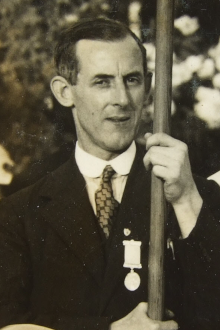
Death of Éamonn Mac Thomáis, Irish Republican Author & Historian

Éamonn Mac Thomáis, author, broadcaster, historian, Irish Republican, advocate of the Irish language and lecturer, dies on August 16, 2002. He presents his own series on Dublin on RTÉ during the 1970s and is well known for guided tours and lectures of his beloved Dublin.

Mac Thomáis comes from a staunch Republican family. He is born Edward Patrick Thomas in the Dublin suburb of Rathmines on January 13, 1927. His father, a fire-brigade officer, dies when he is five years old and his family moves to Goldenbridge, Inchicore. He leaves school at thirteen to work as delivery boy for White Heather Laundry, learning Dublin neighbourhoods with great thoroughness. He says he found work to help his mother pay the rent. He later works as a clerk and is appointed credit controller for an engineering firm.

Mac Thomáis joins the Dublin Brigade of the Irish Republican Army as a young man and is active in the preparations for and prosecution of the 1956-62 border campaign. He is interned in Curragh Camp during the campaign and in December 1961 is sentenced to four months imprisonment under the Offences Against the State Act.

At the November 1959 Ardfheis Mac Thomáis is elected to the Ardchomhairle of Sinn Féin and edits and contributes to the Sinn Féin newspaper United Irishman. He is a close friend of Tomás Mac Giolla and is deeply affected by the 1970 split in Sinn Féin. He takes the Provisional side, opposing Mac Giolla.

Mac Thomáis takes over as editor of An Phoblacht in 1972. In July 1973, he is arrested and charged with IRA membership at the Special Criminal Court in Dublin. He refuses to recognise the court, but he gives a lengthy address from the dock. The following month he is sentenced to 15-months imprisonment. Within two months of completing his sentence he is again before the court on the same charge and again receives a 15-month sentence. Editors of six left-wing and Irish-language journals call for his release, as do a number of writers, and hundreds attend protest meetings – to no avail. He serves his full sentence.

Tim Pat Coogan, editor of The Irish Press, claims the charges against Mac Thomáis are politically motivated to a large degree as his activities are confined strictly to the newspaper An Phoblacht. Under Section 31 of the Broadcasting Act, due to his membership in Sinn Féin in the 1970s he is removed from his position in making some of the RTÉ historical programmes. As a historian he makes numerous contributions to various historical publications such as the Dublin Historical Review.

From 1974 Mac Thomáis writes a number of books on old Dublin. They sell well and remain in print for over 20 years. He also starts a number of walking tours of Dublin, which prove very popular.

Mac Thomáis dies in Dublin on August 16, 2002. He is buried in the republican plot in Dublin’s Glasnevin Cemetery, next to Frank Ryan.

Mac Thomáis’s son Shane, also a historian, runs similar walking tours and is resident historian at Glasnevin Cemetery before his death in 2014.


Leave a comment

Birth of Actress & Author Pauline McLynn

Pauline McLynn, Irish character actress and author, is born in Sligo, County Sligo, on July 11, 1962. She is best known for her roles as Mrs. Doyle in the Channel 4 sitcom Father Ted, Libby Croker in the Channel 4 comedy drama Shameless, Tip Haddem in the BBC One comedy Jam & Jerusalem, and Yvonne Cotton in the BBC soap opera EastEnders.

McLynn grows up with two younger brothers in Galway. She studies History of Art and Modern English at Trinity College Dublin but is more heavily involved in the college’s drama society. She graduates with an MA.

Although McLynn is in her early thirties when playing Mrs. Doyle in Father Ted, makeup is used to make her look far older to fit the character’s elderly profile. She receives a British Comedy Award for her performances in 1996. The award is presented to her by Tony Blair.

Subsequent televised appearances include a similar elderly role in the “Yesterday Island” episode of youth sci-fi series Life Force, sketches on Bremner, Bird and Fortune, and panel shows Just a Minute, Have I Got News for You, and If I Ruled the World. In 1999, she appears in the film adaptation of Angela’s Ashes. She also appears in Jennifer SaundersJam & Jerusalem. Between 2001 and 2003 she reprises Mrs. Doyle in an advert for online tax return filing by the Inland Revenue.

McLynn is critically acclaimed for her performance in the 2005 film Gypo, receiving an Irish Film & Television Academy award nomination for Best Actress.

McLynn appears as Libby Croker in Shameless, which is produced by the British broadcaster Channel 4. In January 2011 it is announced that she has left the show, reportedly after a “difficult year.” She also plays the role of Alice’s mother in the Comedy Central show Threesome. She stars in Samuel Beckett’s Happy Days at the Crucible Theatre, Sheffield, in 2011. She plays Mary Whyte in the BBC’s 2013 sitcom Father Figure.

In 2014, McLynn plays the part of Evelyn in “Kiss for the Camera”, a series three episode of the BBC comedy Pramface. On May 12, 2014, she joins the cast of EastEnders as Yvonne Cotton, the mother of Charlie Cotton (Declan Bennett) and ex-daughter-in-law of Dot Branning (June Brown). After starting as a recurring character, she quickly becomes a regular when her character’s storylines escalate. She makes her final appearance on January 13, 2015, at the end of her contract. However, she returns to the soap opera on May 14, 2015 for one single episode to give evidence against Dot during Nick Cotton‘s (John Altman) murder trial.

In 2017, McLynn appears as the mother of lead character Marcella in Roisin Conaty‘s E4 comedy GameFace, and in April 2018 she portrays Sister Mary in the BBC Two biopic Dave Allen At Peace. She appears as a minor character named Mrs. Trattner in the 2018 film Johnny English Strikes Again.

In 2020, McLynn is one of the celebrity pilgrims on the Sultans Trail in the BBC series Pilgrimage: Road to Istanbul. She also appears in Riverdance: The Animated Adventure.

In 2021 McLynn appears as Oona in the E4 S6 of Inside No. 9. She also appears as Carol, a bar landlady, in the film Last Night in Soho, which is released in October 2021. She also appears in Doctor Who, as Mary in the New Year’s special “Eve of the Daleks.”

McLynn is married to theatrical agent Richard Cook. She is a patron of the children’s charity World Vision Ireland and is president of Friends of Innisfree Housing Association. She is also a patron for Littlehill Animal Rescue, Sanctuary in Ireland and Birmingham Greyhound Protection.

McLynn is a fan of the Premier League football team Aston Villa. She says her best moment supporting Villa came in 1996 when she watched them beat Leeds United in the Football League Cup final with her Father Ted co-star Ardal O’Hanlon, who is a Leeds supporter. She is raised as a Roman Catholic but is now an atheist.

McLynn is involved with many charities against the racing and export of greyhounds. She is a patron of Greyhound Protection UK.


Leave a comment

Death of James Duffy, Author & Publisher

James Duffy, prominent Irish author and publisher, dies at his home at Clontarf, Dublin, on July 4, 1871.

Duffy is born in 1809 probably in County Cavan, at either Shercock or Kingscourt, and is educated locally at a hedge school. He has at least two brothers and two sisters. He first makes a living as a pedlar in County Cavan and County Meath, dealing with Bryan Geraghty, a bookseller in Anglesea Street, Dublin, with whom he exchanges Irish manuscripts for Catholic prayer books. He also buys up Bibles distributed in Ireland by Protestant missionaries for resale in Great Britain. When aged about thirty he sets up in business in Anglesea Street as a publisher, printer and bookseller, specialising in low-priced Catholic books, such as A pocket missal for the use of the laity (1838) and a new edition of the Catechism (1848) by Andrew Donlevy, made possible by the invention of the stereotype. He moves his business to Wellington Quay in 1846. He also prints and distributes public statements by Catholic prelates, and is able to call himself “bookseller to the cardinal archbishop of Dublin.”

At the request of the editor of The Nation, Charles Gavan Duffy (to whom he is not related), he republishes an anthology of nationalistic ballads, The spirit of the nation (1843; 59th ed., 1934), a successful venture that links him to the Young Ireland movement and expands into the publication of numerous popular historical writings, beginning with Gavan Duffy’s Library of Ireland series. He publishes several periodicals for Catholic readers, which combine pietism and patriotism with hagiography: Duffy’s Irish Catholic Magazine (1847–8), Duffy’s Fireside Magazine (1850–54), and Duffy’s Hibernian Magazine (1860–64).

Judged by the distinction of his authors (who include William Carleton, Thomas Davis, John Mitchel, James Clarence Mangan and Richard Robert Madden, the number and popularity of his productions, and their formative influence on Catholic popular opinion, he can be considered the most important Irish publisher in the middle decades of the nineteenth century. He is particularly significant in providing the Young Ireland movement with a cheap and reliable publisher for the dissemination of their writings. Charles Gavan Duffy describes him as “a man of shrewd sense and sly humour but without cultivation or judgment in literature.” He never takes a holiday and, though a kindly employer, never allows his staff to take holidays. The Irish American newspaper Irish American Weekly credits him with providing employment for 500 people and with having bought enough land to give him an income of £5,000 a year. It also notes that his ruthlessness had made him unpopular within his trade.

In 1840 Duffy marries Frances Lynch in Kingscourt, County Cavan. They have five sons and five daughters. The family susceptibility to pulmonary illnesses takes a dreadful toll: none of the sons live beyond the age of twenty-three, three dying from tuberculosis, while one of his daughters dies of pneumonia at the age of fourteen and another two daughters succumb as relatively young adults to tuberculosis.

Duffy dies at the age of 62 on July 4, 1871, at his home at Clontarf, Dublin. He is buried at Glasnevin Cemetery. His will, which disposes of an estate worth almost £25,000, is contested unsuccessfully in court by the younger of his two surviving sons. His son-in-law, Edmund Burke, becomes managing director of James Duffy and Company Limited, but after his death in 1901 the company passes out of the control of its founder’s family.

(From: “Duffy, James” by C. J. Woods, Dictionary of Irish Biography, http://www.dib.ie, October 2009)


Leave a comment

Birth of Myles Byrne, United Irishman & French Army Officer

Myles Byrne, United Irishman, French army officer and author, is born into a Catholic farming family in the townland of Ballylusk, near Monaseed, County Wexford, on March 20, 1780.

At the age of 17, Byrne is asked to join the government Yeomanry. He chooses instead to join the Society of United Irishmen. In defiance of the British Crown and the Protestant Ascendancy the oath-bound movement is determined to achieve an independent and representative government for Ireland. He participates in preparations in Wexford for the Irish Rebellion of 1798 and, at the age of 18, fights at the Battle of Tubberneering on June 4 and, in command of a division of pikemen, in the Battle of Arklow on June 9, in which the rebel leader Father Michael Murphy is killed. In the face of a general rout, he leads a rebel charge in the Battle of Vinegar Hill on June 21.

Keeping command of a small band, Byrne seizes Goresbridge on June 23 but has to deplore the murder of several prisoners and other atrocities committed by his men in revenge for the torture and executions that had been visited upon the peasantry by the yeomanry and government militia. After further skirmishes he joins Joseph Holt and Michael Dwyer in taking to the Wicklow Mountains to continue a guerrilla resistance.

After Holt accepts transportation to Australia in November, Byrne, assisted by his sister, escapes to Dublin. He recalls of his sister, “If I had not remarked a long scar on her neck, she would not have mentioned anything herself. A yeoman … threatened to cut her throat with his sabre if she did not tell instantly the place in which I was hiding. The cowardly villain, no doubt, would have put his threat in execution had not some of his comrades interfered to prevent him.”

In the winter of 1802-03, Byrne enters into the plans of Robert Emmet and Anne Devlin for a renewed uprising. In his Memoirs he describes a meeting he arranged between Robert Emmet and the Wexford rebel leader Thomas Cloney at Harold’s Cross Green, Dublin, just prior to Emmet’s Rebellion, “I can never forget the impression this meeting made on me at the time – to see two heroic patriots, equally devoted to poor Ireland, discussing the best means of obtaining her freedom.”

In July 1803, the plans unravel when Anne Devlin’s cousin, Michael Dwyer, still holding out in Wicklow, recognises that there are neither the promised arms nor convincing proof of an intended French landing. In the north Thomas Russell and James Hope find no enthusiasm for a renewal of the struggle in what in 1798 are the strongest United Irish and Catholic Defender districts.

In Dublin, with their preparations revealed by an accidental explosion of a rebel arms depot, Emmet proceeds with a plan to seize the centres of government. The rising, for which for Byrne turns out with Emmet and Malachy Delaney in gold-trimmed green uniforms, is broken up after a brief confrontation in Thomas Street.

Two days after the fight in Thomas Street, Byrne meets with the fugitive Emmet and agrees to go to Paris to procure French assistance. But in Paris he finds Napoleon‘s attentions focused elsewhere. The First Consul uses a cessation of hostilities with Britain to pursue a very different venture, the re-enslavement of Haiti.

Byrne is commissioned as a captain in Napoleon’s Irish Legion. But at a time when he is convinced that “all Catholic Ireland” is “ready to rise the moment a rallying point was offered,” the Irish exiles cannot deflect the First Consul from other priorities. Rather than in Ireland, with his diminishing Irish contingent, he is to see action in the Low Countries, Germany and Spain.

Byrne rises to the rank of brigadier general and is awarded the Legion of Honour in 1813. Following the Bourbon Restoration, with fellow legionnaire John Allen, he narrowly avoids deportation as a foreign Bonapartist. An introduction to the Prince de Broglie, then vice-president of the Chamber of Deputies, and two audiences with the Minister of War, Marshal Henri Clarke, the Duke of Feltre, contribute to the latter’s decision to quash the deportation order. In August 1817 Byrne is naturalised as a French citizen.

For much of the next decade Byrne finds himself effectively retired on half pay. Returned to active military service in 1828, he distinguishes himself in the French expedition to Morea during the Greek War of Independence. He retires in 1835 with the rank of Chef de Bataillion.

In the 1840s, Byrne is Paris correspondent for The Nation in Dublin, the Young Irelander newspaper that does much to rehabilitate the memory of the United Irishmen.

In his last years Byrne writes his Memoirs, which are an account of his participation in the Irish Rebellion and his time in the Irish Legion of Napoleon. These are first published in three volumes in 1863, but there have been many subsequent reprints. Against the portrayal of 1798 as a series of disjointed, unconnected risings, his memoirs present the United Irishmen as a cohesive revolutionary organisation whose aim of a democratic, secular, republic had captured the allegiance of a great mass of the Irish people.

Byrne dies at his house in the rue Montaigne (now rue Jean Mermoz, 8th arrondissement, near Champs-Élysées), Paris on January 24, 1862, and is buried in Montmartre Cemetery. His grave there is marked by a Celtic Cross, however this headstone appears to be a 1950s replacement for an earlier one.

(Pictured: Miles Byrne (1780-1862), United Irishman. Photograph taken by an unknown photographer in Paris in February 1859. The photograph now resides in Áras an Uachtaráin, the residence of the President of Ireland, in Dublin.)


Leave a comment

Birth of Maurice Lenihan, Journalist & Author

Maurice Lenihan, journalist and author, is born on February 5, 1811, in St. Patrick’s parish, Waterford, County Waterford.

Lenihan is the eldest of fifteen children (ten sons and five daughters) of James Lenihan, woolen draper, and Margaret Lenihan (née Bourke) from Carrick-on-Suir, County Tipperary, where her family is also involved in the woolen trade. He receives his early education at a school attached to St. John’s College, Waterford, and in 1823 goes to Carlow College, which then caters both for junior seminarians and lay students, and it is clear that he is in the latter category. He studies there as a boarder for eight years despite the financial pressure on the family arising from the death of his father in 1829.

Lenihan begins his journalistic career with the Tipperary Free Press in 1831, moves to The Waterford Chronicle two years later, and in 1841 becomes the editor of The Limerick Reporter. This is followed by a brief stint with The Cork Examiner before he settles in Nenagh in 1843 and establishes his own newspaper, The Tipperary Vindicator. In 1849 he purchases The Limerick Reporter, amalgamates it with his existing publication to form The Limerick Reporter and Tipperary Vindicator, and moves to Limerick, where he resides for the remainder of his life. His paper integrates local reporting and analysis with reports and commentary on national and international events and discussion of the major intellectual ideas of the age. He also fosters the careers of local writers, in particular the poets John Francis O’Donnell and Michael Hogan.

Lenihan plays a distinguished role in Limerick local politics, serving on the municipal council continuously from 1863 until his retirement in 1887, and as mayor in 1884. He takes a prominent part also in national political debates and controversies of the period. He is a moderate constitutional nationalist, strongly influenced in his youth by Daniel O’Connell, though he later defends Fenian prisoners. In the 1830s he supports the abolition of tithes, and campaigns in the 1860s for the disestablishment of the Church of Ireland. He champions the cause of Catholic education and favours the teaching of the Irish language in schools and colleges. He consistently supports liberal party candidates in elections and in the 1880s espouses the twin aims of land reform and parliamentary independence.

Lenihan marries a local Nenagh woman, Elizabeth Spain, in November 1843. They have two sons and seven daughters. The family is dogged by ill-health and steadily declining fortunes. The financial problems are caused in part by the losses incurred in the publication in 1866 of Lenihan’s major work of scholarship, Limerick, its history and antiquities. The genesis of this enterprise lay in a series of articles on the sieges of 1690 and 1691, which he had researched and published in his own newspaper. With the encouragement and guidance of his friend, the historian and scholar Eugene O’Curry, he spends five years in research and writing. He had amassed through purchase and borrowing an impressive collection of manuscript materials, most notably the Arthur manuscripts, and these are supplemented by transcripts from most of the principal sources then extant in both Britain and Ireland. He supplements this documentary material with his own local knowledge and oral evidence from elderly residents. The work is haphazardly, even chaotically, arranged and is notable for its voluminous footnotes. These arise from a self-confessed problem in organising his material and from the fact that he acquires further information after the main text has been drafted. These deficiencies are more than compensated for by the vast range of primary source material that, in addition to forming the basis for the main narrative, is reproduced in total or summary form in both the footnotes and appendices. This material has proved invaluable to subsequent generations of scholars researching the history of Limerick.

Poverty, poor health, and personal tragedy are prominent in his final years. His newspaper becomes progressively unprofitable, and he is forced to sell his books and manuscripts to the British Museum. Five of his children predecease him. He dies on December 25, 1895, and is buried in Mount St. Lawrence Cemetery in Limerick.

(From: “Lenihan, Maurice” by Liam Irwin, Dictionary of Irish Biography, http://www.dib.ie, October 2009)


Leave a comment

Death of Cornelius Ryan, Irish American Journalist & Author

Cornelius Ryan, Irish American journalist and author mainly known for his writings on popular military history, dies in Manhattan on November 23, 1974. He is especially known for his World War II books The Longest Day: 6 June 1944 D-Day (1959), The Last Battle (1966), and A Bridge Too Far (1974).

Ryan is born in Dublin on June 5, 1920. He is educated at Synge Street CBS, Portobello, Dublin. He is an altar boy at St. Kevin’s Church, Harrington Street and studies the violin at the Irish Academy of Music in Dublin. He is a boy scout in the 52nd Troop of the Catholic Boy Scouts of Ireland and travels on their pilgrimage to Rome on the liner RMS Lancastria in 1934. He moves to London in 1940 and becomes a war correspondent for The Daily Telegraph in 1941.

Ryan initially covers the air war in Europe, flying along on fourteen bombing missions with the Eighth and Ninth United States Army Air Forces (USAAF). He then joins General George S. Patton‘s Third Army and covers its actions until the end of the European war. He transfers to the Pacific theater in 1945 and then to Jerusalem in 1946.

Ryan emigrates to the United States in 1947 to work for Time, where he reports on the postwar tests of atomic weapons carried out by the United States in the Pacific. He then reports for Time on the Arab-Israeli war in 1948. This is followed by work for other magazines, including Collier’s Weekly and Reader’s Digest.

Ryan marries Kathryn Morgan, a novelist, and becomes a naturalized citizen of the United States in 1951.

On a trip to Normandy in 1949 Ryan becomes interested in telling a more complete story of Operation Overlord than has been produced to date. He begins compiling information and conducting over 1,000 interviews as he gathers stories from both the Allies and the Germans, as well as the French civilians.

In 1956 Ryan begins to write down his World War II notes for The Longest Day: 6 June 1944 D-Day, which tells the story of the D-Day Invasion of Normandy, published three years later in 1959. It is an instant success, and he assists in the writing of the screenplay for the 1962 film of the same name. Darryl F. Zanuck pays the author U.S.$175,000 for the screen rights to the book.

Ryan’s 1957 book One Minute to Ditch! is about the successful ocean ditching of a Pan American Boeing 377 Stratocruiser. He had written an article about the ditching for Collier’s in their December 21, 1956, issue and then expanded it into the book.

Ryan’s next work is The Last Battle (1966), about the Battle of Berlin. The book contains detailed accounts from all perspectives: civilian, American, British, Russian and German. It deals with the fraught military and political situation in the spring of 1945, when the forces of the western allies and the Soviet Union contend for the chance to liberate Berlin and to carve up the remains of Germany.

This work was followed by A Bridge Too Far (1974), which tells the story of Operation Market Garden, the ill-fated assault by allied airborne forces on the Netherlands culminating in the Battle of Arnhem. It is made into a major 1977 film of the same name.

Ryan is awarded the French Legion of Honour and an honorary Doctor of Literature degree from Ohio University, where the Cornelius Ryan Collection is housed in the Alden Library. He is diagnosed with prostate cancer in 1970 and struggles to finish A Bridge Too Far during his illness. He dies in Manhattan on November 23, 1974, while on tour promoting the book, only two months after publication. He is buried in the Ridgebury Cemetery in northern Ridgefield, Connecticut.

Four years after his death, Ryan’s struggle with prostate cancer is detailed in A Private Battle, written by his widow, from notes he had secretly left behind for that purpose.


Leave a comment

Birth of John Russell Young, Journalist, Author & Diplomat

John Russell Young, Irish American journalist, author, diplomat, and the seventh Librarian of the United States Congress from 1897 to 1899, is born on November 20, 1840, in County Tyrone. He is invited by Ulysses S. Grant to accompany him on a world tour for purposes of recording the two-year journey, which he publishes in a two-volume work.

Young is born in County Tyrone but as a young child his family emigrates to Philadelphia, Pennsylvania. He enters the newspaper business as a proofreader at age fifteen. As a reporter for The Philadelphia Press, he distinguishes himself with his coverage of the First Battle of Bull Run. By 1862 he is managing editor of the Press and another newspaper.

In 1865 Young moves to New York City, where he becomes a close friend of Henry George and helps to distribute his book, Progress and Poverty. He begins writing for Horace Greeley‘s New York Tribune and becomes managing editor of that paper. He also begins working for the government, undertaking missions to Europe for the U.S. Department of State and the U.S. Department of the Treasury. In 1872, he joins the New York Herald and reports for them from Europe.

Young is invited to accompany President Ulysses S. Grant on Grant’s famous 1877-79 world tour, chronicled in Young’s book Around the World with General Grant. He impresses Grant, especially in China where he strikes up a friendship with Li Hongzhang. Grant persuades President Chester A. Arthur to appoint Young minister to China in 1882. In this position he distinguishes himself by mediating and settling disputes between the United States and China and France and China. Unlike many other diplomats, he opposes the policy of removing Korea from Chinese suzerainty.

In 1885 Young resumes working for the New York Herald in Europe. In 1890 he returns to Philadelphia. In 1897 President William McKinley appoints him Librarian of Congress, the first librarian confirmed by Congress. During his tenure, the library begins moving from its original home in the United States Capitol building to its own structure, an accomplishment largely the responsibility of his predecessor, Ainsworth Rand Spofford. Spofford serves as Chief Assistant Librarian under Young. Young holds the post of librarian until his death.

Young dies in Washington, D.C. on January 17, 1899, and is interred at Mount Moriah Cemetery in Philadelphia, Pennsylvania.

Young’s brother is Congressman James Rankin Young. His son is Brigadier General Gordon Russell Young, who is Engineer Commission of the District of Columbia from 1945-51 and a recipient of the Distinguished Service Medal and the Legion of Merit.


Leave a comment

Birth of Bill Graham, Rock Journalist & Author

Bill Graham, Irish rock journalist and author, is born in Belfast, Northern Ireland, on August 29, 1951. He attends Blackrock College and Trinity College, Dublin. In addition to authoring several books, he writes for Hot Press magazine from its founding.

Graham’s long time colleague and Hot Press editor Niall Stokes describes him, “In many ways, he was a founding father of modern Irish music. He inspired a whole generation of Irish fans and musicians to look at the world in a different and broader light. And he was good on more than music too. He felt a kinship with Northern Ireland and the people on both sides of the sectarian and political divide there that was unusual in those who were brought up within the narrow confines of the culture of Ireland in the ‘60s and ‘70s – and his political writing reflected this. And he was also ahead of the game in terms of his appreciation of the importance of the politics of food and the position of the developing world in the new era.”

Graham is instrumental in the formation of Irish rock band U2, having brought them to the attention of their manager Paul McGuinness. At an exhibition of early group photos, McGuinness remembers the role Graham played by introducing him to the band. Despite being widely known as the man who “discovered” U2, it is a title he disavowed. He writes enthusiastically about the band, giving them their first exposure. Both guitarist The Edge and Bono have explained Graham’s role in the band’s development.

John Waters observes that “It is often said that Bill ‘discovered’ U2. This is untrue. Bill created U2, through his enthusiasm for them. He gave them a reflection of their own possibilities and they only looked back that once.” Graham has a deep knowledge of virtually every form of popular and roots music. Waters goes on to credit him as “the first Irish writer to write about the connection between Irish political culture and Irish rock ‘n’ roll.”

A number of music critics/journalists have cited Graham as a primary influence, in some cases suggesting they got into the field as a direct result of his writing.

Graham dies of a heart attack at the age of 44 at his home in Howth, County Dublin, on May 11, 1996. His funeral draws many of the biggest bands from the world of Irish music including Clannad, Altan, U2, and Hothouse Flowers, along with singers Simon Carmody and Gavin Friday.


Leave a comment

Death of Author Muiris Ó Súilleabháin

Muiris Ó Súilleabháin, anglicised as Maurice O’Sullivan, Irish author famous for his Irish language memoir of growing up on the Great Blasket Island and in Dingle, County Kerry, off the western coast of Ireland, drowns on June 25, 1950, while swimming at Knocknacarra off the Connemara coast.

Ó Súilleabháin is born on the Great Blasket Island on February 19, 1904. Following the death of his mother when he is six months old, he is raised in an institution in Dingle, County Kerry. At the age of eight, he returns to the Great Blasket Island to live with his father, grandfather and the rest of his siblings, and learns the native language.

Ó Súilleabháin is persuaded to write his memoirs by George Derwent Thomson, a linguist and professor of Greek who had come to the island to hear and learn the Irish language. It is Thomson who encourages him to join Garda Síochána in Dublin in 1927 rather than emigrate to the United States as do most of the young people. He is stationed in the Gaeltacht area of Connemara, where he maintains contact with Thomson.

Fiche Blian ag Fás is published in Irish and English in 1933. As one of the last areas of Ireland in which the old Irish language and culture has continued unchanged, the Great Blasket Island is a place of enormous interest to those seeking traditional Irish narratives. Thomson edits and assembles the memoir, and arranges for its translation into English with the help of Moya Llewelyn Davies.

While Fiche Blian ag Fás is received with tremendous enthusiasm by critics, including E. M. Forster, their praise at times has a condescending tone. Forster describes the book as a document of a surviving “Neolithic” culture. Such interest is tied up with romantic notions of the Irish primitive, and thus when Ó Súilleabháin tries to find a publisher for his second book, Fiche Bliain faoi Bhláth (in English, Twenty Years a-Flowering), there is little interest, as this narrative necessarily departs from the romantic realm of turf fires and pipe-smoking wise-women.

In 1934, Ó Súilleabháin leaves the Guards and settles in Connemara. He marries Cáit ní Chatháin of Carraroe on July 10, 1934. They have one daughter, Máirín, and one son, Eoin, a dramatist and writer.

Ó Súilleabháin drowns on June 25, 1950, while swimming off the Connemara coast. He is buried at Barr an Doire near Carraroe. Dylan Thomas commences, but does not finish, a film script of Twenty Years a-Growing. The partially completed film script is published in 1964.


Leave a comment

Birth of Máire MacSwiney Brugha, Activist & Author

Máire MacSwiney Brugha, Irish activist who is the daughter of Terence MacSwiney and niece of Mary MacSwiney, is born in Cork, County Cork, on June 23, 1918. In addition to being an activist she is also an author and is now regarded as a person of historical importance.

MacSwiney Brugha is the daughter of the former Lord Mayor of Cork Terence MacSwiney and his wife Muriel Frances Murphy. Her father dies on hunger strike when she is two years old. Her father is in jail when she is born and does not see her until she is brought to see him when she is three months old. Her family’s republican and political activities leave a strong mark on her life.

Following the death of her father, her mother moves to Dublin. MacSwiney Brugha goes to live with Madame O’Rahilly, widow of The O’Rahilly, and sees her mother intermittently. Although as a child her parents decide she would speak the Irish language, her father’s death and her mother’s health results in her move to Germany in 1923 and there she is moved around a lot. She learns German and speaks no English and little or no Irish. In 1930 she is moved to Grainau in Bavaria, where she attends school. Her aunt, Mary MacSwiney, a legal guardian of hers, eventually comes to collect her and takes her back to Ireland. This causes a court case when it is claimed her aunt had kidnapped her. As a result of the court case her aunt is given custody, and she and her mother became estranged.

MacSwiney Brugha attends Scoil Íte and then St. Louis Secondary School in Monaghan where, in 1936, she completes her Leaving Certificate and gets a scholarship to University College Cork to study arts. In 1937 she plays the lead role in a play, The Revolutionist, published in 1914 and written by her father and produced by her aunt. She returns to Germany in 1938 to keep up her German and graduates with a first-class honours degree. She goes on to get her higher diploma and becomes a teacher. She spends some time teaching in Scoil Íte and then goes to Dublin in 1942 to get a master’s degree. She meets Ruairí Brugha while in Dublin. His father, Cathal Brugha, was killed in the Irish Civil War in 1922. They marry on July 10, 1945. The marriage produces four children: Deirdre, Cathal, Traolach and Ruairí.

MacSwiney Brugha’s husband has a strong political career with her support. He is a senator, a TD, and a member of the European Parliament. She leads her Fianna Fáil cumann and volunteers with the aid agency Gorta. With her husband as Official Opposition Spokesman on Northern Ireland from 1975 to 1977, the couple are very much involved in creating the policy of developing conciliation rather than aimed more at ending partition which they previously have been focused on.

At the age of 85 and after her sight has failed MacSwiney Brugha dictates her story to her daughter-in-law, Catherine Brugha. History’s Daughter: A Memoir from the Only Child of Terence MacSwiney is launched in 2005. Her own story is recorded in Irish Life and Lore. Her story is also the subject of a radio production. She dies unexpectedly at her home in Clonskeagh, County Dublin, at the age of 93 on May 20, 2012. She is buried in Glasnevin Cemetery.

Fianna Fáil leader Micheál Martin describes her as having made a “strong and valued” contribution to the development of Fianna Fáil while Gerry Adams says she “made her mark” on Irish history.

(Pictured: Máire MacSwiney Brugha on her wedding day, July 10, 1945)