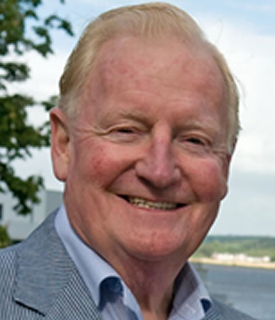
James Plunkett Kelly, known by the pen name James Plunkett, Irish novelist, playwright, and short-story writer, dies in Dublin on May 28, 2003. His works, which deal with Ireland’s political and labour problems, contain vivid portraits of working-class and middle-class Dubliners.
Plunkett is born in Sandymount, Dublin on May 21, 1920, and grows up among the Dublin working class and they, along with the petite bourgeoisie and lower intelligentsia, make up the bulk of the dramatis personæ of his oeuvre. He is educated at Synge Street CBS, a Christian Brothers school located on Synge Street in Dublin. He leaves school at the age of seventeen. He later studies violin and viola at the Dublin College of Music and plays professionally in Dublin. He serves for a time as an official in the Workers’ Union of Ireland.
Plunkett’s best-known works are the novel Strumpet City, set in Dublin in the years leading up to the Dublin lock-out of 1913 and during the course of the strike, and the short stories in the collection The Trusting and the Maimed. His other works include a radio play on James Larkin, who figures prominently in his work.
During the 1960s, Plunkett works as a producer at Telefís Éireann. He wins two Jacob’s Awards, in 1965 and 1969, for his TV productions. In 1971 he writes and presents “Inis Fail – Isle of Destiny,” his very personal appreciation of Ireland. It is the final episode of the BBC series Bird’s Eye View, shot entirely from a helicopter, and the first co-production between the BBC and RTÉ. Plunkett is a member of Aosdána.
James Plunkett dies in a Dublin nursing home on May 28, 2003, just a week after his 83rd birthday. He is cremated at Mount Jerome Cemetery and Crematorium in Dublin.
A second-year class, “2 Plunkett” at Synge Street CBS, is named in honour of James Plunkett.
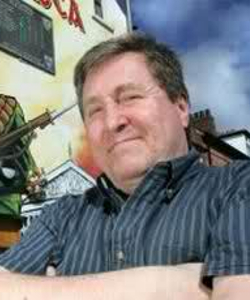
Duddy runs a fish and chip shop in the late 1960s which is supplied with beef burgers from a supplier whose van driver is Martin McGuinness. He is first approached by MI6 officer Frank Steele in the early 1970s but turns the approach down.
In light of the dissolution of Stormont in 1972, Duddy’s role as an intermediary starts in January 1972, when asked by friend and Derry’s Chief Police Office Frank Lagan to persuade the Official Irish Republican Army and the Provisional Irish Republican Army to remove their weapons from the Bogside. Both sides comply, but the Official IRA retains a few weapons for defensive purposes. After thirteen unarmed civil rights marchers are shot dead by British Parachute Regiment troops in what becomes known as Bloody Sunday, Duddy warns Lagan, “This is absolutely catastrophic. We’re going to have a war on our hands.”
In the aftermath of the events and repercussions of Bloody Sunday, MI6 agent Michael Oatley arrives in Belfast in 1973 seeking to understand the situation in Northern Ireland and hopefully create a communications channel between the IRA and the British Government. Duddy becomes the go-between for the communications, and this leads to the IRA ceasefire of 1975/76.
Duddy and Oatley are the main channel of communications between the British Government and the IRA leadership during the 1981 Irish hunger strike. Duddy is codenamed “Soon” by the British. Over the period of July 4-6, 1981, they exchange many telephone calls, with Duddy urging the “utmost haste” on the part of the British because “the situation would be irreparably damaged if a hunger striker died.” He suggests steps which could be taken to give the Provisional IRA a way of ending the strike. British Prime MinisterMargaret Thatcher personally amends the text of an offer which is conveyed to the IRA through Duddy, but the British consider the reply unsatisfactory and do not continue to negotiate through Duddy. Hunger striker Joe McDonnell dies the following day.
In November 1991, as his now friend Oatley is about to retire from MI6 service, Duddy calls Oatley to a diner in Derry. When dinner has finished, McGuinness enters the property. During the meeting, McGuinness and Oatley discuss options for moving the situation forward. A few weeks later, Duddy is pursued by a British businessman who wants to create jobs in Derry. In the first meeting, the businessman produces a letter from then Secretary of State for Northern IrelandPeter Brooke, introducing the “businessman” as Oatley’s MI6 successor. Duddy calls the MI6 agent “Fred,” and acting as the go-between they successfully negotiate a ceasefire. Talks between McGuinness and representatives of the British government are held secretly in his house.
On March 26, 2008, the BBC broadcasts a documentary entitled The Secret Peacemaker about Duddy, directed by Peter Norrey, and presented by Peter Taylor, a journalist who has known Duddy is “the link” for ten years.
In the spring of 2009, Duddy donates his private archives to the James Hardiman Library, NUI Galway, where they are now available to researchers. They chart his involvement in the peace process from 1972 to 1993, and his ongoing interest, and correspondence relating to Northern Ireland, until 2007. The Brendan Duddy Archive is opened in 2011.
At the age of 80, Brendan Duddy dies at Altnagelvin Area Hospital in Derry, Northern Ireland on May 12, 2017.
Kenny is one of the founding members of the Irish Women’s Liberation Movement. Although the group has no formal structure of officials, she is often seen as the “ringleader” of the group. In March 1971, as part of an action by the IWLM, she walks out of Haddington Road church after the Archbishop of Dublin‘s pastoral is read out from the pulpit, confirming that “any contraceptive act is always wrong,” saying “this is Church dictatorship.” In a follow-up letter to The Irish Times she explains her actions by saying Ian Paisley was right, “Home Rule is Rome Rule.”
In 1973, Kenny is allegedly “disturbed in the arms of a former cabinet minister of President Obote of Uganda during a party,” which leads poet James Fenton to coin the euphemism “Ugandan discussions” to mean sexual intercourse. The phrase is first used by the magazine Private Eye on March 9, 1973, but has been widely used since then and is included by the BBC in a list of “The 10 most scandalous euphemisms” in 2013.
The trial of Doherty and the other members of their four-man active service unit nicknamed the “M60 gang” begins in early May 1981, on charges including three counts of murder. On June 10, Doherty and seven other prisoners, including Angelo Fusco and the other members of the IRA unit, take a prison officer hostage at gunpoint in Crumlin Road Gaol and ultimately escape in waiting cars. Two days after the escape, Doherty is convicted in absentia and sentenced to life imprisonment with a minimum recommended term of thirty years.
Doherty escapes across the border into the Republic of Ireland, and then travels to the United States on a false passport. He lives with an American girlfriend in Brooklyn and New Jersey, working on construction sites and as a bartender at Clancy’s Bar in Manhattan, where he is arrested by the FBI on June 28, 1983. He is imprisoned in the Metropolitan Correctional Center in Manhattan, and a legal battle ensues with the British government seeking to extradite him back to Northern Ireland. Doherty claims he is immune from extradition as the killing of Royal Irish Constabulary Captain Herbert Westmacott was a political act. In 1985 federal judge John E. Sprizzo rules Doherty cannot be extradited as the killing is a “political offense.” Doherty’s legal battle continues as the United States Department of Justice then attempts to deport him for entering the country illegally.
Doherty remains in custody at the Metropolitan Correctional Center and attempts to claim political asylum, and on June 15, 1988, Attorney GeneralEdwin Meese overturns an earlier ruling by the Federal Board of Immigration Appeals that Doherty can be deported to the Republic of Ireland and orders his deportation to Northern Ireland. In February 1989 new Attorney General Dick Thornburgh chooses not to support the decision made by his predecessor and asks lawyers for Doherty and the Immigration and Naturalization Service to submit arguments for a review of the decision and Doherty’s claim for asylum. By this time Doherty’s case is a cause célèbre with his sympathisers including over 130 Congressmen and a son of then President of the United StatesGeorge H. W. Bush. In 1990 a street corner near the Metropolitan Correctional Center is named after him.
Doherty is returned to Crumlin Road Gaol before being transferred to HM Prison Maze. He is released from prison on November 6, 1998, under the terms of the Good Friday Agreement. After his release Doherty becomes a community worker specialising in helping disadvantaged young people. In 2006, he appears in the BBC television show Facing the Truth opposite the relatives of a soldier killed in the Warrenpoint ambush.
Stephens’ mother works in the home of the Collins family of Dublin and is adopted by them. He is committed to the Meath Protestant Industrial School for Boys as a small child and spends his childhood there. He attends school with his adopted brothers Thomas and Richard before graduating as a solicitor’s clerk. He is known affectionately in school as “Tiny Tim” due to his 4’10” stature. He is much enthralled by the tales of military valour of his adoptive family and would have become a soldier if not for his height.
By the early 1900s Stephens is increasingly inclined to socialism and the Irish language and by 1912 is a dedicated Irish Republican. He is a close friend of the 1916 Easter Rising leader Thomas MacDonagh, who is then editor of The Irish Review and deputy headmaster in St. Enda’s School, the radical bilingual school run by Patrick Pearse. His growing nationalism brings a schism with his adopted family, but probably wins him his job as registrar in the National Gallery of Ireland, where he works between 1915 and 1925, having previously had an ill-paid job with the Mecredy solicitors’ firm.
Stephens produces many retellings of Irish myths and fairy tales. His retellings are marked by a rare combination of humour and lyricism. He also writes several original novels, The Crock of Gold, Etched in Moonlight and Demi-Gods, based loosely on Irish fairy tales. The Crock of Gold in particular has achieved enduring popularity and has often been reprinted.
Stephens begins his career as a poet under the tutelage of “Æ” (George William Russell). His first book of poems, Insurrections, is published in 1909. His last book, Kings and the Moon (1938), is also a volume of verse.
Stephens’s influential account of the 1916 Easter Rising, Insurrection in Dublin, describes the effect of the deaths by execution of his friend Thomas MacDonagh and others as being “like watching blood oozing from under a door.” Of MacDonagh he writes:
No person living is the worse off for having known Thomas MacDonagh, and I, at least, have never heard MacDonagh speak unkindly or even harshly of anything that lived. It has been said of him that his lyrics were epical; in a measure it is true, and it is true in the same measure that his death was epical. He was the first of the leaders who was tried and shot.
Stephens lives between Paris, London and Dublin. During the 1930s he is a friend of James Joyce, and they mistakenly believe that they share a birthday. Joyce, who is concerned about his ability to finish what later becomes Finnegans Wake, proposes that Stephens assist him, with the authorship credited to JJ & S, short “Jameses Joyce & Stephens,” but also a pun on the popular Irish whiskey made by John Jameson & Sons. The plan is never implemented, as Joyce is able to complete the work on his own.
During the last decade of Stephens’ life, he finds a new audience through a series of broadcasts on the BBC. He dies at Eversleigh on Saint Stephen’s Day, December 26, 1950.
Actors from every genre of stage and screen show come together in the chapel at Terenure College in Dublin on February 4, 2000, for the funeral of Irish television and film actor Tony Doyle.
Brian Quigley, Doyle’s Ballykissangel character, is written out of the show after Doyle’s death in the first episode of the final series where Quigley fakes his own suicide and flees to Brazil.
The Tony Doyle Bursary for New Writing is launched by the BBC following his death. Judges include his friend and Ballykissangel co-star Lorcan Cranitch. Cranitch subsequently stars in the BBC detective series McCready and Daughter, which had been written with Doyle in mind.
Patrick Magee stays in the hotel under the pseudonym Roy Walsh during the weekend of September 14-17, 1984. During his stay, he plants the bomb under the bath in his room, number 629. The device, described as a “small bomb by IRA standards,” is fitted with a long-delay timer made from videocassette recorder components and a Memo Park Timer safety device. The device may have avoided detection by sniffer dogs due to it being wrapped in cling film to mask the smell of the explosive.
The bomb detonates at approximately 2:54 AM (BST) on October 12. The midsection of the building collapses into the basement, leaving a gaping hole in the hotel’s facade. Firemen say that many lives are likely saved because the well-built Victorian hotel remained standing. Margaret Thatcher is still awake at the time, working on her conference speech for the next day in her suite. The blast badly damages her bathroom but leaves her sitting room and bedroom unscathed. Both she and her husband escape injury. She changes her clothes and is led out through the wreckage along with her husband and her friend and aide Cynthia Crawford and driven to Brighton police station.
At about 4:00 AM, as Thatcher leaves the police station, she gives an impromptu interview to the BBC‘s John Cole, saying that the conference would go on as scheduled. Alistair McAlpine persuades Marks & Spencer to open early at 8:00 AM so those who have lost their clothes in the bombing can purchase replacements. Thatcher goes from the conference to visit the injured at the Royal Sussex County Hospital.
Five people are killed, none of whom are government ministers. But a Conservative MP, Sir Anthony Berry, is killed, along with Eric Taylor, North-West Area Chairman of the Conservative Party, Lady Jeanne Shattock, wife of Sir Gordon Shattock, Western Area Chairman of the Conservative Party, Lady Muriel Maclean, wife of Sir Donald Maclean, President of the Scottish Conservatives, and Roberta Wakeham, wife of Parliamentary Treasury Secretary John Wakeham. Donald and Muriel Maclean are in the room in which the bomb explodes, but Mr. Maclean survives.
Several more, including Walter Clegg, whose bedroom is directly above the blast, and Margaret Tebbit, the wife of Norman Tebbit, who is then President of the Board of Trade, are left permanently disabled. Thirty-four people are taken to the hospital and recover from their injuries. When hospital staff asks Norman Tebbit, who is less seriously injured than his wife, whether he is allergic to anything, he is said to answer “bombs.”
Murphy is born to an Anglo-Irish family at Milford House, near the Mayo-Galway border. His childhood in Ireland is documented in the film The Other Irish Travellers made by his niece, Fiona Murphy.
In 1954, Murphy settles at Cleggan, a village on the coast of Galway where fishing has been abandoned after a famous sailing disaster. Several years later, in 1959, he purchases and renovates the Ave Maria, a traditional Galway hooker type boat, from Inishbofin fisherman, Michael Schofield, which he uses to ferry visitors to the island. Taking the first-hand accounts of survivors of the sailing disaster, he weaves the material into a long tour de force poem which closes his first collection Sailing to an Island, published in the early 1960s by Faber & Faber. In 1969, he purchases Ardoileán (High Island), a small island in the vicinity of Inishbofin.
Murphy enjoys commissions for his poems from the BBC which prompts him to start on his long book-length sequence The Battle of Aughrim. Ostensibly about the 18th century triumph of Dutch-led Protestant forces over the Irish and French Catholic forces, the poem deals obliquely not only with the brewing strife in Ulster of the 1960s, but also with the issues of the Vietnam War. Its episodic structure is highly influential on poetic sequences subsequently published by Montague and Heaney.
Since 1971 Murphy has been a poet-in-residence at nine American universities. He lives in Sri Lanka, having previously divided his time between Dublin and Durban, South Africa, where his daughter and her family reside. He is the maternal grandfather of YouTuber Caspar Lee. In 2002, a memoir of his life and times, The Kick, is published by Granta, constructed from detailed diaries kept over the course of five decades.
Bodkin is the eldest son of Matthias McDonnell Bodkin, a nationalist journalist, judge and Member of Parliament. Graduating from the Royal University of Ireland in 1908 he practises law from 1911 until 1916 while collecting art privately, influenced by his uncle Sir Hugh Lane. With the death of Lane in the sinking of the RMS Lusitania in 1915, Bodkin is charged with ensuring that Lane’s collection of art is displayed in Dublin, a dispute that would only finally be settled in 1957 and about which Bodkin is to write Hugh Lane and his Pictures in 1932.
Bodkin leaves the legal profession in 1916 to become a Governor of the National Gallery of Ireland, being appointed Director in 1927. He also serves in 1926 on the committee that commissions the design of the new coinage of the Republic of Ireland from Percy Metcalfe.
In 1935 Bodkin leaves Ireland upon being appointed Director of the newly established Barber Institute of Fine Arts and Barber Professor of Fine Art at the University of Birmingham. The funds available to the Barber Institute for the purchase of new works compare favourably even to some national museums and Bodkin is able to make a string of exceptional purchases in the depressed art market around the time of World War II. The collection that in 1935 numbers just seven works, by 1939 holds major pieces such as Tintoretto‘s Portrait of a Youth (1554), Simone Martini‘s St. John the Evangelist (1320), Nicolas Poussin‘s Tancred and Erminia (1634) and James Abbott McNeill Whistler‘s Symphony in White No. III (1867). Bodkin retires in 1952 but retains control over acquisitions until 1959. His successor as Director and Professor, Ellis Waterhouse, wistfully refers to Bodkin’s wayward later purchases as “Acts of Bod.”
Bodkin is also an active broadcaster and author, publishing personal reminiscences and translations of modern French poetry as well as works of art history and criticism. In particular, his The Approach to Painting (1927), an introduction for a popular audience, runs through many editions over the succeeding thirty years.
Bodkin is awarded the Civil Division of the Order of St. Gregory the Great for services to his church. A bust of Bodkin, previously exhibited at the Royal Academy in 1958, is donated to the Barber Institute of Fine Arts by its sculptor, Sir Charles Wheeler, President of the Royal Academy and a personal friend of Bodkin’s, on the latter’s death.
Bodkin is the subject of This Is Your Life in March 1960 when he was surprised by Eamonn Andrews at the BBC’s Costa Green Studios in Birmingham.
Thomas Bodkin dies in Birmingham, England on April 24, 1961. His remains are interred in Glasnevin Cemetery, Dublin.
David Kelly, Irish actor who has regular roles in several film and television works from the 1950s onwards, is born in Dublin on July 11, 1929. One of the most recognisable voices and faces of Irish stage and screen, Kelly is known to Irish audiences for his role as Rashers Tierney in Strumpet City, to British audiences for his roles as Cousin Enda in Me Mammy and as the builder Mr. O’Reilly in Fawlty Towers, and to American audiences for his role as Grandpa Joe in the film Charlie and the Chocolate Factory. Another notable role is as Michael O’Sullivan in Waking Ned.
He becomes a familiar face on British television beginning in the 1960s with the BBC comedy Me Mammy, opposite Milo O’Shea and Anna Manahan. He goes on to often-memorable guest roles on such series as Oh Father!, Never Mind the Quality, Feel the Width, and On the Buses, and particularly during the 1970s with a long-running role as the one-armed dishwasher Albert Riddle in the Man About the House spin-off Robin’s Nest. He also has a regular long running role alongside Bruce Forsyth in both series of the comedy Slingers Day from 1986 to 1987.
He gains some of his greatest recognition in 1975, playing inept builder Mr. O’Reilly on the second episode of Fawlty Towers. He is in the voice cast of The Light Princess, a partly animated, hour-long family fantasy that airs on the BBC in 1978.
In Ireland, he may be most famous for his portrayal of the character “Rashers” Tierney in the 1980 RTÉ miniseries Strumpet City, which stars Peter O’Toole, Cyril Cusack and Peter Ustinov. He goes on to have starring roles in television shows such as Emmerdale Farm in the 1980s and Glenroe in the 1990s, as well as playing the grandfather in Mike Newell‘s film Into the West (1992).
Following his appearance as Michael O’Sullivan in the 1998 film Waking Ned, Kelly plays roles in such films as Tim Burton‘s Charlie and the Chocolate Factory, in which he plays Grandpa Joe and Agent Cody Banks 2: Destination London. He plays title character Frank Kovak in the mystery film The Kovak Box, in a rare villainous role. Stardust, released in 2007, is his final film. He also does extensive radio work, including a guest appearance on the BBC Radio 4 series Baldi.
David Kelly dies after a short illness on February 12, 2012 at age of 82. The Irish Times refers to him as the “grand old man of Irish acting.” A Catholic funeral mass takes place on February 16, 2012 at the Church of the Miraculous Medal, in his hometown of Dublin. He is cremated at Mount Jerome Cemetery and Crematorium.