seamus dubhghaill

Promoting Irish Culture and History from Little Rock, Arkansas, USA


Leave a comment

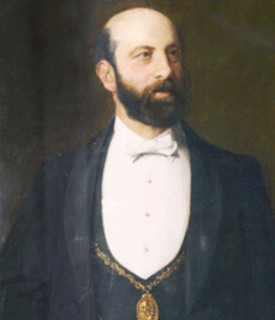
Birth of Otto Moses Jaffe, Lord Mayor of Belfast

otto-jaffe

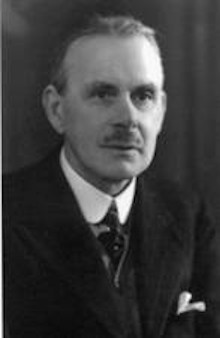
Sir Otto Moses Jaffe, German-born British businessman who is twice elected Lord Mayor of Belfast, is born in Hamburg on August 13, 1846. He is the first non-Protestant to hold the office of Lord Mayor of Belfast.

Jaffe is born into a Jewish family, one of four boys and five girls born to Daniel Joseph and Frederiké Jaffe. In 1852, his parents bring their family to Belfast. His father, along with his older brothers, Martin, John and Alfred, set up a business exporting linen. He is educated at Mr. Tate’s school in Holywood, County Down, and later in Hamburg and Switzerland.

Jaffe marries Paula Hertz, daughter of Moritz Hertz from Braunschweig, on March 8, 1879. They have two sons, Arthur Daniel and William Edward Berthold Jaffe. Daniel Joseph Jaffé is his nephew, son of his brother Martin.

From 1867 to 1877 Jaffe lives and works in New York. In 1877, his brothers retire so he returns to Belfast to head the family business, The Jaffe Brothers, at Bedford Street. He builds it up to become the largest linen exporter in Ireland. He is a member of the Belfast Harbour Commission and becomes a naturalised citizen in 1888. In 1894, he successfully agitates for the reporting and destruction of shipwrecks in the North Atlantic Ocean.

Jaffe is a Justice of the Peace, a governor of the Royal Hospital, a member of the Irish Technical Education Board and a member of the Senate of Queen’s College, which later becomes Queen’s University Belfast. He is the German consul in Belfast. He is an active member of the committee which gets the Public Libraries Act extended to Belfast, leading to the first free library being established there. In 1910 he erects the Jaffe Spinning Mill on the Newtownards Road, also known as Strand Spinning. This provides work for 350 people, rising to 650 in 1914 when the company expands to make munitions. He is lavishly charitable and contributes to Queen’s College.

Jaffe takes a keen interest in the Jewish community of Belfast. He is life-president of the Belfast Hebrew Congregation, which worships at the Great Victoria Street, Belfast synagogue. His father established it on July 7, 1871. Between 1871 and 1903 the congregation increases from fifty-five to over a thousand. He pays most of the £4,000 cost of building the synagogue in Annesley Street. He opens it in 1904 wearing his mayoral regalia. Three years later with his wife, they set up the Jaffe Public Elementary School on the Cliftonville Road.

Jaffe is a member of the Irish Unionist Party. He represents St. Anne’s Ward for the Belfast Corporation in 1894 and is elected Lord Mayor of Belfast in 1899. As mayor, he launches an appeal for the dependents of soldiers fighting in the Second Boer War. On March 5, 1900, he is knighted at Dublin Castle by George Cadogan, 5th Earl Cadogan, Lord Lieutenant of Ireland. In 1901 he is High Sheriff of Belfast and in 1904 is again elected Lord Mayor.

The outbreak of war sees anti-German sentiment and when the RMS Lusitania passenger liner is torpedoed by a German U-boat of the coast of County Cork on May 7, 1915, resulting in the death of 1,000 people, anti-German feeling in Britain and Ireland rise to breaking point. Even though he is loyal to the Crown, and his eldest son Arthur and his nephew are serving in the British Army, Jaffe is accused of being a German spy. Society women refuse support for the Children’s Hospital so long as Jaffe and his wife remain on the board. He is “overwhelmed with pain and sorrow.”

After twenty-five years of service, Jaffe resigns his post as Alderman of Windsor Ward for Belfast City Council in June 1916 when he is almost 70 years of age and takes up residence in London, where he dies on April 29, 1929. Lady Jaffe is too ill to attend his funeral, and she dies a few months later, in August 1929.


Leave a comment

20th Anniversary of the 1981 IRA Hunger Strikes

hunger-strike-20th-anniversary

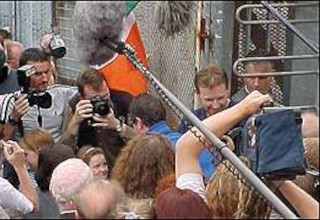
On August 12, 2001, loyalist protesters block a main road in north Belfast to prevent the republican Wolfe Tone Flute band from joining a parade in the Ardoyne district commemorating the 20th anniversary of the 1981 Irish Republican Army (IRA) hunger strikes.

The 20-minute blockade of the Ligoniel Road is in response to the local branch of the loyalist Apprentice Boys of Derry organisation being refused permission to drive their bus past the nationalist Ardoyne the previous day.

Billy Hutchinson, the Progressive Unionist Party Assembly member for Belfast North says, “Nationalists are saying that the Apprentice Boys can’t come down the Crumlin Road on a bus because it is seen to be a parade.” He adds further, “I think loyalists are saying if the Apprentice Boys can’t go down on a bus why should the Wolfe Tone band be allowed to go down on a bus?”

On August 11, police officers prevent the Ligoniel Walker Club of the Apprentice Boys of Derry from driving their bus down the Crumlin Road past the Ardoyne shops because it constitutes a parade and breaches a ruling by the Parades Commission. The club is prevented by the Commission from marching through the area and tries in vain to broker a last minute compromise to use their bus.

Gerry Kelly, Sinn Féin Assembly member for Belfast North, describes the loyalist protest as a “nonsense,” adding he does not believe that nationalist residents had objected to the organisation using their bus. “That is a decision the RUC (Royal Ulster Constabulary) took on the ground. I don’t think there would have been a problem from the people of Ardoyne,” he adds.

The Apprentice Boys vow to seek a judicial review into the decision to prevent them from traveling through the area to get to their main parade in Derry.

After a six and a half hour stand-off, Apprentice Boys representative Tommy Cheevers brands the Parades Commission a “farce.”

(From: “Hunger strike march blocked by loyalists” from The Irish Times, Sunday, August 12, 2001 | Photo credit: PA:Press Association)


Leave a comment

The Ballymurphy Massacre

ballymurphy-massacre-mural

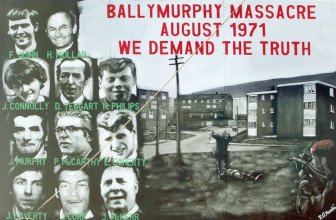
The Ballymurphy Massacre is a series of incidents that take place over a three-day period beginning on August 9, 1971, in which the 1st Battalion, Parachute Regiment of the British Army kill eleven civilians in Ballymurphy, Belfast, Northern Ireland, as part of Operation Demetrius. The shootings are later referred to as Belfast’s Bloody Sunday, a reference to the killing of civilians by the same battalion in Derry a few months later.

Two years into The Troubles and Belfast is particularly affected by political and sectarian violence. The British Army had been deployed in Northern Ireland in 1969, as events had grown beyond the control of the Royal Ulster Constabulary.

On the morning of Monday, August 9, 1971, the security forces launch Operation Demetrius. The plan is to arrest and intern anyone suspected of being a member of the Provisional Irish Republican Army. The unit selected for this operation is the Parachute Regiment. Members of the Parachute Regiment state that, as they enter the Ballymurphy area, they are shot at by republicans and return fire.

Mike Jackson, later to become head of the British Army, includes a disputed account of the shootings in his autobiography and his then role as press officer for the British Army stationed in Belfast while the incidents happened. This account states that those killed in the shootings were Republican gunmen. This claim has been strongly denied by the Catholic families of those killed in the shootings, in interviews conducted during the documentary film The Ballymurphy Precedent.

In 2016, Sir Declan Morgan, the Lord Chief Justice of Northern Ireland, recommends an inquest into the killings as one of a series of “legacy inquests” covering 56 cases related to the Troubles.

These inquests are delayed, as funding had not been approved by the Northern Ireland Executive. The former Stormont first minister Arlene Foster of the Democratic Unionist Party (DUP) defers a bid for extra funding for inquests into historic killings in Northern Ireland, a decision condemned by the human rights group Amnesty International. Foster confirms she had used her influence in the devolved power-sharing executive to hold back finance for a backlog of inquests connected to the conflict. The High Court says her decision to refuse to put a funding paper on the Executive basis was “unlawful and procedurally flawed.”

Fresh inquests into the deaths open at Belfast Coroner’s Court in November 2018 under Presiding Coroner Mrs. Justice Siobhan Keegan. The final scheduled witnesses give evidence on March 2-3, 2020, around the fatal shootings of Father Hugh Mullan and Frank Quinn on waste ground close to an army barracks at Vere Foster school in Springmartin on the evening of August 9. Justice Keegan sets a date of March 20 for final written submissions from legal representatives. A decision is still pending.

The killings are the subject of the August 2018 documentary The Ballymurphy Precedent, directed by Callum Macrae and made in association with Channel 4.

(Pictured: A mural in Belfast commemorating the victims of the Ballymurphy Massacre)


Leave a comment

Final Republican & Loyalist Prisoners Released from Maze Prison

maze-prison-release

The final seventy-eight republican and loyalist prisoners are released from the Maze Prison in Northern Ireland on July 28, 2000 as the final phase of the Good Friday peace accord scheme to release 428 inmates early.

Some of the most prolific bombers and gunmen involved in the Troubles have been imprisoned in the Maze, originally called Long Kesh, since it opened in 1971.

One of the freed republicans, Seán Lynch, describes what he saw as the real and symbolic importance of the Maze. “We had achieved the status of political prisoners even if the British Government never admitted it. The prison struggle was a microcosm of the larger struggle.”

Founder member of the Ulster Defence Association, Thomas McKeown, released in 1990 is one of over 10,000 loyalists sent to the prison. He reflects, “We had it pretty easy. We made replica weapons and instruments from wood and conducted military parades and drill every morning. There were also political classes and other sorts of education.”

After the H-block hunger strikes of the 1980s there are numerous escape attempts and by 1994 the authorities have given in to many of the prisoners’ demands for freedom of association and high levels of autonomy. A total of 2,700 incidents of officers being threatened or attacked are reported. A granite memorial outside the gates bears the names of the 29 prison guards murdered since the prison opened in 1971.

On September 29, 2000, the remaining four prisoners at the Maze are transferred to other prisons in Northern Ireland and the Maze Prison is closed. Redundancy packages are arranged for staff. These are accepted by 300 who left in June 2000.

The future of the buildings is uncertain, but some republicans want it to be turned into a museum to commemorate their struggle.

A monitoring group is set up on January 14, 2003 to debate the future of the 360-acre site. There are many proposals, including a museum, a multi-purpose sports stadium and an office, hotel and leisure village. In January 2006, the government unveils a masterplan for the site incorporating many of these proposals, including a 45,000 seat national multi-sport stadium for association football, rugby and Gaelic games. In October 2006, demolition work begins in preparation for construction on the site, however, in January 2009 plans to build the new multi-purpose stadium are cancelled, with Minister of Culture, Arts and Leisure Gregory Campbell citing a lack of support and concerns for a net loss to the economy.

Discussion is still ongoing as to the listed status of sections of the old prison. The hospital and part of the H-Blocks are currently listed buildings, and will remain as part of the proposed site redevelopment as a “conflict transformation centre” with support from republicans such as Martin McGuinness and opposition from unionists, who consider that this risks creating “a shrine to the IRA.”

In January 2013, plans are approved by the Northern Ireland Minister of the Environment, Alex Attwood, for the site to be redeveloped as showgrounds as the result of an application by the Royal Ulster Agricultural Society with the objective of relocating Balmoral Show from its current location in Belfast. The site is now known as Balmoral Park.

In October 2019, the European Union withdraws £18m that had been approved to develop a peace centre, due to disagreements between Sinn Féin and the Democratic Unionist Party.

(Pictured: IRA prisoners walk out through the Maze turnstile, BBC News Online, July 28, 2000)


Leave a comment

Death of Alex “Hurricane” Higgins, Snooker World Champion

alex-hurricane-higgins

Alexander Gordon “Alex” Higgins, Northern Irish professional snooker player, who is remembered as one of the most iconic figures in the game, dies in Belfast, Northern Ireland on July 24, 2010. He is nicknamed “Hurricane Higgins” because of his fast play.

Higgins is born in Belfast on March 18, 1949.  He starts playing snooker at the age of eleven, often in the Jampot club in his native Sandy Row area of south Belfast and later in the YMCA in the nearby city centre. At age fourteen and weighing seven and a half stone (47.6 kg), he leaves for England and a career as a jockey. However, he never makes the grade because, in his youth, he drinks a lot of Guinness and eats a lot of chocolate, making him too heavy to ride competitively. He returns to Belfast and by 1965, at the age of sixteen, he has compiled his first maximum break. In 1968 he wins the All-Ireland and Northern Ireland Amateur Championships.

Higgins turns professional at the age of 22, winning the World Snooker Championship at his first attempt in 1972, against John Spencer winning 37–32. Higgins is then the youngest ever winner of the title, a record retained until Stephen Hendry‘s 1990 victory at the age of 21. In April 1976, Higgins reaches the final again and faces Ray Reardon. Higgins leads 11–9, but Reardon makes four centuries and seven breaks over 60 to pull away and win the title for the fifth time with the score of 27–16. Higgins is also the runner-up to Cliff Thorburn in 1980, losing 18–16, after being 9–5 up. Higgins wins the world title for a second time in 1982 after beating Reardon 18–15 (with a 135 total clearance in the final frame). It was an emotional as well as professional victory for him. Higgins would have been ranked No. 1 in the world rankings for the 1982-1983 season had he not forfeited ranking points following disciplinary action.

Throughout his career, Higgins wins 20 other titles, one of the most notable being the 1983 UK Championship. In the final he trails Steve Davis 0–7 before producing a famous comeback to win 16–15. He also wins the Masters twice, in 1978 and in 1981, beating Cliff Thorburn and Terry Griffiths in the finals respectively. Another notable victory is his final professional triumph in the 1989 Irish Masters at the age of 40 when he defeats a young Stephen Hendry, which becomes known as “The Hurricane’s Last Hurrah.”

Higgins comes to be known as the “People’s Champion” because of his popularity, and is often credited with having brought the game of snooker to a wider audience, contributing to its peak in popularity in the 1980s. He has a reputation as an unpredictable and difficult character. He is a heavy smoker, struggles with drinking and gambling, and admits to using cocaine and marijuana.

First diagnosed with throat cancer in 1998, Higgins is found dead in bed in his flat on July 24, 2010. The cause of death is a combination of malnutrition, pneumonia, and a bronchial condition. Higgins’ funeral service is held in Belfast on August 2, 2010. He is cremated and his ashes are interred in Carnmoney Cemetery in Newtownabbey, County Antrim.


Leave a comment

Birth of John Miller Andrews, 2nd Prime Minister of Northern Ireland

john-miller-andrews

John Miller Andrews, the second Prime Minister of Northern Ireland, is born in Comber, County Down on July 17, 1871. He is the eldest child in the family of four sons and one daughter of Thomas Andrews, flax spinner, and his wife Eliza Pirrie, a sister of William Pirrie, 1st Viscount Pirrie, chairman of Harland & Wolff. He is named after his maternal great-uncle, John Miller of Comber (1795–1883).

Andrews is educated at the Royal Belfast Academical Institution. In business, Andrews is a landowner, a director of his family linen-bleaching company and of the Belfast Ropeworks. His younger brother, Thomas Andrews, who dies in the 1912 sinking of the RMS Titanic, served as managing director of the Harland and Wolff shipyard in Belfast. Another brother, Sir James Andrews, 1st Baronet, was Lord Chief Justice of Northern Ireland.

In 1902 Andrews marries Jessie, eldest daughter of Bolton stockbroker Joseph Ormrod at Rivington Unitarian Chapel, Rivington, near Chorley, Lancashire, England. They have one son and two daughters. His younger brother, Sir James, marries Jessie’s sister.

Andrews is elected as a member of parliament in the House of Commons of Northern Ireland, sitting from 1921 until 1953 (for Down from 1921–29 and for Mid Down from 1929–1953). He is a founder member of the Ulster Unionist Labour Association, which he chairs, and is Minister of Labour from 1921 to 1937. He is Minister of Finance from 1937 to 1940, succeeding to the position on the death of Hugh MacDowell Pollock. Upon the death of James Craig, 1st Viscount Craigavon in 1940, he becomes leader of the Ulster Unionist Party (UUP) and the second Prime Minister of Northern Ireland.

In April 1943 backbench dissent forces Andrews from office. He is replaced as Prime Minister by Basil Brooke, 1st Viscount Brookeborough. He remains, however, the recognised leader of the UUP for a further three years. Five years later he becomes the Grand Master of the Orange Order. From 1949, he is the last parliamentary survivor of the original 1921 Northern Ireland Parliament, and as such is recognised as the Father of the House. He is the only Prime Minister of Northern Ireland not to have been granted a peerage. His predecessor and successor receive hereditary viscountcies, and later prime ministers are granted life peerages.

Throughout his life Andrews is deeply involved in the Orange Order. He holds the positions of Grand Master of County Down from 1941 and Grand Master of Ireland (1948–1954). In 1949 he is appointed Imperial Grand Master of the Grand Orange Council of the World.

Andrews is a committed and active member of the Non-subscribing Presbyterian Church of Ireland. He regularly attends Sunday worship, in the church built on land donated by his great-grandfather, James Andrews, in his hometown Comber. He serves on the Comber Congregational Committee from 1896 until his death on August 5, 1956, holding the position of Chairman from 1935 onwards. He is buried in the small graveyard adjoining the church.


Leave a comment

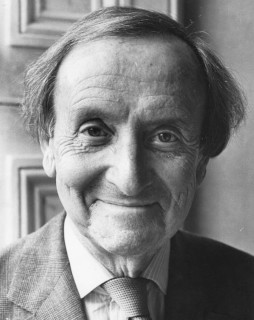
Birth of Samuel Haliday, Irish Presbyterian Minister

burning-bush

Samuel Haliday, Irish Presbyterian non-subscribing minister to the “first congregation” of Belfast, is born on July 16, 1685, in Omagh, County Tyrone, in what is now Northern Ireland. His refusal to sign the Westminster Confession of Faith leads to a split between Subscribing and Non-Subscribing adherents.

Haliday is the son of the Rev. Samuel Haliday (1637–1724), who is ordained presbyterian minister of Convoy, County Donegal, in 1664. He then moves to Omagh in 1677, leaving for Scotland in 1689, where he is successively minister of Dunscore, Drysdale, and New North Church, Edinburgh. He returns to Ireland in 1692, becoming minister of Ardstraw, where he continues until his death.

Haliday enters Glasgow College, enrolled among the students of the first class under John Loudon, professor of logic and rhetoric. He graduates M.A. and goes to Leiden University to study theology in November 1705.

In 1706 Haliday is licensed at Rotterdam and in 1708 receives ordination at Geneva, choosing to be ordained there because of its tolerance. He becomes chaplain to the 26th (Cameronian) Regiment of Foot, serving under John Churchill, 1st Duke of Marlborough in Flanders. He is received by the Synod of Ulster in 1712 as an ordained minister without charge and declared capable of being settled in any of its congregations. For some time, however, he lives in London, where he associates with the Whig faction, in and out of the government, and uses his influence to promote the interests of his fellow-churchmen. He opposes the extension of the Schism Act 1714 to Ireland. In 1718 he takes a leading part in obtaining an increase in the regium donum and the synod of Ulster thanks him. He introduces two historians, Laurence Echard and Edmund Calamy, in a London social meeting with Sir Richard Ellys, 3rd Baronet.

In 1719 Haliday is present at the Salters’ Hall debates, and in the same year receives a call from the first congregation of Belfast, vacant by the death of the Rev. John McBride. He is at this time chaplain to Colonel Anstruther’s regiment of foot. It being rumoured that he holds Arian views, the synod in June 1720 considers the matter, and clears him. His accuser, the Rev. Samuel Dunlop of Athlone, is rebuked.

On July 28, 1720, the day appointed for his installation in Belfast, Haliday refuses to subscribe the Westminster Confession of Faith, making instead a declaration to the presbytery. The presbytery proceeds with the installation, in violation of the law of the church, and in the face of a protest and appeal from four members. The case comes before the synod in 1721, but though Haliday still refuses to sign the Confession, the matter is allowed to drop. A resolution is, however, carried after long debate that all members of synod who are willing to subscribe the confession might do so, with which the majority comply. Hence arises the terms “subscribers” and “non-subscribers.” He continues to be identified with the latter until his death. A number of members of his congregation are so dissatisfied with the issue of the case that they refuse to remain under his ministry. After much opposition they are erected by the synod into a new charge.

The subscription controversy rages for years. Haliday continues to take a major part in it, both in the synod and through the press. To end the conflict, the synod in 1725 adopts the expedient of placing all the non-subscribing ministers in one presbytery, that of Antrim, which in the following year is excluded from the body.

Haliday is a lifelong friend to the philosopher Francis Hutcheson. In 1736 Thomas Drennan is installed as his colleague in Belfast. Haliday dies at the age of 54 on March 5, 1739.

(Pictured: The burning bush is a common symbol used by Presbyterian churches; here as used by the Presbyterian Church in Ireland. The Latin inscription underneath translates as “burning but flourishing”. In Presbyterianism, alternative versions of the motto are also used such as “burning, yet not consumed”.)


Leave a comment

First “Twelfth of July” Sectarian Riots in Belfast

orange-order-paradeThe first recorded “Twelfth of Julysectarian riots erupt in Belfast on July 12, 1813 as clashes break out between Orange marchers and Irish nationalists. Several Orangemen open fire on a crowd in Hercules Street, killing two Protestants and wounding four other people.

The Twelfth, also called the Glorious Twelfth or Orangemen’s Day, is an Ulster Protestant celebration held on July 12. It is first held in the late 18th century in Ulster. It celebrates the Glorious Revolution (1688) and victory of Protestant King William of Orange over Catholic King James II at the Battle of the Boyne in 1690, which begins the Protestant Ascendancy in Ireland.

On and around the Twelfth, large parades are held by the Orange Order and Ulster loyalist marching bands, streets are bedecked with British flags and bunting, and large towering bonfires are lit. Today the Twelfth is mainly celebrated in Ulster, especially in Northern Ireland where it is a public holiday, but smaller celebrations are held in other parts of the world where Orange lodges have been established. The Twelfth involves thousands of participants and spectators.

In Ulster, where about half the population is from a Protestant background and half from a Catholic background, the Twelfth has been accompanied by violence since its beginning. Orange marches through Irish Catholic and Irish nationalist neighbourhoods are usually met with opposition from residents, who see the Orange Order and its marches as sectarian, triumphalist and supremacist. This sometimes leads to violence.

The Order is also politically a unionist/loyalist organisation. Violence related to the Twelfth in Northern Ireland escalates during the 30-year ethno-political conflict known as the Troubles. The Drumcree conflict is the most well-known dispute involving Orange marches.

Attempts have recently been made to downplay the political aspects of the marches and present the Twelfth as a cultural, family-friendly event at which tourists are welcome. The majority of events pass off peacefully, however, there is a small contingency who occasionally stir up trouble.

When July 12 falls on a Sunday, as it does this year, the parades are held on the following day instead.


Leave a comment

Rioting Erupts In Belfast & Derry

belfast-rioting-1970

Intense riots between Protestants and Roman Catholics erupt in Derry and Belfast on June 27, 1970. During the evening, loyalist paramilitaries make incursions into republican areas of Belfast. This leads to a prolonged gun battle between republicans and loyalists. The rioting in both Belfast and Derry takes place despite the presence of more than 8,000 British soldiers, backed up by armored vehicles and helicopters.

The rioting follows the June 26 jailing of Bernadette Devlin, the 23‐year‐old Roman Catholic leader, who had recently been reelected to Parliament in London. She had been convicted of riotous behavior during violence in Derry in August 1969 and sentenced to six months in prison.

The rioting in Belfast begins after Catholic youths hurl stones and disrupt a parade by the militantly Protestant Orange Order. About 100 persons are injured badly enough to be treated in hospitals. A bakery and a butcher shop in a shopping center are set afire and a police station is wrecked with iron bars and clubs. The scene of the rioting is at the intersection of Mayo Street and Springfield Road in a mixed Protestant‐Catholic area.

Armed British soldiers, in visors and helmets and carrying riot shields, separate ugly, shouting mobs of Catholics and Protestants. The troops use tear gas in an effort to break up the crowd and at one point send 1,000 people, including women and children, fleeing with tears streaming down their faces.

There is civilian sniping and firing by British troops in two riot areas — the Springfield Road area and the Crumlin Road area – where rival crowds from segregated slum streets clash later in the afternoon.

At night British soldiers seal off the riot areas to all but military vehicles. Armored cars with machine guns ready stand in the streets, which are littered with glass and stones. Hundreds of soldiers in full battle dress stand against the seedy red‐brick shops and houses.

However, the crowds continue to gather. Buses are set afire, and late at night the army uses tear gas again to drive the mobs away. As rioting erupts in other parts of Belfast, 4,000 British soldiers are said to have been sent into the riot areas. The police are harassed by a half dozen fires around the city. Some of the fires are started with battery devices according to the police.

In Derry, Catholic youths attack soldiers and policemen with stones, bottles and gasoline bombs. The youths begin re‐erecting the barricades that had shielded the Catholic Bogside slum area during rioting the previous year. Ninety-two soldiers are injured and a paint shop near Bogside is set ablaze after looting by children who appear to be no more that 11 or 12 years old.

The wave of agitation begins in October 1968, when a largely Catholic civil rights movement takes to the streets to demand an end to anti‐Catholic discrimination in voting rights, jobs and housing. The Unionist Government in Belfast, which considers itself aligned with the Conservative Party in London, responds reluctantly to the street violence. However, under intense prodding by the Labor Government, it enacts many of the demanded reforms.

However, a Protestant backlash ensues, encouraged by the fiery evangelical preacher, the Rev. Ian Paisley. Paisley fans the latent fear that Northern Ireland‘s Catholics seek to unite Ireland into a Catholic state under Dublin. In the view of many observers, the Protestants have never shared power nor prestige with the Catholic minority, while the Catholics have taken an ambiguous view on whether they wanted to be British or Irish.

(From: “New Rioting Flares in Northern Ireland; 4 Dead and 100 Hurt” by John M. Lee, The New York Times, June 28, 1970)


Leave a comment

The Loughinisland Massacre

CREATOR: gd-jpeg v1.0 (using IJG JPEG v80), quality = 90

The Loughinisland massacre takes place on June 18, 1994, in the small village of Loughinisland, County Down, Northern Ireland. Members of the Ulster Volunteer Force (UVF), a loyalist paramilitary group, burst into a pub with assault rifles and fire on the customers, killing six civilians and wounding five. The pub is targeted because it is frequented mainly by Catholics. The UVF claims the attack is retaliation for the killing of three UVF members by the Irish National Liberation Army (INLA) two days earlier.

About 24 people are gathered in The Heights Bar, also known as O’Toole’s Pub, watching the Republic of Ireland vs. Italy in the 1994 FIFA World Cup. It is thus sometimes referred to as the “World Cup massacre.”

At 10:10 PM, two UVF members wearing boilersuits and balaclavas walk into the bar. One shouts “Fenian bastards!” and opens fire on the crowd with a vz. 58 assault rifle, spraying the small room with more than sixty bullets. Six men are killed outright, and five other people are wounded. Witnesses say the gunmen then run to a getaway car, “laughing.” One witness describes “bodies … lying piled on top of each other on the floor.” The dead were Adrian Rogan (34), Malcolm Jenkinson (52), Barney Green (87), Daniel McCreanor (59), Patrick O’Hare (35) and Eamon Byrne (39), all Catholic civilians. O’Hare is the brother-in-law of Eamon Byrne and Green is one of the oldest people to be killed during the Troubles.

The UVF claims responsibility within hours of the attack. It claims that an Irish republican meeting was being held in the pub and that the shooting was retaliation for the INLA attack. Police say there is no evidence the pub had links to republican paramilitary activity and say the attack is purely sectarian. Journalist Peter Taylor writes in his book Loyalists that the attack may not have been sanctioned by the UVF leadership. Police intelligence indicates that the order to retaliate came from the UVF leadership and that its ‘Military Commander’ had supplied the rifle used. Police believe the attack was carried out by a local UVF unit under the command of a senior member who reported to the leadership in Belfast.

The attack receives international media coverage and is widely condemned. Among those who send messages of sympathy are Pope John Paul II, Queen Elizabeth II and United States President Bill Clinton. Local Protestant families visit their wounded neighbours in the hospital, expressing their shock and disgust.

There have been allegations that police (Royal Ulster Constabulary) double agents or informants in the UVF were linked to the massacre and that police protected those informers by destroying evidence and failing to carry out a proper investigation. At the request of the victims’ families, the Police Ombudsman for Northern Ireland investigate the police. In 2011 the Ombudsman concludes that there were major failings in the police investigation, but no evidence that police colluded with the UVF. The Ombudsman does not investigate the role of informers and the report is branded a whitewash. The Ombudsman’s own investigators demand to be disassociated from it. The report is quashed, the Ombudsman replaced, and a new inquiry ordered.

In 2016, a new Ombudsman report concludes that there had been collusion between the police and the UVF, and that the investigation was undermined by the wish to protect informers but found no evidence police had foreknowledge of the attack. A documentary film about the massacre, No Stone Unturned, is released in 2017. It names the main suspects, one of whom is a member of the British Army and claims that one of the killers was an informer.