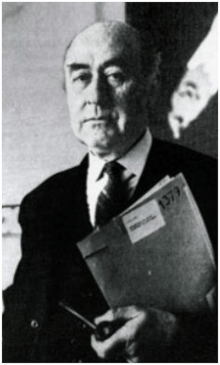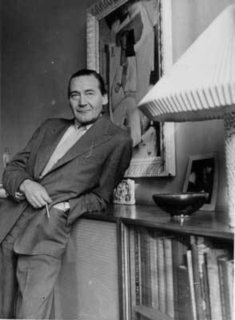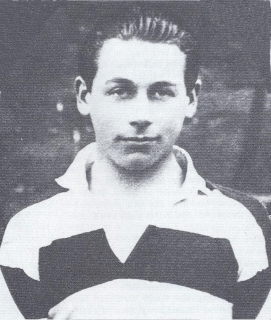
Like other literary civil servants of the period, Wall often takes a satirical view of bureaucracy. Unlike Brian O’Nolan, however, he can play the bureaucrats at their own game and by most accounts he is a highly efficient public servant in his own right. His late novel Hermitage (1982) has some sharp sidelights on the world of Green Tape.
Wall makes his mark mainly as a novelist, but he begins as a playwright and has at least two works performed in the Abbey Theatre. His first real success comes in 1946 with The Unfortunate Fursey, in which he creates a mythical monk who is tormented by the Devil. The picaresque humour and fantasy of the story are enjoyed by the public as essentially good-natured farce, but it is possible that he also intends it as oblique satire on the Irish clergy in general, at a time when any open criticism of them might invite trouble. Fergus Linehan later turns it into a successful musical.
The first Fursey book has successors, and all of them are published in a single volume in 1985, entitled The Complete Fursey. During the 1950s Wall writes two “serious” novels of social criticism, Leaves for the Burning and No Trophies Raise, in which his satirical sense takes a more direct route. They are praised at the time by respected critics and are still well worth rereading.
Apart from his writing, Wall has a distinguished career in Radio Éireann, where he and his colleagues, the novelist Francis MacManus and the poet Roibeard O Farachain, make up a literary and administrative trio nicknamed “Frank, Incense and Mer” by a staff wit. He later becomes secretary of the Arts Council, a sometimes-difficult job which he handles with tact and fairness.
Wall is himself a witty, observant, sometimes catty man in a generation famous for its wit. He and his wife Fanny, who is known as a leading music critic, are for decades an almost indispensable duo in Dublin cultural and social life, although Wall, in spite of his various public roles, is at heart a home loving and industrious man who never seeks publicity.
If and when a fullscale cultural history of Ireland in the 1940s and 1950s comes to be written, Wall’s place in it should be assured. As a successful, long term civil servant, he learned how to work the system in favour of literature and the arts in an age when patronage of them was thin on the ground.
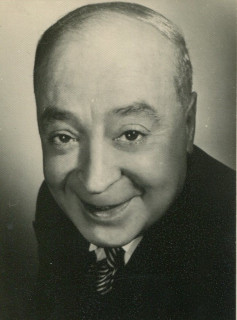
Jimmy O’Dea, Irish actor and comedian, is born at 11 Lower Bridge Street, Dublin, on April 26, 1899.
O’Dea, born James Augustine O’Dea, is one of eleven children of James O’Dea, an ironmonger, and Martha O’Gorman, who keeps a small toy shop. His father has a shop in Capel Street. He is educated at the Irish Christian BrothersO’Connell School in North Richmond Street, Dublin, where a classmate is future TaoiseachSeán Lemass, by the Holy Ghost Fathers at Blackrock College, and by the Jesuits at Belvedere College. From a young age he is interested in taking to the stage. He co-founds an amateur acting group, the Kilronan Players, in 1917, but his father will not hear of it. He is apprenticed to an optician in Edinburgh, Scotland, where he qualifies as an optician.
O’Dea returns to Dublin where, at age 21, he sets up his own business which he eventually gives to his sister, Rita. In his spare time he takes part in amateur productions of Henrik Ibsen and Anton Chekhov. From 1920 he is in the Irish theatre in Hardwicke Street working with actor-producer John MacDonagh. In 1922 he makes a series of comedy films for Norman Whitten. After working in plays by George Bernard Shaw for a few years he rejoins MacDonagh in revues, the first of which, Dublin To-Night, is produced at the Queen’s Theatre, Dublin in 1924. In 1927 he takes to the stage full-time. In 1928, the company’s first production Here We Are wins international acclaim, and in December of the same year it produces its first Christmas Pantomime, Sinbad the Sailor.
O’Dea forms a partnership with Harry O’Donovan whom he first meets in a production of You Never Can Tell in 1924. Their first show is Look Who’s Here at Queen’s Theatre. For more than two decades beginning in 1929 the duo produces two shows a year in Dublin, first in the Olympia Theatre, then in the Gaiety Theatre. They create O’Dea’s most famous character, Mrs. Biddy Mulligan. The role draws on O’Dea’s previous manifestations as “Dames” in Variety performances and pantomimes. Biddy Mulligan is the representation (caricature, parody and stereotype) of a Dublin street-seller, with all the working-class repartee, wisdom and failings implicit. He makes a number of recordings of sketches starring Mrs. Mulligan. Biddy Mulligan is referenced in many Dublin music hall songs such as “Biddy Mulligan the Pride of the Coombe,” “Daffy the Belle of the Coombe” and “The Charladies’ Ball.”
O’Dea makes some film appearances, such as Darby O’Gill and the Little People (1959) in which he plays King Brian of the little people and Johnny Nobody (1961). He also has a successful career in pantomime and tours Ireland and England many times, and is much associated with actress Maureen Potter, with whom he often partners.
O’Dea is also a prolific songwriter in his day. Many of his songs are still well known to this day, some of them having been sung and recorded by Dublin singer Frank Harte.
O’Dea marries Ursula Doyle, a theatrical impresario, in September 1959 with Seán Lemass standing in as best man and Maureen Potter as the bridesmaid. O’Dea had been best man at Lemass’s wedding in 1924.
Jimmy O’Dea dies at Dr. Steevens’ Hospital, Dublin, at age 65, on January 7, 1965. Seán Lemass, at the time Taoiseach, gives the valedictory oration at his funeral. He is buried in Glasnevin Cemetery, Dublin.
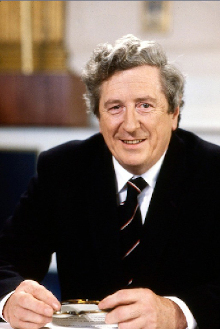
Sir James Peter Comyn, Irish-born barrister and English High Court judge, is born at Beaufield House, Stillorgan, County Dublin on March 8, 1921. Considered by many to be “the finest all-round advocate at the English bar”, he is appointed to the High Court of Justice in 1978, serving on the bench until his retirement in 1985.
Comyn is the son of Nationalist barrister James Comyn KC and of Mary Comyn. Through his father he is the nephew of the barrister Michael Comyn KC. Both his father and uncle had been political and legal advisers to Éamon de Valera, who at one point uses Beaufield House as a safe house. However, the Comyn brothers have a falling out with de Valera shortly before he comes to power in 1932, and Michael Comyn is passed over as Attorney General of the Irish Free State. As a result, James Comyn, who is then attending Belvedere College in Dublin, is sent by his father to attend The Oratory School in England. He spends six months as a trainee at The Irish Times under the editor R. M. “Bertie” Smyllie, but abandons journalism after a joke he added to an obituary is printed in the paper, leading to his demotion to the racing department.
Comyn is called to the English bar by the Inner Temple in 1942, the Irish bar in 1947, and the Hong Kong bar in 1969. In 1944, he begins his pupillage with Edward Holroyd Pearce KC, later a law lord, and joins his chambers at Fountain Court. He practises in London and on the Western circuit, supplementing his earnings by teaching banking, a subject of which he knows nothing. On one occasion, he rises in Lambeth County court to cross-examine a female defendant in an eviction case. Just as he begins by saying “Madam,” the defendant opens her bag, takes out a dead cat, and throws it at him. The judge’s reaction is to tell the defendant, “Madam, if you do that again, I’ll commit you.” Comyn wins the case.
Comyn takes silk in 1961, and acquires a large practice as a senior, appearing in many high-profile cases. In 1964, he wins damages for libel for the former safe-breaker Alfred George Hinds against a Scotland Yard inspector by convincing the jury that Hinds is in fact innocent. In 1970, he successfully defends the Labour MP Will Owen, who is accused of providing information to the Czechoslovak intelligence services. In 1975, he defeats the government’s attempt to obtain an injunction against the publication of the diaries of former minister Richard Crossman.
Comyn is Recorder of Andover between 1964 and 1971 (honorary life recorder from 1972), commissioner of assize for the Western Circuit in 1971, and a Recorder of the Crown Court between 1972 and 1977. He is elected a bencher of the Inner Temple in 1968 and serves as chairman of the Bar council from 1973 to 1974.
Having refused a previous invitation by Quintin Hogg, Baron Hailsham of St. Marylebone to join the bench, Comyn is again nominated by Elwyn Jones, Baron Elwyn-Jones, in 1977, and is appointed a High Court judge in 1978, receiving the customary knighthood upon his appointment. Initially assigned to the Family Division, he does not take to the work and is reassigned to the Queen’s Bench Division in 1979. He has a reputation for leniency in sentencing, first acquired as Recorder of Andover. In 1980–81, he presides over an unsuccessful libel action by a member of the Unification Church, colloquially known as the Moonies, against the Daily Mail, the longest libel trial in England up to that time. His Irish background makes him the target of Irish Republican Army (IRA) action, and in 1981 the Provisional IRA burns his house in Tara.
Recurring bouts of depression lead to Comyn’s early retirement, on grounds of ill health, in 1985. In retirement, he divides his time between England and Ireland, whose citizenship he has retained. He writes a number of books, including memoirs, light verse, and books on famous trials. He also breeds Friesian cattle. He dies in Navan, County Meath on January 5, 1997, at age 75.
Connell is ordained priest by Archbishop John Charles McQuaid on May 19, 1951. He takes up a teaching post at the Department of Metaphysics at the University College Dublin. He is appointed Professor of General Metaphysics in 1972 and in 1983 becomes the Dean of the Faculty of Philosophy and Sociology. The College’s Department of Metaphysics is abolished after his departure.
Connell is appointed Archbishop of Dublin by the Holy See in early 1988. He is consecrated at St. Mary’s Pro-Cathedral, Dublin on March 6, 1988. He is created Cardinal-Priest by Pope John Paul II at the Consistory in Rome on February 21, 2001, with the TitulusS. Silvestri in Capite. Archbishops of Armagh, who hold the higher title of Primate of All Ireland, are more frequently appointed Cardinal than Archbishops of Dublin. The last Archbishop of Dublin to have been a cardinal is Cardinal Edward MacCabe, who was appointed in 1882. A large Irish contingent from Church and State, along with family and friends of the Cardinal, attend the installation which for the first time takes place at the front of the entrance to St. Peter’s Basilica.
On April 26, 2004, Connell retires as archbishop, handing the diocese to the coadjutor bishop, Diarmuid Martin. All bishops submit their resignation to the Pope on their 75th birthday. Connell’s is accepted shortly after his 78th birthday.
It is Connell’s failure, when Archbishop of Dublin in 1988–2004, to address adequately the abuse scandals in Dublin that lead the Vatican to assign Archbishop Martin as his replacement in the country’s largest diocese. The Murphy Report finds that Connell had handled the affair “badly” as he was “slow to recognise the seriousness of the situation.” It does praise him for making the archdiocesan records available to the authorities in 2002 and for his 1995 actions in giving the authorities the names of 17 priests who had been accused of abuse, although it says the list is incomplete as complaints were made against at least 28 priests in the archdiocese.
From 1988 Connell also continues to insure his archdiocese against liability from complainants, while claiming to the Murphy Commission that the archdiocese is “on a learning curve” in regard to child abuse. He arranges for compensation payments to be made from a “Stewardship Trust” that is kept secret from the archdiocese’s parishioners until 2003. In 1996 he refuses to help a victim of Paul McGennis and does not pass on what he knows about McGennis to her, or to the police. He apologises for this in 2002.
Desmond Connell dies in Dublin at the age of 90 on February 21, 2017, exactly sixteen years after his creation as Cardinal.
Fay attends Belvedere College in Dublin. He works for a time in the 1890s with a touring theatre company in Ireland, Scotland, and Wales. When he returns to Dublin, he works with his brother Frank, staging productions in halls around the city. Finally, they form W. G. Fay’s Irish National Dramatic Company, focused on the development of Irish acting talent.
The brothers participate in the founding of the Abbey Theatre and are largely responsible for evolving the Abbey style of acting. After a falling-out with the Abbey directors in 1908, the brothers emigrate to the United States to work in theatre there.
Fay moves to London in 1914, working as an actor on stage and in films. One of his most notable film roles is as Father Tom in Carol Reed‘s Belfast-set Odd Man Out (1947), whose cast is dense with actors from the Abbey Theatre. His memoir, The Fays of the Abbey Theatre, appears in 1935.
Willie Fay dies in London on October 27, 1947, at the age of 74.
(Pictured: William George Fay 1903, Dublin City Council Image Galleries, http://www.dublincity.ie)
Brugha is born Charles William St. John Burgess of mixed Roman Catholic and Protestant parentage in Dublin on July 18, 1874. He attends Colmkille Schools until 1888 when he is admitted to Belvedere College. He intends to study medicine, but this does not come to fruition after his father’s business fails in 1890. He is seen as an austere figure, not very different from Éamon de Valera, and is known not to smoke cigarettes, swear or drink alcohol.
In 1899, Brugha joins the Gaelic League, and he subsequently changes his name from Charles Burgess to Cathal Brugha. He meets his future wife, Caitlín Kingston, at an Irish class in Birr, County Offaly, and they marry in 1912. The marriage produces six children. He becomes actively involved in the Irish Republican Brotherhood (IRB) and in 1913 he becomes a lieutenant in the Irish Volunteers. He leads a group of twenty Volunteers to receive the arms smuggled into Ireland in the Howth gun-running of 1914.
Brugha is second-in-command at the South Dublin Union under Commandant Éamonn Ceannt in the Easter Rising of 1916. On the Thursday of Easter Week, being badly wounded, he is unable to leave when the retreat is ordered. Brugha, weak from loss of blood, continues to fire upon the enemy and is found by Eamonn Ceannt singing “God Save Ireland” with his pistol still in his hands. He recovers over the next year but is left with a permanent limp.
Brugha proposes a Republican constitution at the 1917 Sinn Féin convention, which is unanimously accepted. In October 1917, he becomes Chief of Staff of the Irish Republican Army and holds that post until March 1919.
Brugha is elected Ceann Comhairle of Dáil Éireann at its first meeting on January 21, 1919, and he reads out the Declaration of Independence in Irish, which ratifies “the establishment of the Irish Republic.” On the following day he is appointed president of the ministry pro tempore. He retains this position until April 1, 1919, when Éamon de Valera takes his place.
Brugha has differences with Michael Collins, who, although nominally only the Irish Republican Army‘s (IRA) Director of Intelligence, has far more influence in the organisation as a result of his position as a high-ranking member of the IRB, an organisation that Brugha sees as undermining the power of the Dáil and especially the Ministry for Defence. He opposes the oath of allegiance required for membership of the IRB. In 1919, his proposition that all Volunteers should swear allegiance to the Irish Republic and the Dáil is adopted.
At a top-level IRA meeting in August 1920, Brugha argues against ambushes of Crown forces unless there is first a call to surrender, but it is dismissed as unrealistic by the brigade commanders present. He also has the idea of moving the front line of the war to England but is opposed by Collins.
On January 7, 1922, Brugha votes against the Anglo-Irish Treaty. During the Treaty debates, he points out that Collins has only a middling rank in the Department for Defence, which supervises the IRA, even though Griffith hails him as “the man who had won the war.” It is argued that, by turning the issue into a vote on Collins’ popularity, Brugha swings the majority against his own side. Frank O’Connor, in his biography of Collins, states that two delegates who had intended to vote against the Treaty changed sides in sympathy with Collins. Brugha leaves the Dáil and is replaced as Minister for Defence by Richard Mulcahy.
In the months between the Treaty debates and the outbreak of Irish Civil War, Brugha attempts to dissuade his fellow anti-treaty army leaders, including Rory O’Connor, Liam Mellows and Joe McKelvey, from taking up arms against the Free State. When the IRA occupies the Four Courts, he and Oscar Traynor call on them to abandon their position. When they refuse, Traynor orders the occupation of the area around O’Connell Street in the hope of easing the pressure on the Four Courts and of forcing the Free State to negotiate.
On June 28, 1922, Brugha is appointed commandant of the forces in O’Connell Street. The outbreak of the Irish Civil War ensues in the first week of July when Free State forces commence shelling of the anti-treaty positions.
Most of the anti-Treaty fighters under Traynor escape from O’Connell Street when the buildings they are holding catch fire, leaving Brugha in command of a small rearguard. On July 5, he orders his men to surrender, but refuses to do so himself. He then approaches the Free State troops, brandishing a revolver. He sustains a bullet wound to the leg which “severed a major artery causing him to bleed to death.” He dies on July 7, 1922, eleven days before his 48th birthday. He had been re-elected as an anti-Treaty TD at the 1922 Irish general election but dies before the Dáil assembles. He is buried in Glasnevin Cemetery in Dublin.
Garret FitzGerald succeeds Charles Haughey to become the eighth Taoiseach of Ireland on June 30, 1981. He serves in the position from June 1981 to March 1982 and December 1982 to March 1987.
FitzGerald joins Fine Gael, attaching himself to the liberal wing of the party. and in 1969 is elected to Dáil Éireann, the lower house of the Oireachtas, the Irish parliament. He later gives up his university lectureship to become Minister for Foreign Affairs in the coalition government of Liam Cosgrave (1973–1977). When the coalition government is resoundingly defeated in the 1977 Irish general election, Cosgrave yields leadership of Fine Gael to FitzGerald. In his new role as Leader of the Opposition and party leader, he proceeds to modernize and strengthen the party at the grass roots. He briefly loses power in 1982 when political instability triggers two snap elections.
By the time of the 1981 Irish general election, Fine Gael has a party machine that can easily match Fianna Fáil. The party wins 65 seats and forms a minority coalition government with the Labour Party and the support of a number of Independent TDs. FitzGerald is elected Taoiseach on June 30, 1981. To the surprise of many FitzGerald excluded Richie Ryan, Richard Burke and Tom O’Donnell, former Fine Gael stalwarts, from the cabinet.
On May 5, 2011, it is reported that FitzGerald is seriously ill in a Dublin hospital. Newly elected Fine Gael Taoiseach Enda Kenny sends his regards and calls him an “institution.” On May 6 he is put on a ventilator. On May 19, after suffering from pneumonia, he dies at the Mater Private Hospital in Dublin at the age of 85.
In a statement, Irish PresidentMary McAleese hails FitzGerald as “a man steeped in the history of the State who constantly strove to make Ireland a better place for all its people.” Taoiseach Enda Kenny pays homage to “a truly remarkable man who made a truly remarkable contribution to Ireland.” Henry Kissinger, the former United States Secretary of State, who serves as an opposite number to FitzGerald in the 1970s, recalls “an intelligent and amusing man who was dedicated to his country.”
FitzGerald’s death occurs on the third day of Queen Elizabeth II‘s state visit to the Republic of Ireland, an event designed to mark the completion of the Northern Ireland peace process that had been “built on the foundations” of FitzGerald’s Anglo-Irish Agreement with Margaret Thatcher in 1985. In a personal message, the Queen offers her sympathies and says she is “saddened” to learn of FitzGerald’s death.
On his visit to Dublin, United States PresidentBarack Obama offers condolences on FitzGerald’s death. He speaks of him as “someone who believed in the power of education; someone who believed in the potential of youth; most of all, someone who believed in the potential of peace and who lived to see that peace realised.”
FitzGerald is the author of a number of books, including Planning in Ireland (1968), Towards a New Ireland (1972), Unequal Partners (1979), All in a Life: An Autobiography (1991), and Reflections on the Irish State (2003).
Scott’s family originates in the province of Munster. His father, William Scott, is a school inspector from near Sneem on the Iveragh Peninsula in County Kerry. His mother is from County Cork. He is educated at Belvedere College in Dublin. There he first demonstrates his skills at painting and acting. Initially he wants to pursue a career as a painter, but his father points out that it might make more financial sense to become an architect.
Scott becomes an apprentice for the sum of £375 per annum to the Dublin architectural firm Jones and Kelly. He remains there from 1923 until 1926, where he studies under Alfred E. Jones. In the evenings after work, he also attends the Metropolitan School of Art and the Abbey School of Acting, and appears in many plays there until 1927, including the first productions of Seán O’Casey’s Juno and the Paycock and The Plough and the Stars. On completing his pupilage, he becomes an assistant to Charles James Dunlop and then has a brief spell as an assistant architect in the Office of Public Works.
In 1931 Scott partners with Norman D. Good to form Scott and Good, and they open an office in Dublin. They design the hospital at Tullamore (1934–1937) and Portlaoise General Hospital (1935). Between 1937 and 1938, he is the President of the Architectural Association of Ireland (AAI). He founds his company, Michael Scott Architects, in 1938. That same year he also designs his house Geragh, at Sandycove, County Dublin.
Scott’s most important pre-war commission is the Irish Pavilion for the 1939 New York World’s Fair. He produces a shamrock shaped building constructed in steel, concrete and glass. It is selected by an international jury as the best building in the show. As a result, he is presented with a silver medal for distinguished services and given honorary citizenship of the city of New York by then Mayor Fiorello H. La Guardia. Other better-known architects who design national pavilions for this World Fair include Alvar Aalto of Finland and Oscar Niemeyer of Brazil.
Scott has three major commissions from the Córas Iompair Éireann CIÉ, the Inchicore Chassis Works, the Donnybrook Bus Garage and, most famously, the Dublin Central Bus Station, to be known as àras Mhic Dhiarmada or Busáras. Though initially controversial, Busáras wins Scott the Royal Institute of the Architects of Ireland Triennial Gold Medal for Architecture.
Scott, who spends most of his life living at Sandycove Point, just south of Dún Laoghaire in south Dublin, dies in Dublin on January 24, 1989, and is buried near Sneem in County Kerry.
Campbell is educated at Belvedere College, a famous Irish rugby school in Dublin, where he is on the teams that win the Leinster Schools Rugby Senior Cup twice in a row in 1971 and 1972. He plays for Old Belvedere R.F.C. at club level and represents Leinster at provincial level, although prior to the professional era. While playing for Old Belvedere, he travels to the United States in 1978, where he plays in New York City against the Old Maroon Rugby Club.
Campbell wins a total of 22 caps for Ireland from 1976–1984, scoring 217 test points. His international career is more brief than this span suggests, however, as he plays only four full seasons for Ireland from 1980–1984. Of his career totals, he wins 22 caps and scores 182 points in the Five Nations tournament. He tours twice with Ireland, to Australia in 1979 and to South Africa in 1981.
Campbell wins his first cap for Ireland at the age of 21 against Australia in 1976, but does not secure another cap with Ireland until 1979 during Ireland’s 1979 tour to Australia. He sets an Irish record on the 1979 tour to Australia when he scors 60 points, 19 of them in Brisbane which is an Irish record for points in a match against Australia.
The defining moment in Campbell’s career comes in 1982, with Campbell as the architect-in-chief of Ireland’s 1982 Triple Crown victory, Ireland’s first since 1949. Ireland enters the tournament winless in its past eight matches. Campbell starts the 1982 Five Nations by scoring eight points in Ireland’s 20–12 win against Wales, and also playing a major hand in all three of Ireland’s tries. He then scores another eight points in the following match, a 16–15 win against England. In Ireland’s third match, he kicks all of Ireland’s 21 points, including a career best 6 penalties, against Scotland at Lansdowne Road to secure the Triple Crown. He is the leading scorer in the 1982 Five Nations with 46 points.
In the 1983 Five Nations Championship, Campbell leads Ireland to a joint Five Nations Championship shared with France. He is again the tournament’s leading scorer with 52 points, and scores 21 points against England to set an Irish record for most points against England in a Five Nations match. He plays his last match for Ireland in 1984 against Wales.
Campbell is also capped seven times for the British & Irish Lions. He earns three caps in the 1980 Lions tour to South Africa, where he is the Lions’ leading scorer in the last two tests with six and five points respectively. He earns another four caps in the 1983 Lions tour to New Zealand, where he is the Lions’ leading scorer in the four test matches with 15 points. He scores 184 points in total for the Lions.
Campbell retires from rugby in 1986 following two years of struggles with hamstring injuries. In 2007 he is presented with the Newbridge RFC Legend in Rugby Award along with the Irish Rugby Squad which won the 1982 Triple Crown and elected an Honorary Life Member of Newbridge RFC. He has worked in the family clothing business since retirement from rugby in 1984.
Old Belvedere’s sportsground on Anglesea Road in Dublin is renamed Ollie Campbell Park in his honour in 2019.
Scott is born in Drogheda on June 24, 1905. His family originates in the province of Munster. His father, William Scott, is a school inspector from near Sneem on the Iveragh Peninsula in County Kerry. His mother is from County Cork. He is educated at Belvedere College in Dublin. There he first demonstrates his skills at painting and acting. Initially he wants to pursue a career as a painter, but his father points out that it might make more financial sense to become an architect.
Scott becomes an apprentice for the sum of £375 per annum to the Dublin architectural firm Jones and Kelly. He remains there from 1923 until 1926, where he studies under Alfred E. Jones. In the evenings after work, he also attends the Metropolitan School of Art and the Abbey School of Acting, and appears in many plays there until 1927, including the first productions of Seán O’Casey’s Juno and the Paycock and The Plough and the Stars. On completing his pupilage, he becomes an assistant to Charles James Dunlop and then has a brief spell as an assistant architect in the Office of Public Works.
In 1931 Scott partners with Norman D. Good to form Scott and Good, and they open an office in Dublin. They design the hospital at Tullamore (1934–1937) and Portlaoise General Hospital (1935). Between 1937 and 1938, he is the President of the Architectural Association of Ireland (AAI). He founds his company, Michael Scott Architects, in 1938. That same year he also designs his house Geragh, at Sandycove, County Dublin.
Scott’s most important pre-war commission is the Irish Pavilion for the 1939 New York World’s Fair. He produces a shamrock shaped building constructed in steel, concrete and glass. It is selected by an international jury as the best building in the show. As a result, he is presented with a silver medal for distinguished services and given honorary citizenship of the city of New York by then Mayor Fiorello H. La Guardia. Other better-known architects who design national pavilions for this World Fair include Alvar Aalto of Finland and Oscar Niemeyer of Brazil.
Scott has three major commissions from the Córas Iompair Éireann CIÉ, the Inchicore Chassis Works, the Donnybrook Bus Garage and, most famously, the Dublin Central Bus Station, to be known as àras Mhic Dhiarmada or Busáras. Though initially controversial, Busáras wins Scott the Royal Institute of the Architects of Ireland Triennial Gold Medal for Architecture.
Scott, who spends most of his life living at Sandycove Point, just south of Dún Laoghaire in south Dublin, dies in Dublin on January 24, 1989, and is buried near Sneem in County Kerry.