seamus dubhghaill

Promoting Irish Culture and History from Little Rock, Arkansas, USA


Leave a comment

Ireland Wins the Rugby Triple Crown for First Time

Ireland wins the rugby Triple Crown for first time on March 10, 1894. In rugby union, the Triple Crown (Irish: An Choróin Triarach) is an honour contested annually by the national teams of England, Scotland, Ireland, and Wales as part of the Six Nations Championship. If any one team manages to win all their games against the other three then they win the Triple Crown.

The history of the Ireland national rugby union team begins in 1875, when Ireland plays its first international match, a 0–7 loss against England. Ireland has competed in the Six Nations (formerly known as the Five Nations and originally known as the Home Nations) rugby tournament since 1883. Ireland has also competed at the Rugby World Cup every four years since its inception.

Dublin University is the first organised rugby football club in Ireland, having been founded in 1854. The club is organised by students who have learned the game while at English public schools. During the third quarter of the nineteenth century, and following the adoption of a set of official rules in 1868, rugby football begins to spread quickly throughout Ireland, resulting in the formation of several other clubs which are still in existence, including North of Ireland F.C. (1868), Wanderers F.C. (1869), Queen’s University RFC (1869), Youghal RFC (1869), Lansdowne F.C. (1873), Dungannon RFC (1873), County Carlow F.C. (1873), University College Cork RFC (1874) and Ballinasloe RFC (1875) which amalgamates with Athlone RFC to form Buccaneers RFC.

In 1874, the Irish Football Union. reconstituted as the Irish Rugby Football Union after unification with the North of Ireland Union, is formed by Dublin University Football Club, Wanderers F.C., Engineers F.C., Lansdowne F.C., Bray, Portora, Dungannon RFC and Monaghan. Ireland loses their first test match against England 0-7 at The Oval on February 15, 1875. Both teams field twenty players in this match, as is customary in the early years of rugby union. It was not until 1877 that the number of players is reduced from twenty to fifteen. Ireland’s first home game is also against England in the same year. It is held at the Leinster Cricket Club in Rathmines as Lansdowne Road is deemed unsuitable. The first match at Lansdowne Road is held on March 11, 1878, with England beating Ireland by 2 goals and 1 try to nil.

It is not until 1881 that Ireland first wins a test, beating Scotland at Ormeau Cricket Ground in Belfast. Ireland turns up two men short for their game in Cardiff in 1884 and has to borrow two Welsh players. The first victory Ireland has at Lansdowne Road takes place on February 5, 1887. It is also their first win over England, by two goals to nil. On March 3, 1888, Ireland records their first win over Wales with a goal, a try and a drop goal to nil.

In 1894, Ireland follows the Welsh model of using seven backs instead of six for the first time. After victory over England at Blackheath, Ireland wins back-to-back matches for the first time when recording their first win over Scotland on February 24, 1894. Ireland goes on to beat Wales in Belfast on March 10, 1894, and wins the Triple Crown for the first time.

In the 1890s, rugby is primarily a game for the Protestant middle class, the only Catholic in Edmund Forrest’s 1894 team is Thomas Crean. Of the eighteen players used in the three games, thirteen are from three Dublin clubs – Wanderers, Dublin University and Bective Rangers – and the remaining five are from Ulster. They go on to win the Home international championship twice more before the century is out (1896 and 1899), so that by 1901 all four of the Home Unions have tasted success at a game that is growing in popularity with players and spectators.

(Pictured: The 1894 Ireland Rugby Union team, Kildare Observer, Irish News Archives)

Leave a comment

Birth of Karl Mullen, Rugby Union Player & Gynecologist

Dr. Karl Daniel Mullen, rugby union player and consultant gynecologist who captains the Irish rugby team and captains the British Lions on their 1950 tour to Australia and New Zealand, is born on November 26, 1926, in Courtown Harbour, County Wexford.

Mullen is one of three sons and seven daughters of Daniel Mullen, an officer of the customs and excise, and his wife Annie (née Hargrove). After his parents move to Home Farm Road, Drumcondra, Dublin, he is educated at the Dominican St. Thomas’s Academy, Eccles Street, the Jesuit Belvedere College, Great Denmark Street, and the Royal College of Surgeons in Ireland (RCSI). He plays rugby and cricket at school, association football with Home Farm F.C., and golf in the summer months. Initially a centre, he becomes a prop on the Belvedere junior cup team and, after injury to a teammate, hooker on the senior cup team, which loses the Leinster Schools Rugby Senior Cup final to Castleknock College in 1944.

On January 25, 1947, Mullen makes his formal Irish debut in a 12–8 loss to France. He plays as hooker, winning 25 caps for Ireland from 1947 to 1952. A year later, on January 31, 1948, he plays his first game for Barbarian F.C. in a 9–6 victory over Australia in Cardiff, Wales. After helping Ireland to victory over France on January 1, 1948, at the age of 21, he captains Ireland for the first time, on February 14, 1948, leading them to an 11–10 victory over England at Twickenham Stadium.

Mullen captains the Irish team to their first Grand Slam in the 1948 Five Nations Championship and is one of eight players from that team who live to see the country’s next Grand Slam in 2009.

Ireland retains the triple crown in 1949 by beating Wales 5–0 in Swansea, ending a run of defeats on Welsh soil lasting fourteen years. The following season Ireland suffers from injuries and loses to both England and Wales, the latter securing the triple crown.

Mullen is selected to captain the 1950 Lions Tour to Australia and New Zealand. After appearing in the first two tests against New Zealand, a 9–9 draw and an 8–0 loss, he sustains an ankle injury in the latter game and concedes his place to Dai Davies of Wales. Returning for the second test against Australia, a resounding 24–3 victory, he also plays in a semi-official “British Isles RFU” team against Ceylon during their return journey in September.

Under Mullen’s captaincy Ireland regains the international championship in 1951. His last cap comes in a 14–3 loss to Wales at Lansdowne Road on March 8, 1952. In twenty-five successive appearances (fifteen as captain), he secured three international championships and two triple crowns for Ireland in four seasons, their most successful haul of the twentieth century.

Mullen’s distinguished rugby career has to be fitted around his medical studies. In 1945, he enters the RCSI, graduating L and LM (RCSI and RCPI) in 1949. Awarded the diploma in obstetrics (1952) and membership of the Royal College of Obstetricians and Gynaecologists (1956), he trains at Sir Patrick Dun’s Hospital, Jervis Street Hospital and the Rotunda hospitals. After serving as senior obstetrics registrar at the Derby City General Hospital (1953–56), he returns to Dublin to become a consultant obstetrician, based at Mount Carmel Community Hospital, Churchtown, Dublin, and develops a considerable private practice. By his retirement in 2002, he is estimated to have delivered over 40,000 babies. A proponent of sex education in schools, he appears on RTÉ‘s 7 Days in December 1970, outlining various methods of birth control and calling for a more honest and realistic approach to artificial contraception.

Mullen marries Doreen Kilbride, an accomplished soprano, on April 30, 1952, in Donnybrook, Dublin, interrupting their honeymoon to play for Old Belvedere R.F.C. in the Leinster Senior Cup final. They have eight children, three boys and five girls. In 1975, they move from Altamount, Dundrum, Dublin, to Tulfarris House, Blessington, County Wicklow, adjacent to Poulaphouca Reservoir, where they farm and bred Irish draught horses. In 1985, he sells the property and much of his art collection and moves to Kilcullen, County Kildare.

Mullen is one of eight surviving members of the 1948 team to witness Ireland’s second grand slam on March 21, 2009. Only weeks later, having suffered from a long illness, he dies on April 27, 2009, at his home, Gilltown Lodge, in Kilcullen.

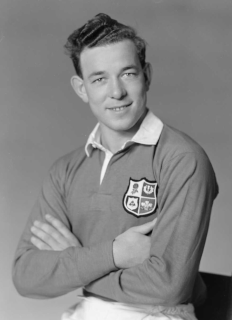
(Pictured: Karl Mullen, captain of the British Lions rugby union team, 1950)


Leave a comment

Birth of Theatre Producer Pádraig Cusack

Pádraig Cusack, Irish theatre producer who has worked with the National Theatre of Great Britain, the Abbey Theatre in Dublin, the National Centre for the Performing Arts (NCPA) in Mumbai and numerous international festivals, is born on March 16, 1962, in Dalkey, County Dublin.

Cusack, the youngest son of the Irish actor Cyril Cusack and actress Maureen Cusack, is the brother of actresses Niamh Cusack, Sinéad Cusack and Sorcha Cusack, and half-brother of Catherine Cusack. He has one brother, Paul Cusack, who is a television producer. He is married and has two daughters, Megan, an actress, who in 2020 joins the leading cast in the Netflix/BBC popular series Call the Midwife in the recurring role of Nurse Nancy Corrigan, and Kitty, a psychology student. Two of his nephews are also actors, Max Irons and Calam Lynch.

Cusack is educated bi-lingually in Irish and English, initially at Scoil Lorcáin in Monkstown, County Dublin, and subsequently at Coláiste Eoin, Booterstown, County Dublin. He is a Taylor Exhibition music scholar at Trinity College Dublin (TCD), before winning a scholarship to train to be a professional cellist at the Royal Northern College of Music in Manchester, England. In 1995, he returns to education to take a post-graduate degree in Business at University College Cork (UCC).

Having begun his career as a freelance musician, playing with the BBC Philharmonic orchestra and English National Opera North, an accident ends Cusack’s career as a musician, resulting in him pursuing a career in arts administration. Initially he focuses on the classical music sector, working at two leading concert venues in London, the Wigmore Hall and the Southbank Centre.

In 1992, Cusack makes his first move into theatre following his appointment as Administrative Director of West Yorkshire Playhouse in Leeds, alongside Jude Kelly, where he produces a number of plays including the touring production of Five Guys Named Moe for Cameron Mackintosh Limited. In 1996, he is appointed Head of Planning of the Royal National Theatre under the outgoing artistic director, Sir Richard Eyre, and subsequently with Sir Trevor Nunn and Sir Nicholas Hytner. In 2009, he becomes the National Theatre’s Associate Producer. During this period, he produces numerous productions for tour both in the UK and internationally, taking the work of the National Theatre to five continents. Alongside this, he works as a touring consultant for the Abbey Theatre in Dublin, the Royal Court Theatre, London, Fiery Angel in London’s West End, Canadian Stage in Toronto, Bangarra Dance Theatre in Sydney, TheEmergencyRoom and Corn Exchange in Dublin and Galway International Arts Festival. In June 2016, he is appointed Executive Producer of Wales Millennium Centre in Cardiff. In addition to this, he is Consultant Producer to the National Centre for the Performing Arts (India) in Mumbai.

As well as his theatre producing work, Cusack offers representation to a number of Irish artists including the director Annie Ryan, the composer Mel Mercier and the British playwright Matt Wilkinson.

In 2023, Cusack is the recipient of the Olwen Wymark Award from the Writers’ Guild of Great Britain for his championing of new writing which is presented at the 18th Annual Awards Ceremony in London.


Leave a comment

Government Imposes Temporary Ban on Livestock Marts

On Monday, February 26, 2001, the Irish Government imposes a temporary ban on the country’s 120 livestock marts as the devastating foot-and-mouth disease spreads and threatens to become an epidemic in Great Britain. Strict procedures are also implemented in airports around Ireland to keep the disease out of the country. All marts along the border counties have been suspended since the previous Friday, February 23.

Joe Walsh, the Minister for Agriculture and Food, announces the emergency measure on Sunday night. The total suspension comes into force immediately and is intended to dramatically reduce the number of livestock movements. The ban is to remain in place for at least a fortnight.

In a related move, Central Statistics Office staff undertaking survey work are instructed not to enter farm premises until further notice.

The Government orders emergency staff to ports and airports on Sunday as the foot-and-mouth outbreak nears epidemic proportions in Britain and Continental countries begin the wholesale slaughter of thousands of animals imported from the United Kingdom.

In an atmosphere of mounting alarm, the Irish Farmers’ Association demands a ban on movement of all animals including racehorses to Britain and for the thorough disinfection of “every foot and tyre” entering Ireland from the UK. Horses and horseboxes arriving at British racecourses are already being disinfected and Sunday’s meeting at Newcastle is abandoned because of its proximity to one of the affected areas. Additional measures are expected to be announced.

Irish rugby fans are asked not to travel to Cardiff on Saturday, March 3, to minimise the risk of spreading the disease, and it seems likely the Government will urge punters to stay away from the Cheltenham Festival if, indeed, the festival goes ahead as scheduled. The Jockey Club says it will follow the Government’s request, but the decision angers the British government, which may order the meeting to be cancelled.

Five new cases of the disease are confirmed in Britain on Sunday, bringing the total to 12 confirmed cases with two suspected outbreaks. The suspected outbreak of most concern to Ireland is at Welsh Country Foods, an abattoir on Anglesey. It remains cordoned off.

British Ministry of Agriculture officials continue tests on the suspect sheep found at the plant over the weekend. Final results of the tests are not available until Monday morning.

A 10-mile exclusion zone is ordered around the Gaerwen plant, which is located adjacent to the Menai Suspension Bridge. However, both exporters and the Farmers’ Union of Wales believe the foot-and-mouth virus is, in fact, present in the plant, which is located less than 15 miles from Holyhead.

British veterinarians are alarmed at the increase in new cases. An epidemic is to be declared if the number of new cases reaches more than 30 per day.

(From: “All marts closed in threat of epidemic” by Ralph Riegel, Irish Independent, http://www.independent.ie, February 26, 2001)


Leave a comment

28th Summit of the British-Irish Council

The British-Irish Council holds its 28th summit at Cathays Park, Cardiff, Wales, on November 25, 2016, and focuses on the United Kingdom‘s exit from the European Union (EU) and the Council’s Early Years policy.

The meeting is an important opportunity to discuss developments and reflect on the perspectives and priorities of all participants since the last British-Irish Council summit in July 2016. There is specific focus during the EU exit roundtable session on agriculture, agri-food and fisheries, trade, and implications of the UK’s exit from the EU.

UK government ministers also emphasize their continued commitment to work closely with all seven member administrations on the UK’s exit from the EU, using existing structures of bilateral and multilateral engagement.

Secretary of State for Wales, Alun Cairns, says, “The British-Irish Council summit is an important forum as we prepare to leave the European Union. The meeting allows us to maintain and strengthen relations between our governments and ensure we are all in the best position to face challenges and find new opportunities. It’s important to remember the UK is leaving the EU, but we are not leaving Europe. We want the best possible relationship with the EU as a whole. The eight council members will discuss issues including Brexit and provide the best opportunities for our young people as part of Early Years strategy. I look forward to some positive and constructive talks on both topics.”

Secretary of State for Northern Ireland, James Brokenshire, says, “At July’s BIC meeting we established an important commitment to maintain intensive and open dialogue and today’s sessions reflected the kind of mature cooperation that close friends and partners enjoy. There was a strong collective will to continue to work together in order to achieve the best outcomes for the people we represent. The UK wants the strongest possible economic links with our European neighbours, especially with Ireland – our nearest neighbour and the only EU member with which we share a land border. So as we forge a new relationship between the UK and Europe we must also maintain and strengthen the bonds within these islands. The BIC will continue to make a vital contribution to that effort and underlines our commitment to the structures set out in the Belfast Agreement and its successors.”

Minister at the Department for Exiting the European Union, Robin Walker, says, “As we begin the work of leaving the European Union, forums such as the British-Irish Council are an important way of maintaining close cooperation and open dialogue between our governments. This includes maintaining our special and friendly relationship with Ireland which has gone from strength to strength over many years. And we will continue to build on this strong relationship as we make a success of Brexit and maximise the opportunities for both our countries.”

A second session at the council addresses the Early Years policies of the eight administrations and welcomes the latest sector report highlighting progress since the 2012 summit. All in attendance acknowledge the critical importance of investment in early years provision in creating strong foundations for children, families and societies to thrive.

The meeting is hosted by the Welsh government, and First Minister of Wales Carwyn Jones welcomes delegation heads. In addition to the UK government ministerial team, the following representatives attend:

The British-Irish Council is a forum for discussion. It was established by the Belfast Agreement to promote positive, practical relationships among the people of the islands and to provide a forum for consultation and co-operation.

(From: “British-Irish Council Summit: Focus on EU exit and ‘Early Years’ policy” press release by the Government of the United Kingdom, http://www.gov.uk, November 25, 2016)


Leave a comment

Birth of John Buckley, Composer & Pedagogue

John Buckley, Irish composer and pedagogue, is born in Templeglantine, County Limerick, on December 19, 1951. He is a co-founder of the Ennis Summer School and a member of Aosdána, Ireland’s state-sponsored academy of creative artists.

Buckley grows up in a rural environment and is introduced to traditional music learning the button accordion from the local player Liam Moloney when he is 9 years of age. In 1969 he moves to Dublin to study for the Teacher’s Diploma at St. Patrick’s College, Drumcondra. Here he has his first opportunity to hear live classical and modern music including contemporary and avantgarde works by Irish composers including Aloys Fleischmann, Brian Boydell, John Kinsella, and Seóirse Bodley, as well as works by international composers such as Krzysztof Penderecki. He becomes a student at the Royal Irish Academy of Music, Dublin (1969–74), studying the flute with Doris Keogh and composition with A. J. Potter and James Wilson. He continues his musical studies with Alun Hoddinott in Cardiff, Wales (1978–82), Aloys Fleischmann in Cork (M.A. in composition, 1980), and briefly with John Cage during a summer school for composers and choreographers at Guildford, Surrey, in 1981. Initially working as secondary school teacher, from 1982 he is able to work independently as a composer.

In 1983, Buckley is the co-founder, with James Wilson, of the annual Ennis Summer School for composition, which becomes an influential training ground for aspiring young Irish composers; pupils include Michael Alcorn, Rhona Clarke, and Gráinne Mulvey. He becomes a member of Aosdána in 1984. Since 2001 he has been a lecturer in music at St. Patrick’s College, Drumcondra. From the National University of Ireland at Maynooth (now Maynooth University) he receives a PhD in 2002 and a DMus in 2007.

Apart from membership in Aosdána, Buckley is honoured with the Varming Prize (1976), the Macaulay Fellowship (1978), the Arts Council‘s Composers’ Bursary (1982) and the Marten Toonder Award (1991).

Buckley’s output includes many commissions for solo instruments, chamber ensembles, choirs, bands and orchestra. His music has been widely performed and broadcast in Ireland and in more than fifty countries worldwide. He has represented Ireland at the UNESCO International Rostrum of Composers on five occasions and at the 1990 Prix Italia. His music has also been performed at five International Society for Contemporary Music (ISCM) festivals.

Buckley’s music does not adhere to any particular compositional school. He acknowledges the influence of Luciano Berio, Witold Lutoslawski, György Ligeti, and Olivier Messiaen. His harmonic approach is freely atonal. Structurally, there is frequently a gradual build-up from initially very limited pitch material to large formal constructions. Many compositions work towards a climax in the fourth quarter of a piece and then return to initial pitch sequences. In a number of early works he explores the Celtic myths of his native Ireland in orchestral scores such as Taller than Roman Spears (1977) and Fornocht do chonac thú (1980) and in small-scale works such as Oileáin (1979) for piano, Boireann (1983) for flute and piano, or I am Wind on Sea (1987) for mezzo-soprano and percussion. Later this aspect becomes less important for him. Works since the late 1980s display “a textural subtlety in marked contrast to the more robust sonorities explored in Buckley’s earlier keyboard works,” a “French refinement of sound, and an elevation of timbre as central characteristics” and “a concern with achieving a greater degree of formal unity” and “an exploration of analogies between sound and light.” O’Leary (2013) describes his style as “characterised by a broad harmonic idiom, contrasting consonance and dissonance in a non-tonal but strongly coloured soundworld.”

In 2010, Buckley arranges a number of Irish traditional songs for flute, some with harp, viola, percussion and string quartet. These are skilled and tasteful settings in a tonal harmonic language, quite unlike his original compositions.


Leave a comment

Birth of Alan Quinlan, Irish Rugby Union Player

Alan Quinlan (Irish: Ailín Ó Caoindealbhain), retired Irish rugby union player, is born in Tipperary, County Tipperary, on July 13, 1974. He plays for Munster and is registered to All-Ireland League side Shannon RFC. He retires from rugby in May 2011.

Quinlan is educated at Abbey CBS in Tipperary and works for a motor dealer after leaving school. He begins his rugby career with Clanwilliam F.C. He moves from Clanwilliam to join Shannon U20s in 1994. He captains the Irish Youth Team against Scotland in 1993. He normally plays as a blindside flanker, but he also plays openside, number eight and second row for Munster.

Quinlan begins playing for Munster in 1996 and captains the youths team before becoming a regular in the first team. In May 2006 he makes a comeback from a cruciate ligament injury earlier in the season to win both the AIB League Division 1 title with Shannon and the Heineken Cup with Munster after a late appearance from the bench in the Heineken Cup Final win over Biarritz in Cardiff. He captains the side from Number Eight in Munster’s upset victory over Ulster in Ravenhill Stadium in the 2007 Celtic League. He is voted Man of the Match as Munster beats Toulouse 16–13 on May 24, 2008 to win the Heineken Cup for a second time. He is part of the squad that wins the 2008–09 Celtic League. In total he holds five league medals with Shannon, as well as two Heineken Cup medals and a Celtic League Medal with Munster. He wins his 201st cap against Leinster, equaling Anthony Foley‘s club record for caps, on October 2, 2010. He becomes Munster’s most capped player ever on October 16, 2010, against Toulon in the Heineken Cup. In the 2009–10 season he represents Munster 21 times, including all eight of their 2010 Heineken Cup matches.

In April 2011, Quinlan officially announces his retirement from professional rugby, to be effective at the end of the 2010/11 season. He plays his last game for Munster on May 6, 2011, against Connacht in the Celtic League, scoring a try to mark the end of his remarkable career and going off to a standing ovation from the Munster and Connacht supporters. He joins the Munster team at the 2011 Celtic League Grand Final trophy presentation, celebrating Munster’s 19–9 victory over old rivals Leinster in Thomond Park.

Quinlan represents Ireland ‘A’ between 1998 and 2001 and makes his senior debut for the Irish national team in October 1999, as a replacement in a test against Romania. He plays his first Six Nations match against Italy in 2001. He is a part of Ireland’s squad at the 2003 Rugby World Cup in Australia and scores two tries in the tournament before dislocating his shoulder scoring a vital try against Argentina in the pool stages, which ends his involvement. He is named in Ireland’s 2007 Rugby World Cup squad but does not make any appearances. Ireland coach Eddie O’Sullivan is widely criticised afterwards for not using his bench. Quinlan takes his caps to a total of 27 by playing in the Autumn Internationals of 2008 against Canada and the All Blacks.

On April 21, 2009, Quinlan is named in the squad for the 2009 British & Irish Lions tour of South Africa. During Munster’s Heineken cup semi-final defeat to Leinster in May 2009, he is cited for making contact with the eye or eye area of Leinster captain Leo Cullen. The offence is deemed at the low range of seriousness and he receives a 12 playing week ban until September 9, 2009. As a result, he misses the Lions tour to South Africa.

Quinlan is a co-commentator for ITV‘s coverage of the 2011 Rugby World Cup. He regularly commentates with RTÉ Sport and Sky Sports on their rugby coverage.

Quinlan marries Irish model Ruth Griffin in Tipperary during the summer of 2008. They have one son named AJ who is born in January 2009. They later split up in June 2010. He releases an autobiography, Quinlan: Red Blooded, in 2010. He is a big golf fan and supports Liverpool.


Leave a comment

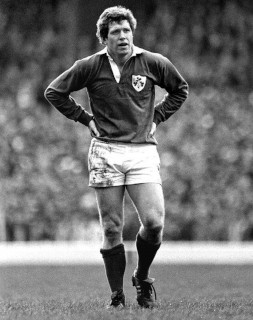
Birth of Fergus Slattery, Rugby Union Player

John Fergus Slattery, former rugby union player who represented Ireland, is born in Dún Laoghaire, the county town of Dún Laoghaire–Rathdown, on February 12, 1949.

Slattery plays club rugby for Blackrock College and University College Dublin before embarking on an international career that takes in 61 caps for Ireland, 18 as captain, and four for the British and Irish Lions. He makes his international debut in a draw against South Africa at Lansdowne Road in 1970.

In 1971, Slattery first tours with the British and Irish Lions squad that toured New Zealand, missing out on a start in the third Test due to illness. With the back-row berths claimed by John Taylor, Peter Dixon and Mervyn Davies and still being a newcomer at international level he has to wait until 1974 for his shot at a Lions Test jersey. In the meantime, he plays for the Barbarian F.C. in the famous 1973 game against the All Blacks in Cardiff.

Slattery tours with the Lions again in 1974, playing in all four Tests and captaining the side for two provincial matches. In South Africa he is an invaluable member of the touring party that comes to be known as “the invincibles.” He starts all four Tests as the Lions win the series 3-0 and skippers the side twice during midweek tour matches.

For Ireland, Slattery captains their hugely successful touring side in Australia in 1979 when they win seven of the eight matches including the two Tests in Brisbane and Sydney. In 1982 he starts all four games of Ireland’s Triple Crown season, being denied the Grand Slam by France in the final game of the Five Nations Championship.

Slattery is inducted into the International Rugby Hall of Fame in 2007.


Leave a comment

Birth of John Jordan, Poet & Writer

john-jordan

John Jordan, Irish poet, short-story writer and broadcaster, is born in the Rotunda Hospital, Dublin on April 8, 1930.

Jordan is educated at Synge Street CBS, University College Dublin (UCD) and Pembroke College, Oxford. In his teens he acts on the stage of the Gate Theatre, Dublin, before winning a Scholarship in English and French to the University of Oxford from UCD. In the mid-1950s he returns to UCD as a lecturer in English and teaches there until the end of the 1960s. He also lectures on sabbatical leave at the Memorial University of Newfoundland and briefly at Princeton University in the United States. He is a founding member of Aosdána. He is a celebrated literary critic from the late 1950s until his death on June 6, 1988, in Cardiff, Wales, where he had been participating in the Merriman Summer School.

In 1962 Jordan re-founds and edits the literary magazine Poetry Ireland in hopes of contributing towards the recreation of Dublin as a literary centre. In this journal, he introduces a number of poets who are to become quite famous later, including Paul Durcan, Michael Hartnett and Seamus Heaney. This series of Poetry Ireland lasts until 1968–69.

In 1981 Jordan becomes the first editor of the new magazine published by the Poetry Ireland Society, called Poetry Ireland Review. He serves as a reviewer of novels for The Irish Times, writes a column for Hibernia, contributes to Envoy, A Review of Literature and Art and The Irish Press among others, and serves as a TV presenter and arts interviewer. He is a defender of Gaelic literature, translates Pádraic Ó Conaire, edits The Pleasures of Gaelic Literature (Mercier Press, 1977), and champions the later plays of Seán O’Casey. His translation of one of Aogán Ó Rathaille‘s essays is published in The Pleasures of Gaelic Poetry (London: Allen Lane, 1982).

Jordan’s Collected Poems (Dedalus Press) and Collected Stories (Poolbeg Press) are edited by his literary executor, Hugh McFadden, and published in Dublin in 1991. His Selected Prose, Crystal Clear, also edited by McFadden, is published by The Lilliput Press in Dublin in 2006. His Selected Poems, edited with an introduction by McFadden, is published in February 2008 by Dedalus Press. Uncollected stories appear in Penguin Book of Irish Short Stories, Cyphers, and The Irish Press, among other places.

Jordan’s literary papers and letters are held in the National Library of Ireland. In 1953 the young Irish artist Reginald Gray is commissioned by University College Dublin to design the decor and costumes for their production of “The Kings Threshold” by William Butler Yeats. The leading role is given to Jordan. During the preparations for the production, Gray starts a portrait of Jordan, which he never finishes. This work now hangs in the Dublin Writers Museum.

(Pictured: John Jordan, by Patrick Swift, c. 1950)


Leave a comment

Final Arrival of the Concorde in Ireland

The supersonic aircraft Concorde arrives at Belfast International Airport, Aldergrove on October 21, 2003, on a farewell tour during its final week before being taken out of service.

In a final week of farewell flights around the United Kingdom, a British Airways Concorde visits Birmingham on October 20, Belfast on October 21, Manchester on October 22, Cardiff on October 23, and Edinburgh on October 24. Each day the aircraft makes a return flight out and back into Heathrow Airport to the cities concerned, often overflying those cities at low altitude. Over 650 competition winners and 350 special guests are carried.

On the evening of October 23, 2003, Queen Elizabeth II consents to the illumination of Windsor Castle as Concorde’s final west-bound commercial flight departs London and flies overhead. This is an honour normally reserved for major state events and visiting dignitaries.

British Airways retires its aircraft the next day, October 24. G-BOAG leaves New York City to a fanfare similar to her Air France predecessor’s, while two more made roundtrips, G-BOAF over the Bay of Biscay, carrying VIP guests including many former Concorde pilots, and G-BOAE to Edinburgh. The three aircraft then circle over London, having received special permission to fly at low altitude, before landing in sequence at Heathrow.

The two round-trip Concordes land at 4:01 and 4:03 PM BST, followed at 4:05 by the one from New York. All three aircraft then spend 45 minutes taxiing around the airport before finally disembarking the last supersonic fare-paying passengers. The pilot of the New York to London flight is Mike Bannister.

All of British Airway’s Concordes have been grounded, have lost their airworthiness certificates and have been drained of hydraulic fluid. Ex-chief Concorde pilot and manager of the fleet, Jock Lowe, estimates it would cost £10-15 million to make G-BOAF airworthy again. British Airways maintains ownership of the Concordes and has stated that their Concordes will not be flown again.