seamus dubhghaill

Promoting Irish Culture and History from Little Rock, Arkansas, USA


Leave a comment

Birth of Mary Leadbeater, Irish Quaker Author & Diarist

Mary Leadbeater (née Shackleton), Irish Quaker author and diarist, is born in the planned Quaker settlement of BallitoreCounty Kildare, on December 1, 1758. She writes and publishes extensively on both secular and religious topics ranging from translation, poetry, letters, children’s literature and biography. Her accounts of the Irish Rebellion of 1798 provide an insight into the effects of the Rebellion on the community in Ballitore.

Shackleton is the daughter of Richard Shackleton (1726–92) by his second wife, Elizabeth Carleton (1726–66), and granddaughter of Abraham Shackleton, schoolmaster of Edmund Burke. Her parents are Quakers. She keeps a personal diary for most of her life, beginning at the age of eleven and writing in it almost daily. There 55 extant volumes of her diaries in the National Library of Ireland.

Shackleton is educated, and her literary studies are aided by Aldborough Wrightson, a man who had been educated at Ballitore school and had returned to die there. In 1784, she travels to London with her father and pays several visits to Burke’s town house, where she meets Sir Joshua Reynolds and George Crabbe. She also goes to Beaconsfield, and on her return writes a poem in praise of the place and its owner, which is acknowledged by Burke on December 13, 1784, in a long letter. On her way home she visits, at Selby, North Yorkshire, some primitive Quakers whom she describes in her journal.

On January 6, 1791, Shackleton marries William Leadbeater, a former pupil of her father and a descendent of the Huguenot Le Batre and Gilliard families. He becomes a prosperous farmer and landowner in Ballitore. She spends many years working in the village post office and also works as a bonnet-maker and a herbal healer for the village. The couple lives in Ballitore and have six children. Their daughter Jane dies at a young age from injuries sustained after an accident with a wax taper. Another daughter, Lydia, is a friend and possible patron of the poet and novelist Gerald Griffin.

On her father’s death in 1792, Leadbeater receives a letter of consolation from Burke. Besides receiving letters from Burke, she corresponds with, among others, Maria Edgeworth, George Crabbe, and Melesina Trench. On May 28, 1797, Burke writes one of his last letters to her.

Leadbeater describes in detail the effects of the Irish Rebellion of 1798 on the lives of her family and neighbours in Ballitore. She is in Carlow on Christmas Day 1796 attending a Quaker meeting when the news arrives that the French fleet has been seen off Bantry. She describes the troops marching out of the town and the ensuing confusion in Carlow and Ballitore.

Leadbeater’s first literary work, Extracts and Original Anecdotes for the Improvement of Youth, is published anonymously in 1794 in Dublin. It contains an account of the history of Quakerism and several poems on secular and religious subjects.

In 1808, Leadbeater publishes Poems with a metrical version of her husband’s prose translation of Maffeo Vegio‘s Thirteenth Book of the Æneid. She next publishes in 1811 Cottage Dialogues among the Irish Peasantry, of which four editions, with some alterations and additions, appear by 1813. In 1813, she tries to instruct the rich on a similar plan in The Landlord’s Friend. Intended as a sequel to Cottage Dialogues, in which persons of quality are made to discourse on such topics as beggars, spinning-wheels, and Sunday in the village, Tales for Cottagers, which she brings out in 1814 in conjunction with Elizabeth Shackleton, is a return to the original design. The tales illustrate perseverance, temper, economy, and are followed by a moral play, Honesty is the Best Policy.

In 1822, Leadbeater concludes this series with Cottage Biography, being a Collection of Lives of the Irish Peasantry. The lives are those of real persons, and contain some interesting passages, especially in the life of James Dunn, a pilgrim to Lough Derg. Many traits of Irish country life appear in these books, and they preserve several of the idioms of the English-speaking inhabitants of the PaleMemoirs and Letters of Richard and Elizabeth Shackleton … compiled by their Daughter is also issued in 1822. Her Biographical Notices of Members of the Society of Friends who were resident in Ireland appears in 1823, and is a summary of their spiritual lives, with a scanty narrative of events. Her last work is The Pedlars, a Tale, published in 1824.

Leadbeater’s best known work, the Annals of Ballitore, is not printed until 1862, when it is brought out with the general title of The Leadbeater Papers (2 vols.) by Richard Davis Webb, a printer who wants to preserve a description on rural Irish life. It tells of the inhabitants and events of Ballitore from 1766 to 1823, and few books give a better idea of the character and feelings of Irish cottagers, of the premonitory signs of the rebellion of 1798, and the Rebellion itself. The second volume includes unpublished letters of Burke and the correspondence with Mrs. Richard Trench and with Crabbe.

Leadbeater dies at Ballitore on June 27, 1826, and is buried in the Quaker burial-ground there.


Leave a comment

Birth of Bernard “Barney” Hughes, Master Baker & Entrepreneur

Bernard “Barney” Hughes, master baker, entrepreneur, and liberal reformer, is born on July 8, 1808, second among eight children of Peter Hughes, probably a tradesman or labourer, and Catherine Hughes (née Quinn), of Blackwatertown, near Armagh in what is now Northern Ireland.

Hughes is brought up as a devout Roman Catholic and speaks both Irish and English fluently. He starts working at age 12 as a baker’s boy in Armagh and around 1822 tries unsuccessfully to set up his own bakery. To enhance his career prospects, he moves to Belfast in the mid-1820s and becomes a journeyman baker. He soon proves to be a highly skilled and reliable worker and in 1833 is appointed operations manager at the Public Bakery, Church Street.

Hughes is a great admirer of Daniel O’Connell and is part of the delegation that meets him when he visits Belfast in 1840. However, his employer does not share his views on liberal reform, and strained relations lead to Hughes setting up his own bakery in December 1840. At this point he must have already gained a reputation as a highly respected citizen in Belfast, as he is able to borrow £1,400 for the new factory that is built at 71 Donegall Street. This proves a wise investment, as within two years his factory produces more bread than any other bakery in the town. Demand for his loaves and his famous “Belfast bap” is fueled by the thousands of poor Catholics who migrate to the city in search of employment in the two decades before the famine.

Hughes is probably the first entrepreneur in Ireland to appreciate how machinery can create economies of scale in food production. He keeps enlarging his factory by adding ovens (using his own patent design) and dough‐mixing machines, and in 1847 opens another bakery on Donegall Place, which becomes known as the “railway bakery” on account of the rails that are used to transport raw materials by cart between various parts of the site. By using new technology, he is able to produce large quantities of consistently high‐quality bread at prices that are up to 20% cheaper than his local competitors. By 1851 he employs up to a third of those in the Belfast baking trade. He removes much of the human drudgery in the baking process, and higher productivity means that his employees can sleep at home rather than on the bakery floor. The population growth of Belfast continues to increase steeply after the famine years, and in 1858 he opens a third bakery on Divis Street, in the Falls area of the town. Distribution problems during the 1840s had convinced Hughes that he needs tighter control over all elements of the food production chain. By the 1870s his empire includes flour mills, ships to import grain, a brewery, shops, and a fleet of horse‐drawn vans.

Hughes is an enlightened employer and throughout his life he gives generously to the poor in Belfast. During the famine years of the 1840s he keeps the price of bread as low as possible, and on special days such as Christmas gives away thousands of loaves. In July 1842 he confronts a mob of up to 2,000 hungry and agitated weavers who are intent on causing damage to his bakery. He convinces them that he is a friend of the people. This is borne out by the fact that he is the largest single donor to both the Belfast Relief Committee and the Belfast Relief Fund for Ireland during the great famine. Though he is not politically ambitious, he does feel that he can use his status as one of the largest employers in Belfast and the wealthiest Catholic layman to promote the liberal cause. He is particularly appalled by the way in which the members of the conservative‐dominated council are able to indemnify themselves against the £84,000 debt which they had accrued while in office during the 1840s and 1850s.

Hughes is the first Catholic to be elected to the Belfast town council (1855–58, 1871–72) and the first Catholic alderman (1872–78). There are numerous attempts to smear his reputation, and articles in the Belfast News Letter lampoon his thick Armagh accent. As councillor he imprudently remarks on one public occasion that Belfast is “governed by Protestants, but the bone and sinew of the town is Roman Catholic.” This is seized upon by his conservative adversaries as evidence of an anti‐Protestant stance. In reality, he is always even‐handed and against any form of violent action. In his Smithfield ward there are large groups of poor Catholics and Protestants in close proximity to each other and this leads to regular disturbances. As a JP (1867–78) he urges fellow members of the Belfast Home Rule Association to avoid the tactics of the Fenians. In 1878 he is one of a group of magistrates who upholds the right of the Protestant shipyard workers to hold processions in Belfast.

Hughes’s fair mindedness sometimes brings him into collision with his more zealous Catholic friends. In 1876 he is heavily criticised for supporting the campaign to have a statue of the Rev. Henry Cooke, the Presbyterian preacher with strong anti‐Catholic views, erected in a prominent position in Belfast. He contributes funds to the Catholic Institute in Belfast, donates the site for St. Peter’s Church in 1858, and pays for the Lady Chapel. Despite his generosity, Patrick Dorrian, the coadjutor bishop of Down and Connor, vetoes a plan by the Vatican to award him a papal honour.

Hughes dies on September 23, 1878, and is buried privately at Friar’s Bush Graveyard. His son Edward, later appointed the first chairman of The Irish News at its launch in 1891, takes over the business and builds a large “model bakery” on a two‐acre site on the Springfield Road which is one of the largest and most technically sophisticated factories of its kind in Europe.

(From: “Hughes, Bernard (‘Barney’)” by Daniel Beaumont, Dictionary of Irish Biography, http://www.dib.ie, October 2009)


Leave a comment

Birth of Joseph Shanahan, Bishop for Southern Nigeria

joseph-shanahan

Joseph Ignatius Shanahan B.Sc., C.S.Sp., priest of the Congregation of the Holy Spirit (Spiritans), is born on June 6, 1871 in Glankeen, Borrisoleigh, County Tipperary. He serves as a bishop in Nigeria, first as prefect apostolic of Lower Niger and then as vicar apostolic of Southern Nigeria.

Shanahan joins the Holy Ghost Order in France in 1886, where his uncle Pat Walsh (Brother Adelm) had also joined the Holy Ghost Fathers. In 1889, he is transferred to the French Juniorate of the Congregation in Cellule in the Auvergne. He makes his profession on Easter Sunday 1898 and his ordination takes place on April 22, 1900 in the Blackrock College chapel.

By mid-July 1902, Shanahan has received his appointment for Nigeria to help Fr. Léon Lejeune make bricks to build the first proper mission house in Onitsha.

Shanahan is instrumental in the setting up of the Saint Patrick’s Society for the Foreign Missions, sometimes known as the Kiltegan Fathers, when in 1920, following his ordination in Maynooth as Bishop for Southern Nigeria (then a British protectorate), he appeals to students in Maynooth College for missionaries to Nigeria and Africa.

In 1924 Bishop Shanahan founds a missionary society for women, the Missionary Sisters of the Holy Rosary, in Killeshandra, County Cavan.

Bishop Shanahan dies at Nairobi, Kenya, on Christmas Day 1943 aged 72 years, and is initially buried in the community cemetery in St. Mary’s School in Nairobi. However, in January 1956 his remains are brought back to Nigeria for the “second burial” in the Cathedral Basilica of the Most Holy Trinity, Onitsha.

Always revered as a saint by those in close contact with him, Shanahan’s cause for Beatification is introduced officially on November 15, 1997 in Onitsha cathedral.


Leave a comment

Death of Peter Doherty, Northern Ireland Footballer

peter-doherty

Peter Dermot Doherty, Northern Ireland international footballer and manager who played for several clubs, including Manchester City F.C. and Doncaster Rovers F.C., dies in Poulton-le-Fylde, Lancashire, England on April 6, 1990.

Born in Magherafelt, County Londonderry on June 5, 1913, Doherty begins his career with Glentoran F.C. in the Irish League. After helping Glentoran to the 1933 Irish Cup, early in the 1933–1934 season he joins English club Blackpool F.C., at the age of 19. He then joins Manchester City on February 19, 1936 for a then-club record of £10,000. Blackpool needs the money urgently, and Doherty is summoned from his lunch to report to Bloomfield Road. He tries hard to persuade Blackpool directors that he does not wish to leave the club, for he is due to marry a local girl and has just bought a new house in the town. The fee is an exceptionally high transfer fee for the period, coming within £1,000 of the British record. Doherty’s Manchester City debut, against Preston North End F.C., is not a successful one. Tightly man-marked by Bill Shankly throughout, he fails to make an impact. He later describes the remainder of his first Manchester City season as “uneventful,” however his second is anything but.

Manchester City starts the 1936–1937 season poorly and are in the bottom half of the table until December. Occasional big wins, including a 6–2 defeat of West Bromwich Albion F.C. and a 4–1 defeat of Everton F.C., are mixed with extended barren runs. At one point the club gains just one win in twelve matches. However, Doherty scores goals regularly. A goal in a 5–3 Christmas day loss to Grimsby Town F.C. is his twelfth of the season. Christmas proves to be a turning point for the club, as a win against Middlesbrough F.C. the following day is the start of a long unbeaten run. By April, Manchester City is second in the table and faces a fixture against Arsenal F.C., league leaders and the dominant club of the period. Doherty scores the first goal in a 2–0 win, and City reaches the top of the table. The unbeaten run continues until the end of the season, and City secures their first league championship with a 4–1 win over Sheffield Wednesday F.C.. Doherty, with 30 league goals, is the club’s leading scorer, helped by a run of eleven goals in seven games as the season draws to a close.

Doherty scores 79 goals in 130 appearances during his time at Maine Road. During the World War II years of 1939–1945, Doherty serves in the Royal Air Force. He remains registered as a Manchester City player, scoring 60 goals in 89 wartime matches, though wartime games are not generally included in official records. He also guests for numerous clubs across the country. During a guest appearance for Port Vale F.C. in 1945, he famously goes to take a penalty but instead of shooting he lays it off to a teammate who scores.

After the conclusion of the war, Doherty transfers to Derby County F.C., with whom he wins the FA Cup, scoring a goal in the final itself. He also goes on to play for Huddersfield Town A.F.C., scoring 33 goals in 83 league appearances.

Doherty makes his final move to Doncaster in 1949, where he assumes the role of player-manager. He later becomes manager of the Northern Ireland national football team (1951–1962), for whom he has 16 caps as a player. He leads the country to the 1958 FIFA World Cup, reaching the quarter-finals. He also manages Bristol City F.C..

Doherty’s coaching techniques are revolutionary at the time. He emphasises ball practice and instead of endless laps of the pitch, suggests volleyball “to promote jumping, timing and judgement,” basketball “to encourage split-second decision-making and finding space,” and walking football “to build up calf muscles.”

Later life sees Doherty become a scout for Liverpool F.C., helping to unearth such talents as Kevin Keegan. He is inducted into the English Football Hall of Fame in 2002.

Following Doherty’s death in 1990, a plaque to mark his birthplace is placed in Magherafelt. It can be found at what is now a barber shop.


4 Comments

Birth of Philip Embury, Methodist Preacher

Philip Embury

Philip Embury, Methodist preacher and a leader of one of the earliest Methodist congregations in the United States, is born in Ballingrane, County Limerick on September 21, 1729.

Embury’s parents are members of the colony of Germans that emigrate from the Palatinate to Ireland early in the eighteenth century, and in which Methodism co-founder John Wesley labors with great success. The colony forms from refugees from the War of the Spanish Succession. Embury is educated at a school near Ballingrane and learns the carpentry trade. He is converted on Christmas day 1752, becomes a local preacher at Court-Matrix in 1758 and marries Margaret Switzer that fall.

In 1760, due to rising rents and scarce land, he goes to New York City and works as a schoolteacher. In common with his fellow emigrants, he begins to lose interest in religious matters and does not preach in New York until 1766 when, moved by the reproaches of his cousin Barbara Heck, sometimes called the “mother of American Methodism,” he begins to hold services first in his own house on Barrack Street, now Park Place, and then in a rigging loft on what is now William Street. The congregation thus forms what is probably the first Methodist congregation in the United States, though it is a disputed question whether precedence should not be given to Robert Strawbridge, who begins laboring in Maryland about this time. Before this, he and Barbara Heck worship along with other Irish Palatines at Trinity Church in Manhattan, where three of his children are baptized.

The first Methodist church is built under Embury’s charge in 1768, in association with Thomas Webb and others, on the site of the present John Street United Methodist Church. He himself works on the building as a carpenter and afterward preaches there gratuitously. In 1769, preachers sent out by John Wesley arrive in New York City, and Embury goes to work in the vicinity of Albany at Camden Valley, New York, where he continues to work at his trade during the week and preaches every Sunday. He and several others receive a grant of 8,000 acres to develop for the manufacture of linen. He organizes among Irish emigrants at Ashgrove, near Camden Valley, the first Methodist society within the bounds of what becomes the flourishing and influential Troy Conference.

Philip Embury dies suddenly in Camden, New York in August 1775, in consequence of an accident in mowing. He is buried on a neighboring farm but in 1832 his remains are removed to Ashgrove churchyard and in 1866 to Woodland cemetery, Cambridge, New York, where a monument to him is unveiled in 1873, with an address by Bishop Matthew Simpson.

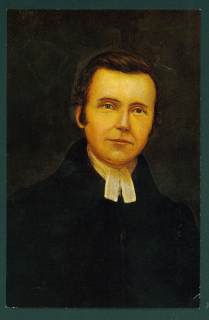
(Pictured: Portrait of Philip Embury by John Barnes, Salem, 1773)


Leave a comment

Birth of Bing Crosby

bing-crosby

Harry Lillis “Bing” Crosby Jr., American singer and actor and descendant of Irish immigrants, is born on May 3, 1903, in Tacoma, Washington. His trademark warm bass-baritone voice makes him one of the best-selling recording artists of all time, selling over one billion analog records and tapes, as well as digital compact discs and downloads around the world.

Crosby’s parents are Harry Lillis Crosby Sr. (1870–1950), a bookkeeper of English descent, and Catherine Helen “Kate” (née Harrigan; 1873–1964), a second-generation Irish American. An ancestor, Simon Crosby, emigrates to America in the 17th century, and one of his descendants marries a descendant of Mayflower passenger William Brewster.

The first multimedia star, from 1931 to 1954 Crosby is a leader in record sales, radio ratings, and motion picture grosses. His early career coincides with technical recording innovations such as the microphone. This allows him to develop a laid-back, intimate singing style that influences many of the popular male singers who follow him, including Perry Como, Frank Sinatra, Dick Haymes, and Dean Martin. Yank, the Army Weekly magazine says that he is the person who has done the most for American soldiers’ morale during World War II.

The biggest hit song of Crosby’s career is his recording of Irving Berlin‘s “White Christmas,” which he introduces on a Christmas Day radio broadcast in 1941. The song then appears in his 1942 movie Holiday Inn. His record hits the charts on October 3, 1942, and rises to No. 1 on October 31, where it stays for eleven weeks.

In 1948, American polls declare him the “most admired man alive,” ahead of Jackie Robinson and Pope Pius XII. Also in 1948, Music Digest estimates that his recordings fill more than half of the 80,000 weekly hours allocated to recorded radio music.

Crosby wins an Academy Award for Best Actor for his role as Father Chuck O’Malley in the 1944 motion picture Going My Way and is nominated for his reprise of the role in The Bells of St. Mary’s opposite Ingrid Bergman the next year, becoming the first of six actors to be nominated twice for playing the same character. In 1963, he receives the first Grammy Global Achievement Award. He is one of 33 people to have three stars on the Hollywood Walk of Fame, in the categories of motion pictures, radio, and audio recording.

Crosby influences the development of the postwar recording industry. After seeing a demonstration of an early Ampex reel-to-reel tape recorder he places a large order for their equipment and convinces ABC to allow him to tape his shows. He becomes the first performer to pre-record his radio shows and master his commercial recordings onto magnetic tape. Through the medium of recording, he constructs his radio programs with the same directorial tools and craftsmanship (editing, retaking, rehearsal, time shifting) used in motion picture production, a practice that becomes an industry standard. In addition to his work with early audio tape recording, he helps to finance the development of videotape, purchases television stations, breeds racehorses, and co-owns the Pittsburgh Pirates baseball team.

On October 13, 1977, Crosby flies alone to Spain to play golf and hunt partridge. The following day, at the La Moraleja Golf Course near Madrid, he plays 18 holes of golf. As Crosby and his party head back to the clubhouse, Crosby says, “That was a great game of golf, fellas.” At about 6:30 PM, he collapses about 20 yards from the clubhouse entrance and dies instantly from a massive heart attack. At Reina Victoria Hospital he is administered the last rites of the Catholic Church and is pronounced dead. On October 18, following a private funeral Mass at St. Paul’s Catholic Church in Westwood, he is buried at Holy Cross Cemetery in Culver City, California. A plaque is placed at the golf course in his memory.


Leave a comment

Death of Honora “Nano” Nagle, Sister John of God

honora-nano-nagle

Honora “Nano” Nagle, Sister John of God and founder of the Sisters of the Presentation the Blessed Virgin Mary, dies of tuberculosis on April 26, 1784. Her recognition as one of the greatest women of Ireland derives from dedication to the poor and oppressed. Her mission between the cutting edge of the gospel and the miseries of her day inspires the Presentation Sisters to minister in joyful service, responding to current needs throughout the world in faithfulness to the gospel.

Born to a wealthy family in Ballygriffin, just north of Killavullen, County Cork in 1718, Nagle’s parents send her to France to be educated since strict penal laws bar Catholic children from attending school in Ireland. She returns to Ireland after her father’s death in 1746. Her mother dies soon afterwards. Prayer and reflection lead Nagle back to France to become a sister.

Even as she begins her new life as a sister, Nagle’s thoughts often return to the children of the poor families back in Ireland.

At age 32, Nagle leaves the convent in France and returns to Ireland, where she secretly gathers the children of the poor and teaches them catechism, reading, writing and mathematics. As she spends her days with the children, they tell her of their sick friends or family members. She begins to visit the sick and the elderly after school, bringing them food, medicine and comfort.

Nagle often makes visits late into the night, carrying her lamp among the alleyways. Before long, she becomes known as the Lady of the Lantern.

Nagle decides to open a convent where women can share the mission of Jesus through prayer, teaching and care for the sick and needy. She and three companions open the first Presentation Convent on Cove Lane (now Douglas Street) in Cork, County Cork on Christmas Day in 1775. There she receives the habit on June 29, 1776, taking the name of Mother Mary of St. John of God. The sisters make their first annual vows on June 24, 1777.

Honora “Nano” Nagle dies from tuberculosis at the age of 65 on April 26, 1784. She leaves her compelling vision of service to a growing community of Presentation Sisters. Her final words are emblematic of her timeless legacy, and they remain a guiding principle for the Sisters: “Love one another as you have hitherto done.”

Nagle is recognized as a woman of faith, hope and heroic virtue by the Roman Catholic Church and is declared Venerable on October 31, 2013, by Pope Francis. Once evidence of an authentic miracle is attributed to her intercession with God, she acquires the title Blessed. Another miracle initiates canonization and public recognition of Nagle as a Saint.


2 Comments

The Opening of the Gaiety Theatre

The Gaiety Theatre, a theatre on South King Street in Dublin off Grafton Street and close to St. Stephen’s Green, opens on November 27, 1871 with John Spencer, the Lord Lieutenant of Ireland, as guest of honour and a double bill of the comedy She Stoops to Conquer and a burlesque version of La Belle Sauvage. Designed by architect Charles J. Phipps and built in under seven months, it specialises in operatic and musical productions, with occasional dramatic shows.

The Gaiety is extended by theatre architect Frank Matcham in 1883, and, despite several improvements to public spaces and stage changes, it retains several Victorian era features and remains Dublin’s longest-established, continuously producing theatre.

Patrick Wall and Louis Elliman purchase the theatre in 1936 and run it for several decades with local actors and actresses. They sell it in 1965, and in the 1960s and the 1970s the theatre is run by Fred O’Donovan and the Eamonn Andrews Studios, until Joe Dowling, former artistic director of the Abbey Theatre, becomes director of the Gaiety in the 1980s. In the 1990s Groundwork Productions take on the lease and the theatre is eventually bought by the Break for the Border Group. The Gaiety is purchased by music promoter Denis Desmond and his wife Caroline in the late 1990s, who undertake a refit of the theatre. The Department of Arts, Sport and Tourism also contributes to this restoration fund.

Performers and playwrights associated with the theatre have been celebrated with hand-prints cast in bronze and set in the pavement beneath the theatre canopy. These handprints include those of Luciano Pavarotti, Brendan Grace, Maureen Potter, Twink, John B. Keane, Anna Manahan, Niall Tóibín and Brian Friel.

The theatre plays host to the 1971 Eurovision Song Contest, the first to be staged in Ireland, during the Gaiety’s centenary year. Clodagh Rodgers, a contestant in that particular contest, later presents her RTÉ television series The Clodagh Rodgers Show from the theatre in the late 1970s.

The Gaiety is known for its annual Christmas pantomime and has hosted a pantomime every year since 1874. Actor and director Alan Stanford directs both Gaiety productions of Snow White and Sleeping Beauty. Irish entertainer June Rodgers stars in the Gaiety pantomime for years, until she begins to headline the equally established Olympia Theatre panto. The Gaiety shows have included Irish performers that appeal to home grown audiences, including a number of Fair City actors. Pantomimes in the 21st century have included versions of Mother Goose (2006), Beauty and the Beast (2007), Cinderella (2008), Jack and the Beanstalk (2009), Aladdin (2010), Robinson Crusoe (2011/12), Peter Pan (2013/14), Red Riding Hood (2014/15).


Leave a comment

Annie Moore Departs Queenstown for the United States

annie-moore

Fifteen-year-old Annie Moore departs Queenstown, now Cobh, County Cork, on December 20, 1891, and becomes the first immigrant to the United States to pass through the Ellis Island facility in New York Harbor.

Her parents, Matthew and Julia Moore, had come to the United States in 1888 and are living at 32 Monroe Street in Manhattan. Moore departs from Queenstown aboard the S.S. Nevada, one of 148 steerage passengers. Accompanied by her brothers, Anthony and Philip, she spends twelve days at sea, including Christmas Day, arriving in New York City on Thursday evening, December 31. It is reported that her arrival is on her 15th birthday, but records in Ireland reveal that her birthday is in May, and she is actually seventeen.

Ellis Island officially opens on January 1, 1892, and, as the first person to be processed at the newly opened facility, Moore is presented with an American $10 gold piece from an American official. All three children are soon reunited with their parents in New York. From 1820 to 1920, more than 4 million people leave their native shores of Ireland bound for the Port of New York and a new life in America.

Moore marries a son of German immigrants, Joseph Augustus Schayer, an employee at Manhattan’s Fulton Fish Market, with whom she has at least eleven children. She dies of heart failure on December 6, 1924, and is buried in Calvary Cemetery, Queens. Her previously unmarked grave is identified in August 2006. On October 11, 2008, a dedication ceremony is held at Calvary which celebrates the unveiling of a marker for her grave, a Celtic cross made of Irish Blue Limestone.

The Irish American Cultural Institute presents an annual Annie Moore Award “to an individual who has made significant contributions to the Irish and/or Irish American community and legacy.” Moore’s story is told in the song “Isle of Hope, Isle of Tears,” written by Brendan Graham. The song has been performed by Ronan Tynan and by The Irish Tenors, of which Tynan was formerly a member. Other artists performing the song include Seán Keane, Sean & Dolores Keane, Daniel O’Donnell, Celtic Thunder, Irish tenor Brian Dunphy, Celtic Woman, and Tommy Fleming.

A woman named “Annie Moore” who died near Fort Worth, Texas in 1924 had long been thought to be the one whose arrival marked the beginning of Ellis Island. Further research, however, established that the Annie Moore in Texas was born in Illinois.