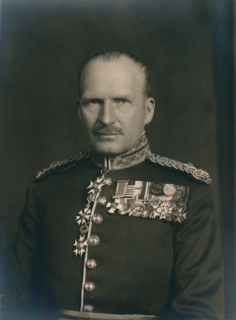
Remaining active during the interwar years, Dill serves as chief assistant to the commandant of the Staff College (1919–22) before commanding the Welsh Border Brigade, TA (1922–23), and 2nd Infantry Brigade at Aldershot (1923–26). In late 1926, he is appointed army instructor at the newly established Imperial Defence College. A period in India follows as general staff officer of the Western Command (1929–31), based at Quetta. On return to England, he is promoted to major general and made commandant of the Staff College. Appointments as commander of the British forces in Palestine and Transjordan (1936–37) and the Aldershot Command (1937–39) follow. During this period, he shows a remarkable ability to both train and inspire those under his command. Most of his colleagues expect him to become the new chief of the Imperial General Staff and are surprised when Major General Lord Gort, junior to Dill in both rank and seniority, is appointed to the post.
At the outbreak of World War II Dill commands I CorpsBritish Expeditionary Force (BEF) in France and is made a full general. In April 1940, he is made vice-CIGS and in May takes over as CIGS. His initial period in office is not a happy one, and he has to inform the public of setbacks in both Norway and France. His workload is enormous, and after the evacuation at Dunkirk in late May he devotes himself to preparing the defences of Britain against invasion. He clashes with Winston Churchill throughout 1941, advocating a more cautious and realistic approach to the situations in North Africa, Greece, and Crete.
The workload begins to affect his health adversely, and in November 1941 it is announced that he will resign as CIGS on reaching the age of 60 and serve as governor-designate of Bombay with the rank of field marshal. He seeks to be more actively involved in the war effort, however, and in December 1941 he visits the United States with Churchill, remaining there as head of the British joint staff mission in Washington, D.C. He plays a significant role in promoting Anglo–American military cooperation and attends the Casablanca, Quebec, and Tehran conferences.
Dill first marries (1907) Ada Maud Le Mottée, daughter of Col. William Le Mottée of the 18th Regiment. Their son, Major John de Guerin Dill, serves as an artillery officer throughout World War II. In October 1941, Dill marries Nancy Isabelle Charrington, widow of Brigadier Denis Walter Furlong. Dill’s honours include a GCB (1942), an honorary degree from Princeton University (1944), the Howland Memorial Prize of Yale University (1944), and a posthumous Distinguished Service Medal (DSM) from the United States government. There are portraits of him in Cheltenham College and the Imperial War Museum, and a statue in Washington, D.C.
(From: “Dill, Sir John Greer” by David Murphy, Dictionary of Irish Biography, http://www.dib.ie, October 2009 | Pictured: Sir John Greer Dill, bromide print, 1932, by Walter Stoneman, National Portrait Gallery, London)
The Darkley killings or Darkley massacre is a gun attack carried out on November 20, 1983, near the village of Darkley, County Armagh, Northern Ireland. Three gunmen attack worshippers attending a church service at Mountain Lodge Pentecostal Church, killing three Protestant civilians and wounding seven. The attackers are rogue members of the Irish National Liberation Army (INLA). They claim responsibility using the cover name “Catholic Reaction Force,” saying it is retaliation for recent sectarian attacks on Catholics by the loyalist Protestant Action Force (PAF). The attack is condemned by INLA leadership.
In the months before the Darkley killings, several Catholic civilians are killed by loyalists. On October 29, 1983, a Catholic civilian member of the Workers’ Party, David Nocher (26), is shot dead in Belfast. On November 8, Catholic civilian Adrian Carroll (24) is shot dead in Armagh. Ulster Defence Regiment (UDR) personnel are later convicted but the convictions are cleared on appeal for three of them (see UDR Four case). Carroll is the brother of an INLA member who was killed a year earlier. These attacks are claimed by the Protestant Action Force, a cover name used mostly by members of the Ulster Volunteer Force (UVF). It is believed the Darkley killings are primarily a retaliation for the killing of Carroll.
On the evening of Sunday, November 20, about sixty people are attending a church service at Mountain Lodge Pentecostal Church. The small, isolated wooden church is outside the village of Darkley, near the border with the Republic of Ireland and several miles from Armagh. As the service begins, three masked gunmen arrive, at least one of whom is armed with a Ruger semi-automatic rifle, and open fire on those standing in the entrance. Three church elders are killed: Harold Browne (59), Victor Cunningham (39) and David Wilson (44). The fatally wounded Wilson staggers into the service, where he collapses and dies. The gunmen then stand outside the building and spray it with bullets, wounding an additional seven people before fleeing in a car. The service is being tape-recorded when the attack takes place. On the tape, the congregation can be heard singing the hymn “Are You Washed in the Blood of the Lamb,” followed by the sound of gunfire. All of the victims are Protestant civilians.
In a telephone call to a journalist, a caller claims responsibility for the attack on behalf of the “Catholic Reaction Force.” He says it is “retaliation for the murderous sectarian campaign carried out by the Protestant Action Force” and adds, “By this token retaliation we could easily have taken the lives of at least 20 more innocent Protestants. We serve notice on the PAF to call an immediate halt to their vicious indiscriminate campaign against innocent Catholics, or we will make the Darkley killings look like a picnic.” The caller names nine Catholics who had been attacked.
The name “Catholic Reaction Force” had never been used before and police say they believe the attack is carried out by members of the INLA. The INLA condemn the attack and deny direct involvement, but say it is investigating the involvement of INLA members or weapons. A week later, INLA leader Dominic McGlinchey admits that one of the gunmen had been an INLA member and admits supplying him with the gun but says there is no justification for the attack. The INLA member’s brother had been killed by loyalists. McGlinchey explains that the INLA member had asked him for a gun to shoot a known loyalist who had been involved in sectarian killings. However, “clearly deranged by the death of his brother,” he “used it instead to attack the Darkley Gospel Hall.” McGlinchey says, “he must have been unbalanced or something to have gone and organised this killing. We are conducting an inquiry.”
There are reprisal sectarian attacks on Catholics in North Belfast, Lisburn, and Portadown within 24 hours of the Darkley massacre. On December 5, fifteen days after the Darkley attack, the PAF shoot dead INLA member Joseph Craven (26) in Newtownabbey.
The name “Catholic Reaction Force” is used several other times. In August 1984, it is used to issue a threat to newspapers against the families of Royal Ulster Constabulary (RUC) officers, after Sean Downes, a Catholic man, dies after the RUC shot him with a plastic bullet during an anti-internment march on the Andersontown Road, Belfast. In May 1986, it is used to claim the killing of Protestant civilian David Wilson (39), who is shot while driving his firm’s van in Donaghmore. The Irish Republican Army (IRA) also claims responsibility, saying Wilson was a member of the UDR. The “Catholic Reaction Force” declares a ceasefire on October 28, 1994. In 2001, the name is used to claim two attacks on homes in which there are no injuries, and in 2002 is used to issue a threat to hospital workers suspected of links to the security forces.
(Pictured: The Mountain Lodge Pentecostal Church at Aughnagurgan outside Darkley, County Armagh, Northern Ireland)
James Green Douglas, Irish businessman and politician dies on September 16, 1954. In 1922 he serves as the first-ever Leas-Chathaoirleach (deputy chairperson) of Seanad Éireann, the upper house of the newly independent Irish parliament. He goes on to serve in the Seanad for 30 years.
Douglas is born July 11, 1887, at 19 Brighton Square, Dublin, the eldest of nine children of John Douglas, proprietor of John Douglas & Sons Ltd, drapers and outfitters of Wexford St. and originally of Grange, County Tyrone, and his wife, Emily, daughter of John and Mary Mitton of Gortin, Coalisland, County Tyrone. The genealogy of the Douglas family to which he belongs can be traced to Samuel Douglas of Coolhill, Killyman, County Tyrone.
Douglas attends (1895–98) a small school for Quaker children and is a boarder (1898–1902) in the Friends’ School, Lisburn. In 1902 he begins a three-year apprenticeship in his father’s business.
On February 14, 1911, Douglas marries Georgina (Ena) Culley (1883–1959), originally of Tirsogue, Lurgan, County Armagh, whom he meets during his apprenticeship. Their children are John Harold Douglas, who succeeds to the family busines and replaces his father as senator, and James Arthur Douglas, who becomes a well-known architect.
From an early age Douglas is fascinated by politics and influenced by the newspapers edited by Arthur Griffith. He becomes a member of the Dublin Liberal Association, whose members for the most part are Protestanthome rulers. After the 1916 Easter Rising, with George Russell and others, who also regard themselves as neither unionists nor nationalists, he sets out to promote what they term “full dominion status” for Ireland. This paves the way for the Irish Convention (1917–18), which, however, fails to reconcile the polarised political attitudes of the time.
Douglas goes on to become a very active member of Seanad Éireann between 1922 and 1936 under the constitution he had helped to prepare. In 1922, he is elected as the first vice-chairman of the Senate. The Senate is abolished in 1936 and re-established under the terms of the 1937 Constitution of Ireland. He is again an active Senator between 1938 and 1943, and from 1944 to 1954. The topics most associated with him during his work as Senator are international refugees and the League of Nations.
For some thirty years he runs the family business, and is also a director of Aspro (Ireland) Ltd, Nugent & Cooper Ltd, Philips Lamps (Ireland) Ltd, and the Greenmount & Boyne Linen Co. Ltd. In addition, he serves as president of the Linen and Cotton Textile Manufacturers Association and as a member of the council of the Federated Union of Employers.
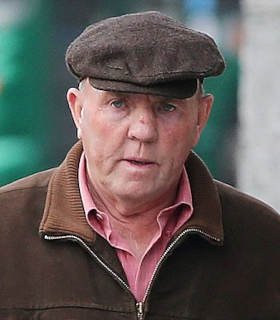
Accused by The Sunday Times of directing an IRA bombing campaign in Britain, in 1987 Murphy unsuccessfully sues the paper for libel in Dublin. The original verdict is overturned by the court of appeal because of omissions in the judge’s summing up and there is a retrial, which he also loses. At the retrial, both Sean O’Callaghan and Eamon Collins, former members of the Provisional Irish Republican Army, testify against Murphy, as do members of the Gardaí, Irish customs officials, British Army and local TDBrendan McGahon. Collins, who had also written a book about his experiences, Killing Rage, is beaten and killed by having a spike driven through his face near his home in Newry eight months later. In 1998, a Dublin court dismisses Murphy’s case after a high-profile trial, during which Murphy states that he has “never been a member of the IRA, no way” and claims not to know where the Maze prison is located. The jury rules, however, that he is an IRA commander and a smuggler.
The Sunday Times subsequently publishes statements given by Adrian Hopkins, the skipper who ferries weapons from Libya to the IRA, to the French authorities who intercept the fifth and final Eksund shipment. Hopkins details how Murphy met a named Libyan agent in Greece, paid for the weapons to be imported, and helped unload them when they arrived in Ireland. According to A Secret History of the IRA by Ed Moloney, Murphy has been the IRA Army Council’s chief of staff since 1997. Toby Harnden’s Bandit Country: The IRA & South Armagh also details Murphy’s IRA involvement.
On September 20, 2016, the BBC‘s Spotlight airs a programme in which an alleged British spy who had infiltrated the IRA claims that in 2006, Murphy had demanded the killing of Denis Donaldson, an IRA member and British informer, in order to maintain discipline. The BBC says it had tried to contact Murphy but had received no reply. He has yet to respond to the allegation. On September 23, 2016, the Donaldson family’s solicitor says that the allegation is “absolute nonsense.”
In October 2005, officers of the British Assets Recovery Agency and the Irish Criminal Assets Bureau carry out raids on a number of businesses in Manchester and Dundalk. It is extensively reported in the media that the investigation is aimed at damaging the suspected multi-million-pound empire of Murphy, who according to the BBC’s Underworld Rich List, has accumulated up to £40 million through smuggling oil, cigarettes, grain and pigs, as well as through silent or partial ownership in legitimate businesses and in property.
A large, purpose-built underground chamber that Gardaí believes the IRA used for interrogation is discovered close to Murphy’s home.
In his first-ever press release, issued on October 12, 2005, Murphy denies he owned any property and denies that he had any links with co-accused Cheshire businessman Dermot Craven. Furthermore, he claims that he had to sell property to cover his legal fees after his failed libel case against The Sunday Times, and that he made a living from farming.
On March 9, 2006, police, soldiers and customs officials from both sides of the Irish border launch a large dawn raid on Murphy’s house and several other buildings in the border region. Three persons are arrested by the Gardaí but are released three days later. A fleet of tankers, computers, documents, two shotguns, more than 30,000 cigarettes and the equivalent of 800,000 euros in sterling bank notes, euro bank notes and cheques are seized. Four diesel laundering facilities attached to a major network of storage tanks, some of which are underground, are also found. The Irish Criminal Assets Bureau later obtains seizure orders to take possession of euro cash and cheques and sterling cash and cheques, together worth around one million Euros.
Sinn Féin President Gerry Adams makes a public statement in support of Murphy following the March 2006 raids. Under political and media pressure over allegations of the IRA’s continued presence in South Armagh, Adams says, “Tom Murphy is not a criminal. He’s a good republican and I read his statement after the Manchester raids, and I believe what he says and also and very importantly he is a key supporter of Sinn Féin’s peace strategy and has been for a very long time.” He adds, “I want to deal with what is an effort to portray Tom Murphy as a criminal, as a bandit, as a gang boss, as someone who is exploiting the republican struggle for his own ends, as a multimillionaire. There is no evidence to support any of that.”
Murphy is arrested in Dundalk, County Louth, on November 7, 2007, by detectives from the Criminal Assets Bureau, on charges relating to alleged revenue offences. The following day, he is charged with tax evasion under the Tax Consolidation Act. He is later released on his own bail of €20,000 with an independent surety of €50,000.
On October 17, 2008, in an agreed legal settlement, Murphy and his brothers pay over £1 million in assets and cash to the authorities in Britain and the Republic in settlement of a global crime and fraud investigation relating to proceeds of crime associated with smuggling and money laundering. After an investigation involving the Irish Criminal Assets Bureau and the UK’s Serious Organised Crime Agency, more than 625,000 euros (£487, 000) in cash and cheques is confiscated by the Republic’s courts, while nine properties in North West England worth £445,000 are confiscated by British courts. Murphy is still fighting a claim in the Republic’s courts for tax evasion, relating to non-completion of tax returns for eight years from 1996. On April 26, 2010, he is further remanded on bail.
In 2011, there are claims that Murphy had become disillusioned with the Northern Ireland peace process and that he had fallen out with Sinn Féin. However, there is no evidence to support he is sympathetic to any dissident republican groups. In March 2013, the Garda and the Police Service of Northern Ireland (PSNI), along with members of the Irish Customs Authority and HM Revenue and Customs (HMRC), raid his farm on the Louth-Armagh border. The Sunday World reports that two hours prior to the raid, at approximately 4:00 a.m., fire is seen coming from Murphy’s yard. There are serious concerns within the Garda and PSNI that a mole may have tipped off Murphy about the raid hours earlier as laptops, computer disks and a large amount of documentation is destroyed in the fires. As a result, an internal Garda investigation takes place.
On December 17, 2015, Murphy is found guilty on nine charges of tax evasion by a three-judge, non-jury Special Criminal Court trial sitting in Dublin, lasting nine weeks. He is tried under anti-terrorist legislation due to the belief by the Director of Public Prosecutions (DPP) that there would not be a fair trial because of the potential of the intimidation of prosecution witnesses and jurors, and the security surrounding the trial.
Murphy is found guilty on all charges of failing to furnish tax returns on his income as a “cattle farmer” between 1996 and 2004. He is prosecuted following a 14-year-long Criminal Assets Bureau investigation, which during a raid of his property uncovers bags with more than €250,000 and more than £111,000 sterling in cash, along with documents, diaries and ledgers. He is remanded on bail until early 2016 for sentencing.
On February 26, 2016, Murphy is sentenced to 18 months in prison. None of the jail term is suspended. Following sentencing, he is immediately transferred from court to Ireland’s highest-security prison, Portlaoise Prison, reserved for terrorists, dissident republicans and serious gangland criminals, under a heavily armed Garda and Irish Army escort due to security concerns.
Murphy appeals the conviction in November 2016. His lawyer, John Kearney, claims that the tax Murphy had not paid had in fact been paid by his brother, Patrick. The Court of Appeal dismisses the appeal on all grounds in January 2017.
Murphy is an active Irish republican paramilitary from his late teens. In March 1972, he is arrested in Dundalk regarding an assault and is sentenced to two years in prison after the Garda Síochána find a loaded revolver in his car. He is imprisoned in the Curragh Camp but escapes in October 1972 and is not recaptured until May 1973. In June 1976, he is imprisoned again, receiving a three-year sentence for firearms offences and a one-year sentence for Provisional Irish Republican Army membership, both sentences to run concurrently. In July 1983, he is arrested in the United States after attempting to buy a consignment of M60 machine guns to be shipped to Ireland for use by the Irish National Liberation Army (INLA). He receives a five-year prison sentence but returns to Ireland in December 1985 after being released early.
In the late 1980s, Murphy begins investing in property and forms a company named Emerald Enterprises in 1990. He purchases the Emerald Bar public house in Dundalk for IR£100,000, and it later becomes a meeting place for dissident republicans. Other investments included 30 acres of land in Drogheda bought for IR£52,000 in 1995, and his company wins contracts for an IR£11 million development at Dublin City University (DCU) and the multi-million-pound International Financial Services Centre in the Dublin Docklands.
Murphy is arrested by the Gardaí on February 21, 1999, for questioning under anti-terrorist legislation. On February 24, he becomes the first person to be charged in connection with the Omagh bombing, when he appears before Dublin‘s Special Criminal Court and is charged with conspiring to cause an explosion under the terms of Ireland’s Offences Against the State Act, between August 13-16, 1998. He is also charged with membership in an illegal organisation, the Real Irish Republican Army (RIRA).
On October 10, 2000, the BBC television show Panorama names Murphy as one of four people connected with the Omagh bombing, along with Seamus Daly and Liam Campbell. In 2001, he undertakes legal action against the BBC and Daily Mail publishers Associated Newspapers for contempt of court. The action against Associated Newspapers is settled on July 31, 2001, and the newspaper releases a statement saying Murphy is entitled to be presumed innocent of the charges against him until proven guilty.
Murphy’s trial begins at Special Criminal Court in Dublin on October 12, 2001. The court hears that Murphy had supplied two mobile phones which were used during the bombing. One witness, Murphy’s second cousin, retracts his evidence and the judge calls the conduct of two detectives outrageous, saying they had persistently lied under cross-examination. Despite this, on January 22, 2002, he is convicted of conspiring to cause the Omagh bombing, and on January 25 is sentenced to 14 years imprisonment with the judge describing him as a long-time republican extremist.
On January 21, 2005, Murphy’s conviction is overturned and a new trial ordered, due to the invasion of Murphy’s presumption of innocence, and alteration of Gardaí interview notes and evidence presented by two officers. A week later, his legal case against the BBC is resolved, with the BBC issuing a statement that Murphy “was fully entitled to maintain his innocence of the charges against him and to test the evidence against him at his trial.”
On October 23, 2006, two Gardaí officers are found not guilty of perjuring themselves during Murphy’s trial. On May 23, 2007, it is announced that Murphy is suffering from short-term memory loss resulting from a car accident in 1988. His lawyers attempt to prevent a retrial taking place, on the grounds that his condition interferes with his right to a fair hearing. The Court of Criminal Appeal is scheduled to hear his case again in October 2008. Following a retrial held in January 2010, he is acquitted on February 24, 2010.
In 2009, Murphy is one of four men found by a civil court to be liable for the Omagh bombing in a case taken by relatives of the victims. On July 7, 2011, in Belfast High Court, Lord Justice Malachy Higgins directs a retrial of the civil claims against Murphy. He questions evidence surrounding emails from U.S. undercover agent David Rupert while overturning the judgment on Murphy. The paucity of the email evidence, the lack of consistency in the emails or at least ambiguity, the possibility of initials referring to someone other than Murphy and the fact that they refer on occasions to double hearsay considerably weaken the emails as evidence, he says. Following a civil retrial on March 20, 2013, Murphy and Seamus Daly are found liable for involvement in the bombing.
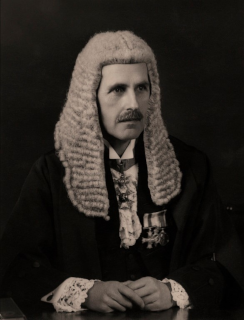
Armstrong is the second surviving son of William Jones Wright Armstrong of County Armagh and Frances Elizabeth, widow of Sir Michael McCreagh, and daughter of Major Christopher Wilson. He is educated at The Royal School, Armagh and Trinity College, Cambridge, gaining a BA (2nd Class Law Tripos) in 1867 and an MA in 1870. Admitted at the Inner Temple in 1866, he is called to the Bar in 1868.
In 1883, Armstrong marries Margaret Leader, daughter of William Leader of Rosnalea, County Cork. They have five sons and three daughters, of whom C. W. Armstrong also becomes a politician.
Armstrong is returned unopposed to the House of Commons of the United Kingdom for Mid Armagh in a by-election in 1921, at the advanced age of 76, becoming one of the oldest first-time MPs whose birth date is recorded. Certainly, he immediately becomes the oldest member of the current House of Commons. He is a Senator of Northern Ireland from 1921 to 1937, and Lord Lieutenant of Armagh from 1924 to 1939. For 25 years he is a member of the Representative Body of the Church of Ireland. He is Chairman of the County Armagh Education Committee from 1925 to 1931, and President of the Association of Education Committees of Northern Ireland. In 1932 he is made a Privy Councillor for Northern Ireland, and in 1938 he serves as a Justice for the Government of Northern Ireland in the absence of the Governor.
Armstrong dies at the age of 99 on December 4, 1943, at his home in Dean’s Hill, County Armagh.
At the outbreak of war in 1939, Stronge joins the North Irish Horse as a lieutenant but has to relinquish his commission the following year due to ill health. He is then granted the rank of captain. Resuming his political career, he becomes Assistant Parliamentary Secretary at the Ministry of Finance (Assistant Whip) (1941–42) and then Parliamentary Secretary at the Ministry of Finance (Chief Whip) (1942–44). His period as Chief Whip is marked by more robust and “fluid” debate within the party and significant backbench discontent in early 1943. In June 1944 he is elected chairman of Armagh County Council, and in the following year is returned unopposed in the general election. He becomes Speaker of the House of Commons of Northern Ireland in 1945 and in this position he earns the respect of, and makes friends with, politicians of every hue, and is regarded as a moderating influence. It has been said of him that he disproved the myth that politicians at Stormont never spoke to each other. He is unopposed in every postwar election up to 1965, when he sees off the challenge of the Liberal candidate. He does not contest the 1969 general election. He is made Chevalier of the Order of Leopold in 1946 and in the same year is appointed to the Privy Council of Northern Ireland. A member of the Commonwealth Parliamentary Association, he is a delegate to its 1950 conference in New Zealand. Another interest is the Royal Over-Seas League, of which he is president for a time.
Stronge is closely associated with Sir Basil Brooke, Dame Dehra Parker and Sir Henry Mulholland. He is president of the Northern Ireland area council of the Royal British Legion, sovereign grand master of the Royal Black Institution, president of the Federation of Boys’ Clubs, and chairman of the Commercial Insurance Co. and of the Central Advisory Council for the Employment of the Disabled. It is this last position that causes a brief interruption of his speakership, with an act of parliament deemed necessary to remove any doubt about it having been an office of profit. A prominent member of the Orange Order, he is also chairman of the BBC appeals advisory committee and the Northern Ireland scout council. His retirement from public life in 1977 is marked by his investiture as a Knight of Grace by Prince Richard, Duke of Gloucester.
A leading member of the Church of Ireland, Stronge becomes Commander of the Order of Saint John in 1952 and is for many years on the Armagh diocesan synod and council. Until his death, he is a nominator for the position of rector and reads the lessons each Sunday morning in Tynan parish church. In September 1921 he marries Gladys Olive, daughter of Major Henry Thomas Hall of Knockbrack, Athenry, County Galway. They have three daughters and a son, James. In his later life he lives with James, a bachelor, on their 800-acre estate near the border. James is educated at Eton College and Christ Church, Oxford. He succeeds his father in the Mid Armagh constituency in 1969, serving as Ulster Unionist MP in the Stormont parliament until 1972. He is firmly opposed to the Sunningdale Agreement of December 1973, which he describes as a “great act of political appeasement.” Although both are known in the locality, neither seeks public attention and both live relatively quiet lives. Stronge likes to work in the garden but has little interest in the farm, most of which is let out to tenants.
Stronge and his son become prominent victims of the Troubles when a unit of the Provisional Irish Republican Army shoots them dead on January 21, 1981, at Tynan Abbey and sets the mansion alight, destroying it. The Provisional IRA statement describes them as “symbols of hated unionism” and their killings as “direct reprisal for a whole series of loyalist assassinations and murder attacks on nationalist people.” The killings come five days after an attempted assassination of the former MP Bernadette Devlin McAliskey and her husband. Tynan Abbey is long held to have been an easy target, given its relative isolation and its proximity to the border. In 1985 a man is tried for their murders but is acquitted. In 1999 the shell of Tynan Abbey is demolished.
(From: “Stronge, Sir Charles Norman Lockhart” by Tom Feeney, Dictionary of Irish Biography, http://www.dib.ie, October 2009)
The Plantation of Ulster is the organised colonisation, or plantation, of the Irish province of Ulster by people from Great Britain during the reign of King James I. Most of the settlers, or planters, come from southern Scotland and northern England. Their culture differs from that of the native Irish. Small privately funded plantations by wealthy landowners begin in 1606, while the official plantation begins in 1609. Most of the colonised land had been confiscated from the native Gaelic chiefs, several of whom had fled Ireland for mainland Europe in 1607 following the Nine Years’ War against English rule. The official plantation comprises an estimated half a million acres of arable land in counties Armagh, Cavan, Fermanagh, Tyrone, Donegal, and Coleraine. Land in counties Antrim, Down, and Monaghan is privately colonised with the king’s support.
Among those involved in planning and overseeing the plantation are King James, the Lord Deputy of Ireland, Arthur Chichester, and the Attorney-General for Ireland, John Davies. They see the plantation as a means of controlling, anglicising, and “civilising” Ulster. The province is almost wholly Gaelic, Catholic, and rural and has been the region most resistant to English control. The plantation is also meant to sever Gaelic Ulster’s links with the Gaelic Highlands of Scotland. The colonists, or “British tenants,” are required to be English-speaking, Protestant and loyal to the king. Some of the undertakers and settlers, however, are Catholic. The Scottish settlers are mostly PresbyterianLowlanders and the English mostly Anglican Northerners. Although some “loyal” natives are granted land, the native Irish reaction to the plantation is generally hostile, and native writers bewail what they see as the decline of Gaelic society and the influx of foreigners.
The Plantation of Ulster is the biggest of the Plantations of Ireland. It leads to the founding of many of Ulster’s towns and creates a lasting Ulster Protestant community in the province with ties to Britain. It also results in many of the native Irish nobility losing their land and leads to centuries of ethnic and sectarian animosity, which at times spills into conflict, notably in the Irish Rebellion of 1641 and, more recently, the Troubles.
Russell is born on April 10, 1867, in Lurgan, County Armagh, in what is now Northern Ireland. He writes with the pseudonym Æ (often written AE or A.E.). He is also a writer on mysticism, and a central figure in the group of devotees of theosophy which meets in Dublin for many years. He takes his pseudonym from a proofreader’s query about his earlier pseudonym, “AEon.”
Russell is the second son of Thomas Russell and Mary Armstrong. His father, the son of a small farmer, becomes an employee of Thomas Bell and Co., a prosperous firm of linen drapers. The family relocates to Dublin, where his father has a new offer of employment, when he is eleven years old.
Following his time at the Metropolitan School of Art, Russell becomes an accounts clerk in a drapery store but leaves in 1897 to organize agricultural cooperatives. Eventually he becomes editor of the periodicals Irish Homestead (1905–23) and The Irish Statesman (1923–30). In 1894 he publishes the first of many books of verse, Homeward: Songs by the Way, which establishes him in what is known as the Irish Literary Revival. His first volume of Collected Poems appears in 1913 and a second in 1926. He maintains a lifelong interest in theosophy, the origins of religion, and mystical experience. Candle of Vision: Autobiography of a Mystic (1918) is the best guide to his religious beliefs.
At the turn of the 20th century, Russell is considered by many to be the equal of Yeats, but he does not continue to grow and develop as Yeats does. He is prolific and versatile, but many critics find his poetry facile, vague, and monotonous, with “rather too much of the Celtic Twilight” in it.
Russell, who had become increasingly unhappy in the Irish Free State which, according to Yeats, he called “a country given over to the Devil,” moves to England soon after his wife’s death in 1932. Despite his failing health he goes on a final lecture tour in the United States but returns home utterly exhausted. He dies of cancer in Bournemouth, England, on July 17, 1935. His body is brought back to Ireland, and he is interred in Mount Jerome Cemetery, Dublin.
The bombing takes place at a time when the Northern Ireland Office arranges multi-party talks, known as the Brooke/Mayhew talks, on the future of Northern Ireland. Sinn Féin members are not invited to attend because of their links with the IRA, which prevents them from being recognised as a “constitutional” party. The talks end in failure soon after.
Built in 1972, the barracks house two companies of the 2nd Battalion, Ulster Defence Regiment (UDR). Seen as an outpost, it sits on the dividing line between a Protestant area and a Catholic area. Although the military barracks itself had not been attacked by the IRA previously, seven UDR soldiers from the base had already been killed during the Troubles.
At 11:30 PM, a driverless truck loaded with 2,500 lb (1,100 kg) of a new type of homemade explosive is rolled down a hill at the rear of the barracks and crashes through the perimeter fence. According to a witness, a UDR lance corporal who alerts the base, the truck is a Mercedes, and a Toyota HiAce van carrying at least two men acts as a support vehicle. The men are seen outside the parked van, masked and armed, one with a handgun and the other with a submachine gun. This same witness alerts the base believing the IRA team are about to carry out a mortar attack, and debris thrown up on the roof by the lorry as it plunges down the hill is misinterpreted by some inside the base as a mortar projectile. Automatic fire is heard by other witnesses just before the main blast. A Reuters report claims that IRA members trigger the bomb by firing upon the driverless vehicle. It is later determined that the lorry had been stolen the day before in Kingscourt, County Cavan, in the Republic of Ireland.
The blast leaves a crater 200 ft. (61 m) deep and throws debris and shrapnel as far as 300 yards (270 m). The explosion can be heard over 30 miles (48 km) away, as far as Dundalk. This is the biggest bomb detonated by the IRA up to this point. Most of the UDR base is destroyed by the blast and the fire that follows. At first, a massive mortar attack is suspected. Some livestock are killed and windows broken around the nearby Mossfield housing as a result of the explosion. The cars parked outside the base are obliterated. Ceilings are brought down and the local primary school is also damaged.
The barracks is usually manned by eight soldiers, but at the time there are 40 people in the complex, attending a social event. Three UDR soldiers – Lance Corporal Robert Crozier (46), Private Sydney Hamilton (44) and Private Paul Blakely (30) – are killed and ten are wounded. Two of them are caught by the explosion when they come out to investigate after a sentry gives the alarm. A third dies inside the base. Four civilians are also wounded. The Provisional IRA claims responsibility two days later.
The base is never rebuilt. It had outlived its operational usefulness and a decision had already been taken to close it down. The decision not to rebuild the compound raises some controversy among unionists. A memorial stone is erected by the main entrance road with the names of the UDR soldiers killed over the years while serving in Glenanne.







 seamus dubhghaill