Having joined the Civil Service in 1952, Bloomfield is appointed Permanent Secretary to the power sharing executive in 1974. After the collapse of the executive, he goes on to become Permanent Secretary for the Department of the Environment and the Department of Economic Development, and finally Head of the Northern Ireland Civil Service on December 1, 1984. In that capacity he is the most senior advisor to successive Secretaries of State for Northern Ireland and other Ministers on a wide range of issues. He retires from the post in April 1991.
Since retiring from the Civil Service, Bloomfield has embarked on a life of involvement in a diverse range of organisations. He has taken up roles such as Chairman for the Northern Ireland Legal Services Commission and his alma mater, the Royal Belfast Academical Institution. He has also been involved in the political reform of the States of Jersey and spearheaded the Association for Quality Education, which is fighting to retain academic selection in the Northern Ireland education system. In December 1997 he is asked by the Secretary of State for Northern Ireland, Mo Mowlam, to become the Northern Ireland Victims Commissioner for a fixed term. His role is to produce a report on the way forward for Victims issues in Northern Ireland. His report entitled We Will Remember Them is published in April 1998. From 1991 to 1999 he serves as the BBC‘s National Governor for Northern Ireland.
Living in the nationalist Beechmount neighbourhood of the Falls, he stands for the Falls as a candidate for the Dock Labour Party in a city council by-election in 1956, but loses to Paddy Devlin of the Irish Labour Party, who later becomes his close ally. In 1958, he is elected to Belfast City Council as a member of the Irish Labour Party.
Many sympathetic British Members of Parliament (MPs) are present at a civil rights march in Derry on October 5, 1968, when Fitt and others are beaten by the Royal Ulster Constabulary. Fitt also supports the 1969 candidacy of Bernadette Devlin in the Mid Ulster by-election who runs as an anti-abstentionist ‘Unity‘ candidate. Devlin’s success greatly increases the authority of Fitt in the eyes of many British commentators, particularly as it produces a second voice on the floor of the British House of Commons who challenge the Unionist viewpoint at a time when Harold Wilson and other British ministers are beginning to take notice.
In August 1970, Fitt becomes the first leader of a coalition of civil rights and nationalist leaders who create the Social Democratic and Labour Party (SDLP). By this time Northern Ireland is charging headlong towards near-civil war and the majority of unionists remain hostile.
After the collapse of Stormont in 1972 and the establishment of the Northern Ireland Assembly in 1973 Fitt becomes deputy chief executive of the short-lived Power-Sharing Executive created by the Sunningdale Agreement.
Fitt becomes increasingly detached from both his own party and also becomes more outspoken in his condemnation of the Provisional Irish Republican Army. He becomes a target for republican sympathisers in 1976 when they attack his home. He becomes disillusioned with the handling of Northern Ireland by the British government. In 1979, he abstains from a crucial vote in the House of Commons which brings down the Labour government, citing the way that the government had failed to help the nationalist population and tried to form a deal with the Ulster Unionist Party.
In 1979, Fitt is replaced by John Hume as leader of the SDLP and he leaves the party altogether after he agrees to constitutional talks with British Secretary of StateHumphrey Atkins without any provision for an ‘Irish dimension’ and then sees his decision overturned by the SDLP party conference. Like Paddy Devlin before him, he claims the SDLP has ceased to be a socialist force.
In 1981, he opposes the hunger strikes in the Maze prison in Belfast. His seat in Westminster is targeted by Sinn Féin as well as by the SDLP. In June 1983, he loses his seat in Belfast West to Gerry Adams, in part due to competition from an SDLP candidate. The following month, on October 14, 1983, he is created a UK life peer as Baron Fitt, of Bell’s Hill in County Down. His Belfast home is firebombed a month later and he moves to London.
Gerry Fitt dies in London on August 26, 2005, at the age of 79, after a long history of heart disease.
Chesney is a son of Captain Alexander Chesney, an Irishman of Scottish descent who, having emigrated to South Carolina in 1772, serves under Lord Francis Rawdon-Hastings (afterwards Marquess of Hastings) in the American War of Independence, and subsequently receives an appointment as coast officer at Annalong, County Down, where Chesney is born.
Lord Rawdon gives Chesney a cadetship at the Royal Military Academy, Woolwich, and he is gazetted to the Royal Artillery in 1805. Although he rises to be lieutenant-general and colonel-commandant of the 14th brigade Royal Artillery (1864), and general in 1868, Chesney’s memory lives not for his military record, but for his connection with the Suez Canal, and with the exploration of the Euphrates valley, which starts with his being sent out to Constantinople in the course of his military duties in 1829, and his making a tour of inspection in Egypt and Syria. In 1830, after taking command of 7th Company, 4th Battalion Royal Artillery in Malta, he submits a report on the feasibility of making a Suez Canal. This is the original basis of Ferdinand de Lesseps’ great undertaking. In 1831 he introduces to the home government the idea of opening a new overland route to India, by a daring and adventurous journey along the Euphrates valley from Anahto the Persian Gulf. Returning home, Acting Lt. Colonel Chesney busies himself to get support for the latter project, to which the East India Company’s board is favourable. In 1835 he is sent out in command of a small expedition, on which he takes a number of soldiers from 7th Company RA and for which Parliament votes £20,000, in order to test the navigability of the Euphrates.
After encountering immense difficulties, from the opposition of the Egyptian pasha, and from the need of transporting two steamers, one of which is subsequently lost, in sections from the Mediterranean Sea over the hilly country to the river, they successfully arrive by water at Bushirein the summer of 1836, and prove Chesney’s view to be a practical one. In the middle of 1837, Chesney returns to England, and is given the Royal Geographical Society’s gold medal, having meanwhile been to India to consult the authorities there. The preparation of his two volumes on the expedition, published in 1850, is interrupted by his being ordered out in 1843 to command the artillery at Hong Kong.
In 1847, his period of service is completed, and he goes home to Ireland, to a life of retirement. However, in 1856 and again in 1862 he goes out to the East to take a part in further surveys and negotiations for the Euphrates valley railway scheme, which, however, the government does not take up, in spite of a favourable report from the House of Commons committee in 1871. In 1868 Chesney publishes a further volume of narrative on his Euphrates expedition.
In 1869, Lesseps greets him in Paris as the “father “ of the canal. Francis Rawdon Chesney dies at the age of 82 in Mourne, County Down, on January 30, 1872.
Joseph Tomelty, Irish character actor and playwright, is born at Portaferry, County Down, on March 5, 1911. He works in film, television, radio, and on the stage, starring in Sam Thompson‘s 1960 play Over the Bridge.
Tomelty is the eldest of seven children. His father is known as “Rollickin’ James” for his skill on the fiddle. He leaves his local primary school at the age of 12 and is apprenticed to the trade of housepainter, his father’s trade. He moves to Belfast and attends classes at Belfast Technical College.
Tomelty first acts with St. Peter’s Players and with others in 1937 and 1938 takes part in discussions which lead to the formation of the Northern Ireland Players on a more professional basis. Radio plays Barnum is Right and Elopement are broadcast in December 1938 and February 1939 respectively. The Northern Ireland Players choose the stage version of Barnum is Right for their first major commercial venture at the Empire Theatre in June 1939.
In 1940 the Northern Ireland Players join forces with the Ulster Theatre and the Jewish Institute Dramatic Society to form the Group Theatre. In 1942 Tomelty becomes its general manager remaining in the post until 1951. His play, Idolatry at Innishargie, enjoys a short run at the Group Theatre in 1942, but The End House, a controversial political play, does not even appear there. The play deals with what he describes as “the inhumanity that resulted from the Special Powers Act.” It is however performed at the Abbey Theatre in Dublin in 1944.
Meanwhile, his career as a character actor rapidly develops and a successful stage and film career is underway. In 1948 he is commissioned by the BBC in Belfast to write the weekly radio comedy drama series The McCooeys. This radio series lasts for seven years with Tomelty writing 6,000 word scripts for each episode. He continues to write plays, including his masterpiece, and a modern Irish theatre classic, All Souls’ Night in 1948.
In 1954 Tomelty is injured in an automobile accident while filming Bhowani Junction in England and, while he recovers, he is never as productive again. He dies in Belfast on June 7, 1995.
Since the beginning of its campaign, the IRA has carried out numerous attacks on economic targets, killing many members of the public in the process. The IRA’s goal is to harm the economy and cause disruption, which will put pressure on the British government to withdraw from Northern Ireland.
On February 17, 1978, an IRA unit plants an incendiary device attached to petrol-filled canisters on meat hooks outside the window of the Peacock Room in the restaurant of the La Mon House Hotel. The IRA often give bomb warnings in advance of destroying property but never when targeting the police or military. After planting the bomb, the IRA members attempt to send a warning from the nearest public telephone but find that it has been vandalised. On the way to another telephone, they are delayed again when forced to stop at an Ulster Defence Regiment (UDR) checkpoint. By the time they are able to send the warning, only nine minutes remain before the bomb detonates at 21:00. The blast creates a fireball, killing twelve people and injuring thirty more, many of whom are severely burned. Many of the injured are treated in the Ulster Hospital in nearby Dundonald. A 2012 news article claims that the IRA were targeting Royal Ulster Constabulary (RUC) officers they believed were meeting in the restaurant that night. The article claims that the IRA had gotten the wrong date and that the meeting of RUC officers had taken place exactly one week earlier.
The day after the explosion, the IRA admits responsibility and apologises for the inadequate warning. The hotel had allegedly been targeted by the IRA as part of its firebomb campaign against commercial targets. However, the resulting carnage brings quick condemnation from other Irish nationalists, with one popular newspaper comparing the attack to the 1971 McGurk’s Bar bombing. Sinn Féin president Ruairí Ó Brádaigh also strongly criticises the operation. In consequence of the botched attack, the IRA Army Council gives strict instructions to all units not to bomb buses, trains, or hotels.
A team of 100 RUC detectives is deployed in the investigation. As part of the investigation, 25 people are arrested in Belfast, including Gerry Adams. Adams is released from custody in July 1978. Two prosecutions follow. One Belfast man is charged with twelve murders but is acquitted. He is convicted of IRA membership but successfully appeals. In September 1981, another Belfast man, Robert Murphy, is given twelve life sentences for the manslaughter of those who died. Murphy is freed on licence in 1995. As part of their bid to catch the bombers, the RUC passes out leaflets which display a graphic photograph of a victim’s charred remains.
In 2012, a news article claims that two members of the IRA bombing team, including the getaway driver, are British double agents working for MI5. According to the article, one of the agents is Denis Donaldson. That year, Northern Ireland’s Historical Enquiries Team (HET) completes a report on the bombing. It reveals that important police documents, including interviews with IRA members, have been lost. A number of the victims’ families slam the report and call for a public inquiry. They claim the documents had been removed to protect certain IRA members. Unionist politician Jim Allister, who has been supporting the families, says, “There is a prevalent belief that someone involved was an agent and that is an issue around which we need clarity.”
James (Jim) Larkin, Irish trade union leader and socialist activist, is born to Irish parents in Liverpool, England, on January 21, 1876. He and his family later move to a small cottage in Burren, County Down. Growing up in poverty, he receives little formal education and begins working in a variety of jobs while still a child.
In 1905, Larkin is one of the few foremen to take part in a strike on the Liverpool docks. He is elected to the strike committee, and although he loses his foreman’s job as a result, his performance so impresses the National Union of Dock Labourers (NUDL) that he is appointed a temporary organiser.
Larkin moves to Belfast in 1907 to organise the city’s dock workers for the NUDL. He succeeds in unionising the workforce, and as employers refuse to meet the wage demands, he calls the dockers out on strike in June. Carters and coal men soon join in, the latter settling their dispute after a month.
In 1908, Larkin moves south and organises workers in Dublin, Cork, and Waterford, with considerable success. His involvement, against union instructions, in a dispute in Dublin results in his expulsion from the NUDL. The union later prosecutes him for diverting union funds to give strike pay to Cork workers engaged in an unofficial dispute. After trial and conviction for embezzlement in 1910, he is sentenced to prison for a year. This is widely regarded as unjust, and the Lord Lieutenant of Ireland, Lord Aberdeen, pardons him after he has served three months in prison.
After his expulsion from the NUDL, Larkin founds the Irish Transport and General Workers’ Union (ITGWU) at the end of December 1908. The organisation exists today as the Services Industrial Professional & Technical Union (SIPTU). In early 1909, Larkin moves to Dublin, which becomes the main base of the ITGWU and the focus of all his future union activity in Ireland.
In early 1913, Larkin achieves some successes in industrial disputes in Dublin. Two major employers, Guinness and the Dublin United Tramway Company, are the main targets of Larkin’s organising ambitions. The chairman of the Dublin United Tramway Company, industrialist and newspaper proprietor William Martin Murphy, is determined not to allow the ITGWU to unionise his workforce. On August 15, he dismisses 40 workers he suspects of ITGWU membership, followed by another 300 over the next week. On August 26, 1913, the tramway workers officially go on strike.
The resulting industrial dispute is the most severe in Ireland’s history. Employers in Dublin engage in a sympathetic lockout of their workers when the latter refuses to sign the pledge, employing blackleg labour from Britain and from elsewhere in Ireland. Guinness, the largest employer in Dublin, refuses the employers’ call to lock out its workers but it sacks 15 workers who struck in sympathy.
For seven months the lockout affects tens of thousands of Dublin workers and employers, with Larkin portrayed as the villain by Murphy’s three main newspapers, the Irish Independent, the Sunday Independent, and the Evening Herald, and by other bourgeois publications in Ireland. The lock-out eventually concludes in early 1914 when calls by James Connolly and Larkin for a sympathetic strike in Britain are rejected by the British Trades Union Congress (TUC). Larkin’s attacks on the TUC leadership for this stance also lead to the cessation of financial aid to the ITGWU.
Some months after the lockout ends, Larkin leaves for the United States. He intends to recuperate from the strain of the lockout and raise funds for the union. Once there he becomes a member of the Socialist Party of America and is involved in the Industrial Workers of the World union (the Wobblies). He becomes an enthusiastic supporter of the Soviet Union and is expelled from the Socialist Party of America in 1919 along with numerous other sympathisers of the Bolsheviks during the Red Scare of that year.
Upon his return to Ireland in April 1923, Larkin receives a hero’s welcome and immediately sets about touring the country meeting trade union members and appealing for an end to the Irish Civil War. In September 1923, Larkin forms the Irish Worker League (IWL), which is soon afterwards recognised by the Communist International as the Irish section of the world communist movement.
James Larkin dies in his sleep on January 30, 1947, in the Meath Hospital. Fr. Aloysius Travers, OFM, who had administered last rites to James Connolly in 1916, also administers extreme unction to Larkin. His funeral mass is celebrated by the Catholic Archbishop of Dublin, John Charles McQuaid, who had visited him in hospital before he died, and thousands line the streets of the city as the hearse passes through on the way to Glasnevin Cemetery.
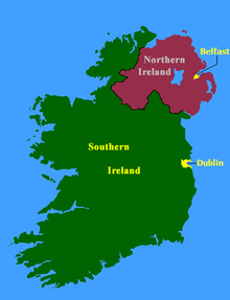
The Act is intended to establish separate Home Rule institutions within two new territories of Ireland – the six northeastern counties of Antrim, Armagh, Down, Fermanagh, Londonderry, and Tyrone are to form “Northern Ireland,” while the remaining 26 counties of the country are to form “Southern Ireland.” Each territory is to be self-governing, except in areas specifically reserved to the Parliament of the United Kingdom such as defence, foreign affairs, international trade, and currency. Provision is made for their future reunification under common Home Rule institutions.
Home Rule never takes effect in Southern Ireland due to the Irish War of Independence, which results instead in the Anglo-Irish Treaty and the establishment in 1922 of the Irish Free State. However, the institutions set up under this Act for Northern Ireland continue to function until they are suspended by the British parliament in 1972 as a consequence of the Troubles.
At the time of Stearne’s birth, his grand-uncle, James Ussher, is Bishop of Meath. His father, John Stearne of Cambridge, who settled in County Down and married Mabel Bermingham, a niece of Ussher, is remote relation of Archbishop Richard Sterne.
Stearne enters Trinity College, Dublin at the age of fifteen in 1639, and obtains a scholarship in 1641. On the outbreak of the Irish Rebellion of 1641, Stearne leaves for England, and in 1643 goes to Cambridge, where he studies medicine at Sidney Sussex College, and collects material for his first work, Animi Medela. He remains at Cambridge about seven years, and then spends some time at Oxford, where he is welcomed by Seth Ward, then fellow of Wadham College. He is elected a fellow of Trinity College, Dublin in 1643, a position from which he is ejected by order of the Rump Parliament. Upon his return to Ireland in 1651 he is restored to his fellowship by Henry Cromwell, with whom he is on good terms, and to whom he dedicates one of his books.
In 1656 Stearne is appointed the first Hebrew lecturer in Trinity College, Dublin, receiving the degree of M.D. in 1658, and that of LL.D. in 1660. In 1659 he resigns his fellowship but is appointed to a senior fellowship in 1660, after the Restoration, receiving a dispensation from the statutes of the university respecting celibacy. He becomes in the same year professor of law. During his tenure of these various offices, Stearne practises as a physician in Dublin, obtaining special permission to reside outside the walls of the college.
Stearne is best known as the founder of the Irish College of Physicians. In 1660 he proposes to the university that Trinity Hall, situated in Back Lane, Dublin, then affiliated to the university, of which he has been constituted president in 1654, should be a college of physicians. The arrangement is sanctioned, and Stearne, on the nomination of the provost and senior fellows of Trinity College, in whom the appointment is vested, becomes its first president. No students are to be admitted who do not belong to Trinity College.
In 1662 Stearne is appointed for life professor of medicine in the university. In 1667 a charter is granted to the College of Physicians, under which a governing body of fourteen fellows is constituted, of whom Sir William Petty is one, with Stearne at their head as president for life.
Stearne dies in Dublin on November 18, 1669, and is buried, by his own request, in the chapel of Trinity College, where his epitaph, by his friend Henry Dodwell the elder, describes him as Philosophus, Medicus, summusque Theologus idem.
In 1922, Walton wins scholarships to Trinity College, Dublin for the study of mathematics and science. He is awarded bachelor’s and master’s degrees from Trinity in 1926 and 1927, respectively. Walton receives seven prizes for excellence in physics and mathematics, including the Foundation Scholarship in 1924. Following graduation he is awarded an 1851 Research Fellowship from the Royal Commission for the Exhibition of 1851 and is accepted as a research student at Trinity College, Cambridge, under the supervision of Sir Ernest Rutherford, Director of Cambridge University’s Cavendish Laboratory. At the time there are four Nobel Prize laureates on the staff at the Cavendish lab and a further five are to emerge, including Walton and John Cockcroft. Walton is awarded his PhD in 1931 and remains at Cambridge as a researcher until 1934.
During the early 1930s, Walton and John Cockcroft collaborate to build an apparatus that splits the nuclei of lithiumatoms by bombarding them with a stream of protons accelerated inside a high-voltage tube. The splitting of the lithium nuclei produces helium nuclei. This is experimental verification of theories about atomic structure that have been proposed earlier by Rutherford, George Gamow, and others. The successful apparatus, a type of particle accelerator now called the Cockcroft-Walton generator, helps to usher in an era of particle-accelerator-based experimental nuclear physics. It is this research at Cambridge in the early 1930s that wins Walton and Cockcroft the Nobel Prize in physics in 1951.
Walton is associated with the Dublin Institute for Advanced Studies for over 40 years, serving long periods on the board of the School of Cosmic Physics and on the Council of the Institute. Following the 1952 death of John J. Nolan, the inaugural chairman of the School of Cosmic Physics, Walton assumes the role, and serves in that position until 1960, when he is succeeded by John H. Poole.
Although he retires from Trinity College Dublin in 1974, he retains his association with the Physics Department at Trinity up to his final illness. His is a familiar face in the tea-room. Shortly before his death he marks his lifelong devotion to Trinity by presenting his Nobel medal and citation to the college. Ernest Walton dies in Belfast on June 25, 1995, aged 91. He is buried in Dean’s Grange Cemetery, Dún Laoghaire–Rathdown.
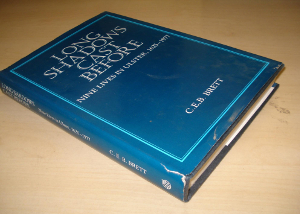
Brett is born into a long line of solicitors, the family firm being L’Estrange and Brett, based in Belfast. He is a partner there from 1954 until 1994. He is educated at Rugby School and New College, Oxford, where he is President of the Poetry Society and a friend of Dylan Thomas and attends lectures by Lord Clark.
Between 1949 and 1950 he works in France as a journalist with the Continental Daily Mail, where he is said to have mixed in anarchist and Trotskyite circles.
In 1956, the Earl of Antrim invites Brett to join the Northern Ireland Committee of the National Trust. On finding there are no books written to prepare himself for this, he resolves to write the necessary volumes. In 1957 he becomes the first chairman of the Ulster Architectural Heritage Society, founded alongside, amongst others Lady Dunleath. Brett serves as chairman for ten years and then as President from 1979 until his death.
With the National Trust he puts his legal skill to use in order to establish a public footpath along the cliffs of the North Coast of Ulster. He also sits on the board of the Irish Architectural Archive in Dublin.
In 1971, he is appointed to the board of the newly created Northern Ireland Housing Executive. He serves as Chairman for five years from 1979, during which time 50,000 dwellings are built. He is asked to compile a list of historic buildings in Jersey in 1975. In 1986, Brett becomes the first chairman of the International Fund for Ireland, established to encourage investment in Ireland.
Brett is also involved in Northern Irish politics, being chairman of the Northern Ireland Labour Party for a time. In 1981 he receives a CBE, this is followed by a Knighthood in 1990.
Brett dies on December 19, 2005. His church memorial is located along those of his family in the Comber Church of Ireland Parish Church of St. Mary, in Comber, North County Down.