seamus dubhghaill

Promoting Irish Culture and History from Little Rock, Arkansas, USA


Leave a comment

Death of Mary Carryl, Servant of the Ladies of Llangollen

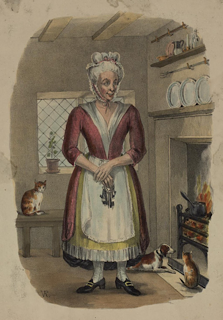
Mary Carryl, an Irish-born loyal servant and friend of the celebrated Ladies of Llangollen, dies on November 22, 1809. She serves them up to her death. When the Ladies die, they share the same grave.

Carryl is brought up in a poor family in RossCounty Wexford. Little is known about her until she is employed by Lady Elizabeth “Betty” and Sir William Fownes, 2nd Baronet, at the Woodstock Estate near InistiogeCounty Kilkenny. He inherits the baronetcy from his father Sir William Fownes, 1st Baronet, the Lord Mayor of Dublin, and over 21,000 acres from his grandfather. When Fownes marries Elizabeth Ponsonby, he receives £4,000 as a dowry and the couple builds the six-bayed, three-story Woodstock House in County Kilkenny in 1745-47. In 1769, the Fownes have a thirteen-year-old guest to stay for some time named Sarah Ponsonby, who is Elizabeth’s cousin and the orphaned daughter of Chambré Brabazon Ponsonby. She attends school at Kilkenny.

Sarah develops a friendship with Eleanor Butler, which is not approved of by the Fownes nor by Eleanor’s family guardians. When the friendship begins, Sarah is an unhappy thirteen-year-old orphan. She is captivated by the well-educated Eleanor Butler, a 30-year-old spinster no longer considered marriageable. Sarah is also receiving unwanted attention from Sir William, her guardian.

When Eleanor Butler runs away from home, she is hidden in Sarah’s room and Carryl smuggles in food for her stowaway. Eventually Butler and Ponsonby agree that they can leave Ireland together. They go to Llangollen in Wales where they set up home in a cottage called Plas Newydd. Meanwhile Carryl, who is known as Mary the Bruiser, has been fired after throwing a candlestick that wounds another servant. Her prospects are saved when Eleanor and Sarah send for her to come to Llangollen.

In time Eleanor and Sarah become notorious as “The Ladies of Llangollen,” and Carryl becomes both their servant and the head of the household. She is loyal to her employers. She is said to have “masculine qualities” and Lady Eleanor’s diary records how she gives as good as she gets as she bargains loudly with the fishermen, the butchers and the inebriated.

The lifestyle of the Ladies of Llangollen attracts attention. They receive notable visitors including the Arthur Wellesley, 1st Duke of Wellington; the poets William Wordsworth and Anna Seward; enlightenment leaders Erasmus Darwin and Josiah Wedgwood; and writers including Sir Walter Scott.[3]

Carryl dies at Plas Newydd on November 22, 1809, and is buried in the churchyard of St. Collen’s Church, Llangollen. She leaves a shilling to her brother and sister, but leaves the field she owns to Sarah. When in time the Ladies of Llangollen die, they are buried beside their faithful servant.

The memorial monument to Mary Carryl, Eleanor Butler and Sarah Ponsonby in the churchyard of St. Collen’s Church is erected in 1810. The inscription on Carryl’s part of the monument reads: “In Memory of / Mrs Mary Carryl / Deceased 22 November 1809 / This monument is erected by Eleanor Butler, / and Sarah Ponsonby, of Plasnewydd in this Parish. / Released from Earth and all its transient woes, / She whose remains beneath this stone repose, / Stedfast in Faith resigned her parting breath, / Looked up with Christian joy, and smiled in Death! / Patient, Industrious, Faithful, Generous, Kind, / Her Conduct left the proudest far behind, / Her Virtues dignified her humble birth, / And raised her mind above this sordid earth, / Attachment (Sacred bond of grateful breasts) / Extinguished but with life, this Tomb attests, / Reared by Two Friends who will her loss bemoan, / ‘Till with Her Ashes…Here shall rest, Their own.”

(Pictured: A portrait of Mary Carryl from the Welsh Portrait Collection at the National Library of Wales)


Leave a comment

Birth of Nora Twomey, Animator, Director & Screenwriter

Nora Twomey, Irish animator, director, screenwriter, producer and voice actress, is born on October 31, 1971, in Cork, County Cork. She is best known as the co-founder of Cartoon Saloon, alongside Tomm Moore and Paul Young, an animation studio and production company, based in Kilkenny, County Kilkenny.

Twomey is educated at St. Mary’s Secondary School in Midleton, County Cork but leaves before completing the Leaving Certificate at the age of fifteen. She does manual labor at a local factory but continues to draw and briefly studies fine art before she is admitted to Ballyfermot Senior College in Dublin to their School of Animation program on the basis of her portfolio. In the factory she operates a conveyor belt for up to twelve hours on end during the night shift. She credits this period of her life to much of her success, as she wears headphones to drown out the loud noise of machinery, the silence combined with the monotony of the task she performs allows her to ponder concepts and generate ideas, many of which are put to film later in her life.

After graduating from Ballyfermot Senior College in 1995, Twomey begins to work for Brown Bags Film, an animation studio in Dublin. In 1999, she helps found Cartoon Saloon, along with Tomm Moore, Paul Young and Ross Murray. In 2002, she directs the award-winning short animated film From Darkness. The short film has no dialogue and is based on an Inuit folk tale where a man helps a woman with only a skeleton for a body to regenerate. She also works on the successful animated TV series Skunk Fu!.

Twomey goes on to write and direct the animated short Cúilín Dualach (Backwards Boy), released in 2004. Based on a story by Jackie Mac Donacha, a boy with his head on backwards finds only love and acceptance in his mother and has to work to gain that from the rest of his community but most of all his father.

Twomey co-directs, with Tomm Moore, The Secret of Kells, an animated feature film as well as doing additional voice acting for the film. The film is set in 9th century Ireland, at the time when the Book of Kells is written. In it, a 12-year-old orphan boy living at a monastery has the task of finishing a book with the art of illumination. The film premieres at the Berlin International Film Festival in February 2009. The Secret of Kells is nominated in the category of Best Animated Feature Film at the 82nd Academy Awards.

Twomey continues to work on feature films with Cartoon Saloon with 2014’s Song of the Sea directed by Tomm Moore. She works as the film’s head of story and voice director.

Twomey next directs the animated film The Breadwinner, released in 2017. Based on the best-selling young adult novel by Deborah Ellis, an 11-year-old girl named Parvana must dress as a boy and become the titular breadwinner for her family when her father is wrongfully arrested by the Taliban. It premieres at the Toronto International Film Festival in September 2017 with a wide release in November 2017. It is the first feature-length film she has sole director credit on. She works on the project with actress Angelina Jolie, who helps fund the project and works as an executive producer. The project is a huge success for Twomey, as she is recognized as a solo female filmmaker, and given accolades as well as being lauded by many as a source of female empowerment, all while battling cancer during production. During the development of The Breadwinner, she is named in Variety‘s “2017 10 Animators to Watch.”

Twomey is a member of the Academy of Motion Picture Arts and Sciences.

Twomey becomes the seventh graduate of Ballyfermot Senior College to be nominated for an Academy Award with her work on The Breadwinner when it is nominated for Best Animated Feature at the 90th Academy Awards. She is also nominated for an award at the Golden Globe Awards.

The Breadwinner earns ten nominations at the 45th Annie Awards, including Outstanding Achievement for Directing in an Animated Feature Production for Twomey. It wins the award for best animated feature for an independent film. This marks the first time a sole female director directs the film that wins the award. It also wins the Cinema for Peace award for Justice in 2018.

Twomey’s work also has a heavy presence at the Emile Awards, an annual event held by the European Animation Awards Association that honors European creators of animation. During the awards of 2018, which are hosted in Lile, France, her film The Breadwinner wins awards in five categories: Best Direction, Best Storyboarding, Best Character Animation, Best Background, and Best Character Design.

Twomey has won several awards according to the Screen Directors Guild of Ireland (SDGI). These awards include the best New Irish Short Animation at the Galway Film Fleadh (2002), Best Short at the Boston Irish Film Festival (2003), Best Animation at the Kerry Film Festival (2003), and the Silver Award at the Kalamazoo Animation Festival International (2003) for her film From Darkness. Her film Cúilín Dualach (Backwards Boy) also wins the Best Animated Short from the Irish Film & Television Academy (2005), Best Short Film at Cartoons on the Bay (2005), Best Animation for Children at Animadrid (2005) and the Best Animation at the Celtic Film Festival (2005). Among other awards, the 2018 Cinema for Peace Award for Justice for her movie The Breadwinner can be included.

Cartoon Saloon, the studio Twomey co-founds with contemporaries Paul Young and Tom Moore in Kilkenny, has been nominated for five Academy Awards, a British Academy of Film and Television Arts (BAFTA) award and several Emmy Awards.


Leave a comment

Birth of John Cuffe, 3rd Earl of Desart

John Otway O’Conner Cuffe, 3rd Earl of Desart, an Irish Conservative politician styled Viscount Castlecuffe until 1820, is born on October 12, 1818. He serves as Under-Secretary of State for War and the Colonies between March and December 1852 in the first administration of Edward Smith-Stanley, 14th Earl of Derby.

Cuffe is the son of John Otway Cuffe, 2nd Earl of Desart, and Catherine, daughter of Maurice O’Connor. He succeeds in the earldom in November 1820, aged two, on the early death of his father. He is educated at Eton College and enters Christ Church, Oxford in 1836 but takes no degree.

Cuffe sits in the House of Commons of the United Kingdom as Member of Parliament for Ipswich between June and July 1842, when his election is declared void. He does not stand in the subsequent by-election. In 1846 he is elected an Irish representative peer and thus takes a seat in the House of Lords, which he holds until his death in 1865. He serves as Under-Secretary of State for War and the Colonies in Lord Derby’s short-lived protectionist government of 1852.

Cuffe marries Lady Elizabeth Lucy Campbell, daughter of John Campbell, 1st Earl Cawdor, in 1842. They have three sons and a daughter. He dies at the age of 46 at his home in Belgravia, City of Westminster, Greater London on April 1, 1865, due to a fall suffered during an attack of paralysis. He is buried in Castleinch Cemetery, Kilkenny, County Kilkenny. He is succeeded in the earldom by his son, William. The Countess of Desart dies in April 1898, aged 76.


Leave a comment

Death of Sir Denis Pack, British Army General

Sir Denis Pack, British Army major general who serves in the French Revolutionary and Napoleonic Wars, dies in London on July 24, 1823.

Pack is born on October 7, 1775 in Kilkenny, County Kilkenny, the younger son of Rev. Thomas Pack, Dean of Ossory, and Catherine Pack (née Sullivan), of St. Andrew’s parish, Dublin. In June 1790, he enters Trinity College Dublin (TCD), aged 15, but does not take his degree. His elder brother, Thomas Pack, previously attends TCD, but dies in December 1786.

Pack enters the army in November 1791, being commissioned as a cornet in the 14th Light Dragoons, and serves with this regiment in Flanders in 1794 as part of Francis Rawdon-Hastings‘s expedition. Transferring to the 8th Light Dragoons, he is promoted to lieutenant In March 1795 and takes part in the expedition to Quiberon Bay. He is promoted to captain in February 1796 and serves with the 5th Dragoon Guards in Ireland during the Irish Rebellion of 1798. Promoted to major In August 1798, he is attached to the 4th Royal Irish Dragoon Guards, and after the surrender of the French expeditionary force at Ballinamuck, County Longford, on September 8, 1798 he commands the troops that escort General Jean Joseph Amable Humbert and the other French officers to Dublin.

Promoted to lieutenant colonel in December 1800, Pack commands the 71st (Highland) Regiment of Foot and takes part in the expedition to the Cape of Good Hope in 1806. He then takes part in General John Whitelocke‘s expedition to South America and is captured after an unsuccessful attack on Montevideo. His fellow-prisoner is William Carr Beresford, later 1st Viscount Beresford, and the two men remain friends for the rest of their lives. Refusing to give their parole to General Santiago de Liniers, they escape from La Plata in a boat, meeting a British cruiser at sea. Pack later takes part in the successful attack on Montevideo on February 9, 1807.

Pack is posted to Portugal in 1808 and is present at the Battle of Roliça on August 17 and the Battle of Vimeiro on August 21. In 1809, he takes part in the Walcheren Campaign and, promoted to colonel in July 1810, he is made aide-de-camp to George III. Returning to Portugal in 1810, he serves under Beresford, commanding a Portuguese brigade, and takes part in the Battle of Bussaco on September 27, 1810. Promoted to brigadier general in January 1812, he takes part in the Siege of Ciudad Rodrigo and is present at the Battle of Salamanca on July 22, 1812. In June 1813, he is promoted to major general and later is present at the battles of Vitoria (June 21, 1813), Nivelle (November 10, 1813), Nive (December 10-13, 1813), Orthez (February 27, 1814) and the final French defeat at Toulouse (April 10, 1814). In January 1815, he is made a Knight Commander of the Order of the Bath (KCB) in recognition of his services in the Peninsula.

During the Waterloo campaign of 1815, Pack commands one of the brigades in General Sir Thomas Picton‘s division. Present at the Battle of Quatre Bras (June 16, 1815), he plays a prominent part in the Battle of Waterloo, bringing his brigade forward at a crucial moment to stop the advance of the French 3rd Division under General Pierre-Louis Binet de Marcognet. During the course of his career he is wounded several times and is awarded numerous honours including the Peninsular Gold Cross (with seven clasps), the Military Order of the Tower and Sword (Portugal) and the Order of Saint Vladimir (Russia). In 1819, he is appointed Lieutenant-Governor of Plymouth, and is later made honorary colonel of the 84th (York and Lancaster) Regiment of Foot in 1822.

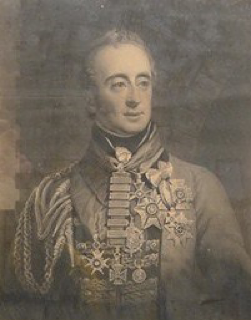
In July 1816, Pack marries Lady Elizabeth Louisa de la Poer Beresford, daughter of George Beresford, 1st Marquess of Waterford. They have two sons and two daughters. His descendants adopted “Pack-Beresford” as their family name. He dies on July 24, 1823, at Lord Beresford’s house in Upper Wimpole Street, London. A monument to him is later erected in St. Canice’s Cathedral, Kilkenny. A portrait by G. L. Saunders is in family possession; another by Charles Turner, showing Pack wearing his numerous orders and decorations, is in the National Portrait Gallery, London. A collection of his papers is held by the University of Southampton.


Leave a comment

Death of Charles Kendal Bushe, Lawyer & Judge

Charles Kendal Bushe, Irish lawyer and judge, dies in County Dublin on July 10, 1843. Known as “silver-tongued Bushe” because of his eloquence, he is Solicitor-General for Ireland from 1805 to 1822 and Lord Chief Justice of the King’s Bench for Ireland from 1822 to 1841.

Bushe is born at Kilmurry House, near Thomastown, County Kilkenny, the only son of the Reverend Thomas Bushe, rector of Mitchelstown, and his wife Katherine Doyle, daughter of Charles Doyle of Bramblestown, near Gowran. Kilmurry House had been built by the Bushe family in the 1690s. His father is forced to sell it to pay his debts, but he is able to repurchase it in 1814. He goes to the celebrated Quaker academy, Shackleton’s School in BallitoreCounty Kildare, then graduates from Trinity College Dublin (TCD), where his eloquence makes him a star of the College Historical Society. He is called to the Bar in 1790.

Bushe is a member of the Irish Parliament for Callan from 1796 to 1799, and for Donegal Borough from 1799 to 1800. He is Escheator of Leinster in 1799. By this time the office is a sinecure. He is vehemently opposed to the Acts of Union 1800, referring emotionally to Britain’s subjection of Ireland as “six hundred years of uniform oppression and injustice,” a phrase which quickly became a proverb. Although he refuses an offer of a place on the Bench as a bribe for supporting the Union, cynics note that his staunch opposition to the Union does not prevent him accepting high office under the British Crown afterwards. He is appointed Solicitor-General for Ireland in 1805 and holds the office for 17 years until in 1822 he is appointed Lord Chief Justice of the King’s Bench for Ireland, although only after William Saurin, the equally long-serving Attorney-General, refuses the position. He retire in 1841.

As an advocate “silver-tongued Bushe” is legendary for his eloquence, and as a politician, he is admired by his English contemporaries like Sir Robert Peel and Lord Brougham. As a judge, according to F. Elrington Ball, he does not live up to expectations, although, if not an outstanding judge, he is an impressive and dignified one. As a statesman he is often accused of double-dealing: having opposed the Acts of Union, he has few scruples about accepting office under the new regime; and while himself supporting Catholic Emancipation, he prosecutes members of the Catholic Association for sedition, merely for advocating the same cause.

In Dublin, Bushe is a member of Daly’s Club.

Bushe dies in County Dublin on July 10, 1843, and is buried at Mount Jerome Cemetery and Crematorium in Harold’s Cross, County Dublin.


Leave a comment

Birth of Luke O’Toole, Irish Gaelic Games Administrator

Luke O’Toole, Irish Gaelic games administrator, is born on June 21, 1873, in Ballycumber, Tinahely, County Wicklow.

O’Toole is the second son among five children of John O’Toole and Bridie O’Toole (née Doran). Of farming stock on both sides, he is educated at the local national school at Ballycumber and at a Dublin secondary school. When in the mid-1890s he moves to Dublin, he joins the Benburb Gaelic Football Club at Donnybrook, where his teammates include the future nationalist parliamentarian Thomas M. Kettle, who is killed in 1916 near Ginchy, France, during World War I. The proprietor of two newsagents’ shops near his home in Mount Pleasant Square, he soon becomes his club’s delegate to the Dublin county committee of the Gaelic Athletic Association about 1899. Founded in 1884 by Michael Cusack, the GAA by the late 1890s is insolvent and almost moribund, having been riven by rival nationalist factions. However, a group of younger officials which includes O’Toole is determined not to allow the Association to die, and at its annual congress in Thurles on September 22, 1901, stages what is in effect a palace coup. Alderman James Nowlan of Kilkenny, County Kilkenny, a labour activist and Gaelic League enthusiast, is elected president, and in a contest for the post of secretary, O’Toole defeats Cusack.

O’Toole holds the post of chief officer of the GAA until his death almost thirty years later. During this period, despite major political and military turmoil, including the world war, the Irish War of Independence, and the Irish Civil War, he is instrumental in turning the Association into the biggest Irish sports body, and some leading members, such as Michael Collins and Harry Boland, play major political roles between 1913 and 1923. Essentially a backroom administrator, O’Toole rarely appears in public apart from GAA events, one notable exception being on November 25, 1913, at the foundation meeting of the Irish Volunteers at the Rotunda Rink, Dublin, where he is one of the platform party. After the suppression of the 1916 Easter Rising, he goes into hiding temporarily in his native Wicklow. From then until the cessation of hostilities in mid-1921 he manages to evade the notice of the authorities though he is always a close associate of Sinn Féin leaders. He plays a big part in reviving the fortunes of the GAA after the Irish Civil War and is a principal organiser of the Tailteann Games in 1924 and 1928. His career, however, is cut short at the age of 56 by his sudden death at his desk on July 17, 1929.

For most of his life O’Toole resides in a house provided by the GAA beside Croke Park, the Association’s headquarters and principal stadium. He marries Bridget Doyle, a shopkeeper of Dublin. They have four sons and four daughters.

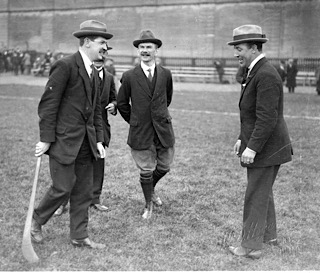
(From: “O’Toole, Luke” by Marcus de Búrca, Dictionary of Irish Biography, http://www.dib.ie, October 2009 | Pictured: Michael Collins, Luke O’Toole and Harry Boland in 1921, Image credit: GAA)


Leave a comment

Birth of Tim Pat Coogan, Journalist, Writer & Broadcaster

Timothy Patrick “Tim Pat” Coogan, Irish journalist, writer and broadcaster, is born in Monkstown, County Dublin, on April 22, 1935. He serves as editor of The Irish Press newspaper from 1968 to 1987. He is best known for such books as The IRA (1970) and On the Blanket: The H Block Story (1980), and biographies of Michael Collins and Éamon de Valera.

Coogan’s particular focus is on Ireland’s nationalist/independence movement in the 20th century, a period of unprecedented political upheaval. He blames the Troubles in Northern Ireland on “Paisleyism.”

Coogan is the first of three children born to Beatrice (née Toal) and Eamonn Coogan, a native of Kilkenny who is an Irish Republican Army (IRA) volunteer during the Irish War of Independence and later serves as the first Deputy Commissioner of the newly established Garda Síochána, then a Fine Gael TD for the Kilkenny constituency. His mother, the daughter of a policeman, is a Dublin socialite who is crowned Dublin’s Civic Queen of Beauty in 1927. She writes for the Evening Herald and takes part in various productions in the Abbey Theatre and Radio Éireann. He spends many summer holidays in the town of Castlecomer, County Kilkenny, his father’s hometown.

A former student of the Irish Christian Brothers in Dún Laoghaire and Belvedere College in Dublin, Coogan spends most of his secondary studies at Blackrock College in Dublin.

In 2000, Irish writer and editor Ruth Dudley Edwards is awarded £25,000 damages and a public apology by the High Court in London against Coogan for factual errors in references to her in his book Wherever Green is Worn: The Story of the Irish Diaspora (2000). In the book, he writes that Dudley Edwards had “groveled to and hypocritically ingratiated herself with the English establishment to further her writing career.” He also alleges that Dudley Edwards “had abused the position of chairwoman of the British Association for Irish Studies (BAIS) by trying to impose her political views on it” and that her commission to write True Brits had been awarded because of political favouritism.

When Taoiseach Enda Kenny causes confusion following a speech at Béal na Bláth by incorrectly claiming Michael Collins had brought Lenin to Ireland, Coogan comments, “Those were the days when bishops were bishops and Lenin was a communist. How would that have gone down with the churchyard collections?”

In November 2012, for reasons that are uncertain, the United States embassy in Dublin refuses to grant Coogan a visa to visit the United States. As a result, a planned book tour for his book The Famine Plot, England’s role in Ireland’s Greatest Tragedy (2012) is cancelled. After representations to then Secretary of State Hillary Clinton by United States Senator Chuck Schumer (D-NY) and Congressman Peter T. King (R-NY), he receives his visa.

Coogan has been criticised by the Irish historians Liam Kennedy and Diarmaid Ferriter, as well as Cormac Ó Gráda, for a supposed lack of thoroughness in his research and bias:

“Well, I waited in this book to hear some great revelation, and it just isn’t there. It’s anticlimactic. I could not see the great plot, and indeed there is no serious historian who … I can’t think of a single historian who has researched the Famine in depth – and Tim Pat has not researched it in depth” (The Famine Plot).

“Coogan is not remotely interested in looking at what others have written on 20th-century Irish history…. he does not appear interested in context and shows scant regard for evidence. He does not attempt to offer any sustained analysis in relation to the challenges of state building, the meaning of sovereignty, economic and cultural transformations, or comparative perspectives on the evolution of Irish society. There is no indication whatsoever that Coogan has engaged with the abundant archival material relating to the subject matter he pronounces on. There is no rhyme or reason when it comes to the citation of the many quotations he uses; the vast majority are not referenced. For the 300-page text, 21 endnotes are cited and six of them relate to Coogan’s previous books, a reminder that much of this tome consists of recycled material…. Tim Pat Coogan… he is a decent, compassionate man who has made a significant contribution to Irish life. But he has not read up on Irish history; indeed, such is the paucity of his research efforts that this book amounts to a travesty of 20th-century Irish history” (1916: The Mornings After).


Leave a comment

Death of Séamus Pattison, Labour Party Politician

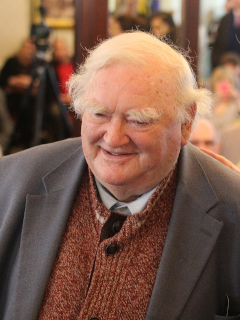
Séamus Pattison, Irish Labour Party politician, dies at his home in Kilkenny, County Kilkenny, on February 4, 2018. He serves as a Teachta Dála (TD) for the Carlow–Kilkenny constituency (1961-2007), Minister of State for Social Welfare (1983-87), Father of the Dáil (1995-2007), Ceann Comhairle of Dáil Éireann (1997-2002) and Leas-Cheann Comhairle of Dáil Éireann (2002-07). He is also a Member of the European Parliament (MEP) for the Leinster constituency (1981-83).

Pattison is born in Kilkenny on April 19, 1936. His father is Labour Party TD James Pattison, who represents Carlow–Kilkenny from 1933 to 1957. After his education at University College Cork, he becomes a full-time trade union official, serving with the Irish Transport and General Workers’ Union (ITGWU).

Pattison unsuccessfully contests the Carlow–Kilkenny by-election for Labour in June 1960 but is elected at the 1961 Irish general election to the 17th Dáil and holds the seat at eleven further general elections.

Pattison serves as Mayor of Kilkenny on three occasions: 1967, 1976 and 1992. He becomes an MEP for Leinster in 1981, to replace Liam Kavanagh who becomes Minister for Labour following the 1981 Irish general election. He resigns as an MEP in 1983, following his appointment as Minister of State at the Department of Social Welfare, a position in which he serves until Labour leaves the government in January 1987.

Pattison is unanimously elected Ceann Comhairle of Dáil Éireann on June 26, 1997, serving for the 28th Dáil. When the 29th Dáil assembles following the 2002 Irish general election he is succeeded by Rory O’Hanlon but is appointed as Leas-Cheann Comhairle (deputy chairperson) for the 29th Dáil.

Pattison is also a member of the Parliamentary Assembly of the Council of Europe.

In September 2005, Pattison announces he will retire at the 2007 Irish general election, and his nephew Eoin Pattison unsuccessfully seeks the nomination. Labour county councillor Michael O’Brien is selected in February 2006 to contest the seat but is unsuccessful in the 2007 Irish general election.

When Pattison retires from politics at the 2007 election, he has served in Dáil Éireann for 45 years and 7 months, making him the fifth-longest serving TD ever, and the longest-ever-serving Labour Party TD. He is the longest-serving sitting TD from 1995 to 2007 and has the informal title of Father of the Dáil.

Pattison dies at the age of 81 from Parkinson’s disease at his home in Kilkenny on February 4, 2018.


Leave a comment

Birth of Mildred Anne Butler, Animal & Genre Painter

Mildred Anne Butler, Irish artist who works in watercolour and oil of landscape, genre and animal subjects, is born on January 11, 1858, in Kilmurry, a Georgian house near Thomastown, County Kilkenny.

The youngest daughter of Captain Henry Butler, a grandson of the Edmund Butler, 11th Viscount Mountgarret, and Clara Butler (née Taylor) of the Newarke, Leicester, England. Her father is himself an enthusiastic painter, known for his publication South African sketches: illustrative of the wildlife of a hunter on the frontier of Cape Colony (1841). Her early artistic efforts are mainly copies of romantic subjects, but the influence of the London artist Paul Jacob Naftel, with whom she begins corresponding in the early 1880s, proves to be crucial to her artistic development. Studies with William Frank Calderon, an expert in animal painting, are also significant. She subsequently spends the summers of 1894 and 1895 in Newlyn, Cornwall, England, with the Irish artist Norman Garstin, who introduces her to contemporary French painting.

In 1885, Butler makes her first visit to the continent, traveling through France, Switzerland, and Italy. From 1905 to 1914 she travels regularly to Europe, most particularly Aix-les-Bains and Wiesbaden, during which time she produces genre views of French and German villages. After 1914 her life at the family home is interrupted only by visits to London exhibitions. She is best known for her paintings of Kilmurry and its environs, many of which display an interest in botany. Much of her work is dominated by detailed representations of animals and birds, often drawn from photographs and stuffed specimens.

Butler’s career as an exhibitor begins in 1882 with the Irish Fine Arts Society, later known as the Water Colour Society of Ireland (WCSI), with which she has a long association. She exhibits regularly with the society from 1892 onward and is a member of its committee for many years. She is also closely associated with the Dudley Museum and Art Gallery in London. Her work is first shown there in 1888, and on this evidence, she is elected to their society. The purchase by the Chantrey bequest for the Tate Gallery of The Morning Bath for £50 in 1896 is a high point in her career. The first painting by a woman to be selected by the council, its purchase is followed by almost consistently good press reviews for her work. The Athenaeum of May 5, 1897, writes: “The young lady knows how to look at her subjects with the eyes of a well-trained artist.”

Butler also comes to the attention of the American artistic press. She contributes to the portfolio of drawings given by the Society of Lady Artists to Princess May on her marriage to the Duke of York in 1893, while in 1922 her work is included in the portfolio presented to Princess Mary on her marriage. Her patrons include Queen Alexandra, and the grand duke of Hesse, who purchases two of her paintings after she is invited to exhibit in Hesse Darmstadt in 1911. In 1914 she is made a member of the Union Internationale des Beaux Arts, and in 1921 her paintings are shown in Japan. She regularly exhibits with the Belfast Ramblers, the Royal Ulster Academy, the Royal Academy of Arts (RA), the Royal Hibernian Academy (RHA), the Society of Lady Artists, and the Royal Watercolour Society, of which she is made an associate member in 1896, and a full member in 1937.

In her later years, severe rheumatism prevents Butler from painting. She has a keen interest in music. She survives all five of her siblings, and inherits Kilmurry, where she dies on October 11, 1941. She is buried at Thomastown, County Kilkenny. Her paintings are represented in the collections of the National Gallery of Ireland, Dublin City Gallery the Hugh Lane, the Ulster Museum, and the Tate, London.

(From: “Butler, Mildred Anne” by Frances Clarke, Dictionary of Irish Biography, http://www.dib.ie, October 2009)


Leave a comment

Death of Máirín Cregan, Playwright & Novelist

Máirín Cregan, Irish nationalist who is involved in the 1916 Easter Rising and Irish War of Independence, dies in Dublin on November 9, 1975. She makes her name writing for children, as well as writing plays and novels for adults.

Mary Ellen Cregan is born in Killorglin, County Kerry, on March 27, 1891, to Morgan Cregan and Ellen O’Shea. Her father is a stonemason from Limerick. The family are strong believers in the Gaelic revival movement and Cregan herself learns the Irish language and performs songs at Gaelic League concerts. Although she goes to primary school locally, she goes away to secondary school to St. Louis Convent in Carrickmacross, County Monaghan. After finishing school, she becomes a teacher, working in Goresbridge, County Kilkenny from 1911 to 1914.

In September 1914 Cregan goes to Dublin to study music in the Leinster School of Music, under Madame Coslett Heller. It is while she is in Dublin that she becomes friends with the Ryan family, who are strong nationalists as well as interested in the Gaelic League and Sinn Féin. She begins to sing for concerts which are fundraisers for the Irish Volunteers. The last concert is just two weeks before the Easter Rising.

During Easter week Cregan is sent to Tralee with “automatics and ammunition” by Seán Mac Diarmada. While she is carrying a violin case of munitions, she is also carrying details for the wireless technology needed for communicating with the SS Aud, the boat which is carrying more weapons for the rebellion. The communications with the SS Aud go wrong when the car carrying the Volunteers goes off a pier and the occupants are drowned. She is still in the area to assist with the surviving Volunteer, who unfortunately knows nothing of the details for the SS Aud. She is not easily able to get back to Dublin, because owing to the Rising the city is cut off. By the time she gets back, her friends have been arrested.

When Cregan is going to school in Dublin she is also working in a school in Rathmines. Like many of the teachers, she loses her job after the rising because of her connection to the rebels. However, she is able to get new positions over the next few years in both Ballyshannon and Portstewart until she marries. In Ballyshannon she experiences the early expressions of support and sympathy, but Portstewart is a Unionist enclave with many houses flying union flags on polling day in 1918.

Cregan is a member of Cumann na mBan and with them is active during the Irish War of Independence. She is given a medal for her participation. On July 23, 1919, she marries Dr. James Ryan in Athenry, County Galway. His entire family had been deeply involved in the Easter Rising, as well as the Irish War of Independence and the Irish Civil War. They have three children, Eoin, who becomes a Senator, Nuala (Colgan) and Seamus.

The family is initially based in Wexford during the War. The house is often raided when the British soldiers are looking for her husband and Cregan herself is arrested in February 1921 for refusing to put up martial law posters. Later the family sells the house and remains mobile while she works for the Sinn Féin government, and her husband is in prison. It is during this time that she works as a courier to the continent and to London. After the war, they purchase Kindlestown House in Delgany, County Wicklow, where they remain for the rest of their lives.

Cregan works as a journalist for The Irish Press and The Sunday Press. Her political awareness and involvement mean that her work there is on political articles.

Cregan’s first book for children is Old John and gains her considerable international success and attention. Sean Eoin is also published in Irish and is illustrated by Jack Butler Yeats. Her work is also aired on the BBC and RTÉ. Rathina wins the Downey Award in the United States in 1943. She also writes two plays: Hunger strike (1933), based on experience of her husband’s involvement in such a strike, which is broadcast on Radio Éireann on May 5, 1936, and Curlew’s call (1940).

Cregan dies on November 9, 1975, in St. Vincent’s Hospital, Dublin, and is buried in Redford cemetery near her home in County Wicklow.

(Pictured: Máirín Cregan and her husband, Dr. James Ryan)