seamus dubhghaill

Promoting Irish Culture and History from Little Rock, Arkansas, USA


Leave a comment

The Derryard Checkpoint Attack

The Provisional Irish Republican Army (IRA) attacks a British Army permanent vehicle checkpoint complex manned by the King’s Own Scottish Borderers (KOSB) near the Northern IrelandRepublic of Ireland border at Derryard, north of Rosslea, County Fermanagh, on December 13, 1989.

According to journalist Ed Moloney, the IRA Army Council, suspecting a great deal of infiltration by double agents at the grassroots level of the IRA, decide to form an experimental flying column (rather than the usual active service unit) to mount a large-scale operation against a permanent vehicle checkpoint along the border. It hopes that this will prevent any information leak that might result in another fiasco like the Loughgall Ambush of 1987.

Moloney maintains that the planning is in the charge of Thomas Murphy, alleged leader of the South Armagh Brigade, and that the raid is to be led by East Tyrone Brigade member Michael “Pete” Ryan. Journalist Ian Bruce instead claims that the IRA unit is led by an Irish citizen who had served in the Parachute Regiment, citing intelligence sources. The column is made up of about 20 experienced IRA volunteers from throughout Northern Ireland, eleven of whom are to carry out the attack itself. Bruce reports that IRA members from County Monaghan, supported by local Fermanagh militants, carry out the raid.

The target is a permanent vehicle checkpoint at Derryard. Described as a “mini base,” it includes an accommodation block and defensive sangars. It is manned by eight soldiers of the 1st Battalion, King’s Own Scottish Borderers and a Royal Ulster Constabulary (RUC) officer. The eleven IRA members are driven to the checkpoint in the back of a makeshift Bedford armoured dumper truck. They are armed with 7.62mm AK-47s, 5.56mm ArmaLite AR-18s, two 12.7mm DShK heavy machine-guns, RPG-7s, different kinds of grenades, and a LPO-50 flamethrower. The heavy machine guns and the flamethrower are mounted on a tripod on the lorry bed. To assure widespread destruction, the column plan to detonate a van bomb after the initial assault.

The attack takes place shortly after 4:00 PM. IRA members seal off roads leading to the checkpoint in an attempt to prevent civilians from getting caught up in the attack. The truck is driven from the border and halted at the checkpoint. As Private James Houston begins to check the back of the truck, the IRA open fire with assault rifles and throw grenades into the compound. Two RPG-7s are fired at the observation sangar while the flamethrower stream is directed at the command sangar. Heavy shooting continues as the truck reverses and smashes through the gates of the compound. At least three IRA volunteers dismount inside the checkpoint and spray the portacabins with gunfire and the flamethrower’s fire stream, while throwing grenades and nail bombs. The defenders are forced to seek shelter in sangars, from where they fire into their own base. A farmer some distance away sees an orange ball of flames and hears gunfire ‘raking the fields.’ As the truck drives out of the now wrecked compound, a red transit van loaded with a 400-lb. (182 kg) bomb is driven inside and set to detonate once the IRA unit has made its escape. However, only the booster charge explodes.

The attack is finally repulsed by a four-men Borderers section from the checkpoint that is patrolling nearby, with the support of a Westland Wessex helicopter. The patrol fires more than 100 rounds at the IRA unit. The Wessex receives gunfire and is forced to take evasive action. The IRA column, at risk of being surrounded, flee toward the border in the armoured truck. It is found abandoned at the border with a 460-lb. (210 kg) bomb on board.

Two soldiers are killed in the attack: Private James Houston (22) from England and Lance-Corporal Michael Patterson (21) from Scotland. Corporal Whitelaw is badly wounded by shrapnel and later airlifted for treatment. Another soldier suffers minor injuries.

There is outrage in Westminster and among unionists, as a supposedly well-defended border post has been overrun by the IRA and two soldiers killed. On the other hand, according to Moloney, there is also some disappointment among republicans. Despite the positive propaganda effect, the quick and strong reaction from the outpost’s defenders convince some high-ranking IRA members that the Army Council has been infiltrated by a mole.

KOSB officers and security sources believe that the IRA unit involved was not locally recruited, putting the blame instead on IRA members from Clogher, County Tyrone and South Monaghan in the Republic. The same sources say that the attack was executed “in true backside-or-bust Para style.”

After the action of Derryard, the British Army in Northern ireland are issued the French designed Luchaire 40mm rifle grenade, fitted on the muzzle of the SA80 rifle. This gives the troops a lightweight armour piercing capability to deal with the threat imposed by improvised armoured vehicles. Permanent checkpoints along the border are also fitted with general-purpose machine guns. From 1990 until the end of the IRA campaign in 1997, there are a number of further bloodless, small-scale attacks against permanent vehicle checkpoints along this part of the border using automatic weapons, particularly in County Fermanagh and against a military outpost at Aughnacloy, County Tyrone.

Two soldiers, Corporal Robert Duncan and Lance Corporal Ian Harvey, are bestowed the Distinguished Conduct Medal (DCM), while Lance-Corporal Patterson receives a posthumous mention in dispatches for his actions during the attack. The checkpoint is dismantled in March 1991, as part of a major border security re-arrangement codenamed Operation Mutilate.

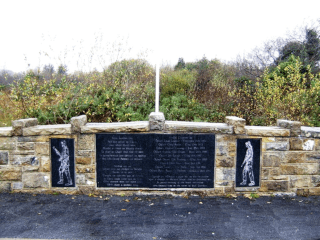
(Pictured: Republican memorial at Carragunt bridge, on the border between Northern Ireland and the Republic, often crossed by Provisional IRA forces during the Troubles to attack British targets inside County Fermanagh)


Leave a comment

British Ultimatum to the Irish Delegation at the Anglo-Irish Treaty Talks

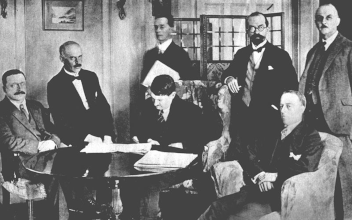
The Irish delegation at the Anglo-Irish Treaty talks in London are given an ultimatum by British Prime Minister David Lloyd George on December 5, 1921. Sign the treaty or face “immediate and terrible war.”

In 1920, during the Irish War of Independence, the Government of Ireland Act not only establishes the new state of Northern Ireland but gives that state the right to opt-out of a future self-governing Irish Free State within the British Commonwealth of Nations.

The Northern state consists of the six northeastern counties of Ulster with a unionist majority. They are Antrim, Down, Armagh, Derry, Tyrone, and Fermanagh. Belfast is to be the seat of a government and hold limited devolved powers. The counties of Donegal, Cavan, and Monaghan are to be absorbed within the Irish Free State controlled from parliament in Dublin.

Irish nationalists are dismayed with the plan. Protestant Unionists, particularly those living within the boundaries of the new state, accept and start to implement the Act. Sectarian attacks are launched upon Catholic homes in Belfast, Derry, Banbridge, Lisburn, and Dromore. Catholics are driven from Belfast shipyards and from various engineering works in the city. Supposedly these attacks are in revenge for Irish Republican Army (IRA) assassinations.

The IRA continues the campaign to establish a republic with the Irish War of Independence. By the middle of 1921, both sides are exhausted, and a truce is called on June 9.

In July 1921, Éamon DeValera, the president of Dáil Éireann, goes to London to meet with Prime Minister Lloyd George. They agree an Irish delegation will come to London to discuss terms in the autumn.

The delegation appointed by the Dáil to travel to London consists of Arthur Griffith (Minister for Foreign Affairs and chairman of the delegation); Michael Collins (Minister for Finance and deputy chairman of the delegation); Robert Barton (Minister for Economic Affairs); George Gavan Duffy and Éamonn Duggan, with Erskine Childers, Fionán Lynch, Diarmuid O’Hegarty, and John Chartres providing secretarial assistance. DeValera himself does not attend. Future historians wonder if he knew they would not be able to negotiate a 32 county Irish Republic.

During the debate, Lloyd George insists Ireland remain part of the Commonwealth and Dáil Éireann members take the oath of allegiance to the British throne. After a delay of two months, Lloyd George delivers the ultimatum on December 5, sign a treaty within three days or there will be war.

The Anglo-Irish Treaty is to give Ireland a 26 county Free State with Dominion status. The right to raise taxes, regulate foreign trade, independence in internal affairs, own an army, and the oath of allegiance is changed to one of fidelity.

The British are to retain three naval bases within the jurisdiction of the Free State, at Cobh, Lough Swilly, and Berehaven. The Northern Ireland boundary is to be determined by a commission. This gives false hope to large tracts of Tyrone, Fermanagh, Down, Armagh, and Derry City would be given to the Free State as they have Catholic majorities.

Just after 2:00 AM on December 6, 1921, the Irish delegation, without consulting the Dáil, finally sign a treaty with the British. Collins writes, prophetically, later on the day of the signing, “early this morning I signed my death warrant.”

The Treaty displeases the Catholics in the north and the unionists in the south. Meanwhile, many of those involved in the conflict are abhorred at the fact that not all of Ireland is to leave the United Kingdom.

(From: “The Anglo-Irish Treaty (1921)” by Brian O’Neill, Your Irish Culture, http://www.yourirish.com, May 20, 2020)


Leave a comment

Birth of Thomas Heazle Parke, Physician, British Army Officer & Author

Thomas Heazle Parke FRSGS, Irish physician, British Army officer and author who is known for his work as a doctor on the Emin Pasha Relief Expedition, is born at Clogher House in Kilmore, County Roscommon on November 27, 1857.

Parke is brought up in Carrick-on-Shannon, County Leitrim. He attends the Royal College of Surgeons in Ireland in Dublin, graduating in 1878. He becomes a registered medical practitioner in February 1879, working as a dispensary medical officer in Ballybay, County Monaghan, and then as a surgeon in Bath, Somerset, England.

Parke joins the British Army Medical Services (AMS) in February 1881 as a surgeon, first serving in Egypt during the final stages of the ʻUrabi revolt in 1882. As a senior medical officer at a field hospital near Cairo, he is responsible for treating battle casualties as well as the deadly cholera epidemic that afflicts 20% of British troops stationed there. In late 1883, he returns to Ireland, where he is stationed at Dundalk with the 16th The Queen’s Lancers. He arrives in Egypt once again in 1884 as a part of the Nile Expedition sent in relief of General Charles Gordon, who is besieged in Khartoum by Mahdists in neighbouring Sudan. The expedition arrives too late, and Gordon is killed. Parke later negatively recounts this experience in an 1892 journal article titled How General Gordon Was Really Lost. Following the expedition, he spends the next few years stationed in Alexandria, where he notably introduces fox hunting to Egypt, becoming master of the Alexandria Hunt Club.

In January 1887, while in Alexandria, Parke is invited by Edmund Musgrave Barttelot to accompany him on the Emin Pasha Relief Expedition. The expedition is led by Henry Morton Stanley, and journeys through the African wilderness in relief of Emin Pasha, an Egyptian administrator who had been cut off by Mahdist forces following the Siege of Khartoum. He is initially rejected by Stanley upon his arrival in Alexandria but is invited by telegram a day later to join the expedition in Cairo. On February 25, 1887, the expedition sets off from Zanzibar for the Congo.

The expedition lasts for three years and faces great difficulty, with the expedition of 812 men suffering from poor logistical planning and leadership. The rainforest is much larger than Stanley expected, leading much of the party to face starvation and disease. The expedition has to resort to looting native villages for food, escalating the conflict between the two groups. Parke, for his part, saves the lives of many in the party, including Stanley, who suffers from acute abdominal pain and a bout of sepsis. Stanley describes Parke’s care as “ever striving, patient, cheerful and gentle…most assiduous in his application to my needs, and gentle as a woman in his ministrations.” Parke also treats Arthur Jephson for fever, and nurses Robert H. Nelson through starvation. Furthermore, after a conflict with the natives, he has to save William Grant Stairs by orally sucking the poison out of an arrow wound.

During the expedition, Parke purchases from an Arab slaver a Mangbetu Pigmy girl, who serves as his nurse and servant for over a year.

After returning to Ireland, Parke receives an Honorary Fellowship of the Royal College of Surgeons in Ireland and is awarded gold medals from the British Medical Association (BMA) and the Royal Geographical Society. He publishes several books, including My Personal Experiences in Equatorial Africa (1891) and A Guide to Health in Africa.

In August 1893, Parke visits William Beauclerk, 10th Duke of St. Albans in Ardrishaig, Scotland. He dies during that visit on August 11, 1893, presumably due to a seizure. His coffin is brought back to Ireland, where he receives a military funeral as it passes from the Dublin docks to Broadstone railway station. He is buried near his birthplace in Drumsna, County Roscommon.

A bronze statue of Parke stands on Merrion Street in Dublin, outside the National Museum of Ireland – Natural History. He is also commemorated by a bust in the Royal College of Surgeons in Ireland.

(Pictured: Photograph of Thomas Heazle Parke by Eglington & Co., Wellcome Collection gallery)


Leave a comment

The Battle of Clontibret

The Battle of Clontibret is fought in County Monaghan in May 1595 during the Nine Years’ War, between the crown forces of England‘s Queen Elizabeth I and the Irish army of Hugh O’Neill, Earl of Tyrone. It ends in victory for Tyrone on May 27, 1595, and is the first severe setback suffered by the English during the war.

The Nine Years War begins with a conflict over English efforts to maintain a string of garrisons along the southern border of Tyrone’s territory in Ulster. The Irish leader promptly besieges the English garrison at Monaghan Castle, and Sir Henry Bagenal, commander of the English forces, marches out to its relief on May 25 from Dundalk, via Newry. His army is made up of 1,750 troops, including some veterans and certain companies newly arrived from the Spanish campaign in Brittany, but there are many recruits in the ranks. Bagenal’s men are predominantly infantry, armed with muskets and pikes. There is also a small number of horsemen raised in the Pale.

The Battle of Clontibret is essentially a two day running battle, as Bagenal’s column is ambushed on its way to and from the castle at Monaghan town. The Irish fight sharply along the roads about Crossdall, around 4 miles from Monaghan, firing on the English column with calivers from the surrounding woodland. With the loss of 12 dead and 30 wounded the English reach the castle, which is re-supplied and reinforced with one company. Bagenal has misgivings about his supply of powder and lead, much of which had been used on the way, and can afford little for the garrison before he starts back.

Two days later, on May 27, Bagenal sets out for Newry in a column, but by another route, past the townland of Clontibret. The route lay through drumlin country, which abounds with hills, bogs and woods, making it ideal for an ambush. The column comes under fire from the outset, and then falls into a major ambush at a pass near Clontibret. Tyrone’s army, about 4,000 strong, consists of contingents from the O’Neill, MacMahon and Maguire clans, as well as Scottish mercenaries. The Irish also deploy a greatly enlarged force of cavalry and caliver-men. To Bagenal’s puzzlement, the caliver-men are turned out in red coats and acquitted themselves with expertise. Fire from the flanks is heavy, and many English troops are killed or wounded while the Irish cavalry plays around the fringes. Tyrone himself is almost killed in hand-to-hand combat with a Palesman named Seagrave, who leads a cavalry charge on the Irish position. Seagrave has his arm chopped off by Tyrone’s standard bearer O’Cahan, and is killed by Tyrone with a dagger thrust to the groin. Bagenal’s column is slowed to a crawl and, as night falls in the wilderness, the commander calls his men to a halt and camps at the hilltop of Ballymacowen. It seems that hundreds are missing, and there is fear that the Irish will renew the attack under cover of darkness. There is no further attack and, a little after first light, reinforcements from Newry arrive to relieve the column.

According to intelligence received in the days following, Tyrone’s failure to follow up is caused by a lack of powder, ironic given the state of Bagenal’s own supplies. The overall sense in government is of disquiet, and a bad job is made of hushing up the casualty figures. This gives fuel to the rumours of a severe defeat, and many people set greater store on the numbers put about by confederate supporters.

Sir Ralph Lane, the muster-master-general, informs the queen’s principal secretary, William Cecil, 1st Baron Burghley, that “more men were hurt and killed in that late service than was convenient to declare.” The casualty figures for both sides vary depending on sources. Bagenal admits only 31 killed and 109 wounded on the second day of fighting, but his losses are almost certainly higher. The Irish annals claimed up to 700 English killed. Estimates of the confederate losses vary between 100 to 400 killed. Three years later, Bagenal leads an army into another ambush by Tyrone, at the Battle of the Yellow Ford. The English general is killed and his troops are routed with heavy losses.

(From: “Battle of Clontibret,” wikia.org, https://military.wikia.org | Pictured: The marker stone on the northern edge of the battlefield commemorating the Irish victory at Clontibret, 1595)


Leave a comment

Birth of Basil Kelly, Northern Irish Barrister, Judge & Politician

Sir John William Basil Kelly, Northern Irish barrister, judge and politician, is born in County Monaghan on May 10, 1920. He rises from poverty to become the last Attorney General of Northern Ireland and then one of the province’s most respected High Court judges. For 22 years he successfully conducts many of the most serious terrorist trials.

A farmer’s son, Kelly is raised amid the horror of the Irish Civil War. The family is burned out when he is five and, penniless, goes north to take a worker’s house near the Harland & Wolff shipyard in Belfast. Even though they are Protestant the Kellys are met with a cold welcome. To counter that, his mother starts a bakery while he and his father sell the hot rolls to the area pubs.

Kelly initially attends a shipyard workers’ school, sometimes without shoes, and then goes on to Methodist College Belfast, where only boys prepared to work hard are welcome. His mother, who had taught him to play the piano by marking out the keyboard on the kitchen table, is so cross when she hears that he has been playing football in the street that she tells the headmaster that he does not have enough homework.

On a visit to an elder sister at Trinity College, Dublin, Kelly is so impressed by her smoking and her painted nails that he decides to follow her to the university, where he reads legal science. After being called to the Bar of Northern Ireland in 1944, he has the usual slow start, traveling up to 100 miles to earn a five-guinea fee. However, aided by a photographic memory and the patronage of Catholic solicitors, he gradually builds up a large practice, concentrating on crime and workers’ compensation while earning a reputation as the finest cross-examiner in the province.

Kelly first makes a mark by his successful defence of an aircraftman accused of killing a judge’s daughter. The man is found guilty but insane, though the complications involved bring it back to court 20 years later. After appointment as Queen’s Counsel in 1958 he skillfully conducts two cases which go to the House of Lords. One involves the liability of a drunken psychopath, the other the question of automatism where a person, acting like a sleepwalker, does not know what he is doing.

In the hope of speeding his way to the Bench, Kelly is elected to the House of Commons of Northern Ireland as Ulster Unionist Party (UUP) member for Mid Down in 1964. His capacity for hard work leads to his being appointed Attorney General four years later.

In March 1972, the entire Government of Northern Ireland resigns, and the Parliament of Northern Ireland is prorogued. As a result, Kelly ceases to be Attorney General. The office of Attorney General for Northern Ireland is transferred to the Attorney General for England and Wales, and he is the last person to serve as Stormont’s Attorney General.

In 1973, Kelly is appointed as a judge of the High Court of Northern Ireland, and then as a Lord Justice of Appeal of Northern Ireland in 1984, when he is also knighted and appointed to the Privy Council of the United Kingdom. On the bench he proves a model of fairness and courtesy with a mastery of facts, but his role often puts him in danger.

A Provisional Irish Republican Army (IRA) gang once targets him with a bomb-laden milk van, intending to drive it through his gates. But the police are alerted and immediately take him to Stormont, where he lives for the next two months.

For a year Kelly presides alone over a non-jury Diplock court, protected by armed police and wearing a bulletproof vest before writing his judgment under Special Air Service (SAS) guard in England. He convicts dozens of people on “supergrass” evidence, though there are subsequently doubts about the informant and some of his judgments are overturned.

One of the accused, Kevin Mulgrew, is sentenced to 963 years in prison, with Kelly telling him, “I do not expect that any words of mine will ever raise in you a twinge of remorse.” While the IRA grumbles about the jail terms he dispenses, and he is often portrayed as an unthinking legal hardliner by Sinn Féin, he is a more subtle figure and is often merciful towards those caught up in events or those whom he considers too young for prison.

Kelly retires in 1995 and moves to England, where he dies at the age of 88 at his home in Berkshire on December 5, 2008, following a short illness. He is survived by his wife, Pamela Colmer.

(From: “Basil Kelly,” Independent.ie (www.independent.ie), January 4, 2009)


Leave a comment

Death of Charles Leslie, Jacobite Propagandist & Non-Juror

Charles Leslie, former Church of Ireland priest who becomes a leading Jacobite propagandist after the 1688 Glorious Revolution, dies in Glaslough, County Monaghan on April 13, 1722. One of a small number of Irish Protestants to actively support the Stuarts after 1688, he is best remembered today for his role in publicising the 1692 Massacre of Glencoe.

Leslie is born on July 27, 1650, in Dublin, the sixth son and one of eight surviving children of John Leslie (1571-1671) and Katherine Conyngham (or Cunningham), daughter of Dr. Alexander Cunningham, Dean of Raphoe. He is allegedly named after the executed Charles I and educated at Enniskillen school and Trinity College, Dublin. After his father dies in 1671, he studies law in London before changing career and being ordained as an Anglican priest in 1681. Shortly afterwards, he returns to the family estate at Glaslough in County Monaghan and marries Jane Griffith. They have a daughter, Vinigar Jane, who appears to have died young and two sons, Robert (1683-1744) and Henry who are also Jacobites and spend time in exile.

Leslie is appointed assistant curate for the Church of Ireland parish of Donagh but as most of his parish is Roman Catholic or Presbyterian, he has few duties. His father had been chaplain to Charles I and a key supporter of Caroline religious reforms, first in Scotland, then in Ireland as Bishop of Raphoe in 1633, while the estate at Glaslough was granted by Charles II in 1660 as a reward for his service. With this background, Leslie is a firm supporter of the Stuart dynasty, although deeply hostile to Catholicism and soon becomes involved in political and theological disputes.

When the Catholic James II becomes King in 1685, his brother-in-law Henry Hyde, 2nd Earl of Clarendon, is appointed Lord Lieutenant of Ireland. In July 1686, Leslie’s legal training results in Clarendon making him chancellor of Connor cathedral and later Justice of the Peace. Clarendon’s authority is overshadowed by his Catholic deputy Richard Talbot, 1st Earl of Tyrconnell, who begins undermining legal restrictions on Catholics embodied in the Test Act. Clarendon employs Leslie’s polemical skills to oppose the appointment of Catholics to public office, but he is recalled in 1687. When James is deposed by the Glorious Revolution in December 1688, Leslie is in the Isle of Wight.

Shortly afterwards, Leslie becomes Clarendon’s personal chaplain and like his patron refuses to take the oath of allegiance to William III and Mary II. Like other non-jurors, he is deprived of his Church offices and becomes instead one of the most prominent Jacobite and Tory propagandists. This includes a long dispute with his Trinity College contemporary William King, who supports the Revolution. Gilbert Burnet, Bishop of Salisbury, later names him ‘the violentest Jacobite’ active in England during these years.

Much of Leslie’s early writing focuses on Scotland, where the 1690 Settlement ends Episcopacy and restores a Presbyterian kirk. He uses this to inspire concern about William’s intentions towards the Church of England. Ironically, his modern fame now rests primarily on a pamphlet written in 1695, called Gallienus Redivivus, or Murther will out, &c. Being a true Account of the De Witting of Glencoe, Gaffney. The focus of this is William’s alleged complicity in the 1672 death of Dutch Republican leader Johan de Witt, with other crimes including Glencoe included as secondary charges. During the Jacobite rising of 1745, Charles Stuart orders Leslie’s pamphlet and the 1695 Parliamentary minutes of the investigation to be reprinted in the Edinburgh Caledonian Mercury.

During the 1690s, Leslie serves as a messenger between James’ court in exile at Château de Saint-Germain-en-Laye and the Non-Juror community in England, including the non-juror bishops Jeremy Collier, Thomas Ken and George Hickes. He defends Collier and two other non-juror priests when they become involved in a furor over the execution of Sir John Friend and Sir William Parkyns for their role in the 1696 Jacobite plot to assassinate William. Immediately prior to the execution, the clergymen declare the two absolved of their sins, effectively declaring the correctness of their actions, while also performing a rite not recognised by the Church of England.

In 1702, the accession of Queen Anne, the last Stuart monarch, causes a resurgence in Jacobite activity and in 1704, Leslie begins a weekly periodical initially called The Observator, later The Rehearsal of Observator and finally The Rehearsal. Although his Tory readership shares his High Church principles, he is primarily a Jacobite and violently opposes the common practice of ‘occasional conformity.’ The Rehearsal is forced to close in 1709 and he falls out with his former allies, including Henry Sacheverell whose trial helped the Tories win a landslide victory in the 1710 British general election.

Despite his Tory allies now being in government, a warrant is issued for Leslie’s arrest for his tract The Good Old Cause, or, Lying in Truth. In 1711 he escapes to Paris, where James Francis Edward Stuart has succeeded his father as the Stuart heir in 1701. He continues to write polemics and act as a Jacobite agent. However, after the failed Jacobite rising of 1715, France withdraws support for the Stuarts who are forced to leave France, eventually being invited to settle in Rome by Pope Benedict XIV. The Spanish-sponsored 1719 Rising in Scotland is judged to have done more damage to the Jacobite cause than otherwise, one of its leaders concluding “it bid fair to ruin the King’s Interest and faithful subjects in these parts.”

Despite these failures, Leslie remains a dedicated Jacobite but his lifelong antipathy towards Catholicism makes living in Rome as a Papal pensionary difficult, while hopes of converting James to Anglicanism fades due to his devout personal Catholicism. He returns to Paris in 1717 and in 1719 publishes a two folio-volume edition of his Theological Works. It is later claimed these placed him ‘very high in the list of controversial authors, the ingenuity of the arguments being equalled only by the keenest and pertinacity with which they are pursued.’ He invites friends and supporters to subscribe to these and by 1721, over 500 members of the House of Lords and House of Commons have pledged a total of £750. Charles Spencer, 3rd Earl of Sunderland finally allows him to return home, with the stipulation he cease his political activities.

Charles Leslie dies at Glaslough on April 13, 1722. His grandchildren include Charles Leslie MP, whose son in turn is John Leslie, Bishop of Kilmore, Elphin and Ardagh.

(Pictured: Charles Leslie, mezzotint by Unknown artist, National Portrait Gallery, NPG D5066)


Leave a comment

Birth of Thomas Devin Reilly, Revolutionary & Journalist

Thomas Devin Reilly, Irish revolutionary, Young Irelander and journalist, is born in Monaghan, County Monaghan, on March 30, 1824.

Reilly is the son of a solicitor and completes his education at Trinity College, Dublin. From early on he espouses the republican beliefs of Theobald Wolfe Tone and Robert Emmet and writes for The Nation and John Martin‘s The Irish Felon in support of economic and political improvements for the working class. He is more interested in the realities of the common man than high idealism.

As a member of the Irish Confederation during the Great Famine, Reilly together with John Mitchel and James Fintan Lalor advocate the refusal to pay rents, retention of crops by small tenant farmers and labourers to feed their own families, and the breaking up of bridges and tearing up of railway lines to prevent the removal of food from the country.

Reilly is involved in the failed Young Ireland Rebellion of 1848 and is forced to flee to the United States where he becomes active in U.S. political affairs in support of Irish independence. He is reported to be the founder of The People newspaper in New York City which folds after six months in 1849.

James Connolly claims that as the editor of the Protective Union labour rights newspaper for the printers of Boston, Reilly is a pioneer of American labour journalism and that Horace Greeley believed of his series of articles in The American Review on the European situation “that if collected and published as a book, they would create a revolution in Europe.”

It is possible that Connolly confuses The United States Magazine and Democratic Review, which is known for its political activism, with The American Review, which for a time had Edgar Allan Poe as an editorial assistant. Other sources refer to Reilly as being editor of the New York Democratic Review and later the Washington Union.

Thomas Devin Reilly dies at the age of 30 on March 5, 1854. He is buried at Mount Olivet Cemetery in Washington, D.C., together with his infant child Mollie and wife Jennie Miller from Enniskillen.


Leave a comment

Death of John Robert Gregg, Inventor of Gregg Shorthand

John Robert Gregg, educator, publisher, humanitarian, and the inventor of the eponymous shorthand system Gregg shorthand, dies in Cannondale, Connecticut on February 23, 1948.

Gregg is born on June 17, 1867, in Shantonagh, County Westmeath, as the youngest child of Robert and Margaret Gregg, where they remain until 1872, when they move to Rockcorry, County Monaghan. He enters the village school in Rockcorry in 1872. On his second day of class, he is caught whispering to a schoolmate, which prompts the schoolmaster to hit the two children’s heads together. This incident profoundly damages his hearing for the rest of his life, rendering him unable to participate fully in school, unable to understand his teacher. This ultimately leads to him being unnecessarily perceived as dull or mentally challenged by his peers, teachers, and family.

In 1877, after seeing a friend use Pitman shorthand to take verbatim notes of a preacher’s sermon, Robert Gregg sees the shorthand skill as a powerful asset, so he makes it mandatory for his children to learn Pitman shorthand, with the exception of John, who is considered by his family too “simple” to learn it. None of the children succeed in fully learning the system. On his own, John learns the shorthand system of Samuel Taylor. He teaches himself the system fully, since he does not require the ability to hear in order to learn from the book.

Gregg says he initially set out to improve the English adaptation by John Matthew Sloan of the French Duployan shorthand, while working with one of Sloan’s sales agents, Thomas Malone. Malone publishes a system called Script Phonography, of which Gregg asserts a share in authorship is owed to him. Angered by Malone, he resigns from working with him and encouraged by his older brother Samuel, publishes and copyrights his own system of shorthand in 1888. It is put forth in a brochure entitled Light-Line Phonography: The Phonetic Handwriting which he publishes in Liverpool, England.

In 1893, Gregg emigrates to the United States. That year he publishes Gregg shorthand with great success. He settles in Chicago in 1895 and by 1896 dozens of American public schools are teaching Gregg shorthand. The first Gregg Shorthand Association is formed in Chicago that year with 40 members. In 1897 the Gregg Publishing Company is formed to publish shorthand textbooks.

By 1907 Gregg is so successful that he opens an office in New York and then moves there. The popularity of his shorthand system continues to grow with it being taught in 533 school systems by 1912. In 1914 the New York City Board of Education approves the experimental introduction of Gregg shorthand into its high schools, where the Pitman system had long held sway. That same year the system is admitted to Columbia University (New York) and the University of California, Berkeley.

After World War I, Gregg travels extensively throughout Great Britain, hoping to popularize his system there. He is not quite as successful in this endeavor as he had been in America, but he sees Gregg shorthand become wildly popular in France, Germany, Poland, Spain, and especially Latin America, where for years Gregg’s birthday is a national holiday.

Following his wife’s death in 1928 Gregg returns to New York. He throws himself into volunteer work and continues to perfect the Gregg system. Over the next several years he is the recipient of several honorary degrees from American educational institutions. At one such ceremony in June 1930 he renews his acquaintance with Janet Kinley, daughter of the president of the University of Illinois. The two are married in October of that year. They purchase a home in Cannondale, a historic section of Wilton, Connecticut.

In the 1930s Gregg begins writing a history of shorthand, the subject that had been his lifelong obsession. The first chapter is printed in 1933, and successive chapters follow at intervals until 1936. He devotes time to charitable work and institutes scholarships in the arts and in court reporting at his Chicago school. His voluntary work on behalf of Allied soldiers and British civilians during World War II wins recognition from King George VI, who awards him a medal for “Service in the Cause of Freedom” in 1947.

In December 1947 Gregg undergoes surgery from which he seems to recover well. However, on February 23, 1948, he suffers a heart attack and dies in Cannondale, Connecticut at the age of eighty.


2 Comments

The Ballytrain Barracks Attack

An Irish Republican Army (IRA) unit commanded by Ernie O’Malley and Eoin O’Duffy captures a Royal Irish Constabulary (RIC) barracks at Ballytrain, County Monaghan, on February 14, 1920 during the Irish War of Independence.

After a month of intense IRA activity across the country, the War of Independence continues unabated in February 1920. Becoming more daring in the process, the IRA continues to target the RIC and their barracks. Elsewhere, local issues and tensions also surface, and in some cases, they become embroiled in the struggle for Independence. February 1920 is a month of chaos across the country.

Described by the newspapers of the day as a ‘fierce affray’ the three-hour assault on the RIC barracks at Ballytrain, County Monaghan is a significant engagement for the Monaghan IRA during the War of Independence. Launched at 2:00 AM on a Sunday morning and led by Eoin O’Duffy, later a Commissioner of An Garda Siochana, the attack had been carefully planned.

Located eight miles from Castleblayney, the RIC barracks in Ballytrain is manned by Sergeants Lawson and Graham and four constables, Roddy, Gallagher, Murtagh, and Nelson, all of whom it is said fight against the odds for over three hours. At 5:00 AM, when ‘the leader’ of the IRA party demands the officers surrender it is met by continued firing from the police. O’Duffy then gives the order to plant explosives at the gable wall, which instantly collapses. Four RIC officers are buried in the rubble of the building and are later transferred to Carrickmacross hospital for treatment. About fifty men then rush the building carrying off a quantity of weapons.

A house belonging to a man named Mitchell is raided before the attack, where four members of the family are held hostage throughout the night. The IRA smashes all of the windows in the house allowing them to fire on the barracks. As many as 150 men take part in the raid, which also sees some men taking up position in cattle byres, which had been cleaned out in order to give protection. It is later alleged that O’Duffy had told the RIC men that he was glad no one had been killed in the exchange, saying, “We did not come here to do injury, but only for arms.” It is hardly the welcome Sergeant Graham had expected having only arrived in the barracks three days earlier.

(From: Irish Newspaper Archives, irishnewsarchive.com, February 17, 2020)


Leave a comment

Death of Isabella Tod, Women’s Rights Activist

Isabella Maria Susan Tod, Irish women’s rights activist, dies at her home at 71 Botanic Avenue in Belfast on December 8, 1896. She is a formidable lady who uses her political skills to great advantage in order to further many causes.

Tod is born on May 18, 1836, in Edinburgh into a well-known Irish Presbyterian family, her uncle being the Rev. Hope Masterton Waddell, one of the earliest Irish Presbyterian missionaries who served with the Scottish Missionary Society in Jamaica and whose great grandfather is the Rev. Charles Masterton, one of the most distinguished minsters of the General Synod of Ulster who ministers at Connor and Rosemary Street, Belfast. She is very proud of her Presbyterian heritage and of her Scottish ancestry.

The daughter of James Banks Tod, an Edinburgh merchant, Tod spends her early years in Edinburgh. She is educated at home by her mother, Maria Isabella Waddell, who comes from County Monaghan. The family moves to Belfast in the 1850s following the death of her father. She and her mother join Elmwood Presbyterian Church. Her Presbyterian background no doubt contributes to her radical views on social issues and women’s rights. She earns her living from writing and journalism, contributing, for example, to the Dublin University Magazine, an independent literary, cultural and political magazine, and to the Banner of Ulster, a Presbyterian newspaper.

Tod becomes one of the leading pioneers in the fight to improve the position of women. She is the only woman called to give evidence to a Select Committee of Enquiry on the reform of the married women’s property law in 1868 and serves on the executive of the Married Women’s Property Committee in London from 1873 to 1874. She successfully campaigns for the repeal of the Contagious Diseases Acts of 1864, 1866 and 1869 which enacted that a woman suspected of being a prostitute could be arrested and forced to undergo medical examination for venereal disease. She sees this legislation as an infringement of a woman’s civil liberties.

Tod is also a strong supporter of the temperance movement and, along with her friend Margaret Byers, forms the Belfast Women’s Temperance Association in 1874. Perhaps she is best known for her tireless campaign to extend the educational provision for middle-class women. For example, in 1878 she organises a delegation to London to put pressure on the Government to include girls in the Intermediate Education Act of 1878. The Ladies’ Collegiate School in Belfast, Alexandra College in Dublin and the Belfast Ladies Institute owe their existence largely to her. She writes a paper entitled “An Advanced Education for Girls in the Upper and Middle Classes” which is presented in 1867 at a meeting of the National Association for the Promotion of Social Science and is among the pamphlets held in the Presbyterian Historical Society of Ireland library.

Tod is also an active campaigner for women’s right to vote, embarking on her first campaign in 1872 and addressing meetings in Belfast, Carrickfergus, Coleraine and Londonderry. Following a meeting in Dublin a suffrage committee is established that later becomes the Dublin Women’s Suffrage Society and in 1873 she forms the North of Ireland Women’s Suffrage Society. She extends her meetings to London, Glasgow and Edinburgh and is a frequent visitor to London to lobby politicians during the parliamentary session.

Tod is very much a staunch opponent of Home Rule, establishing a branch of the London-based Women’s Liberal Federation in Belfast and the Liberal Women’s Unionist Association. She sees unionism as the way to progress. “I knew that all the social work in which I had taken so prominent a part for 20 years was in danger and most of it could not exist a day under a petty legislature of the character which would be inevitable,” she says. “What we dread is the complete dislocation of all society, especially in regard to commercial affairs and organised freedom of action.”

Tod suffers from ill-health in her later days and dies in Belfast of pulmonary illness on December 8, 1896. She is buried in Balmoral Cemetery in South Belfast.