After a month of intense IRA activity across the country, the War of Independence continues unabated in February 1920. Becoming more daring in the process, the IRA continues to target the RIC and their barracks. Elsewhere, local issues and tensions also surface, and in some cases, they become embroiled in the struggle for Independence. February 1920 is a month of chaos across the country.
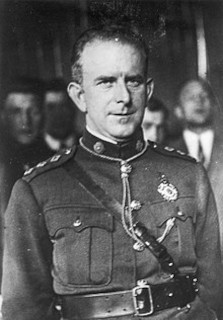
Described by the newspapers of the day as a ‘fierce affray’ the three-hour assault on the RIC barracks at Ballytrain, County Monaghan is a significant engagement for the Monaghan IRA during the War of Independence. Launched at 2:00 AM on a Sunday morning and led by Eoin O’Duffy, later a Commissioner of An Garda Siochana, the attack had been carefully planned.
Located eight miles from Castleblayney, the RIC barracks in Ballytrain is manned by Sergeants Lawson and Graham and four constables, Roddy, Gallagher, Murtagh, and Nelson, all of whom it is said fight against the odds for over three hours. At 5:00 AM, when ‘the leader’ of the IRA party demands the officers surrender it is met by continued firing from the police. O’Duffy then gives the order to plant explosives at the gable wall, which instantly collapses. Four RIC officers are buried in the rubble of the building and are later transferred to Carrickmacross hospital for treatment. About fifty men then rush the building carrying off a quantity of weapons.
A house belonging to a man named Mitchell is raided before the attack, where four members of the family are held hostage throughout the night. The IRA smashes all of the windows in the house allowing them to fire on the barracks. As many as 150 men take part in the raid, which also sees some men taking up position in cattle byres, which had been cleaned out in order to give protection. It is later alleged that O’Duffy had told the RIC men that he was glad no one had been killed in the exchange, saying, “We did not come here to do injury, but only for arms.” It is hardly the welcome Sergeant Graham had expected having only arrived in the barracks three days earlier.
(From: Irish Newspaper Archives, irishnewsarchive.com, February 17, 2020)
Tod is born on May 18, 1836, in Edinburgh into a well-known Irish Presbyterian family, her uncle being the Rev. Hope Masterton Waddell, one of the earliest Irish Presbyterian missionaries who served with the Scottish Missionary Society in Jamaica and whose great grandfather is the Rev. Charles Masterton, one of the most distinguished minsters of the General Synod of Ulster who ministers at Connor and Rosemary Street, Belfast. She is very proud of her Presbyterian heritage and of her Scottish ancestry.
The daughter of James Banks Tod, an Edinburgh merchant, Tod spends her early years in Edinburgh. She is educated at home by her mother, Maria Isabella Waddell, who comes from County Monaghan. The family moves to Belfast in the 1850s following the death of her father. She and her mother join Elmwood Presbyterian Church. Her Presbyterian background no doubt contributes to her radical views on social issues and women’s rights. She earns her living from writing and journalism, contributing, for example, to the Dublin University Magazine, an independent literary, cultural and political magazine, and to the Banner of Ulster, a Presbyterian newspaper.
Tod becomes one of the leading pioneers in the fight to improve the position of women. She is the only woman called to give evidence to a Select Committee of Enquiry on the reform of the married women’s property law in 1868 and serves on the executive of the Married Women’s Property Committee in London from 1873 to 1874. She successfully campaigns for the repeal of the Contagious Diseases Acts of 1864, 1866 and 1869 which enacted that a woman suspected of being a prostitute could be arrested and forced to undergo medical examination for venereal disease. She sees this legislation as an infringement of a woman’s civil liberties.
Tod is also a strong supporter of the temperance movement and, along with her friend Margaret Byers, forms the Belfast Women’s Temperance Association in 1874. Perhaps she is best known for her tireless campaign to extend the educational provision for middle-class women. For example, in 1878 she organises a delegation to London to put pressure on the Government to include girls in the Intermediate Education Act of 1878. The Ladies’ Collegiate School in Belfast, Alexandra College in Dublin and the Belfast Ladies Institute owe their existence largely to her. She writes a paper entitled “An Advanced Education for Girls in the Upper and Middle Classes” which is presented in 1867 at a meeting of the National Association for the Promotion of Social Science and is among the pamphlets held in the Presbyterian Historical Society of Ireland library.
Tod is also an active campaigner for women’s right to vote, embarking on her first campaign in 1872 and addressing meetings in Belfast, Carrickfergus, Coleraine and Londonderry. Following a meeting in Dublin a suffrage committee is established that later becomes the Dublin Women’s Suffrage Society and in 1873 she forms the North of Ireland Women’s Suffrage Society. She extends her meetings to London, Glasgow and Edinburgh and is a frequent visitor to London to lobby politicians during the parliamentary session.
Tod is very much a staunch opponent of Home Rule, establishing a branch of the London-based Women’s Liberal Federation in Belfast and the Liberal Women’s Unionist Association. She sees unionism as the way to progress. “I knew that all the social work in which I had taken so prominent a part for 20 years was in danger and most of it could not exist a day under a petty legislature of the character which would be inevitable,” she says. “What we dread is the complete dislocation of all society, especially in regard to commercial affairs and organised freedom of action.”
Tod suffers from ill-health in her later days and dies in Belfast of pulmonary illness on December 8, 1896. She is buried in Balmoral Cemetery in South Belfast.
As commander of the 2nd Northern Division of the IRA, O’Duffy sees action in Belfast when defending Catholic ghettoes from attacks by Protestant pogromists. He also leads the Free State forces into Limerick city.
In 1933, O’Duffy becomes associated with Cumann na nGaedheal by taking on the leadership of their security organization the Army Comrades Association, later to be known colloquially as the Blueshirts. This organization is to become a participant in many street brawls with anti-treaty sympathizers who try to break up pro-treaty political meetings. When the pro-treaty parties merge in 1933 to become Fine Gael, he is the party President for a short period of time.
After the 1933 Irish general election, which again sees de Valera in power, O’Duffy is dismissed from his post as Garda Commissioner on the grounds that due to his past political affiliations, he will be unable to carry out his duties without bias.
In Europe, the new phenomenon of fascism is gaining ground and O’Duffy, like many of his pro-treaty colleagues, is drawn to it. His Army Comrades Association is renamed the National Guard, and they begin to take on many of the symbols of fascism such as the outstretched arm salute and the blue uniforms.
When O’Duffy plans a massed march for August 1933 in Dublin to commemorate the deaths of Arthur Griffith and Michael Collins, de Valera, fearing a coup, has it banned. Possibly de Valera is also testing the loyalty of the army and the Garda Síochána. In September the National Guard itself is banned although it reforms under the title The League of Youth.
In 1934 O’Duffy suddenly and inexplicably resigns as president of Fine Gael although it is known that many of its members are growing worried by his actions and statements. The Blueshirt movement begins to unravel at the seams. That same year he forms his own fascist movement, the National Corporate Party.
In 1936, supported by the Catholic Church in Ireland, O’Duffy leads 700 of his followers to Spain to help General Francisco Franco in the Spanish Civil War against the republican government. They form part of the XV Bandera Irlandesa del Terico, a part of the Spanish Legion. The Bandera sees little or no action and are returned to Ireland in 1937.
Although O’Duffy has some low-level dalliance with the Nazis he never does regain any of his political influence. His health is on the decline, and he dies on November 30, 1944. De Valera grants him a state funeral and he is interred in Glasnevin Cemetery in Dublin.
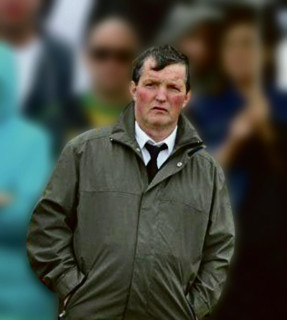
McMahon plants a bomb in Shadow V, a 27-foot fishing boat belonging to Mountbatten at Mullaghmore, near Donegal Bay. Lord Mountbatten and the others are killed on August 27, 1979, when the bomb detonates. The other victims are Doreen Knatchbull, Baroness Brabourne, Mountbatten’s elder daughter’s mother-in-law, his grandson Nicholas Knatchbull and 15-year-old crewmember Paul Maxwell.
McMahon is arrested by the Garda, the Republic of Ireland‘s police force, two hours before the bomb detonates at a Garda checkpoint between Longford and Granard on suspicion of driving a stolen vehicle.
The IRA claims responsibility for the act in a statement released immediately afterwards. In the statement from the organisation they say, “This operation is one of the discriminate ways we can bring to the attention of the English people the continuing occupation of our country.”
McMahon is tried for the assassinations in the Republic of Ireland and convicted by forensic evidence supplied by Dr. James O’Donovan that shows flecks of paint from the boat and traces of nitroglycerine on his clothes. He is sentenced to life imprisonment for murder on November 23, 1979, but is released in 1998 under the terms of the Good Friday Agreement.
Following his release, Toby Harnden in Bandit Country: The IRA & South Armagh (1999) reports that McMahon is holding a tricolour in the first rank of the IRA colour party at a 1998 IRA meeting in Cullyhanna. However, according to a BBC report, McMahon says that he left the IRA in 1990.
McMahon twice refuses to meet John Maxwell, the father of Paul Maxwell, who seeks him out to explain the reasons for his son’s death. In a May 2011 interview for The Telegraph, Maxwell states that he had “made two approaches to McMahon, the first through a priest, who warned me in advance that he thought there wouldn’t be any positive response. And there wasn’t. I have some reservations about meeting him, obviously – it might work out in such a way that I would regret having made the contact. On the other hand, if we met and I could even begin to understand his motivation. If we could meet on some kind of a human level, a man-to-man level, it could help me come to terms with it. But that might be very optimistic. McMahon knows the door is open at this end.”
McMahon likewise refuses requests from Nicholas Knatchbull’s twin brother, who lost an eye in the same explosion. The latter, however, has forgiven McMahon and other members of the IRA who committed the act.
McMahon’s wife has stated, “Tommy never talks about Mountbatten, only the boys who died. He does have genuine remorse. Oh God yes.”
McMahon lives with his wife Rose in Lisanisk, Carrickmacross, County Monaghan. He has two grown sons. He helps with Martin McGuinness‘s presidential campaign in 2011, erecting posters for McGuinness around Carrickmacross.
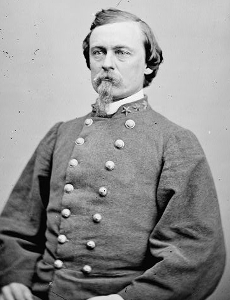
Finegan comes to Florida in the 1830s, first establishing a sawmill at Jacksonville and later a law practice at Fernandina, where he becomes the business partner of David Levy Yulee and begins construction of the Florida Railroad to speed transportation of goods and people from the new state’s east coast to the Gulf of Mexico.
Finegan’s successes are perhaps attributable to his first marriage on July 28, 1842, to the widow Rebecca Smith Travers. Her sister, Mary Martha Smith, is the wife of Florida’s territorial governor, Robert Raymond Reid, an appointee of President Martin Van Buren. In 1852, he is a member of the Committee of Vigilance and Safety of Jacksonville, Florida.
By the outbreak of the American Civil War, Finegan had built his family a forty-room mansion in Fernandina on the site of the modern Atlantic Elementary School. At Florida’s secession convention, he represents Nassau County alongside James G. Cooper.
In April 1862, Finegan assumes command of the District of Middle and Eastern Florida from Brigadier General James H. Trapier. Soon thereafter, he suffers some embarrassment surrounding the wreck of the blockade runnerKate at Mosquito Inlet (the modern Ponce de Leon Inlet). Her cargo of rifles, ammunition, medical supplies, blankets, and shoes is plundered by civilians. Attempts to recover these items takes months before he issues a public appeal. Eventually, most of the rifles are found, but the other supplies are never recovered. Also in 1862, recognizing the importance of Florida beef to the Confederate cause, he gives cattle baron Jacob Summerlin permission to select thirty men from the state troops under his command to assist in rounding up herds to drive north.
At this time, the principal Confederate military post in east Florida is dubbed “Camp Finegan” to honor the state’s highest-ranking officer. It is about seven miles west of Jacksonville, south of the rail line near modern Marietta.
In 1863, Finegan complains of the large quantity of rum making its way from the West Indies into Florida. Smugglers are buying it in Cuba for a mere seventeen cents per gallon, only to sell it in the blockaded state for twenty-five dollars per gallon. He urges Governor John Milton to confiscate the “vile article” and destroy it before it can impact army and civilian morals.
In February 1864, General P. G. T. Beauregard begins rushing reinforcements to Finegan after Confederate officials become aware of a build-up of Union Army troops in the occupied city of Jacksonville. As Florida is a vital supply route and source of beef to the other southern states, they cannot allow it to fall completely into Union hands.
On February 20, 1864, Finegan stops a Union Army advance from Jacksonville under General Truman Seymour that is intent upon capturing the state capitol at Tallahassee. Their two armies clash at the Battle of Olustee, where Finegan’s men defeat the Union Army and force them to flee back beyond the St. Johns River. Critics have faulted Finegan for failing to exploit his victory by pursuing his retreating enemy, contenting himself by salvaging their arms and ammunition from the battlefield. His victory, however, is one rare bright spot in an otherwise gloomy year for the dying Confederacy.
Some Finegan detractors believe he did little more to contribute to the Confederate victory at Olustee than to shuttle troops forward to General Alfred H. Colquitt of Georgia, whom they credit for thwarting the Union Army advance. They point out that Finegan was quickly relieved of his command over the state troops, replaced by Major GeneralJames Patton Anderson. But this change in command is necessary as Finegan is ordered to lead the “Florida Brigade” in the Army of Northern Virginia, where he serves effectively until near the end of the war.
Finegan returns to Fernandina after the war to discover his mansion has been seized by the Freedmen’s Bureau for use as an orphanage and school for black children. It takes some legal wrangling, but he is eventually able to recover this property. He has to sell most of his lands along Lake Monroe to Henry Shelton Sanford for $18,200 to pay his attorneys and other creditors. He does retain a home site at Silver Lake. Adding to his sorrows is the untimely death of his son Rutledge on April 4, 1871, precipitating a move to Savannah, Georgia. There, he feels at home with the large Irish population and works as a cotton broker.
It is while living in Savannah that Finegan marries his second wife, the widow Lucy C. Alexander, a Tennessee belle. They eventually settle on a large orange grove in Orange County, Florida. Finegan dies on October 29, 1885, at Rutledge, Florida. According to the Florida Union, his death is the result of “severe cold, inducing chills, to which he succumbed after brief illness.” The paper describes him as “hearty, unaffected, jovial, clear-headed, and keen-witted.” He is buried at the Old City Cemetery in Jacksonville.
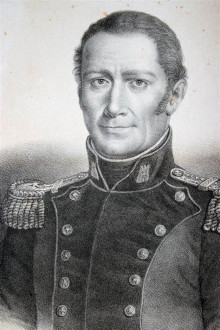
He is born John MacKenna, the son of William MacKenna of Willville House near Monaghan and Eleanora O’Reilly and, on his mother’s side, a nephew to CountAlejandro O’Reilly. Count O’Reilly takes an interest in the young Mackenna and takes him to Spain where he studies at the Royal School of Mathematics in Barcelona. He also trains in the Royal Military Academy as a Military Engineer between 1785 and 1791.
In 1787 Mackenna is accepted into the Irish Brigade of the Spanish Army, and joins the army fighting in Ceuta in northern Africa, under Lieutenant Colonel Luis Urbina, and is promoted to Second Lieutenant. In 1791 he resumes his studies in Barcelona and acts as liaison with mercenaries recruited in Europe. The following year he is promoted to Lieutenant in the Royal Regiment of Engineers. In the War of the Pyrenees against the French, he fights in Rosselló under General Ricardos and there meets the future liberator of Argentina, José de San Martín. For his exploits in defence of the Plaza de Rozas, he is promoted to captain in 1795.
For the purpose of a new assignment, in October 1796, Mackenna leaves Spain for South America. He arrives in Buenos Aires and then travels to Mendoza and to Chile across the Andes and then to Peru. Once in Lima, he contacts Ambrosio O’Higgins, another Irishman, at that time Viceroy of Perú, who names him Governor of Osorno and puts him in charge of the reconstruction works for the southern Chilean town.
In this capacity, Mackenna convinces the families of Castro, on Chiloé Island, to move to Osorno to found a colony there. He builds the storehouse and two mills, as well as the road between Osorno and present-day Puerto Montt. His successful administration provokes jealousy from Chile’s captain-general Gabriel de Avilés, who fears that Mackenna and Ambrosio O’Higgins will create an Irish colony in Osorno. Both Irishmen are loyal to the Spanish crown, though Mackenna has good relations with O’Higgins’ son Bernardo, the future emancipator of Chile, and is also connected with the VenezuelanFrancisco de Miranda and his group of supporters of South American independence. When Ambrosio O’Higgins dies in 1801, Avilés is appointed viceroy of Peru. It takes him eight years to remove Mackenna, O’Higgins’s protégé, from Osorno.
In 1809 Mackenna marries Josefina Vicuña y Larraín, an eighteen-year-old Chilean woman from a family with revolutionary connections, with whom he has three children. After the Declaration of Chilean Independence in 1810, he adheres to the Patriot side and is commissioned by the first Chilean government to prepare a plan for the defense of the country and oversees the equipment of the new Chilean Army. At this juncture he trains the first military engineers for the new army.
The following year Mackenna is called to the defence committee of the new Republic of Chile, and in 1811 is appointed governor of Valparaíso. Owing to political feuds with José Miguel Carrera and his brothers, he is dismissed from the post and taken prisoner. He is a firm ally of Bernardo O’Higgins, who appoints him as one of the key officers to fight the Spanish army of General José Antonio Pareja. His major military honour is attained in 1814 at the Battle of Membrillar, in which the general assures a temporary collapse of the royal forces.
As a reward for his victory, Mackenna is appointed commandant-general by Bernardo O’Higgins, but after a coup d’état led by Luis Carrera he is exiled to Argentina in 1814, when Carrera comes to power. Mackenna dies in Buenos Aires on November 21, 1814, following a duel with Carrera.
A bust of General Mackenna is publicly presented to Monaghan County Museum on August 5, 2004 by his direct descendant, Luis Valentín Ferrada. At the presentation ceremony, MacKenna, the man “unreservedly regarded as the greatest of County Monaghan’s exiles” is commemorated in speeches by Most Rev. Dr. Joseph Duffy, Bishop of Clogher and by his descendant Senor Ferrada who declares, “In this city of Monaghan, very near to Willville House, the tombs of my ancestors are in the old cemetery. There, my own blood is interred in the sacred earth.”
Whitla is the fourth son of Robert Whitla, a woolen draper and pawnbroker, and his wife Anne, daughter of Alexander Williams of Dublin. His first cousin is painter Alexander Williams. Educated at the town’s Model School, he is articled at fifteen to his brother James, a local pharmacist, completing his apprenticeship with Wheeler and Whitaker, Belfast‘s leading pharmaceutical firm. Proceeding to study medicine at Queen’s College, Belfast, he takes the LAH, Dublin, and the LRCP and LRCS of Edinburgh in 1873.
With his qualifications Whitla obtains a post as resident medical officer at the Belfast General Hospital. He next spends some time in London, at St. Thomas’s Hospital, where he meets his future wife, Ada Bourne, daughter of George Bourne, a prominent Staffordshire farmer. She is a ward sister and friend of Florence Nightingale and a member of The Salvation Army.
The pair are married in 1876, settling in Belfast where Whitla establishes a general medical practice. He is awarded the MD of the Queen’s University of Ireland in 1877, with first class honours, gold medal, and commendation.
In 1906 Whitla is appointed a governor of Methodist College Belfast, and he takes a keen interest in the school’s affairs. In 1919, he retires as Professor of Materia Medica in the university.
A strong unionist, Whitla is elected to parliament in 1918, serving until 1923 as representative of the Queen’s University at Westminster. He is appointed honorary physician to the king in Ireland in 1919 and is subsequently university pro-chancellor.
During the 1920s Whitla’s public appearances are fewer and, after a stroke in 1929, he is confined to his room. Lady Whitla dies in 1932. He dies at their Belfast residence, Lennoxvale, on December 11, 1933, and is given a civic funeral two days later. He is buried at Belfast City Cemetery.
During Whitla’s lifetime his gifts to his profession include the Good Samaritan stained glass window erected in the Royal Hospital and a building to house the Ulster Medical Society. At his death Lennoxvale is bequeathed to Queen’s University as a residence for the Vice-Chancellor. The university also is his residuary legatee and acts on his suggestion that the available funds should provide an assembly hall. The Sir William Whitla Hall is opened in 1949.
Whitla also leaves £10,000 to Methodist College Belfast to build a chapel, library or hall. The Whitla Hall at the Methodist College is opened in 1935.
McElwaine is born on April 1, 1960, the oldest of eight children, in the townland of Knockacullion, beside the hamlet and townland of Knockatallon, near the village of Scotstown in the north of County Monaghan. At the age of 14, he takes his first steps towards becoming involved in physical force republicanism when he joins Na Fianna Éireann. Two years later he turns down an opportunity to study in the United States and joins the Irish Republican Army (IRA), stating “no one will ever be able to accuse me of running away.”
McElwaine becomes Officer Commanding of the IRA in County Fermanagh by the age of 19. On February 5, 1980, he kills off-duty Ulster Defence Regiment (UDR) corporal Aubrey Abercrombie as he drives a tractor in the townland of Drumacabranagher, near Florencecourt. Later that year, on September 23, he kills off-duty Royal Ulster Constabulary (RUC) Reserve Constable Ernest Johnston outside his home in Rosslea. He is suspected of involvement in at least ten other killings.
On March 14, 1981, a detachment of the British Army surrounds a farmhouse near Rosslea, containing McElwaine and three other IRA members. Despite being armed with four rifles, including an Armalite, the IRA members surrender and are arrested. While on remand in Crumlin Road Gaol, McElwaine stands in the February 1982 Irish general election as an independent candidate for Cavan–Monaghan and receives 3,974 votes (6.84% of the vote). In May 1982 he is convicted of murdering the RUC and UDR members, with the judge describing him as a “dangerous killer” and recommending he spend at least 30 years in prison.
On September 25, 1983, McElwaine is involved in the Maze Prison escape, the largest break-out of prisoners in Europe since World War II and in British prison history. Thirty-eight republican prisoners, armed with six handguns, hijack a prison meals lorry and smash their way out of the prison. After the escape McElwaine joins an IRA Active Service Unit operating in the area of the border between Counties Monaghan and Fermanagh. The unit targets police and military patrols with gun and bomb attacks, while sleeping rough in barns and outhouses to avoid capture.
On April 26, 1986, McElwaine and another IRA member, Seán Lynch, are preparing to ambush a British Army patrol near Rosslea, County Fermanagh when they are ambushed themselves by a detachment from the Special Air Service Regiment. Both are wounded but Lynch manages to crawl away. A January 1993 inquest jury returns a verdict that McElwaine had been unlawfully killed. The jury rules the soldiers had opened fire without giving him a chance to surrender, and that he was shot dead five minutes after being wounded. The Director of Public Prosecutions requests a full report on the inquest from the RUC, but no one has been prosecuted for McElwaine’s death.
McElwaine is buried in Scotstown, with his funeral attended by an estimated 3,000 people, including Gerry Adams and Martin McGuinness. McGuinness gives an oration describing McElwaine as “a brave intelligent soldier, a young man who gave up his youth to fight for the freedom of his country” and “an Irish freedom fighter murdered by British terrorists.”
On April 1, 1990, a monument to McElwaine is erected in Corlat, County Monaghan. The oration is given by a Catholic priest, Father Piaras Ó Dúill, who compares McElwaine to Nelson Mandela, saying they both had the same attitude to oppression, and both refused to denounce principle. The inscription on the monument is a quote from Patrick Pearse: “As long as Ireland is unfree the only honourable attitude for Irishmen and Irishwomen is an attitude of revolt.” A monument to McElwaine and six other republicans is erected in Rosslea in 1998 and unveiled by veteran republican Joe Cahill.
Duffy is born on April 12, 1816, in Dublin Street, Monaghan, County Monaghan. Both of his parents die while he is still a child and his uncle, Fr. James Duffy, who is the Catholic Parish Priest of Castleblayney, becomes his guardian for a number of years. He is educated at St. Malachy’s College in Belfast and is admitted to the Irish Bar in 1845. Duffy becomes a leading figure in Irish literary circles.
In August 1850, Duffy forms the Tenant Right League to bring about reforms in the Irish land system and protect tenants’ rights, and in 1852 is elected to the House of Commons for New Ross. By 1855, the cause of Irish tenants seems more hopeless than ever. Broken in health and spirit, Duffy publishes a farewell address to his constituency, declaring that he has resolved to retire from parliament, as it is no longer possible to accomplish the task for which he has solicited their votes.
In 1871, Duffy leads the opposition to Premier Sir James McCulloch‘s plan to introduce a land tax, on the grounds that it unfairly penalises small farmers. When McCulloch’s government is defeated on this issue, Duffy becomes Premier and Chief Secretary. The majority of the colony is Protestant, and Duffy is accused of favouring Catholics in government appointments. In June 1872, his government is defeated in the Assembly on a confidence motion allegedly motivated by sectarianism.
When Graham Berry becomes Premier in 1877, he makes Duffy Speaker of the Legislative Assembly, a post he holds without much enthusiasm until 1880, when he quits politics and retires to the south of France. He remains interested in both the politics of his adoptive country and of Ireland. He is knighted in 1873 and is made KCMG in 1877. Sir Charles Gavan Duffy dies in Nice, France, at the age of 86 in 1903.
Micheal O’Siadhail, poet and linguist, is born in Dublin on January 12, 1947. Among his awards are The Marten Toonder Prize and The Irish American Culture Institute Prize for Literature.
O’Siadhail is born into a middle-class Dublin family. His father, a chartered accountant, is born in County Monaghan and works most of his life in Dublin, and his mother is a Dubliner with roots in County Tipperary. Both of them are portrayed in his work in several poems such as “Kinsmen” and “Promise”. From the age of twelve, he is educated at the Jesuit boarding school Clongowes Wood College, an experience he is later to describe in a sequence of poems “Departure” (The Chosen Garden).
At Clongowes O’Siadhail is influenced by his English teacher, the writer Tom MacIntyre, who introduces him to contemporary poetry. At thirteen he first visits the Aran Islands. This pre-industrial society with its large-scale emigration has a profound impact on him. His earlier work reflects this tension between his love of his native Dublin and his emotional involvement with those outlying communities and which features in the sequence “Fists of Stone” (The Chosen Garden).
In 1970 O’Siadhail marries Bríd Ní Chearbhaill, who is born in Gweedore, County Donegal. She is for most of her life a teacher and later head mistress in an inner-city Dublin primary school until her retirement in 1995 due to Parkinson’s disease. She is a central figure in his oeuvre celebrated in the sequence “Rerooting” in The Chosen Garden and in Love Life, which is a meditation on their lifelong relationship. One Crimson Thread travels with the progression of her Parkinson’s Disease. She dies on June 17, 2013.
For seventeen years, O’Siadhail earns his living as an academic; firstly, as a lecturer at Trinity College (1969–73) where he is awarded a Master of Letters degree in 1971 and then as a research professor at the Dublin Institute for Advanced Studies. During these years he gives named lectures in Dublin and at Harvard University and Yale University and is a visiting professor at the University of Iceland in 1982. In 1987 he resigns his professorship to devote himself to writing poetry which he describes as “a quantum leap.”
During his years as an academic, O’Siadhail, writing under the Irish spelling of his name, published works on the linguistics of Irish and a textbook for learners of Irish.
O’Siadhail serves as a member of the Arts Council of the Republic of Ireland (1987–93), of the Advisory Committee on Cultural Relations (1989–97) and is editor of Poetry Ireland Review. He is the founding chairman of ILE (Ireland Literature Exchange). As a founder member of Aosdána (Academy of Distinguished Irish Artists) he is part of a circle of artists and works with his friend the composer Seóirse Bodley, the painters Cecil King and Mick O’Dea and in 2008 gives a reading as part of Brian Friel‘s eightieth birthday celebration.