Two warships, the Rhathemus and the Dee, steam into Dublin Harbour, carrying around 3,000 British troops to ensure the mass rally in favour of Repeal of the Union does not take place. The nationalist newspaper, the Freeman’s Journal, alleges that the troops have been summoned to “cut the people down” and “run riot in the blood of the innocent.”
O’Connell, the charismatic leader of the Repeal Association, has always insisted that his movement is non-violent. On the banning of the meeting and the arrival of troops, he frantically moves to call it off and to prevent “the slaughter of the people.”
Handbills are posted around the streets of Dublin advising his supporters of the meeting’s cancellation. A prominent Dublin builder and O’Connell supporter, Peter Martin, is sent to Clontarf to dismantle the platform erected there. Other activists are sent on horseback to the roads leading into the city to send back the thousands converging on Clontarf for the meeting.
The following day passes without incident. The Freeman’s Journal rages against the “corrupt and impotent Government that has perverted the form of law for the purpose of robbing the people.”
The Warder, a Dublin unionist newspaper, had been urging the suppression of the “plainly illegal under common law” O’Connellite mass meetings for months. The newspaper stops short of calling for civil war in the run–up to the meeting. Now it declares itself satisfied. It congratulates the Conservative government for belatedly seeing sense.
By contrast, the Repeal camp is deeply split. Many, particularly those Young Irelanders grouped around The Nation, blame O’Connell for capitulation to the threat of force and for his unwillingness to confront the British government. They break from him acrimoniously the following year.
With the cancellation of the Clontarf meeting, O’Connell’s strategy of mass mobilisation in pursuit of Irish self government is over. He himself is arrested on charges of “seditious conspiracy” three days later.
(From: “Today in Irish History, The Repeal Meeting at Clontarf is Banned, 8 October 1843, John Dorney, The Irish Story (theirishstory.com), October 8, 2011)
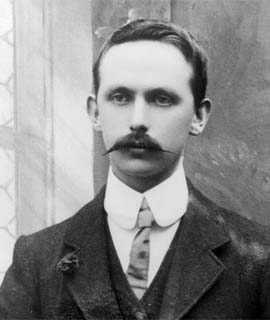
Ceannt, born Edward Thomas Kent, is the sixth of seven children of James Kent and Joanne Galway. His father is a Royal Irish Constabulary officer stationed in Ballymoe. In 1883 he is promoted and transferred to Ardee, County Louth. When his father retires from the force in 1892, the family moves to Dublin. Here he attends the North Richmond Street Christian Brothers School. Two other leaders from the 1916 rising, Seán Heuston and Con Colbert, are educated at the school. Upon finishing school, he goes on to secure a job with the clerical staff of the City Treasurer and Estates and Finances office. He works as an accountant with the Dublin Corporation from 1901-1916.
In 1907 Ceannt joins the Dublin central branch of Sinn Féin and over the following years becomes increasingly determined to see an Independent Ireland. In 1912 he is sworn to the Irish Republican Brotherhood (IRB) by Seán MacDiarmada. This movement is pledged to achieve Irish independence and to do so by using physical force if necessary.
In May 1915, the IRB Military Council, consisting of Joseph Plunkett and Seán MacDiarmada as well as Ceannt, begin plans for a rebellion. Ceannt is one of the seven men to sign the Proclamation of the Irish Republic and is appointed Director of Communications. He is made commandant of the 4th Battalion of the Volunteers and during the Rising is stationed at the South Dublin Union, with more than 100 men under his command, notably his second-in-command Cathal Brugha, and W. T. Cosgrave. The South Dublin Union controls a large area south of Kilmainham around Dolphin’s Barn.
As 3rd Royal Irish come to Mount Brown, a section of Ceannt’s battalion under section commander John Joyce opens fire, killing a number of soldiers. The British cannot break through to Dublin Castle and so bring up more troops from Kilmainham Barracks. A ceasefire allows casualty retrieval. The Volunteers drive back repeated assaults from determined regimental attacks. Ceannt uses a contingent at the Marrowbone Lane Distillery to enfilade the passing soldiers. On Tuesday, April 25, the British could close off the battle but fail to press home the advantage when the 4th Royal Dublin Fusiliers arrive. Ceannt continues to hold out with 20 times fewer men. On Thursday, April 27, a British battalion comes south as far as the Rialto Bridge when Ceannt’s outposts open fire.
The British are forced to tunnel into the buildings and, as Ceannt’s numbers reduce, it is increasingly involved in close quarter fighting. His unit sees intense fighting at times during the week but surrenders when ordered to do so by his superior officer Patrick Pearse.
After the unconditional surrender of the 1916 fighters, Ceannt, along with the other survivors, are brought to Richmond Barracks to be detained. On Monday, May 1, plain clothes detectives known as the “G-men” identify the leaders of the Rising, Ceannt being one of them. He is tried under court martial as demanded by General John Maxwell. Maxwell is determined to afflict the death penalty upon Ceannt and the other leaders of the Rising. However, he faces legal issues which only allow the death penalty to be used if one is found aiding the enemy, being Germany at this time. Not until Maxwell obtains a letter from Patrick Pearse addressed to his mother regarding the communication with the Germans is he legally obliged to deploy the death penalty. From this point Ceannt and his comrades begin facing the prospect of a firing squad. On Tuesday, May 2, he is sent to Kilmainham Gaol to face trial and execution.
Ceannt is held in Kilmainham Gaol until his execution by firing squad on May 8, 1916, aged 34. He is buried at Arbour Hill Prison in Dublin.
Robert Emmet, one of the most famous revolutionaries in Irish history, is captured by the British at the home of a Mrs. Palmer in Harold’s Cross, outside Dublin on August 25, 1803.
Emmet is born at 109 St. Stephen’s Green in Dublin on March 4, 1778. He is the youngest son of Dr. Robert Emmet, a court physician, and his wife Elizabeth Mason. He attends Oswald’s school in Dopping’s-court, off Golden-lane and enters Trinity College, Dublin, in October 1793 at the age of fifteen. In December 1797, he joins the College Historical Society, a debating society.
While he is in college, his brother Thomas and some of his friends become involved in political activism. Emmet becomes secretary of a secret United Irish Committee in college and is expelled in April 1798 as a result. That same year he flees to France to avoid the many British arrests of nationalists that are taking place in Ireland. While in France, he garners the support of Napoleon, who promises to lend support when the upcoming revolution starts.
After the Irish Rebellion of 1798, Emmet is involved in reorganising the defeated Society of United Irishmen. In April 1799, a warrant is issued for his arrest. He escapes and soon after travels to the continent in the hope of securing French military aid. His efforts are unsuccessful, as Napoleon is concentrating his efforts on invading England. He returns to Ireland in October 1802.
In March of the following year, Emmet begins to prepare a new rebellion, with fellow Anglo-Irish revolutionaries Thomas Russell and James Hope. The revolutionaries conceal their preparations, but a premature explosion at one of Emmet’s arms depots kills a man, forcing Emmet to advance the date of the rising before the authorities’ suspicions are aroused.
Despite being unable to secure help from Michael Dwyer‘s Wicklow rebels and many rebels from Kildare turning back due to the scarcity of firearms, the rising begins in Dublin on the evening of July 23, 1803. Failing to seize the lightly defended Dublin Castle, the rising amounts to a large-scale disturbance in the Thomas Street area. Emmet witnesses a dragoon being pulled from his horse and piked to death, the sight of which prompts him to call off the rising to avoid further bloodshed. However, sporadic clashes continue into the night until finally quelled by British military forces.
Emmet flees into hiding, moving from Rathfarnham to Harold’s Cross so that he can be near his sweetheart, Sarah Curran. He is captured on August 25 and taken to Dublin Castle, then later removed to Kilmainham Gaol. Vigorous but ineffectual efforts are made to procure his escape.
Emmet is tried for and found guilty of high treason on September 19, 1803. Chief Justice John Toler, 1st Earl of Norbury sentences Emmet to be hanged, drawn, and quartered, as is customary for conviction of treason. The following day, Emmet is executed in Thomas Street near St. Catherine’s Church. He is hanged and beheaded after his death. Out of fear of being arrested, no one comes forward to claim his remains.
Emmet’s remains are first delivered to Newgate Prison and then returned to Kilmainham Gaol, where the jailer is under instructions to be bury the remains in a nearby hospital’s burial grounds if no one claims them. No remains have been found there and though not confirmed, it appears that he was secretly removed and reinterred in St. Michan’s Church, a Dublin church with strong United Irish associations. There is also speculation that the remains are buried secretly in the vault of a Dublin Anglican church. When inspected in the 1950s, a headless corpse is found in the vault but cannot be identified. The widely accepted theory is that Emmet’s remains are transferred to St. Peter’s Church in Aungier St. under cover of the burial of his sister in 1804. In the 1980s the church is deconsecrated, and all the coffins are removed from the vaults. The church has since been demolished.
O’Neill, the eldest legitimate son of Conn O’Neill, 1st Earl of Tyrone, is a chieftain whose support the English consider worth gaining. However, he rejects overtures from Thomas Radclyffe, 3rd Earl of Sussex, the Lord Deputy of Ireland, and refuses to help the English against the Scottish settlers on the coast of Antrim. He allies himself instead with the MacDonnells, the most powerful of these immigrants. Nevertheless, Queen Elizabeth I of England is disposed to come to terms with O’Neill who, after his father’s death, is de facto chief of the O’Neill clan. She recognizes his claims to the chieftainship, thus throwing over a kinsman, Brian O’Neill. O’Neill, however, refuses to put himself in the power of Sussex without a guarantee for his safety and his claims are so exacting that Elizabeth determines to restore Brian. An attempt to incite the O’Donnells against him, however, is frustrated.
Elizabeth, who is not prepared to undertake the subjugation of the Irish chieftain, urgently desires peace with O’Neill, especially when the devastation of his territory by Sussex brings him no nearer to submission. Sussex is not supported by the queen, who sends Gerald FitzGerald, 11th Earl of Kildare to arrange terms with O’Neill. The latter agrees to present himself before Elizabeth. Accompanied by Thomas Butler, 10th Earl of Ormond and Kildare, he reaches London on January 4, 1562. Elizabeth temporizes but, finding that O’Neill is in danger of becoming a tool in the hands of Spanish intriguers, permits him to return to Ireland, recognizing him as “the O’Neill,” and chieftain of Tyrone.
There are at this time three powerful contemporary members of the O’Neill family in Ireland — O’Neill, Turlough Lynagh O’Neill, and Matthew Ó Néill, 1st Baron Dungannon. Turlough had schemed to supplant O’Neill during his absence in London. The feud does not long survive O’Neill’s return to Ireland, where he reestablishes his authority and renews his turbulent tribal warfare. Elizabeth at last authorizes Sussex to take the field against O’Neill, but two expeditions fail. O’Neill then lays the entire blame for his lawless conduct on the lord deputy’s repeated alleged attempts on his life. Elizabeth consents to negotiate, and practically all of O’Neill’s demands are conceded.
O’Neill then turns his hand against the MacDonnells, claiming that he is serving the Queen of England in harrying the Scots. He fights an indecisive battle with Sorley Boy MacDonnell near Coleraine in 1564, and in 1565 he routs the MacDonnells and takes Sorley Boy prisoner near Ballycastle. This victory strengthens O’Neill’s position, but the English make preparations for his subjugation.
Failing in an attempt to arrange terms, and also in obtaining the help which he solicited from France, O’Neill is utterly routed by the O’Donnells at the Battle of Farsetmore near Letterkenny and, seeking safety in flight, throws himself on the mercy of his enemies, the MacDonnells. Attended by a small body of gallowglass, and taking his prisoner Sorley Boy with him, he presents himself among the MacDonnells near Cushendun, on the Antrim coast, hoping to propose an alliance. Here, on June 2, 1567, he is killed by the MacDonnells and his headless body is buried at Crosskern Church at Ballyterrim above Cushendun. His body is possibly later moved to Glenarm Abbey. Unbeknownst to O’Neill, The Scots had already come to an agreement with Henry Sidney and William Piers, Seneschal of Clandeboye, commander of the English garrison at Carrickfergus. The English Government tries to pass this off as a “drunken brawl” turned savage. Piers travels to Cushendun to take O’Neill’s head and send it to Dublin Castle.
The Restoration of the monarchy begins in 1660. The Commonwealth of England, Scotland and Ireland (1649–60) result from the Wars of the Three Kingdoms but collapse in 1659. Politicians such as General George Monck try to ensure a peaceful transition of government from the “Commonwealth” republic back to monarchy. From May 1, 1660 the English, Scottish and Irish monarchies are all restored under King Charles II. The term Restoration may apply both to the actual event by which the monarchy was restored, and to the period immediately before and after the event.
With the collapse of The Protectorate in England during May 1659 the republic which had been forced upon Ireland by Oliver Cromwell quickly begins to unravel.
Royalists plan an uprising in Ireland and seek to turn Henry Cromwell and Lord Broghill, who is in contact with the King’s court in the summer of 1659, towards the cause but the plan comes to aught. Henry Cromwell leaves Ireland in June 1659. Broghill shows reluctance to declare for the King, but nevertheless republicans are suspicious of him following George Booth‘s revolt in England in 1659.
Sir Theophilus Jones, a former soldier under Charles I of Ireland and governor of Dublin during the republic, seizes Dublin Castle with a group of officers and declares for Parliament. Acting in Charles II’s interest, Sir Charles Coote seizes Galway while Lord Broghill holds firm in Munster. On January 9, 1660 a council of officers declare Edmund Ludlow a traitor and he flees to England. The regicideHardress Waller re-takes Dublin Castle in February 1660 but with little support he surrenders to Sir Charles Coote. Waller along with fellow regicide John Cook is arrested and sent to England. The officers in Dublin support General Monck.
The army is purged of radicals and a Convention Parliament is called. Coote seeks to move the Convention Parliament towards restoration, but his rival Broghill does not openly declare for the King until May 1660.
In February 1660 Coote sends a representative to King Charles II in the Netherlands and invites him to make an attempt on Ireland, but the King regards it as inexpedient to try to reclaim Ireland before England. At the same time Broghill sends his brother to invite the King to land at Cork. In March 1660 a document is published asking for the King’s return, “begged for his forgiveness, but stipulated for a general indemnity and the payment of army arrears.”
Following events in England, Charles is proclaimed King of Ireland in Dublin on May 14 without any dissent. The Irish Royal Army is reestablished.
After 1660, the commonwealth parliamentary union is treated as null and void. As in England the republic is deemed constitutionally never to have occurred. The Convention Parliament is dissolved by Charles II in January 1661, and he summons his first parliament in Ireland in May 1661.
(Pictured: Charles II in Garter robes by John Michael Wright or studio, c. 1660–1665)
Myles is the third of eleven children born to John Myles (1807-1871), a wealthy corn merchant, and his second wife Prudence, daughter of William Bradshaw of Kylebeg, County Tipperary. The Myles family has been prominent merchants in and around Limerick city since Oliver Cromwell‘s time.
A prominent sportsman from an early age, Myles graduates in medicine at Trinity College Dublin in 1881. One of his duties in his first job as resident surgeon at Dr. Steevens’ Hospital is to render medical assistance to the victims of the Phoenix Park murders on May 6, 1882.
Myles is also an active Home Ruler. He owns a yacht, the Chotah. In 1914, he is recruited by James Creed Meredith to help in the importation of guns for the Irish Volunteers with Erskine Childers, Edward Conor Marshall O’Brien and others. Childers lands his part of the consignment from the Asgard at Howth on July 26, 1914. Myles’s cargo is landed by the Chotah at Kilcoole, County Wicklow a week later. Meredith himself helps out aboard the Chotah during the operation. On August 1, 1914, 600 Mauser rifles and 20,000 rounds of ammunition are landed at the beach in Kilcoole. Once the arms are landed, they are taken away by Volunteers on bicycles and in vehicles. The arms are taken to Patrick Pearse‘s St. Enda’s School, in Rathfarnham, County Dublin.
Myles is appointed temporary Lieutenant Colonel in the Royal Army Medical Corps on November 21, 1914, and also becomes Honorary Surgeon in Ireland to the King. He is appointed to be an Additional Member of the Military Division of the Third Class, or Companion, of the Most Honourable Order of the Bath, for services rendered in connection with the war, the appointment to date from January 1, 1917.
Sir Thomas Myles dies at the St. Lawrence’s Hospital in Dublin on July 14, 1937, and is buried at Deansgrange Cemetery in Dublin. Every year at the University of Limerick, the Sir Thomas Myles lecture is delivered as part of the Sylvester O’Halloran Surgical Meeting in honour of this remarkable surgeon and son of Limerick.
Republican activists James Murphy and Patrick Kennedy are murdered in Dublin on February 9, 1921.
Murphy and Kennedy are arrested by Auxiliaries in Dublin and are in the custody of ‘F’ Company of the Auxiliary Division of the Royal Irish Constabulary (ADRIC). Two hours later, constables of the Dublin Metropolitan Police find the two men lying shot, with pails on their heads, in Clonturk Park, Drumcondra. Kennedy is dead and Murphy is dying. Murphy dies in Mater Hospital, Dublin on February 11, but just before dying he testifies that Captain William Lorraine King, commanding officer of ‘F’ Company ADRIC, had taken them and stated that they were “just going for a drive.” King is arrested for the killings. King and two of his men, H. Hinchcliffe and F.J. Welsh are court-martialed on February 13-15 but are acquitted after Murphy’s dying declaration is ruled inadmissible, and two officers from ‘F’ Company provide perjured alibis for Captain King at the time of the shootings.
King is implicated and court-martialed for the deaths of Conor Clune, Peader Clancy, and Dick McKee, the latter two leading lights in the Dublin Irish Republican Army (IRA), the former a luckless Gaelic League member. All three are captured in Dublin on November 20, 1920, the day before Bloody Sunday. Clune is caught at Vaughn’s Hotel in Parnell Square, Dublin and the two IRA leaders at Lower Gloucester St., complete with British army officer uniforms and detonators. Sometime between then and the next day, as news no doubt filters in of the deaths of several British intelligence officers, the prisoners are killed in questionable circumstances in the Dublin Castle guard room. According to an official report from Dublin Castle, the prisoners attempt to grab rifles and hurl unfused grenades and are killed in that action. The guards of ‘F’ Company in the room at the time are cleared of wrongdoing by a court inquiry. A Major Reynolds of ‘F’ Company is said to pass details of the killers to Michael Collins. The Times notes that it seems as if the prisoners had been lined up and shot. In a later novel, Major Jocelyn Lee Hardy more or less confesses to the killing of one of the prisoners.
Ironically, Captain King is on Michael Collins list of British Intelligence officers to be executed on the morning of November 20, 1920. He is not in his room when the assassins arrive as he is interrogating the prisoners in Dublin Castle.
(Pictured: Major William Lorraine King, ‘F’ Company Auxiliary Division of the Royal Irish Constabulary)
In the 17th century, parliament settles at Chichester House, a town house in Hoggen Green (later College Green) formerly owned by Sir George Carew, Lord President of Munster and Lord High Treasurer of Ireland, which had been built on the site of a nunnery disbanded by King Henry VIII at the time of the dissolution of the monasteries. Carew’s house, named Chichester House after its later owner Sir Arthur Chichester, is a building of sufficient importance to have become the temporary home of the Kingdom of Ireland’s law courts during the Michaelmas law term in 1605. Most famously, the legal documentation facilitating the Plantation of Ulster is signed there on November 16, 1612.
Chichester House is in a dilapidated state, allegedly haunted and unfit for official use. In 1727 parliament votes to spend £6,000 on a new building on the site. It is to be the world’s first purpose-built two-chamber parliament building.
The then ancient Palace of Westminster, the seat of the English before 1707 and, later, British Parliament, is a converted building. The House of Commons‘s odd seating arrangements is due to the chamber’s previous existence as a chapel. Hence MPs face each other from former pews.
The original, domed House of Commons chamber is destroyed by fire in the 1790s, and a less elaborate new chamber, without a dome, is rebuilt in the same location and opened in 1796, four years before the Parliament’s ultimate abolition.
Pearce’s designs come to be studied and copied both at home and abroad. The Viceregal Apartments in Dublin Castle imitate his top-lit corridors. The British Museum in Bloomsbury in London copies his colonnaded main entrance. His impact reaches Washington, D.C., where his building, and in particular his octagonal House of Commons chamber, is studied as plans are made for the United States Capitol building. While the shape of the chamber is not replicated, some of its decorative motifs are, with the ceiling structure in the Old Senate Chamber and old House of Representatives chamber (now the National Statuary Hall) bearing a striking resemblance to Pearce’s ceiling in the House of Commons.
(Pictured: Architectural drawing of the front of Parliament House by Peter Mazell based on the drawing by Rowland Omer, 1767)
O’Brien moves with his family to Dublin in 1897 and quickly becomes involved in the Irish Socialist Republican Party (ISRP). He is described as “a very significant figure in the ISRP” by ISRP historian David Lynch. He is a member of the Socialist Party of Ireland, serving on its executive.
An important figure in the Labour Party in Ireland in its formative days, O’Brien resists James Larkin‘s attempt to gain control of the Party on release from prison. Taking Larkin to court over his occupation of ITGWU headquarters, the Larkin-O’Brien feud results in a split within the labour and trade union movements, and the formation of the Irish Congress of Trade Unions.
In 1930, O’Brien seeks to have Leon Trotsky granted asylum in Ireland, but the head of the Free State government, W. T. Cosgrave, refuses to allow it.
Active in politics and the trade union movement into his 60s, O’Brien retires in 1946 and dies on October 31, 1968.
Luby is the son of a Church of Ireland clergyman from Templemore, County Tipperary, his mother being a Catholic. He is educated at Trinity College Dublin where he studies law and puts in the necessary number of terms in London and Dublin where he acquires a reputation as a scholar and takes his degree. He goes on to teach at the college for a time.
In 1851 Luby travels to France, where he hopes to join the French Foreign Legion to learn infantry tactics but finds the recruiting temporarily suspended. From France he goes to Australia for a year before returning to Ireland. From the end of 1855 he edits the Tribune newspaper founded by John E. Pigot who had been a member of The Nation group. During this time, he remains in touch with the small group of ’49 men including Philip Gray and attempts to start a new revolutionary movement. Luby’s views on social issues grow more conservative after 1848 which he makes clear to James Stephens whom he meets in 1856.
In the autumn of 1857 Owen Considine arrives with a message signed by four Irish exiles in the United States, two of whom are John O’Mahony and Michael Doheny. The message conveys the confidence they have in Stephens and asks him to establish an organisation in Ireland to win national independence. Considine also carries a private letter from O’Mahony to Stephens which is a warning, and which is overlooked by Luby and Stephens at the time. Both believe that there is a strong organisation behind the letter, only later to find it is rather a number of loosely linked groups. On December 23 Stephens dispatches Joseph Denieffe to America with his reply which is disguised as a business letter dated and addressed from Paris. In his reply, Stephen’s outlines his conditions and his requirements from the organisation in America.
On March 17, 1858, Denieffe arrives in Dublin with the acceptance of Stephens’s terms by the New York Committee and the eighty pounds. On that very evening the Irish Republican Brotherhood is established in Peter Langan’s timberyard in Lombard Street.
In mid-1863 Stephens informs his colleagues he wishes to start a newspaper, with financial aid from O’Mahony and the Fenian Brotherhood in America. The offices are established at 12 Parliament Street, almost at the gates of Dublin Castle. The first issue of the Irish People appears on November 28, 1863. The staff of the paper along with Luby are Charles J. Kickham and Denis Dowling Mulcahy as the editorial staff. Jeremiah O’Donovan Rossa and James O’Connor have charge of the business office, with John Haltigan being the printer. John O’Leary is brought from London to take charge in the role of Editor.
On July 15, 1865, American-made plans for a rising in Ireland are discovered. Superintendent Daniel Ryan, head of the G Division of the Dublin Metropolitan Police at Dublin Castle, has an informer within the offices of the Irish People who supplies him with an “action this year” message on its way to the IRB unit in Tipperary. With this information, Ryan raids the offices of the Irish People on Thursday, September 15, followed by the arrests of Luby, O’Leary and O’Donovan Rossa. Kickham is caught after a month on the run. Stephens is also caught with the support of Fenian prison warders. The last number of the paper is dated September 16, 1865.
After his arrest and the suppression of the Irish People, Luby is sentenced to twenty years of penal servitude. He is released in January 1871 but is compelled to remain away from Ireland until the expiration of his sentence.
Upon his release Luby goes first to the Continent and later settles in New York City. He lectures all over the country for years and writes for a number of Irish newspapers on political topics. At the memorial meeting on the death of John Mitchel, he delivers the principal address in Madison Square Garden.
Thomas Clarke Luby dies at 109½ Oak Street, Jersey City, New Jersey of paralysis, on November 29, 1901, and is buried in a grave shared with his wife in Bayview Cemetery in Jersey City. His epitaph reads: “Thomas Clarke Luby 1822–1901 He devoted his life to love of Ireland and quest of truth.”