seamus dubhghaill

Promoting Irish Culture and History from Little Rock, Arkansas, USA


Leave a comment

Death of Basil Maturin, Catholic Priest & Writer

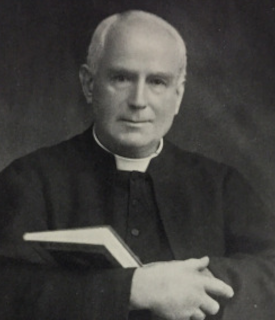
Basil William Maturin, Irish-born Anglican priest, preacher and writer who later converts to Catholicism, dies aboard the RMS Lusitania after it is torpedoed by a German U-boat and sinks on May 7, 1915.

Maturin is born on February 15, 1847, at All Saints’ vicarage, Grangegorman, Dublin, the third of the ten children of the Rev. William Basil Maturin and his wife, Jane Cooke (née Beatty). The Maturins, a prominent Anglo-Irish family of Huguenot ancestry, have produced many influential Church of Ireland clergymen over the generations, the most notable being Maturin’s grandfather, the writer Charles Robert Maturin. His own father, whose tractarian convictions are considered too “high church” for many in Dublin, is a somewhat controversial figure in the church. Religion plays a huge part in the Maturin children’s lives. Two of his brothers enter the church and two sisters become nuns. As a young man, he assists in training the choir and playing the organ at his father’s church. Educated at home and at a Dublin day school, he goes on to attend Trinity College Dublin (TCD), from where he graduates BA in 1870.

Though he initially intends to make a career in the army as an engineer, a severe attack of scarlet fever around 1868, and the death of his brother Arthur, changes his outlook on life, and he decides to become a clergyman. He is ordained a deacon in 1870 and later that year goes as a curate to Peterstow, Herefordshire, England, where his father’s friend Dr. John Jebb is rector. He subsequently joins the Society of St. John the Evangelist, entering the novitiate at Cowley, Oxford, in February 1873. As a Cowley father he is sent in 1876 to establish a mission in Philadelphia, Pennsylvania, where he works as an assistant priest and, from 1881, as rector of Saint Clement’s Church. Though he proves to be an effective clergyman and popular preacher, his growing religious doubts and increasing interest in Catholicism results in his returning to Oxford in 1888. Then follows a six-month visit in 1889–90 to a society house in Cape Town, South Africa. He returns to Britain, where he preaches, and conducts retreats around the country and occasionally on the continent. In 1896 he produces the first in a series of religious publications, Some Principles and Practices of Spiritual Life.

Maturin’s continuing religious anxieties eventually lead to his conversion to Catholicism on March 5, 1897, at the Jesuit Beaumont College outside London. He then studies theology at the Canadian College, Rome, and is ordained there in 1898. Following his return to England he lives initially at Archbishop’s House, Westminster, and undertakes missionary work. He then serves at St. Mary’s, Cadogan Street, in 1901. He becomes parish priest of Pimlico and, in 1905, having joined the newly established Society of Westminster Diocesan Missionaries, organises the opening of St. Margaret’s chapel on St. Leonard’s Street, where huge crowds come to hear his sermons. As a Catholic priest, he returns to Ireland on several occasions, and frequently preaches at the Carmelite church, Clarendon Street, Dublin. His attempt, at the age of sixty-three, to enter into monastic life at the Benedictine monastery at Downside, in 1910, proves unsuccessful. He returns to London and begins working in St. James’s, Spanish Place, while maintaining his preaching commitments. He continues to write, publishing Self-Knowledge and Self-Discipline (1905), Laws of the Spiritual Life (1907) and his autobiographical The Price of Unity (1912), in which he traces his gradual move toward Catholicism. His sermons, like his approach when hearing confessions, are said to have much appeal for their integrity. Despite his influence as a preacher, he seems often feel that his life and vocation lack real purpose and at times he suffers from depression.

After a brief visit to the United States in 1913, Maturin accepts the post of Catholic chaplain at the University of Oxford in 1914. He travels to New York in 1915 and, after preaching there throughout the spring, boards the RMS Lusitania in May to return to England. The liner is torpedoed and sinks on May 7, 1915, off the southern coast of Ireland. He assists his fellow passengers in the last minutes, and it is presumed that he refuses a life jacket, as they are in short supply. His body washes ashore. A service is held for him at Westminster Cathedral.

Maturin’s friend Wilfrid Philip Ward edits a collection of his spiritual writings, Sermons and Sermon Notes, in 1916.

(From: “Maturin, Basil William” by Frances Clarke, Dictionary of Irish Biography, http://www.dib.ie, October 2009)


Leave a comment

Birth of Alexander Mitchell, Engineer & Inventor

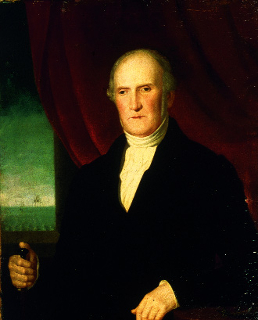
Alexander Mitchell, Irish engineer who from 1802 is blind, is born in Dublin on April 13, 1780. He is known as the inventor of the screw-pile lighthouse.

Mitchell’s family moves to Belfast while he is a child. He receives his formal education at Belfast Academy where he excels in mathematics. He begins to notice that his eyesight is failing. By the age of 16 he can no longer read and by the age of 22 he is completely blind.

Undeterred, Mitchell borrows £100 and starts up a successful business making bricks in the Ballymacarrett area of Belfast. This enables him to start building his own houses and he completes approximately twenty in the city. It is during this period that his talent for inventing comes to the fore and he fabricates several machines for use in brickmaking and the building trade.

Mitchell patents the screw pile in 1833, for which he later gains some fame. The screw-pile is used for the erection of lighthouses and other structures on mudbanks and shifting sands, including bridges and piers. His designs and methods are employed all over the world from the Portland, Maine breakwater to bridges in Bombay. Initially it is used for the construction of lighthouses on Maplin Sands in the Thames Estuary in 1838, at Fleetwood Lancashire (UK) Morecambe Bay in 1839 and at Belfast Lough where his lighthouse is finished in July 1844.

In 1848 Mitchell is elected member of the Institution of Civil Engineers (ICE) and receives the Telford Medal the following year for a paper on his invention.

In May 1851 Mitchell moves to Cobh to lay the foundation for the Spit Bank Lighthouse. The success of these undertakings leads to the use of his invention on the breakwater at Portland, the viaduct and bridges on the Bombay, Baroda and Central India Railway and a broad system of Indian telegraphs.

Mitchell becomes friendly with astronomer John Thomas Romney Robinson and mathematician George Boole.

Mitchell dies at Glen Devis near Belfast on June 25, 1868, and is buried in the old Clifton graveyard in Belfast. His wife and daughter predecease him.


Leave a comment

Death of Iris Cummins, First Female Engineering Graduate at UCC

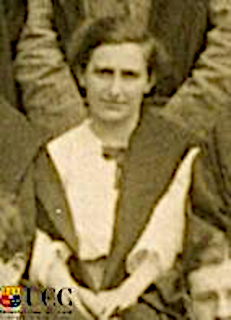
Iris Ashley Cummins, the first female engineer to graduate from University College Cork (UCC), dies in Dublin on April 30, 1968. She is also an international field hockey player.

Cummins is born on June 6, 1894, in Woodville, Glanmire, County Cork, to William Edward Ashley Cummins (1858–1923), professor of medicine at UCC, and Jane Constable Cummins (née Hall). Of her four sisters and six brothers, Geraldine is a renowned psychic and author, Jane serves as a squadron officer in the Women’s Royal Air Force (WRAF) during World War II and becomes a medical doctor, Mary is a gynaecologist and fellow of the Royal College of Physicians of Ireland (RCPI), and her brother Marshall is involved in setting up the first blood transfusion service in Cork.

Cummins begins to study at UCC in 1912. At that time, there are 78 women students out of the 420 students enrolled. She graduates with an engineering degree in 1915. During her time in engineering, she is editor of the Journal of the Engineering Society.

While she is in college, Cummins is on the Ireland field hockey team. She earns her first “cap” for hockey in 1914 and leads the college hockey team to victory in the Munster cup. The Irish hockey team tours the United States in 1925 with Cummins as the captain. With the team she goes to the White House at the invitation of Calvin Coolidge.

Cummins works for the Royal Arsenal with the munitions factory at Woolwich, London, and then the Vickers Limited factory at nearby Erith. She works in a shipyard in Scotland during World War I between 1915 and 1916 before returning to Cork. Initially, she finds it difficult to find work there.

In 1924, Cummins founds a private practice in the city and works there until 1927 at which time she is appointed to the Irish Land Commission in Dublin. She moves to Dublin and although she visits, she never returns to live in Cork. She retires from the Land Commission in 1954.

In 1927, Cummins becomes the first woman member of the Institution of Civil Engineers of Ireland.

Cummins is a Council member of the Women’s Engineering Society, having joined at the organisation’s inception. In December 1919, she writes an encouraging article in the very first edition of the society’s journal, The Woman Engineer. Based on her own Irish university experience, it lays out the practicalities of studies as well as social interactions likely to be encountered by a woman thinking of training as a civil engineer. The following year, she has another article published, this time in the Practical Engineer magazine, entitled The Suitability of Women for the Engineering Industries.

Twenty years later, in 1940, Cummins writes a lively piece entitled Women Engineers Overseas – in Eire for The Woman Engineer journal on her experiences as one of the earliest women engineers in Ireland. In this article, she recounts a tale of encountering the “oldest Inhabitant” of a very rural area, a proud owner of two fine horses, who on discovering “you must be an engineer, so would ye mind mending the electric light in the mare’s stable?”

Cummins dies at the age of 73 in Dublin on April 30, 1968.

(Pictured: Detail from photo of the 1913-14 2nd Year Engineering Class at University College Cork (UCC University Archives, OCLA, UCC))


Leave a comment

Death of Sir Charles Algernon Parsons, Anglo-Irish Engineer & Scientist

Sir Charles Algernon Parsons, Anglo-Irish engineer and scientist best known for his invention of the compound steam turbine, dies on February 11, 1931, on board the steamship Duchess of Richmond while on a cruise with his wife.

Parsons is born in London on June 13, 1854, the youngest among eleven children of the famous astronomer William Parsons, 3rd Earl of Rosse, of Parsonstown (now Birr), King’s County (now County Offaly) and Mary Parsons (née Field), a Yorkshire heiress. Only four sons survive to adulthood. He is strongly influenced by his father, who encourages him to use the workshops at the Birr Castle observatory, and he is tutored at home by some of the assistant astronomers before entering Trinity College Dublin in 1871. He transfers to St. John’s College, Cambridge, and upon graduation in 1877 as eleventh wrangler in a class of thirty-six studying mathematics, he takes the unusual step for the son of an earl, of becoming a premium apprentice at the Elswick Engine and Ordnance Works of Sir William George Armstrong at Newcastle upon Tyne. In the period following this he develops a unique high-speed steam engine, and a torpedo which is powered by a gas turbine. He joins Clarke Chapman at Gateshead as a partner in 1884. In a matter of months he files patents for the world’s first effective steam turbine. These embody many novelties, but the key feature is an electricity generator rated at 6 kW and designed to run, directly coupled, at the astonishing speed of 18,000 rpm.

Parsons is not satisfied that his partners’ efforts to promote turbine development are sufficiently aggressive, and in 1889 he leaves to establish his own company, C. A. Parsons & Company, at Heaton near Newcastle upon Tyne. The price of this impetuous action is the loss of access to his original patents. He quickly establishes alternative designs and by 1892 he has built a turbo-alternator with an output of 100 kW for the Cambridge Electricity Company. Exhausting to a condenser, it has a steam consumption comparable with the best steam engines. Even his 1884 patents envisage applying turbines to marine propulsion, but it is 1893 before he can embark on the design of a suitable demonstration boat of 40 tons. By using careful tests on models, he perfects the hull shape and predicts the power requirements. At this time he recovers his 1884 patents and even wins the very rare prize of an extension for five years, which is a measure of the perceived national importance of his invention.

A syndicate is formed to raise the capital necessary to build Parsons’s turbine-powered vessel Turbinia. At the Spithead Fleet Review in 1897 she speeds among the ships of the world’s navies at 34.5 knots. In 1905 the Royal Navy decides to adopt turbines for its future warships. This example is followed by navies worldwide, from the United States to Japan. Builders of mercantile vessels follow quickly and the turbines of the Cunard liner RMS Mauretania (1906), each developing 26,000 kW, are the largest in existence at the time. The Mauretania holds the Blue Riband for the speediest Atlantic crossing until 1929, a fact that keeps Parsons’s name before the public.

The firm of C. A. Parsons (1889), which builds turbines for use on land, is privately owned, but the Parsons Marine Steam Turbine Company (1897) is a public company. Parsons also earns income from over 300 patents through the Parsons Foreign Patents Co. (1899). He readily licenses others to use his patents but he avoides costly litigation, the ruin of many inventors.

Parsons inherits an interest in optical instruments from his father. In 1890 he develops a cost-effective method for manufacturing searchlight mirrors, using sheets of plate glass and an iron mold heated in a gas furnace. During World War I he supplies most of the national requirements. In 1921 he acquires the optical instrument manufacturers Ross Ltd. and the Derby Crown Glass Company, makers of optical quality glass. In 1925 the firm of Howard Grubb, which makes large optical telescopes, is rescued from insolvency by Parsons. He believes that it is of national importance to maintain the industrial capacity to make optical equipment. Not all of his projects are commercially profitable, as for example his acoustic amplifier, dubbed the “Auxetophone,” or his attempts at synthesising diamonds, which absorbs much time and effort. In the development of his many inventions, he displays great tenacity in the face of reverses and always employs a meticulously scientific approach.

The supply of power on a large scale is revolutionised by the steam turbine. During the twenty years following the building of his first turbogenerator, Parsons remains at the forefront of promoting, building, and selling ever larger and more efficient turbines. He is not only a scientific engineer and inventor, but also a successful manufacturer and businessman. Modest and retiring in manner, his chief weakness lay in a lack of skill in managing interpersonal relationships, though this is compensated to a large extent by his integrity and loyalty. He seeks out the ablest men to run his businesses, among them several Fellows of the Royal Society (FRS). He is elected FRS himself in 1898 and is knighted in 1911. In 1927 he becomes the first engineer to be awarded the Order of Merit for his outstanding contributions to society. He is honoured by many universities and institutions in Europe and the United States.

Parsons marries Katharine Bethell, a Yorkshire woman, in 1883. They have one daughter and a son who dies on active service in 1918. He keeps a residence in London and in Northumbria.

Parsons dies on February 11, 1931, on board the steamship Duchess of Richmond while on a cruise with his wife. The cause of death is given as neuritis. A memorial service is held at Westminster Abbey on March 3, 1931. He is buried in the parish church of St. Bartholomew’s in Kirkwhelpington in Northumberland. His estate is valued at £1,214,355 gross.

A portrait of Parsons, painted by Maurice Codner, hangs in the Institution of Mechanical Engineers, London. There is also a portrait by Sir William Orpen in the Laing Art Gallery, Newcastle upon Tyne, and a portrait by Walter Stoneman in the National Portrait Gallery, London.

(From: “Parsons, Sir Charles Algernon” by W. Garrett Scaife, Dictionary of Irish Biography, http://www.dib.ie, October 2009)


Leave a comment

Birth of Irish Mathematician James Thomson

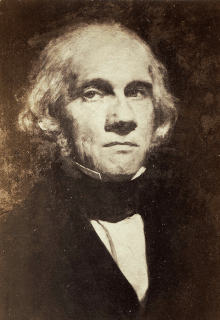
James Thomson, Irish mathematician notable for his role in the formation of the thermodynamics school at the University of Glasgow, Is born on November 13, 1786, in Ballynahinch, County Down, in what is now Northern Ireland. He is the father of the engineer and physicist James Thomson and the physicist William Thomson, 1st Baron Kelvin.

Born into an Ulster Scots family, Thomson is the fourth son of Agnes Nesbit and James Thomson, a small farmer, at Annaghmore, near Ballynahinch, County Down, in Ulster. His early education is from his father. At the age of 11 or 12 he finds out for himself the art of dialling. His father sends him to a school at Ballykine, near Ballynahinch, kept by Samuel Edgar, father of John Edgar. Here he soon rises to be an assistant.

Wishing to become a minister of the Presbyterian church, Thomson enters the University of Glasgow in 1810, where he studies for several sessions, supporting himself by teaching in the Ballykine school during the summer. He graduates MA in 1812, and in 1814 he is appointed headmaster of the school of arithmetic, bookkeeping, and geography in the newly established Royal Belfast Academical Institution. In 1815 he is Professor of Mathematics in its collegiate department. Here he proves himself as a teacher. In 1829 the honorary degree of LL.D. is conferred upon him by the University of Glasgow, where in 1832 he is appointed Professor of Mathematics. He holds this post until his death on January 12, 1849.

Thomson is buried with his family on the northern slopes of the Glasgow Necropolis to the east of the main bridge entrance. The grave is notable due to the modern memorial to Lord Kelvin at its side.

Thomson is the author of schoolbooks that have passed through many editions including Arithmetic (1819), Trigonometry, Plane and Spherical (1820), Introduction to Modern Geography (1827), The Phenomena of the Heavens (1827), The Differential and Integral Calculus (1831), and Euclid (1834).

A paper, “Recollections of the Battle of Ballynahinch, by an Eye-witness,” which appears in the Belfast Magazine for February 1825, is from his pen.


Leave a comment

Birth of Thomas Steele, Engineer & Political Activist

Thomas (Tom) Steele, engineer and political activist, is born on November 3, 1788, at Derrymore, County Clare, the son of William Steele, gentleman, and Catherine Steele (née Bridgeman).

In July 1805 Steele enters Trinity College Dublin, graduating BA in the spring of 1810. He then studies at Magdalene College, Cambridge, where he graduates MA in 1820, becoming an associate member of the Institution of Civil Engineers in the same year. In 1821 he inherits Cullane House, near Craggaunowen, County Clare, on the death of his uncle. Of an enthusiastic and adventurous nature, in 1823 he decides to support the cause of the liberals in Spain who had rebelled against the autocratic rule of Ferdinand VII in 1820. Mortgaging the house and lands at Cullane, he purchases a large quantity of arms and ships them to Spain on board the ship Iris. Commissioned in the Legion Estrenjera of the liberal army, he distinguishes himself in the Battle of Trocadero and the defence of Madrid. He later publishes an account of his experiences, Notes on the war in Spain (London, 1824).

Returning from Spain with his fortunes ruined, Steele begins experiments with underwater diving apparatus, patenting “Steele’s improved diving-bell” in 1825. In the same year he becomes a partner in the Vigo Bay Co., which attempts to recover gold and silver bullion from Spanish ships which sank in Vigo Bay in 1702. After extensive diving operations using Steele’s diving-bell, the company is wound up at an acrimonious meeting of shareholders in September 1826. Despite claims by some of the shareholders that bullion had been found, the scheme is a total failure.

Steele is involved in the Catholic Association and, a close friend of Daniel O’Connell, is active in the emancipation campaign although himself a protestant. In 1828 he seconds O’Connell’s nomination for Clare in the general election of that year. Appointed by O’Connell as ‘Head Pacificator,’ he tours the country collecting weapons and discouraging the rural population from engaging in faction fighting. There is a certain irony in this appointment, as Steele’s own volatile temper is well known. A noted duelist, he fights an inconclusive duel in 1829 with William Smith O’Brien, who had opposed O’Connell’s second candidature for County Clare. In 1828 he is a founder of the Limerick Independent Club.

An associate of the diving pioneers John and Charles Deane, Steele dives on the wreck of the Intrinsic, off the Clare coast in January 1836, using their new diving helmet. He then begins developing equipment to provide underwater illumination, and in 1840 dives with the Deane brothers off Plymouth on the wreck of Henry VIII‘s ship, the Mary Rose. Yet he is in serious financial difficulties, which are not helped by some of his more eccentric building projects. It is said of him that “he seemed utterly incapable of rationally estimating the value of money in his own case.” He begins renovating, at great expense, a ruined castle that stands on his land at Cullane. He also later has a large standing stone, known as the ‘Umbilicus Hiberniae’ (‘Navel of Ireland’), removed from Birr, King’s County (now County Offaly), and taken to his house. At Cullane it is set up as an altar and used for mass whenever O’Connell or members of the Catholic Association visit. It is not returned to Birr until 1974.

Known as “Honest Tom Steele,” Steele is deeply devoted to O’Connell, and is one of his key lieutenants during the repeal campaigns of the 1830s and 1840s. He takes his title and responsibilities as O’Connell’s “Head Pacificator” so seriously and generally expresses himself with such long-winded pomposity that he becomes something of a figure of fun for opponents of O’Connell and for many of the younger men in the Repeal Association. Tried on conspiracy charges after the prohibition of the Clontarf monster meeting, he is one of the six “traversers” imprisoned with O’Connell in Richmond jail from May to September 1844. Strongly supporting O’Connell’s repudiation of physical force, he chairs and takes a prominent part in the peace resolution debates of July 1846 in which the Young Ireland group walks out of the Repeal Association.

After the death of O’Connell on May 15, 1847, Steele falls into a deep depression and, financially ruined, jumps from Waterloo Bridge in London on April 19, 1848. Pulled from the river by a Thames boatman, he survives for a number of weeks. Former political opponents, including Lord Brougham, offer financial help but he refuses. He dies on June 15, 1848, and his remains are taken to Dublin, where he is waked at Conciliation Hall, the headquarters of the Repeal Association, on Burgh Quay. He is buried in Glasnevin Cemetery, beside O’Connell’s tomb. He appears as one of the figures on the O’Connell memorial in O’Connell Street, Dublin.

Steele never marries but harbours an unrequited passion for a Miss Eileen Crowe of Ennis, County Clare, and is often to be seen standing on a large rock, which comes to be known as “Steele’s Rock,” on the banks of the River Fergus in Ennis as he tries to catch a glimpse of Miss Crowe, who lives across the river.

(From: “Steele, Thomas (Tom)” by David Murphy, Dictionary of Irish Biography, http://www.dib.ie | Pictured: (L to R) Thomas Steele, Daniel O’Connell and O’Gorman Mahon by Joseph Patrick Haverty)


Leave a comment

Birth of Robert Lloyd Praeger, Writer & Librarian

Robert Lloyd Praeger, Irish naturalist, writer and librarian, is born on August 25, 1865 in Holywood, County Down, in what is now Northern Ireland.

From a Unitarian background, Praeger is raised in Holywood and attends the school of the Reverend McAlister and then the nearby Sullivan Upper School.

Praeger works in the National Library of Ireland in Dublin from 1893 to 1923. He co-founds and edits The Irish Naturalist, and writes papers on the flora and other aspects of the natural history of Ireland. He organises the Lambay Survey in 1905-06 and, from 1909 to 1915, the wider Clare Island Survey. He is an engineer by qualification, a librarian by profession and a naturalist by inclination.

Praeger is awarded the Veitch Memorial Medal of the Royal Horticultural Society in 1921. He becomes the first President of both An Taisce and the Irish Mountaineering Club in 1948, and serves as President of the Royal Irish Academy for 1931–34.

Praeger is instrumental in developing advanced methodologies in Irish botany by inviting Knud Jessen, the acclaimed Danish expert in Glacial and Post-Glacial flora, to undertake research and teaching in Ireland. This leads to the establishment of ‘paleoecology‘ as a distinct field of study in Ireland.

A vice-county system is adopted by Praeger dividing Ireland into forty vice-counties based on the counties. However, the boundaries between them does not always correspond to the administrative boundaries and there are doubts as to the correct interpretation of them.

Praeger dies on May 5, 1953 and is buried in Deans Grange Cemetery, Dublin, together with his wife Hedwig. His younger sister Rosamond Praeger is a sculptor and botanical artist.

(Pictured: Portrait of Robert Lloyd Praeger by Sarah Cecilia Harrison, National Museums Northern Ireland)


Leave a comment

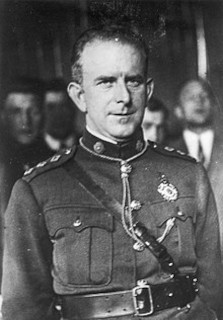
Death of Eoin O’Duffy, Activist, Soldier & Police Commissioner

Eoin O’Duffy, Irish nationalist political activist, soldier and police commissioner, dies in Dublin on November 30, 1944.

O’Duffy is born near Castleblayney, County Monaghan on January 28, 1890. Trained initially as an engineer, he later becomes an auctioneer. He becomes interested in Irish politics and joins Sinn Féin, later becoming a member of the Irish Republican Army (IRA).

During the Irish War of Independence, O’Duffy commands the Monaghan Brigade and in February 1920 he successfully captures the Royal Irish Constabulary (RIC) barracks at Ballytrain taking from it weapons and explosives. Also present at this victory is Ernie O’ Malley, who goes on to organize flying columns, and the socialist guerrilla fighter Peadar O’Donnell.

In the 1921 Irish elections, O’Duffy becomes TD for Monaghan. By 1922, he has been promoted to Chief of Staff of the IRA and is one of Michael Collins foremost supporters when he accepts the Anglo-Irish Treaty and fights in the Irish Civil War as a general of the Free State Army.

As commander of the 2nd Northern Division of the IRA, O’Duffy sees action in Belfast when defending Catholic ghettoes from attacks by Protestant pogromists. He also leads the Free State forces into Limerick city.

In September 1922, following the mutiny in Kildare by Civic Guard recruits, O’Duffy replaces Michael Staines as commissioner. Under him the police force is renamed the Garda Síochána, disarmed and is later merged with the Criminal Investigation Department (CID) and the Dublin Metropolitan Police (DMP). His fervent Catholicism is greatly reflected in the ethos of the Garda Síochána.

In 1933, O’Duffy becomes associated with Cumann na nGaedheal by taking on the leadership of their security organization the Army Comrades Association, later to be known colloquially as the Blueshirts. This organization is to become a participant in many street brawls with anti-treaty sympathizers who try to break up pro-treaty political meetings. When the pro-treaty parties merge in 1933 to become Fine Gael, he is the party President for a short period of time.

It is believed that O’Duffy unsuccessfully encourages W. T. Cosgrave to consider a coup-de’etat in the event of Fianna Fáil winning the 1932 Irish general election. Cosgrave, in the event, puts his trust in a democracy when Fianna Fáil does, in fact, form a government, led by Éamon de Valera, with the help of the Labour Party.

After the 1933 Irish general election, which again sees de Valera in power, O’Duffy is dismissed from his post as Garda Commissioner on the grounds that due to his past political affiliations, he will be unable to carry out his duties without bias.

In Europe, the new phenomenon of fascism is gaining ground and O’Duffy, like many of his pro-treaty colleagues, is drawn to it. His Army Comrades Association is renamed the National Guard, and they begin to take on many of the symbols of fascism such as the outstretched arm salute and the blue uniforms.

When O’Duffy plans a massed march for August 1933 in Dublin to commemorate the deaths of Arthur Griffith and Michael Collins, de Valera, fearing a coup, has it banned. Possibly de Valera is also testing the loyalty of the army and the Garda Síochána. In September the National Guard itself is banned although it reforms under the title The League of Youth.

In 1934 O’Duffy suddenly and inexplicably resigns as president of Fine Gael although it is known that many of its members are growing worried by his actions and statements. The Blueshirt movement begins to unravel at the seams. That same year he forms his own fascist movement, the National Corporate Party.

In 1936, supported by the Catholic Church in Ireland, O’Duffy leads 700 of his followers to Spain to help General Francisco Franco in the Spanish Civil War against the republican government. They form part of the XV Bandera Irlandesa del Terico, a part of the Spanish Legion. The Bandera sees little or no action and are returned to Ireland in 1937.

Although O’Duffy has some low-level dalliance with the Nazis he never does regain any of his political influence. His health is on the decline, and he dies on November 30, 1944. De Valera grants him a state funeral and he is interred in Glasnevin Cemetery in Dublin.


Leave a comment

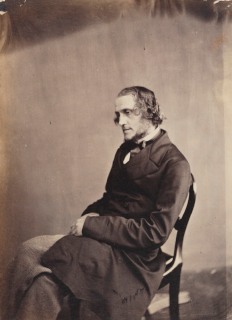
Birth of Architect Benjamin Woodward

Benjamin Woodward, Irish architect who, in partnership with Sir Thomas Newenham Deane, designs a number of buildings in Dublin, Cork and Oxford, is born in Tullamore, County Offaly on November 16, 1816.

Woodward is trained as an engineer but develops an interest in medieval architecture, producing measured drawings of Holy Cross Abbey in County Tipperary. These drawings are exhibited at the Royal Institute of British Architects (RIBA) in London in 1846.

The same year Woodward joins the office of Sir Thomas Deane and becomes a partner in 1851 along with Deane’s son, Thomas Newenham Deane. It seems that Deane looks after business matters and leaves the design work to Woodward.

Woodward’s two most important buildings are the Museum at Trinity College, Dublin (1854-1857) and the Oxford University Museum of Natural History, Oxford, (1854-1860). He is also responsible for the Kildare Street Club in Dublin (1858-1861) and Queen’s College Cork, now University College Cork (1845-1849).

The work of Deane and Woodward is characterised by naturalistic decoration with foliage and animals carved into capitals and plinths around windows and doors. It is extolled by John Ruskin in particular when he visits the Museum at Trinity College, Dublin. Woodward collaborates in particular with the O’Shea brothers, James and John, who are stone carvers from County Cork. They, along with London sculptors, carve the abundant decorative stonework at Trinity, showing owls, lizards, cats and monkeys, as well as other flora and fauna. Later the O’Sheas carve stonework at the Kildare Street Club, including the famous window piece showing the club members as monkeys playing billiards. Some stories tell of the O’Sheas getting into trouble and possibly even being sacked for carving cats or monkeys at the Oxford University Museum.

Benjamin Woodward dies on May 16, 1861.

(Pictured: Benjamin Woodward attributed to Lewis Carroll, albumen print, late 1850s, © National Portrait Gallery, London)


Leave a comment

Abduction of IRA Captain Noel Lemass

noel-lemass-monument

Noel Lemass, Anti-Treaty Irish Republican Army (IRA) officer in Dublin and brother of Seán Lemass, is abducted by Free State plainclothesmen and killed on July 3, 1923. His body is found in the Wicklow Mountains on October 13.

Lemass is a member of the 3rd Battalion, Dublin Brigade of the IRA. He along with his younger brother Seán, later Ireland’s fourth Taoiseach, take part in the Easter Rising where he fights at the General Post Office (GPO). He is employed as an engineer in Dublin Corporation. When the Irish Civil War breaks out in 1922 both he and his brother take the Anti-Treaty side, and both fight together at the Four Courts.

After the fall of the Four Courts, Lemass is imprisoned but manages to escape and makes his way to England. He returns to Ireland in the summer of 1923 when the cease-fire has been declared and goes back to his former employers at the Dublin Corporation, hoping to resume his work there. He offers the town clerk, John J. Murphy, if he would forward a letter to the authorities that he plans to write, “stating that he had no intention of armed resistance to the Government.”

In July 1923, two months after the Irish Civil War ends, Lemass is kidnapped in broad daylight by Free State agents outside MacNeils Hardware shop, at the corner of Exchequer and Drury Street. Three months later, on October 13, his decomposed body is found on the Featherbed Mountain near Sally Gap, twenty yards from the Glencree Road, in an area known locally as ‘The Shoots.’

The body is clothed in a dark tweed suit, light shirt, silk socks, spats and a knitted tie. The pockets contain Rosary beads, a watch-glass, a rimless glass, a tobacco pouch and an empty cigarette case. The trousers’ pockets are turned inside out, as if they had been rifled. There is what appears to be an entrance bullet wound on the left temple and the top of the skull is broken, suggesting an exit wound. He has been shot at least three times in the head and his left arm is fractured, his teeth have been brutally forced from his jaws and his right foot is never found. It is likely that he is killed elsewhere and dumped at this spot.

Meeting two days later, Dublin Council passes a strongly worded vote of sympathy with Lemass’s family. Describing their fellow employee as an “esteemed and worthy officer of the Council who had been foully and diabolically murdered,” the Council adjourns for one week as a mark of respect.

(Pictured: Captain Noel Lemass Memorial Stone at the spot where his body was found on Featherbed Mountain)