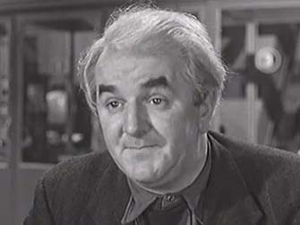
Joseph Tomelty, Irish character actor and playwright, is born at Portaferry, County Down, on March 5, 1911. He works in film, television, radio, and on the stage, starring in Sam Thompson‘s 1960 play Over the Bridge.
Tomelty is the eldest of seven children. His father is known as “Rollickin’ James” for his skill on the fiddle. He leaves his local primary school at the age of 12 and is apprenticed to the trade of housepainter, his father’s trade. He moves to Belfast and attends classes at Belfast Technical College.
Tomelty first acts with St. Peter’s Players and with others in 1937 and 1938 takes part in discussions which lead to the formation of the Northern Ireland Players on a more professional basis. Radio plays Barnum is Right and Elopement are broadcast in December 1938 and February 1939 respectively. The Northern Ireland Players choose the stage version of Barnum is Right for their first major commercial venture at the Empire Theatre in June 1939.
In 1940 the Northern Ireland Players join forces with the Ulster Theatre and the Jewish Institute Dramatic Society to form the Group Theatre. In 1942 Tomelty becomes its general manager remaining in the post until 1951. His play, Idolatry at Innishargie, enjoys a short run at the Group Theatre in 1942, but The End House, a controversial political play, does not even appear there. The play deals with what he describes as “the inhumanity that resulted from the Special Powers Act.” It is however performed at the Abbey Theatre in Dublin in 1944.
Meanwhile, his career as a character actor rapidly develops and a successful stage and film career is underway. In 1948 he is commissioned by the BBC in Belfast to write the weekly radio comedy drama series The McCooeys. This radio series lasts for seven years with Tomelty writing 6,000 word scripts for each episode. He continues to write plays, including his masterpiece, and a modern Irish theatre classic, All Souls’ Night in 1948.
In 1954 Tomelty is injured in an automobile accident while filming Bhowani Junction in England and, while he recovers, he is never as productive again. He dies in Belfast on June 7, 1995.
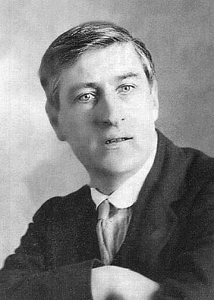
Pádraic Ó Conaire, Irish writer and journalist whose production is primarily in the Irish language, is born in Galway on February 20, 1882. During his lifetime he writes 26 books, 473 stories, 237 essays, and 6 plays. His acclaimed novel Deoraíocht has been described by Angela Bourke as “the earliest example of modernist fiction in Irish.”
Ó Conaire’s father is a publican, who owns two premises in the town of Galway. His mother is Kate McDonagh. He is orphaned by the age of eleven. He spends a period living with his uncle in Garaffin, Ros Muc, Connemara. The area is in the Gaeltacht (Irish-speaking area) and Ó Conaire learns to speak Irish fluently.
He emigrates to London in 1899 where he gets a job with the Board of Education and becomes involved in the work of the Gaelic League. A pioneer in the Gaelic revival in the last century, Ó Conaire and Patrick Pearse are regarded as being the two most important Irish language short story writers during the first decades of the 20th century.
Ó Conaire is married to Molly Ní Mhanais, with whom he has four children: Eileen (born February 22, 1905), Patrick (born November 3, 1906), Kathleen (born February 24, 1909, and Mary Josephine (born July 28, 1911 but dies of diphtheria in 1922).
Ó Conaire returns to Ireland in 1914, leaving his family in London. Living mostly in Galway, he earns a meagre living through writing, teaching at Gaeltacht summer schools, and as an occasional organiser for the Gaelic League.
Ó Conaire dies at the age of 46 while on a visit to Dublin in 1928 after complaining of internal pains while at the head office of the Gaelic League. His fellow poet Frederick Robert Higgins writes a celebrated Lament for Pádraic Ó Conaire.
Pádraic Ó Conaire has family still living to this day in England as well as in Galway and Canada. The Ó Conaire surname is still strong in the Ros Muc area.
Greatrakes is the son of William Greatrakes and Mary, daughter of Sir Edward Harris, Chief Justice of Munster, who are English Protestants settlers. He goes to the free school at Lismore until he is 13 years of age and is designed for the college of Dublin. However, when the Irish Rebellion of 1641 breaks out, he and his mother flee into England, where he is received by his great uncle, Edmund Harris. After Harris dies, his mother places him with John Daniel Getsius, a German minister, of Stoke Gabriel, in Devonshire.
After five or six years in England, Greatrakes returns to his native country, which he finds in a distracted state, and therefore spends a year in contemplation at the Castle of Cappoquin. In 1649 he is a lieutenant in Lord Broghill‘s regiment in the English Parliamentary army in Ireland, then campaigning in Munster against the Irish Royalists. In 1656, with a great part of the army being disbanded, Greatrakes retires to Affine, his native place, and is made clerk of the peace for County Cork, Register for transplantation, and a Justice of the Peace. However, he loses these positions after the Restoration.
Greatrakes seems to have been very religious. His outlook is grave but simple. He says himself, that ever since the year 1662 he has felt a strange impulse or persuasion that he has the gift of curing the King’s evil. This suggestion becomes so strong, that he strokes several persons, and cures them.
Three years afterwards, an epidemical fever is raging in the country, he is again persuaded that he can also cure the fever. He makes the experiment, and he affirms to his satisfaction that he cures all who come to him. At length, in April 1665, another kind of inspiration suggests to him, that he has the gift of healing wounds and ulcers. He even finds that he cures convulsions, the dropsy, and many other distempers.
On April 6, 1665, Robert Phayre, a former Commonwealth Governor of County Cork, is living at Cahermore, in that county, when he is visited by Greatrakes, who had served in his regiment in 1649. Greatrakes cures Phayre in a few minutes of an acute ague. John Flamsteed, the famous astronomer, then aged 19, goes to Ireland in August 1665 to be touched by Greatrakes for a natural weakness of constitution, but receives no benefit. Crowds flock to him from all parts, and he performs such extraordinary cures, that he is summoned into the bishop’s court at Lismore, and, not having a licence for practising, is forbidden to lay hands on anyone else in Ireland.
In 1665, Greatrakes is invited to England by his old commander, Lord Broghill, now Earl of Orrery, to cure Anne, Viscountess Conway of an inveterate headache. He arrives in England in early 1666 but fails to cure the Viscountess. Undaunted, he travels through the country healing the sick.
King Charles II, being informed of it, summons Greatrakes to Whitehall. While unpersuaded that Greatrakes has miraculous power, the king does not forbid him to continue his ministrations.
Every day Greatrakes goes to a place in London where many sick persons, of all ranks in society, assemble. Pains, gout, rheumatism, convulsions, and so forth are allegedly driven by his touch from one body part to another. Upon reaching the extremities, all symptoms of these ailments cease. As the treatment consists entirely of stroking, Greatrakes is called The Stroker. He ascribes certain disorders to the work of evil spirits. When persons possessed by such spirits see Greatrakes or hear his voice, the afflicted fall to the ground or into violent agitation. He then proceeds to cure them by the same method of stroking. While many are skeptical, Greatrakes does find zealous advocates for the efficacy of his healing powers.
In 1667, Greatrakes returns to Ireland and resumes farming in 1668 on £1,000 a year. Although he lives for many years, he no longer keeps up the reputation of performing the strange cures which procured him a name. But in this his case is very singular, that on the strictest enquiry no sort of blemish is ever thrown upon his character, nor does any of those curious and learned persons, who espouse his cause, draw any imputation upon themselves.
Greatrakes dies on November 28, 1682, at Affane, County Waterford. It is believed that he may be buried in Lismore Church or under the aisle of the old Affane Church near to his father.
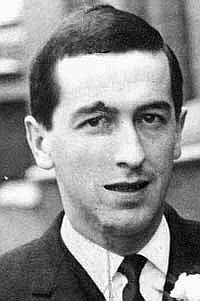
Stagg is educated to primary level at Newbrook Primary School and at CBS Ballinrobe to secondary level. After finishing his schooling, he works as an assistant gamekeeper with his uncle prior to emigrating to England in search of work.
Once in England he gains employment as a bus conductor in north London and later becomes a bus driver. Whilst in England he meets and marries fellow Mayo native, Bridie Armstrong from Carnacon. In 1972, he joins the Lutoncumann of Sinn Féin and soon after becomes a volunteer in the Provisional Irish Republican Army (IRA).
In April 1973, Stagg is arrested with six others alleged to comprise an IRA unit planning bombing attacks in Coventry. He is tried at BirminghamCrown Court. The jury finds three of the seven not guilty. The remaining four are all found guilty of criminal damage and conspiracy to commit arson. Stagg and English-born priest, Father Patrick Fell, are found to be the unit’s commanding officers. Stagg is given a ten-year sentence and Fell twelve years. Thomas Gerald Rush is given seven years and Anthony Roland Lynch, who is also found guilty of possessing articles with intent to destroy property, namely nitric acid, balloons, wax, and sodium chlorate, is given ten years.
Following the hunger strike that results in the death of Michael Gaughan, the Price sisters, Feeney, and Kelly are granted repatriation to Ireland. Stagg is denied repatriation and is transferred to Long Lartin Prison. During his time there he is subject to solitary confinement for refusing to do prison work and is also subjected, along with his wife and sisters during visits, to humiliating body searches. In protest against this he begins a second hunger strike that lasts for thirty-four days. This ends when the prison governor agrees to an end to the strip-searches on Stagg and his visitors. Stagg is bed-ridden for the rest of his incarceration in Long Lartin, due to a kidney complaint.
In 1975 Stagg is transferred to Wakefield Prison, where it is demanded that he again do prison work. He refuses and is placed in solitary confinement. On December 14, 1975, Stagg embarks on a hunger strike in Wakefield, along with a number of other republican prisoners, after being refused repatriation to Ireland during the IRA/British truce. Stagg’s demands are an end to solitary confinement, no prison work, and repatriation to prison in Ireland. The British government refuses to meet any of these demands. Stagg dies on February 12, 1976, after 62 days on hunger strike.
Frank Stagg’s burial causes considerable controversy in Ireland, with republicans and two of his brothers seeking to have Stagg buried in the republican plot in Ballina in accordance with his wishes, while his widow, his brother, Emmet Stagg, and the Irish government wish to have him buried in the family plot in the same cemetery and to avoid republican involvement in the funeral. As the republicans wait at Dublin Airport for the body, the Irish government orders the flight to be diverted to Shannon Airport.
His body is taken to Ballina and buried near the family plot. In order to prevent the body being disinterred and reburied by republicans, the grave is covered with concrete. In November 1976, a group of republicans tunnel under the concrete to recover the coffin under cover of darkness and rebury it in the republican plot.
His early education is of the plainest kind, but he is eager for culture, fond of reading, and anxious to become an artist. He later studies at the Cork School of Art.
Maclise exhibits for the first time at the Royal Academy of Arts in 1829. Gradually he begins to confine himself more exclusively to subject and historical pictures, varied occasionally by portraits – such as those of Lord Campbell, novelist Letitia Landon, Charles Dickens, and other of his literary friends. In 1833, he exhibits two pictures which greatly increase his reputation and, in 1835, the Chivalric Vow of the Ladies and the Peacock procure his election as associate of the Academy, of which he becomes full member in 1840. The years that follow are occupied with a long series of figure pictures, deriving their subjects from history and tradition and from the works of William Shakespeare, Oliver Goldsmith, and Alain-René Lesage.
Maclise also designs illustrations for several of Dickens’s Christmas books and other works. Between the years 1830 and 1836 he contributes to Fraser’s Magazine, under the pseudonym of Alfred Croquis, a remarkable series of portraits of the literary and other celebrities of the time – character studies, etched or lithographed in outline, and touched more or less with the emphasis of the caricaturist, which are afterwards published as the Maclise Portrait Gallery (1871). During the rebuilding of the Houses of Parliament in London in 1834–1850 by Charles Barry, Maclise is commissioned in 1846 to paint murals in the House of Lords on such subjects as Justice and Chivalry.
In 1858, Maclise commences one of the two great monumental works of his life, The Meeting of Wellington and Blücher, on the walls of the Palace of Westminster. It is begun in fresco, a process which proves unmanageable. The artist wishes to resign the task, but, encouraged by Prince Albert, he studies in Berlin the new method of water-glass painting, and carries out the subject and its companion, The Death of Nelson, in that medium, completing the latter painting in 1864.
Maclise’s vast painting of The Marriage of Strongbow and Aoife (1854) hangs in the National Gallery of Ireland, Dublin. It portrays the marriage of the main Norman conqueror of Ireland “Strongbow” to the daughter of his Gaelic ally. By the grand staircase of Halifax Town Hall, which is completed in 1863, there is a wall painting by Maclise.
The intense application which he gives to these great historic works, and various circumstances connected with the commission, has a serious effect on Maclise’s health. He begins to shun the company in which he formerly delighted, his old buoyancy of spirits is gone, and in 1865, when the presidency of the Royal Academy is offered to him he declines the honour. He dies of acute pneumonia on April 25, 1870 at his home 4 Cheyne Walk, Chelsea, London.
(Pictured lower right: The Marriage of Strongbow and Aoife)
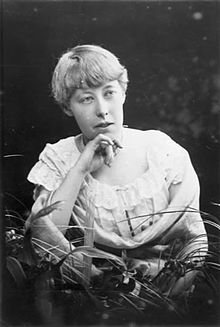
Katharine Tynan, Irish writer, known mainly for her novels and poetry, is born into a large farming family in Clondalkin, County Dublin, on January 23, 1859.
Tynan is educated at St. Catherine’s, a convent school in Drogheda. Her poetry is first published in 1878. She meets and becomes friendly with the poet Gerard Manley Hopkins in 1886. She goes on to play a major part in Dublin literary circles. In 1898 she marries English writer and barrister Henry Albert Hinkson, and they move to England. After her marriage she usually writes under the name Katharine Tynan Hinkson, or variations thereof. Later she lives at Claremorris, County Mayo, when her husband is a magistrate from 1914 until 1919. Of their three children, Pamela Hinkson (1900–1982) was also known as a writer.
For a while, Tynan is a close associate of William Butler Yeats (who may have proposed marriage and been rejected, around 1885), and later a correspondent of Francis Ledwidge. Involved in the Irish Literary Revival, Tynan expresses concern for feminist causes, the poor, and the effects of World War I in her work. She also meditates on her Catholic faith. A prolific writer, she wrote more than one hundred novels, twelve collections of short stories, reminiscences, plays, and more than a dozen books of poetry.
Katharine Tynan Hinkson dies on April 2, 1931, in Wimbledon, London, at the age of 72.
James (Jim) Larkin, Irish trade union leader and socialist activist, is born to Irish parents in Liverpool, England, on January 21, 1876. He and his family later move to a small cottage in Burren, County Down. Growing up in poverty, he receives little formal education and begins working in a variety of jobs while still a child.
In 1905, Larkin is one of the few foremen to take part in a strike on the Liverpool docks. He is elected to the strike committee, and although he loses his foreman’s job as a result, his performance so impresses the National Union of Dock Labourers (NUDL) that he is appointed a temporary organiser.
Larkin moves to Belfast in 1907 to organise the city’s dock workers for the NUDL. He succeeds in unionising the workforce, and as employers refuse to meet the wage demands, he calls the dockers out on strike in June. Carters and coal men soon join in, the latter settling their dispute after a month.
In 1908, Larkin moves south and organises workers in Dublin, Cork, and Waterford, with considerable success. His involvement, against union instructions, in a dispute in Dublin results in his expulsion from the NUDL. The union later prosecutes him for diverting union funds to give strike pay to Cork workers engaged in an unofficial dispute. After trial and conviction for embezzlement in 1910, he is sentenced to prison for a year. This is widely regarded as unjust, and the Lord Lieutenant of Ireland, Lord Aberdeen, pardons him after he has served three months in prison.
After his expulsion from the NUDL, Larkin founds the Irish Transport and General Workers’ Union (ITGWU) at the end of December 1908. The organisation exists today as the Services Industrial Professional & Technical Union (SIPTU). In early 1909, Larkin moves to Dublin, which becomes the main base of the ITGWU and the focus of all his future union activity in Ireland.
In early 1913, Larkin achieves some successes in industrial disputes in Dublin. Two major employers, Guinness and the Dublin United Tramway Company, are the main targets of Larkin’s organising ambitions. The chairman of the Dublin United Tramway Company, industrialist and newspaper proprietor William Martin Murphy, is determined not to allow the ITGWU to unionise his workforce. On August 15, he dismisses 40 workers he suspects of ITGWU membership, followed by another 300 over the next week. On August 26, 1913, the tramway workers officially go on strike.
The resulting industrial dispute is the most severe in Ireland’s history. Employers in Dublin engage in a sympathetic lockout of their workers when the latter refuses to sign the pledge, employing blackleg labour from Britain and from elsewhere in Ireland. Guinness, the largest employer in Dublin, refuses the employers’ call to lock out its workers but it sacks 15 workers who struck in sympathy.
For seven months the lockout affects tens of thousands of Dublin workers and employers, with Larkin portrayed as the villain by Murphy’s three main newspapers, the Irish Independent, the Sunday Independent, and the Evening Herald, and by other bourgeois publications in Ireland. The lock-out eventually concludes in early 1914 when calls by James Connolly and Larkin for a sympathetic strike in Britain are rejected by the British Trades Union Congress (TUC). Larkin’s attacks on the TUC leadership for this stance also lead to the cessation of financial aid to the ITGWU.
Some months after the lockout ends, Larkin leaves for the United States. He intends to recuperate from the strain of the lockout and raise funds for the union. Once there he becomes a member of the Socialist Party of America and is involved in the Industrial Workers of the World union (the Wobblies). He becomes an enthusiastic supporter of the Soviet Union and is expelled from the Socialist Party of America in 1919 along with numerous other sympathisers of the Bolsheviks during the Red Scare of that year.
Upon his return to Ireland in April 1923, Larkin receives a hero’s welcome and immediately sets about touring the country meeting trade union members and appealing for an end to the Irish Civil War. In September 1923, Larkin forms the Irish Worker League (IWL), which is soon afterwards recognised by the Communist International as the Irish section of the world communist movement.
James Larkin dies in his sleep on January 30, 1947, in the Meath Hospital. Fr. Aloysius Travers, OFM, who had administered last rites to James Connolly in 1916, also administers extreme unction to Larkin. His funeral mass is celebrated by the Catholic Archbishop of Dublin, John Charles McQuaid, who had visited him in hospital before he died, and thousands line the streets of the city as the hearse passes through on the way to Glasnevin Cemetery.
Gilbert is born in Grange, County Sligo, on February 17, 1821. Her family makes their residence at King House in Boyle, County Roscommon, until early 1823, when they journey to Liverpool, thence departing for India on March 14. Gilbert spends much of her childhood in India but is educated in Scotland and England. At age 19 she elopes with Lieutenant Thomas James. The couple separates five years later, and, in 1843, Gilbert launches a career as a dancer. Her London debut in June 1843 as “Lola Montez, the Spanish dancer” is disrupted when she is recognized as Mrs. James. The fiasco would probably have ended the career of anyone less beautiful and determined, but Gilbert receives additional dancing engagements throughout Europe. During her travels she reputedly forms liaisons with Franz Liszt and Alexandre Dumas, among many others.
Late in 1846, Gilbert dances in Munich and Ludwig I of Bavaria is so struck by her beauty that he offers her a castle. She accepts, becomes Baroness Rosenthal and Countess of Lansfeld, and remains as his mistress. Under Gilbert’s influence, Louis inaugurates liberal and anti-Jesuit governmental policies, but his infatuation with her helps to bring about the collapse of his regime in the revolution of 1848. In March of that year Ludwig abdicates in favour of his son. Gilbert flees to London, where in 1849 she marries Lieutenant George Heald, although she has never been divorced from James. Heald later leaves her.
From 1851 to 1853 Gilbert performs in the United States. Her third marriage, to Patrick P. Hull of San Francisco in 1853, ends in divorce soon after she moves to Grass Valley, California. There, among other amusements, she coaches young Lotta Crabtree in singing and dancing. She settles in New York City after an unsuccessful tour of Australia in 1855–1856 and gathers a following as a lecturer on such topics as fashion, gallantry, and beautiful women. An apparently genuine religious conversion leads her to take up various personal philanthropies.
Gilbert publishes Anecdotes of Love; Being a True Account of the Most Remarkable Events Connected with the History of Love; in All Ages and among All Nations (1858), The Arts of Beauty, or, Secrets of a Lady’s Toilet with Hints to Gentlemen on the Art of Fascination (1858), and Lectures of Lola Montez, Including Her Autobiography (1858). The international notoriety of her heyday persists long after her death and inspires numerous literary and balletic allusions.
Gilbert spends her last days in rescue work among women. By November 1859 she is showing the tertiary effects of syphilis, and her body begins to waste away. She dies at the age of 39 on January 17, 1861. She is buried in Green-Wood Cemetery in Brooklyn, New York.
Thomas Dermody, classical scholar and poet, is born in Ennis, County Clare, on January 15, 1775. He writes under several pseudonyms including Mauritius Moonshine and Marmaduke Myrtle.
Dermody is scholarly but lives hard and makes little of his life. At the age of nine he is employed as a classical teacher in his father’s school, and has already acquired from his father a love for literature and the bottle.
Dermody has the genius of a poet, and writes fairly good poetry, but his genius is not enough. He lives for 27 years, half his life a promising boy and half a ne’er-do-well. His promise brings him generous patrons in his early days in Ireland, but he scorns the hand that feeds him, denies the friends who could nurse his genius, and runs away to England to keep bad company.
At the age of nineteen, he enlists in the army and behaves uncommonly well under military discipline. He becomes corporal, sergeant, and eventually second lieutenant, serving with distinction. He is wounded in France, and upon his return to England, is retired on half-pay.
He gains and loses friend after friend and abuses patron after patron. They clothe and clean him and make him presentable, but he then drinks himself to nakedness and rags and behaves like a brute. Such from day to day and year to year is his life, and in the end he drinks himself to death and perishes in a miserable cottage near Lewisham on July 15, 1802. He is filled with conceit and a slave to his desires, but the lines that are fading away on the stone above his grave show that he was a poet. Dermody is buried in the churchyard of St. Mary’s Church Lewisham.
Dermody publishes two books of poems which, after his death, are collected as The Harp of Erin. Some 56 of his sonnets have been published in various works, from his first 1789 collection Poems to those published in 1792, with a few posthumously published verses in the biography by James Grant Raymond. Samuel Taylor Coleridge takes an interest in some of his verse which has been included in the literary magazine The Anthologia Hibernica.
George Berkeley, Irish philosopher whose primary achievement is the advancement of a theory he calls “immaterialism” (later referred to as “subjective idealism” by others), dies in Oxford, England, on January 14, 1753. His theory of immaterialism denies the existence of material substance and instead contends that familiar objects like tables and chairs are only ideas in the minds of perceivers and, as a result, cannot exist without being perceived. Berkeley is also known for his critique of abstraction, an important premise in his argument for immaterialism.
Berkeley is born at his family home, Dysart Castle, near Thomastown, County Kilkenny, the eldest son of William Berkeley, a cadet of the noble family of Berkeley. He is educated at Kilkenny College and attends Trinity College, Dublin, earning a bachelor’s degree in 1704 and completing a master’s degree in 1707. He remains at Trinity College after completion of his degree as a tutor and Greek lecturer.
In this book, Berkeley’s views are represented by Philonous, while Hylas embodies the Irish thinker’s opponents, in particular John Locke. Berkeley argues against Sir Isaac Newton‘s doctrine of absolute space, time, and motion in De Motu (On Motion), published in 1721. His arguments are a precursor to the views of Ernst Mach and Albert Einstein. In 1732, he publishes Alciphron, a Christian apologetic against the free-thinkers, and in 1734, he publishes The Analyst, a critique of the foundations of calculus, which is influential in the development of mathematics.
His last major philosophical work, Siris (1744), begins by advocating the medicinal use of tar water and then continues to discuss a wide range of topics, including science, philosophy, and theology. Interest in Berkeley’s work increases after World War II because he tackles many of the issues of paramount interest to philosophy in the 20th century, such as the problems of perception, the difference between primary and secondary qualities, and the importance of language. It sold more copies than any of his other books during his lifetime.
In 1734, Berkeley is appointed Bishop of Cloyne in Ireland, a position he holds until his death. He remains at Cloyne until 1752, when he retires and goes to Oxford to live with his son and supervise his education. He dies soon afterward and is buried in Christ Church Cathedral, Oxford.
The Berkeley portion of the Yale University campus is named after George Berkeley.







 seamus dubhghaill