seamus dubhghaill

Promoting Irish Culture and History from Little Rock, Arkansas, USA


Leave a comment

Death of Séamus Ennis, Musician, Singer & Music Collector

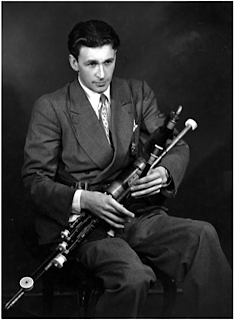
Séamus Ennis (Irish: Séamas Mac Aonghusa), Irish musician, singer and Irish music collector, dies in Naul, County Dublin, on October 5, 1982. He is most noted for his uilleann pipe playing and is partly responsible for the revival of the instrument during the twentieth century, having co-founded Na Píobairí Uilleann, a nonprofit organisation dedicated to the promotion of the uilleann pipes and its music. He is recognised for preserving almost 2,000 Irish songs and dance-tunes as part of the work he does with the Irish Folklore Commission. He is widely regarded as one of the greatest uilleann pipers of all time.

Ennis’s father, James, works for the Irish civil service at Naul, County Dublin. In 1908, James Ennis is in a pawn shop in London and purchases a bag containing the pieces of a set of old uilleann pipes. They were made in the mid nineteenth century by Coyne Pipemakers of Thomas Street in Dublin. In 1912, he comes in first in the Oireachtas competition for warpipes and second in the uilleann pipes. He is also a prize-winning dancer. In 1916, he marries Mary Josephine McCabe, an accomplished fiddle player from County Monaghan. They have six children, Angela, Séamus, Barbara, and twins, Cormac and Ursula (Pixie) and Desmond. Séamus is born on May 5, 1919, in Jamestown in Finglas, Dublin. James Ennis is a member of the Fingal trio, which includes Frank O’Higgins on fiddle and John Cawley on flute, and performs regularly with them on the radio. At the age of thirteen, Séamus starts receiving lessons on the pipes from his father. He attends a Gaelscoil, Cholmcille, and a Gaelcholáiste, Coláiste Mhuire, which gives him a knowledge of the Irish language that serves him well in later life. He sits in an exam to become Employment Exchange clerk but is too far down the list to be offered a job. He is twenty and unemployed.

Colm Ó Lochlainn is editor of Irish Street Ballads and a friend of the Ennis family. In 1938, Ennis confides in Colm that he intends to move to England to join the British Army. Colm immediately offers him a job at The Three Candles Press. There Ennis learns all aspects of the printing trade. This includes writing down slow airs for printed scores – a skill which later proves important. Colm is director of an Irish language choir, An Claisceadal, which Ennis joins. In 1942, during The Emergency, shortages and rationing mean that things become difficult in the printing trade. Professor Seamus Ó Duilearge of the Irish Folklore Commission hires the 23-year-old to collect songs. He is given “pen, paper and pushbike” and a salary of three pounds per week. Off he goes to Connemara.

From 1942 to 1947, working for the Irish Folklore Commission, Ennis collects songs in west Munster; counties GalwayCavanMayoDonegalKerry; the Aran Islands and the Scottish Hebrides. His knowledge of Scottish Gaelic enables him to transcribe much of the John Lorne Campbell collection of songs. Elizabeth Cronin of BallyvourneyCounty Cork, is so keen to chat to Ennis on his visits that she writes down her own songs and hands them over as he arrives, and then gets down to conversation. He has a natural empathy with the musicians and singers he meets. In August 1947, he starts work as an outside broadcast officer with Raidió Éireann. He is a presenter and records Willie ClancySeán Reid and Micho Russell for the first time. There is an air of authority in his voice. In 1951, Alan Lomax and Jean Ritchie arrived from the United States to record Irish songs and tunes. The tables are turned as Ennis becomes the subject of someone else’s collection. There is a photograph from 1952/53 showing Ritchie huddled over the tape recorder while Ennis plays uilleann pipes.

Late in 1951, Ennis joins the BBC. He moves to London to work with producer Brian George. In 1952, he marries Margaret Glynn. They have two children, the organist Catherine Ennis and Christopher. His job is to record the traditional music of England, ScotlandWales and Ireland and to present it on the BBC Home Service. The programme is called As I Roved Out and runs until 1958. Meeting up with Alan Lomax again, he is largely responsible for the album Folk and Primitive Music (volume on Ireland) on the Columbia Records label.

In 1958, after his contract with the BBC is not renewed, Ennis starts doing freelance work, first in England then back in Ireland, with the new TV station Teilifis Éireann. Soon he is relying totally on his musical ability to make a living. About this time, his marriage breaks down and he returns to Ireland. He suffers from tuberculosis and is ill for some time. In 1964, he performs at the Newport Folk Festival. His father gives him the pipes he had bought in 1908. Although most pipers can be classed as playing in a tight style or an open style, Ennis is in between. He is a master of the slow air, knowing how to decorate long notes with taste and discreet variation.

Two events will live in legend among pipers. The first is in Bettystown, County Meath, in 1968, when the society of Irish pipers, Na Píobairí Uilleann, is formed. Breandán Breathnach is playing a tape of his own piping. Ennis asks, “What year?” Breandán replies, “1948.” Ennis says, “So I thought.” For a couple of hours the younger players perform while Ennis sits in silence. Eventually he is asked to play. Slowly he takes off his coat and rolls up his sleeves. He spends 20 minutes tuning up his 130-year-old pipes. He then asks the gathering whether all the tape recorders are ready and proceeds to play for over an hour. To everyone’s astonishment he then offers his precious pipes to Willie Clancy to play a set. Clancy demurs but eventually gives in. Next, Liam O’Flynn is asked to play them, and so on, round the room. The second unforgettable session is in Dowlings’ Pub in Prosperous, County KildareChristy Moore is there, as well as most of the future members of Planxty.

Ennis never runs any school of piping but his enthusiasm infuses everyone he meets. In the early 1970s, he shares a house with Liam O’Flynn for almost three years. Finally, he purchases a piece of land in Naul and lives in a mobile home there. One of his last performances is at the Willie Clancy Summer School in 1982. He dies on October 5, 1982. His pipes are bequeathed to Liam O’Flynn. Radio producer Peter Browne produces a compilation of his performances, called The Return from Fingal, spanning 40 years.

Séamus Ennis Road in his native Finglas is named in his honour. The Séamus Ennis Arts Centre in Naul is opened in his honour, to commemorate his work and to promote the traditional arts. He is also the subject of Christy Moore’s song “The Easter Snow.” This is the title of a slow air Ennis used to play, and one after which he named his final home in Naul.


Leave a comment

Birth of Banjo Player Gerry O’Connor

Gerry O’Connor, traditional tenor banjo player, is born on July 21, 1960, in Nenagh, County Tipperary. As Earl Hitchener, music critic for The Wall Street Journal, says, O’Connor can be considered at the moment “the single best four-string banjoist in the history of Irish Music.” He also plays mandolinfiddle, guitar and tenor guitar.

O’Connor releases four solo albums and his third one, titled No Place Like Home, is named by The Irish Times as Number 1 Traditional/Folk album of the year in 2004. After the sudden death of banjo player Barney McKenna on April 5, 2012, he joins The Dubliners to complete their planned tour, until the final shows at Vicar Street in Dublin, on December 28-30. McKenna himself says about Gerry O’Connor: “He’s my best pupil ever.” Together with Eamonn CampbellPatsy Watchorn and Seán Cannon, O’Connor keeps touring in 2013 as The Dublin Legends.

In addition to his solo performances and recordings, O’Connor is a member of Four Men and a Dog. He also works on Michael Flatley‘s Lord of the Dance soundtrack and guests over the years with many famous Irish artists such as The WaterboysMary Black, Arcady, Moya BrennanLuka BloomSharon Shannon and performs for U.S. President Bill Clinton in Belfast during his historic visit to Ireland. More recently he guests on Christy Moore‘s album Folk Tale (2011).

O’Connor is one of four musicians brought together by blues rock singer/guitar player Joe Bonamassa to perform on a variety of instruments in an acoustic concert at the Vienna State Opera on July 3, 2012. None of the five had ever worked together nor even met until they arrive in Vienna, where three days later they put on a live performance. The event is released on March 12, 2013, on CD and DVD/Blu-Ray, titled An Acoustic Evening At The Vienna Opera House, and in 2014 is broadcast as a PBS special.

O’Connor mainly plays CGDA tuned tenor banjo, instead of the usual Irish tuning GDAE. He plays a David Boyle banjo on almost every tour since 1996, but usually records with an Epiphone Recording A banjo.


Leave a comment

Birth of Kate Thompson, Author & Accomplished Fiddler

Katharine Anna Thompson, British-Irish author best known for children’s novels, is born in Halifax, West Yorkshire, England, on November 10, 1956. Most of her children’s fiction is fantasy but several of her books also deal with the consequences of genetic engineering.

Thompson is the youngest child of the social historians and peace activists E. P. Thompson and Dorothy Towers. She has lived in Ireland since 1981 and many of her books are set there. She trains racehorses in the UK and United States and travels extensively in India before settling in 1984 in Inagh, County Clare, in the west of Ireland with her partner Conor Minogue. They have two daughters, Cliodhna and Dearbhla. She is an accomplished fiddler with an interest in Irish traditional music, which is reflected in The New Policeman (2005).

Thompson wins two major annual awards for The New Policeman (Bodley Head, 2005), set in modern Kinvara and the Irish mythological Tír na nÓg: the Guardian Children’s Fiction Prize and the Whitbread Children’s Book Award. It also wins the Dublin Airport Authority Children’s Book of the Year Award for 2005.

Thompson wins the Bisto Children’s Book of the Year Award four times, for The Beguilers (2001), The Alchemist’s Apprentice (2002), Annan Water (2004) and The New Policeman. Creature of the Night (2008) is shortlisted for the 2008 Booktrust Teenage Prize and the 2009 Carnegie Medal.

Thompson holds an MA in Irish traditional music performance from the University of Limerick.


Leave a comment

Birth of Paddy Killoran, Fiddle Player & Bandleader

Patrick J. Killoran, Irish traditional fiddle player, bandleader and recording artist is born on September 21, 1903, in Emlaghgissan (also spelled “Emlagation”), a townland in the civil parish of Emlaghfad near the town of Ballymote, County Sligo. He is regarded, along with James Morrison and Michael Coleman, as one of the finest exponents of the south Sligo fiddle style in the “golden age” of the ethnic recording industry of the 1920s and 1930s.

Killoran’s father Patrick plays the flute and his mother Mary the concertina, but he is also influenced by local fiddle master Philip O’Beirne, who had earlier tutored Michael Coleman. As a teenager, he is a volunteer with the Ballymote-based 3rd Battalion of the south Sligo Brigade of the Irish Republican Army (IRA) during the Irish War of Independence.

In 1925, Killoran emigrates to New York City, arriving on May 19 on the Cunard liner Scythia. Within a few months, he officially declares his intention to become a citizen of the United States, listing his address as 227 East 126th Street in east Harlem and his occupation as “laborer.” He later lodges with fellow Sligo fiddler James Morrison in a Columbus Avenue apartment on Manhattan‘s Upper West Side. A 1927 newspaper ad for “Morrison’s Orchestra” offers “Irish music by P. Killoran and J. Morrison, celebrated violinists,” giving 507 West 133d Street in west Harlem as the contact address. He soon launches his own career as a soloist and bandleader. A publicity photo of his quartet c. 1928 includes button accordionist D. Casey, tenor banjo player Richard Curran and second fiddler Denis Murphy. By the next year, he is performing on a weekly radio program sponsored by the Pride of Erin Ballrooms, located at the corner of Bedford and Atlantic Avenues in Brooklyn. He also tries another side occupation as his 1931 naturalization petition lists his occupation as “Music store owner.”

At the Pride of Erin, and later at the Sligo Ballroom at 125th Street and St. Nicholas Avenue in Harlem, Killoran’s “Irish Orchestra” provides music for Irish dancing, while Jack Healy, another Ballymote native, leads a group for “American” dancing. Healy, as a singer and tenor saxophone player, also performs and records with Killoran’s group, the membership of which over the course of the 1930s includes fiddler Paddy Sweeney, another Sligo native, fiddle and clarinet player Paul Ryan, Ryan’s brother Jim on the C Melody saxophone, pianists Eileen O’Shea, Edmund Tucker and Jim McGinn, drummer Mickey Murphy, button accordionists Tommy Flanagan and William McElligott and tenor banjo/tenor guitar player Michael “Whitey” Andrews.

Killoran’s band is variously billed as his “Pride of Erin Orchestra,” “Radio Dance Orchestra,” “Sligo Ballroom Orchestra,” “Lakes of Sligo Orchestra” and “Irish Barn Dance Boys.” The group is a popular choice for county association functions, particularly those of Sligo and Roscommon. In 1932, he leads a band that accompanies Cardinal William Henry O’Connell of Boston to the Eucharistic Congress in Ireland and briefly bills his group as the “Pride of Erin Eucharistic Congress Orchestra.” He regularly performs at Irish beach resorts on the Rockaway peninsula and in East Durham in the Catskill Mountains.

Uniquely among the major New York Irish musicians of the pre-World War II era, Killoran continues his musical career through the 1950s. He issues new recordings, including duets with flute player Mike Flynn and some fiddle-and-viola sides with Paul Ryan, and leads an active dance band. Age and illness eventually force him to retire, and in 1962 he turns over leadership of the band, a fixture at the City Center Ballroom, to button accordionist Joe Madden, father of Cherish the Ladies flute player Joanie Madden.

In 1956, Killoran is a co-founder of the Dublin Recording Company, later better known simply as Dublin Records, which is organized to record new Irish discs in New York.

Killoran is a founding member of the Emerald Irish Musicians Benevolent Society, a group that stages “Night of Shamrocks” concerts to raise money for the benefit of sick and deceased Irish musicians in New York. He is also a member of the Irish Musicians Association of America, and a New York branch of that organization, which later merges with Comhaltas Ceoltóirí Eireann, is named for him.

In addition to the 1932 trip to the Eucharistic Congress, Killoran returns to Ireland at least twice. In 1949, he plays on a Radio Éireann program hosted by piper and folklorist Séamus Ennis. Some selections from that broadcast are recorded on a private disc and are later released on CD. On a 1960 visit, he visits Sligo and Clare and performs at a concert in County Longford.

Killoran is married twice. His first wife, Anna Gorman, a native of County Roscommon, dies in 1935. His second wife is Betty (Bridget) Hayes, an immigrant from Shanaway West, County Clare, who survives him. He dies in New York City on April 24, 1965.

A “Paddy Killoran Traditional Festival” is celebrated in the third week of June in Ballymote, where a monument in Killoran’s honor is erected in 2012.


Leave a comment

Birth of Liam O’Flynn, Uilleann Piper & Traditional Musician

Liam O’Flynn, Irish uilleann piper and Irish traditional musician, is born on September 15, 1945, in Kill, County Kildare. In addition to a solo career and as a member of Planxty, he records with Christy Moore, Dónal Lunny, Andy Irvine, Kate Bush, Mark Knopfler, The Everly Brothers, Emmylou Harris, Mike Oldfield, Mary Black, Enya and Sinéad O’Connor.

O’Flynn is acknowledged as Ireland’s foremost exponent of the uilleann pipes and brings the music of the instrument to a worldwide audience. In 2007, he is named TG4 Musician of the Year at the Gradam Ceoil TG4, considered to be the foremost recognition given to traditional Irish musicians.

O’Flynn is born to musical parents. His father, Liam, is a teacher and fiddle player. His mother, Maisie (née Scanlan), who comes from a family of musicians from County Clare, plays and teaches piano. From an early age, he shows musical talent, and is encouraged to pursue his interest in the uilleann pipes by the piper Tom Armstrong. At the age of 11, he begins taking classes with Leo Rowsome. He is also influenced by Willie Clancy and Séamus Ennis. In the 1960s, he begins to receive recognition of his talent, winning prizes at the Oireachtas na Gaeilge and the Fleadh Cheoil. During his early years, he is sometimes billed as Liam Óg Ó Flynn.

In 1972, O’Flynn co-founds the Irish traditional music group Planxty, alongside Christy Moore, Andy Irvine and Dónal Lunny and remains a member throughout the band’s various incarnations. While Seán Ó Riada and The Chieftains had reinvigorated Irish traditional instrumental music in an ensemble format during the 1960s, Planxty builds on that foundation and takes it one step further. They bring a punch and vitality to acoustic music that draws heavily on O’Flynn’s piping virtuosity.

As O’Flynn grows in his skill as a musician and as he begins to meet pipers like Willie Clancy and Séamus Ennis, he becomes acutely aware of his position in the tradition of piping. His subsequent close friendship with Ennis, which starts as a master/pupil relationship, teaches him that there is much more to being a piper than playing tunes. He notes, “Seamus Ennis gave me much more than a bag of notes.”

“When I’m playing, I’m certainly lost within it. The only way to describe it, is that it’s like looking inwards. I think when a performer engages with the audience, and vice versa, it’s like a spell is cast and a terrific passage of feelings moves from the musician to the audience and back again.”

Following the break-up of Planxty in 1983, O’Flynn finds work as a session musician with such prominent artists as The Everly Brothers, Enya, Kate Bush, Nigel Kennedy, Rita Connolly, and Mark Knopfler. He also works on film scores, including Kidnapped (1979) and A River Runs Through It (1992). He is adventurous enough to work with avant-garde composer John Cage, but his most natural alliance is with neo-romantic composer Shaun Davey.

The Bothy Band are natural successors to the original Planxty, and one of its members, Matt Molloy, who subsequently joins The Chieftains, plays with The Chieftains’ fiddler Seán Keane on O’Flynn’s album, The Piper’s Call, which is performed in the 1999 BBC Proms season at the Royal Albert Hall. He also works on projects with Seamus Heaney, mixing poetry with music.

O’Flynn’s name is mentioned in Christy Moore’s song “Lisdoonvarna.”

O’Flynn dies in a Dublin hospital on March 14, 2018, following a long illness. His cremated remains rest at Newlands Cross Cemetery and Crematorium in Dublin.

The Liam O’Flynn Award is awarded each year by the Arts Council and the National Concert Hall to recognise individual creativity in Traditional Irish music. Awardees include Úna Monaghan, Barry Kerr, Jack Talty, Louise Mulcahy and Strange Boy (aka Jordan Kelly).


Leave a comment

Birth of Patrick Devlin, Irish Rock Guitarist & Singer

Patrick Devlin, guitarist and singer, is born in Dublin on August 8, 1967. He currently fronts Blaggards, an American Celtic rock band based in Houston, Texas. The Houston Press describes Blaggards as “H-town’s heir to the emerald throne of Phil Lynott and Shane MacGowan.”

Growing up in Dublin, Devlin listens to and is influenced by Irish rebel music and heavy metal bands like Black Sabbath and Iron Maiden.

After moving to Houston in 1994, Devlin tends bar in Irish pubs and music venues for a number of years before starting his first band. From his perspective behind the bar, he realizes there is a local demand for Irish rock music that nobody is fulfilling. In 1996, to this end he forms a band called On the Dole. Although the band does well for several years, opening for legendary Irish touring acts like The Wolfe Tones and The Saw Doctors, eventually he decides it is time to clear the decks and start again.

In 2003, while hosting a weekly open mic at an Irish pub, Devlin meets bassist and singer Chad Smalley, son of Nobel laureate Richard Smalley and a veteran of the Houston music scene who had recently returned from New York and is looking for a new project. The two of them soon begin singing and performing together every week, developing a tight vocal harmony style.

In July 2004, Devlin and Smalley form Blaggards, along with violinist Turi Hoiseth and drummer Brian Vogel. Hoiseth and Vogel have since left the band, leaving Devlin and Smalley as the only original members.

Blaggards tours nationally and internationally. They perform at South by Southwest in 2008, where they are the only Celtic-based act on the official schedule. Their music has been played on the Sirius Satellite Radio program Celtic Crush, hosted by Larry Kirwan of Black 47. In 2013 he includes their recording of “The Irish Rover” on his compilation album Larry Kirwan’s Celtic Invasion.

The song “Big Strong Man” from Blaggards’ first album Standards (2005) appears in the 2010 British film The Kid, directed by Nick Moran.

“Big Strong Man” and “Drunken Sailor” (also from Standards) are both featured in episode 86 of the CBS series The Good Wife, aired on March 24, 2013.

Blaggards’ second album, Live in Texas, is released in 2010. It is a recording of a live performance at Houston’s Continental Club on June 13, 2009. The band’s latest album, Blagmatic, is released on July 14, 2021.

Blaggards, with Arizona-based fiddle player Heide Riggs and drummer Kevin “Turbo” Newton in the current lineup, continue to maintain a rigorous schedule, playing constantly throughout Texas and touring nationally several times a year. Beginning in 2010 (excluding the COVID years), the band does a 10-day Ireland tour every year in the early fall.


Leave a comment

Death of Matt Talbot

Matthew Talbot, an Irish ascetic revered by many Catholics for his piety, charity and mortification of the flesh, suddenly dies on a Dublin street on June 7, 1925. Though he has not yet been formally recognized as a saint, he has been declared Venerable and is considered a patron of those struggling with alcoholism. He is commemorated on 19 June.

Talbot is born on May 2, 1856, at 13 Aldborough Court, Dublin, the second eldest of twelve children of Charles and Elizabeth Talbot, a poor family in the North Strand area. He is baptized in St. Mary’s Pro-Cathedral on May 5. His father and all but the oldest of his brothers is heavy drinkers. In 1868, he leaves school at the age of twelve and goes to work in a wine merchant’s store. He very soon begins “sampling their wares,” and is considered a hopeless alcoholic by age thirteen. He then goes to the Port & Docks Board where he works in the whiskey stores. He frequents pubs in the city with his brothers and friends, spending most or all of his wages and running up debts. When his wages are spent, he borrows and scrounges for money. He pawns his clothes and boots to get money for alcohol. On one occasion, he steals a fiddle from a street entertainer and sells it to buy drink.

One evening in 1884, 28-year-old Talbot, who is penniless and out of credit, waits outside a pub in the hope that somebody will invite him in for a drink. After several friends had passed him without offering to treat him, he goes home in disgust and announces to his mother that he is going to “take the pledge” (renounce drink). He goes to Holy Cross College, Clonliffe, where he takes the pledge for three months. At the end of the three months, he takes the pledge for six months, then for life.

Having drunk excessively for 16 years, Talbot maintains sobriety for the following forty years of his life. There is evidence that his first seven years after taking the pledge are especially difficult. He finds strength in prayer, begins to attend daily Mass, and reads religious books and pamphlets. He repays all his debts scrupulously. Having searched for the fiddler whose instrument he had stolen, and having failed to find him, he gives the money to the church to have Mass said for him.

Even when his drinking is at its worst, Talbot is a hard worker. When he joins Pembertons, the building contractors, as a hod-carrier, his work-rate is such that he is put first on the line of hodmen to set the pace. Later, in Martin’s timber yard, he takes on the meanest and hardest jobs. He is respectful to his bosses but not obsequious, and on occasion stands up for a fellow worker. On September 22, 1911, he joins the builder’s labourers branch of the Irish Transport and General Workers Union (ITGWU). When the Dublin Lockout of 1913 leads to sympathy strikes throughout the city, the men of Martin’s, including Talbot, come out. At first, he refuses his strike pay, saying that he had not earned it. Later he accepts it but asks that it be shared out among the other strikers. After his death a rumour is put about that he was a strike-breaker in 1913, but all the evidence contradicts this.

From being an indifferent Catholic in his drinking days, Talbot becomes increasingly devout. He lives a life of prayer, fasting, and service, trying to model himself on the sixth century Irish monks. He is guided for most of his life by Michael Hickey, Professor of Philosophy at Holy Cross College. Under Hickey’s guidance his reading becomes wider. He laboriously reads scripture, the lives of saints, the Confessions of Saint Augustine, and the writings of Francis de Sales and others. When he finds a part difficult to understand, he asks a priest to clarify it.

Hickey also gives Talbot a light chain, much like a clock chain, to wear as a form of penance. He becomes a Third Order Franciscan in 1890 and is a member of several other associations and sodalities. He is a generous man. Although poor himself, he gives unstintingly to neighbours and fellow workers, to charitable institutions and the Church. He eats very little. After his mother’s death in 1915, he lives in a small flat with very little furniture. He sleeps on a plank bed with a piece of timber for a pillow. He rises at 5:00 a.m. every day so as to attend Mass before work. At work, whenever he has spare time, he finds a quiet place to pray. He spends most of every evening on his knees. On Sundays he attends several Masses. He walks quickly, with his head down, so that he appears to be hurrying from one Mass to another.

Talbot is on his way to Mass on Trinity Sunday, June 7, 1925, when he collapses and dies of heart failure on Granby Lane in Dublin. Nobody at the scene is able to identify him. His body is taken to Jervis Street Hospital, where he is undressed, revealing the extent of his austerities. A chain had been wound around his waist, with more chains around an arm and a leg, and cords around the other arm and leg. The chains found on his body at death are not some extreme penitential regimes but a symbol of his devotion to Mary, Mother of God, that he wished to give himself to her totally as a slave. His story quickly filters through the community, and there are many spectators when his funeral takes place at Glasnevin Cemetery on June 11, 1925. In 1972, his remains are removed to a tomb in Our Lady of Lourdes Church in Seán McDermott Street, Dublin, in the area where he spent his life.

As word of Talbot spreads, he rapidly becomes an icon for Ireland’s Catholic temperance movement, the Pioneer Total Abstinence Association. His story soon becomes known to the large Irish diaspora communities. Many addiction clinics, youth hostels and statues have been named after him throughout the world. One of Dublin’s main bridges is also named after him. A statue of Talbot is erected at Sir John Rogerson’s Quay in 1988. Pope John Paul II, as a young man, wrote a paper on him.

There is a small plaque in Granby Lane at the site of Talbot’s death. Prior to the current plaque on the Eastern side of the lane, a small brass cross was inlaid in a stone wall on the Western side of the lane.

In August 1971, Archbishop of Dublin John Charles McQuaid unveils a plaque to Talbot at a block of flats known as “Matt Talbot Court” due to it being on the same site as one of Talbot’s residences. President Éamon de Valera and Fine Gael leader Liam Cosgrave attend the ceremony.

(Pictured: Portrait of Matt Talbot, near the end of his life, taken from the only photograph known to exist)


Leave a comment

Birth of Brendan Gleeson, Actor & Film Director

Brendan Gleeson, Irish actor and film director, is born in Dublin on March 29, 1955. He is the recipient of three Irish Film & Television Academy (IFTA) Awards, two British Independent Film Awards (BIFA), and a Primetime Emmy Award and has been nominated twice for a BAFTA Award, five times for a Golden Globe Award and once for an Academy Award. In 2020, he is listed at number 18 on The Irish Times list of Ireland’s greatest film actors. He is the father of actors Domhnall Gleeson and Brian Gleeson.

Gleeson is the son of Frank and Pat Gleeson. He has described himself as having been an avid reader as a child. He receives his second-level education at St. Joseph’s CBS in Fairview, Dublin, where he is a member of the school drama group. He receives his Bachelor of Arts at University College Dublin (UCD), majoring in English and Irish. After training as an actor, he works for several years as a secondary school teacher of Irish and English at the now defunct Catholic Belcamp College in north County Dublin. He works simultaneously as an actor while teaching, doing semi-professional and professional productions in Dublin and surrounding areas. He leaves the teaching profession to commit full-time to acting in 1991. In an NPR interview to promote Calvary in 2014, he states he was molested as a child by a Christian Brother in primary school but was in “no way traumatised by the incident.”

As a member of the Dublin-based Passion Machine Theatre company, Gleeson appears in several of the theatre company’s early and highly successful plays such as Brownbread (1987), written by Roddy Doyle and directed by Paul Mercier, Wasters (1985) and Home (1988), written and directed by Paul Mercier. He also writes three plays for Passion Machine: The Birdtable (1987) and Breaking Up (1988), both of which he directs, and Babies and Bathwater (1994) in which he acts. Among his other Dublin theatre work are Patrick Süskind‘s one-man play The Double Bass and John B. Keane‘s The Year of the Hiker.

Gleeson starts his film career at the age of 34. He first comes to prominence in Ireland for his role as Michael Collins in The Treaty, a television film broadcast on RTÉ One, and for which he wins a Jacob’s Award in 1992. He acts in such films as Braveheart, I Went Down, Michael Collins, Gangs of New York, Cold Mountain, 28 Days Later, Troy, Kingdom of Heaven, Lake Placid, A.I. Artificial Intelligence, Mission: Impossible 2, and The Village. He wins critical acclaim for his performance as Irish gangster Martin Cahill in John Boorman‘s 1998 film The General.

In 2003, Gleeson is the voice of Hugh the Miller in an episode of the Channel 4 animated series Wilde Stories. While he portrays Irish statesman Michael Collins in The Treaty, he later portrays Collins’ close collaborator Liam Tobin in the film Michael Collins with Liam Neeson taking the role of Collins. He later goes on to portray Winston Churchill in Into the Storm, winning a Primetime Emmy Award for his performance. He plays Barty Crouch, Jr. impersonating Hogwarts professor Alastor “Mad-Eye” Moody in the fourth, and Alastor Moody himself in fifth and seventh Harry Potter films. His son Domhnall plays Bill Weasley in the seventh and eighth films.

Gleeson provides the voice of Abbot Cellach in The Secret of Kells, an animated film co-directed by Tomm Moore and Nora Twomey of Cartoon Saloon, which premieres in February 2009 at the Jameson Dublin International Film Festival. He stars in the short film Six Shooter in 2006, written and directed by Martin McDonagh, which wins an Academy Award for Best Live Action Short Film. In 2008, he stars in the comedy crime film In Bruges, also written and directed by McDonagh. The film, and his performance, enjoy huge critical acclaim, earning him several award nominations, including his first Golden Globe nomination. In the movie, he plays a mentor-like figure for Colin Farrell‘s hitman. In his review of In Bruges, Roger Ebert describes the elder Gleeson as having a “noble shambles of a face and the heft of a boxer gone to seed.”

In July 2012, Gleeson starts filming The Grand Seduction, with Taylor Kitsch, a remake of Jean-François Pouliot‘s French-Canadian La Grande Séduction (2003) directed by Don McKellar. The film is released in 2013. In 2016, he appears in the video game adaptation Assassin’s Creed and Ben Affleck‘s crime drama Live by Night. In 2017, he finishes Psychic, a short in which he directs and stars. From 2017 to 2019 he stars in the crime series Mr. Mercedes. He receives a Golden Globe Award nomination for his performance as Donald Trump in the Showtime series The Comey Rule (2020). In 2022, he reunites with Martin McDonagh in the tragic comedy The Banshees of Inisherin starring opposite Colin Farrell. For his performance as Colm Doherty, he receives numerous awards nominations, including the Academy Award, Golden Globe, and Critics’ Choice Movie Award for Best Supporting Actor. He receives an Emmy Award nomination for Stephen Frears‘s Sundance TV series State of the Union (2022).

Gleeson is a fiddle and mandolin player, with an interest in Irish folklore. He plays the fiddle during his roles in Cold Mountain, Michael Collins, The Grand Seduction, and The Banshees of Inisherin, and also features on Altan‘s 2009 live album. In the Coen brothersThe Ballad of Buster Scruggs (2018), he sings “The Unfortunate Rake.” He also makes a contribution in 2019 to the album by Irish folk group Dervish with a version of “Rocky Road to Dublin.”

Gleeson has been married to Mary Weldon since 1982. They have four sons: Domhnall, Fergus, Brían, and Rory. Domhnall and Brían are also actors. He speaks fluent Irish and is an advocate of the promotion of the Irish language. He is a fan of the English football club Aston Villa, as is his son Domhnall.


2 Comments

Monument Honouring Francis O’Neill Unveiled in Trawlebane, County Cork

Francis O’Neill (Irish: Proinsias Ó Néill), an Irish-born American police officer and collector of Irish traditional music, is honoured in his native West Cork on March 11, 2000, where Garda Commissioner Patrick Byrne unveils a life-size monument of O’Neill playing a flute adjacent to the O’Neill family homestead in Trawlebane, County Cork. The monument, made by sculptor Jeanne Rynhart, and a commemorative wall are erected through the efforts of the Captain Francis O’Neill Memorial Company.

O’Neill is born in Trawlebane, near Bantry, County Cork, on August 28, 1848. At an early age he hears the music of local musicians, among them Peter Hagarty, Cormac Murphy and Timothy Dowling. At the age of 16, he becomes a cabin boy on an English merchant ship and remains a seaman until 1869. On a voyage to New York City, he meets Anna Rogers, a young emigrant whom he later marries in Bloomington, Illinois. They move to Chicago, and he becomes a Chicago policeman in 1873. He rises through the ranks quickly, eventually succeeding Joseph Kipley as the Chief of Police from 1901 to 1905. He has the rare distinction, in a time when political “pull” counts for more than competence, of being re-appointed three times to the position by two different mayors.

O’Neill is a flautist, fiddler and piper and is part of the vibrant Irish community in Chicago at the time. During his time as chief, he recruits many traditional Irish musicians into the police force, including Patrick O’Mahony, James O’Neill, Bernard Delaney, John McFadden and James Early. He also collects tunes from some of the major performers of the time including Patsy Touhey, who regularly sends him wax cylinders and visits him in Chicago. He also collects tunes from a wide variety of printed sources.

O’Neill retires from the police force in 1905. After that, he devotes much of his energy to publishing the music he has collected. His musical works include:

  • O’Neill’s Music of Ireland (1903), containing 1,850 pieces of music.
  • The Dance Music of Ireland (1907), sometimes called, “O’Neill’s 1001,” because of the number of tunes included.
  • 400 tunes arranged for piano and violin (1915).
  • Waifs and Strays of Gaelic Melody (1922), 365 pieces.
  • Irish Folk Music: A Fascinating Hobby (1910). Appendix A contains O’Farrells Treatise and Instructions on the Irish Pipes, published 1797-1800; appendix B is Hints to Amateur Pipers by Patrick J. Touhy.
  • Irish Minstrels and Musicians (1913), biographies of musicians, including those from whom he collected tunes in Chicago.

O’Neill dies of heart failure at his home in Chicago at the age of 87 on January 26, 1936. He is buried at Mount Olivet Cemetery.

In 2008, Northwestern University Press issues Chief O’Neill’s Sketchy Recollections of an Eventful Life in Chicago, a non-musical memoir edited by Ellen Skerrett and Mary Lesch, a descendant of O’Neill, with a foreword by Nicholas Carolan of the Irish Traditional Music Archive. Carolan himself writes a musical biography of O’Neill, A Harvest Saved: Francis O’Neill and Irish Music in Chicago, which is published in Ireland by Ossian in 1997. An historical biography of O’Neill, The Beat Cop: Chicago’s Chief O’Neill and the Creation of Irish Music, by Michael O’Malley, is published by the University of Chicago Press in 2022.

Chief O’Neill’s life is memorialized in the musical play Music Mad: How Chief O’Neill Saved the Soul of Ireland, which premieres in Chicago in 2012. Written by Adam B. Whiteman with the approval and acceptance of Francis O’Neill’s great-granddaughter, Mary Lesch, the show contains both dramatized content and material from O’Neill’s own writings.

Peter Hagarty and Francis O’Neill are memorialized in the song, Píobaire Bán, written by Tim O’Riordan. It is recorded by Patrick O’Sullivan on the CD One More Time and on O’Riordan’s own CD Taibhse.

In August 2013, the inaugural Chief O’Neill Traditional Music Festival takes place in Bantry, County Cork, just a few miles from Trawlebane. The 2013 event marks the centenary of the publication of O’Neill’s Irish Minstrels and Musicians. The event has taken place annually since.

Chief O’Neill’s Pub and Restaurant in Chicago’s Avondale neighborhood bears his name and displays related memorabilia.

O’Neill’s biographer, Nicholas Carolan, refers to him as “the greatest individual influence on the evolution of Irish traditional dance music in the twentieth century.”


Leave a comment

Death of Concertina Player Elizabeth “Lizzie” Crotty

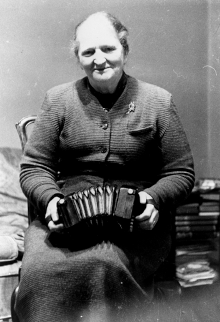
Elizabeth “Lizzie” Crotty (née Markham), concertina player better known as Mrs. Crotty, dies in Kilrush, County Clare, from angina pectoris on December 27, 1960.

Markham is born on January 8, 1886, at Gower, Cooraclare, County Clare, the youngest in the large family of Michael Markham, farmer, and Margaret Markham (née Keane). She attends national school in Cooraclare from 1893 to 1899. Although she does not speak or understand the Irish language, as do her father and likely her mother, the Rosary is recited in Irish at home. She and a sister are the only siblings not to emigrate. Her mother plays the fiddle, while her older sister Margaret (Maggie) plays the concertina and probably influences her to do likewise. She has no single teacher and acquires tunes and her style of playing from neighbours and family friends. She begins to play a two-row German-type concertina at house dances throughout west Clare and becomes very much in demand.

In 1914, Markham marries Michael (Miko) Crotty from Gowerhass, the townland next to Gower. Miko had been in the United States for a couple of years and uses the money earned there to buy a public house on the Market Square in Kilrush, now known as “Crotty’s Pub.” They live in the Square in Kilrush and Miko bottles his own whiskey. The pub is an important venue for Irish traditional music, especially for those who wish to hear Crotty play. She remains relatively unknown outside of Clare until the early 1950s, and there are a relatively small number of recordings of her playing the concertina. The broadcaster Ciarán Mac Mathúna conducts recording sessions in her house in 1955 and she is to be heard on A Job of Journeywork, his programme on Radio Éireann. She possesses a number of concertinas, but the Lachenal that she purchases in the 1950s is her favourite and the one with which she is most closely identified. In 1954, she is a founder member and the first president of the Clare branch of Comhaltas Ceoltóirí Éireann. During her time as president, the All Ireland Fleadh is held in Ennis in 1956.

Crotty often sings the traditional song “An draighneán donn,” which is one of her favourites. Among tunes she enjoys playing are the “Ewe reel,” the “Dublin reel,” and “The maid of Mount Cisco,” along with “The wind that shakes the barley.” Her straight style of playing for dancing and dancers increases her popularity. Seán Ó Riada regards her as one of the finest concertina players he ever heard. Although she does not read or write staff notation, she creates a written code for herself by giving the concertina keys a number and by using a symbol for the press or draw movement on the concertina keys.

Crotty suffers from severe angina which necessitates visits for medical treatment to Dublin, where she becomes friends with fiddle player Kathleen Harrington (née Gardiner). They attend the Pipers’ Club in Thomas Street, play together on Radio Éireann, and travel together to fleadhanna.

Crotty dies on December 27, 1960, of an anginal attack while at her home. She is buried in (old) Shanakyle cemetery. She loses her first three children, and a son drowns in the River Shannon in 1945. Another son, Thomas, becomes a priest. A festival, ‘Éigse Mrs Crotty’, is held in her memory each summer in Kilrush. Her son Paddy gives three perpetual trophies for presentation at the All-Ireland Fleadh Cheoil.

(From: “Crotty, Elizabeth (‘Lizzie’)” by Ríonach uí Ógáin, Dictionary of Irish Biography, http://www.dib.ie, October 2009)